CS 1101 Group 1 Discussion 5 Lek Hsiang


- Slides: 28
CS 1101 Group 1 Discussion 5 Lek Hsiang Hui lekhsian @ comp. nus. edu. sg http: //www. comp. nus. edu. sg/~lekhsian/cs 1101
Debugging in Dr Java Checklist • Setting a breakpoint – Before running program – During the debugging process • Step into a method • Watches
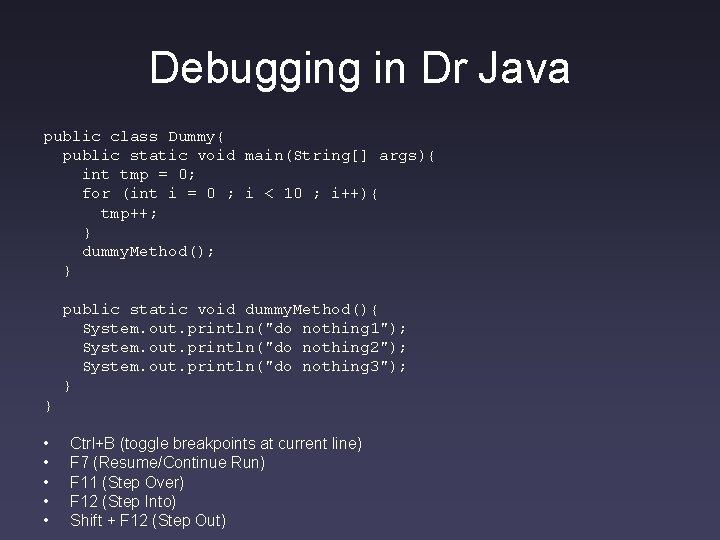
Debugging in Dr Java public class Dummy{ public static void main(String[] args){ int tmp = 0; for (int i = 0 ; i < 10 ; i++){ tmp++; } dummy. Method(); } public static void dummy. Method(){ System. out. println("do nothing 1"); System. out. println("do nothing 2"); System. out. println("do nothing 3"); } } • • • Ctrl+B (toggle breakpoints at current line) F 7 (Resume/Continue Run) F 11 (Step Over) F 12 (Step Into) Shift + F 12 (Step Out)
Search And Sorting
Searching • Linear Search – Go through all the items in an array • Binary Search – Search by “cutting” the possible solutions by ½ each time
Sorting • Bubble Sort • Insertion Sort • Selection Sort
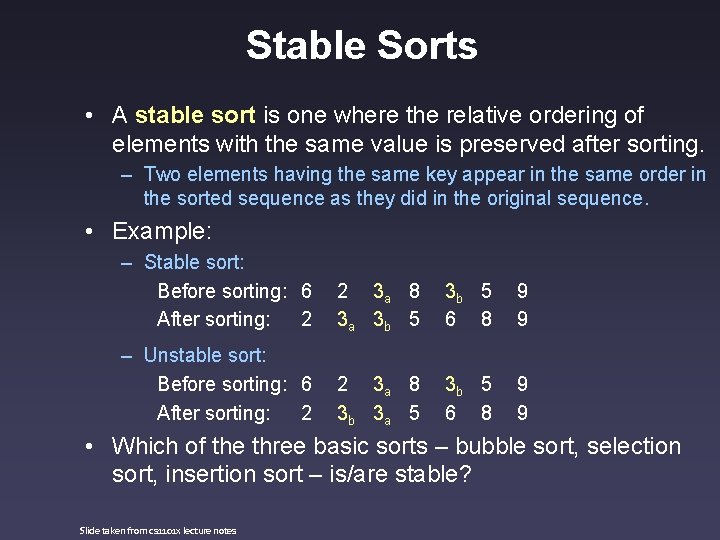
Stable Sorts • A stable sort is one where the relative ordering of elements with the same value is preserved after sorting. – Two elements having the same key appear in the same order in the sorted sequence as they did in the original sequence. • Example: – Stable sort: Before sorting: 6 After sorting: 2 2 3 a 8 3 a 3 b 5 6 8 9 9 – Unstable sort: Before sorting: 6 After sorting: 2 2 3 a 8 3 b 3 a 5 3 b 5 6 8 9 9 • Which of the three basic sorts – bubble sort, selection sort, insertion sort – is/are stable? Slide taken from cs 1101 x lecture notes
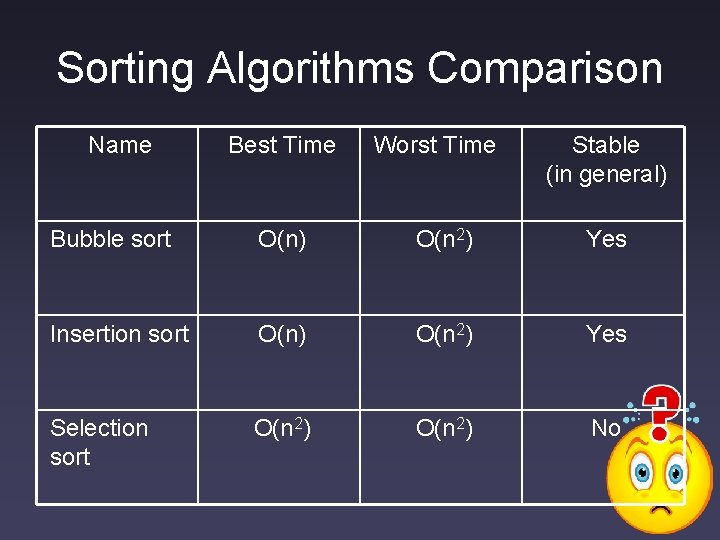
Sorting Algorithms Comparison Name Best Time Worst Time Stable (in general) Bubble sort O(n) O(n 2) Yes Insertion sort O(n) O(n 2) Yes Selection sort O(n 2) No
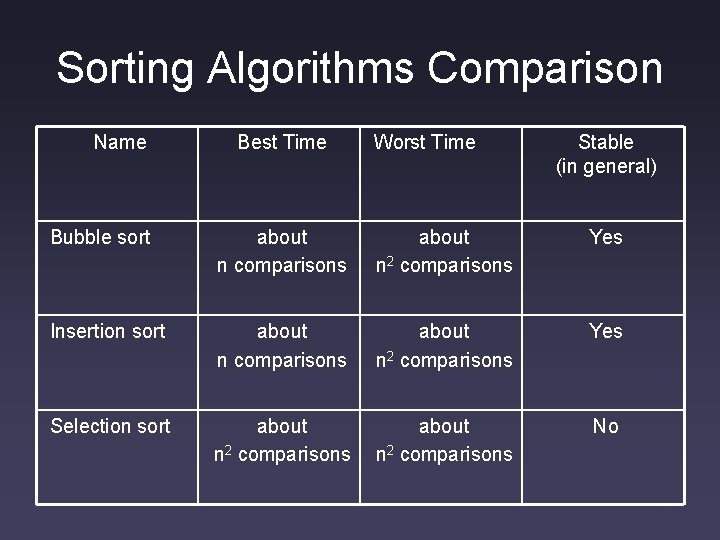
Sorting Algorithms Comparison Name Best Time Worst Time Stable (in general) Bubble sort about n comparisons about n 2 comparisons Yes Insertion sort about n comparisons about n 2 comparisons Yes Selection sort about n 2 comparisons No
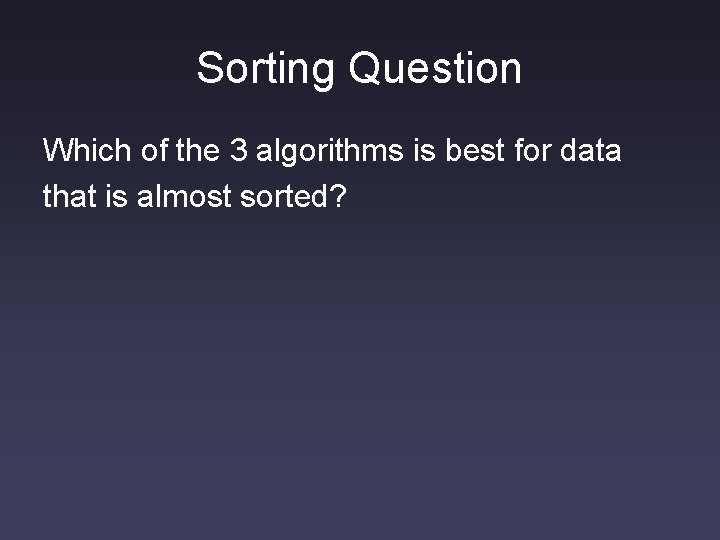
Sorting Question Which of the 3 algorithms is best for data that is almost sorted?
Recursion
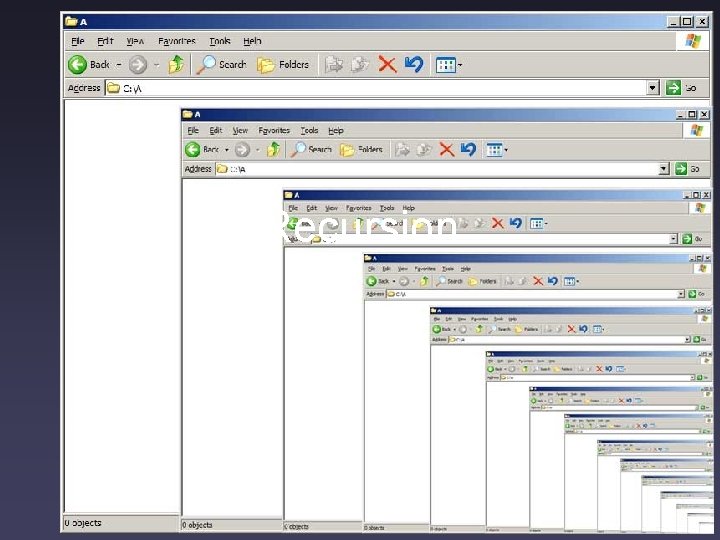
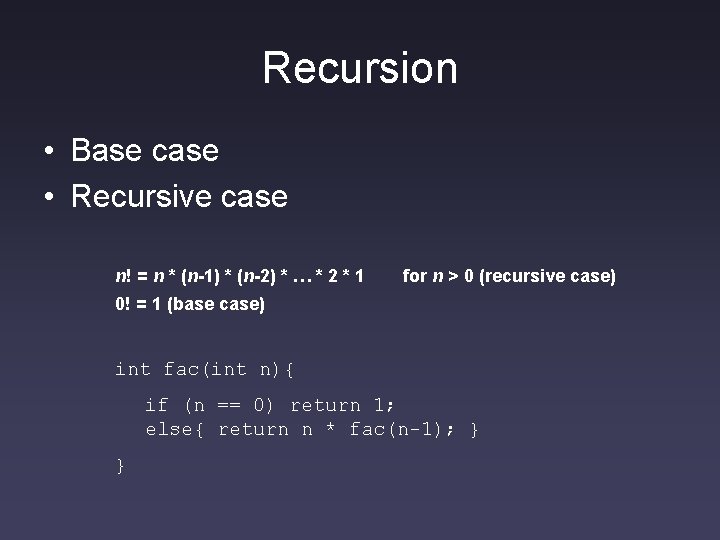
Recursion • Base case • Recursive case n! = n * (n-1) * (n-2) * … * 2 * 1 for n > 0 (recursive case) 0! = 1 (base case) int fac(int n){ if (n == 0) return 1; else{ return n * fac(n-1); } }
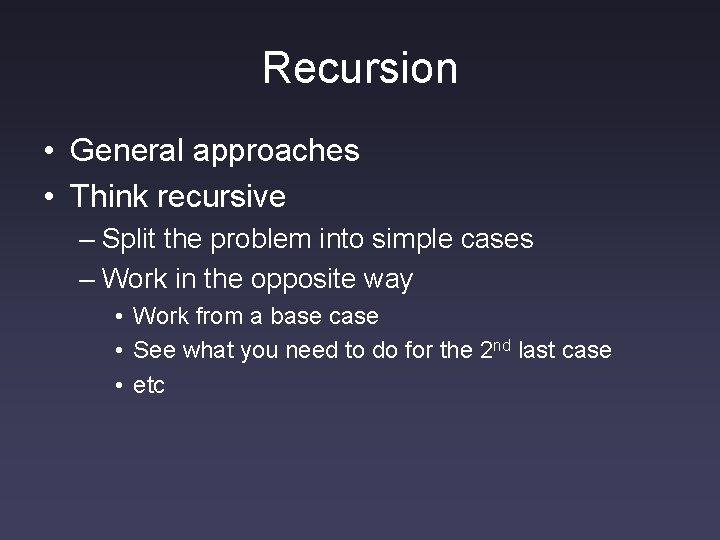
Recursion • General approaches • Think recursive – Split the problem into simple cases – Work in the opposite way • Work from a base case • See what you need to do for the 2 nd last case • etc
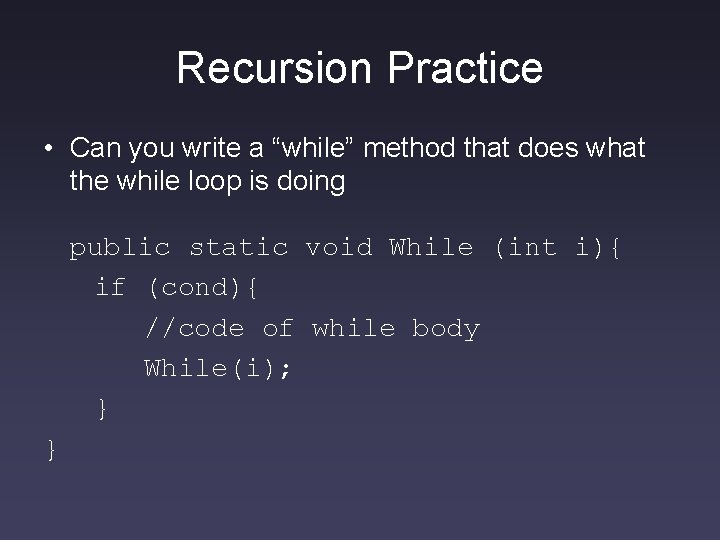
Recursion Practice • Can you write a “while” method that does what the while loop is doing
Recursion Practice • Can you write a “while” method that does what the while loop is doing public static void While (int i){ if (cond){ //code of while body While(i); } }
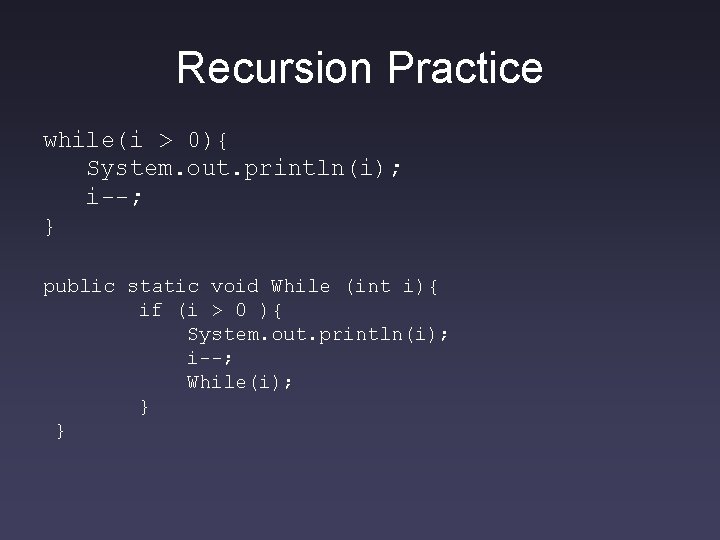
Recursion Practice while(i > 0){ System. out. println(i); i--; } public static void While (int i){ if (i > 0 ){ System. out. println(i); i--; While(i); } }
References • Pass by Value – Java is always pass by value! • Pass by Reference
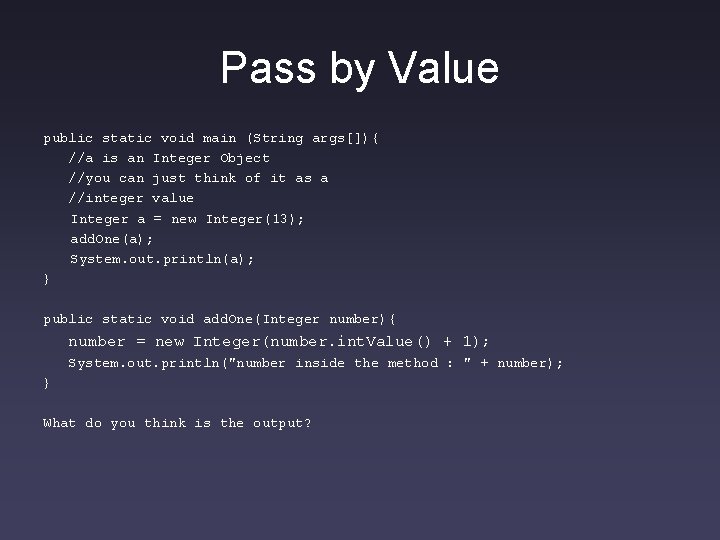
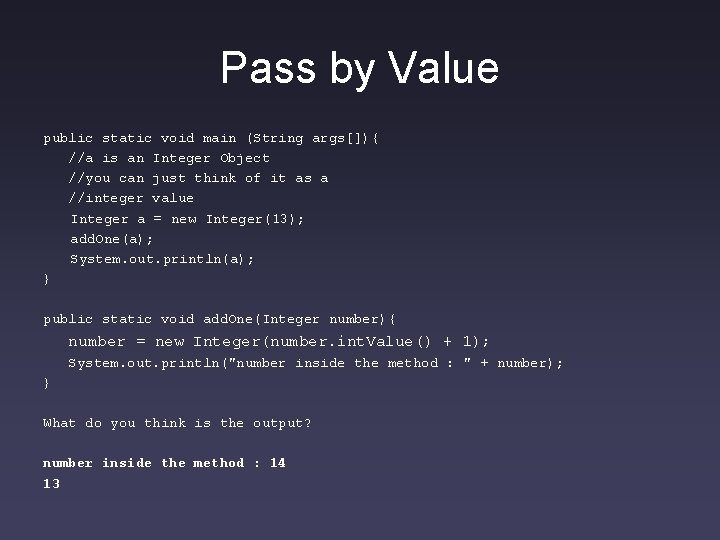
Pass by Value public static void main (String args[]){ //a is an Integer Object //you can just think of it as a //integer value Integer a = new Integer(13); add. One(a); System. out. println(a); } public static void add. One(Integer number){ number = new Integer(number. int. Value() + 1); System. out. println("number inside the method : " + number); } What do you think is the output?
Pass by Value public static void main (String args[]){ //a is an Integer Object //you can just think of it as a //integer value Integer a = new Integer(13); add. One(a); System. out. println(a); } public static void add. One(Integer number){ number = new Integer(number. int. Value() + 1); System. out. println("number inside the method : " + number); } What do you think is the output? number inside the method : 14 13
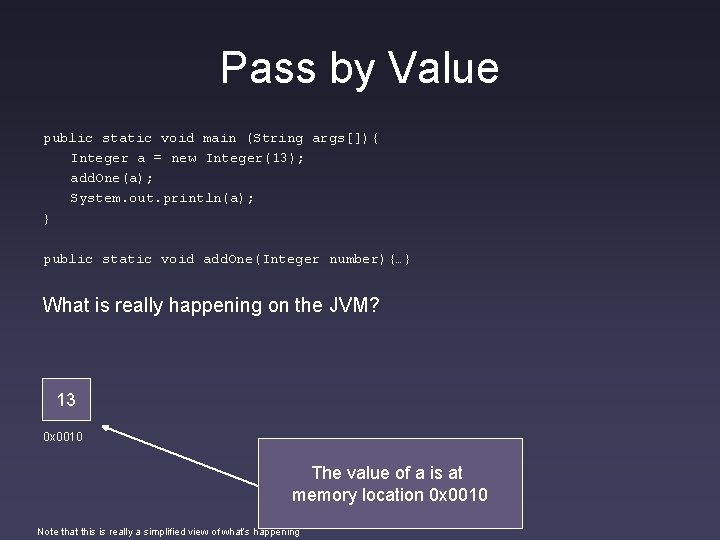
Pass by Value public static void main (String args[]){ Integer a = new Integer(13); add. One(a); System. out. println(a); } public static void add. One(Integer number){…} What is really happening on the JVM? 13 0 x 0010 The value of a is at memory location 0 x 0010 Note that this is really a simplified view of what’s happening
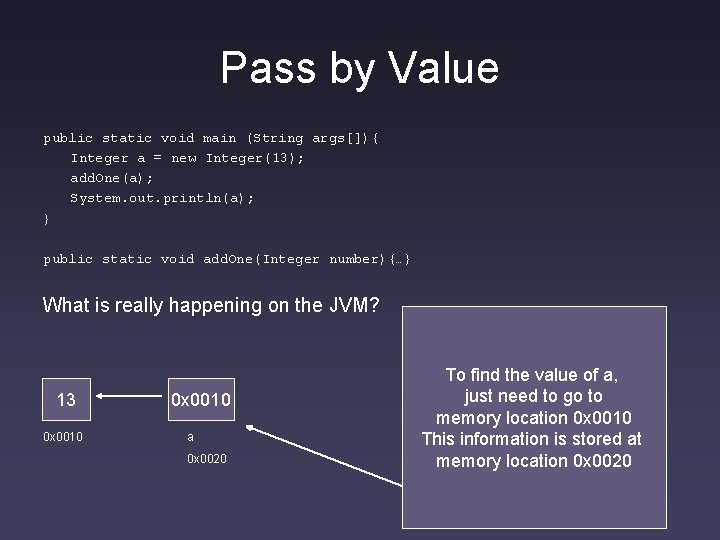
Pass by Value public static void main (String args[]){ Integer a = new Integer(13); add. One(a); System. out. println(a); } public static void add. One(Integer number){…} What is really happening on the JVM? 13 0 x 0010 a 0 x 0020 To find the value of a, just need to go to memory location 0 x 0010 This information is stored at memory location 0 x 0020
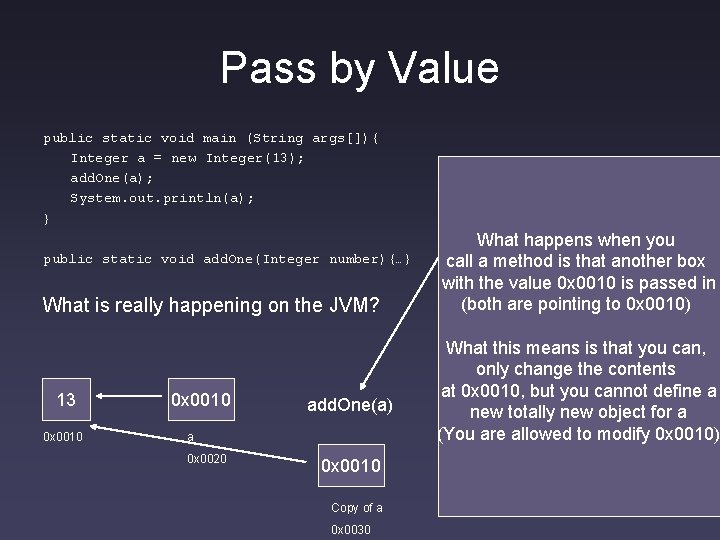
Pass by Value public static void main (String args[]){ Integer a = new Integer(13); add. One(a); System. out. println(a); } public static void add. One(Integer number){…} What is really happening on the JVM? 13 0 x 0010 add. One(a) a 0 x 0020 0 x 0010 Copy of a 0 x 0030 What happens when you call a method is that another box with the value 0 x 0010 is passed in (both are pointing to 0 x 0010) What this means is that you can, only change the contents at 0 x 0010, but you cannot define a new totally new object for a (You are allowed to modify 0 x 0010)
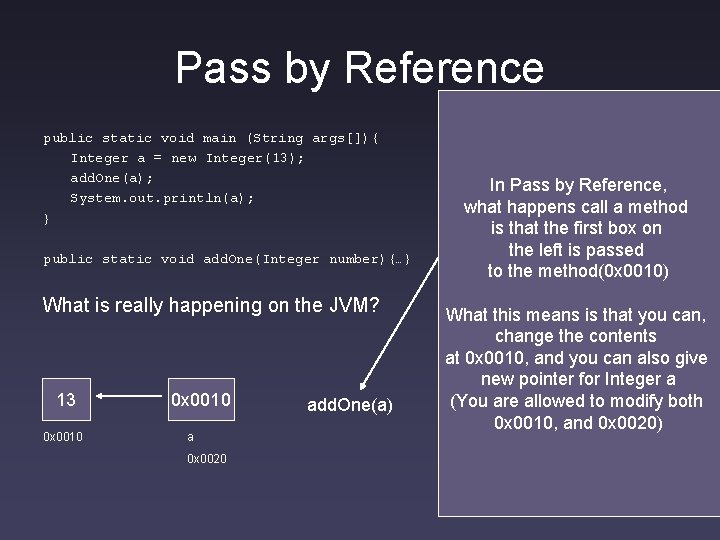
Pass by Reference public static void main (String args[]){ Integer a = new Integer(13); add. One(a); System. out. println(a); } public static void add. One(Integer number){…} What is really happening on the JVM? 13 0 x 0010 a 0 x 0020 add. One(a) In Pass by Reference, what happens call a method is that the first box on the left is passed to the method(0 x 0010) What this means is that you can, change the contents at 0 x 0010, and you can also give new pointer for Integer a (You are allowed to modify both 0 x 0010, and 0 x 0020)
Java (Pass by value) • When you are passing primitive data types to methods (int, byte, double etc), you can think of it as you are giving the method the numerical value of the variable, not the variable itself
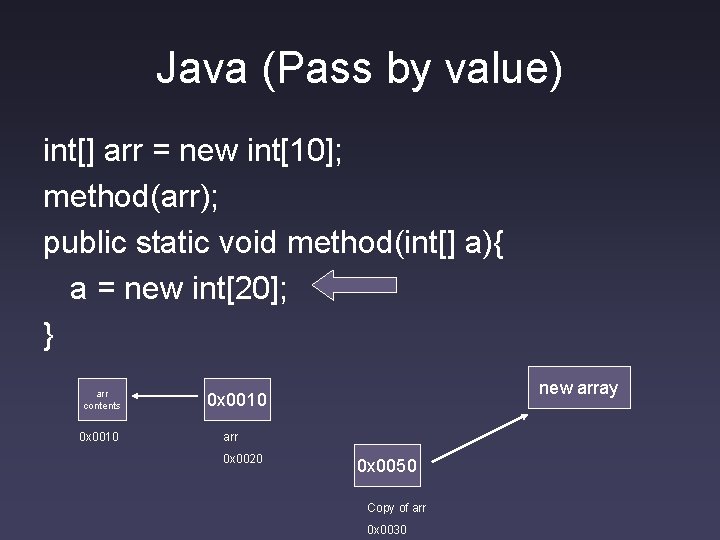
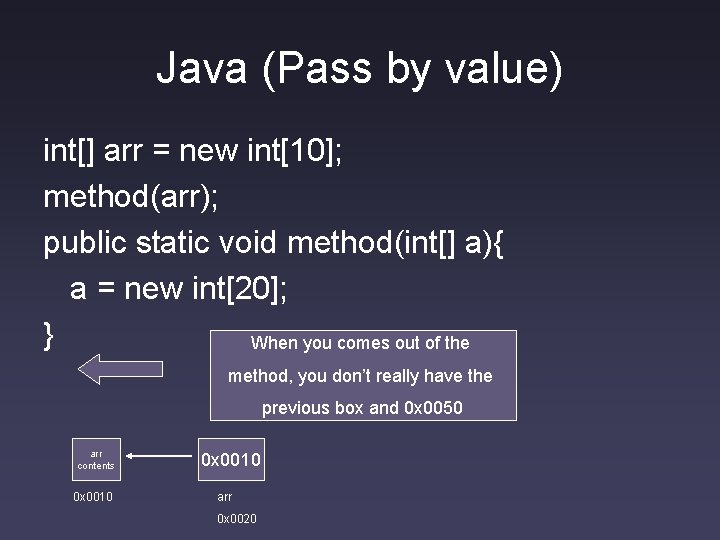
Java (Pass by value) • When you are passing in references… – Objects, Arrays* – Can really think of Arrays are Objects • You are given access to the content of that Object (but cannot modify the container)
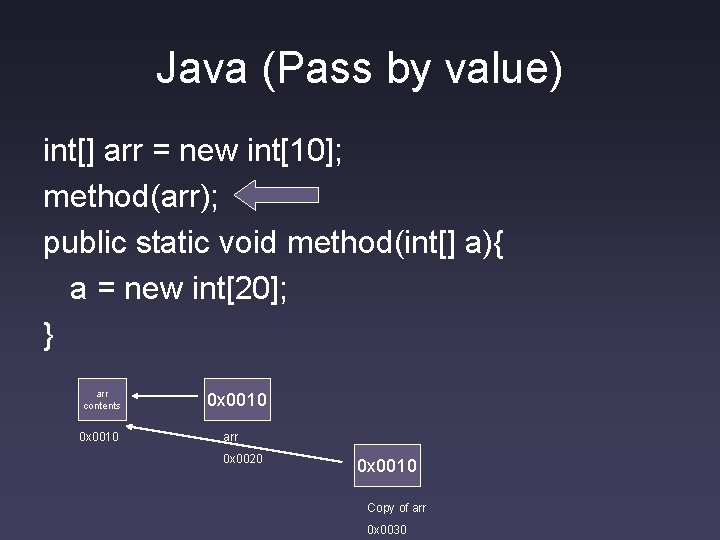
Java (Pass by value) int[] arr = new int[10]; method(arr); public static void method(int[] a){ a = new int[20]; } arr contents 0 x 0010 arr 0 x 0020 0 x 0010 Copy of arr 0 x 0030
Java (Pass by value) int[] arr = new int[10]; method(arr); public static void method(int[] a){ a = new int[20]; } arr contents 0 x 0010 new array 0 x 0010 arr 0 x 0020 0 x 0050 Copy of arr 0 x 0030
Java (Pass by value) int[] arr = new int[10]; method(arr); public static void method(int[] a){ a = new int[20]; } When you comes out of the method, you don’t really have the previous box and 0 x 0050 arr contents 0 x 0010 arr 0 x 0020