
AF Procurement Fraud Program Introduction and Basics Procurement
AF Procurement Fraud Program Introduction and Basics Procurement Fraud Branch AFLOA/JAQ
Why are we here? • • Educate and Train Reinvigorate the AF procurement fraud remedies program outside of AFMC – Note that this is about much more than just “procurement fraud” – More broadly … doing better business, weeding out non-responsible • suppliers, shoring up internal controls to prevent fraud, waste, and corruption (see FAR 1. 602 -2) Save taxpayer/AF funds in era of fiscal limitations – Or at least be positioned to say that we’re doing everything we can to ensure that funds are well spent & investments well protected – Not about beating up on contractors – Not about seeing fraud under every rock • Very important to distinguish between fraud/corruption and contractor (or Government) incompetence and mistakes
The Big Picture: What is the mission? • Prevent, detect, deter, & remedy fraud/corruption – – – Preserve integrity of Government acquisition process – Transparency, fairness, and accountability (inside and out) Protect taxpayer interests…and money! Protect national security (counterfeit parts, etc. ) • Defend /preserve AF business interests – – – Work with responsible/ethical/capable contractors (cf. FAR 9. 4) Foster fair and robust competition for Gov’t requirements Ensure that we get what we paid for – supply or service Acquisition Integrity! 3
Also in the news … How could a contracting scam avoid detection for so long? The Washington Post (Dec 24, 2011) Private contractors and government employees skimmed millions from the Army Corps of Engineers in what authorities have described as one of the most brazen contracting scams in federal government history. From 2007 through September, the contractors and two program managers at the Army Corps inflated $25 million in contract orders by $20 million… Starting in 2007, the two Corps program managers and [a Contractor employee] began steering work to a Chantilly-based firm identified in court papers as “Company A. ” That company’s chief technology officer…then began filing inflated invoices for work to Eyak. Tek [the prime contractor - an Alaska Native Corporation], which passed the bills to the government… The conspirators also were working to ensure that the government’s statement of objectives for the work were tailored to favor that firm… Part of the problem, contracting specialists say, was that the Army Corps program managers were high enough in the organization that there was no one to check their work. **** 4
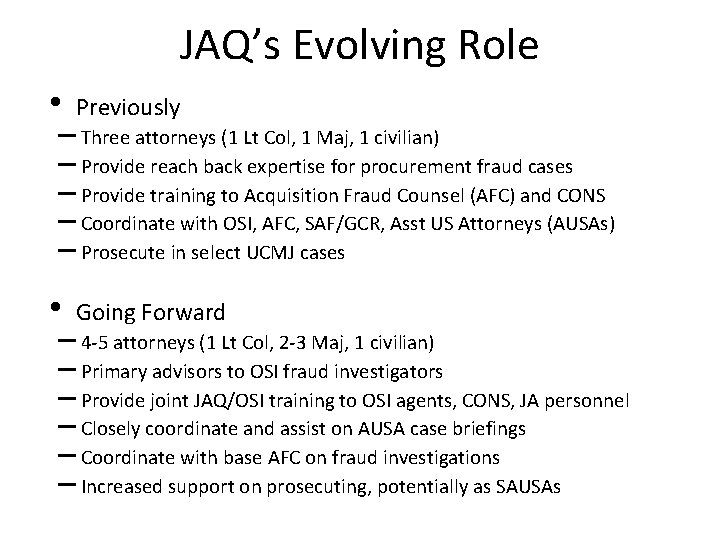
JAQ’s Evolving Role • Previously • Going Forward – Three attorneys (1 Lt Col, 1 Maj, 1 civilian) – Provide reach back expertise for procurement fraud cases – Provide training to Acquisition Fraud Counsel (AFC) and CONS – Coordinate with OSI, AFC, SAF/GCR, Asst US Attorneys (AUSAs) – Prosecute in select UCMJ cases – 4 -5 attorneys (1 Lt Col, 2 -3 Maj, 1 civilian) – Primary advisors to OSI fraud investigators – Provide joint JAQ/OSI training to OSI agents, CONS, JA personnel – Closely coordinate and assist on AUSA case briefings – Coordinate with base AFC on fraud investigations – Increased support on prosecuting, potentially as SAUSAs
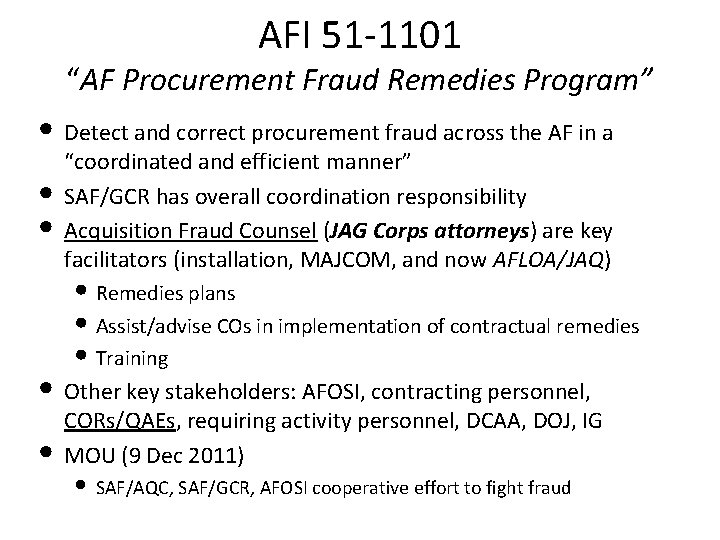
AFI 51 -1101 “AF Procurement Fraud Remedies Program” • Detect and correct procurement fraud across the AF in a • • “coordinated and efficient manner” SAF/GCR has overall coordination responsibility Acquisition Fraud Counsel (JAG Corps attorneys) are key facilitators (installation, MAJCOM, and now AFLOA/JAQ) • Remedies plans • Assist/advise COs in implementation of contractual remedies • Training • Other key stakeholders: AFOSI, contracting personnel, • CORs/QAEs, requiring activity personnel, DCAA, DOJ, IG MOU (9 Dec 2011) • SAF/AQC, SAF/GCR, AFOSI cooperative effort to fight fraud
Common Problem Areas & Problem Signs/Red Flags Where there is smoke, there MIGHT be fire…
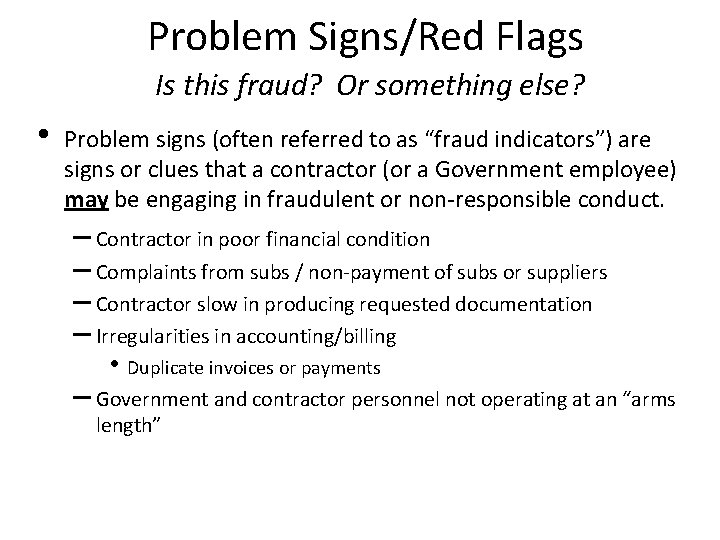
Problem Signs/Red Flags Is this fraud? Or something else? • Problem signs (often referred to as “fraud indicators”) are signs or clues that a contractor (or a Government employee) may be engaging in fraudulent or non-responsible conduct. – Contractor in poor financial condition – Complaints from subs / non-payment of subs or suppliers – Contractor slow in producing requested documentation – Irregularities in accounting/billing • Duplicate invoices or payments – Government and contractor personnel not operating at an “arms length”
Problem Signs/Red Flags • When identifying the need or requirement – Inadequate or vague need assessment – Need determination appears unnecessarily tailored in ways that can only be met by certain contractors – “Urgency” of need (required time frame for acquisition) appears questionable • In development of specifications and SOW/PWS – Contractor involvement in writing specs or SOW w/o proper precautions concerning conflicts of interest • Requirement seems to match products/capabilities of specific contractor – Gov’t employee providing preferred contractor(s) with advance information concerning requirements and pending contracts (potential Procurement Integrity Act violation) – Specifications seem unnecessarily restrictive – Requirements seem to be split unnecessarily … to lower cost and avoid supervision/oversight
Problem Signs/Red Flags • Other pre-solicitation issues – Sole source justification appears unnecessary or is poorly supported – Market research seems inadequate to properly establish evaluation factors, determine contract type, determine whether COTS solution could satisfy Government’s needs, etc. • Solicitation issues – Time for submission of bids/proposals is restricted so that only a certain contractors (those with advance notice? ) have adequate time to submit bids/proposals – Evidence of improper communications or social contact between Gov’t employees and contractors – Customer regularly “recommends” (or demands? ) a particular supplier or subcontractor – Contractor makes false statements during pre-award survey (i. e. , regarding qualifications, capabilities, etc. )
Problem Signs/Red Flags • Submission of bids – Withdrawal by a low bidder who later becomes subcontractor to high bidder – Apparent collusion or bid rigging among the bidders • Competing contractors seem to win bids on rotating basis – Losing contractors’ bids somehow always just too high to be acceptable • Winning bidders often subcontract with competitors – Required contractor certifications appear falsified • Small business certification • Buy-American Act certification • Certification of independent price determination
Problem Signs/Red Flags • Evaluation of bids and proposals – CO accepts bids that appear to be nonresponsive – CO disqualifies otherwise qualified offeror(s) w/o proper justification – Gov’t employee reveals offeror rankings or fails to adequately/ appropriately protect IGCE, source selection information, etc. -giving one contractor an unfair competitive advantage • Contract award – CO allows apparent winning bidder to withdraw w/o justification – Award goes to contractor with documented history of poor performance – Gov’t personnel receive gifts from winning bidder
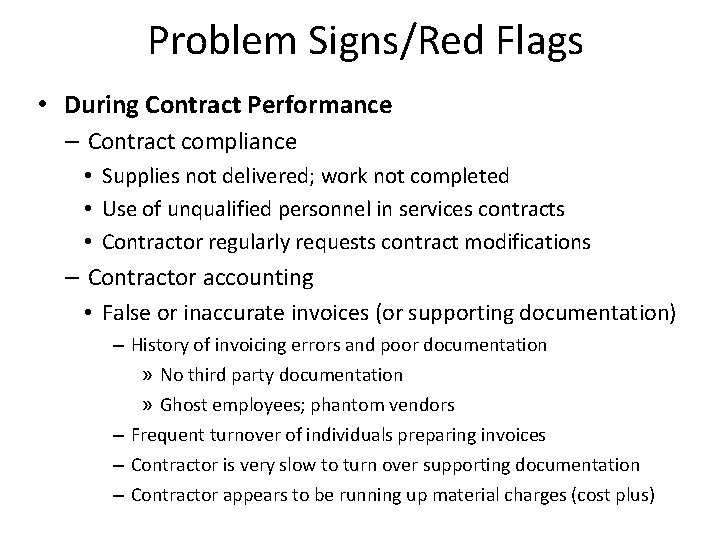
Problem Signs/Red Flags • During Contract Performance – Contract compliance • Supplies not delivered; work not completed • Use of unqualified personnel in services contracts • Contractor regularly requests contract modifications – Contractor accounting • False or inaccurate invoices (or supporting documentation) – History of invoicing errors and poor documentation » No third party documentation » Ghost employees; phantom vendors – Frequent turnover of individuals preparing invoices – Contractor is very slow to turn over supporting documentation – Contractor appears to be running up material charges (cost plus)
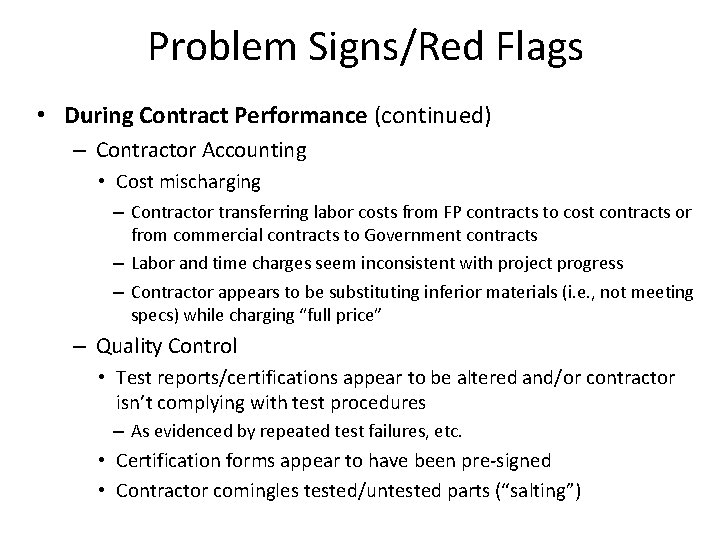
Problem Signs/Red Flags • During Contract Performance (continued) – Contractor Accounting • Cost mischarging – Contractor transferring labor costs from FP contracts to cost contracts or from commercial contracts to Government contracts – Labor and time charges seem inconsistent with project progress – Contractor appears to be substituting inferior materials (i. e. , not meeting specs) while charging “full price” – Quality Control • Test reports/certifications appear to be altered and/or contractor isn’t complying with test procedures – As evidenced by repeated test failures, etc. • Certification forms appear to have been pre-signed • Contractor comingles tested/untested parts (“salting”)
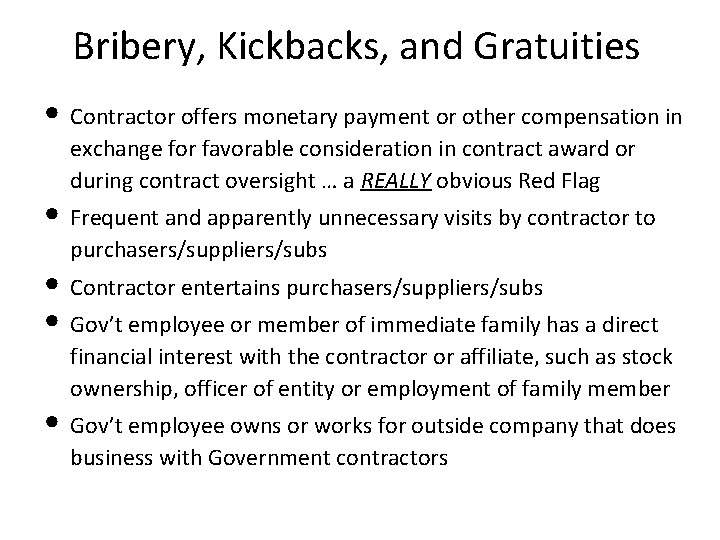
Bribery, Kickbacks, and Gratuities • Contractor offers monetary payment or other compensation in exchange for favorable consideration in contract award or during contract oversight … a REALLY obvious Red Flag • Frequent and apparently unnecessary visits by contractor to purchasers/suppliers/subs • Contractor entertains purchasers/suppliers/subs • Gov’t employee or member of immediate family has a direct financial interest with the contractor or affiliate, such as stock ownership, officer of entity or employment of family member • Gov’t employee owns or works for outside company that does business with Government contractors
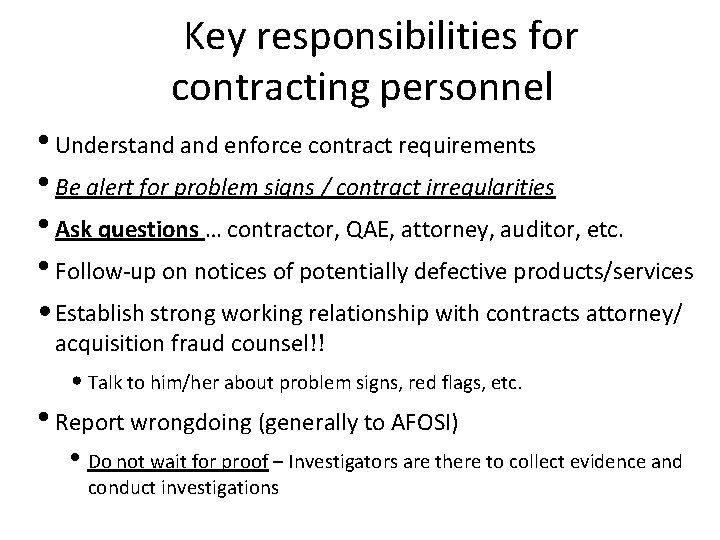
Key responsibilities for contracting personnel • Understand enforce contract requirements • Be alert for problem signs / contract irregularities • Ask questions … contractor, QAE, attorney, auditor, etc. • Follow-up on notices of potentially defective products/services • Establish strong working relationship with contracts attorney/ acquisition fraud counsel!! • Talk to him/her about problem signs, red flags, etc. • Report wrongdoing (generally to AFOSI) • Do not wait for proof – Investigators are there to collect evidence and conduct investigations
Typical Installation-Level Cases • Small business acts as front or “pass through” for a large business that does majority of the work – Violates various SBA rules & contract clauses (i. e. , FAR 52. 219 -14) • Gov’t personnel disclose IGCE to contractors – Dual culpability • Contractor bills for services never accomplished – Indicates a COR problem • Construction contractor bills for work that doesn’t comply with specs – Indicates a COR problem • Contractors take turns winning awards (collusion) 17
Coordinating Remedies
Coordinating Remedies: What’s the Point? • • Mere mention of “fraud” does not mean CO’s ability to implement remedies is automatically restricted Rule: CO cannot take action that may prejudice pending or potential fraud litigation or constitute settlement of fraud matter – However, agencies can and should consider implementing • administrative & contractual remedies whenever such remedies are appropriate – AF can often get prompt/beneficial results (funds returned on the contract, contractor debarred, etc. ) via administrative and contractual remedies – even during the pendency of a civil or criminal case Stakeholders (Contracting, customer, AFOSI, DOJ, etc. ) have to coordinate to be able to pull this off
Administrative Remedies: Suspensions & Debarments • • Administrative measures used to ensure that the Government does business only with responsible contractors (FAR 9. 4) – Protects Government and integrity of the procurement process – Not punishment…but obvious, immediate collateral consequences Contractors found “Not Presently Responsible” may be suspended or debarred – Can result from fraudulent or other illegal activity or from poor contract performance – Focus on the contractor’s honesty, integrity, ethics, responsibility, competence, among other factors • Judgments / Convictions are not necessary
Suspension and Debarment (cont. ) • Suspension – Facts still being developed through investigation or legal proceedings • Used when immediate action needed to protect Government’s interests – Length: Maximum of one year unless extended due to • criminal/civil proceedings – Based on “adequate evidence” Debarment – Basis: • Investigation or legal proceeding concluded (conviction or civil • judgment), OR Where the facts, by a preponderance of evidence, prove improper conduct – Length: For time period specified by the Suspension & Debarment Official (SDO) … “generally three years”
Suspension and Debarment (cont. ) • • Procedure: – Notice to Contractor – Contractor response … dispute or concede facts • If factual dispute: Discovery and mini-trial (administrative) • All handled by SAF/GCR! What’s required of the Contracting Officer? – Talk to your contracts attorney / fraud counsel – Provide the factual support for the alleged misconduct • • Contract documents, memos, e-mails, etc. Remember that “misconduct” can include a willful failure to perform or repeated poor performance (on one or more contracts) – Fraud counsel (either locally or at AFLOA/JAQ) will assist with putting together the “referral” package (to SAF/GCR)
Suspension and Debarment (cont. ) • Suspended or debarred contractors are not eligible for award of new (future) Government contracts – Contractor obligated to complete previously awarded contracts – Government may not exercise options on existing contracts – Government may not modify existing contracts to extend • • performance period of add work Excluded Parties List System Bottom line: An important remedy w/in AF control – Helps investigators … contractor incentivized to disclose facts quickly i/o to keep business running/maintain cash flow – “Show cause” letters (i. e. , “tell me why I shouldn’t immediately suspend/debar you”) can be a useful tool—staffed up to SDO through fraud counsel
Recent Do. D IG Audit Report No. D-2011 -083 (July 14, 2011) Finding B. Contracting Officer Involvement in the Suspension & Debarment Process Could Be Improved “…. The Services’ contracting personnel had little to no involvement in the Suspension and Debarment (S&D) process and did not refer poorly performing contractors to the S&D officials for fact-based suspensions and debarments …. As a result of the Services’ contracting officers potentially not referring as many poorly performing contractors to the S&D officials for suspension or debarment, poorly performing contractors may still be receiving Federal contracts. ”
Contractual Remedies - Examples • Cost Mischarging – Improper allocation of costs, charging of unallowable costs, or artificially inflating costs resulting in overcharging for goods and services • Engage – call out the contractor • Price/Cost adjustment • Withhold Contract Payments (FAR 32. 612) • Disallowance of Contract Costs (FAR 42. 8) • FAR 32. 6 – Contract Debts
Contractual Remedies - Examples • Failure to Meet Contract Specifications (contractor represents that specifications have been met) • Cure Notice/Show Cause (FAR Part 49) • Termination (FAR Part 49) • Unilateral Price Reduction (FAR 43. 103(b)) • Suspend/Reduce Progress Payments (FAR 32. 503 -6) • Revoke Acceptance – Latent Defect (FAR 52. 246 -2) • Contractor Correct/Replace at no charge to Gov’t (FAR 52. 246 -3)
Contractual Remedies - Examples • Product Substitution – Intentional submission of goods and/or services that do not conform to contract specifications or requirements • Reject Product or Service (FAR 52. 246 -2) • Cure Notice/Show Cause • Post-Acceptance – Latent Defect • Contractor Correct/Replace at no cost to Gov’t • Termination
Contractual Remedies • Past Performance assessments– Past performance information is relevant information, for future source selection purposes, regarding the contractor’s actions under previously awarded contracts. It includes, for example, the contractor’s record of conforming to contract requirements and to standards of good workmanship. . . and generally, the contractor’s business-like concern for the interest of the customer. FAR 42. 1501 • This is the bare minimum requirement for addressing poorly performing/corrupt/unethical contractors
Civil and Criminal Remedies
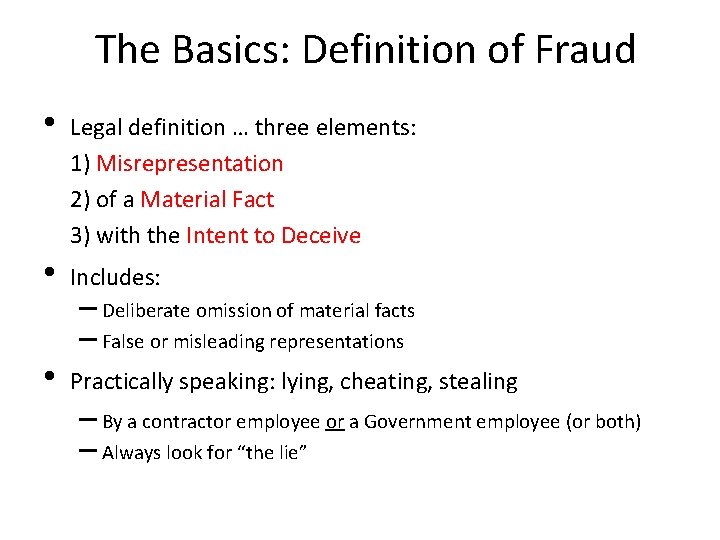
The Basics: Definition of Fraud • Legal definition … three elements: 1) Misrepresentation 2) of a Material Fact 3) with the Intent to Deceive • Includes: • Practically speaking: lying, cheating, stealing – Deliberate omission of material facts – False or misleading representations – By a contractor employee or a Government employee (or both) – Always look for “the lie”
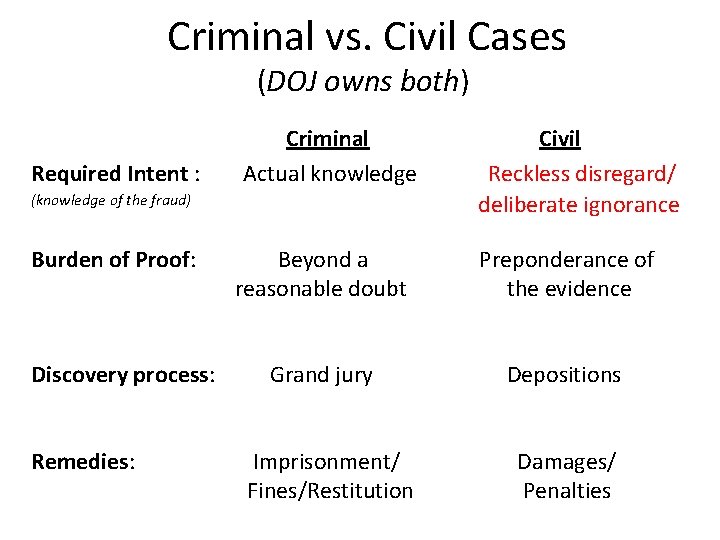
Criminal vs. Civil Cases (DOJ owns both) Required Intent : Criminal Actual knowledge (knowledge of the fraud) Burden of Proof: Discovery process: Remedies: Civil Reckless disregard/ deliberate ignorance Beyond a reasonable doubt Preponderance of the evidence Grand jury Depositions Imprisonment/ Fines/Restitution Damages/ Penalties
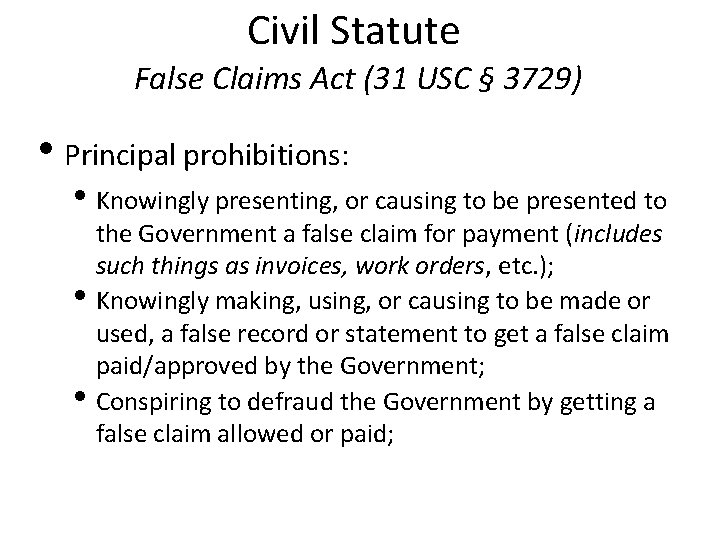
Civil Statute False Claims Act (31 USC § 3729) • Principal prohibitions: • Knowingly presenting, or causing to be presented to • • the Government a false claim for payment (includes such things as invoices, work orders, etc. ); Knowingly making, using, or causing to be made or used, a false record or statement to get a false claim paid/approved by the Government; Conspiring to defraud the Government by getting a false claim allowed or paid;
Civil Prosecution False Claims Act • Imposes up to treble damages and civil fines of $5, 500 to $11, 000 per false claim • Establishes “preponderance of the evidence" standard for all elements of the claim - including damages • Establishes liability for "deliberate ignorance" and "reckless disregard" of the truth • – No specific intent to defraud required Defendant pays successful plaintiff's expenses &attorney's fees
Qui Tam suits • Private litigant (“relator”) may sue alleged perpetrator of fraud under False Claims Act in name of United States – Cases filed “under seal” (existence of suit not disclosed to defendant) • – Litigant entitled to share of any recovery DOJ may intervene (60 days) in order to take the lead on the case … investigation by Government necessary to determine validity of case – If DOJ does not intervene, relator may proceed on his/her own
Final “Take-Aways” • “Red flags” can indicate a variety of things … not just “fraud” • Use business judgment in deciding what to do • Get your fraud counsel (contracts attorney) involved early • Outright fraud and corruption aren’t the only concerns • Waste & inefficiency in acquisition/contracting takes many forms • Contractor responsibility (FAR 9. 4) • When fraud/corruption is uncovered, remember that you have a range of potential remedies • However, coordinate before you act! • Lean on your contracts attorney/fraud counsel! • Administrative remedy can be a very powerful tool
Thoughts or questions?
- Slides: 36