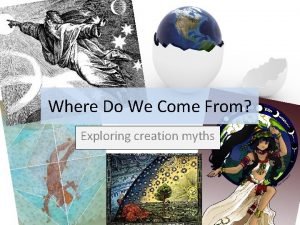
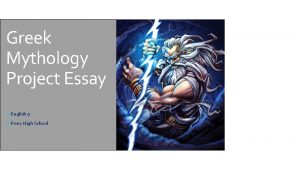
Creation Myths Hesiods Theogony and Ovids Metamorphoses Allen

- Slides: 81
Creation Myths Hesiod’s Theogony and Ovid’s Metamorphoses Allen Romano aromano@uchicago. edu background: Muses
Possibly humorous title • small text small text Pretty Picture
Important title here • more important stuff here • and here
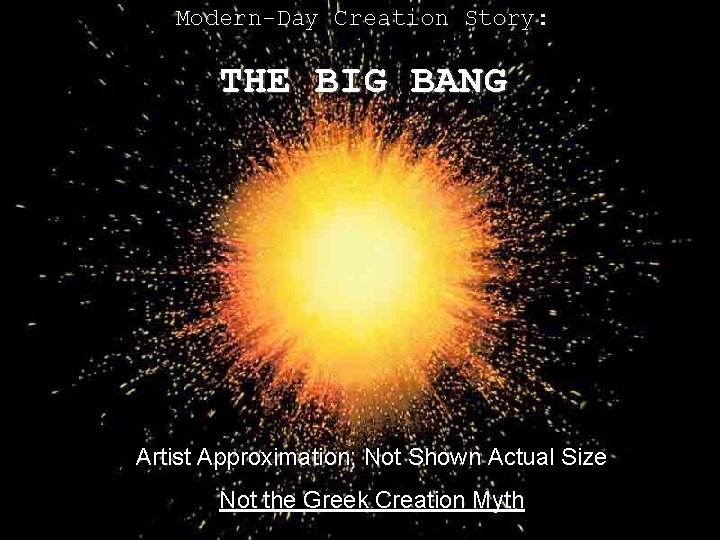
Modern-Day Creation Story: THE BIG BANG Artist Approximation; Not Shown Actual Size Not the Greek Creation Myth
Agenda 1. Why explain the creation of the universe? Some possibilities. . . 2. Hesiod’s Theogony (in context) 3. Ovid’s Metamorphoses (in context) and Hesiod vs. Ovid
Why Tell Creation Stories?
How to Do Things with Creation Myths Today’s question: How do people use creation myths? Ask: • Who’s telling the creation story? • To whom? • Why in this particular way? • Is there something else a person telling a creation story is trying to convey beyond the details of the story itself?
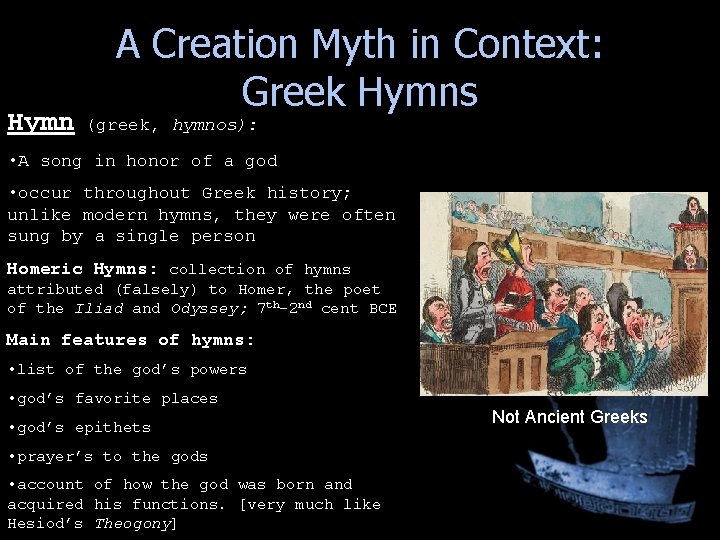
Hymn A Creation Myth in Context: Greek Hymns (greek, hymnos): • A song in honor of a god • occur throughout Greek history; unlike modern hymns, they were often sung by a single person Homeric Hymns: collection of hymns attributed (falsely) to Homer, the poet of the Iliad and Odyssey; 7 th-2 nd cent BCE Main features of hymns: • list of the god’s powers • god’s favorite places • god’s epithets • prayer’s to the gods • account of how the god was born and acquired his functions. [very much like Hesiod’s Theogony] Not Ancient Greeks
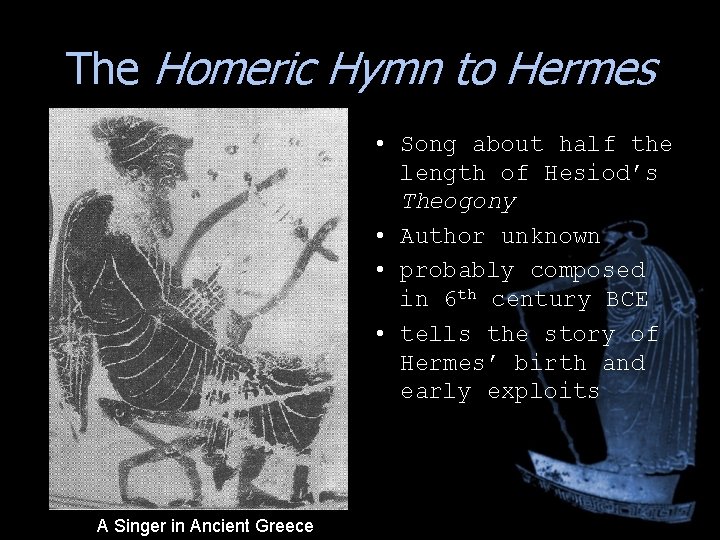
The Homeric Hymn to Hermes • Song about half the length of Hesiod’s Theogony • Author unknown • probably composed in 6 th century BCE • tells the story of Hermes’ birth and early exploits A Singer in Ancient Greece
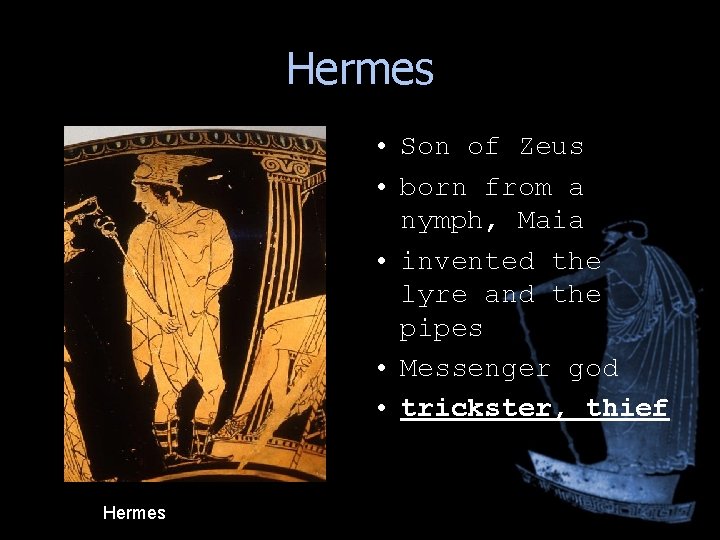
Hermes • Son of Zeus • born from a nymph, Maia • invented the lyre and the pipes • Messenger god • trickster, thief Hermes
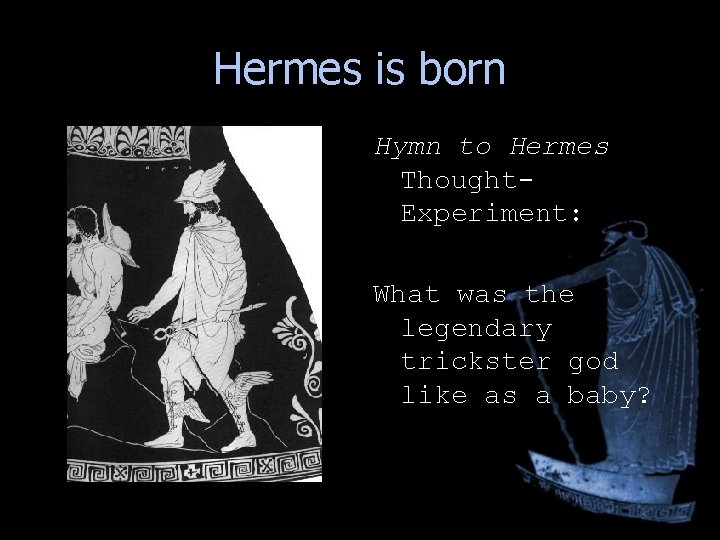
Hermes is born Hymn to Hermes Thought. Experiment: What was the legendary trickster god like as a baby?
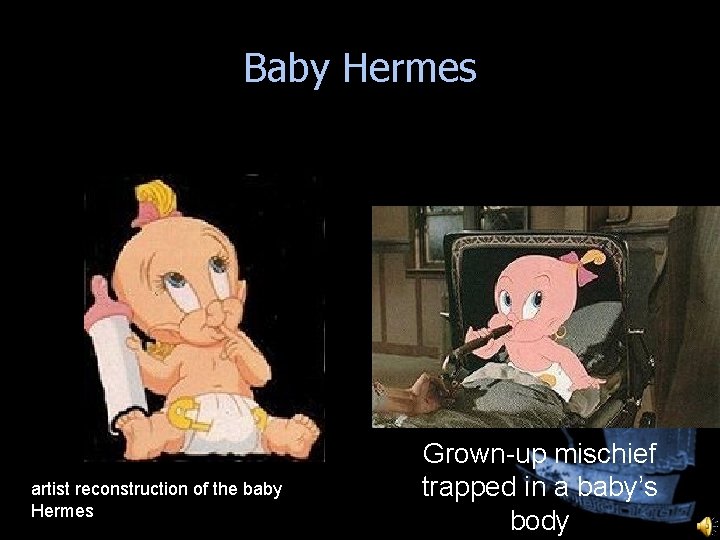
Baby Hermes artist reconstruction of the baby Hermes Grown-up mischief trapped in a baby’s body
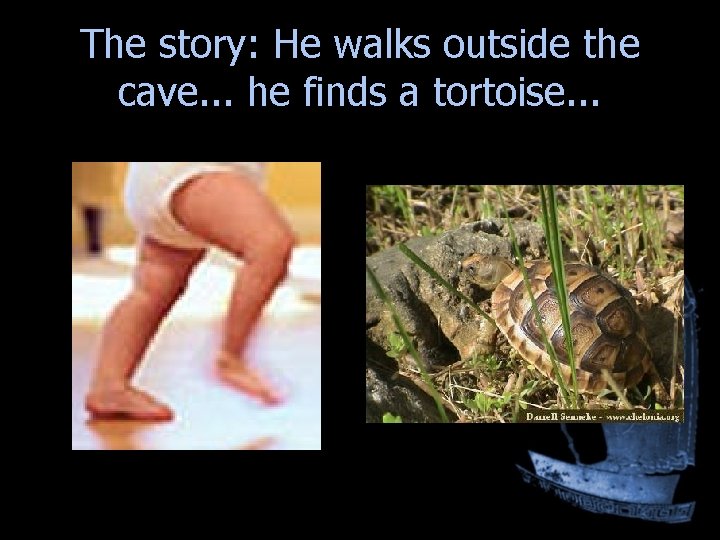
The story: He walks outside the cave. . . he finds a tortoise. . .
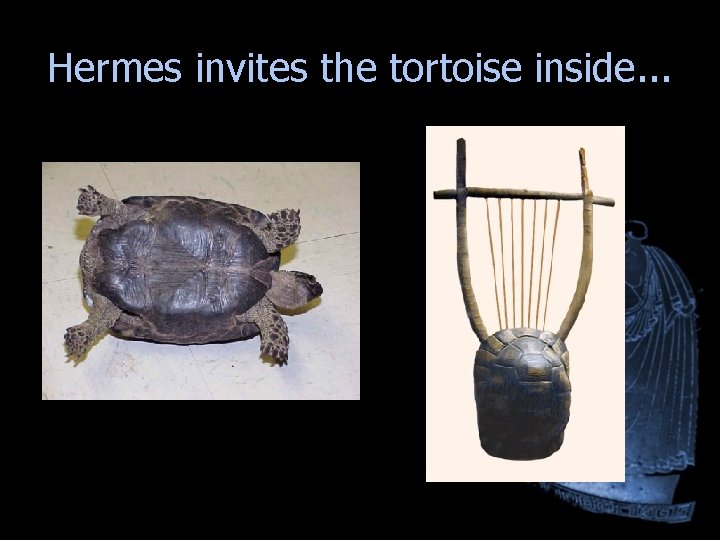
Hermes invites the tortoise inside. . .
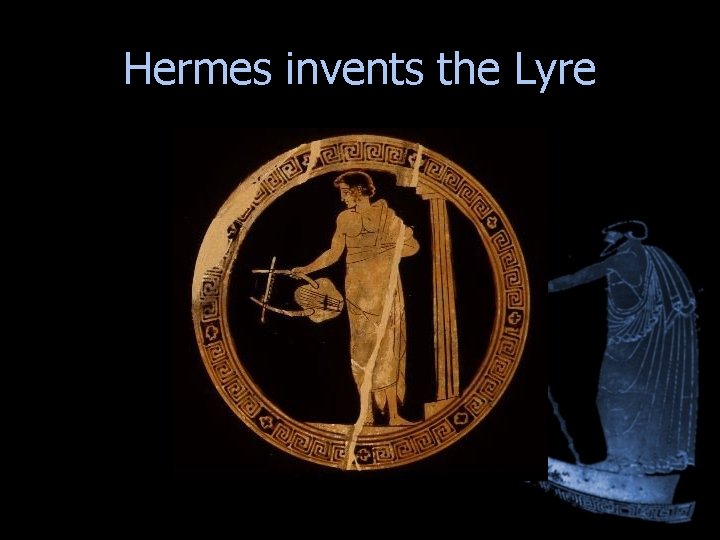
Hermes invents the Lyre
A little thief: Hermes steals his big brother Apollo’s Cattle
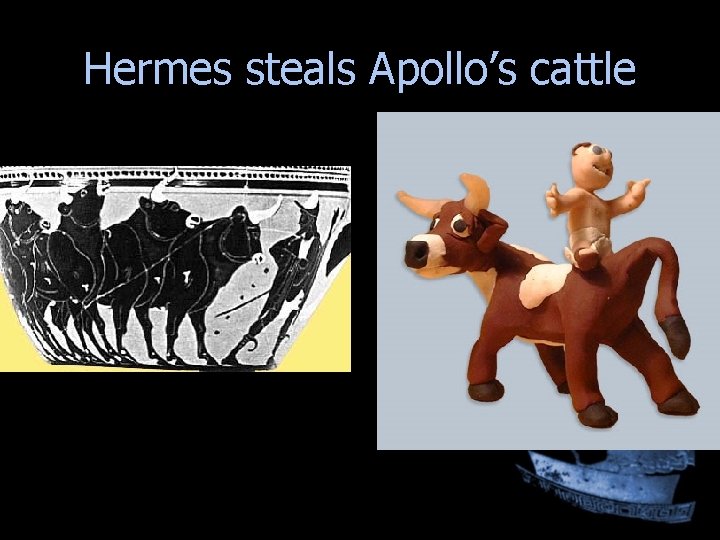
Hermes steals Apollo’s cattle
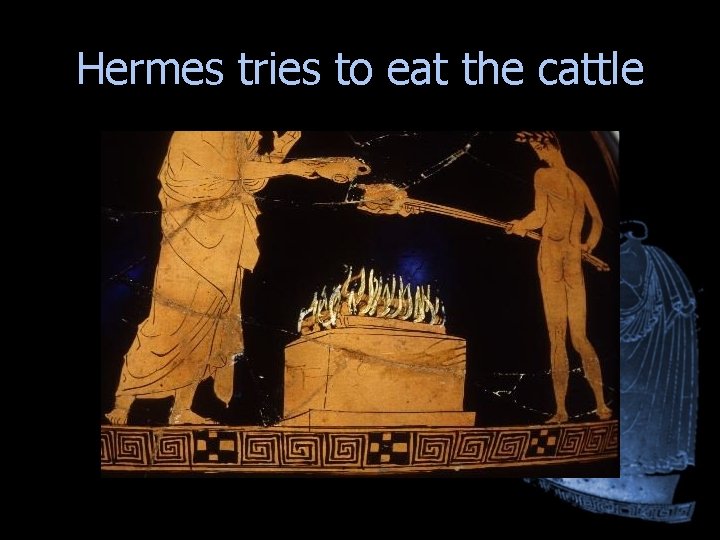
Hermes tries to eat the cattle
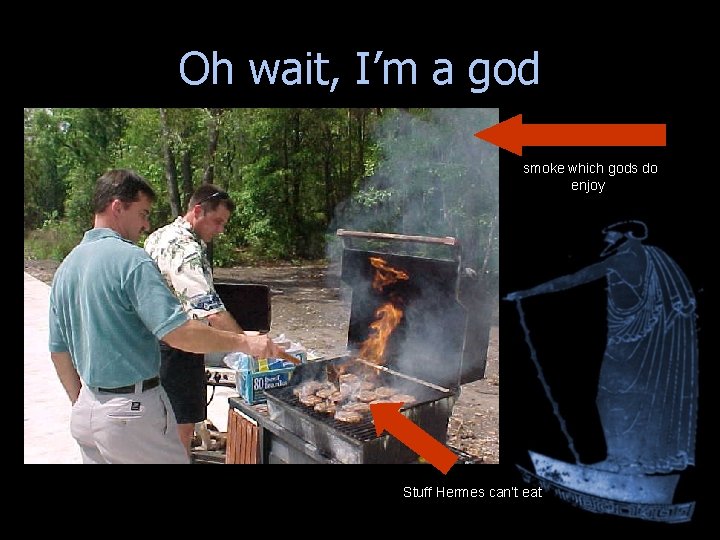
Oh wait, I’m a god smoke which gods do enjoy Stuff Hermes can’t eat
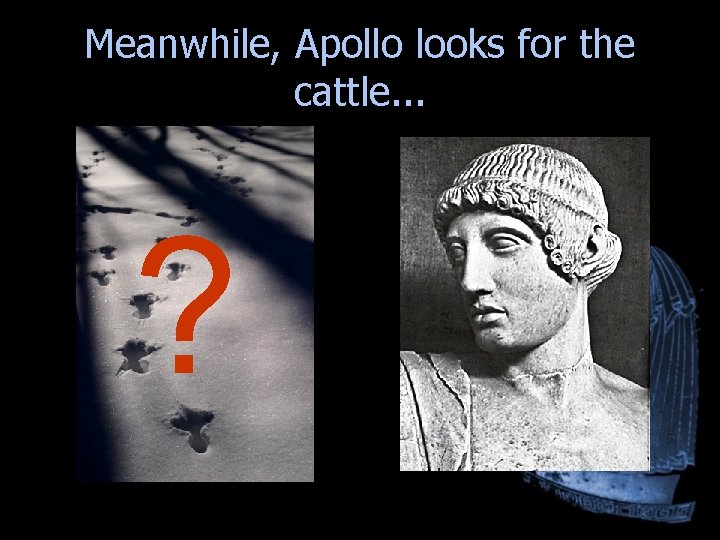
Meanwhile, Apollo looks for the cattle. . . ?
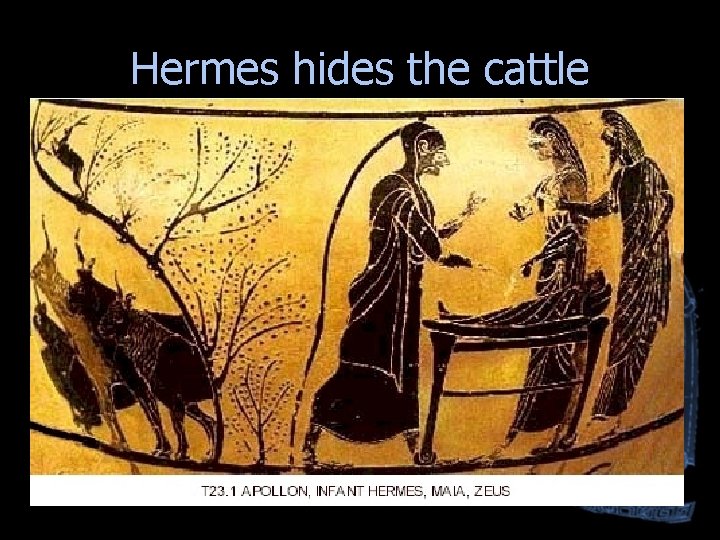
Hermes hides the cattle
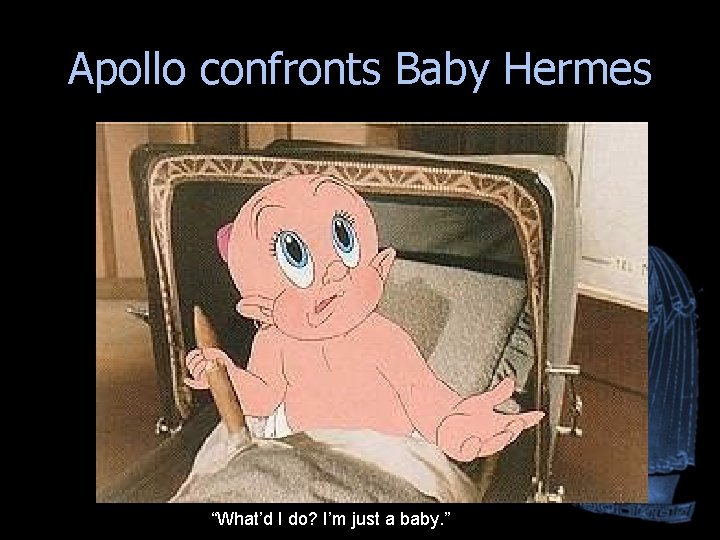
Apollo confronts Baby Hermes “What’d I do? I’m just a baby. ”
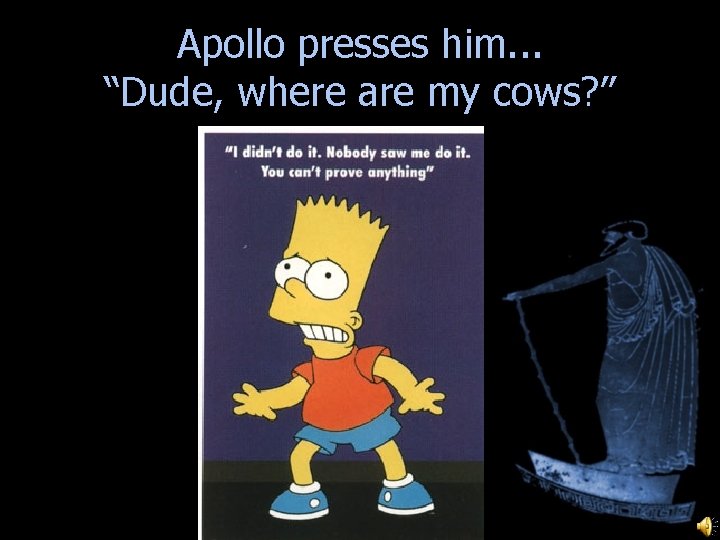
Apollo presses him. . . “Dude, where are my cows? ” alternate reconstruction: Baby Hermes
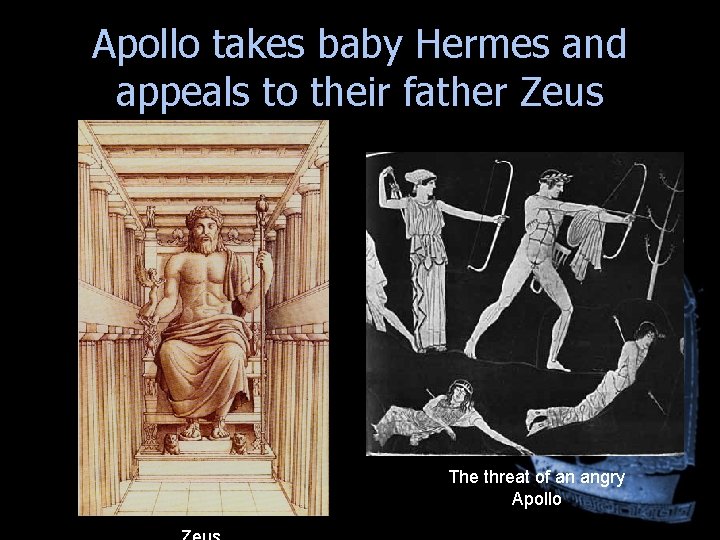
Apollo takes baby Hermes and appeals to their father Zeus The threat of an angry Apollo
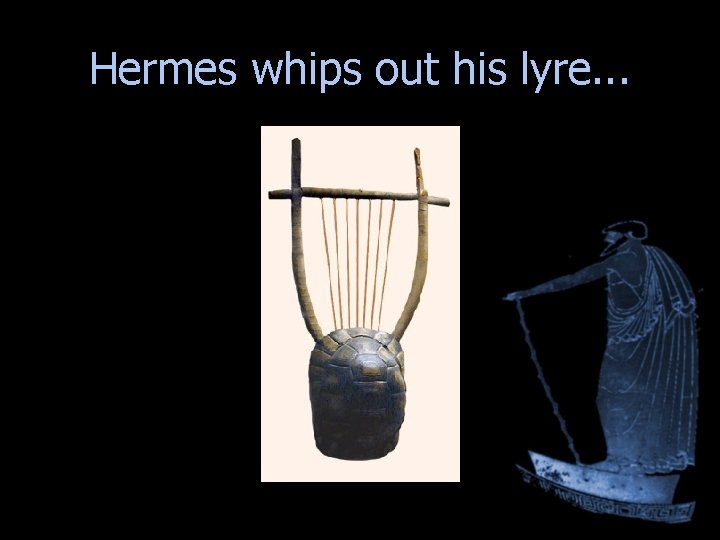
Hermes whips out his lyre. . .
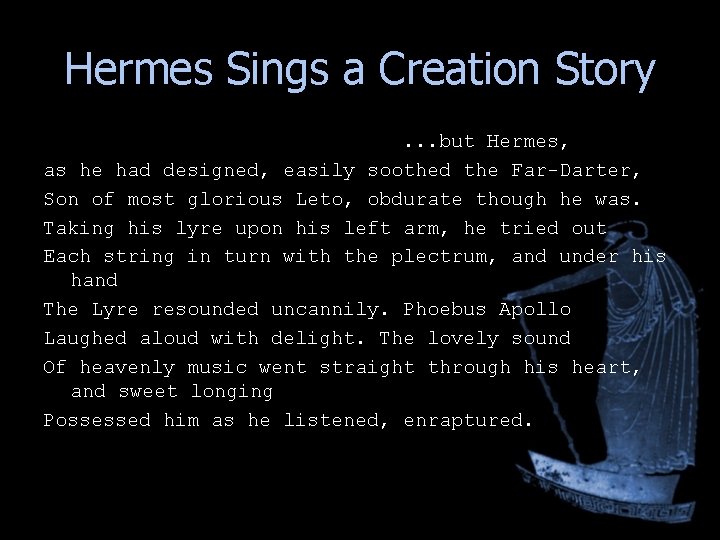
Hermes Sings a Creation Story. . . but Hermes, as he had designed, easily soothed the Far-Darter, Son of most glorious Leto, obdurate though he was. Taking his lyre upon his left arm, he tried out Each string in turn with the plectrum, and under his hand The Lyre resounded uncannily. Phoebus Apollo Laughed aloud with delight. The lovely sound Of heavenly music went straight through his heart, and sweet longing Possessed him as he listened, enraptured.
Hermes Sings a Creation Story he burst into song – and lovely his voice – Telling of how the immortal gods and black earth First came to be, and how each was allotted his portion. Mnemosyne [Memory], mother of the Muses, first of the gods He honored with song, for to her Maia’s son was apportioned by lot. Hermes, the son brilliant in splendor of Zeus, Hymned the undying gods according to age, And told the tale of how each one was born, relating All things in order, to the sweet strains of the lyre on his arm. from the Homeric Hymn to Hermes
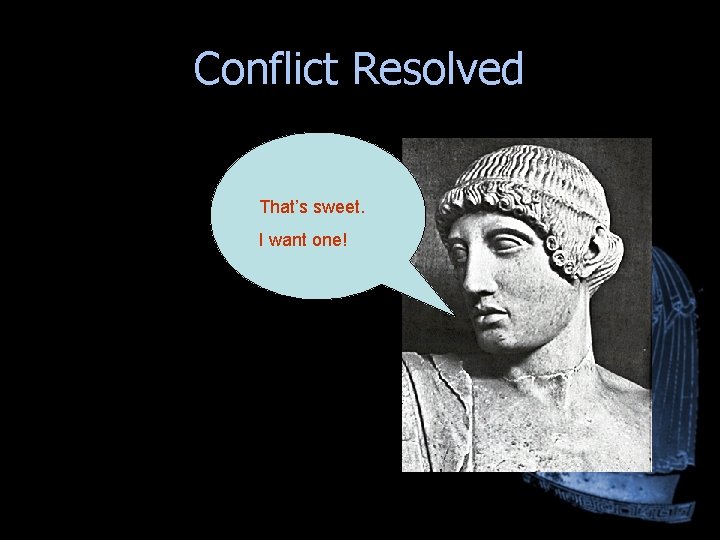
Conflict Resolved That’s sweet. I want one!
Hermes’ Expert Use of a Creation Myth • Song is itself a cure for strife – Theogony 99 -104: “For if anyone is grieved, if his heart is sore with fresh sorrow, if he is troubled, and a singer who serves the Muses chants the deeds of past men or the blessed gods. . . He soon forgets his heartache, and of all his cares he remembers none. ” • Cosmogony and Theogony: Singing about the ordering of the universe prevents disorder
Why tell Creation stories? Distinct Uses of Creation Myths Hopi Creation: Spider Woman leads the people out of the underworlds; teaches them how to live What telling this myth does: • ethical instruction (how to hunt, grow corn, build houses) • sites of present habitation explained by what happened on the mythic journey out of the underworld
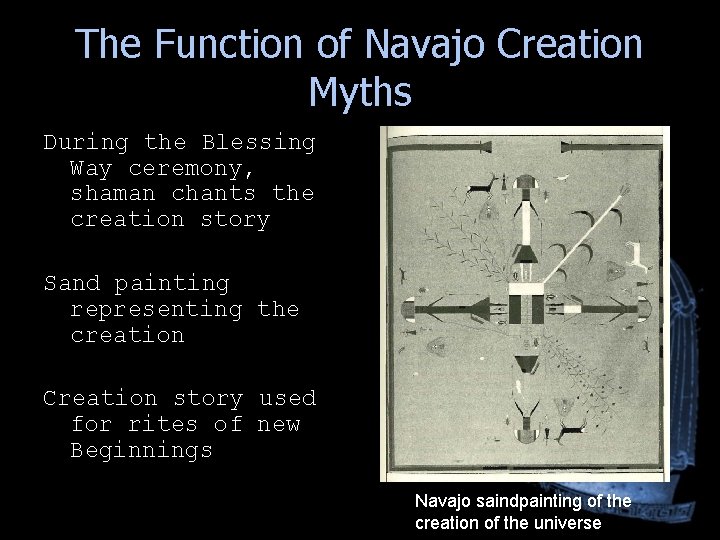
The Function of Navajo Creation Myths During the Blessing Way ceremony, shaman chants the creation story Sand painting representing the creation Creation story used for rites of new Beginnings Navajo saindpainting of the creation of the universe
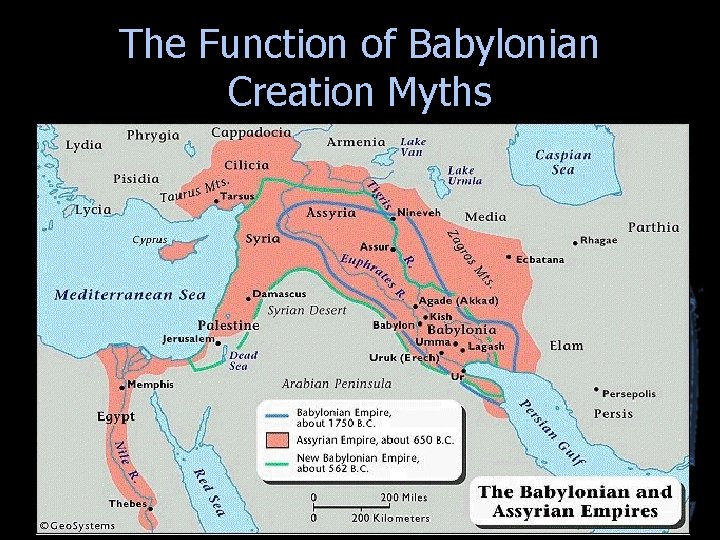
The Function of Babylonian Creation Myths
The Function of Babylonian Creation Myths Told at the dedication of sacred buildings: In the beginning Anu (sky) created the heavens, and Nudimmud (Eawaters) created Apsu, the primeval waters. Then Ea took some clay and created necessary elements for the buildings of great structures. He made the Arazu, the gods of the various crafts.
Questions • Why did Hesiod tell his creation story in the way that he did? • Why did Ovid tell his creation story in the way that he did?
Hesiod’s Theogony
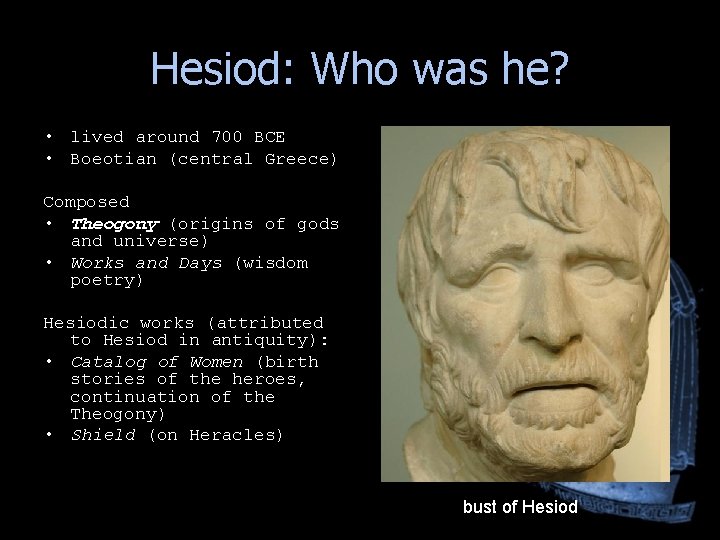
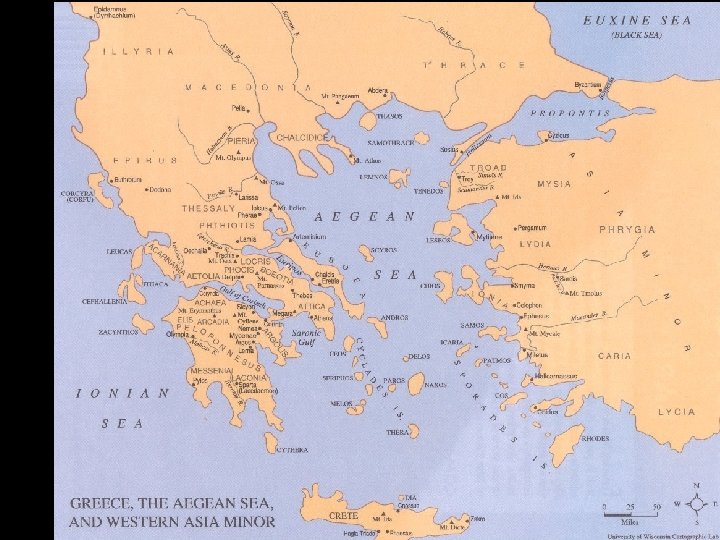
Hesiod: Who was he? • lived around 700 BCE • Boeotian (central Greece) Composed • Theogony (origins of gods and universe) • Works and Days (wisdom poetry) Hesiodic works (attributed to Hesiod in antiquity): • Catalog of Women (birth stories of the heroes, continuation of the Theogony) • Shield (on Heracles) bust of Hesiod
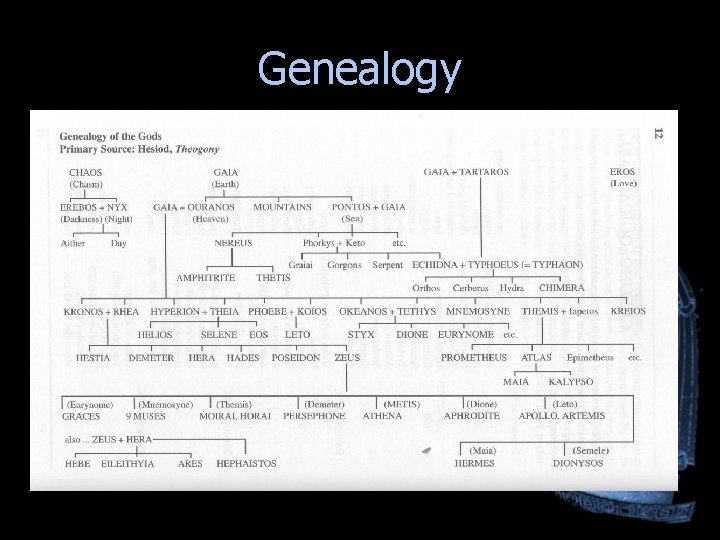
The Backbone of the Theogony: Genealogy: • Account of familial descent – Gr. genos “race, generation” – /log/ ~ Gr. logos “account, word” (e. g. logic)
Genealogy
Cosmogony vs. Theogony Cosmogony • story that explains the generation of the world – kosmos “world, order” – /gon/ ~ genos “race, generation” (e. g. gonads) Theogony • story that explains the generation of the gods – theos “god” (e. g. theology, polytheism / monotheism)
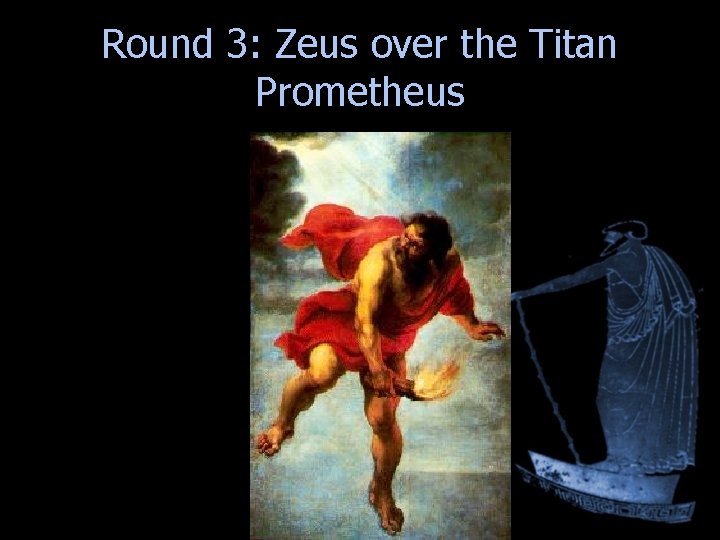
Structure of the Theogony Succession Myth: story of the overthrow of a god or generation of gods Succession Myth, interwoven with genealogy 1. Kronos succeeds his father Ouranos: Castration of Ouranos, birth of Aphrodite 2. Zeus Ascendant over Kronos: Tricking of Kronos, birth of Zeus; Zeus outwits Prometheus 3. Zeus and his generation defeat the Titans of the earlier generation 4. Zeus defeats a big monster (Typhoeus); Zeus swallows Metis to ensure there will be no more successors.
A Series of Contests [Hesiod vs. Muses] • Kronos defeats Ouranos • Zeus defeats Kronos • Zeus defeats Prometheus • Zeus defeats Titans
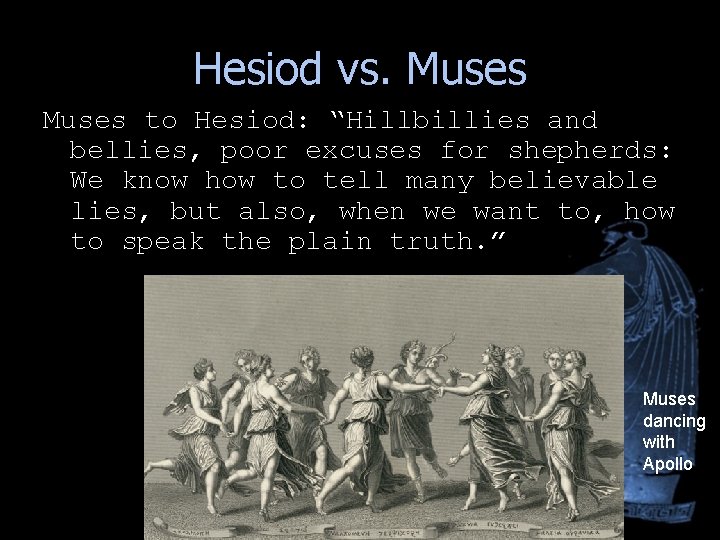
Hesiod vs. Muses to Hesiod: “Hillbillies and bellies, poor excuses for shepherds: We know how to tell many believable lies, but also, when we want to, how to speak the plain truth. ” Muses dancing with Apollo
Competitive Singing Muses: • Sing a theogony in honor of Zeus Hesiod • Turns the Muses’ theogony into a cosmogony • Honors Zeus with a more elaborate song
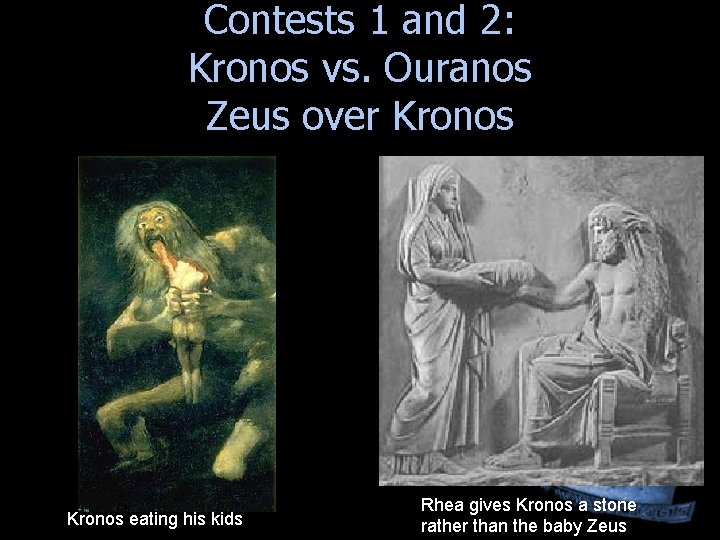
Contests 1 and 2: Kronos vs. Ouranos Zeus over Kronos eating his kids Rhea gives Kronos a stone rather than the baby Zeus
Round 3: Zeus over the Titan Prometheus
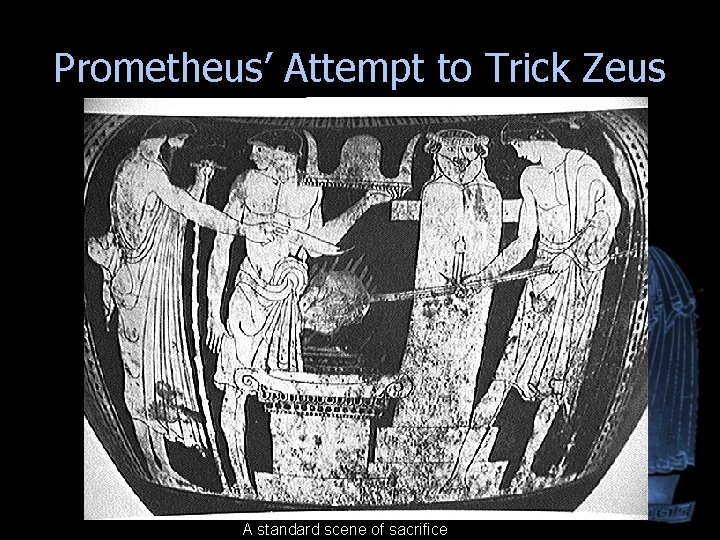
Prometheus’ Attempt to Trick Zeus A standard scene of sacrifice
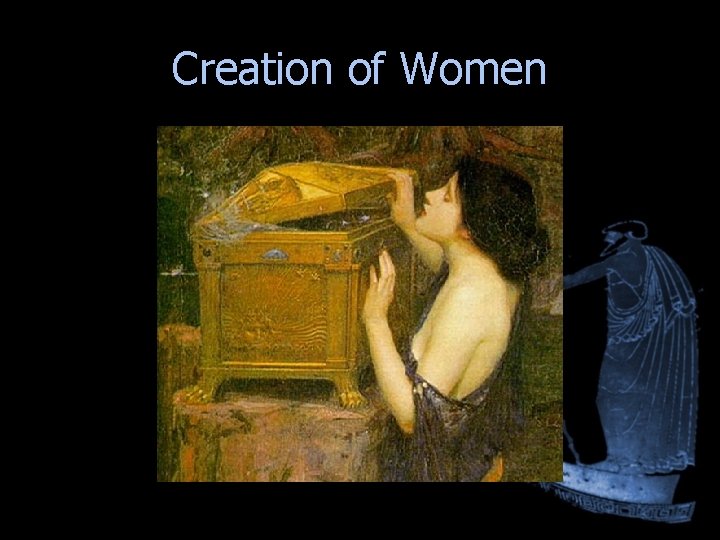
Creation of Women
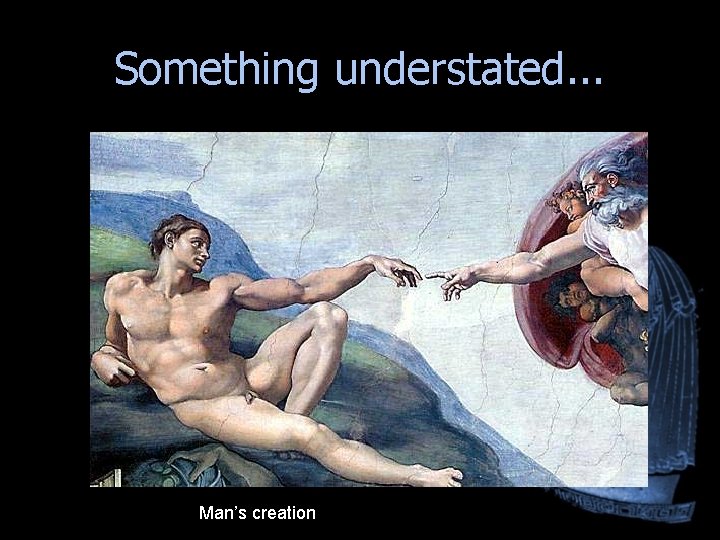
Something understated. . . Man’s creation
Round 4: Zeus vs. Monsters
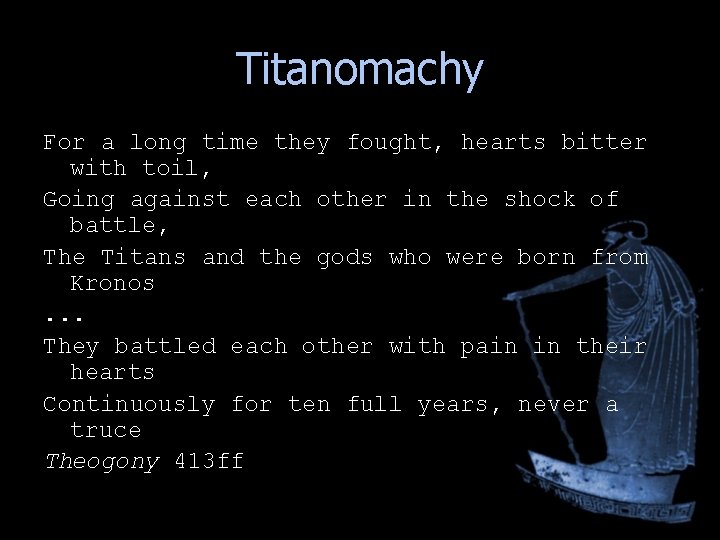
Titanomachy For a long time they fought, hearts bitter with toil, Going against each other in the shock of battle, The Titans and the gods who were born from Kronos. . . They battled each other with pain in their hearts Continuously for ten full years, never a truce Theogony 413 ff
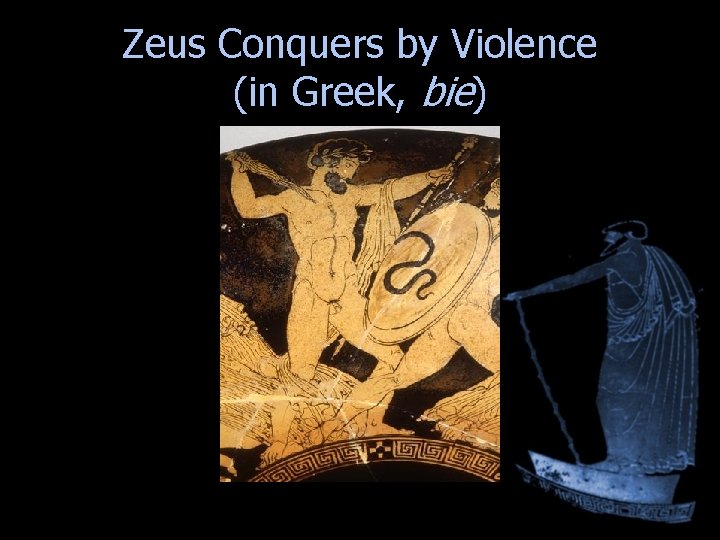
Zeus Conquers by Violence (in Greek, bie)
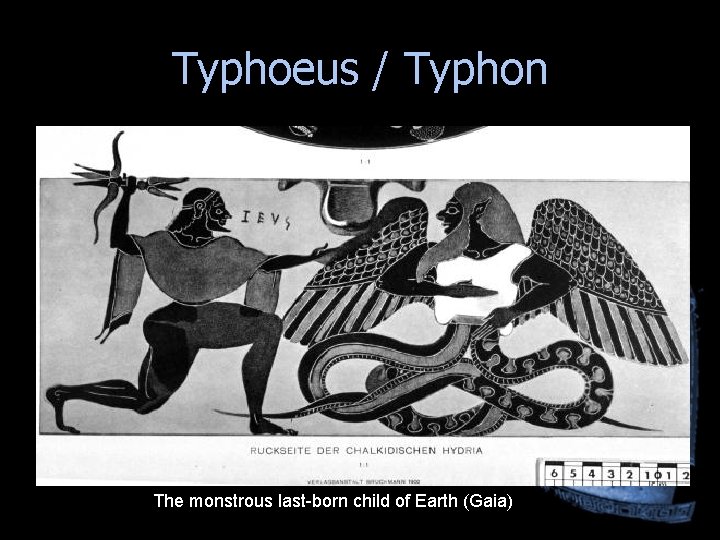
Typhoeus / Typhon The monstrous last-born child of Earth (Gaia)
Zeus Wins the Right to Rule So the blessed gods had done a hard piece of work, settled by force the question of rights with the Titans Theogony 667 ff.
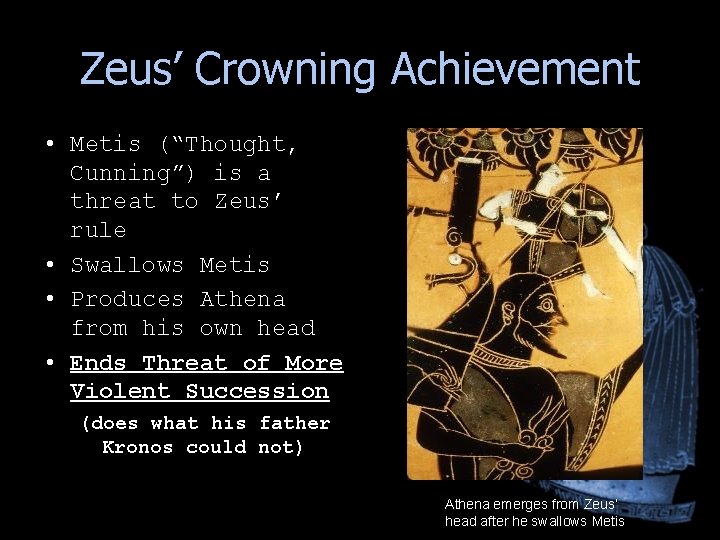
Zeus’ Crowning Achievement • Metis (“Thought, Cunning”) is a threat to Zeus’ rule • Swallows Metis • Produces Athena from his own head • Ends Threat of More Violent Succession (does what his father Kronos could not) Athena emerges from Zeus’ head after he swallows Metis
Kingship and Zeus Calliope (one of the Muses). . . For she keeps the company of reverend kings. When the daughters of great Zeus will honor a lord Whose lineage is divine, and look upon his birth, They distill a sweet dew upon his tongue, And from his mouth words flow like honey. The people all look to him as he arbitrates settlements With judgments straight. . For though it is singers and lyre players that come from the Muses and far-shooting Apollo And kings come from Zeus, happy is the man Whom the Muses love. Theogony lines 81 -98
Why tell this myth Possibilities: • Kingship / ruling elite – Zeus is a model king, guarantor of justice and order • patriarchy – Zeus is able to produce Athena without women; conquers female-spawned Titans, monster Typhon, and female Metis • Encodes basic Greek values – for example, justice (dike ~ balance, good order) – but also proper containment of violence (bie)
Ovid’s Metamorphoses
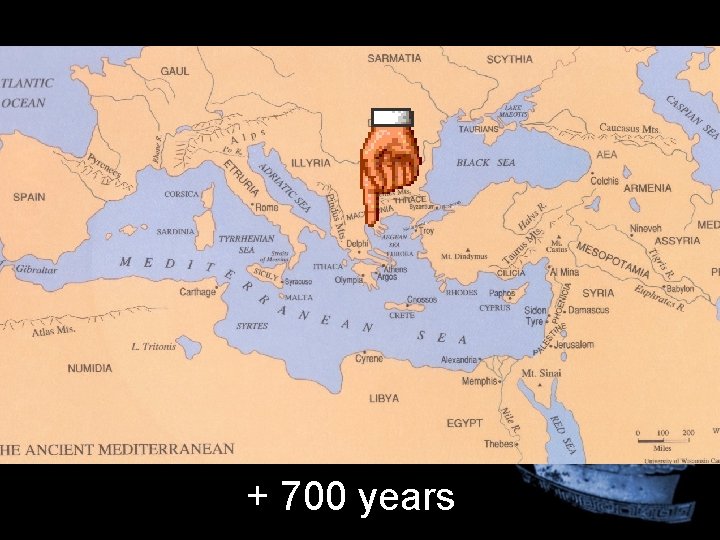
+ 700 years
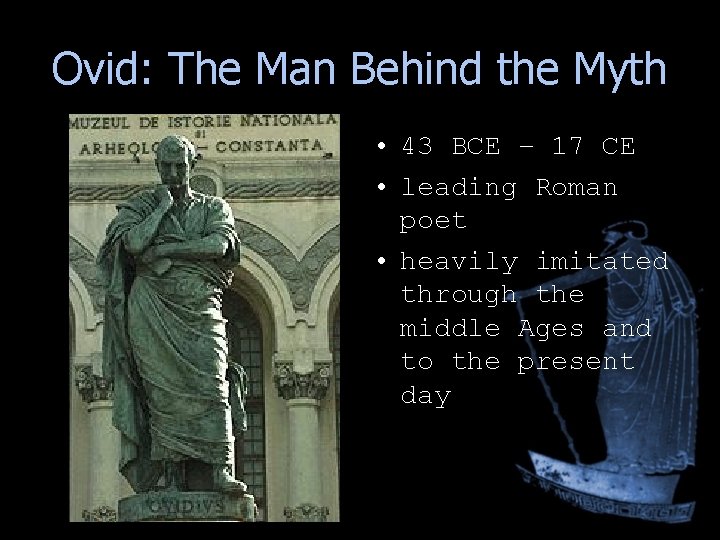
Ovid: The Man Behind the Myth • 43 BCE – 17 CE • leading Roman poet • heavily imitated through the middle Ages and to the present day
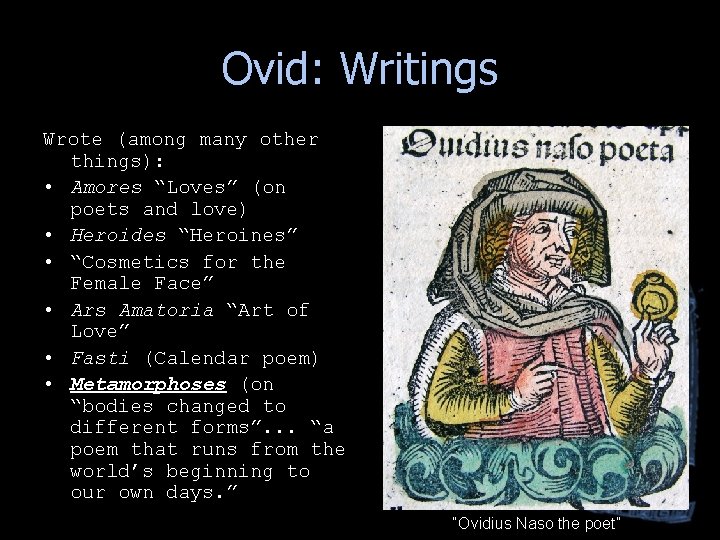
Ovid: Writings Wrote (among many other things): • Amores “Loves” (on poets and love) • Heroides “Heroines” • “Cosmetics for the Female Face” • Ars Amatoria “Art of Love” • Fasti (Calendar poem) • Metamorphoses (on “bodies changed to different forms”. . . “a poem that runs from the world’s beginning to our own days. ” “Ovidius Naso the poet”
Ovid What’s changed? • Writing: Oral performance of Hymns and Hesiod’s poetry vs. book scrolls as vehicle for literature • Philosophy: Hesiod = pre-Plato, pre. Aristotle; Ovid = post-Plato, post. Aristotle and their successors (Stoics, Epicureans, etc. ) • Patronage: Ovid works for a portion of his life under Augustus’ rule statements about kingship, order, disorder are especially pointed
One of Ovid’s Many Models Apollonius (3 rd century BCE) Argonautica: Journey of the Argonauts to get the golden fleece Before they’ve even set out, The ship’s crew is about to quarrel.
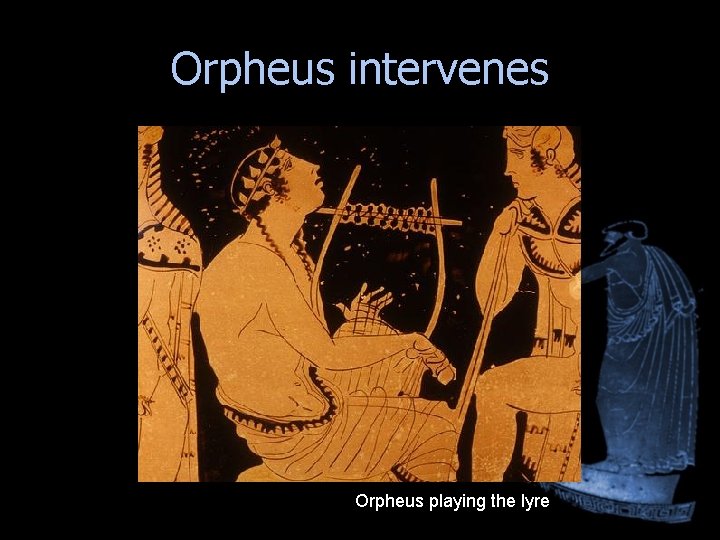
Orpheus intervenes Orpheus playing the lyre
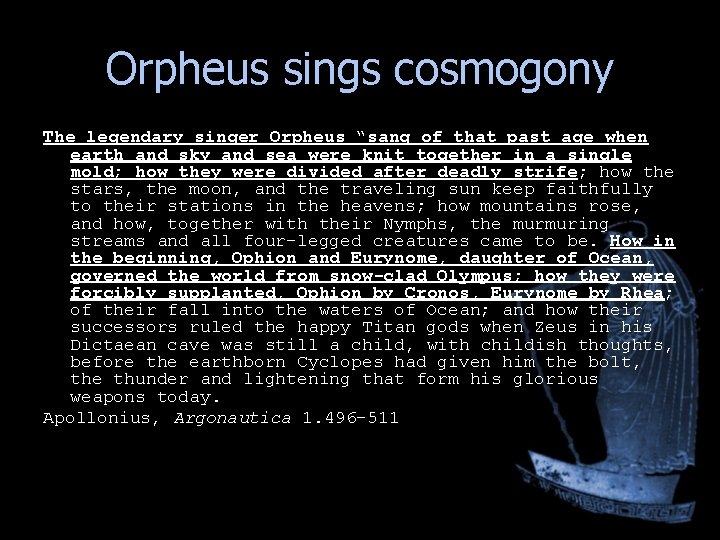
Orpheus sings cosmogony The legendary singer Orpheus “sang of that past age when earth and sky and sea were knit together in a single mold; how they were divided after deadly strife; how the stars, the moon, and the traveling sun keep faithfully to their stations in the heavens; how mountains rose, and how, together with their Nymphs, the murmuring streams and all four-legged creatures came to be. How in the beginning, Ophion and Eurynome, daughter of Ocean, governed the world from snow-clad Olympus; how they were forcibly supplanted, Ophion by Cronos, Eurynome by Rhea; of their fall into the waters of Ocean; and how their successors ruled the happy Titan gods when Zeus in his Dictaean cave was still a child, with childish thoughts, before the earthborn Cyclopes had given him the bolt, the thunder and lightening that form his glorious weapons today. Apollonius, Argonautica 1. 496 -511
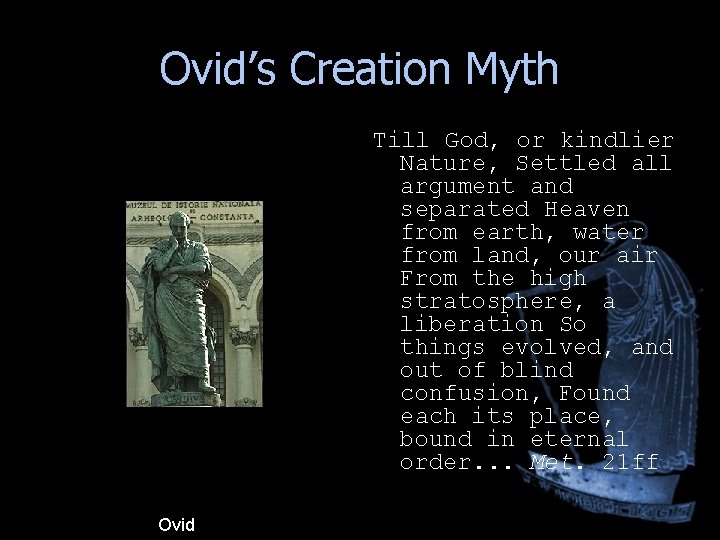
Ovid’s Creation Myth Till God, or kindlier Nature, Settled all argument and separated Heaven from earth, water from land, our air From the high stratosphere, a liberation So things evolved, and out of blind confusion, Found each its place, bound in eternal order. . . Met. 21 ff Ovid
Ovid’s Different Kind of Myth The creation of mortals but something else was needed, a finer being, More capable of mind, a sage, a ruler, So Man was born, it may be, in God’s image, Or Earth, perhaps, so newly separated From the old fire of Heaven, still retained Some seed of the celestial force which refasioned Gods out of the living clay and running water. All other animals look downward; Man, Alone, erect, can raise his face toward Heaven. Metamorphoses 72 ff
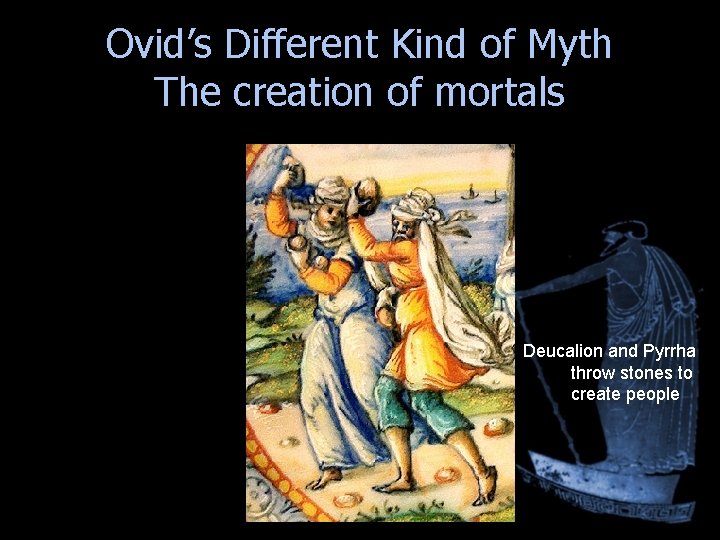
Ovid’s Different Kind of Myth The creation of mortals Deucalion and Pyrrha throw stones to create people
Ovid’s different kind of mythmaking: Chaos and Craftsman “Before the ocean was, or earth, or heaven, Nature was all alike, a shapelessness, Chaos, so-called, all rude and lumpy matter, Nothing but bulk, inert, in whose confusion Discordant atoms warred. . . Heat fought with cold, wet fought with dry, the hard fought with the soft. . . till God, or kindlier Nature, settled all argument, and separated Heaven from earth, water from land, etc. ” Ovid Metamorphoses 1. 5 -23
Types of Creation Headline: Millions of Ways to Explain Creation Payoff: Two different means of creation in Ovid and Hesiod
Methods of Creation Automatic Creation • • from chaos (like in the Theogony) creation from cosmic egg creation from elements (usually water) creation by secretion (that is, by spit, sweat, semen, urine, feces etc. ) VS. Architectural Creation • creation by thought, by word (like in Genesis) • creation by construction and craft; divine architect
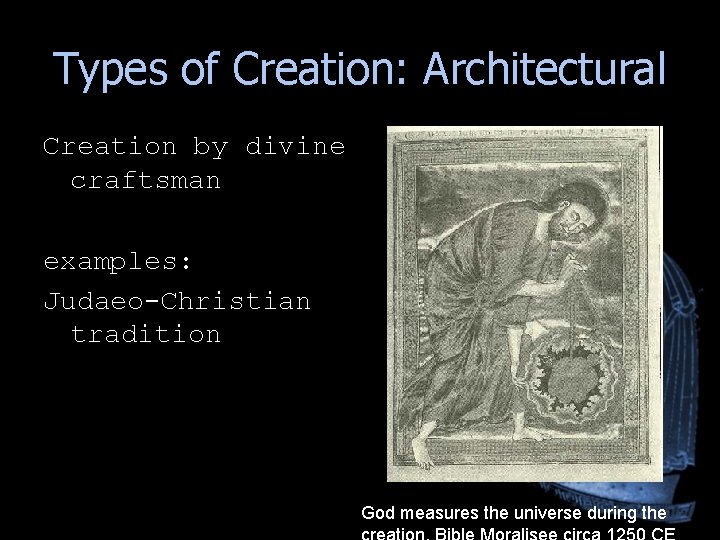
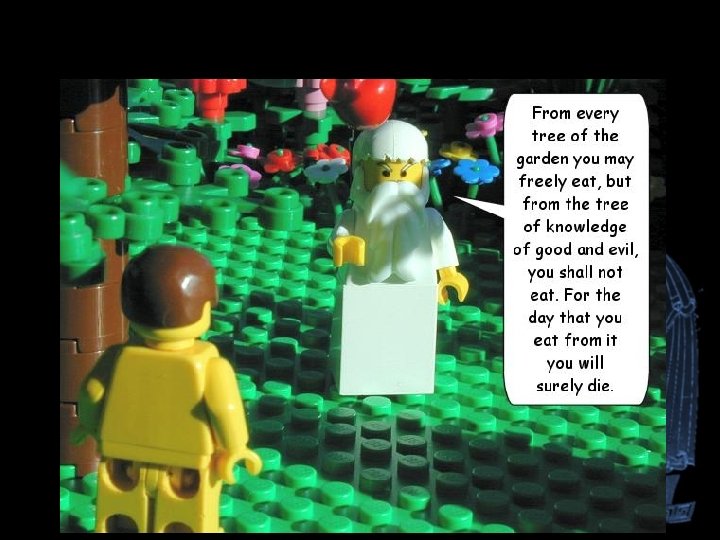
Types of Creation: Architectural Creation by divine craftsman examples: Judaeo-Christian tradition God measures the universe during the
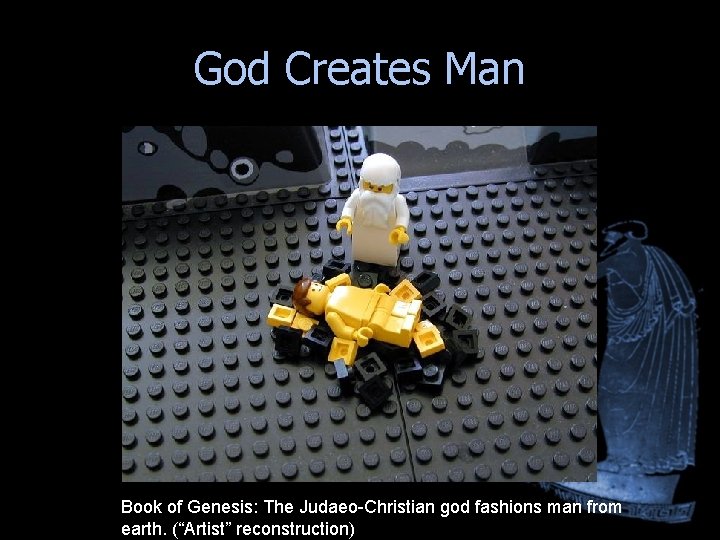
God Creates Man Book of Genesis: The Judaeo-Christian god fashions man from earth. (“Artist” reconstruction)
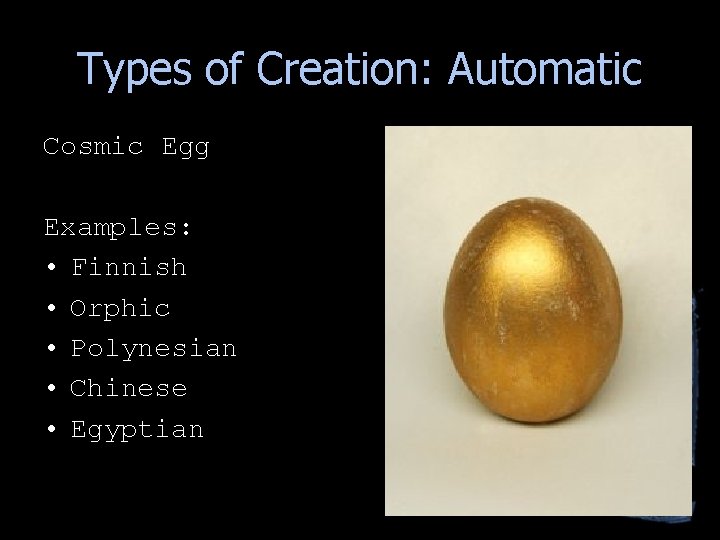
Types of Creation: Automatic Cosmic Egg Examples: • Finnish • Orphic • Polynesian • Chinese • Egyptian
Sidenote: Greek Alternatives Orphic Creation In the beginning was the silver cosmic egg, created by Time. Phanes broke forth from the egg as the firstborn (Protogonos), the androgynous container of all the seeds of life. It was Phanes who created the universe, beginning with a daughter Nux (Night), and later the familiar gods, Gaia and Ouranos
Ovid’s different kind of mythmaking “Before the ocean was, or earth, or heaven, Nature was all alike, a shapelessness, Chaos, so-called, all rude and lumpy matter, Nothing but bulk, inert, in whose confusion Discordant atoms warred. . . Heat fought with cold, wet fought with dry, the hard fought with the soft. . . till God, or kindlier Nature, settled all argument, and separated Heaven from earth, water from land, etc. ” Ovid Metamorphoses 1. 5 -23
Hesiod vs. Ovid • Hesiod describes automatic creation, structured as genealogy; succession myths of gods interwoven • Ovid starts by describing creation from Chaos (like Hesiod) but then describes creation through a divine craftsman.
Ovid’s Agenda Some Possibilities: • Kingship: criticism of imperial power? • Re-asserting mythic explanations against philosophic ones • Entertainment – Exploiting the literary tradition of mythtelling
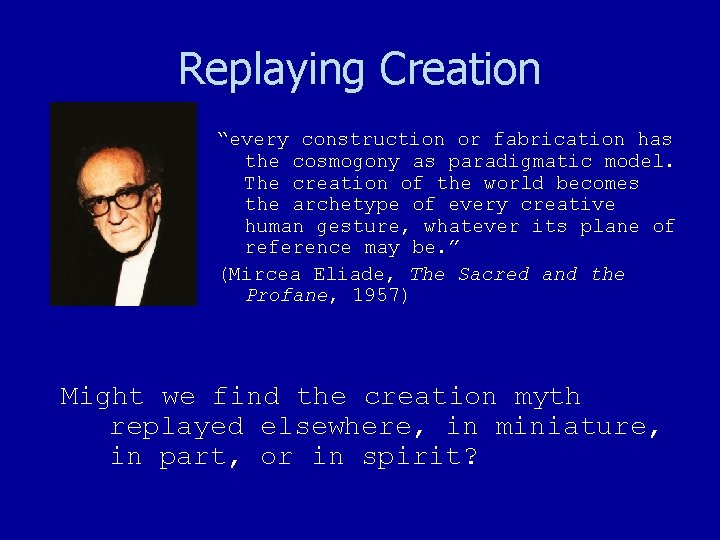
Replaying Creation “every construction or fabrication has the cosmogony as paradigmatic model. The creation of the world becomes the archetype of every creative human gesture, whatever its plane of reference may be. ” (Mircea Eliade, The Sacred and the Profane, 1957) Might we find the creation myth replayed elsewhere, in miniature, in part, or in spirit?
Creation Myths Hesiod’s Theogony and Ovid’s Metamorphoses Allen Romano aromano@uchicago. edu background: Muses