
Objective To be able to pronounce and read
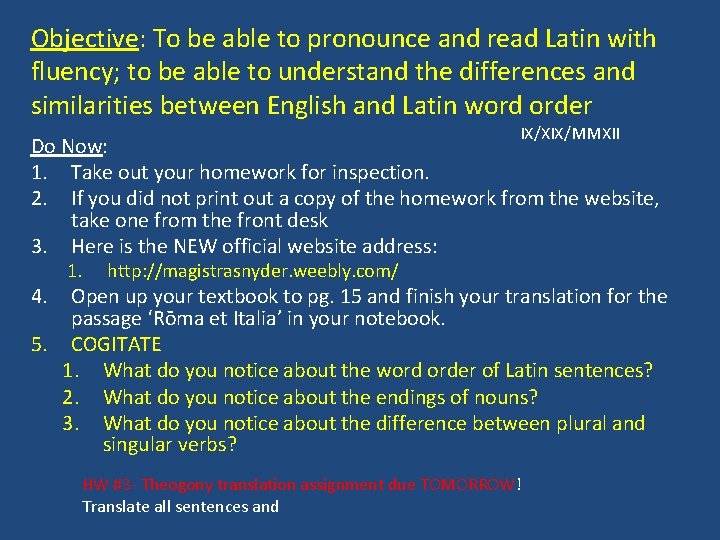
Objective: To be able to pronounce and read Latin with fluency; to be able to understand the differences and similarities between English and Latin word order IX/XIX/MMXII Do Now: 1. Take out your homework for inspection. 2. If you did not print out a copy of the homework from the website, take one from the front desk 3. Here is the NEW official website address: 4. 1. http: //magistrasnyder. weebly. com/ Open up your textbook to pg. 15 and finish your translation for the passage ‘Rōma et Italia’ in your notebook. 5. COGITATE 1. What do you notice about the word order of Latin sentences? 2. What do you notice about the endings of nouns? 3. What do you notice about the difference between plural and singular verbs? HW #3 - Theogony translation assignment due TOMORROW! Translate all sentences and

Macrons • All Latin vowels come in 2 types, long and short • Long vowels have a symbol known as a macron, or long mark, which changes their sound slightly – ā = ahh as in calm – ē = ‘A’ as in pay – ī = eee as in free – ō = ‘O’ as in go – ū = ooo as in glue
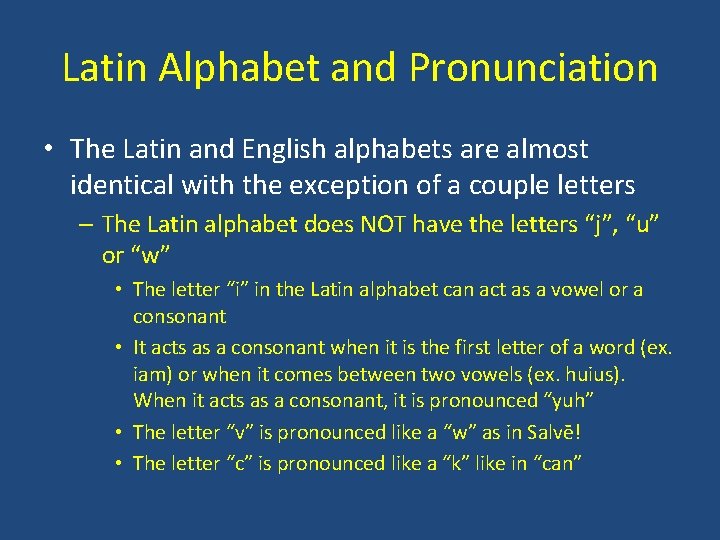
Latin Alphabet and Pronunciation • The Latin and English alphabets are almost identical with the exception of a couple letters – The Latin alphabet does NOT have the letters “j”, “u” or “w” • The letter “i” in the Latin alphabet can act as a vowel or a consonant • It acts as a consonant when it is the first letter of a word (ex. iam) or when it comes between two vowels (ex. huius). When it acts as a consonant, it is pronounced “yuh” • The letter “v” is pronounced like a “w” as in Salvē! • The letter “c” is pronounced like a “k” like in “can”
Exerceāmus! Practice saying the following words aloud: • Salvē! • Valēte! • iamdudum • silvae • insulae
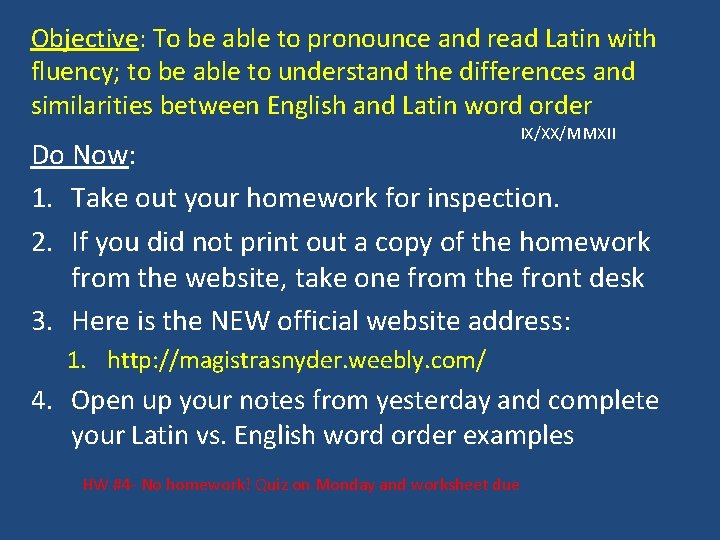
Objective: To be able to pronounce and read Latin with fluency; to be able to understand the differences and similarities between English and Latin word order IX/XX/MMXII Do Now: 1. Take out your homework for inspection. 2. If you did not print out a copy of the homework from the website, take one from the front desk 3. Here is the NEW official website address: 1. http: //magistrasnyder. weebly. com/ 4. Open up your notes from yesterday and complete your Latin vs. English word order examples HW #4 - No homework! Quiz on Monday and worksheet due
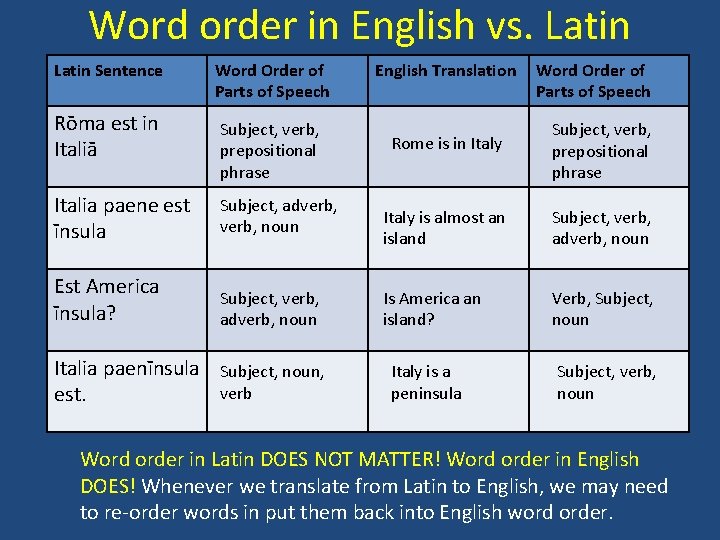
Word order in English vs. Latin Sentence Word Order of Parts of Speech Rōma est in Italiā Subject, verb, prepositional phrase Italia paene est īnsula Subject, adverb, noun Est America īnsula? Subject, verb, adverb, noun Italia paenīnsula Subject, noun, verb est. English Translation Word Order of Parts of Speech Rome is in Italy Subject, verb, prepositional phrase Italy is almost an island Subject, verb, adverb, noun Is America an island? Verb, Subject, noun Italy is a peninsula Subject, verb, noun Word order in Latin DOES NOT MATTER! Word order in English DOES! Whenever we translate from Latin to English, we may need to re-order words in put them back into English word order.
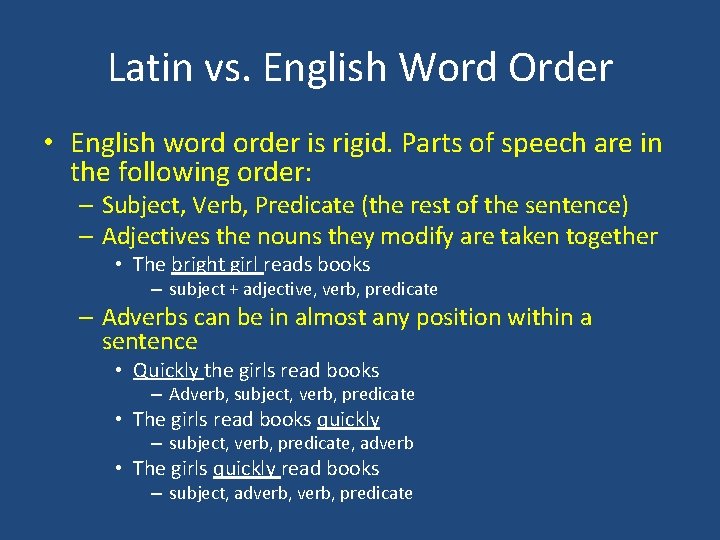
Latin vs. English Word Order • English word order is rigid. Parts of speech are in the following order: – Subject, Verb, Predicate (the rest of the sentence) – Adjectives the nouns they modify are taken together • The bright girl reads books – subject + adjective, verb, predicate – Adverbs can be in almost any position within a sentence • Quickly the girls read books – Adverb, subject, verb, predicate • The girls read books quickly – subject, verb, predicate, adverb • The girls quickly read books – subject, adverb, predicate
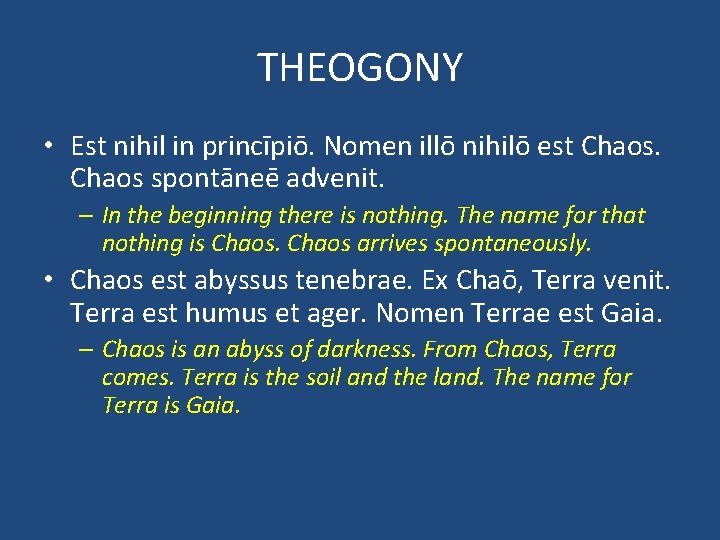
THEOGONY • Est nihil in princīpiō. Nomen illō nihilō est Chaos spontāneē advenit. – In the beginning there is nothing. The name for that nothing is Chaos arrives spontaneously. • Chaos est abyssus tenebrae. Ex Chaō, Terra venit. Terra est humus et ager. Nomen Terrae est Gaia. – Chaos is an abyss of darkness. From Chaos, Terra comes. Terra is the soil and the land. The name for Terra is Gaia.
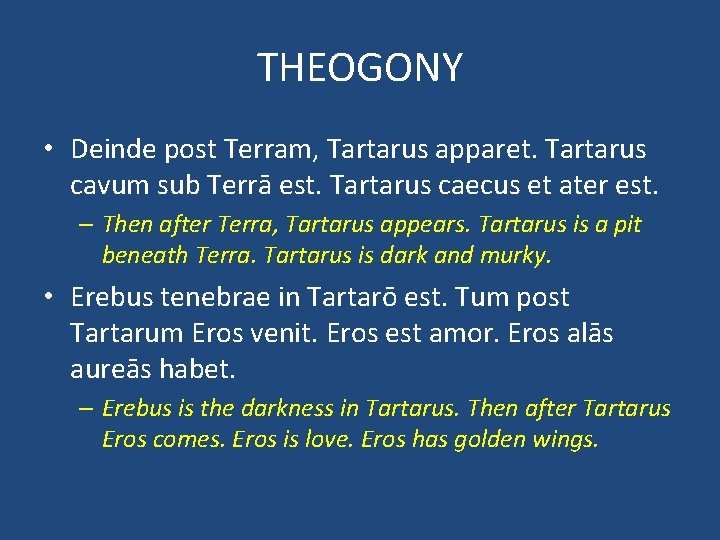
THEOGONY • Deinde post Terram, Tartarus apparet. Tartarus cavum sub Terrā est. Tartarus caecus et ater est. – Then after Terra, Tartarus appears. Tartarus is a pit beneath Terra. Tartarus is dark and murky. • Erebus tenebrae in Tartarō est. Tum post Tartarum Eros venit. Eros est amor. Eros alās aureās habet. – Erebus is the darkness in Tartarus. Then after Tartarus Eros comes. Eros is love. Eros has golden wings.
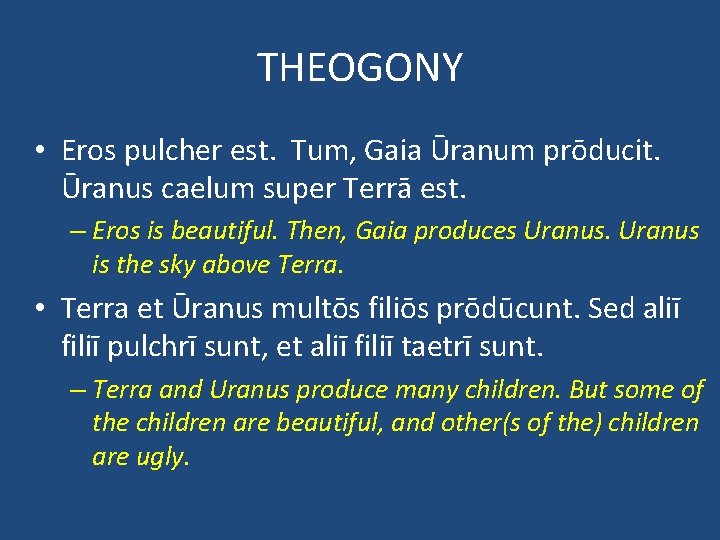
THEOGONY • Eros pulcher est. Tum, Gaia Ūranum prōducit. Ūranus caelum super Terrā est. – Eros is beautiful. Then, Gaia produces Uranus is the sky above Terra. • Terra et Ūranus multōs filiōs prōdūcunt. Sed aliī filiī pulchrī sunt, et aliī filiī taetrī sunt. – Terra and Uranus produce many children. But some of the children are beautiful, and other(s of the) children are ugly.

Compare these verbs… • Terra et Ūranus multōs filiōs prōdūcunt • aliī filiī taetrī sunt PLURAL! To these verbs… • Eros pulcher est • Tartarus apparet • Chaos spontāneē advenit Plural verbs end in the letters ‘-nt’ Singular verbs end in the letter ‘-t’ SINGULAR!
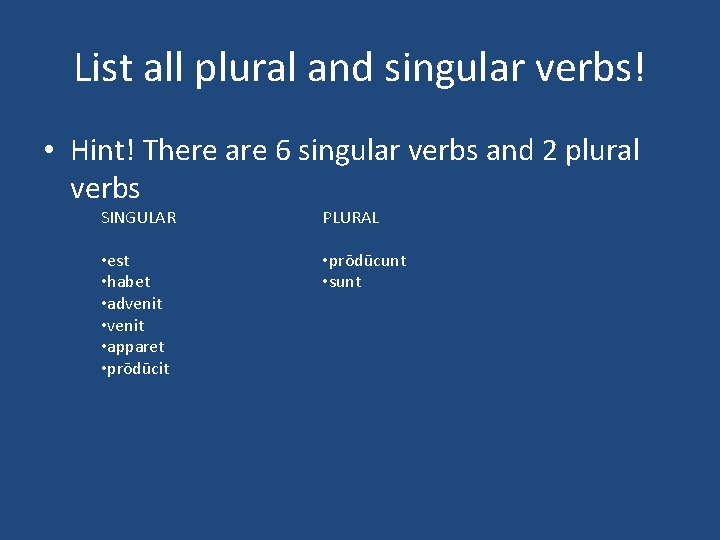
List all plural and singular verbs! • Hint! There are 6 singular verbs and 2 plural verbs SINGULAR PLURAL • est • habet • advenit • apparet • prōdūcit • prōdūcunt • sunt

Objective: To be able to pronounce and read Latin with fluency; to be able to understand the differences and similarities between English and Latin word order IX/XIX/MMXII Do Now: 1. Take out your homework for inspection. 2. If you did not print out a copy of the homework from the website, take one from the front desk 3. Here is the NEW official website address: 1. http: //magistrasnyder. weebly. com/ 1. 2. 3. 4. 5. Neuter plural noun: _______ Future tense verb: _______ Ablative without a preposition: _______ Genitive showing possession: _________ Vocative: _________ 4. Find the following forms: HW #4 - Verb synopsis
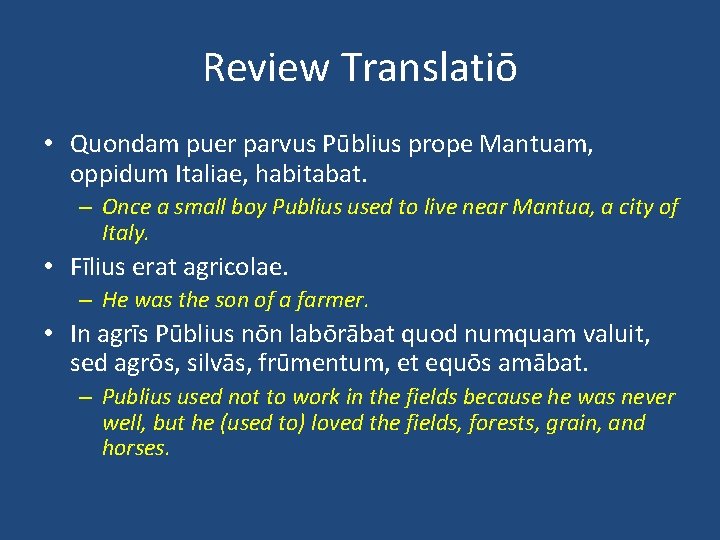
Review Translatiō • Quondam puer parvus Pūblius prope Mantuam, oppidum Italiae, habitabat. – Once a small boy Publius used to live near Mantua, a city of Italy. • Fīlius erat agricolae. – He was the son of a farmer. • In agrīs Pūblius nōn labōrābat quod numquam valuit, sed agrōs, silvās, frūmentum, et equōs amābat. – Publius used not to work in the fields because he was never well, but he (used to) loved the fields, forests, grain, and horses.

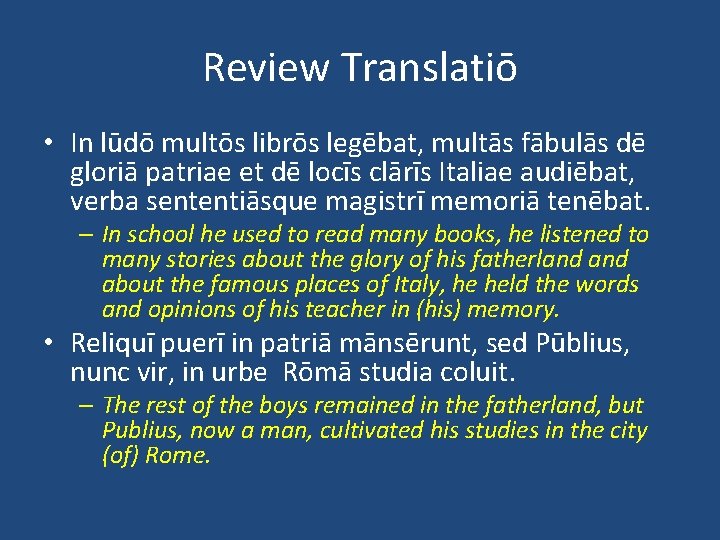
Review Translatiō • In lūdō multōs librōs legēbat, multās fābulās dē gloriā patriae et dē locīs clārīs Italiae audiēbat, verba sententiāsque magistrī memoriā tenēbat. – In school he used to read many books, he listened to many stories about the glory of his fatherland about the famous places of Italy, he held the words and opinions of his teacher in (his) memory. • Reliquī puerī in patriā mānsērunt, sed Pūblius, nunc vir, in urbe Rōmā studia coluit. – The rest of the boys remained in the fatherland, but Publius, now a man, cultivated his studies in the city (of) Rome.
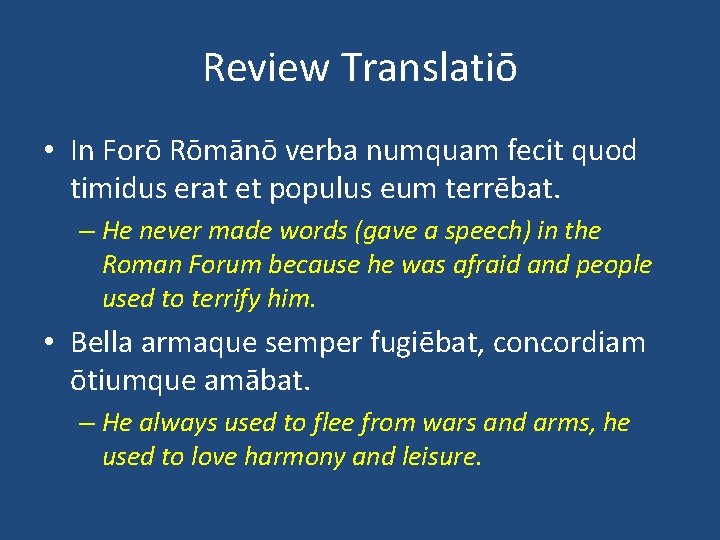
Review Translatiō • In Forō Rōmānō verba numquam fecit quod timidus erat et populus eum terrēbat. – He never made words (gave a speech) in the Roman Forum because he was afraid and people used to terrify him. • Bella armaque semper fugiēbat, concordiam ōtiumque amābat. – He always used to flee from wars and arms, he used to love harmony and leisure.
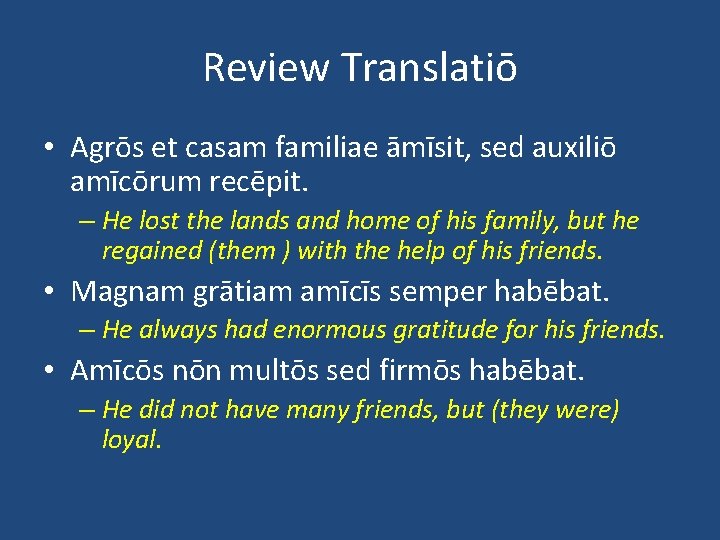
Review Translatiō • Agrōs et casam familiae āmīsit, sed auxiliō amīcōrum recēpit. – He lost the lands and home of his family, but he regained (them ) with the help of his friends. • Magnam grātiam amīcīs semper habēbat. – He always had enormous gratitude for his friends. • Amīcōs nōn multōs sed firmōs habēbat. – He did not have many friends, but (they were) loyal.
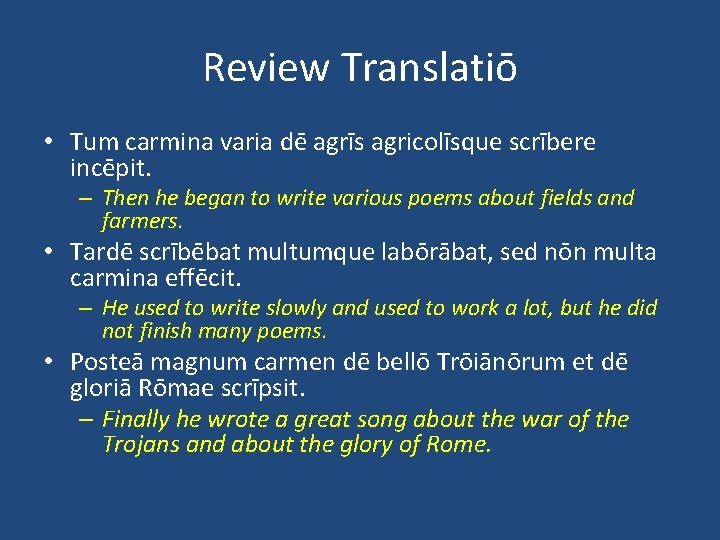
Review Translatiō • Tum carmina varia dē agrīs agricolīsque scrībere incēpit. – Then he began to write various poems about fields and farmers. • Tardē scrībēbat multumque labōrābat, sed nōn multa carmina effēcit. – He used to write slowly and used to work a lot, but he did not finish many poems. • Posteā magnum carmen dē bellō Trōiānōrum et dē gloriā Rōmae scrīpsit. – Finally he wrote a great song about the war of the Trojans and about the glory of Rome.
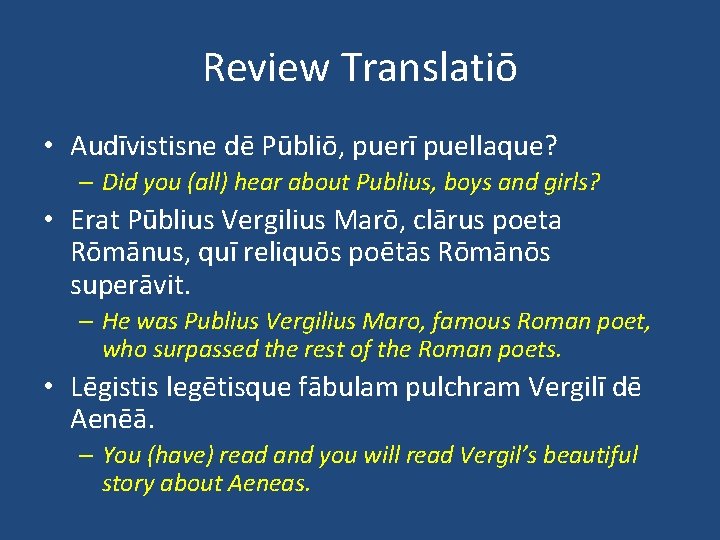
Review Translatiō • Audīvistisne dē Pūbliō, puerī puellaque? – Did you (all) hear about Publius, boys and girls? • Erat Pūblius Vergilius Marō, clārus poeta Rōmānus, quī reliquōs poētās Rōmānōs superāvit. – He was Publius Vergilius Maro, famous Roman poet, who surpassed the rest of the Roman poets. • Lēgistis legētisque fābulam pulchram Vergilī dē Aenēā. – You (have) read and you will read Vergil’s beautiful story about Aeneas.
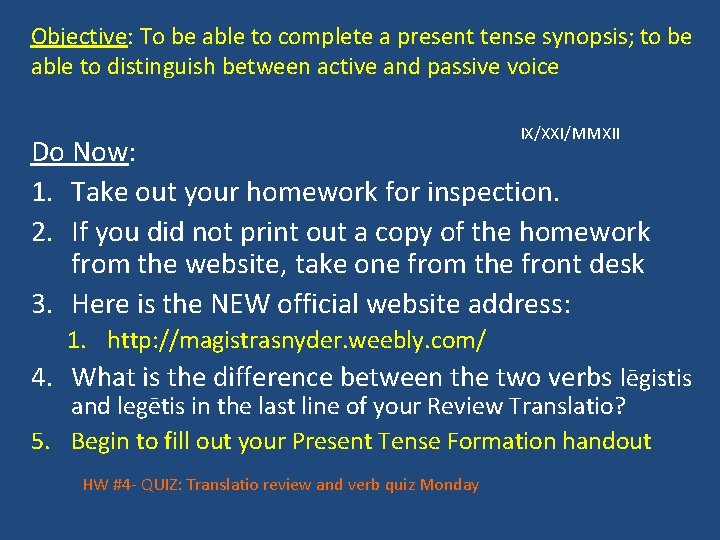
Objective: To be able to complete a present tense synopsis; to be able to distinguish between active and passive voice IX/XXI/MMXII Do Now: 1. Take out your homework for inspection. 2. If you did not print out a copy of the homework from the website, take one from the front desk 3. Here is the NEW official website address: 1. http: //magistrasnyder. weebly. com/ 4. What is the difference between the two verbs lēgistis and legētis in the last line of your Review Translatio? 5. Begin to fill out your Present Tense Formation handout HW #4 - QUIZ: Translatio review and verb quiz Monday
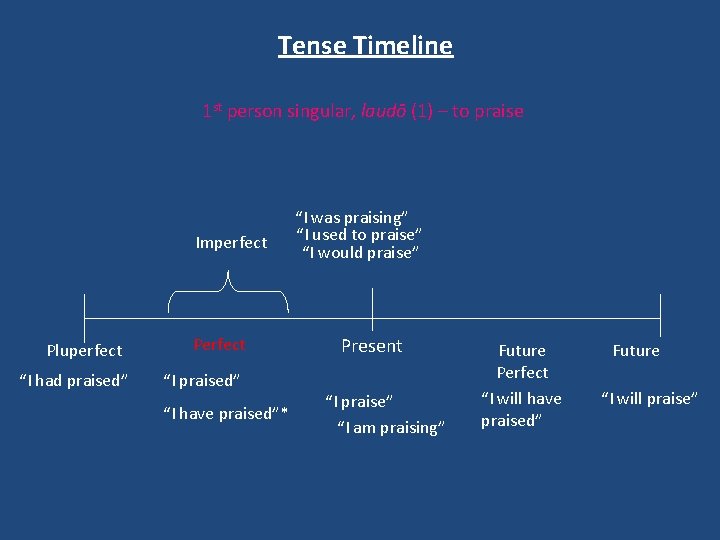
Tense Timeline 1 st person singular, laudō (1) – to praise Imperfect Pluperfect “I had praised” Perfect “I praised” “I have praised”* “I was praising” “I used to praise” “I would praise” Present “I praise” “I am praising” Future Perfect “I will have praised” Future “I will praise”
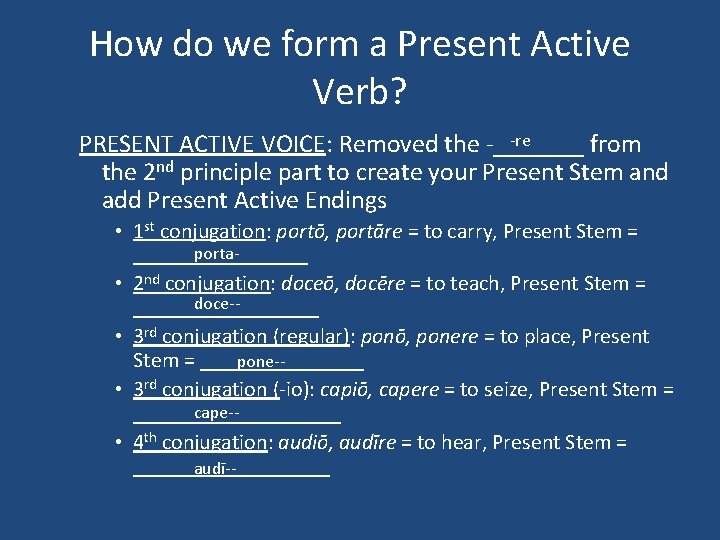
How do we form a Present Active Verb? -re PRESENT ACTIVE VOICE: Removed the -_______ from the 2 nd principle part to create your Present Stem and add Present Active Endings • 1 st conjugation: portō, portāre = to carry, Present Stem = porta________ • 2 nd conjugation: doceō, docēre = to teach, Present Stem = doce-_________ • 3 rd conjugation (regular): ponō, ponere = to place, Present Stem = ________ pone- • 3 rd conjugation (-io): capiō, capere = to seize, Present Stem = cape-__________ • 4 th conjugation: audiō, audīre = to hear, Present Stem = _________ audī--
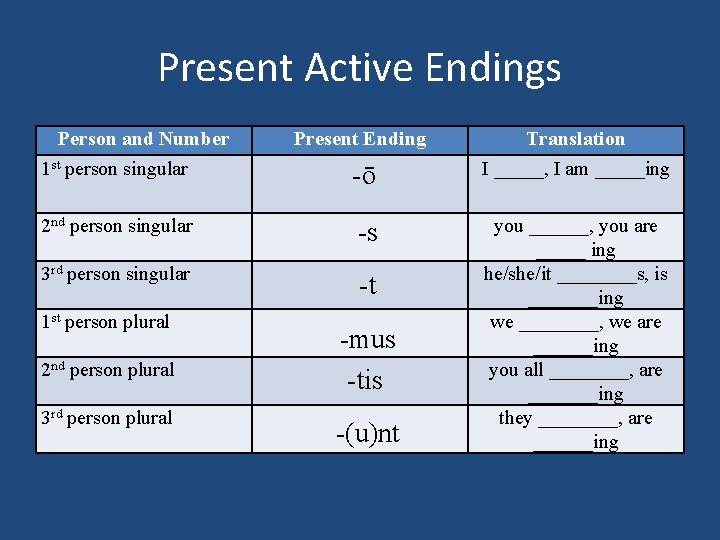
Present Active Endings Person and Number 1 st person singular Present Ending -ō 2 nd person singular -s 3 rd person singular -t 1 st person plural 2 nd person plural 3 rd person plural -mus -tis -(u)nt Translation I _____, I am _____ing you ______, you are _____ ing he/she/it ____s, is _______ing we ____, we are ______ing you all ____, are _______ing they ____, are ______ing
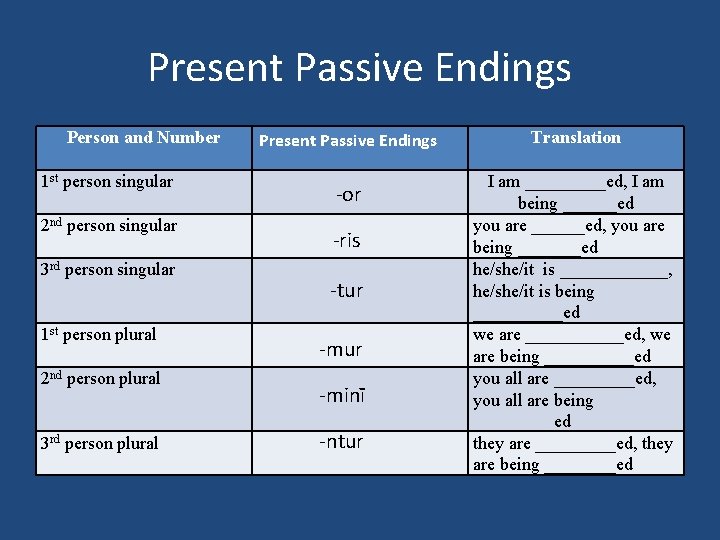
Present Passive Endings Person and Number 1 st person singular 2 nd person singular 3 rd person singular 1 st person plural 2 nd person plural 3 rd person plural Present Passive Endings Translation -or I am _____ed, I am being ______ed you are ______ed, you are being _______ed he/she/it is ______, he/she/it is being _____ed we are ______ed, we are being _____ed you all are _____ed, you all are being _____ed they are _____ed, they are being ____ed -ris -tur -minī -ntur
- Slides: 25