CORRELATION POWER ANALYSIS AGAINST AES Ali Shayei Mohammad
- Slides: 22
CORRELATION POWER ANALYSIS AGAINST AES Ali Shayei Mohammad Sadegh Alizadeh 1393
Outline Introduction • Power Analysis Attack • AES • Theoretical aspects of CPA • Practical aspects • Countermeasures • Comparison with DPA • References • 2
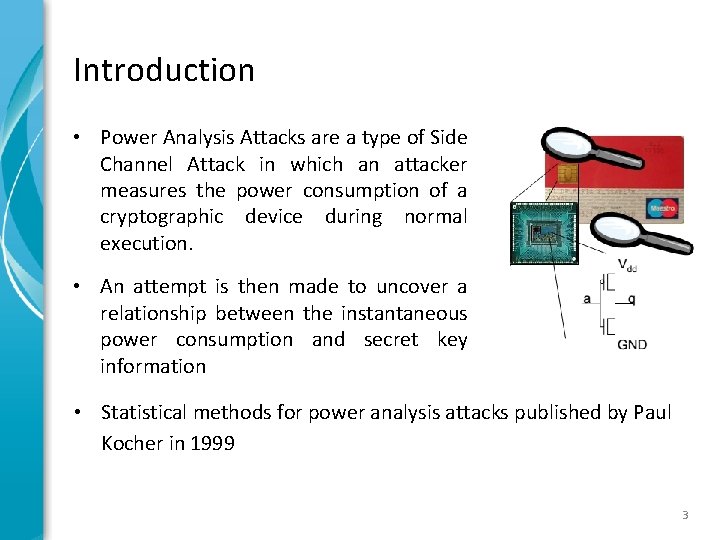
Introduction • Power Analysis Attacks are a type of Side Channel Attack in which an attacker measures the power consumption of a cryptographic device during normal execution. • An attempt is then made to uncover a relationship between the instantaneous power consumption and secret key information • Statistical methods for power analysis attacks published by Paul Kocher in 1999 3
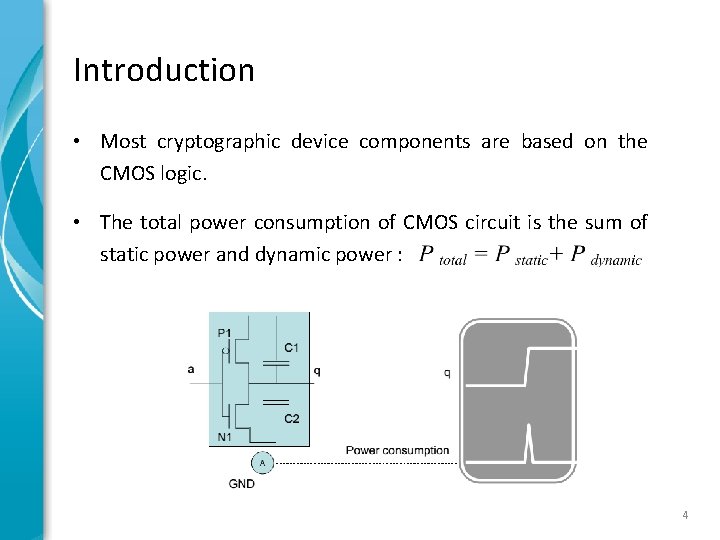
Introduction • Most cryptographic device components are based on the CMOS logic. • The total power consumption of CMOS circuit is the sum of static power and dynamic power : 4
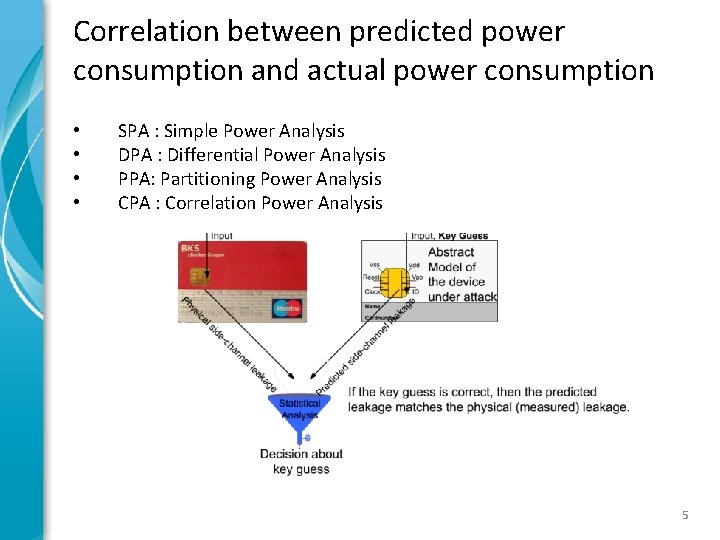
Correlation between predicted power consumption and actual power consumption • • SPA : Simple Power Analysis DPA : Differential Power Analysis PPA: Partitioning Power Analysis CPA : Correlation Power Analysis 5
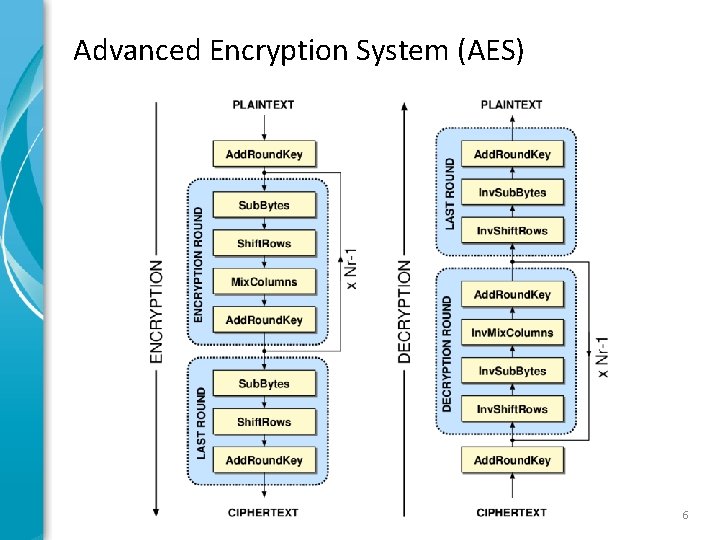
Advanced Encryption System (AES) 6
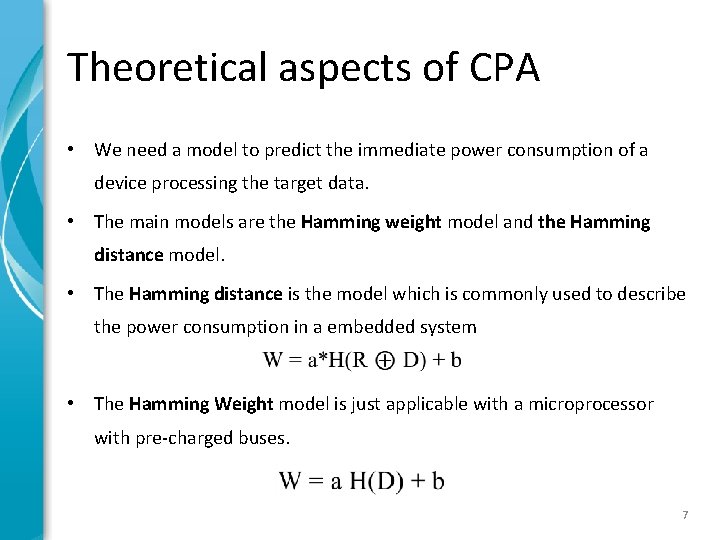
Theoretical aspects of CPA • We need a model to predict the immediate power consumption of a device processing the target data. • The main models are the Hamming weight model and the Hamming distance model. • The Hamming distance is the model which is commonly used to describe the power consumption in a embedded system • The Hamming Weight model is just applicable with a microprocessor with pre-charged buses. 7
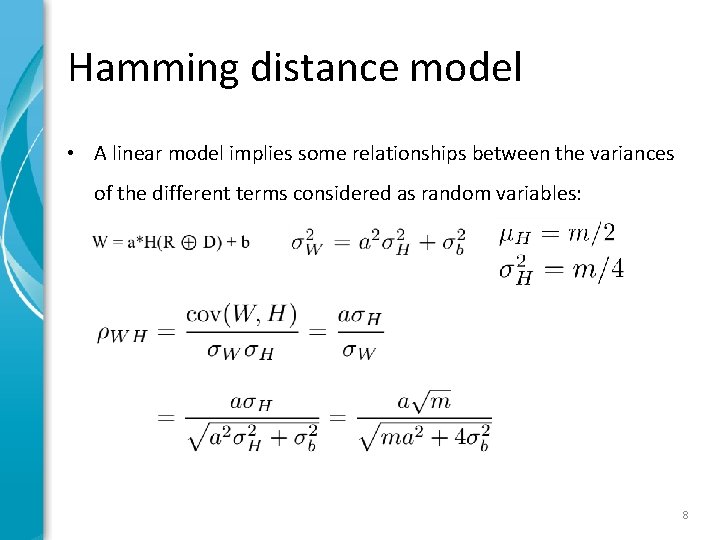
Hamming distance model • A linear model implies some relationships between the variances of the different terms considered as random variables: 8
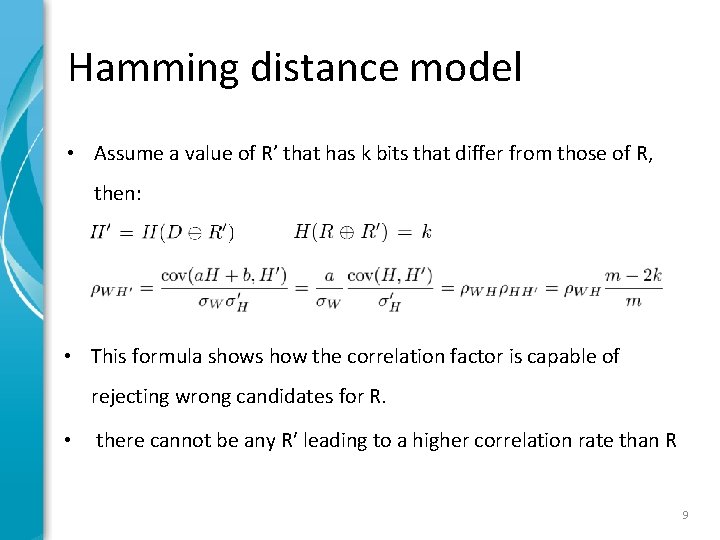
Hamming distance model • Assume a value of R’ that has k bits that differ from those of R, then: • This formula shows how the correlation factor is capable of rejecting wrong candidates for R. • there cannot be any R′ leading to a higher correlation rate than R 9
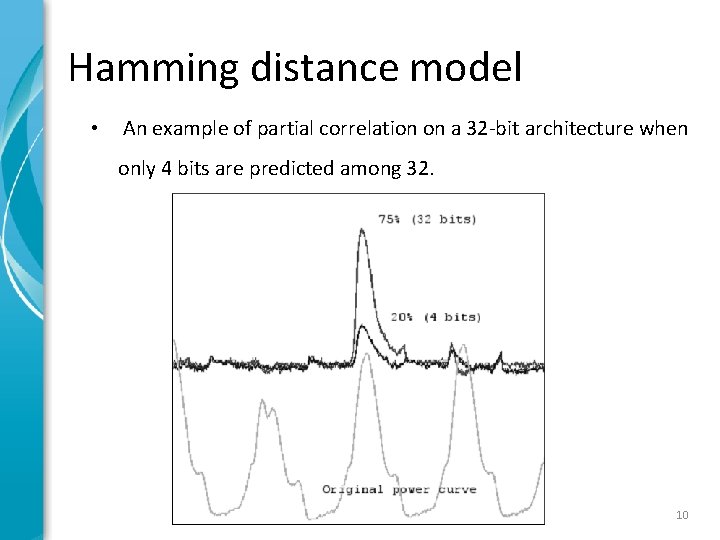
Hamming distance model • An example of partial correlation on a 32 -bit architecture when only 4 bits are predicted among 32. 10
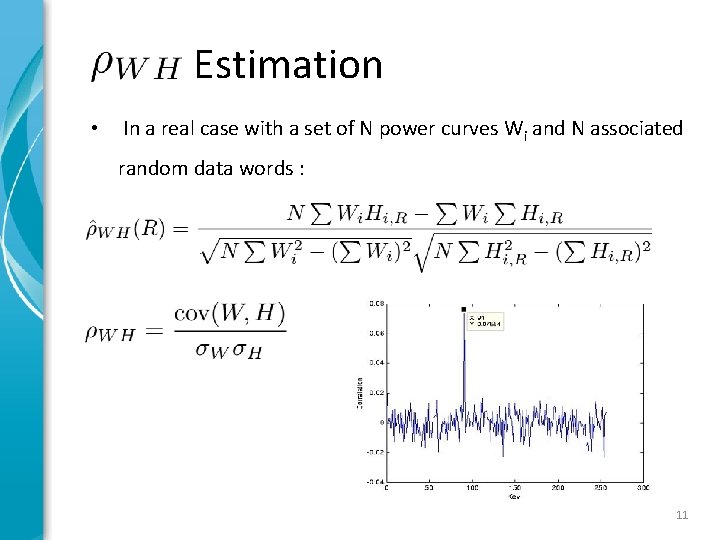
Estimation • In a real case with a set of N power curves Wi and N associated random data words : 11
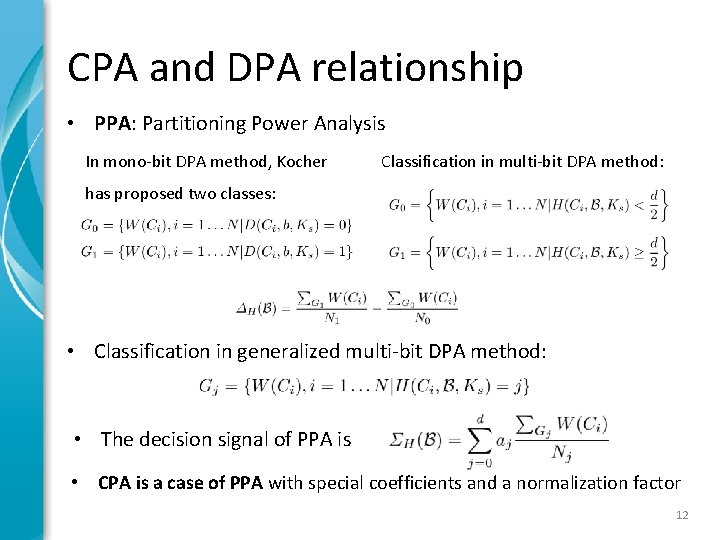
CPA and DPA relationship • PPA: Partitioning Power Analysis In mono-bit DPA method, Kocher Classification in multi-bit DPA method: has proposed two classes: • Classification in generalized multi-bit DPA method: • The decision signal of PPA is • CPA is a case of PPA with special coefficients and a normalization factor 12
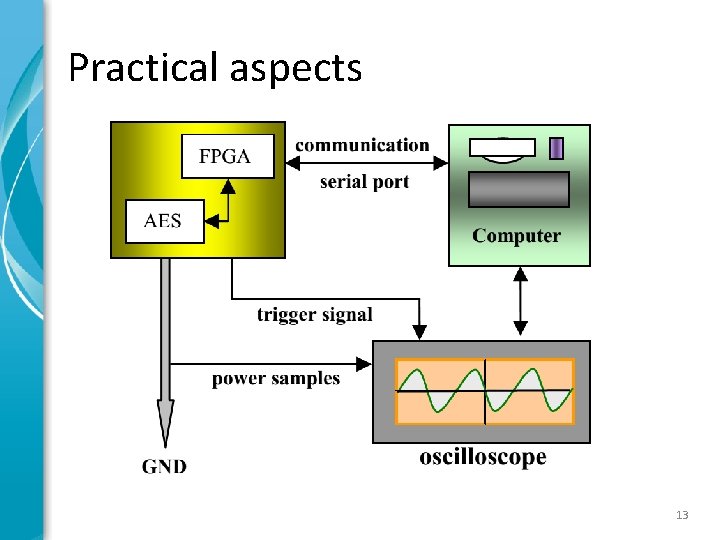
Practical aspects 13
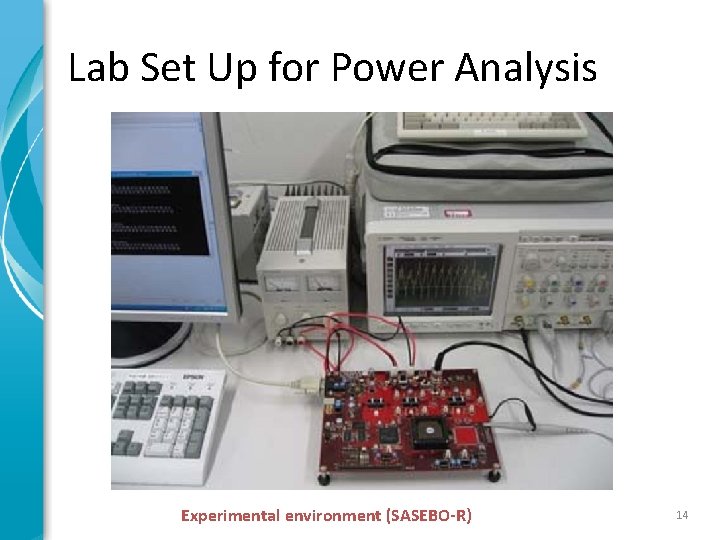
Lab Set Up for Power Analysis Experimental environment (SASEBO-R) 14
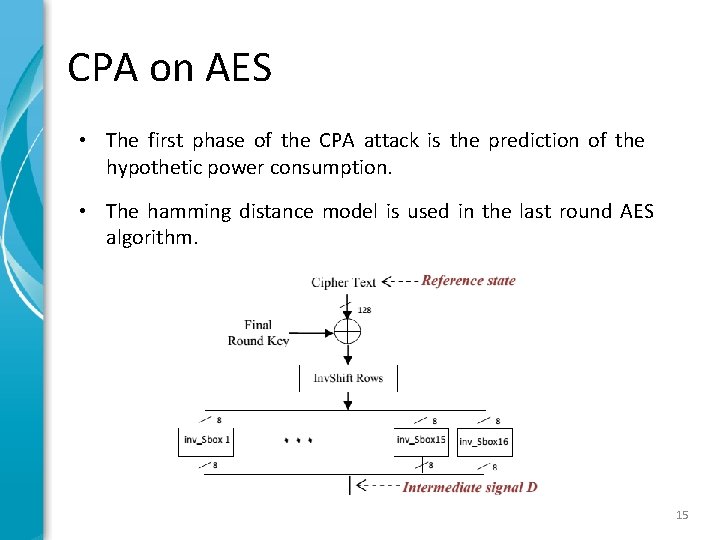
CPA on AES • The first phase of the CPA attack is the prediction of the hypothetic power consumption. • The hamming distance model is used in the last round AES algorithm. 15
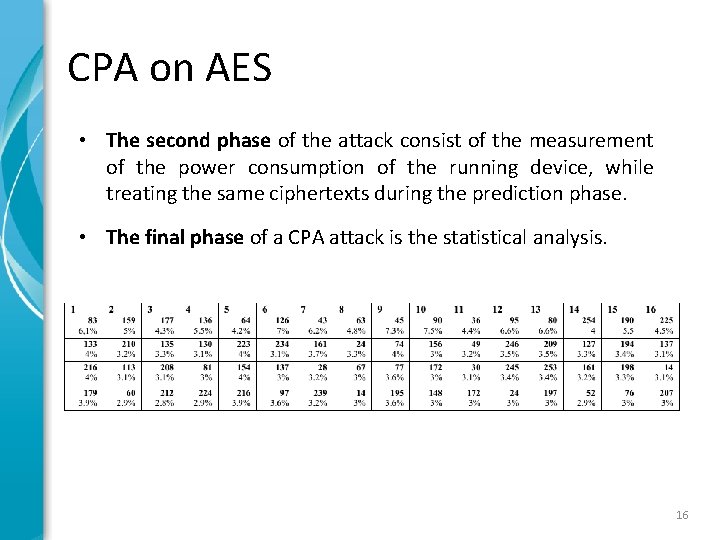
CPA on AES • The second phase of the attack consist of the measurement of the power consumption of the running device, while treating the same ciphertexts during the prediction phase. • The final phase of a CPA attack is the statistical analysis. 16
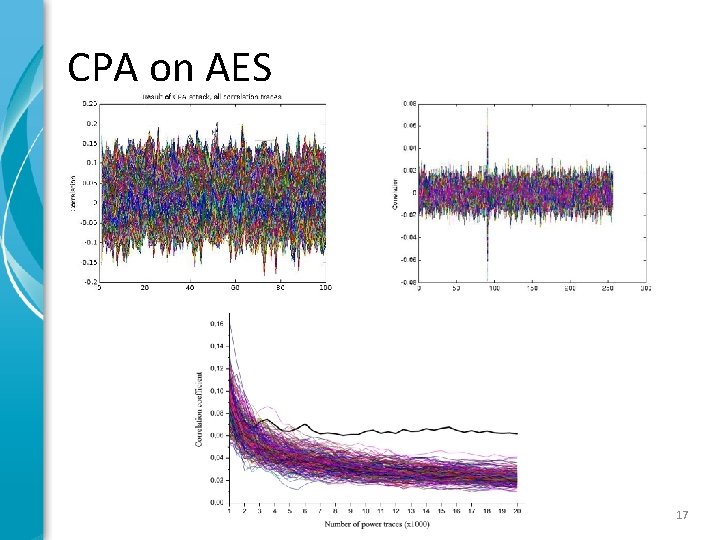
CPA on AES 17
CPA Counter-measures • There are different kinds of countermeasures which are completely similar to those designed against DPA: • introducing de-synchronization in the execution of the process so that the curves are not aligned anymore within a same acquisition set. e. g. fake cycles, insertion, unstable clocking or random delays • blurring the power traces with additional noise or filtering circuitry • The data can also be ciphered dynamically during a process 18
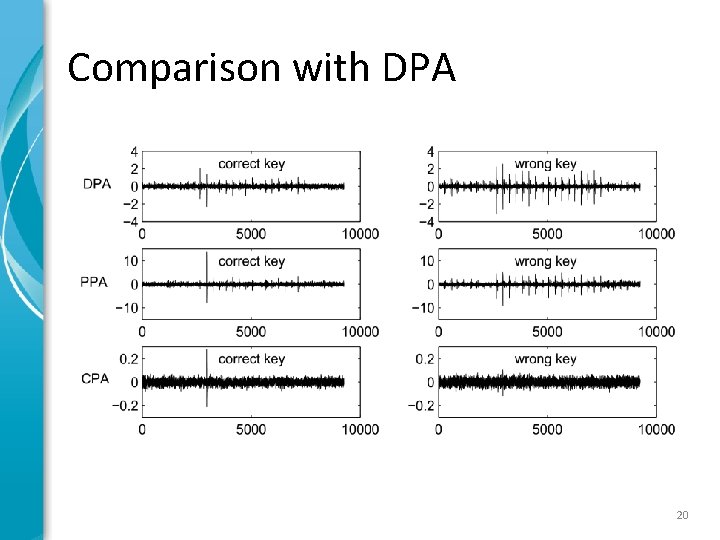
Comparison with DPA • DPA attack works quite well only if the following assumptions are fulfilled: • Word space assumption: within the word hosting the predicted bit, the contribution of the non-targeted bits is independent of the targeted bit value. • Guess space assumption: the predicted value of the targeted bit for any wrong sub-key guess does not depend on the value associated to the correct guess. • Time space assumption: the power consumption W does not depend on the value of the targeted bit except when it is explicitly handled. 19
Comparison with DPA 20
References • Brier, E. , Clavier, C. , Olivier, F. : Correlation Power Analysis with a Leakage Model. In: Joye, M. , Quisquater, J. -J. (eds. ) CHES 2004. LNCS, vol. 3156, pp. 16– 29. Springer, Heidelberg(2004) • E. Brier, C. Clavier, and F. Olivier. Optimal statistical power analysis. http: //eprint. iacr. org/2003/152/ • Noura Benhadjyoussef, Hassen Mestiri, Mohsen Machhout, Rached Tourki, “Implementation of CPA analysis against AES design on FPGA” • Hongying Liu, Satoshi Goto, Yukiyasu Tsunoo, “Correlation Power Analysis with Companding Methods” • Thanh-Ha Le, Jessy Clediµ ere , Cecile Canovas , “A proposition for Correlation Power Analysis enhancement” 21
THANKS FOR YOUR ATTENTION 22