Cook Levin HAM NPcompleteness 3 SAT CLIQUE 1
- Slides: 44
Cook. Levin HAM NPcompleteness 3 SAT CLIQUE 1
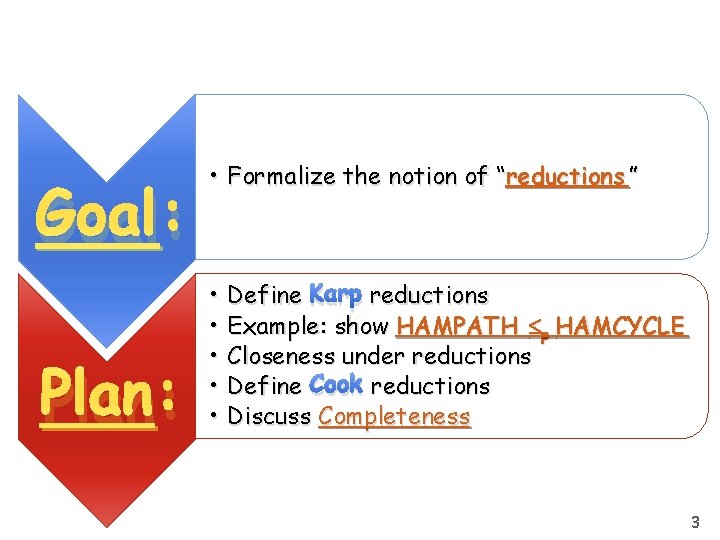
Reductions Or • How to link between problems’ complexity, while not knowing what they are 2
Goal: Plan: • Formalize the notion of “reductions ” • Define Karp reductions • Example: show HAMPATH p HAMCYCLE • Closeness under reductions • Define Cook reductions • Discuss Completeness 3
Reductions an efficient procedure for A using A cannot be an efficient procedure for B • In other words: B is at least as hard as A Notation A radically harder than B ≤p B 4
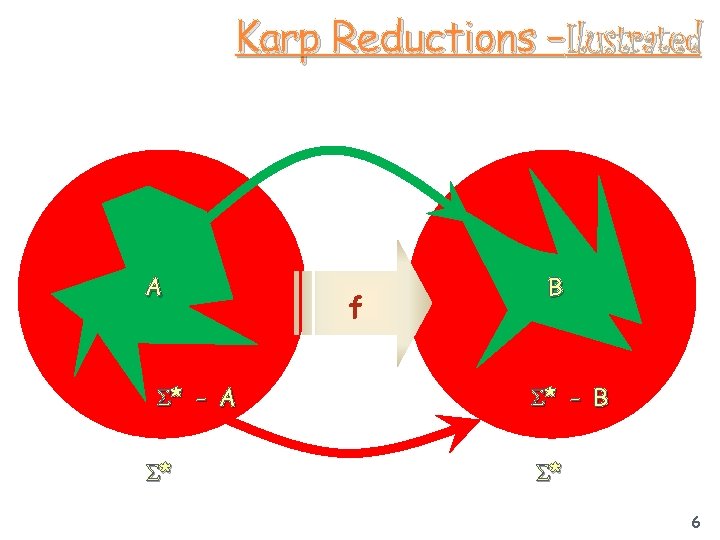
SIP 250 Karp reductions –Definition A is polynomial-time reducible to B (denote A p B)) If there exists a s. t. for every w poly-time-computable function f: * * e TM m i t y l o p i. e. , on ) w ( f s t u p that out input w w A f(w) B f is a poly-time reduction of A to B 5
Karp Reductions –Ilustrated A * - A * f B * - B * 6
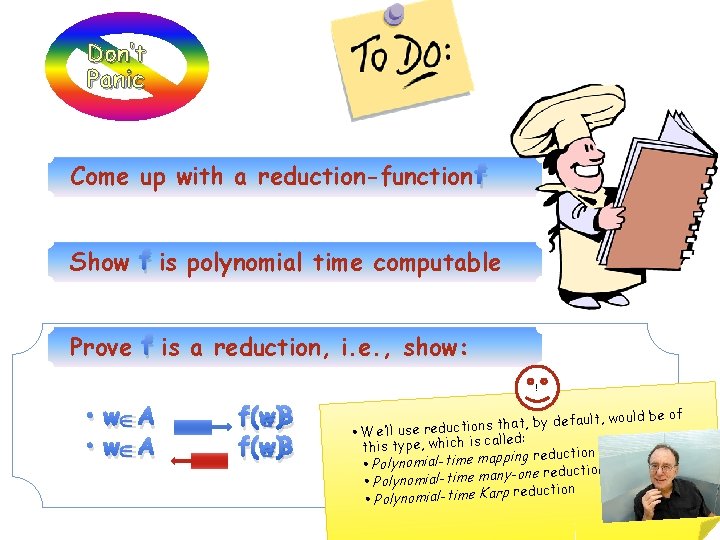
Don’t Panic Come up with a reduction-function f Show f is polynomial time computable Prove f is a reduction, i. e. , show: ! • w A B f(w) ould that, by default, w ns io ct du re e us ll • We’ called: this type, which is ping reduction • Polynomial-time map y-one reduction • Polynomial-time man rp reduction • Polynomial-time Ka be of 7
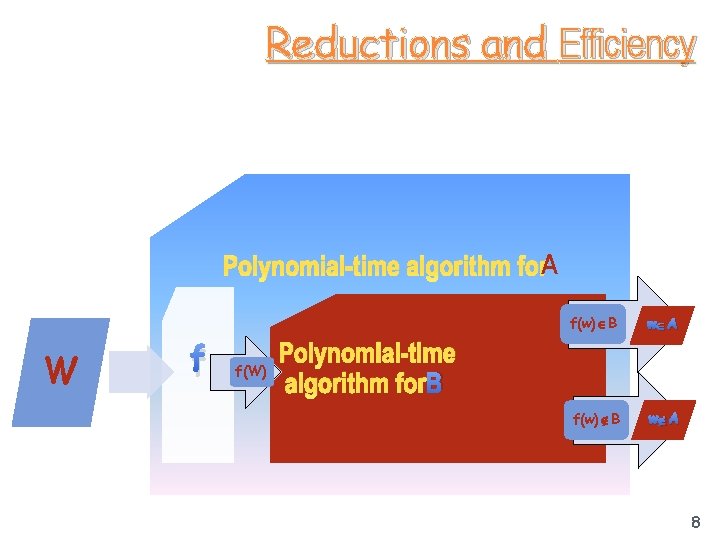
Reductions and Efficiency Polynomial-time algorithm for. A W f f(W) f(w) B w A Polynomial-time algorithm for. B 8
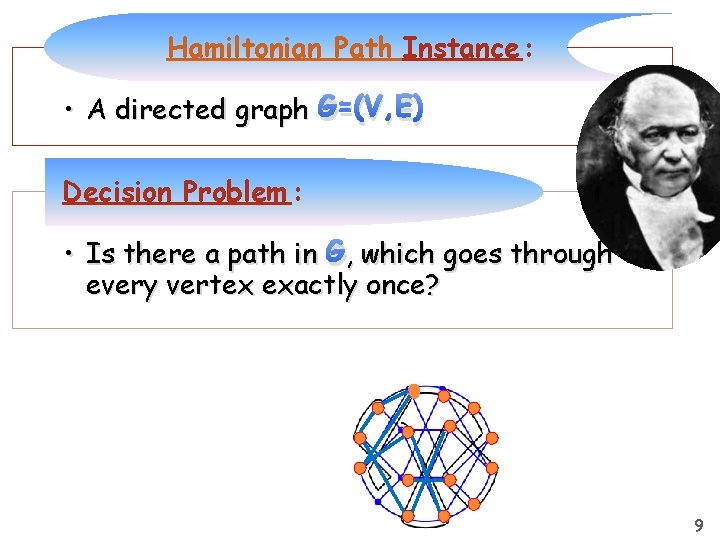
Hamiltonian Path Instance : • A directed graph G=(V, E) Decision Problem : • Is there a path in G, , which goes through every vertex exactly once? 9
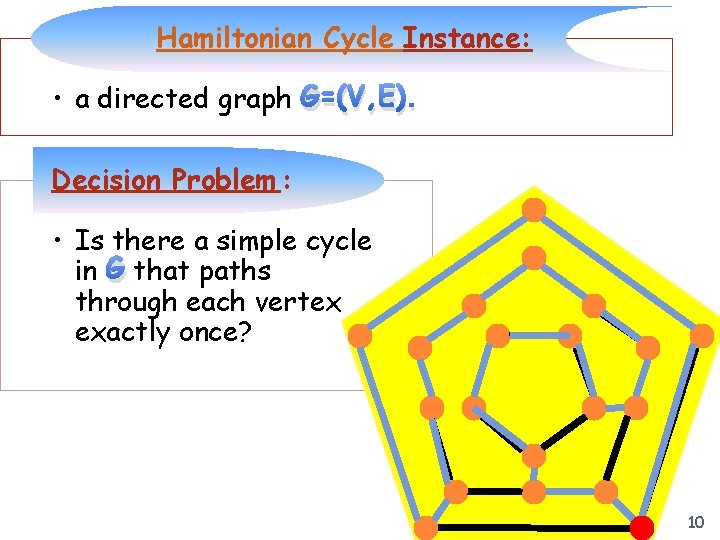
Hamiltonian Cycle Instance: • a directed graph G=(V, E). Decision Problem : • Is there a simple cycle in G that paths through each vertex exactly once? 10
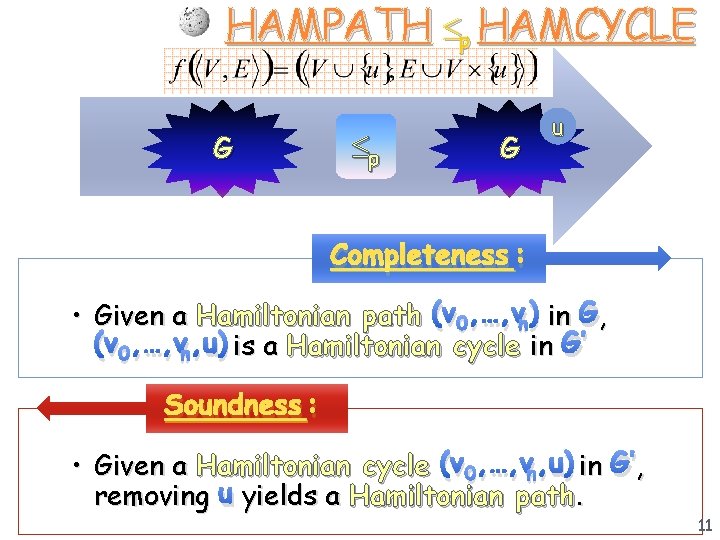
HAMPATH p HAMCYCLE G p G u Completeness : • Given a Hamiltonian path (v 0, …, vn) in G, , (v 0 , …, vn , u) is a Hamiltonian cycle in G’ Soundness : • Given a Hamiltonian cycle (v 0, …, vn, u) in G’, , removing u yields a Hamiltonian path. 11
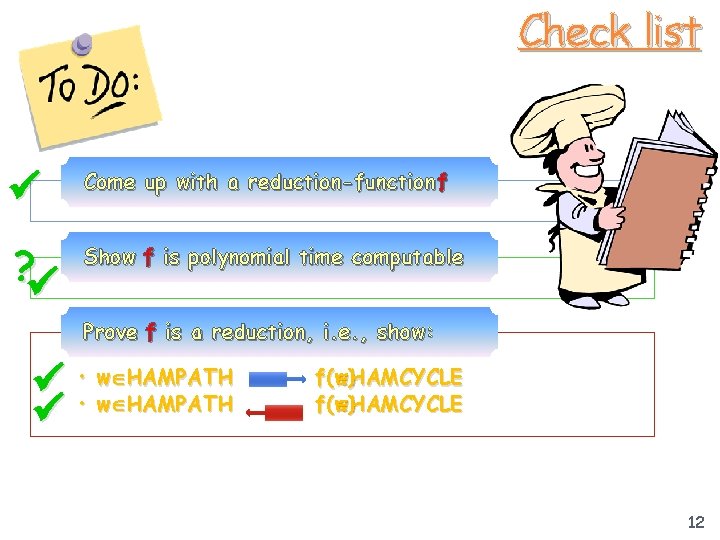
Check list Come up with a reduction-function f ? Show f is polynomial time computable Prove f is a reduction, i. e. , show: • w HAMPATH f(w) HAMCYCLE 12
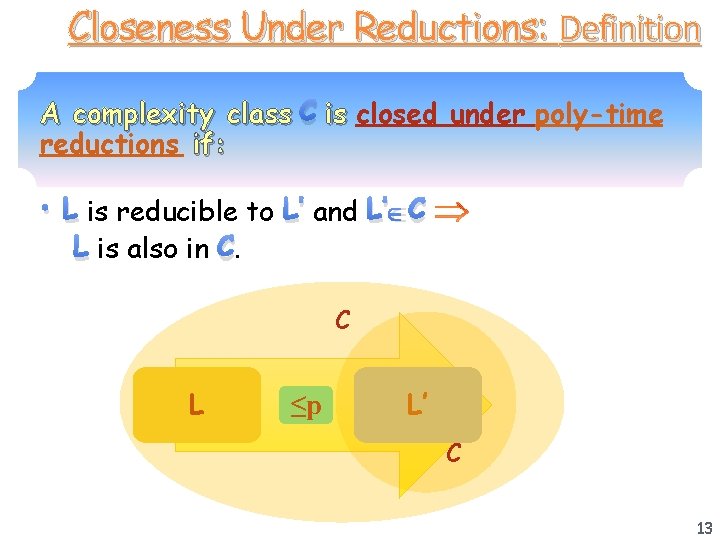
Closeness Under Reductions: Definition A complexity class C is closed under poly-time reductions if: • L is reducible to L’ and L’ C L is also in C. C L ≤p L’ C 13
Observation Theorem : NP PSPACE and EXPTIME are • P, NP, closed under polynomial-time Karp reductions Proof: • Do it yourself !! 14
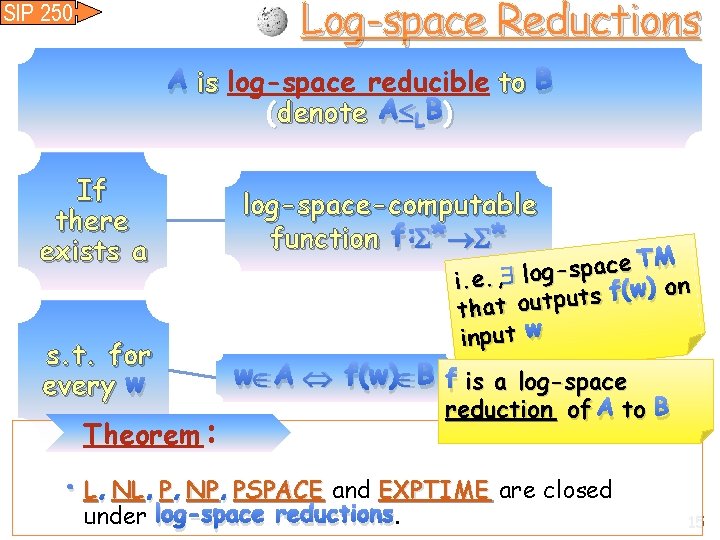
Log-space Reductions SIP 250 A is log-space reducible to B (denote A L B)) If there exists a log-space-computable function f: * * s. t. for every w w A f(w) B f is a log-space Theorem : e TM c a p s g o l i. e. , on ) w ( f s t u p that out input w reduction of A to B • L , NL , P , NP , PSPACE and EXPTIME are closed under log-space reductions. 15
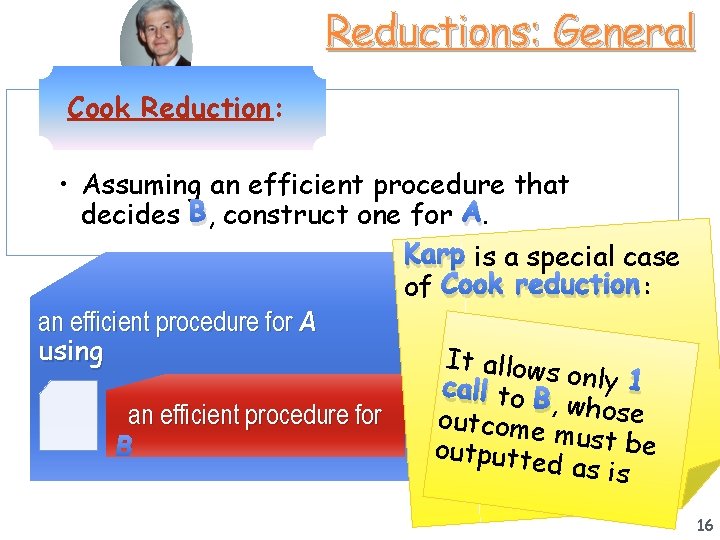
Reductions: General Cook Reduction: • Assuming an efficient procedure that decides B, construct one for A. Karp is a special case of Cook reduction : an efficient procedure for A using It allows only 1 call to B, w an efficient procedure for outcome hose must be B outputte d as is 16
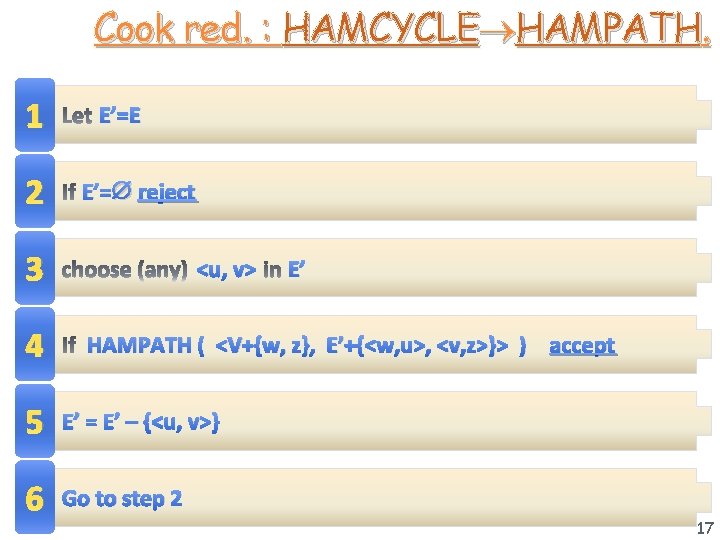
Cook red. : HAMCYCLE HAMPATH. 1 2 E’=E E’= reject 3 4 <u, v> E’ HAMPATH ( <V+{w, z}, E’+{<w, u>, <v, z>}> ) accept 5 • E’ = E’ – {<u, v>} 6 • Go to step 2 17
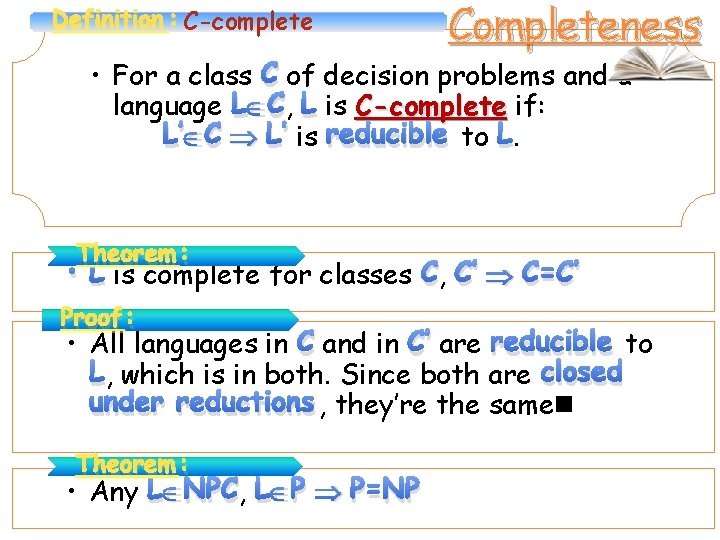
Definition : C-complete Completeness • For a class C of decision problems and a language L C, L is C-complete if: L’ C L’ is reducible to L. Theorem : • L is complete for classes C, C’ C=C’ Proof: • All languages in C and in C’ are reducible to L, which is in both. Since both are closed under reductions , they’re the same Theorem : • Any L NPC, L P P=NP
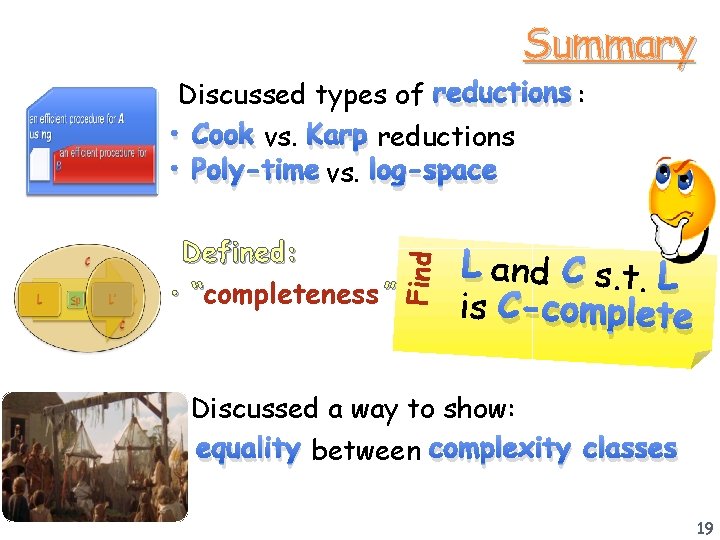
Summary Discussed types of reductions : • Cook vs. Karp reductions • Poly-time vs. log-space Find Defined: • “completeness ” L and C s. t. L is C-complete Discussed a way to show: • equality between complexity classes 19
The Cook/ Levin theorem: SAT is NP-Complete: 20
Goal: Plan: • In the beginning… of NP-Completeness • SAT - definition and examples • The Cook-Levin Theorem • Look ahead 21
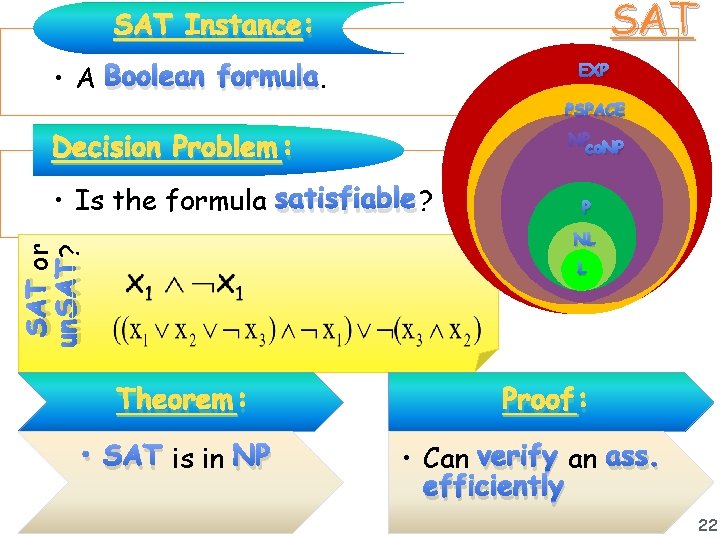
SAT Instance: • A Boolean formula. EXP PSPACE Decision Problem : NPco. NP • Is the formula satisfiable ? P SAT or un SAT? NL L Theorem : • SAT is in NP Proof: • Can verify an ass. efficiently 22
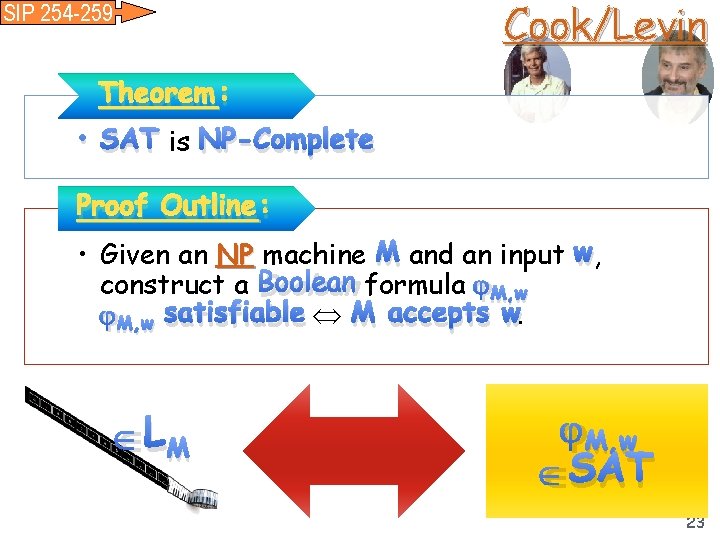
Cook/Levin SIP 254 -259 Theorem : • SAT is NP-Complete Proof Outline: • Given an NP machine M and an input w, construct a Boolean formula M, w satisfiable M accepts w. LM M, w SAT 23
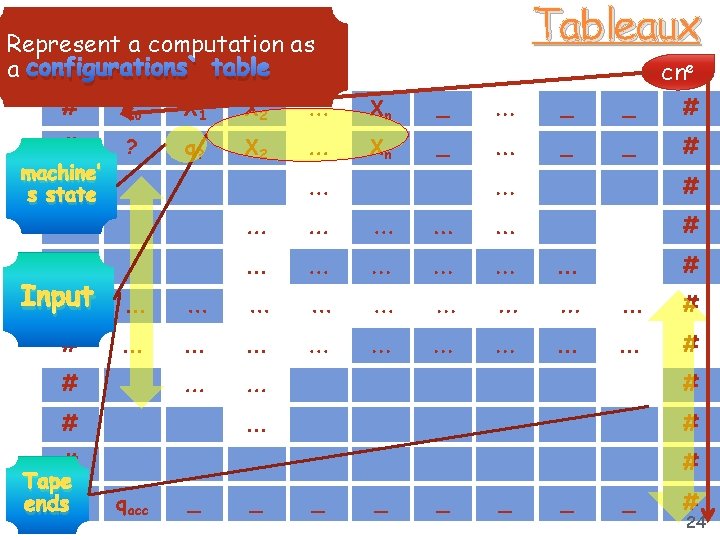
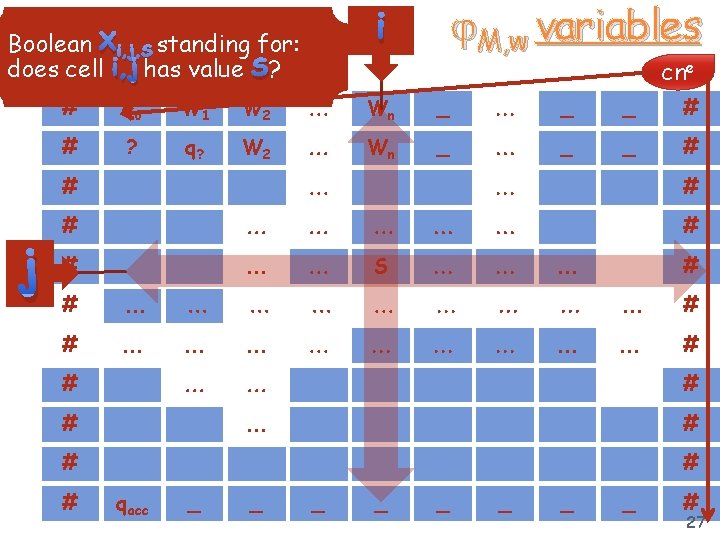
Tableaux Represent a computation as a configurations` table # # machine’ # s state # q 0 X 1 X 2 Xn _ _ _ # ? q? X 2 Xn _ _ _ # # Input # # cne # # # # # # Tape ends# # qacc _ _ _ _ # 24
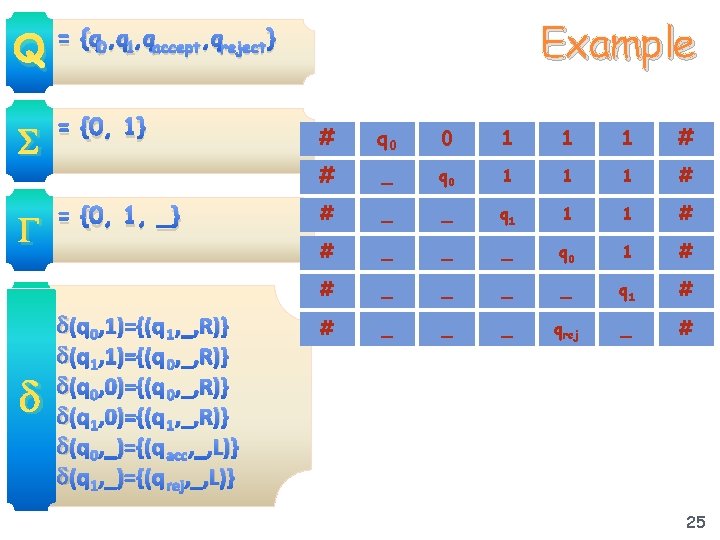
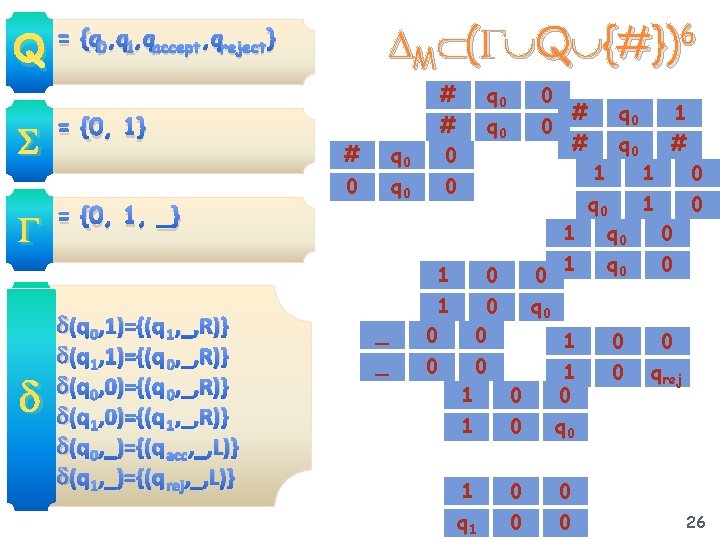
M ( Q {#})6 • = {q 0, q 1, qaccept , qreject } Q • = {0, 1} # q 0 0 # q 0 # 0 0 q 0 0 • = {0, 1, _} q 0 1 # q 0 # 1 • (q 0, 1)={(q 1, _, R)} • (q 1, 1)={(q 0, _, R)} • (q 0, 0)={(q 0, _, R)} • (q 1, 0)={(q 1, _, R)} • (q 0, _)={(q acc , _, L)} • (q 1, _)={(q rej , _, L)} # 1 1 0 0 _ 1 0 0 0 q 0 _ 0 0 q 0 1 0 q 0 0 1 0 0 0 qrej 1 0 1 0 q 0 1 0 0 q 1 0 0 26
cne # q 0 W 1 W 2 Wn _ _ _ # # ? q? W 2 Wn _ _ _ # # j M, w variables i Boolean Xi, j, S standing for: does cell i, j has value S? # # # S # # # # # # # qacc _ _ _ _ # 27
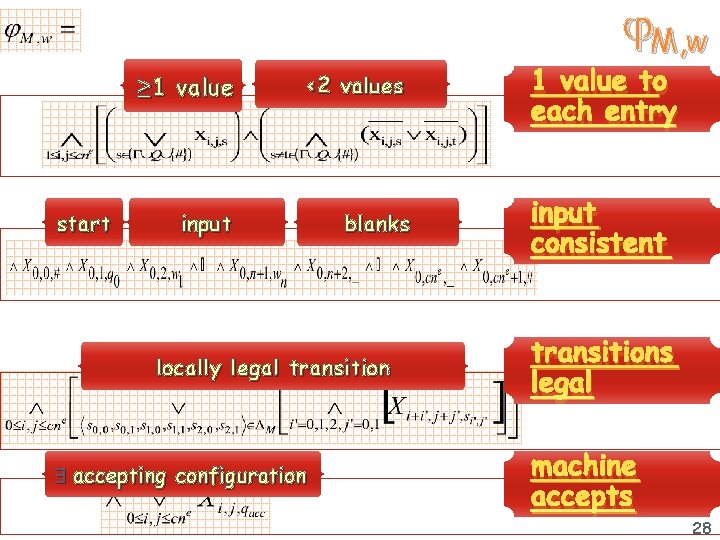
M, w start ≥ 1 value <2 values input blanks locally legal transition accepting configuration 1 value to each entry input consistent transitions legal machine accepts 28
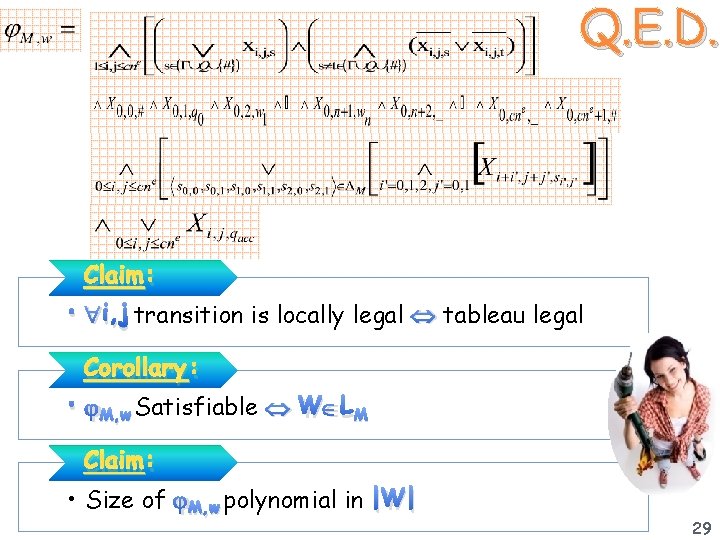
Q. E. D. Claim: • i, j transition is locally legal tableau legal Corollary: • M, w Satisfiable W LM Claim: • Size of M, w polynomial in |W| 29
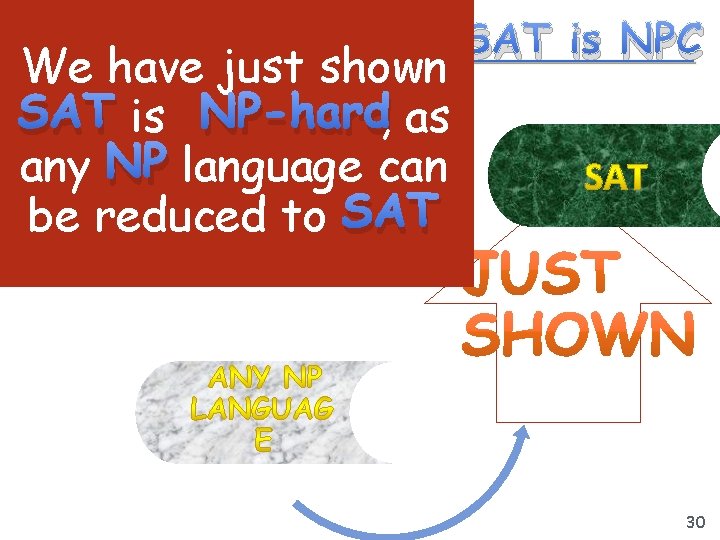
We have just shown SAT is NP-hard, as any NP language can be reduced to SAT is NPC 30
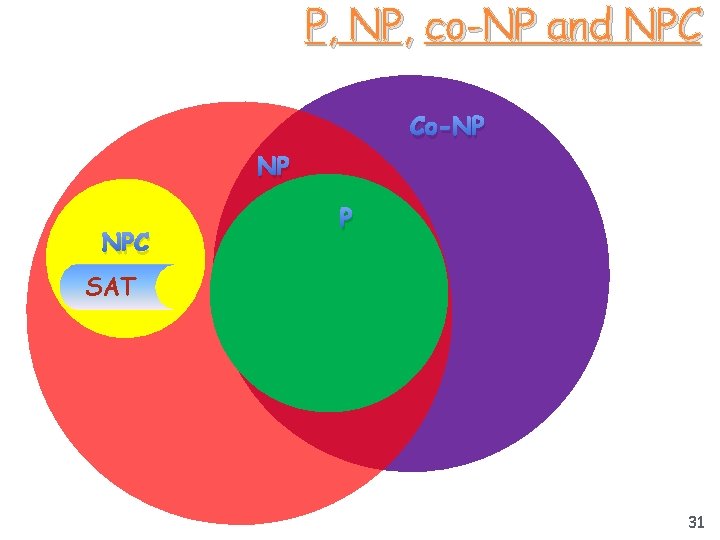
P, NP, co-NP and NPC Co-NP NP NPC P SAT 31
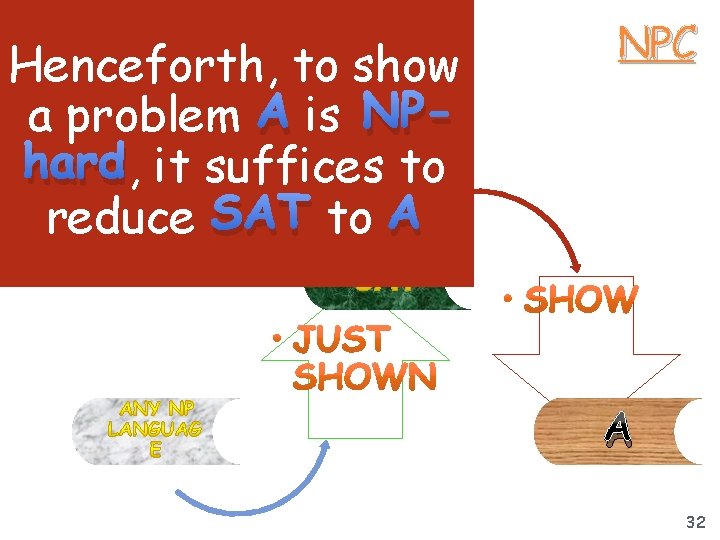
Henceforth, to show a problem A is NPhard, it suffices to reduce SAT to A NPC A 32
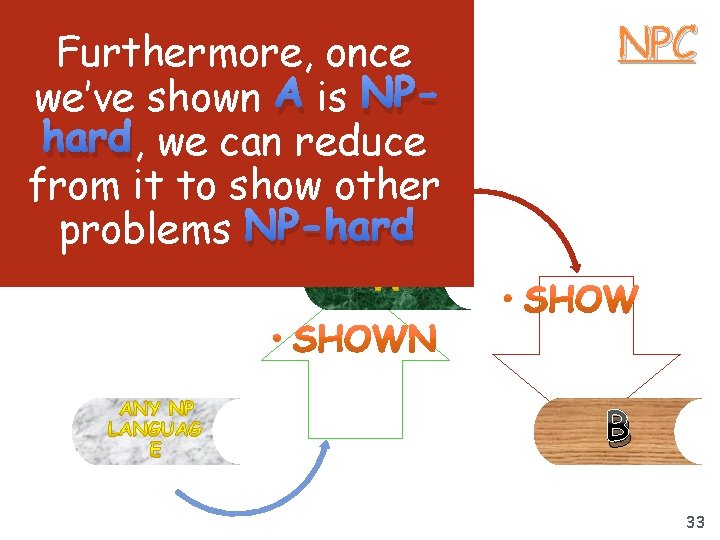
Furthermore, once we’ve shown A is NPhard, we can reduce from it to show other problems NP-hard NPC B 33
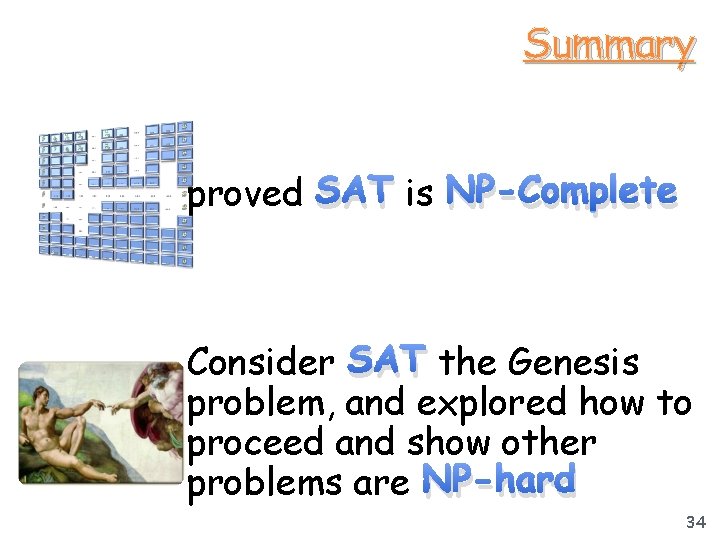
Summary proved SAT is NP-Complete Consider SAT the Genesis problem, and explored how to proceed and show other problems are NP-hard 34
Goal: Plan: • introduce some additional NP -Complete problems. • 3 SAT • CLIQUE & INDEPENDENTSET 35
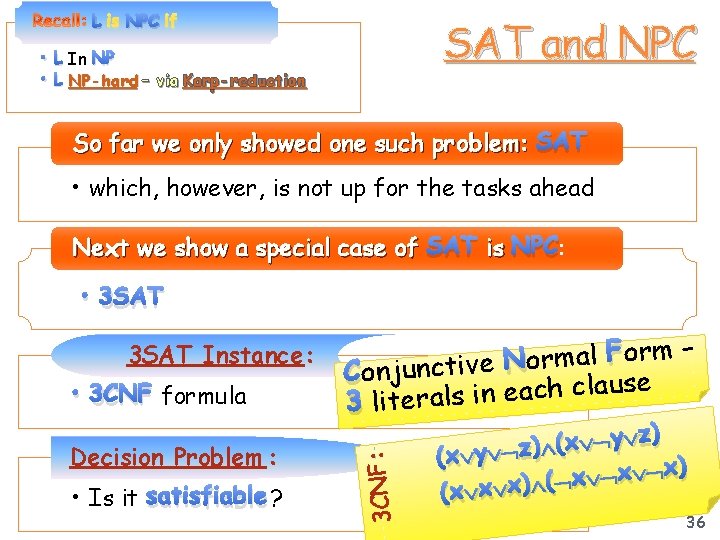
L is NPC if SAT and NPC • L In NP • L NP-hard – via Karp-reduction So far we only showed one such problem: SAT • which, however, is not up for the tasks ahead Next we show a special case of SAT is NPC: • 3 SAT • 3 CNF formula Decision Problem : • Is it satisfiable ? – m r o l F a m r o Conjunctive N h clause ac e n i s l a r e t i l 3 3 CNF: 3 SAT Instance: y z) x ( ) z (x y x) x x (x x x) ( 36
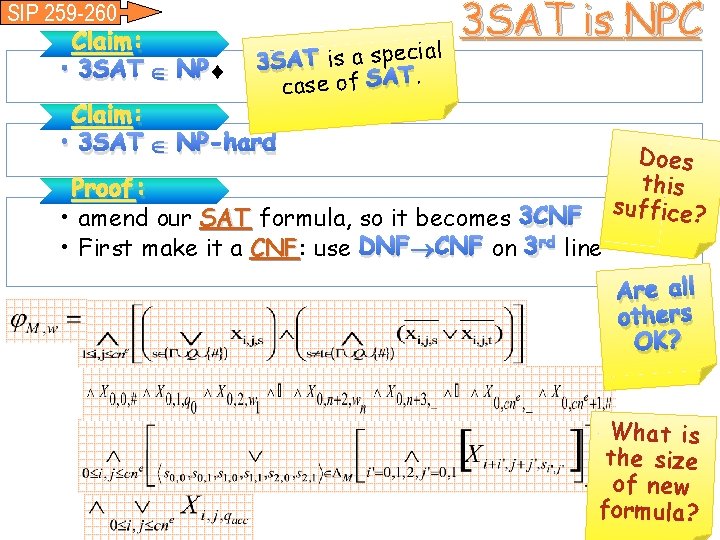
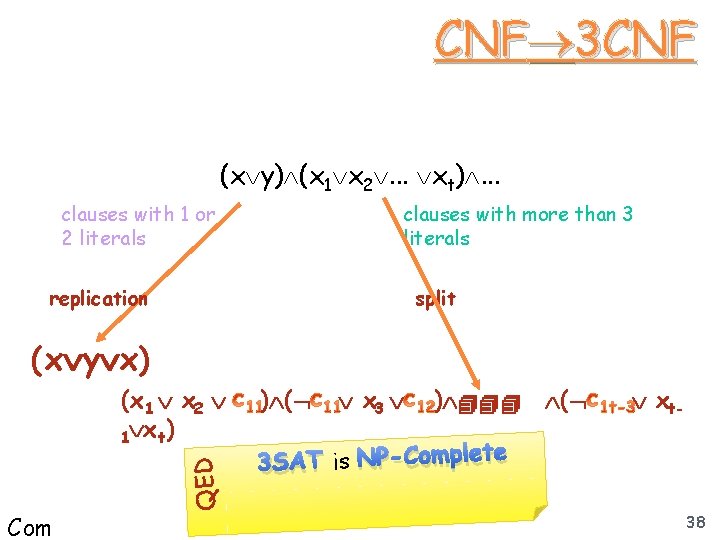
SIP 259 -260 Claim: • 3 SAT NP cial e p s a s i T A 3 S case of SAT. 3 SAT is NPC Claim: • 3 SAT NP-hard Proof: • amend our SAT formula, so it becomes 3 CNF • First make it a CNF: CNF use DNF CNF on 3 rd line Does this suffice? Are all others OK? What is the size of new formula? 37
CNF 3 CNF (x y) (x 1 x 2. . . xt). . . clauses with 1 or 2 literals clauses with more than 3 literals replication split (x y x) Com QED (x 1 x 2 1 x t) ) ( x 3 ). . . ( xt- 3 SAT is NP-Complete 38
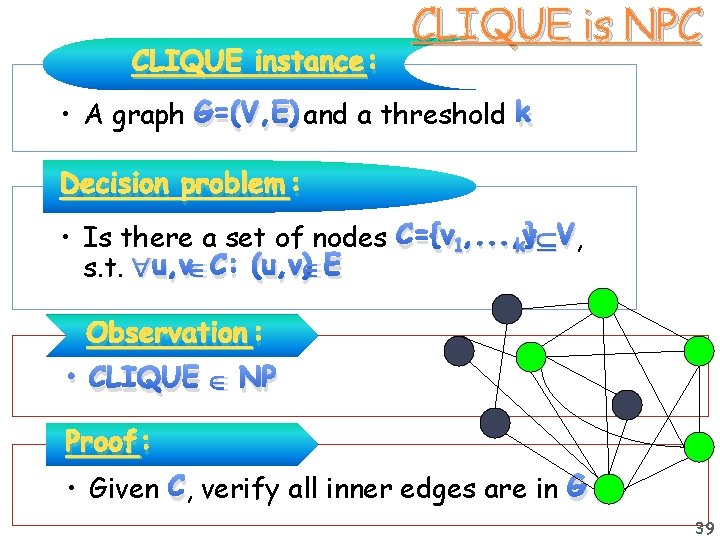
CLIQUE instance: CLIQUE is NPC • A graph G=(V, E) and a threshold k Decision problem : • Is there a set of nodes C={v 1, . . . , v k } V, s. t. u, v C: (u, v) E Observation : • CLIQUE NP Proof: • Given C, verify all inner edges are in G 39
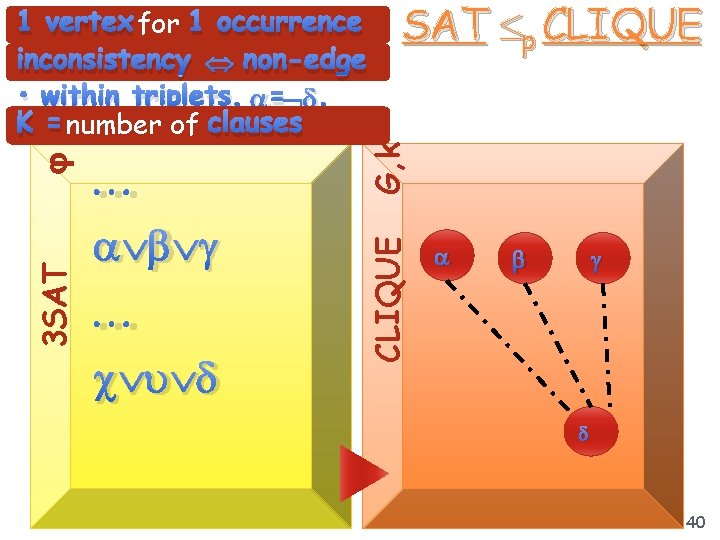
G, k SAT p CLIQUE 3 SAT 1 vertex for 1 occurrence inconsistency non-edge • within triplets. = . K = number of clauses 40
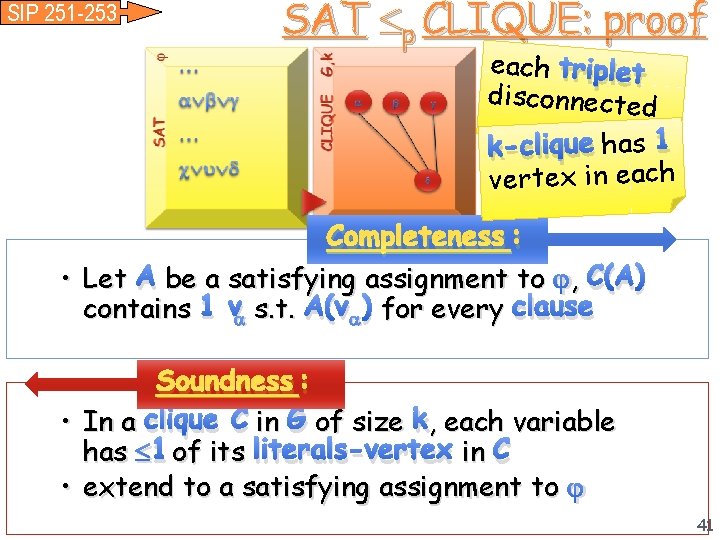
SIP 251 -253 SAT p CLIQUE: proof each triplet disconnected k-clique has 1 vertex in each Completeness : • Let A be a satisfying assignment to , , C(A) contains 1 v s. t. A(v ) for every clause Soundness : • In a clique C in G of size k, , each variable has 1 of its literals-vertex in C • extend to a satisfying assignment to 41
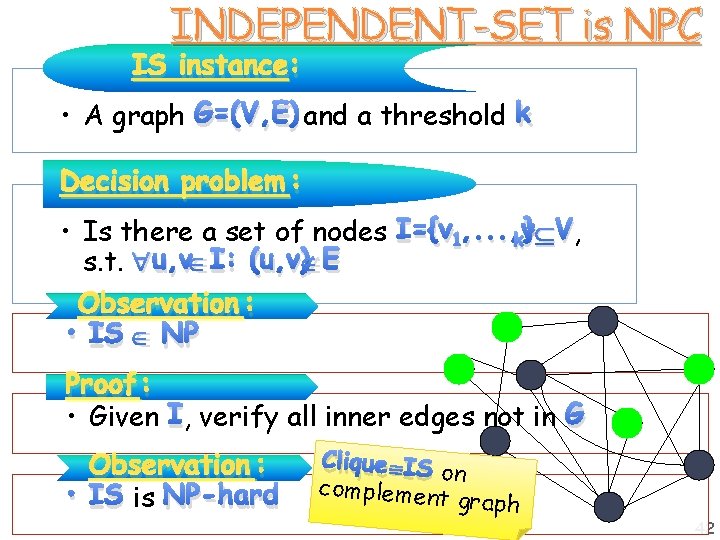
INDEPENDENT-SET is NPC IS instance: • A graph G=(V, E) and a threshold k Decision problem : • Is there a set of nodes I={v 1, . . . , v k } V, s. t. u, v I: (u, v) E Observation : • IS NP Proof: • Given I, verify all inner edges not in G Observation : • IS is NP-hard Clique IS on complement gr aph 42
Reductions Hamiltonian Path Polynomial Time Reductions Completeness Log Space Reductions Completeness WWindex Hamilton, William Rowan Karp, Richard Complexity Classes NP co-NP Levin, Leonid P L EXPTIME Cook, Stephen Arthur NL PSPACE 43
SAT Cook-Levin Theorem 3 SAT Cook-Levin Theorem Clique Independent Set Subset Sum CNF NPC NP Hard WWindex 44