Comparing CMMI and OPM 3 Pat Wegerson 02
- Slides: 25
Comparing CMMI® and OPM 3® Pat Wegerson 02 April 2009 CMMI® is a Registered Trademark of the Software Engineering Institute OPM 3® is a Registered Trademark of the Project Management Institute 02 April 2009
Agenda Introduction n OPM 3 Review n CMMI Review n Similarities of CMMI and OPM 3 n Differences of CMMI and OPM 3 n Summary n 02 April 2009 2
Introduction “Best Practice” models describe an “ideal” organization and its operation n Best Practice models useful for: n ¨ Information / Knowledge ¨ Appraisal / Assessment ¨ Improvement Guide n “All models are wrong, but some are useful. ” - George Box 02 April 2009 3
Introduction -2 n Parent of ‘maturity models’ – Philip Crosby ¨ Wrote “Quality is Free” in 1979 n Crosby’s Quality Management Maturity Grid: ¨ Uncertainty ¨ Awakening ¨ Enlightenment ¨ Wisdom ¨ Certainty 02 April 2009 4
OPM 3 Review Organizational Project Management Maturity Model (OPM 3) n First released in 2003 n Built upon Project Management Body of Knowledge (PMBOK®) n ¨ Standards first released 1987 ¨ Guide first released 1996 02 April 2009 5
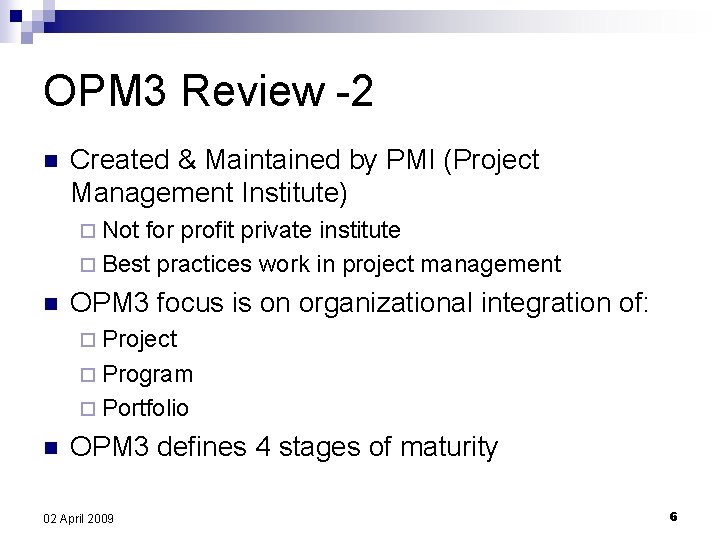
OPM 3 Review -2 n Created & Maintained by PMI (Project Management Institute) ¨ Not for profit private institute ¨ Best practices work in project management n OPM 3 focus is on organizational integration of: ¨ Project ¨ Program ¨ Portfolio n OPM 3 defines 4 stages of maturity 02 April 2009 6
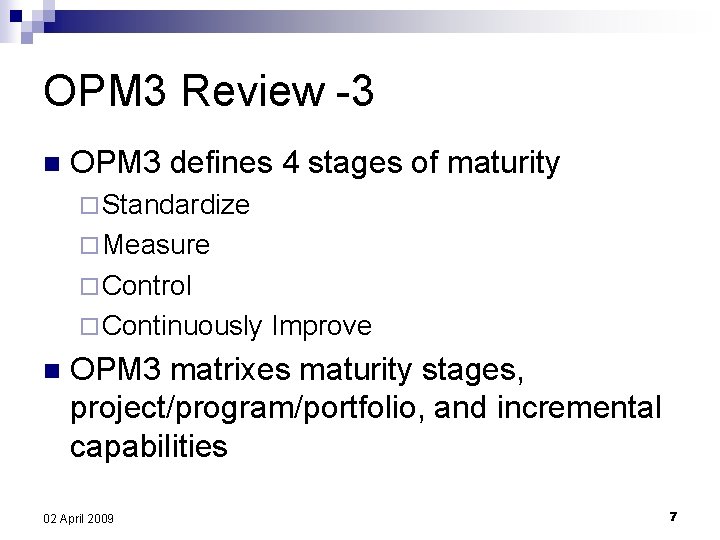
OPM 3 Review -3 n OPM 3 defines 4 stages of maturity ¨ Standardize ¨ Measure ¨ Control ¨ Continuously Improve n OPM 3 matrixes maturity stages, project/program/portfolio, and incremental capabilities 02 April 2009 7
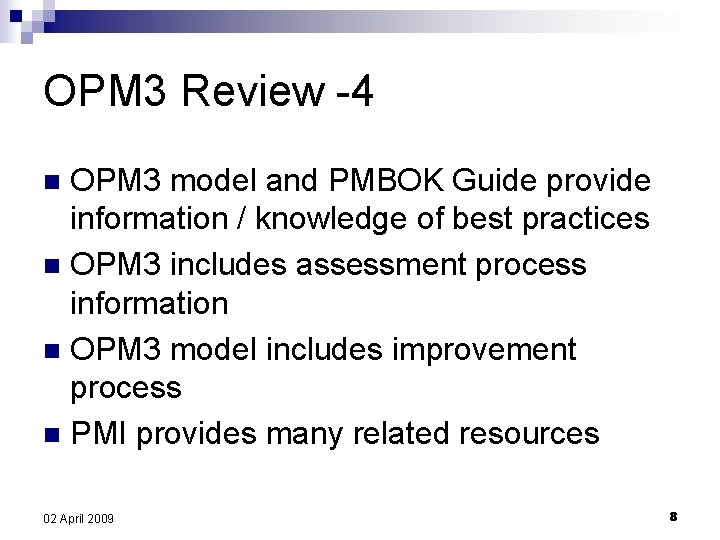
OPM 3 Review -4 OPM 3 model and PMBOK Guide provide information / knowledge of best practices n OPM 3 includes assessment process information n OPM 3 model includes improvement process n PMI provides many related resources n 02 April 2009 8
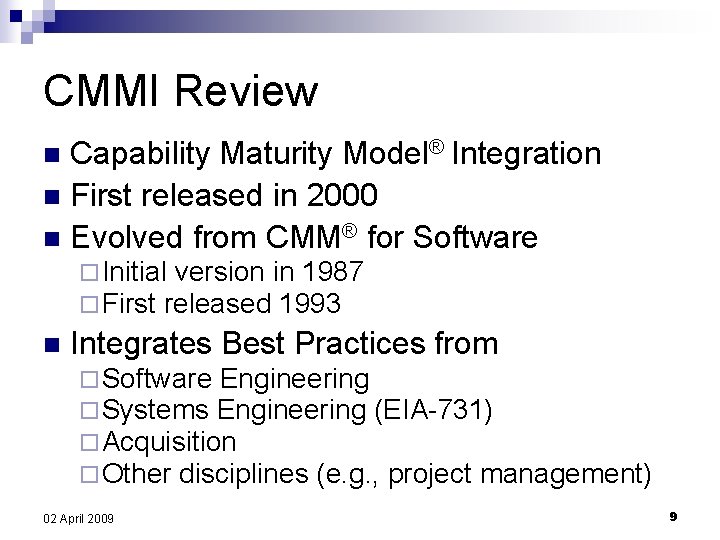
CMMI Review Capability Maturity Model® Integration n First released in 2000 n Evolved from CMM® for Software n ¨ Initial version in 1987 ¨ First released 1993 n Integrates Best Practices from ¨ Software Engineering ¨ Systems Engineering (EIA-731) ¨ Acquisition ¨ Other disciplines (e. g. , project management) 02 April 2009 9
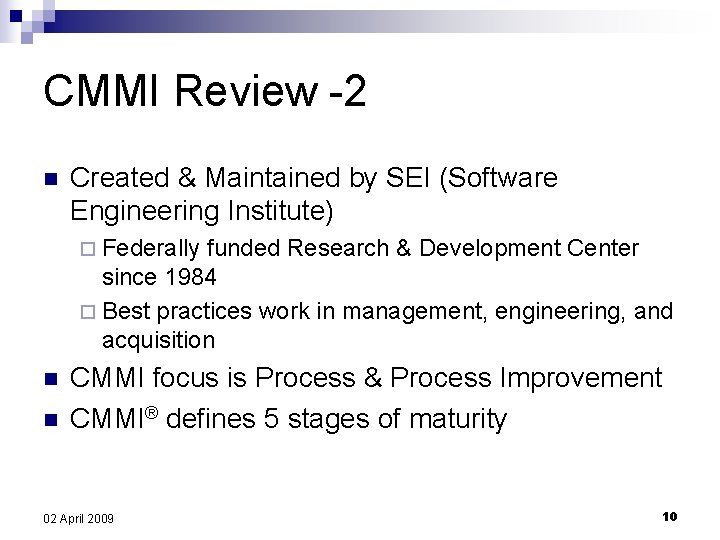
CMMI Review -2 n Created & Maintained by SEI (Software Engineering Institute) ¨ Federally funded Research & Development Center since 1984 ¨ Best practices work in management, engineering, and acquisition n n CMMI focus is Process & Process Improvement CMMI® defines 5 stages of maturity 02 April 2009 10
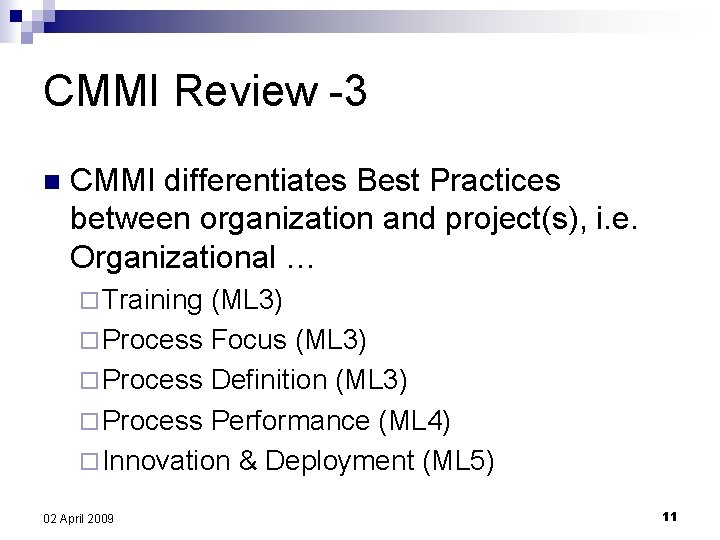
CMMI Review -3 n CMMI differentiates Best Practices between organization and project(s), i. e. Organizational … ¨ Training (ML 3) ¨ Process Focus (ML 3) ¨ Process Definition (ML 3) ¨ Process Performance (ML 4) ¨ Innovation & Deployment (ML 5) 02 April 2009 11
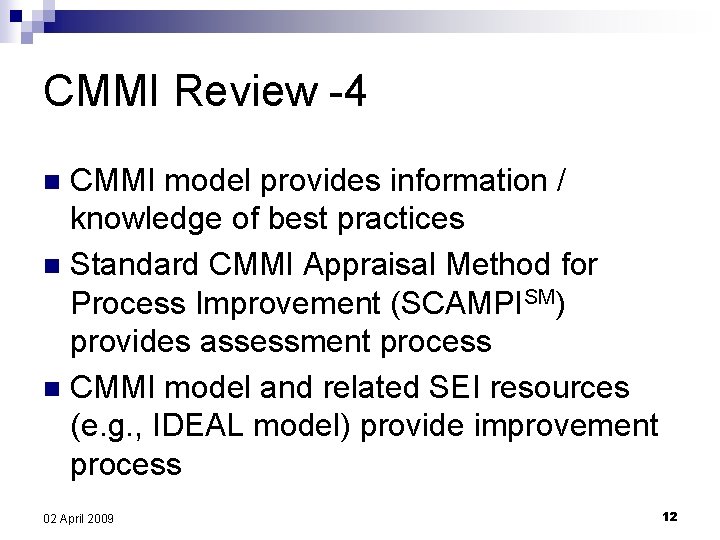
CMMI Review -4 CMMI model provides information / knowledge of best practices n Standard CMMI Appraisal Method for Process Improvement (SCAMPISM) provides assessment process n CMMI model and related SEI resources (e. g. , IDEAL model) provide improvement process n 02 April 2009 12
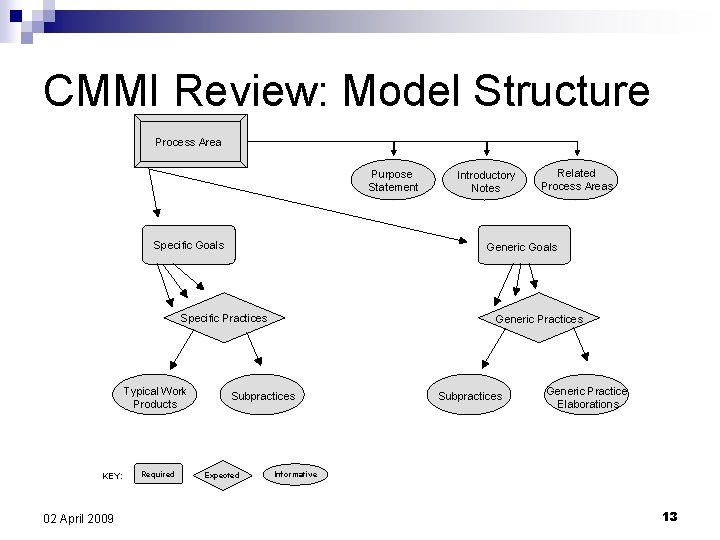
CMMI Review: Model Structure Process Area Purpose Statement Specific Goals KEY: 02 April 2009 Required Related Process Areas Generic Goals Specific Practices Typical Work Products Introductory Notes Generic Practices Subpractices Expected Subpractices Generic Practice Subpractices Elaborations Informative 13
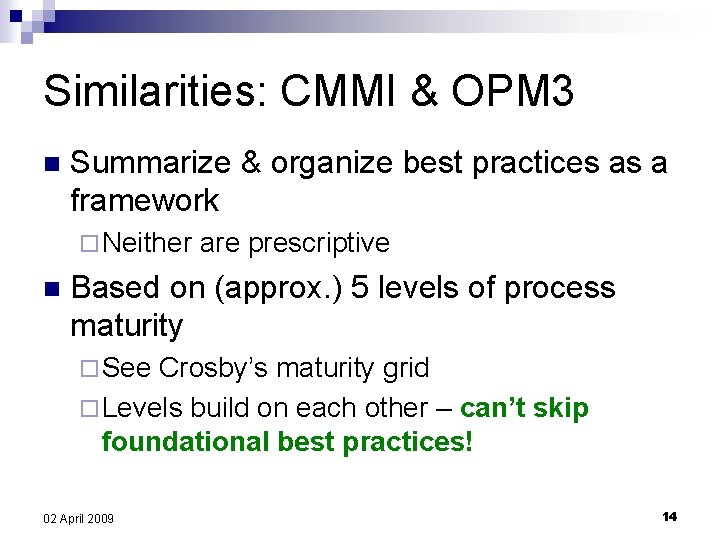
Similarities: CMMI & OPM 3 n Summarize & organize best practices as a framework ¨ Neither are prescriptive n Based on (approx. ) 5 levels of process maturity ¨ See Crosby’s maturity grid ¨ Levels build on each other – can’t skip foundational best practices! 02 April 2009 14
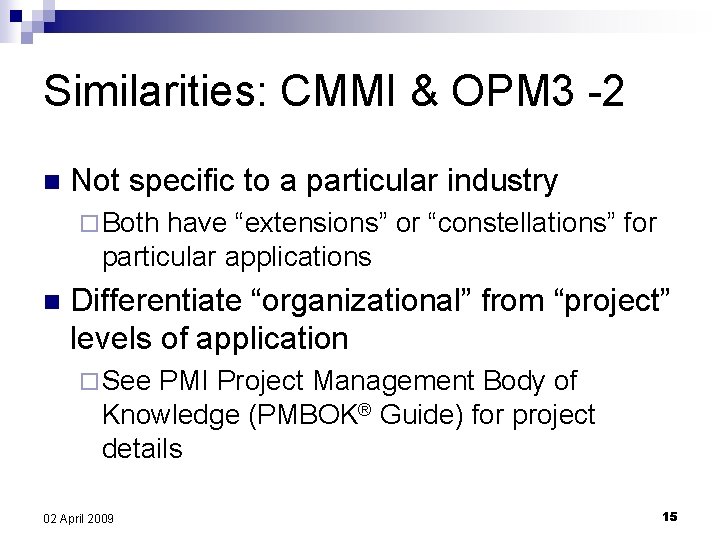
Similarities: CMMI & OPM 3 -2 n Not specific to a particular industry ¨ Both have “extensions” or “constellations” for particular applications n Differentiate “organizational” from “project” levels of application ¨ See PMI Project Management Body of Knowledge (PMBOK® Guide) for project details 02 April 2009 15
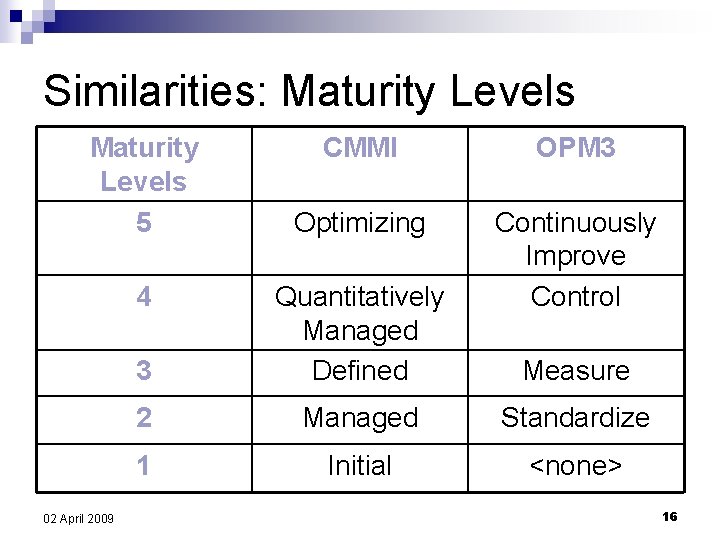
Similarities: Maturity Levels 5 4 02 April 2009 CMMI OPM 3 Optimizing Continuously Improve Control 3 Quantitatively Managed Defined 2 Managed Standardize 1 Initial <none> Measure 16
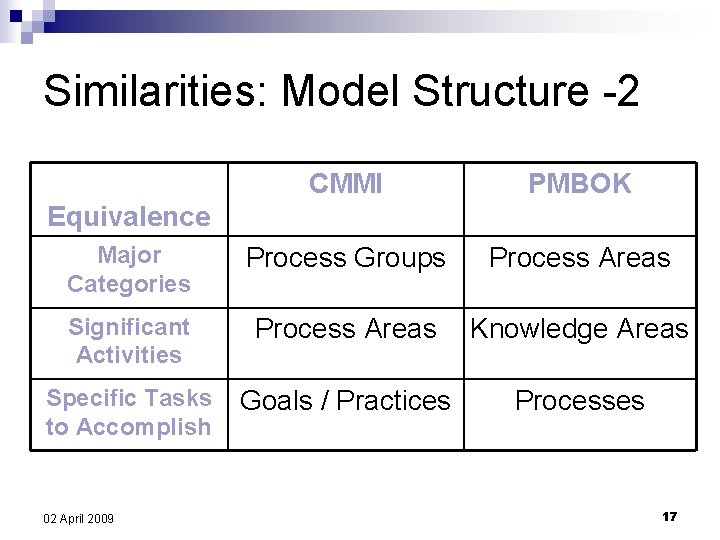
Similarities: Model Structure -2 CMMI PMBOK Major Categories Process Groups Process Areas Significant Activities Process Areas Knowledge Areas Specific Tasks to Accomplish Goals / Practices Processes Equivalence 02 April 2009 17
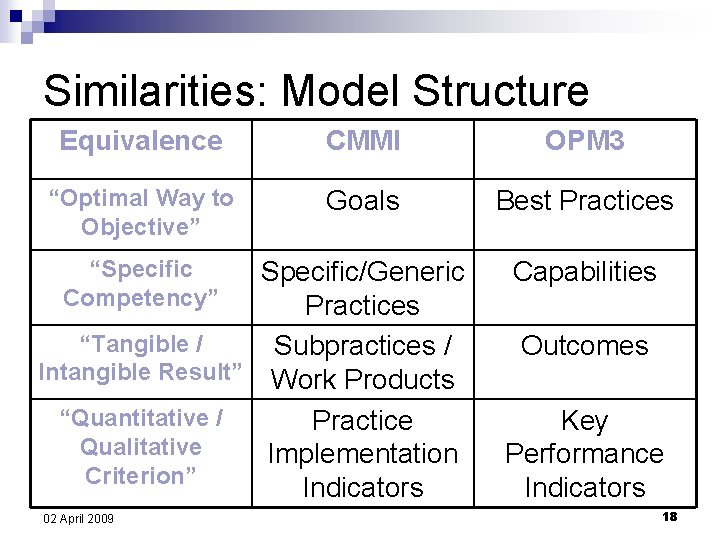
Similarities: Model Structure Equivalence CMMI OPM 3 “Optimal Way to Objective” Goals Best Practices “Specific Competency” Specific/Generic Practices “Tangible / Subpractices / Intangible Result” Work Products “Quantitative / Practice Qualitative Implementation Criterion” Indicators 02 April 2009 Capabilities Outcomes Key Performance Indicators 18
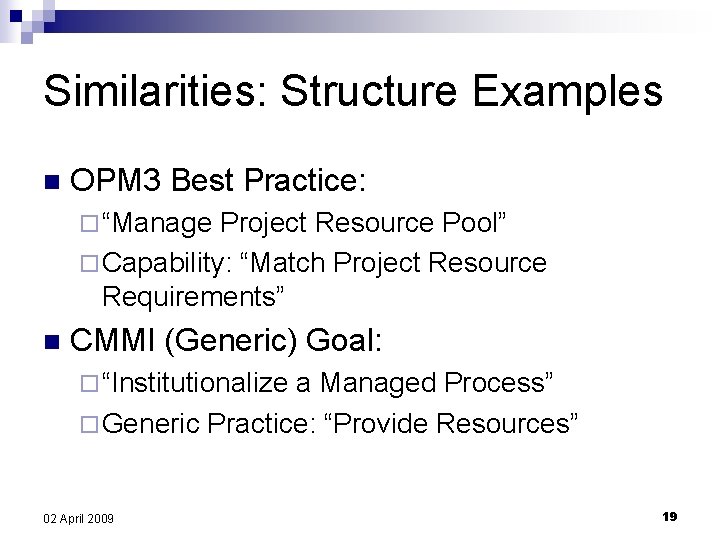
Similarities: Structure Examples n OPM 3 Best Practice: ¨ “Manage Project Resource Pool” ¨ Capability: “Match Project Resource Requirements” n CMMI (Generic) Goal: ¨ “Institutionalize a Managed Process” ¨ Generic Practice: “Provide Resources” 02 April 2009 19
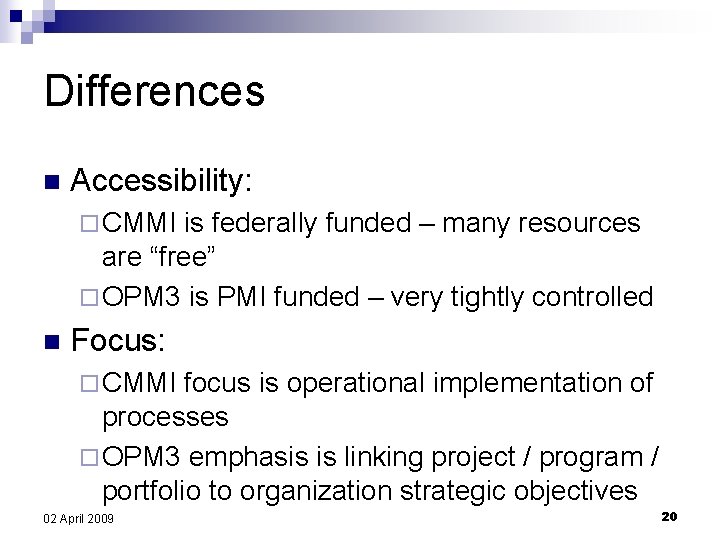
Differences n Accessibility: ¨ CMMI is federally funded – many resources are “free” ¨ OPM 3 is PMI funded – very tightly controlled n Focus: ¨ CMMI focus is operational implementation of processes ¨ OPM 3 emphasis is linking project / program / portfolio to organization strategic objectives 02 April 2009 20
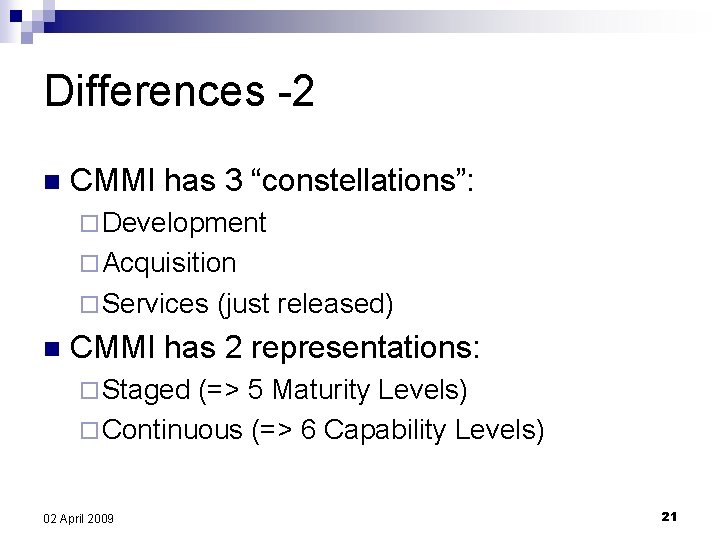
Differences -2 n CMMI has 3 “constellations”: ¨ Development ¨ Acquisition ¨ Services (just released) n CMMI has 2 representations: ¨ Staged (=> 5 Maturity Levels) ¨ Continuous (=> 6 Capability Levels) 02 April 2009 21
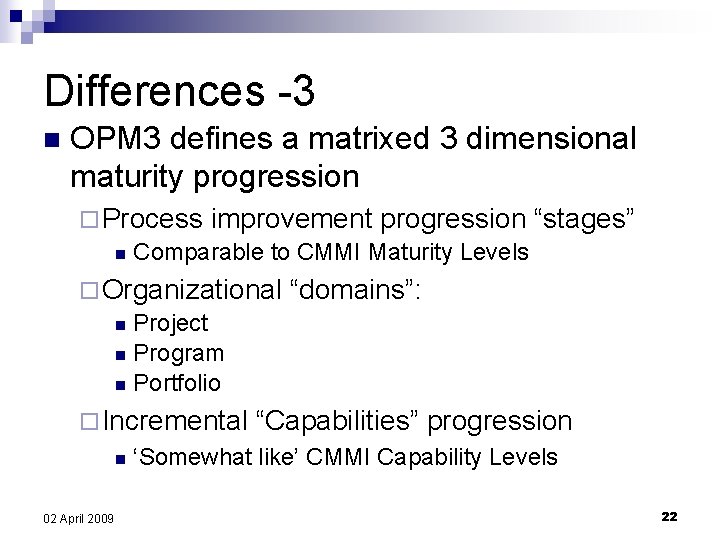
Differences -3 n OPM 3 defines a matrixed 3 dimensional maturity progression ¨ Process improvement progression “stages” n Comparable to CMMI Maturity Levels ¨ Organizational “domains”: n Project n Program n Portfolio ¨ Incremental “Capabilities” progression n 02 April 2009 ‘Somewhat like’ CMMI Capability Levels 22
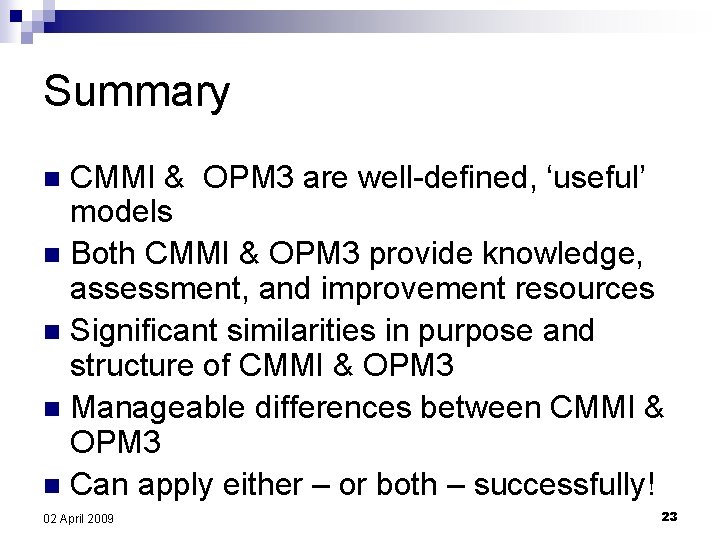
Summary CMMI & OPM 3 are well-defined, ‘useful’ models n Both CMMI & OPM 3 provide knowledge, assessment, and improvement resources n Significant similarities in purpose and structure of CMMI & OPM 3 n Manageable differences between CMMI & OPM 3 n Can apply either – or both – successfully! n 02 April 2009 23
Questions? 02 April 2009 24
References / Resources n “An Executive’s Guide to OPM 3®”; Project Management Institute (PMI), 2004. n “Comparing CMMI® and OPM 3®”; John L. Sullivan, 01/16/2007; http: //www. allpm. com/modules. php? op=modload&name=News&file=article&sid=1659 n “OPM 3® and CMMI®: A Preliminary Integration”; Mark A. Ward, 2007; http: //www. pmiadsig. org/Documents/Webinar%20 OPM 3%20 and%20 CMMI%20 Integration. pdf n “CMMI® and OPM 3®”; The Cahaba Group LLC, 2004; http: //www. pmimontgomery. org/pdf/Presentations/2004_10%20 TCG%20 PMI%20 Pre sentation. pdf n “A Guide to the Project Management Body of Knowledge PMBOK® Guide—Fourth Edition”, PMI, 2008. “CMMI®: Guidelines for Process Integration and Product Improvement, Second Edition”; Chrissis, Mary Beth et. al. , Addison-Wesley, 2006. n 02 April 2009 25