
Software Engineering CE 501 Prepared by Jay Dave
Software Engineering CE 501 Prepared by : Jay Dave
Prepared by : Ashwin Raiyani

RK UNIVERSITY Teaching Scheme & Book Information Prepared by : Ashwin Raiyani
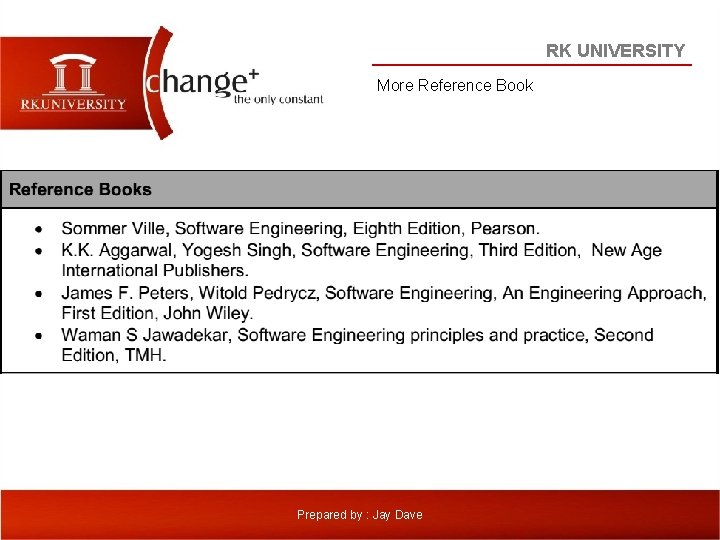
RK UNIVERSITY More Reference Book Prepared by : Jay Dave
Chapter-3 THE CONCURRENT MODEL
CMMI Capability maturity model integration
CMMI • The original CMM was developed and upgraded by the Software Engineering Institute • throughout the 1990 s as a complete SPI framework • a comprehensive process • meta-model that is predicated on a set of system and software engineering capabilities • that should be present as organizations reach different levels of process capability and maturity.
CMMI • The CMMI represents a process metamodel in two different ways: (1) as a“continuous” model and (2) as a “staged” model.
CMMI • Level 0: Incomplete—the process area (e. g. , requirements management) is • either not performed or does not achieve all goals and objectives defined by the CMMI for level 1 capability for the process area. • Level 1: Performed—all of the specific goals of the process area (as defined • by the CMMI) have been satisfied. Work tasks required to produce defined work products are being conducted.
• Level 2: Managed—all capability level 1 criteria have been satisfied. In addition, • all work associated with the process area conforms to an organizationally defined policy; all people doing the work have access to adequate resources to get the job done; stakeholders are actively involved in the process area as required; all work tasks and work products are “monitored, controlled, and reviewed; and are evaluated for adherence to the process description
CMMI • Level 3: Defined—all capability level 2 criteria have been achieved. In addition, • the process is “tailored from the organization’s set of standard • processes according to the organization’s tailoring guidelines, and contributes • work products, measures, and other processimprovement information • to the organizational process assets”
CMMI • Level 4: Quantitatively managed—all capability level 3 criteria have been • achieved. In addition, the process area is controlled and improved using • measurement and quantitative assessment. “Quantitative objectives for quality • and process performance are established and used as criteria in managing • the process”
CMMI • Level 5: Optimized—all capability level 4 criteria have been achieved. In • addition, the process area is adapted and optimized using quantitative (statistical) means to meet changing customer needs and to continually improve the efficacy of the process area under consider
CMMI • The CMMI defines each process area in terms of “specific goals” and the “specific practices” required to achieve these goals. Specific goals establish the characteristics that must exist if the activities implied by a process area are to be effective. • Specific practices refine a goal into a set of process-related activities.
CMMI • For example, project planning is one of eight process areas defined by the CMMI • for “project management” category. 6 The specific goals (SG) and the associated specific • practices (SP) defined for project planning are [CMM 07]: • SG 1 Establish Estimates • SP 1. 1 -1 Estimate the Scope of the Project • SP 1. 2 -1 Establish Estimates of Work Product and Task Attributes • SP 1. 3 -1 Define Project Life Cycle • SP 1. 4 -1 Determine Estimates of Effort and Cost
CMMI • SG 2 Develop a Project Plan • SP 2. 1 -1 Establish the Budget and Schedule • SP 2. 2 -1 Identify Project Risks • SP 2. 3 -1 Plan for Data Management • SP 2. 4 -1 Plan for Project Resources • SP 2. 5 -1 Plan for Needed Knowledge and Skills • SP 2. 6 -1 Plan Stakeholder Involvement • SP 2. 7 -1 Establish the Project Plan
CMMI • SG 3 Obtain Commitment to the Plan • SP 3. 1 -1 Review Plans That Affect the Project • SP 3. 2 -1 Reconcile Work and Resource Levels • SP 3. 3 -1 Obtain Plan Commitment
CMMI • In addition to specific goals and practices, the CMMI also defines a set of five • generic goals and related practices for each process area. Each of the five generic • goals corresponds to one of the five capability levels. Hence, to achieve a particular • capability level, the generic goal for that level and the generic practices that correspond • to that goal must be achieved. To illustrate, the generic goals (GG) and practices • (GP) for the project planning process area are
CMMI • GG 1 Achieve Specific Goals • GP 1. 1 Perform Base Practices • GG 2 Institutionalize a Managed Process • GP 2. 1 Establish an Organizational Policy • GP 2. 2 Plan the Process • GP 2. 3 Provide Resources • GP 2. 4 Assign Responsibility • GP 2. 5 Train People
CMMI • • • • GP 2. 6 Manage Configurations GP 2. 7 Identify and Involve Relevant Stakeholders GP 2. 8 Monitor and Control the Process GP 2. 9 Objectively Evaluate Adherence GP 2. 10 Review Status with Higher-Level Management GG 3 Institutionalize a Defined Process GP 3. 1 Establish a Defined Process GP 3. 2 Collect Improvement Information GG 4 Institutionalize a Quantitatively Managed Process GP 4. 1 Establish Quantitative Objectives for the Process GP 4. 2 Stabilize Subprocess Performance GG 5 Institutionalize an Optimizing Process GP 5. 1 Ensure Continuous Process Improvement GP 5. 2 Correct Root Causes of Problems
CMMI • The staged CMMI model defines the same process areas, goals, and practices as the continuous model. • The primary difference is that the staged model defines five maturity levels, rather than five capability levels. To achieve a maturity level, the specific goals and practices associated with a set of process areas must be achieved.
- Slides: 21