Measurement and Analysis How Can I Optimize My

- Slides: 15
“Measurement and Analysis: How Can I Optimize My Transition from CMM to the CMMI? ” Process. Velocity, LLP. Gary F. Norausky, Partner November 19, 2003 ÓCopyright Process. Velocity, LLP. 2003. Slides intended for informational purposes only. CMM and Capability Maturity Model are registered in the U. S. Patent and Trademark Office. CMMI and SCAMPI are service marks of Carnegie Mellon University. 1
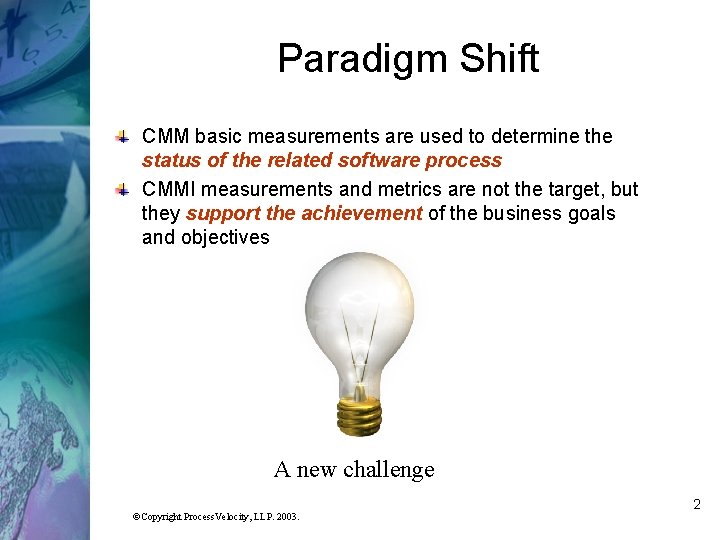
Paradigm Shift CMM basic measurements are used to determine the status of the related software process CMMI measurements and metrics are not the target, but they support the achievement of the business goals and objectives A new challenge ÓCopyright Process. Velocity, LLP. 2003. 2
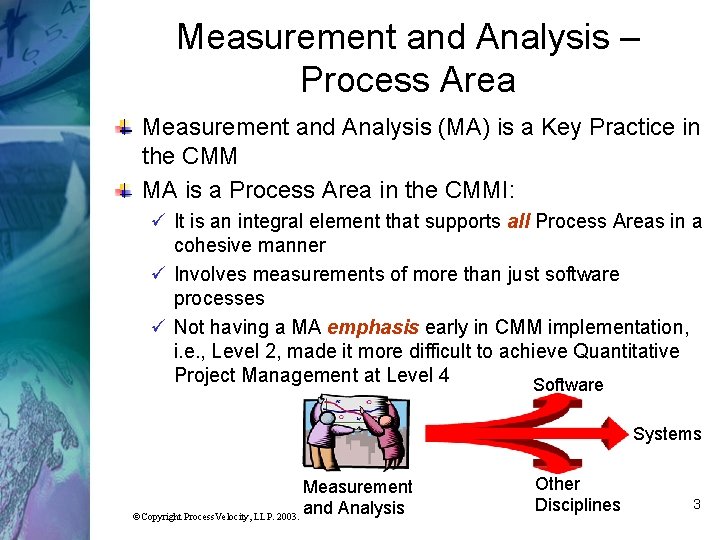
Measurement and Analysis – Process Area Measurement and Analysis (MA) is a Key Practice in the CMM MA is a Process Area in the CMMI: ü It is an integral element that supports all Process Areas in a cohesive manner ü Involves measurements of more than just software processes ü Not having a MA emphasis early in CMM implementation, i. e. , Level 2, made it more difficult to achieve Quantitative Project Management at Level 4 Software Systems Measurement and Analysis ÓCopyright Process. Velocity, LLP. 2003. Other Disciplines 3
Moving MA from a Key Practice to a Process Area Requires: ü ü Identifying information needs and objectives Identifying and specifying correct measures Determining your current/desired measurement capability Developing processes and methods to define, collect and analyze the measures ü Communicating the measures to Stakeholders Institutionalization of MA activities includes: ü Integrating the MA activities into the processes used by the organization ü Using measures as part of a cause and effect relationship ü Using measures to focus priorities ÓCopyright Process. Velocity, LLP. 2003. 4
Pre-CMMI Transition Take inventory of your current CMM measurements and consider the following questions: ü ü ü ü What is needed to benchmark them against the CMMI? How are they generated? What’s working now? Where do they reside and who has access to them? Who is receiving them? Stakeholders? Who is analyzing the measurements? What is the frequency of existing measurement report(s)? Is this frequency sufficient for the Stakeholders? ü Is there any redundancy across multiple disciplines? ü Do they enable business decisions? ÓCopyright Process. Velocity, LLP. 2003. 5
Common Measurement Problems - CMM No Measurement Plan/Design Measures collected, but not used Measurement Repository is questionable Misinterpretation of measures collected: ü Most measures are collected to satisfy a Key Process Area’s requirement: Do not provide insight into the Key Process Area’s implementation status/effectiveness Normally, do not provide insight into accomplishment of business goals and objectives ü Graphical representations of data do not relate to being proactive about the data shown, i. e. , A good graphic is after the fact. ÓCopyright Process. Velocity, LLP. 2003. 6
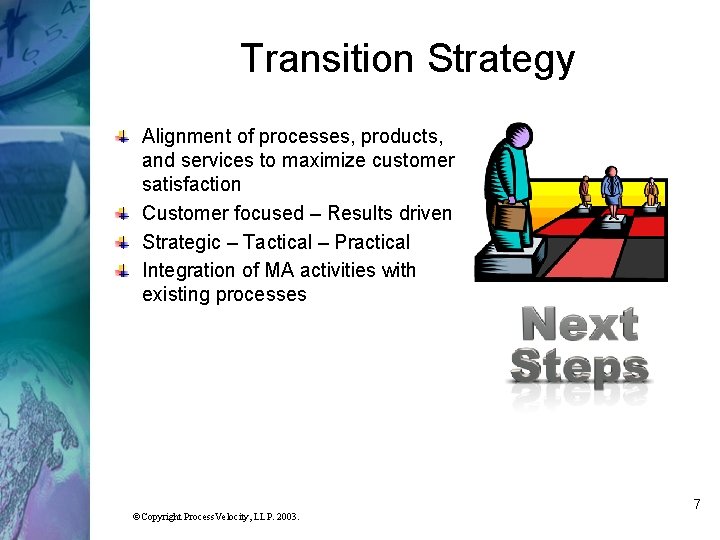
Transition Strategy Alignment of processes, products, and services to maximize customer satisfaction Customer focused – Results driven Strategic – Tactical – Practical Integration of MA activities with existing processes ÓCopyright Process. Velocity, LLP. 2003. 7
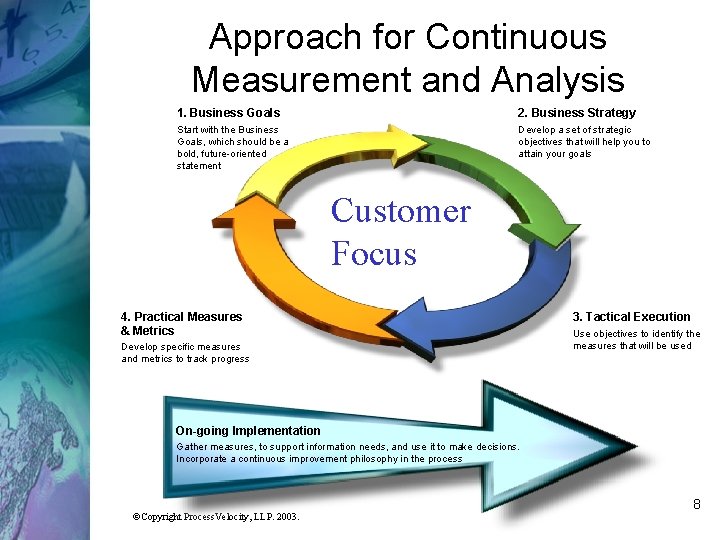
Approach for Continuous Measurement and Analysis 1. Business Goals 2. Business Strategy Start with the Business Goals, which should be a bold, future-oriented statement Develop a set of strategic objectives that will help you to attain your goals Customer Focus 4. Practical Measures & Metrics Develop specific measures and metrics to track progress 3. Tactical Execution Use objectives to identify the measures that will be used On-going Implementation Gather measures, to support information needs, and use it to make decisions. Incorporate a continuous improvement philosophy in the process ÓCopyright Process. Velocity, LLP. 2003. 8
Motivation for Pragmatic Measurements Communicate Effectively: ü Measurements provide objective information throughout the organization. Track Specific Project Objectives: ü Measurements can accurately describe the status of project processes and products. Identify and Correct Problems Early: ü Measurements facilitate a proactive management strategy. Make Key Trade-off Decisions: ü Every project is subject to constraints and Trade-offs occur to meet established project objectives. Justify Decisions: ü The current technology business environments demand successful project performance. Decisions are based upon objective measures. ÓCopyright Process. Velocity, LLP. 2003. 9
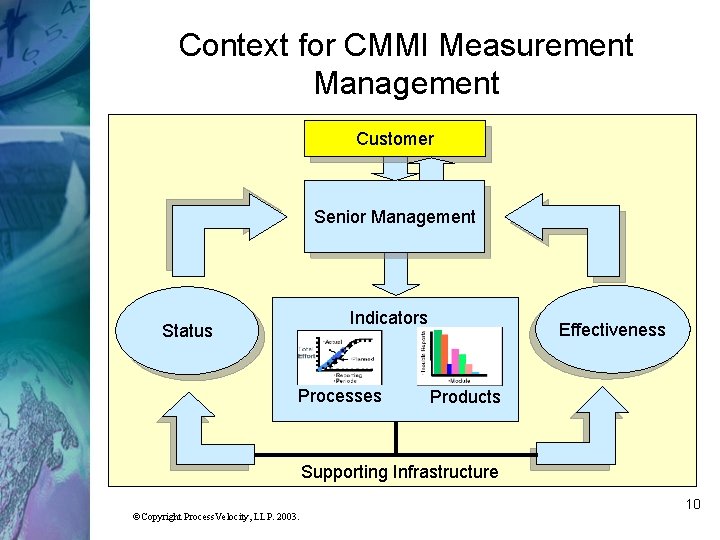
Context for CMMI Measurement Management Customer Senior Management Indicators Status Processes Effectiveness Products Supporting Infrastructure ÓCopyright Process. Velocity, LLP. 2003. 10
Measurement Plan CMMI requires more measurement planning & design considerations: ü Information needs ü Supporting infrastructure ü Involvement of multiple disciplines Many organizations transitioning to CMMI from the CMM will have to address the following: ü ü Documenting information needs Defining measurement objectives Defining measurement specifications Establish/Refine collection, storage, and analysis procedures It’s a challenge for the WHOLE ORGANIZATION, not just engineering! ÓCopyright Process. Velocity, LLP. 2003. 11
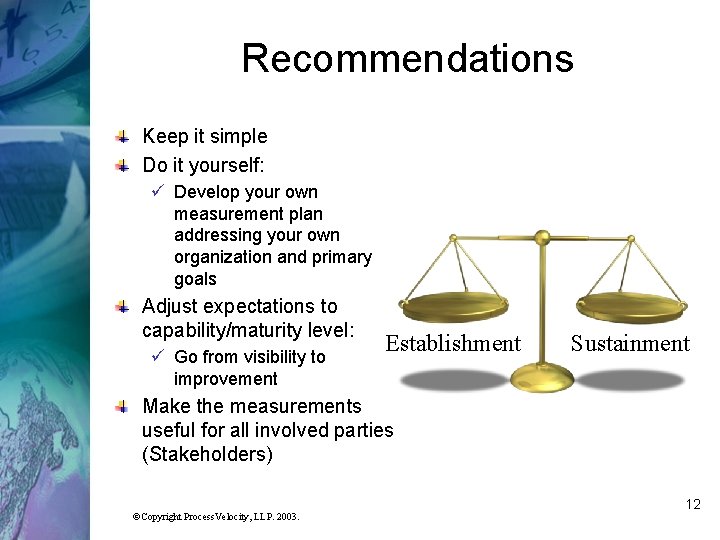
Recommendations Keep it simple Do it yourself: ü Develop your own measurement plan addressing your own organization and primary goals Adjust expectations to capability/maturity level: ü Go from visibility to improvement Establishment Sustainment Make the measurements useful for all involved parties (Stakeholders) ÓCopyright Process. Velocity, LLP. 2003. 12
Measurement Concerns Ensure information is of sufficient quality for measurement goals: ü Can you trust the data? Ambiguous interpretation of data: ü If change requests are high, might mean Product quality is low Customers have high expectations ü If size is large, might mean Implementation is inefficient Problem is complex ÓCopyright Process. Velocity, LLP. 2003. 13
What to avoid? Expensive measurement program: ü Large number of measurements of all types of work products ü Large number of predefined reports generated on a periodic basis Projects being delayed: ü Staff is busy collecting and analyzing data on top of the standard metrics activity ÓCopyright Process. Velocity, LLP. 2003. 14
Contact Us Process. Velocity, LLP Gary F. Norausky Partner www. processvelocity. com ÓCopyright Process. Velocity, LLP. 2003. 15