q q Is entering our lives and changing

- Slides: 44
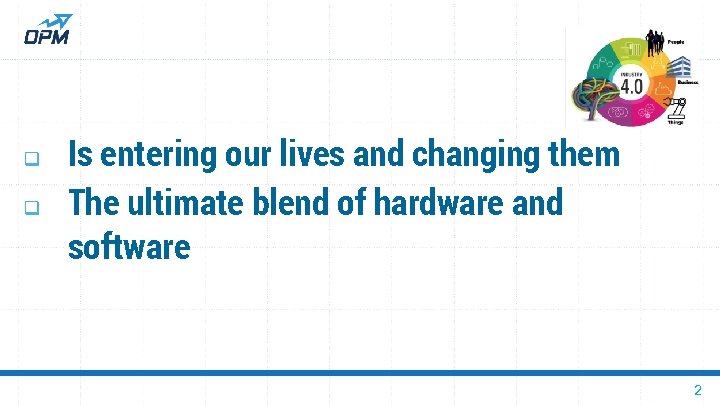
q q Is entering our lives and changing them The ultimate blend of hardware and software 2
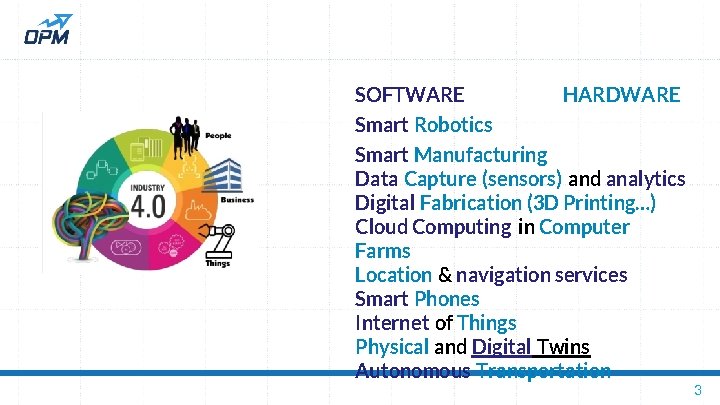
SOFTWARE HARDWARE Smart Robotics Smart Manufacturing Data Capture (sensors) and analytics Digital Fabrication (3 D Printing…) Cloud Computing in Computer Farms Location & navigation services Smart Phones Internet of Things Physical and Digital Twins Autonomous Transportation 3
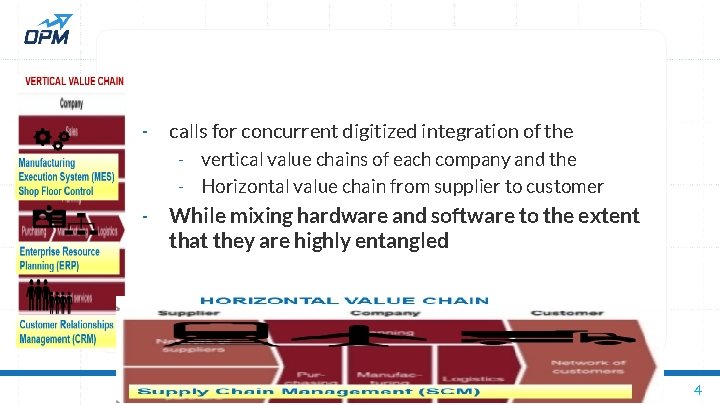
- calls for concurrent digitized integration of the - vertical value chains of each company and the - Horizontal value chain from supplier to customer - While mixing hardware and software to the extent that they are highly entangled 4
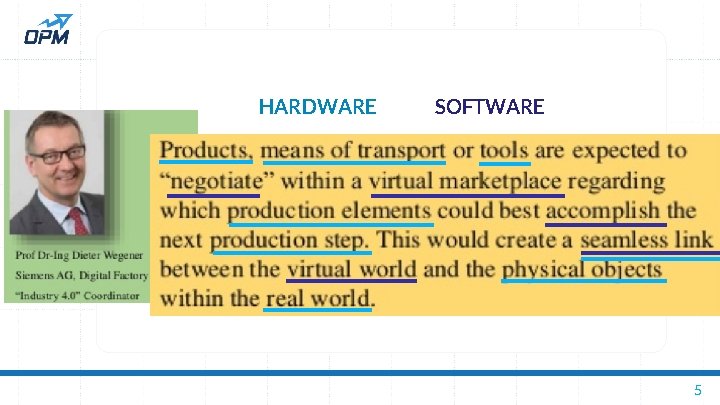
HARDWARE SOFTWARE 5
What are the implications of this ultimate hardwaresoftware fusion on the future of Systems Engineering? - What does SE need in order to remain relevant and drive the Industry 4. 0 vision forward? - We must use a language and a methodology that cater to modeling and architecting systems with the Industry 4. 0 - hardware-software fusion paradigm mindset! But you may rightly ask: “Wait a minute – What about UML and Sys. ML? ” 6
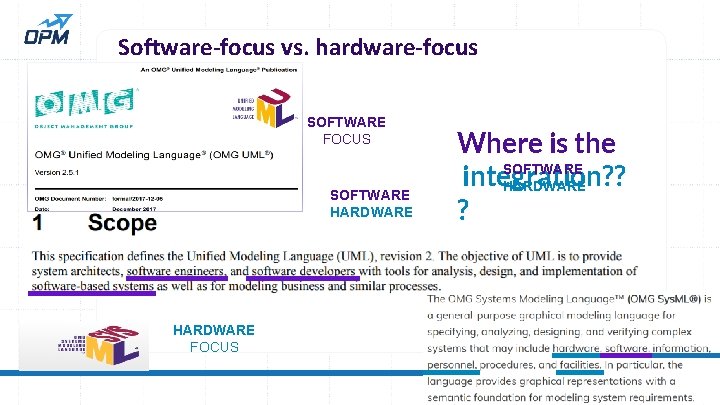
Software-focus vs. hardware-focus SOFTWARE FOCUS SOFTWARE HARDWARE FOCUS Where is the SOFTWARE integration? ? HARDWARE ?
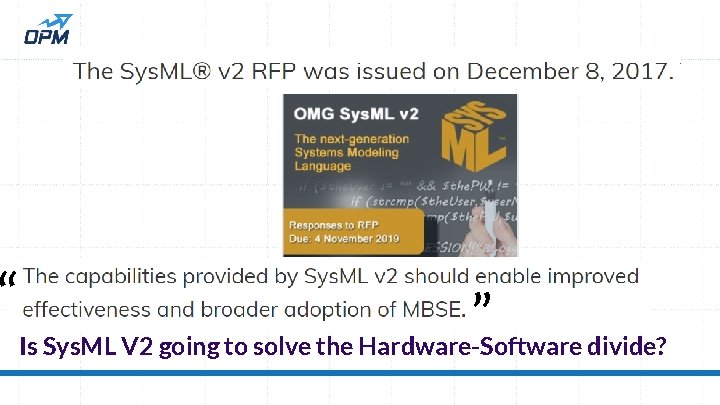
X “ ” Is Sys. ML V 2 going to solve the Hardware-Software divide?
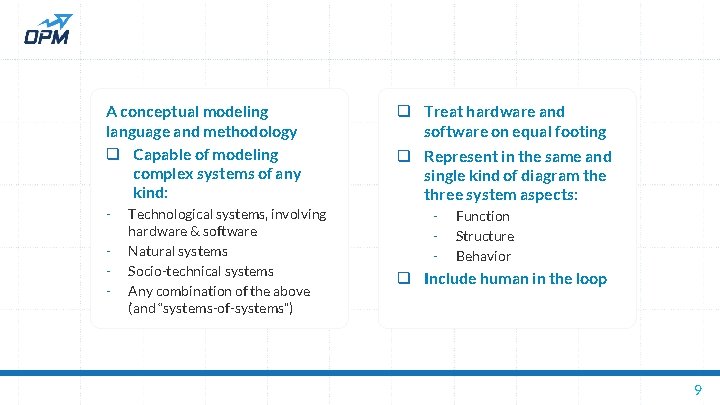
A conceptual modeling language and methodology q Capable of modeling complex systems of any kind: - Technological systems, involving hardware & software Natural systems Socio-technical systems Any combination of the above (and “systems-of-systems”) q Treat hardware and software on equal footing q Represent in the same and single kind of diagram the three system aspects: - Function Structure Behavior q Include human in the loop 9
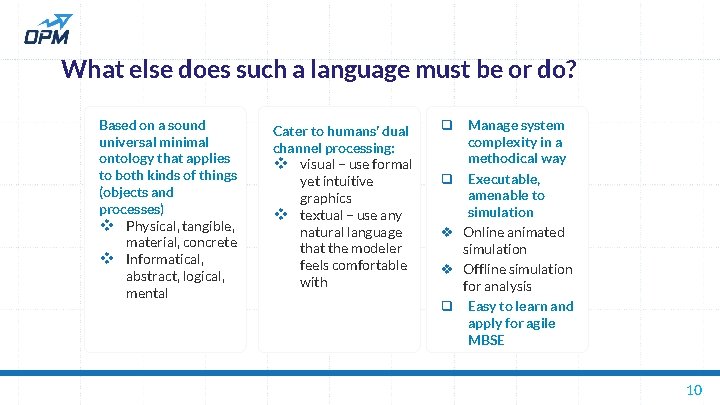
What else does such a language must be or do? Based on a sound universal minimal ontology that applies to both kinds of things (objects and processes) v Physical, tangible, material, concrete v Informatical, abstract, logical, mental Cater to humans’ dual channel processing: v visual – use formal yet intuitive graphics v textual – use any natural language that the modeler feels comfortable with q Manage system complexity in a methodical way q Executable, amenable to simulation v Online animated simulation v Offline simulation for analysis q Easy to learn and apply for agile MBSE 10
11
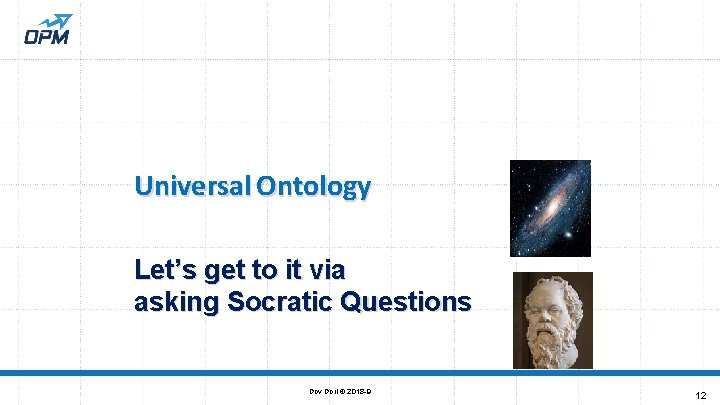
Universal Ontology Let’s get to it via asking Socratic Questions Dov Dori © 2018 -9 12
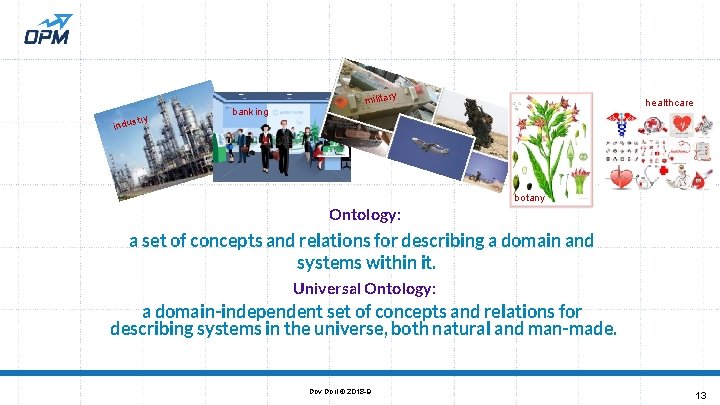
try indus banking military healthcare botany Ontology: a set of concepts and relations for describing a domain and systems within it. Universal Ontology: a domain-independent set of concepts and relations for describing systems in the universe, both natural and man-made. Dov Dori © 2018 -9 13
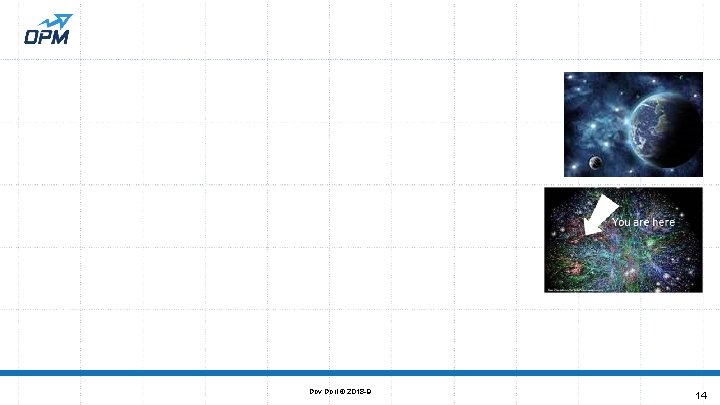
Dov Dori © 2018 -9 14
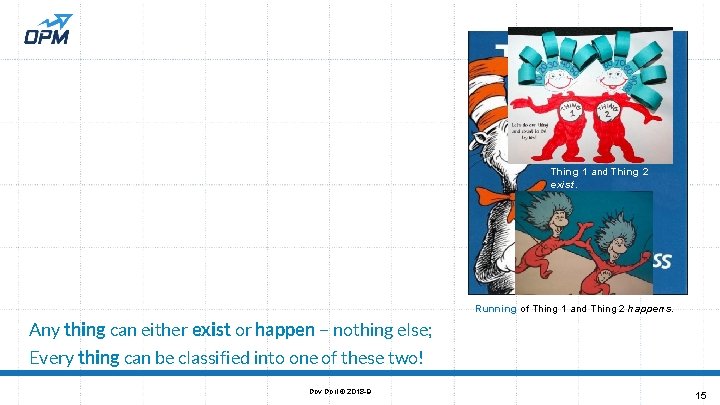
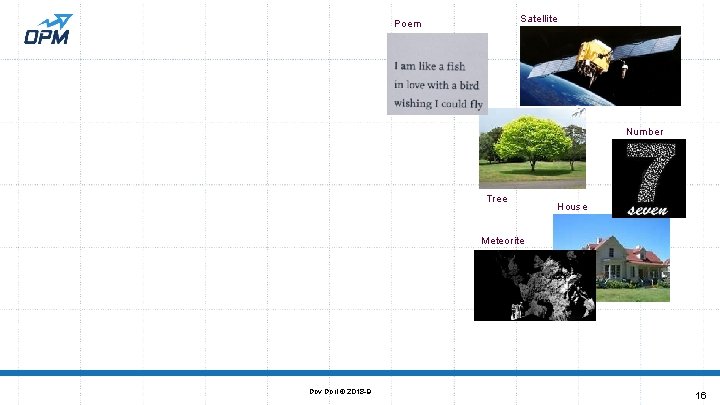
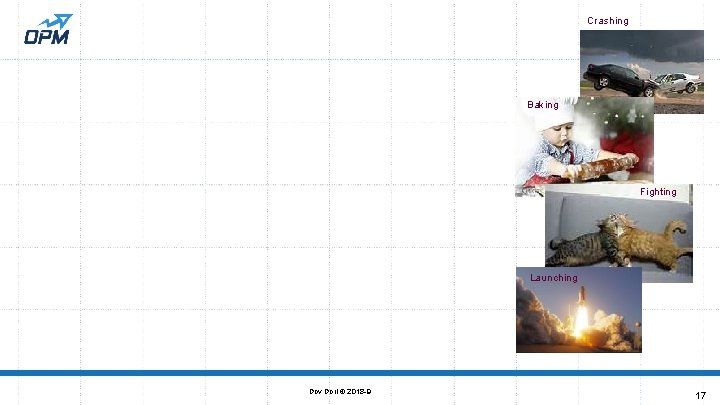
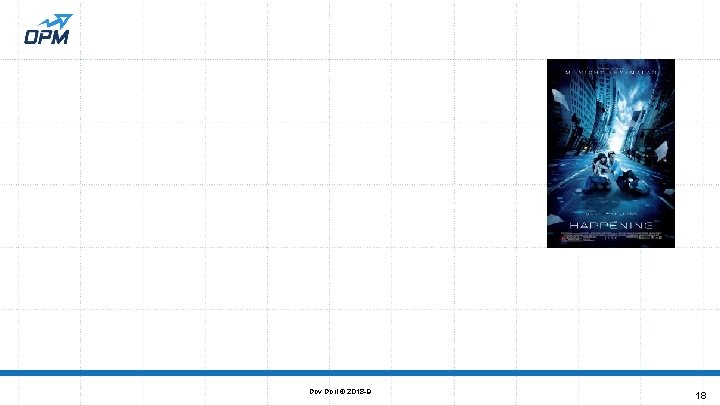
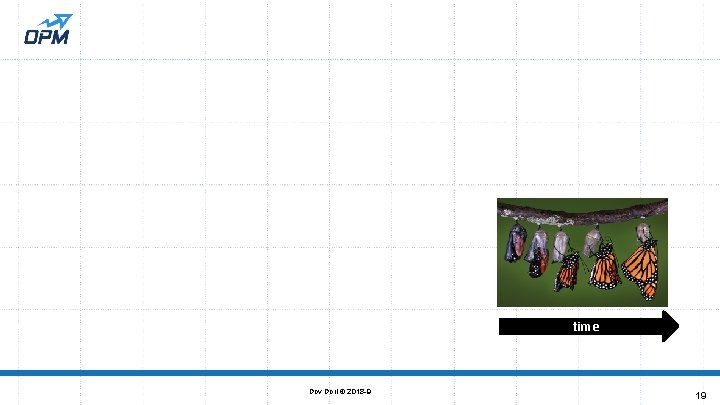
Thing 1 and Thing 2 exist. Running of Thing 1 and Thing 2 happens. Any thing can either exist or happen – nothing else; Every thing can be classified into one of these two! Dov Dori © 2018 -9 15
Satellite Poem Number Tree House Meteorite Dov Dori © 2018 -9 16
Crashing Baking Fighting Launching Dov Dori © 2018 -9 17
Dov Dori © 2018 -9 18
time Dov Dori © 2018 -9 19
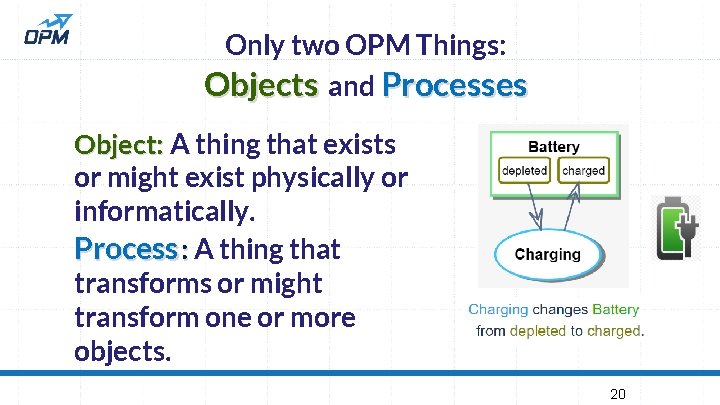
Only two OPM Things: Objects and Processes Object: A thing that exists or might exist physically or informatically. Process : A thing that transforms or might transform one or more objects. 20
The Object-Process Theorem Stateful objects , processes , and relations among them constitute a universal ontology. Caveat: May not apply to quantum-scale systems (e. g. , an electron may be both an object and a process) 10/31/2020 Dov Dori © 2018 -92017 -8 21
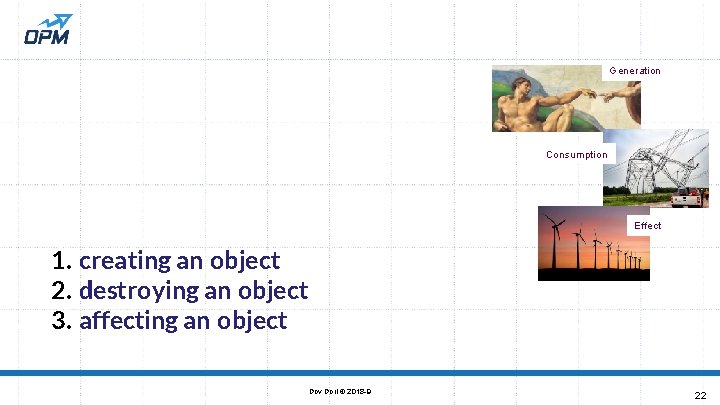
Generation Consumption Effect 1. creating an object 2. destroying an object 3. affecting an object Dov Dori © 2018 -9 22
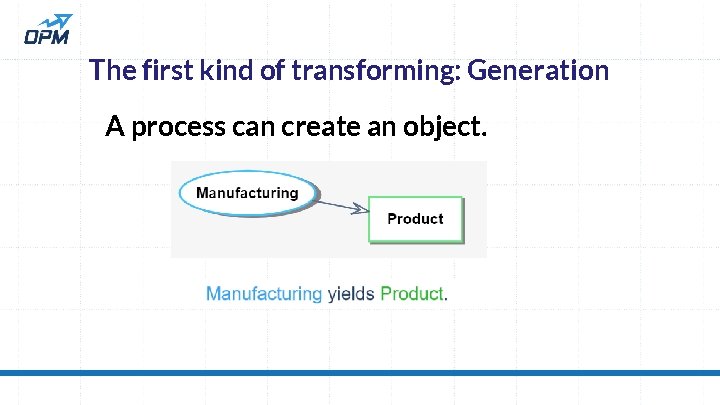
The first kind of transforming: Generation A process can create an object.
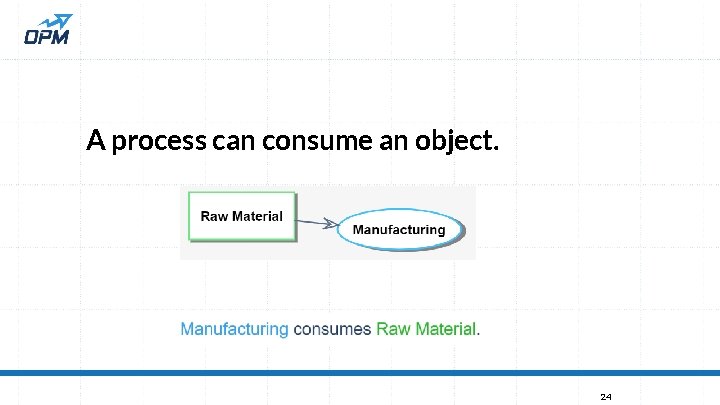
A process can consume an object. 24
Dov Dori © 2018 -9 25
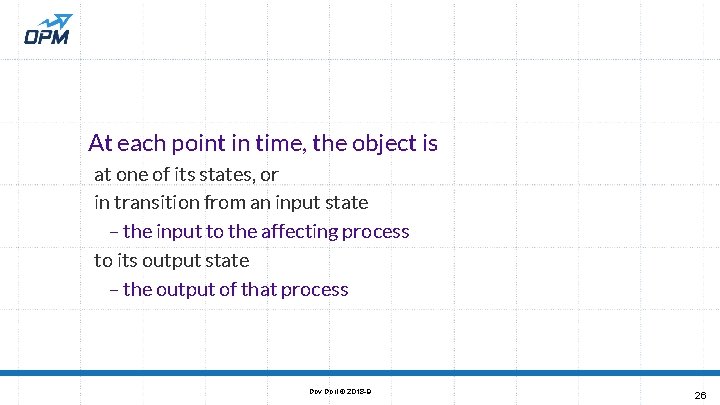
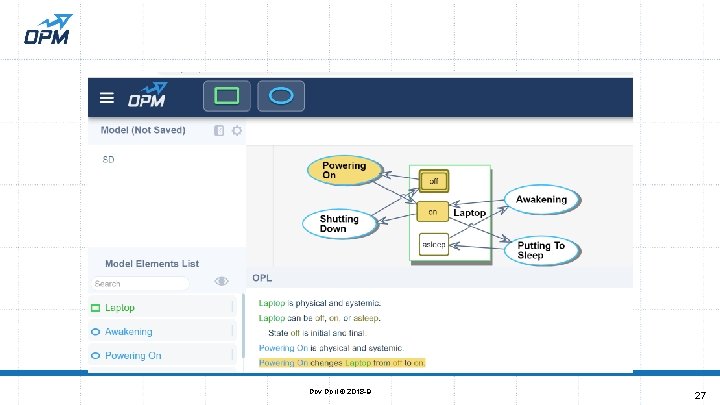
At each point in time, the object is at one of its states, or in transition from an input state – the input to the affecting process to its output state – the output of that process Dov Dori © 2018 -9 26
Dov Dori © 2018 -9 27
10/31/2020 Dov Dori © 2018 -92017 -8 28
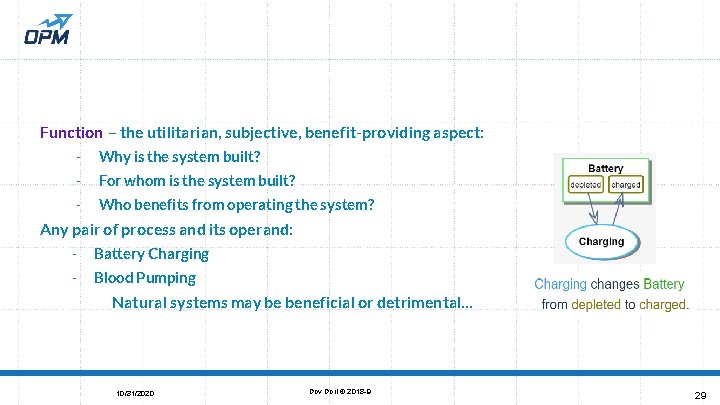
Function – the utilitarian, subjective, benefit-providing aspect: - Why is the system built? - For whom is the system built? - Who benefits from operating the system? Any pair of process and its operand: - Battery Charging - Blood Pumping Natural systems may be beneficial or detrimental. . . 10/31/2020 Dov Dori © 2018 -9 29
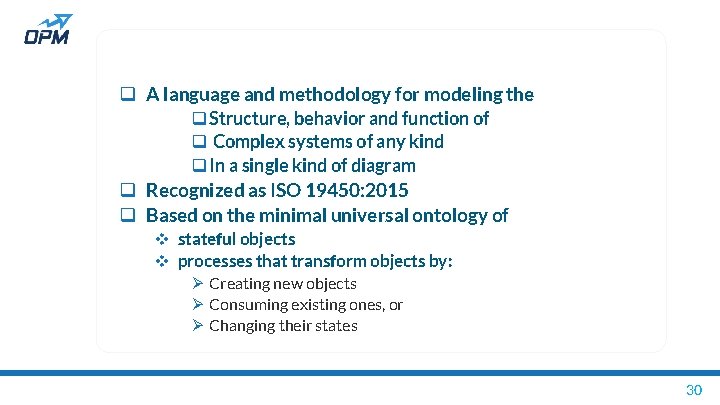
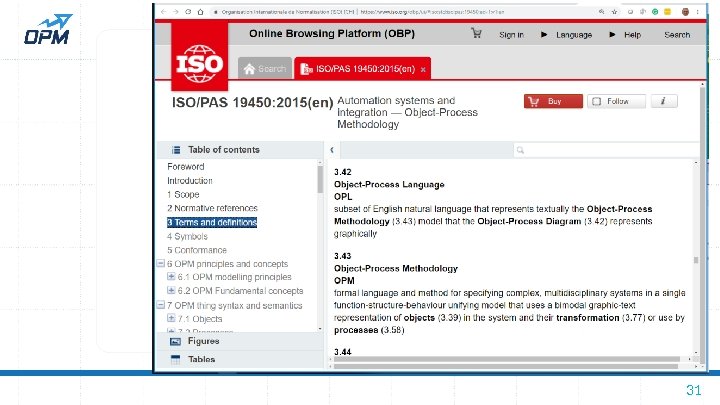
q A language and methodology for modeling the q Structure, behavior and function of q Complex systems of any kind q In a single kind of diagram q Recognized as ISO 19450: 2015 q Based on the minimal universal ontology of v stateful objects v processes that transform objects by: Ø Creating new objects Ø Consuming existing ones, or Ø Changing their states 30
31
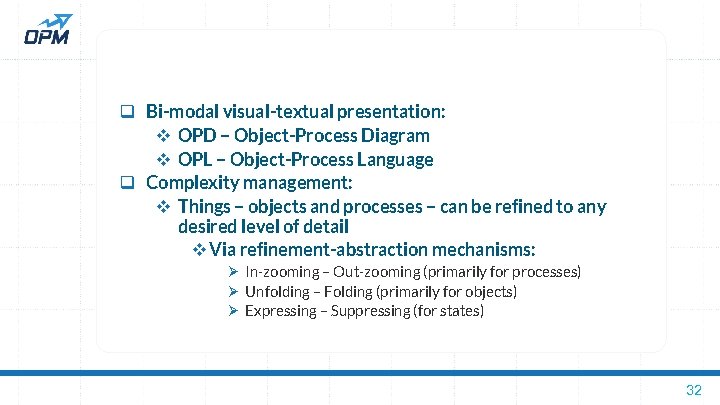
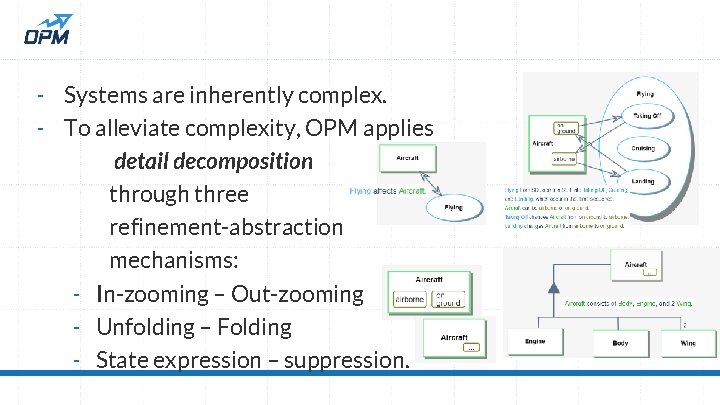
q Bi-modal visual-textual presentation: v OPD – Object-Process Diagram v OPL – Object-Process Language q Complexity management: v Things – objects and processes – can be refined to any desired level of detail v Via refinement-abstraction mechanisms: Ø In-zooming – Out-zooming (primarily for processes) Ø Unfolding – Folding (primarily for objects) Ø Expressing – Suppressing (for states) 32
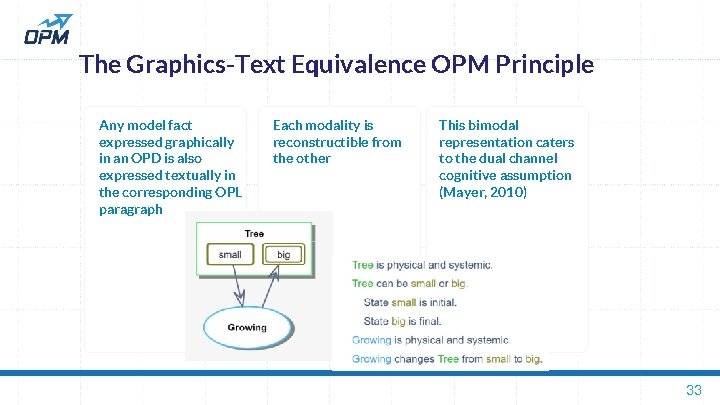
The Graphics-Text Equivalence OPM Principle Any model fact expressed graphically in an OPD is also expressed textually in the corresponding OPL paragraph Each modality is reconstructible from the other This bimodal representation caters to the dual channel cognitive assumption (Mayer, 2010) 33
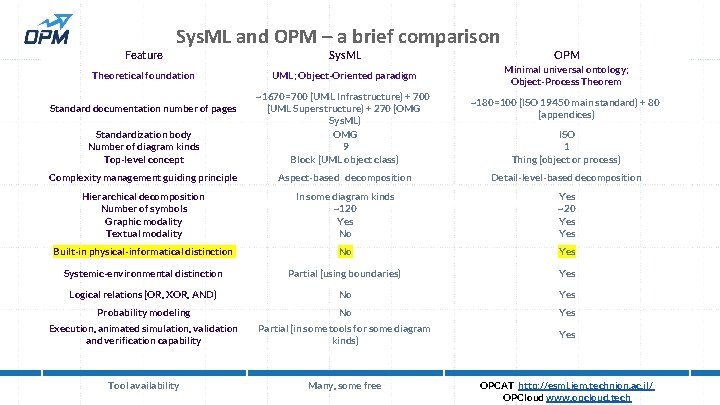
Feature Sys. ML and OPM – a brief comparison Theoretical foundation Sys. ML OPM UML; Object-Oriented paradigm Minimal universal ontology; Object-Process Theorem Standardization body Number of diagram kinds Top-level concept ~1670=700 (UML Infrastructure) + 700 (UML Superstructure) + 270 (OMG Sys. ML) OMG 9 Block (UML object class) Complexity management guiding principle Aspect-based decomposition Detail-level-based decomposition Hierarchical decomposition Number of symbols Graphic modality Textual modality In some diagram kinds ~120 Yes No Yes ~20 Yes Built-in physical-informatical distinction No Yes Systemic-environmental distinction Partial (using boundaries) Yes Logical relations (OR, XOR, AND) No Yes Probability modeling No Yes Execution, animated simulation, validation and verification capability Partial (in some tools for some diagram kinds) Yes Tool availability Many, some free Standard documentation number of pages ~180=100 (ISO 19450 main standard) + 80 (appendices) ISO 1 Thing (object or process) OPCAT http: //esml. iem. technion. ac. il/ OPCloud www. opcloud. tech
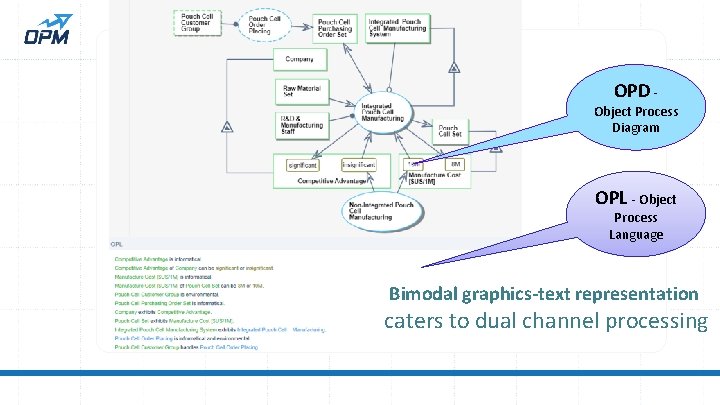
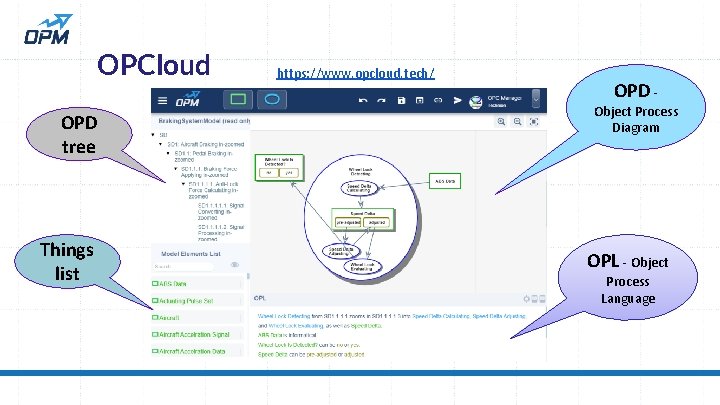
OPD - Object Process Diagram OPL - Object Process Language Bimodal graphics-text representation caters to dual channel processing
OPCloud OPD tree Things list https: //www. opcloud. tech/ OPD - Object Process Diagram OPL - Object Process Language
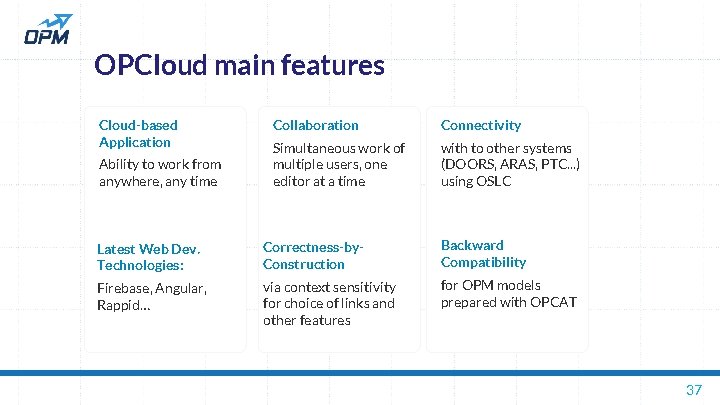
OPCloud main features Cloud-based Application Ability to work from anywhere, any time Collaboration Connectivity Simultaneous work of multiple users, one editor at a time with to other systems (DOORS, ARAS, PTC. . . ) using OSLC Latest Web Dev. Technologies: Correctness-by. Construction Backward Compatibility Firebase, Angular, Rappid… via context sensitivity for choice of links and other features for OPM models prepared with OPCAT 37
- Systems are inherently complex. - To alleviate complexity, OPM applies detail decomposition through three refinement-abstraction mechanisms: - In-zooming – Out-zooming - Unfolding – Folding - State expression – suppression.
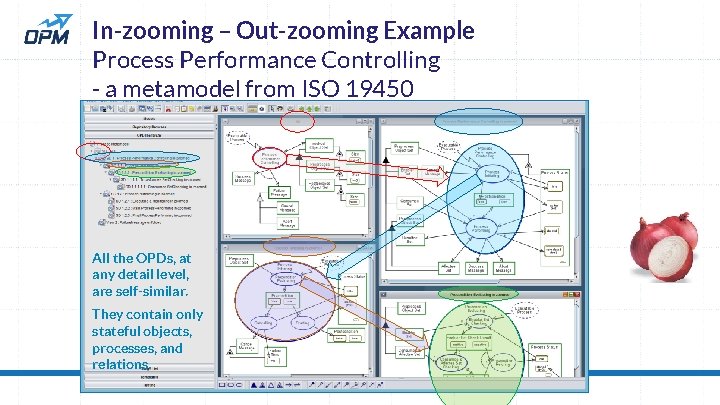
In-zooming – Out-zooming Example Process Performance Controlling - a metamodel from ISO 19450 All the OPDs, at any detail level, are self-similar. They contain only stateful objects, processes, and relations.
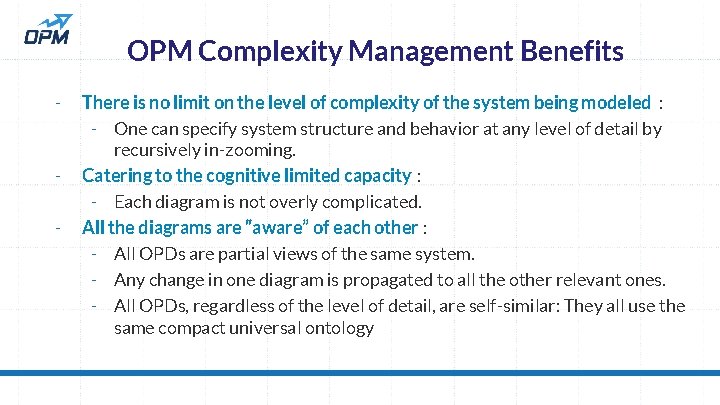
OPM Complexity Management Benefits - - There is no limit on the level of complexity of the system being modeled : - One can specify system structure and behavior at any level of detail by recursively in-zooming. Catering to the cognitive limited capacity : - Each diagram is not overly complicated. All the diagrams are “aware” of each other : - All OPDs are partial views of the same system. - Any change in one diagram is propagated to all the other relevant ones. - All OPDs, regardless of the level of detail, are self-similar: They all use the same compact universal ontology
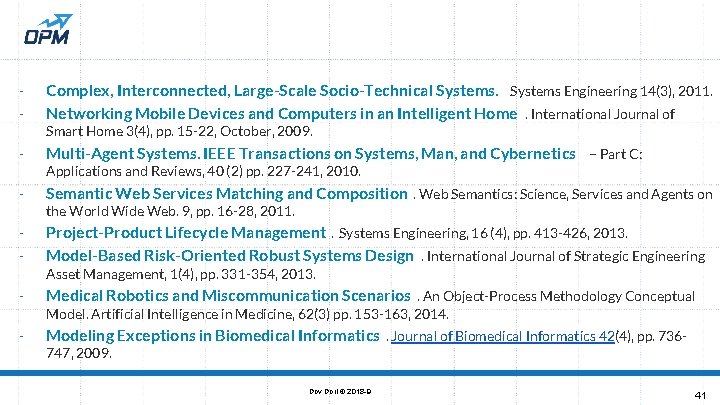
- Complex, Interconnected, Large-Scale Socio-Technical Systems Engineering 14(3), 2011. Networking Mobile Devices and Computers in an Intelligent Home. International Journal of - Multi-Agent Systems. IEEE Transactions on Systems, Man, and Cybernetics – Part C: - Semantic Web Services Matching and Composition. Web Semantics: Science, Services and Agents on - Project-Product Lifecycle Management. Systems Engineering, 16 (4), pp. 413 -426, 2013. Model-Based Risk-Oriented Robust Systems Design. International Journal of Strategic Engineering - Medical Robotics and Miscommunication Scenarios. An Object-Process Methodology Conceptual - Modeling Exceptions in Biomedical Informatics. Journal of Biomedical Informatics 42(4), pp. 736 - Smart Home 3(4), pp. 15 -22, October, 2009. Applications and Reviews, 40 (2) pp. 227 -241, 2010. the World Wide Web. 9, pp. 16 -28, 2011. Asset Management, 1(4), pp. 331 -354, 2013. Model. Artificial Intelligence in Medicine, 62(3) pp. 153 -163, 2014. 747, 2009. Dov Dori © 2018 -9 41
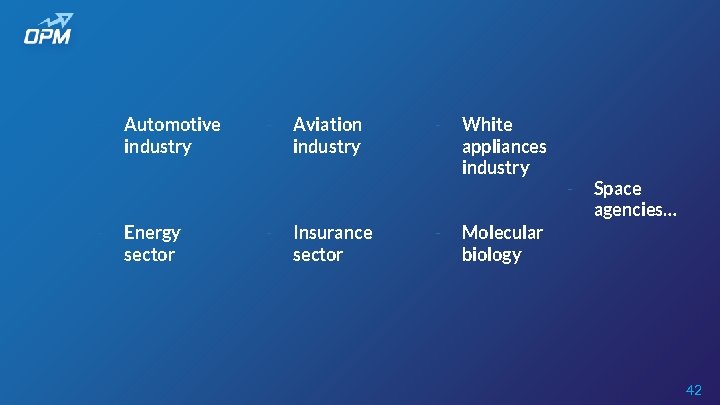
- - Automotive industry Energy sector - - Aviation industry Insurance sector - - White appliances industry - Space agencies… Molecular biology 42
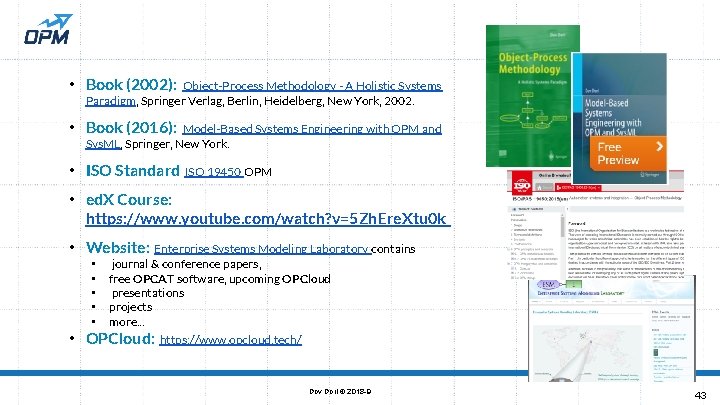
• Book (2002): Object-Process Methodology - A Holistic Systems Paradigm, Springer Verlag, Berlin, Heidelberg, New York, 2002. • Book (2016): Model-Based Systems Engineering with OPM and Sys. ML, Springer, New York. • ISO Standard ISO 19450 OPM • ed. X Course: https: //www. youtube. com/watch? v=5 Zh. Ere. Xtu 0 k • Website: Enterprise Systems Modeling Laboratory contains • • • journal & conference papers, free OPCAT software, upcoming OPCloud presentations projects more. . . • OPCloud: https: //www. opcloud. tech/ Dov Dori © 2018 -9 43
dori@technion. ac. il Tel: +972 -77 -8872441 Visit our Lab site; Download OPCAT free http: //esml. iem. technion. ac. il/ Experience OPCloud, Cloud-based OPM modeling: https: //www. opcloud. tech/ OPCloud@technion. ac. il Enterprise Systems Modeling Laboratory 212 Bloomfield, Technion - Israel Institute of Technology Haifa, 3200003 Israel 44