
Obtain authorization before entering a confined space The
Obtain authorization before entering a confined space The nature of industry in which PDO operates frequently requires personnel to enter ‘Confined Spaces’ to carry out inspections and / or maintenance and repair work. A confined space: • Has limited or restricted means of entry or exit • Is large enough for an employee to enter and perform assigned work, and • Is not designed for continuous occupancy by the employee. A “permit-required” confined space is one that meets the definition of a confined space and has one or more of these characteristics: • Contains or has the potential to contain a hazardous atmosphere, • Contains a material that has the potential for engulfing the entrant, • Has an internal configuration that might cause an entrant to be trapped or asphyxiated by inwardly converging walls or by a floor that slopes downward and tapers to a smaller cross section, and/or contains any other recognised serious safety or health hazards. 1
Obtain authorization before entering a confined space Potential Hazards Associated with Confined Space Entry These hazards can be any or all of the following: • Oxygen deficiency or enrichment • Flammability (fire and / or explosion) • Residual liquids, or solids and associated toxic or other noxious gases • Chemical hazards • Physical hazards • Number of personnel working within the confined space • Restricted entry / exit • Narcotic / anaesthetic effect of hydrocarbon gas and vapours 2
Obtain authorization before entering a confined space To comply to this Rule comply with PR-1148 Confined Space Entry and; • Avoid entering the Confined Space if the work can be done from outside • Complete a Risk Assessment and mitigate all risks to where possible to achieve ALARP (As Low As Reasonably Practicable) • People entering the Confined Space must be kept to the minimum / controlled / monitored and logged at all times • Monitor the atmosphere regularly • Rotate the people in the Confined Space to reduce risk of heat exhaustion • Always be aware of changes in conditions and be prepared to act accordingly • Ensure compliance to the following key procedures; • PR-1073 Gas Freeing and Purging of Process Equipment (Exc. Tanks) • PR-1076 Positive Isolation of Process Equipment • PR-1078 Hydrogen Sulphide Management • PR-1079 Gas Freeing and Purging of Tanks • PR-1081 The Buddy System • PR-1154 Gas Testing Procedure • PR-1172 Permit to Work System • SP-1104 Electrical Safety Rules 3
Obtain authorization before entering a confined space Working Atmosphere • Gas testing of confined spaces shall only be carried out by authorised personnel and shall be as required on the PTW and recorded on the Confined Space Entry Certificate and the Additional Gas Test Record form (if required). Refer to PTW System PR-1172. • Any confined space must have between 20% & 21% oxygen concentration by volume before any entry is authorised. In addition the possible hazards of hydrocarbons (narcotic effect) and H 2 S must be assessed where applicable. All testing shall be carried out using approved PDO testing equipment suitable for the gases being tested for i. e. Hydrocabons in air or hydrocarbons in an inert atmosphere etc. Care should be taken that the correct units of measurement are used. • If Naturally Occurring Radioactive Material (NORM) or Mercury is suspected then the necessary external and internal tests MUST be carried out by competent persons and the results checked and confirmed by the Production Chemists. If the tests are outside the specified limits, the confined space should be ventilated continuously and re-tested at regular intervals until acceptable. Further information on NORM and Mercury can be obtained in: • SP-1170 - HSE Specification - Naturally Occurring Radioactive Materials (NORM) • PR-1515 - Control of HSE Risks of Dealing with Mercury in PDO Facilities 4
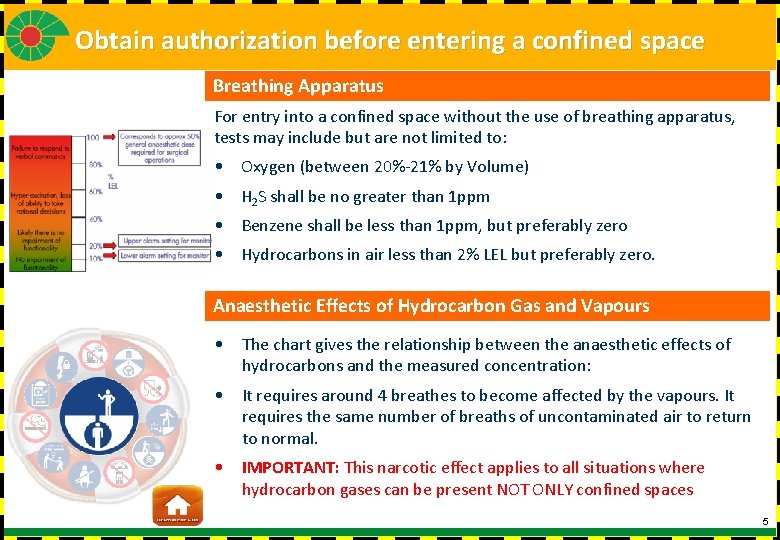
Obtain authorization before entering a confined space Breathing Apparatus For entry into a confined space without the use of breathing apparatus, tests may include but are not limited to: • Oxygen (between 20%-21% by Volume) • H 2 S shall be no greater than 1 ppm • Benzene shall be less than 1 ppm, but preferably zero • Hydrocarbons in air less than 2% LEL but preferably zero. Anaesthetic Effects of Hydrocarbon Gas and Vapours • The chart gives the relationship between the anaesthetic effects of hydrocarbons and the measured concentration: • It requires around 4 breathes to become affected by the vapours. It requires the same number of breaths of uncontaminated air to return to normal. • IMPORTANT: This narcotic effect applies to all situations where hydrocarbon gases can be present NOT ONLY confined spaces 5
Obtain authorization before entering a confined space 6
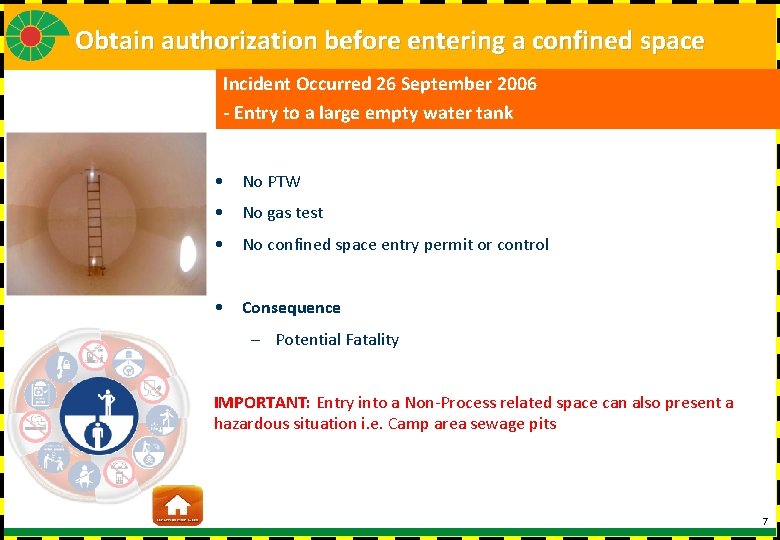
Obtain authorization before entering a confined space Incident Occurred 26 September 2006 - Entry to a large empty water tank • No PTW • No gas test • No confined space entry permit or control • Consequence – Potential Fatality IMPORTANT: Entry into a Non-Process related space can also present a hazardous situation i. e. Camp area sewage pits 7
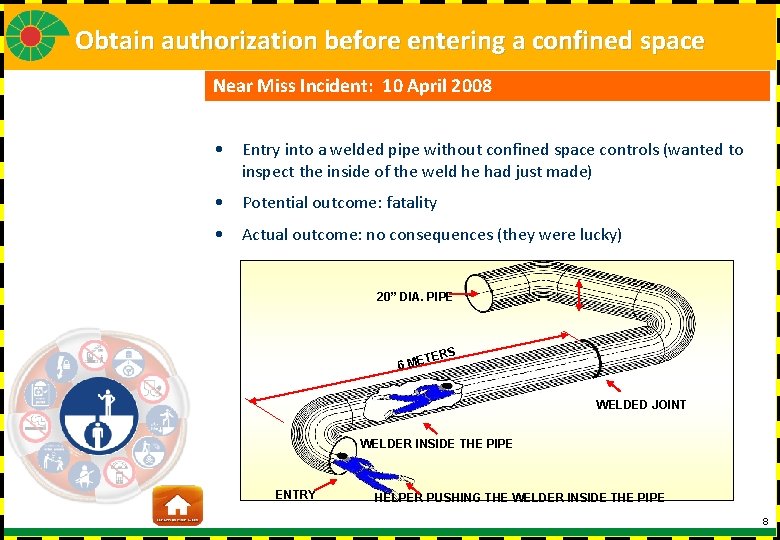
Obtain authorization before entering a confined space Near Miss Incident: 10 April 2008 • Entry into a welded pipe without confined space controls (wanted to inspect the inside of the weld he had just made) • Potential outcome: fatality • Actual outcome: no consequences (they were lucky) 20” DIA. PIPE S TER 6 ME WELDED JOINT WELDER INSIDE THE PIPE ENTRY HELPER PUSHING THE WELDER INSIDE THE PIPE 8
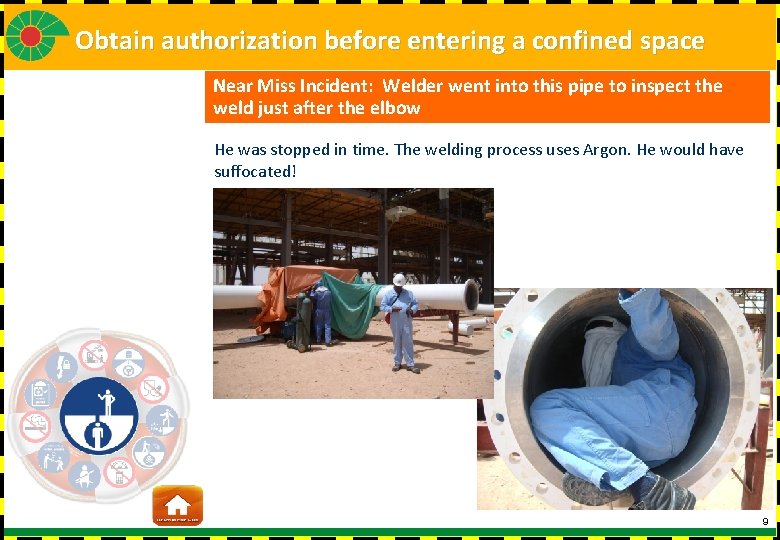
Obtain authorization before entering a confined space Near Miss Incident: Welder went into this pipe to inspect the weld just after the elbow He was stopped in time. The welding process uses Argon. He would have suffocated! 9
Obtain authorization before entering a confined space Supervisor Tips • Pose Question to your group • Allow 5 minutes for discussion on each Question • Summarize what you have heard before moving to the next Question • Split big groups up into smaller discussion teams • Take your time • Encourage everyone to take part • Look for real examples from your own workplace • Find and use real examples of incidents related to this rule from your site • Link the discussion to real work on site involving the people in the tool box talk 10
Obtain authorization before entering a confined space Question You are the Permit Applicant and you have to assess if the work to be carried out in a small vessel qualifies as a ‘Confined Space’. Which of these statements is not applicable: a. Has limited or restricted means of entry or exit b. Is not large enough for an employee to enter and perform assigned work correct answer c. Is not designed for continuous occupancy by the employee 11
Obtain authorization before entering a confined space Question You are the Area Authority and the results of the test for a confined space entry are: • Oxygen (between 20%-21%) • H 2 S <1 ppm • Benzene shall be less than 5 ppm • Hydrocarbons in air 4% LEL. Do you: a. Allow the entry to take place provided the levels do not increase b. Request a second gas test to be taken to verify results c. Allow entry provided BA is worn correct answer d. Stop the work until the correct conditions are obtained correct answer 12
Obtain authorization before entering a confined space Question You are the Safety Man outside the confined space that has contained hydrocarbons. You notice some the work force inside the space behaving irrationally and showing signs of hyper-activity. Do you: a. b. c. d. Tell them to stop and get on with their work Report them to the Permit Holder Raise the alarm and evacuate the confined space All of the above correct answer 13
- Slides: 13