Clumped YSO Jets and the Convergence of Radiatively
- Slides: 26
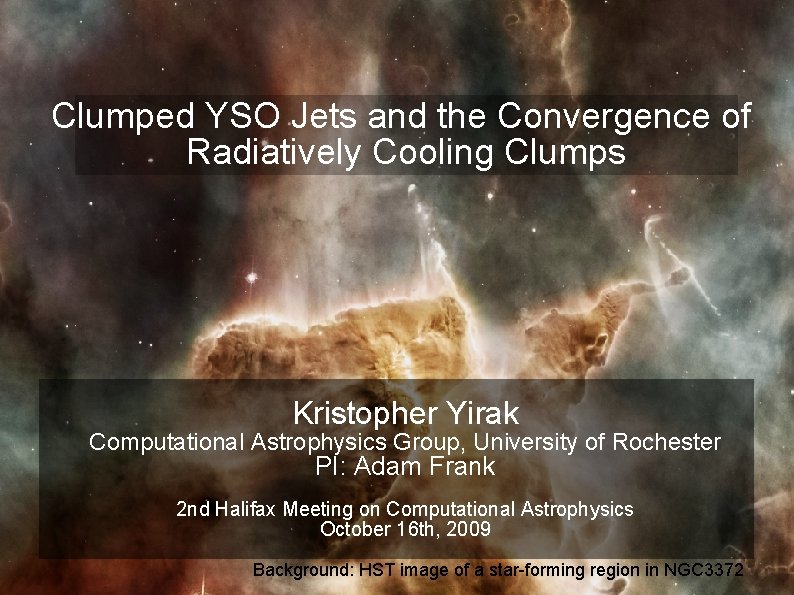
Clumped YSO Jets and the Convergence of Radiatively Cooling Clumps Kristopher Yirak Computational Astrophysics Group, University of Rochester PI: Adam Frank 2 nd Halifax Meeting on Computational Astrophysics October 16 th, 2009 1 / 17 Astro. BEAR: Background: HST image of a star-forming region in NGC 3372 http: //www. pas. rochester. edu/~bearclaw
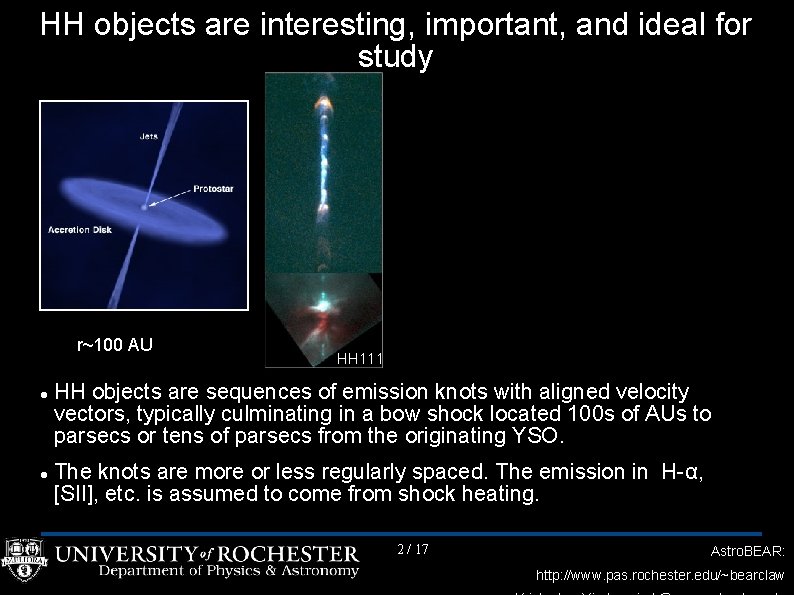
HH objects are interesting, important, and ideal for study r~100 AU HH 111 HH objects are sequences of emission knots with aligned velocity vectors, typically culminating in a bow shock located 100 s of AUs to parsecs or tens of parsecs from the originating YSO. The knots are more or less regularly spaced. The emission in H-α, [SII], etc. is assumed to come from shock heating. 2 / 17 Astro. BEAR: http: //www. pas. rochester. edu/~bearclaw
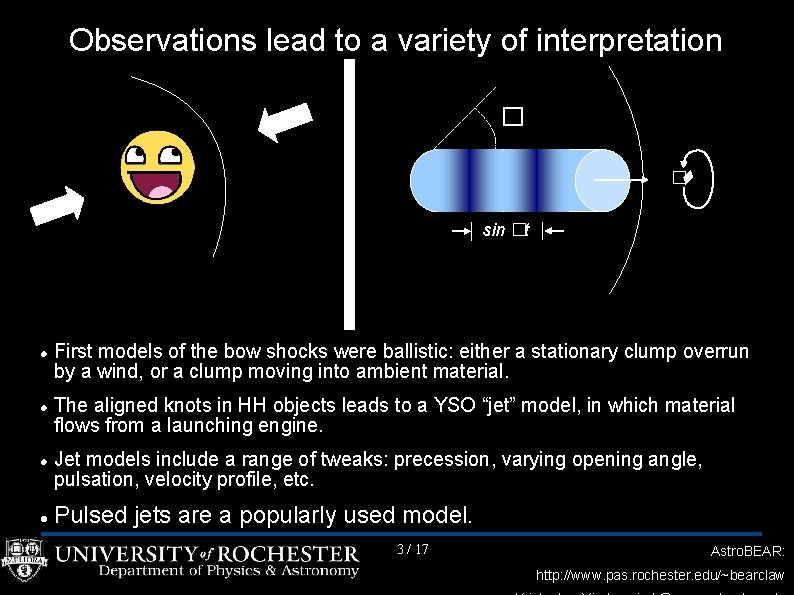
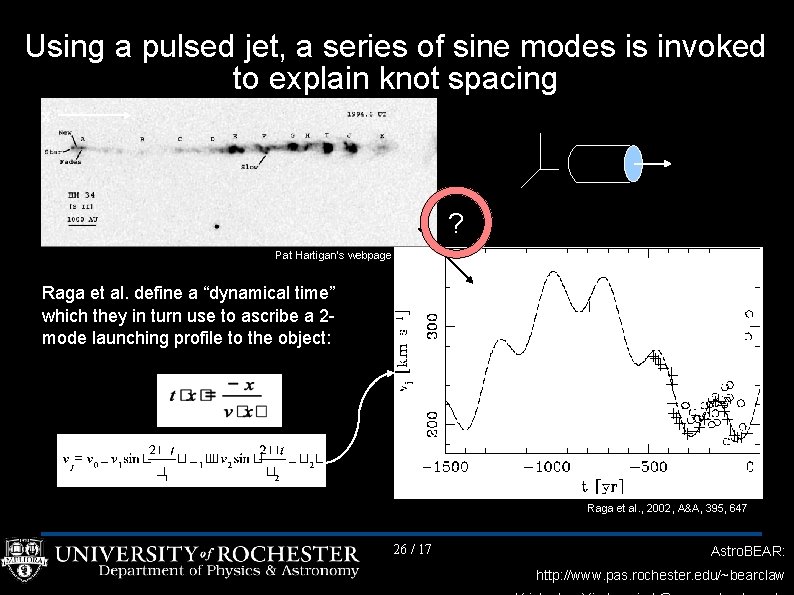
Observations lead to a variety of interpretation � � t sin �t First models of the bow shocks were ballistic: either a stationary clump overrun by a wind, or a clump moving into ambient material. The aligned knots in HH objects leads to a YSO “jet” model, in which material flows from a launching engine. Jet models include a range of tweaks: precession, varying opening angle, pulsation, velocity profile, etc. Pulsed jets are a popularly used model. 3 / 17 Astro. BEAR: http: //www. pas. rochester. edu/~bearclaw
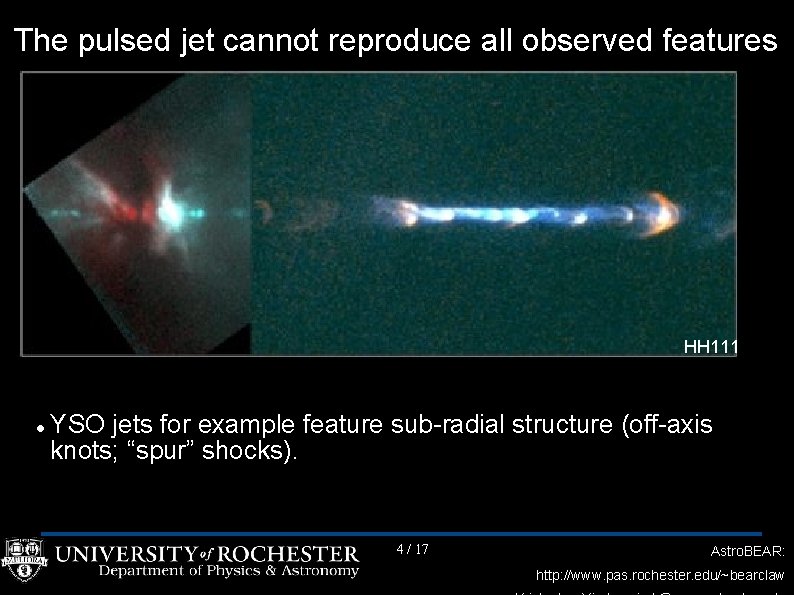
The pulsed jet cannot reproduce all observed features HH 111 YSO jets for example feature sub-radial structure (off-axis knots; “spur” shocks). 4 / 17 Astro. BEAR: http: //www. pas. rochester. edu/~bearclaw
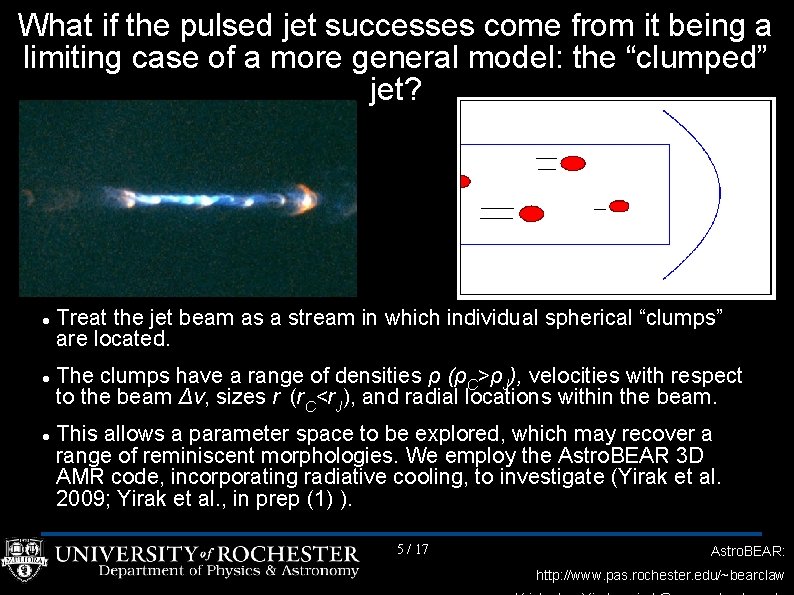
What if the pulsed jet successes come from it being a limiting case of a more general model: the “clumped” jet? Treat the jet beam as a stream in which individual spherical “clumps” are located. The clumps have a range of densities ρ (ρC>ρJ), velocities with respect to the beam Δv, sizes r (r. C<r. J), and radial locations within the beam. This allows a parameter space to be explored, which may recover a range of reminiscent morphologies. We employ the Astro. BEAR 3 D AMR code, incorporating radiative cooling, to investigate (Yirak et al. 2009; Yirak et al. , in prep (1) ). 5 / 17 Astro. BEAR: http: //www. pas. rochester. edu/~bearclaw
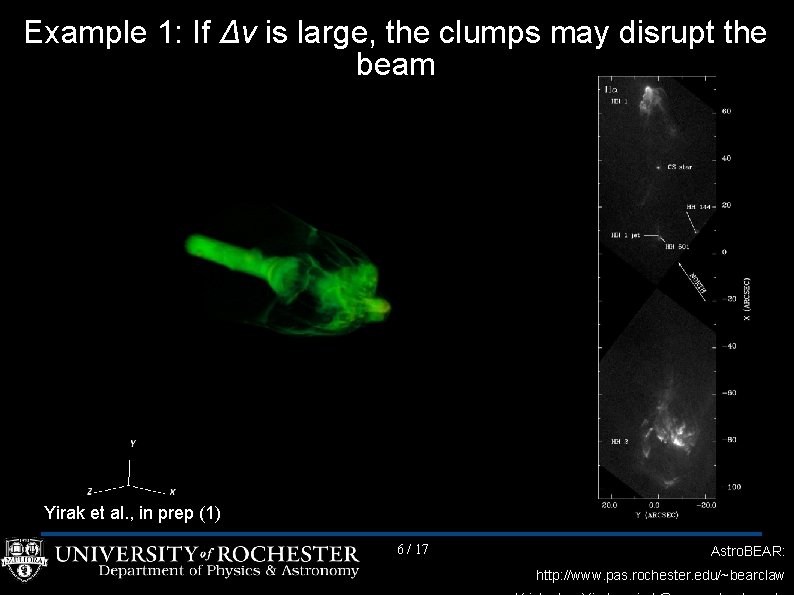
Example 1: If Δv is large, the clumps may disrupt the beam Yirak et al. , in prep (1) 6 / 17 Astro. BEAR: http: //www. pas. rochester. edu/~bearclaw
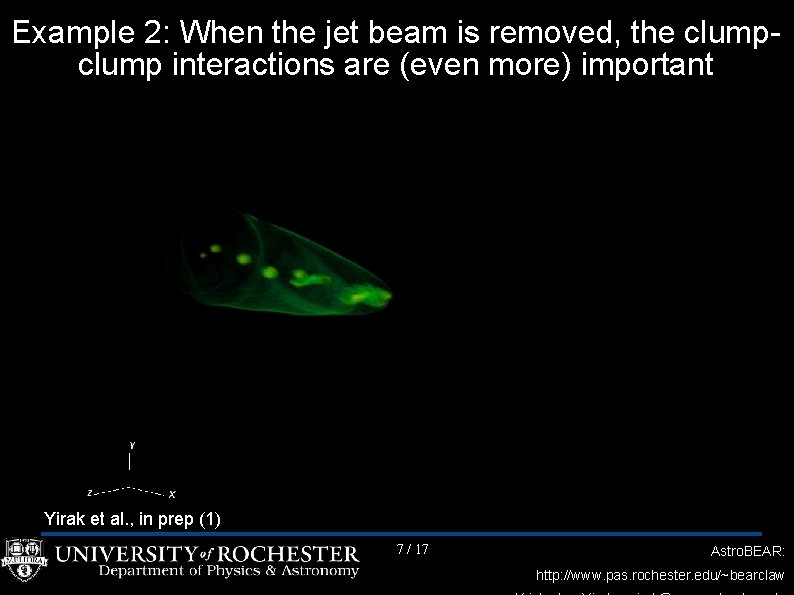
Example 2: When the jet beam is removed, the clump interactions are (even more) important Yirak et al. , in prep (1) 7 / 17 Astro. BEAR: http: //www. pas. rochester. edu/~bearclaw
A natural corollary: the evolution of radiatively cooling shocked clumps In the adiabatic limit, shocked clumps have been extensively studied (Stone, Norman 1992; Klein et al. 1994; Shin et al. 2008; many others). Less extensive when radiative cooling is included (Mellema et al. 2002; Fragile et al. 2004; Orlando et al. 2008). 8 / 17 Astro. BEAR: http: //www. pas. rochester. edu/~bearclaw
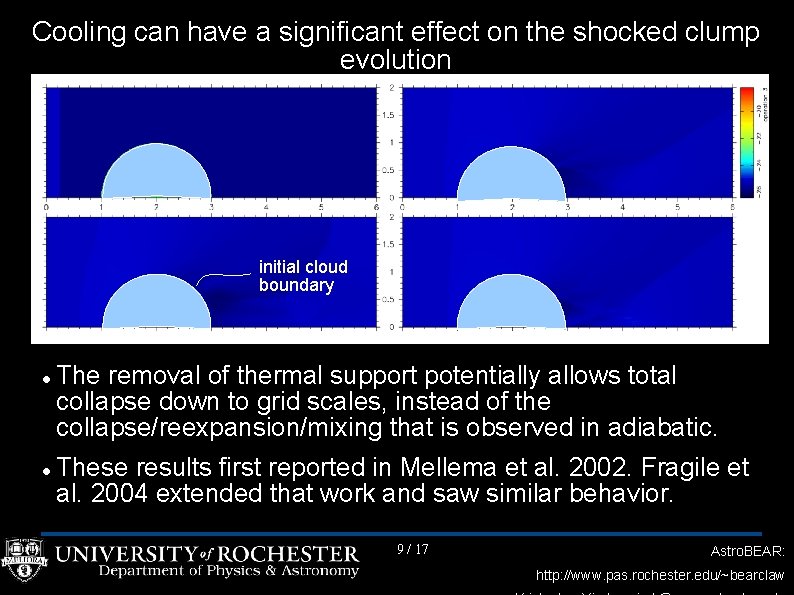
Cooling can have a significant effect on the shocked clump evolution initial cloud boundary The removal of thermal support potentially allows total collapse down to grid scales, instead of the collapse/reexpansion/mixing that is observed in adiabatic. These results first reported in Mellema et al. 2002. Fragile et al. 2004 extended that work and saw similar behavior. 9 / 17 Astro. BEAR: http: //www. pas. rochester. edu/~bearclaw
Why: cooling reduces the size of interaction regions in multiple-shock systems Cooling reduces shock speeds (via effectively lowering γ). For clumps, this implies smaller bow shock stand-off distances, as well as longer cloud-crushing times (t. CC). The limiting case is isothermal ( v. PS = v. S for M ≫ 1) (e. g. , Dyson & Williams 1980). The effect is determined by the ratio of cloud radius to cooling length, χCOOL ≡ r. C/LCOOL. For numerics, this implies a limiting resolution, below which important physics will not be fully resolved. Convergence studies of adiabatic clumps propose 100 -200 cells/r. C is sufficient to resolve hydrodynamics. No convergence study of cooling clumps in the literature. 10 / 17 Astro. BEAR: http: //www. pas. rochester. edu/~bearclaw
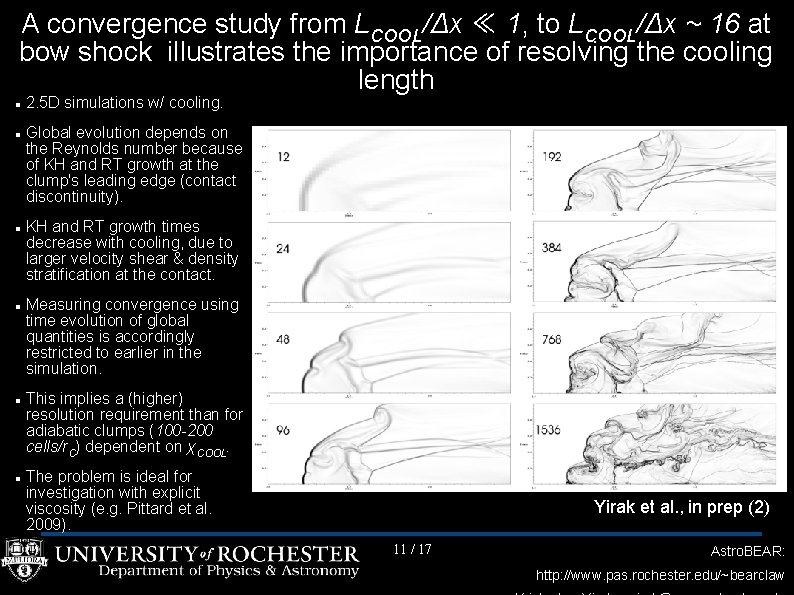
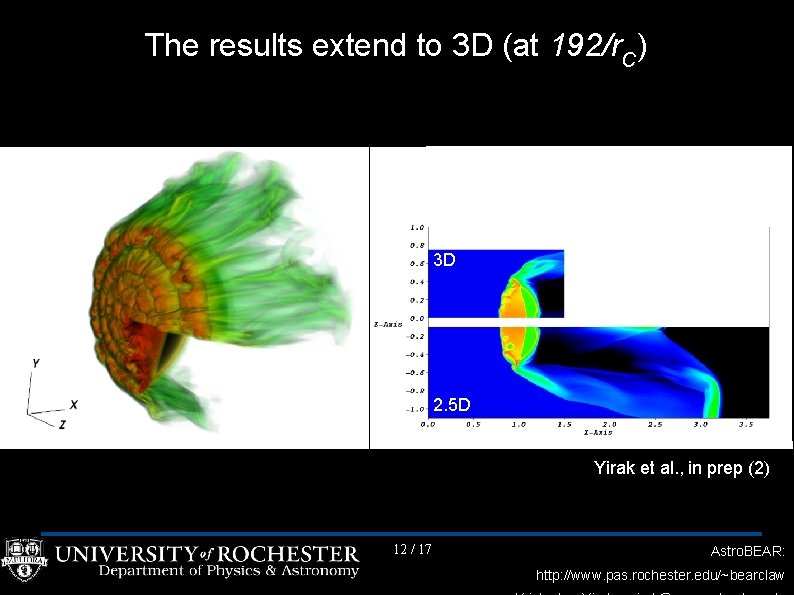
A convergence study from LCOOL/Δx ≪ 1, to LCOOL/Δx ~ 16 at bow shock illustrates the importance of resolving the cooling length 2. 5 D simulations w/ cooling. Global evolution depends on the Reynolds number because of KH and RT growth at the clump's leading edge (contact discontinuity). KH and RT growth times decrease with cooling, due to larger velocity shear & density stratification at the contact. Measuring convergence using time evolution of global quantities is accordingly restricted to earlier in the simulation. This implies a (higher) resolution requirement than for adiabatic clumps (100 -200 cells/r. C) dependent on χCOOL. The problem is ideal for investigation with explicit viscosity (e. g. Pittard et al. 2009). Yirak et al. , in prep (2) 11 / 17 Astro. BEAR: http: //www. pas. rochester. edu/~bearclaw
The results extend to 3 D (at 192/r. C) 3 D 2. 5 D Yirak et al. , in prep (2) 12 / 17 Astro. BEAR: http: //www. pas. rochester. edu/~bearclaw
Keeping χCOOL in mind, it will be interesting to revisit previous cooling clump results Simulation currently being performed on 512 processors on Bluegene/P system at the new Center for Research Computing at UR. Same physical parameters as Fragile et al. 2004, but with LCOOL/Δx ~ 1. Cf. Klein Woods 1998: Nonlinear Thin Shell Instability requires higher resolution in cooling & isothermal 13 / 17 Astro. BEAR: http: //www. pas. rochester. edu/~bearclaw
What to do when cooling clouds collapse? Radiative cooling may allow clump remnants to collapse to the point where the Jeans length becomes comparable to the remnant size. Thus, cooling clumps may be progenitors of local star formation. Accurately capturing this evolution requires the use of selfgravity. 14 / 17 Astro. BEAR: http: //www. pas. rochester. edu/~bearclaw
HYPRE: what to do when cooling clouds collapse HYPRE is a library of linear system solvers written in C developed at LLNL for massively parallel applications. HYPRE has been implemented in the fixed-grid version of Astro. BEAR. HYPRE is presently being implemented in the AMR version of Astro. BEAR. *** Please see my poster for details. *** 15 / 17 Astro. BEAR: http: //www. pas. rochester. edu/~bearclaw
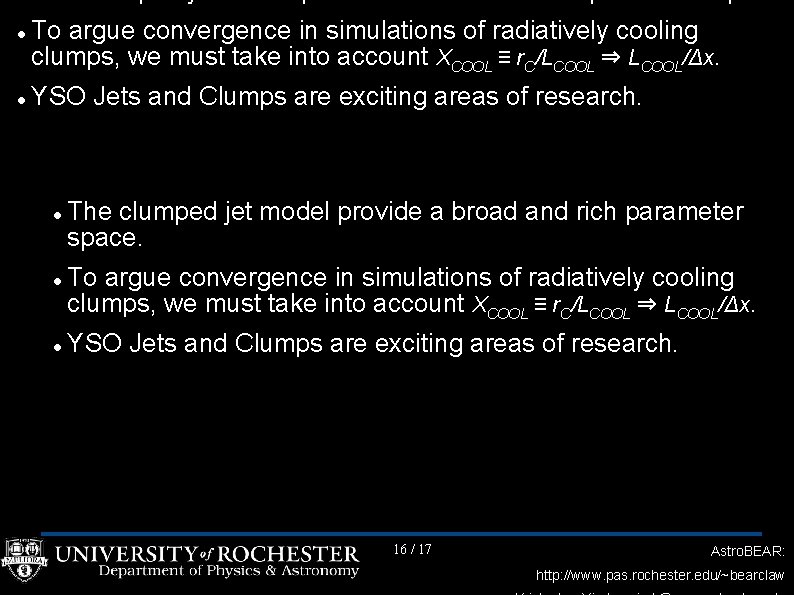
To argue convergence in simulations of radiatively cooling clumps, we must take into account ΧCOOL ≡ r. C/LCOOL ⇒ LCOOL/Δx. YSO Jets and Clumps are exciting areas of research. The clumped jet model provide a broad and rich parameter space. To argue convergence in simulations of radiatively cooling clumps, we must take into account ΧCOOL ≡ r. C/LCOOL ⇒ LCOOL/Δx. YSO Jets and Clumps are exciting areas of research. 16 / 17 Astro. BEAR: http: //www. pas. rochester. edu/~bearclaw
Thank you. Thanks to past and present group members: PI: Adam Frank Jonathan Carroll Andrew Cunningham (LLNL) Tim Dennis Christina Haig Martin Huarte-Espinosa Sorin Mitran (UNC) Alexei Poludnenko (Naval Lab) Ed Schroeder Brandon Shroyer Sean Tanny (Rice U. ) Peggy Varniere (U. Paris 7) Thanks to Spitzer, NSF, STSci, as well as the University of Rochester Laboratory for Laser Energetics (LLE). Thank you to the LOC for orchestrating the conference and giving me the opportunity to speak. 17 / 17 Astro. BEAR: http: //www. pas. rochester. edu/~bearclaw
Extra Slides 18 / 17 Astro. BEAR: http: //www. pas. rochester. edu/~bearclaw
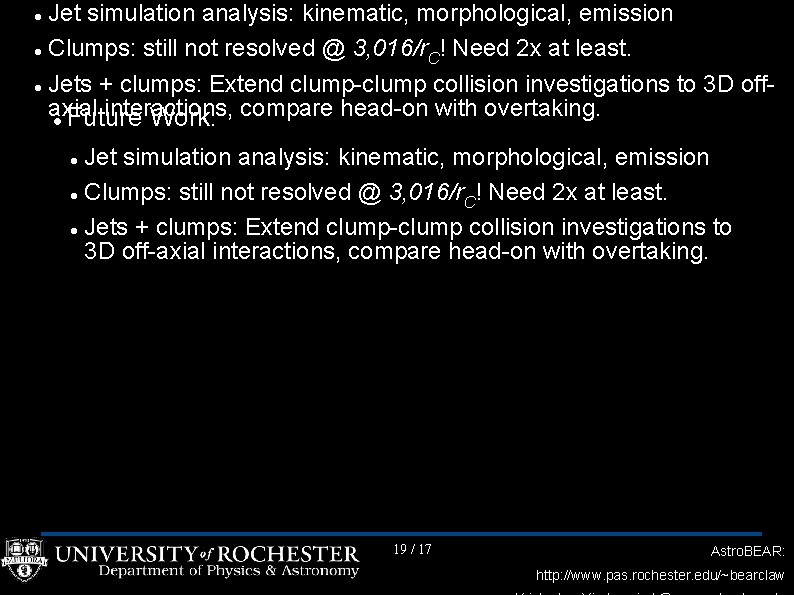
Jet simulation analysis: kinematic, morphological, emission Clumps: still not resolved @ 3, 016/r ! Need 2 x at least. C Jets + clumps: Extend clump-clump collision investigations to 3 D offaxial interactions, compare head-on with overtaking. Future Work: Jet simulation analysis: kinematic, morphological, emission Clumps: still not resolved @ 3, 016/r ! Need 2 x at least. C Jets + clumps: Extend clump-clump collision investigations to 3 D off-axial interactions, compare head-on with overtaking. 19 / 17 Astro. BEAR: http: //www. pas. rochester. edu/~bearclaw
References Dyson, J. & Wiliams, D. 1980, The Physics of the Interstellar Medium, Taylor & Francis Fragile, C. P. , Murray, S. D. , Anninos, P. , & van Breugel, W. 2004, Ap. J, 604, 74 Klein, R. I. , Mc. Kee C. F. , & Colella, P. 1994, Ap. J, 420, 213 Klein, R. I. , & Woods, D. T. 1998, Ap. J, 497, 777 Mellema, G. , Kurk, J. D. , & Rottgering, H. J. A. 2002, A&A, 395, L 13 Orlando, S. , Peres, G. , Reale, F. , Bocchino, F. , Rosner, R. , Plewa, T. , & Siegel, A. 2008, A&A, 444, 505 Pittard, J. M. , Falle, S. A. E. G. , Hartquist, T. W. , & Dyson, J. E. 2009, MNRAS, 394, 1351 Shin, M. S. , Stone, J. M. , & Snyder, G. F. 2008, Ap. J, 680, 336 Stone, J. M. & Norman, M. L. 1992, Ap. J, 612, 319 Yirak, K. , Frank, A. , Cunningham, 20 A. , / 17 & Mitran, S. 2009, 695, 999 Astro. BEAR: http: //www. pas. rochester. edu/~bearclaw
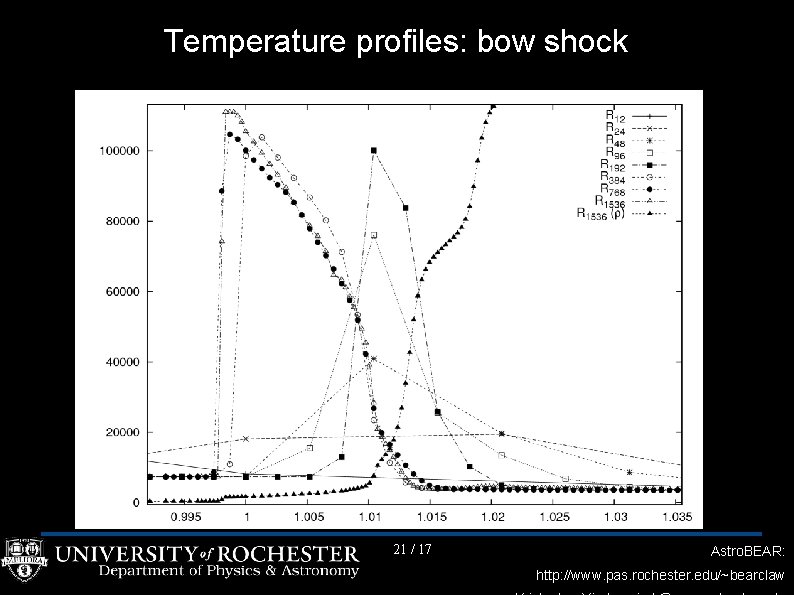
Temperature profiles: bow shock 21 / 17 Astro. BEAR: http: //www. pas. rochester. edu/~bearclaw
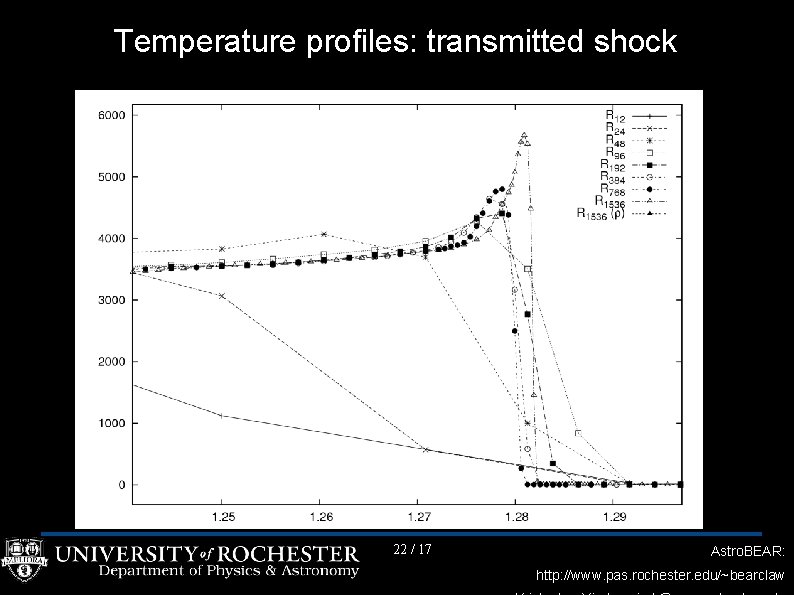
Temperature profiles: transmitted shock 22 / 17 Astro. BEAR: http: //www. pas. rochester. edu/~bearclaw
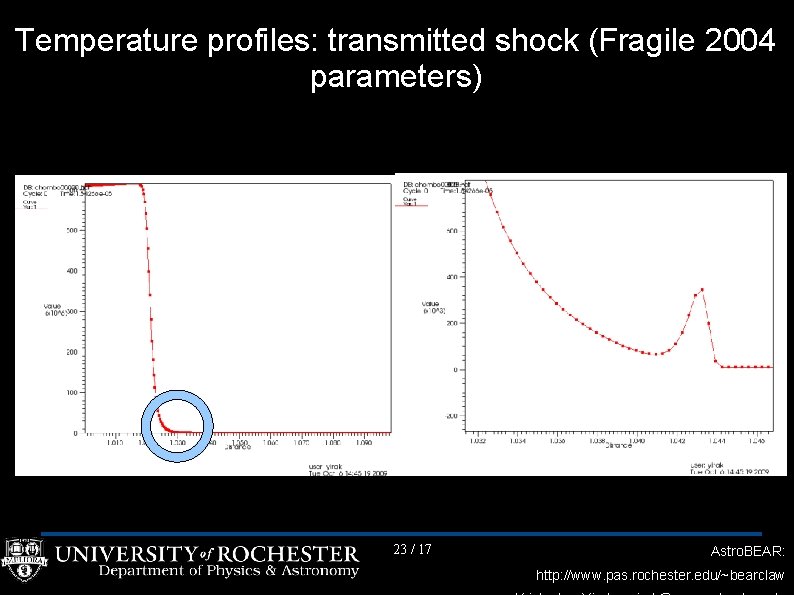
Temperature profiles: transmitted shock (Fragile 2004 parameters) 23 / 17 Astro. BEAR: http: //www. pas. rochester. edu/~bearclaw
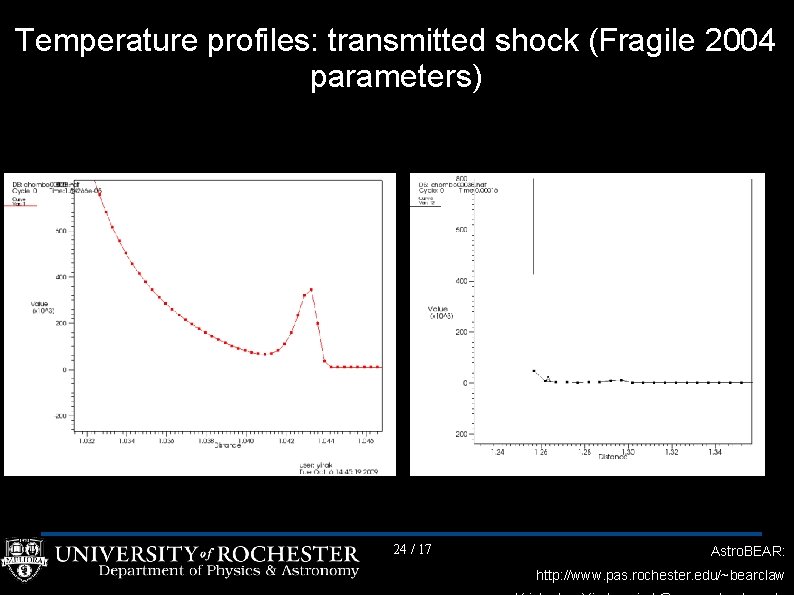
Temperature profiles: transmitted shock (Fragile 2004 parameters) 24 / 17 Astro. BEAR: http: //www. pas. rochester. edu/~bearclaw
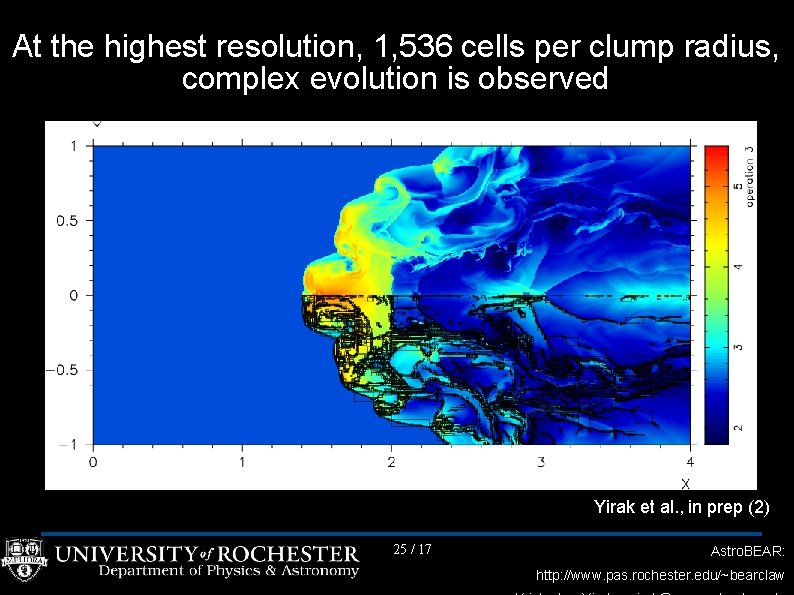
At the highest resolution, 1, 536 cells per clump radius, complex evolution is observed Yirak et al. , in prep (2) 25 / 17 Astro. BEAR: http: //www. pas. rochester. edu/~bearclaw
Using a pulsed jet, a series of sine modes is invoked to explain knot spacing x ? Pat Hartigan's webpage Raga et al. define a “dynamical time” which they in turn use to ascribe a 2 mode launching profile to the object: Raga et al. , 2002, A&A, 395, 647 26 / 17 Astro. BEAR: http: //www. pas. rochester. edu/~bearclaw