Class Notes 9 Power Series 13 82 A

- Slides: 43
Class Notes 9: Power Series (1/3) 82 A – Engineering Mathematics
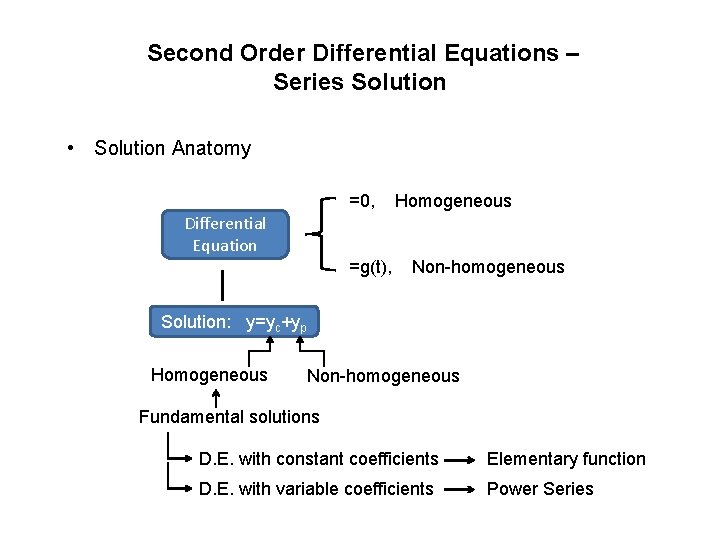
Second Order Differential Equations – Series Solution • Solution Anatomy =0, Homogeneous Differential Equation =g(t), Non-homogeneous Solution: y=yc+yp Homogeneous Non-homogeneous Fundamental solutions D. E. with constant coefficients Elementary function D. E. with variable coefficients Power Series
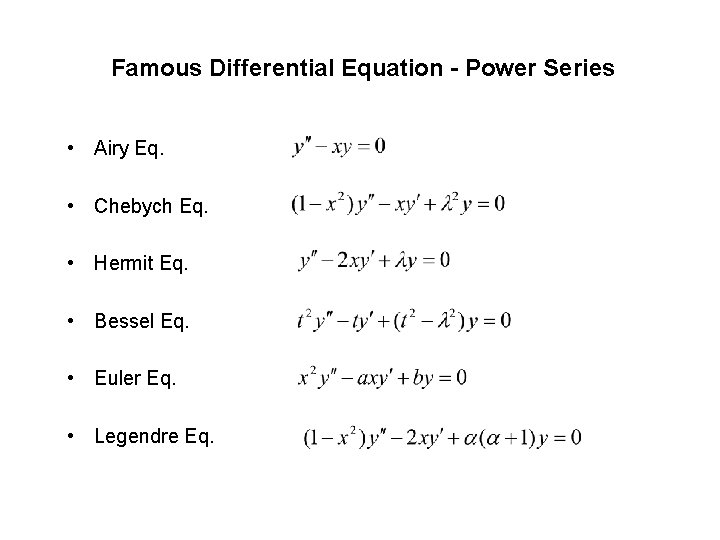
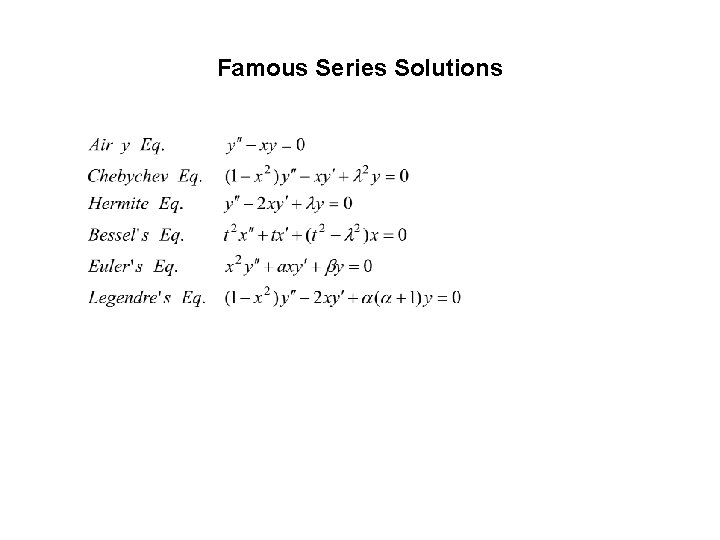
Famous Differential Equation - Power Series • Airy Eq. • Chebych Eq. • Hermit Eq. • Bessel Eq. • Euler Eq. • Legendre Eq.
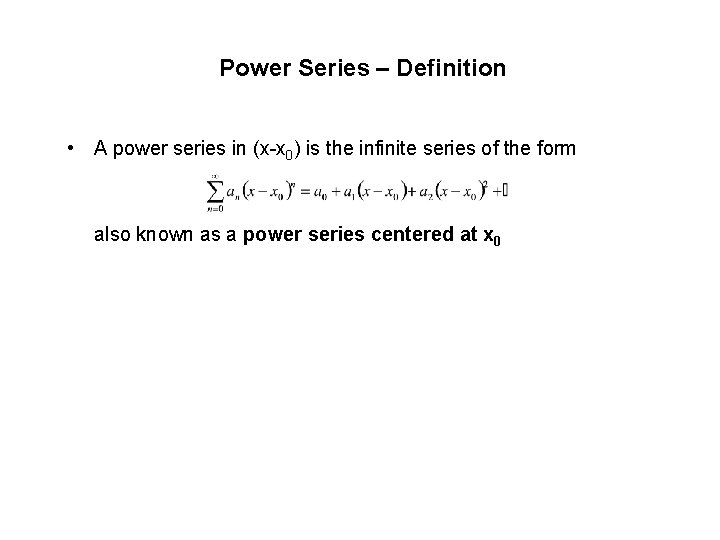
Power Series – Definition • A power series in (x-x 0) is the infinite series of the form also known as a power series centered at x 0
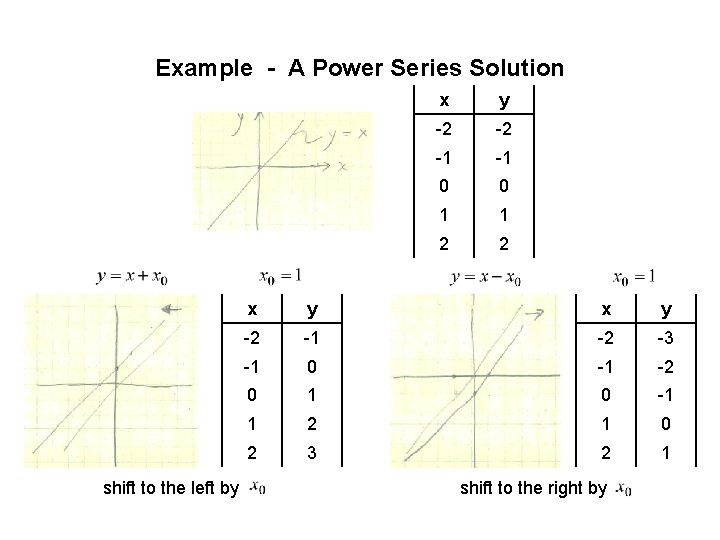
Example - A Power Series Solution shift to the left by x y -2 -2 -1 -1 0 0 1 1 2 2 x y -2 -1 -2 -3 -1 0 -1 -2 0 1 0 -1 1 2 1 0 2 3 2 1 shift to the right by
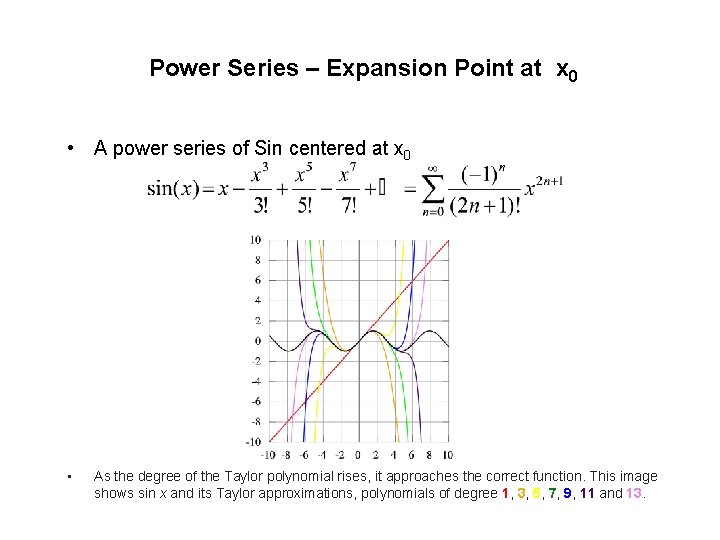
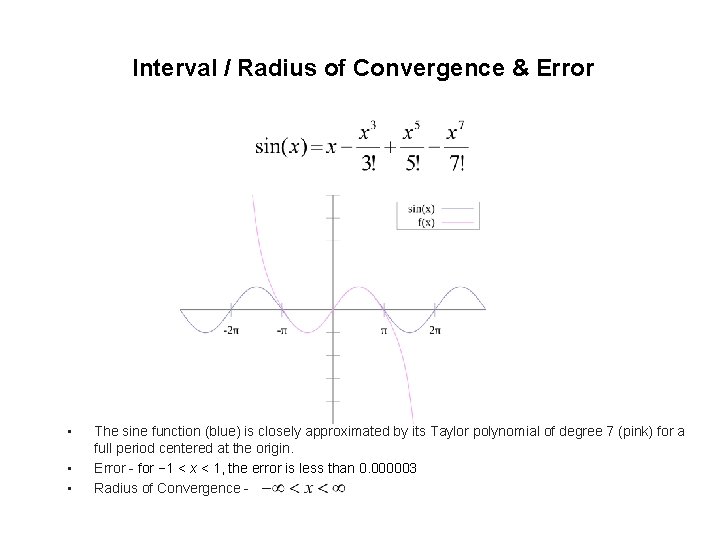
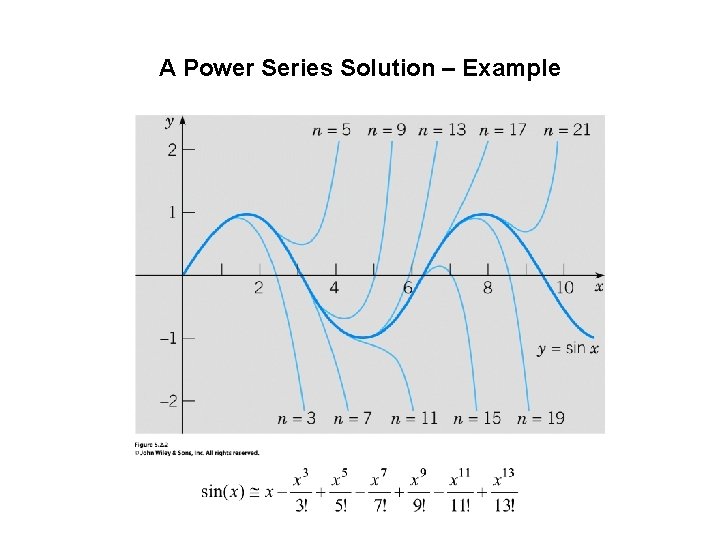
Power Series – Expansion Point at x 0 • A power series of Sin centered at x 0 • As the degree of the Taylor polynomial rises, it approaches the correct function. This image shows sin x and its Taylor approximations, polynomials of degree 1, 3, 5, 7, 9, 11 and 13.
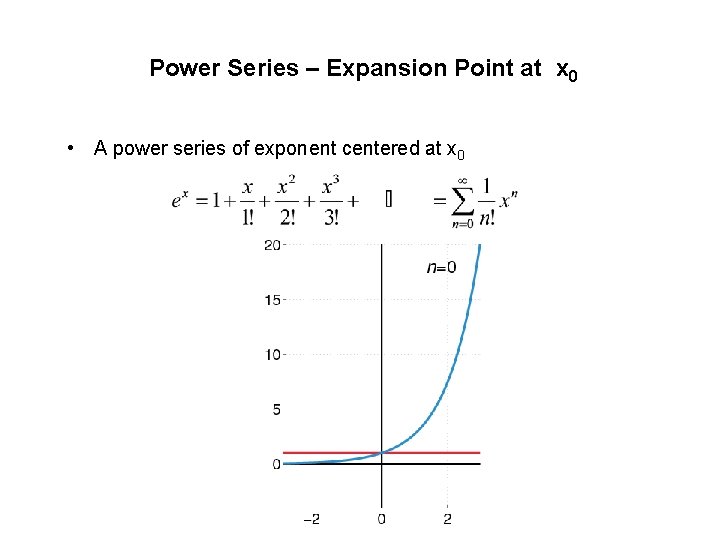
Power Series – Expansion Point at x 0 • A power series of exponent centered at x 0
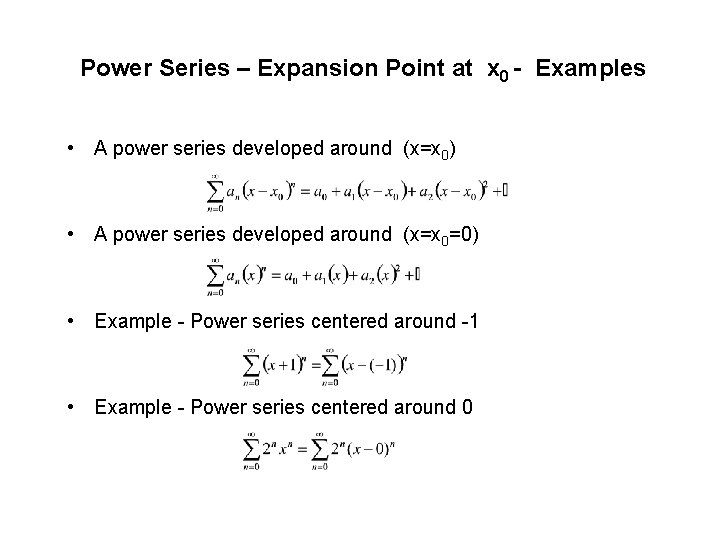
Power Series – Expansion Point at x 0 - Examples • A power series developed around (x=x 0) • A power series developed around (x=x 0=0) • Example - Power series centered around -1 • Example - Power series centered around 0
Interval / Radius of Convergence & Error • • • The sine function (blue) is closely approximated by its Taylor polynomial of degree 7 (pink) for a full period centered at the origin. Error - for − 1 < x < 1, the error is less than 0. 000003 Radius of Convergence -
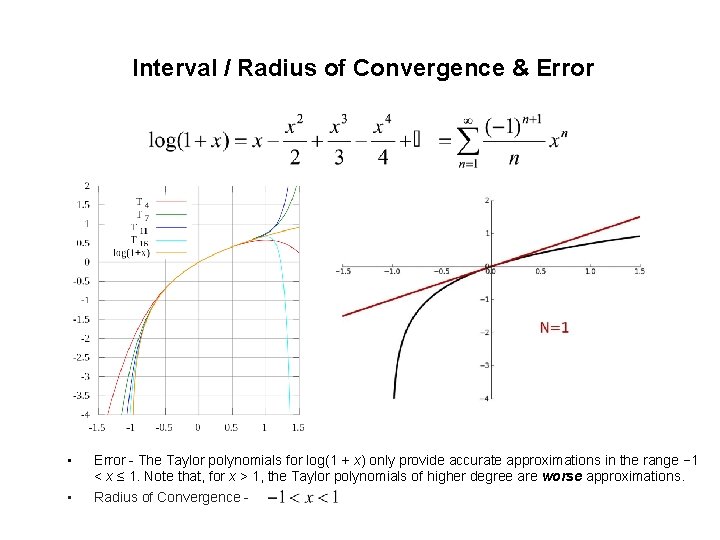
Interval / Radius of Convergence & Error • • Error - The Taylor polynomials for log(1 + x) only provide accurate approximations in the range − 1 < x ≤ 1. Note that, for x > 1, the Taylor polynomials of higher degree are worse approximations. Radius of Convergence -
Radius of Convergence
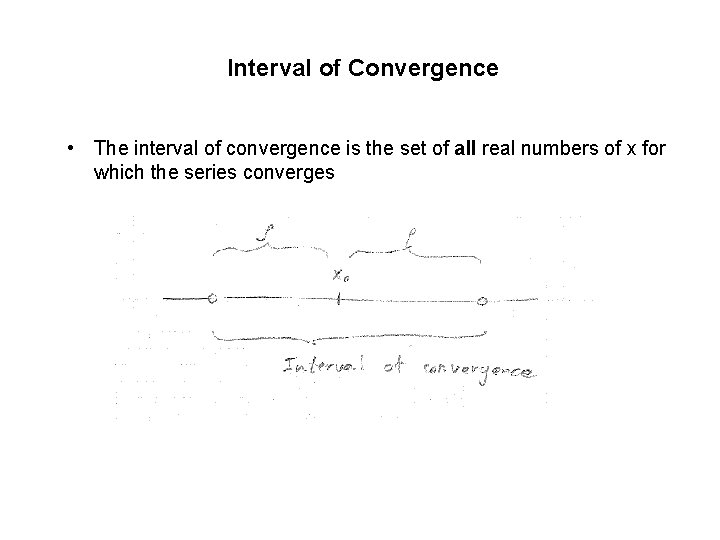
Interval of Convergence • The interval of convergence is the set of all real numbers of x for which the series converges
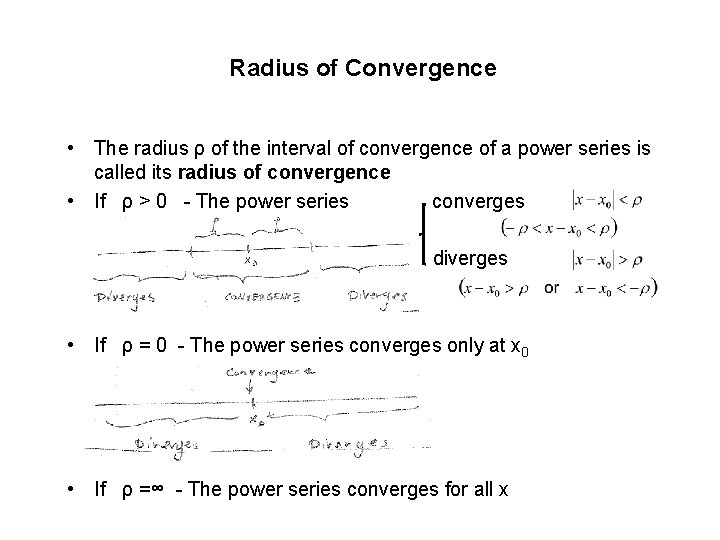
Radius of Convergence • The radius ρ of the interval of convergence of a power series is called its radius of convergence • If ρ > 0 - The power series converges diverges • If ρ = 0 - The power series converges only at x 0 • If ρ =∞ - The power series converges for all x
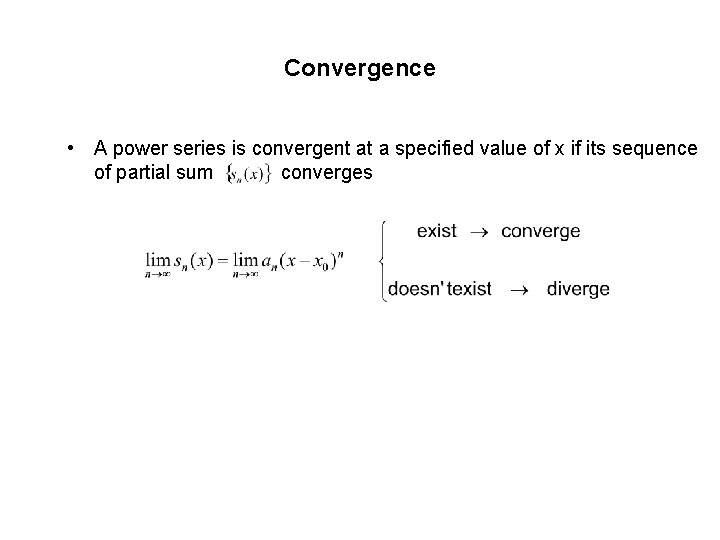
Convergence • A power series is convergent at a specified value of x if its sequence of partial sum converges
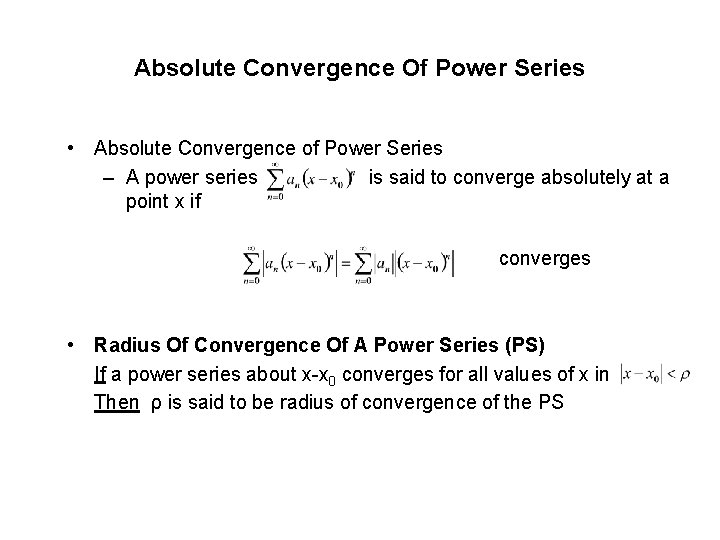
Absolute Convergence Of Power Series • Absolute Convergence of Power Series – A power series is said to converge absolutely at a point x if converges • Radius Of Convergence Of A Power Series (PS) If a power series about x-x 0 converges for all values of x in Then ρ is said to be radius of convergence of the PS
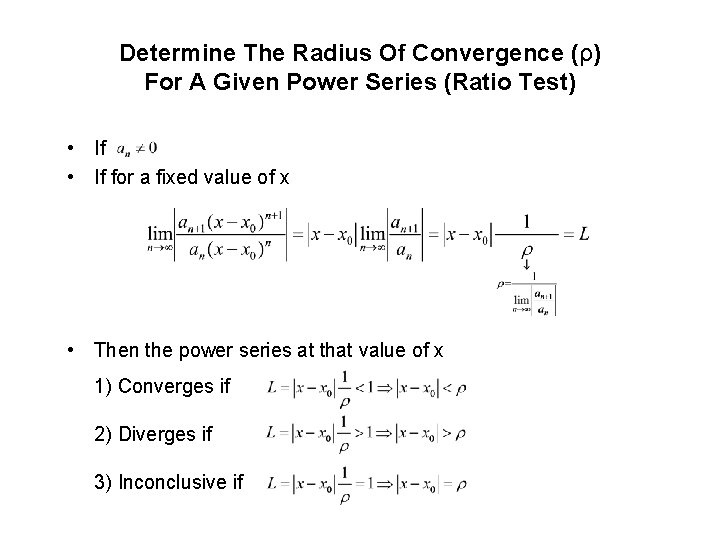
Determine The Radius Of Convergence (ρ) For A Given Power Series (Ratio Test) • If for a fixed value of x • Then the power series at that value of x 1) Converges if 2) Diverges if 3) Inconclusive if
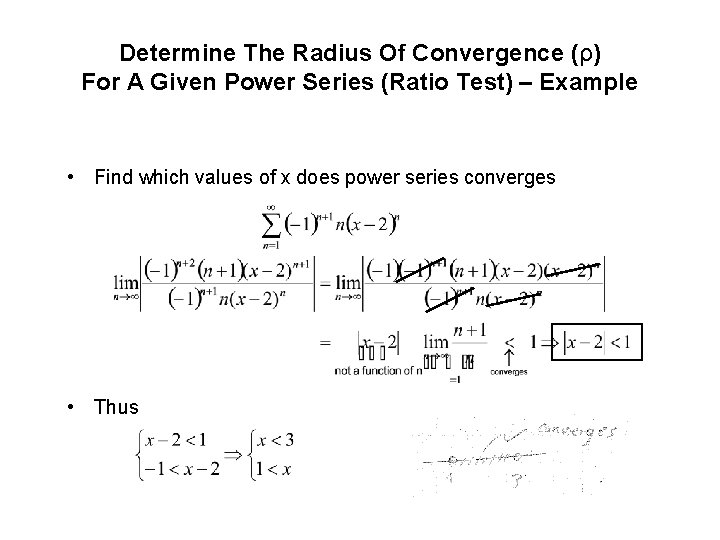
Determine The Radius Of Convergence (ρ) For A Given Power Series (Ratio Test) – Example • Find which values of x does power series converges • Thus
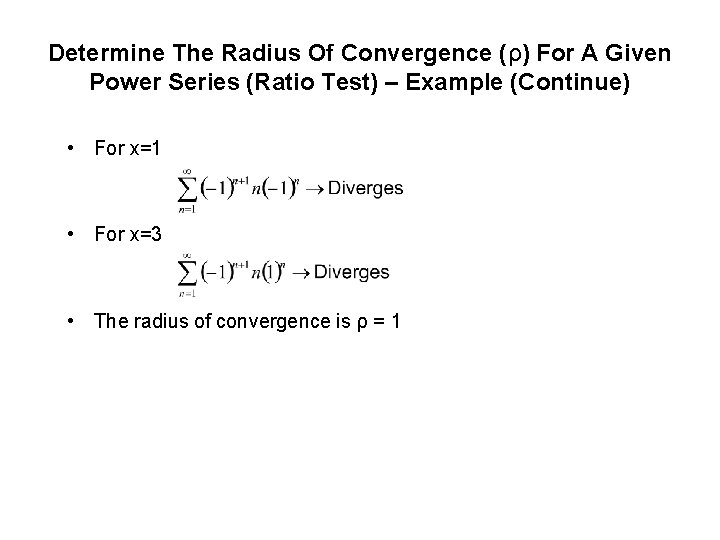
Determine The Radius Of Convergence (ρ) For A Given Power Series (Ratio Test) – Example (Continue) • For x=1 • For x=3 • The radius of convergence is ρ = 1
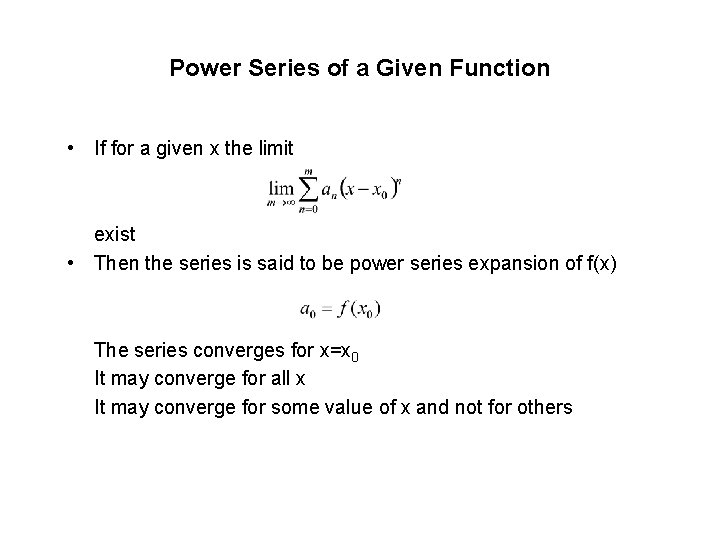
Power Series of a Given Function • If for a given x the limit exist • Then the series is said to be power series expansion of f(x) The series converges for x=x 0 It may converge for all x It may converge for some value of x and not for others
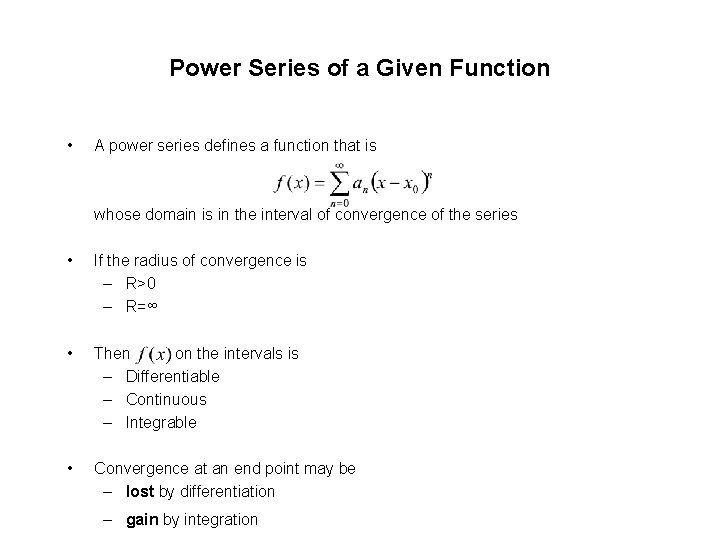
Power Series of a Given Function • A power series defines a function that is whose domain is in the interval of convergence of the series • If the radius of convergence is – R>0 – R=∞ • Then on the intervals is – Differentiable – Continuous – Integrable • Convergence at an end point may be – lost by differentiation – gain by integration
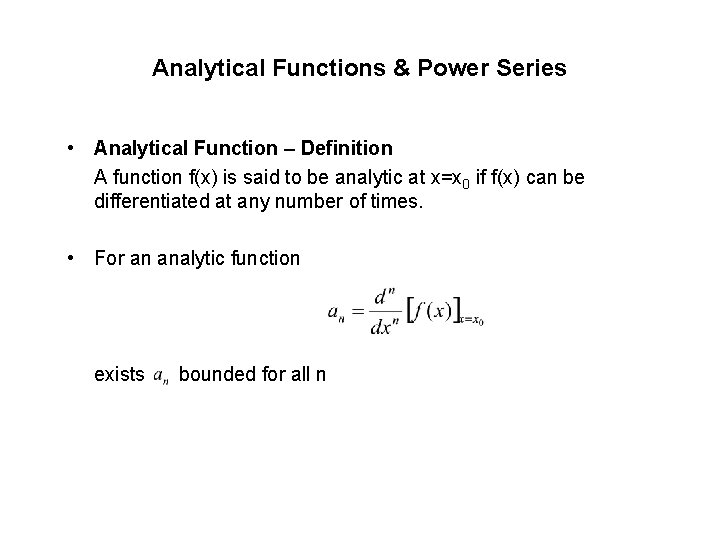
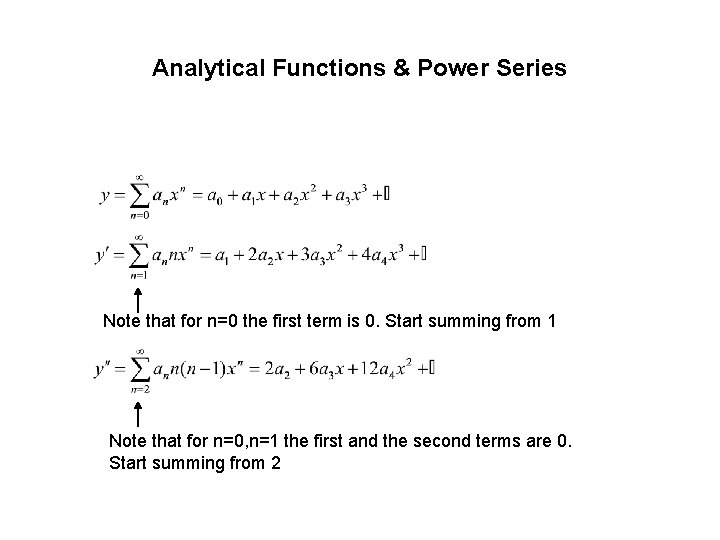
Analytical Functions & Power Series • Analytical Function – Definition A function f(x) is said to be analytic at x=x 0 if f(x) can be differentiated at any number of times. • For an analytic function exists bounded for all n
Analytical Functions & Power Series Note that for n=0 the first term is 0. Start summing from 1 Note that for n=0, n=1 the first and the second terms are 0. Start summing from 2
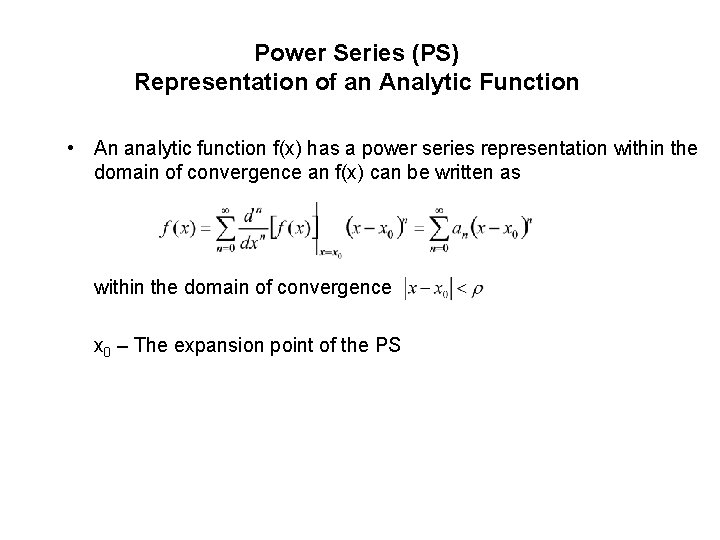
Power Series (PS) Representation of an Analytic Function • An analytic function f(x) has a power series representation within the domain of convergence an f(x) can be written as within the domain of convergence x 0 – The expansion point of the PS
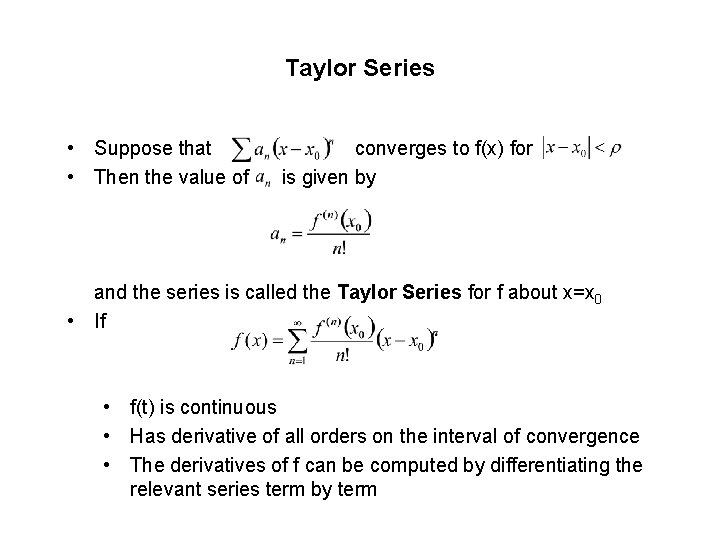
Taylor Series • Suppose that converges to f(x) for • Then the value of is given by and the series is called the Taylor Series for f about x=x 0 • If • f(t) is continuous • Has derivative of all orders on the interval of convergence • The derivatives of f can be computed by differentiating the relevant series term by term
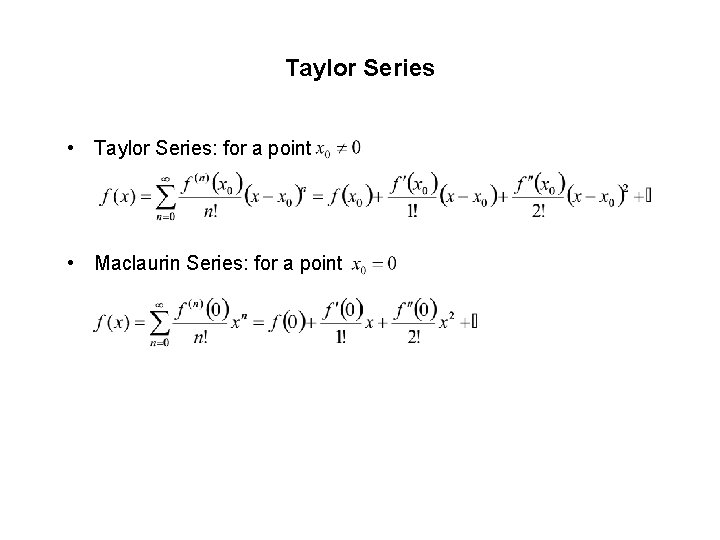
Taylor Series • Taylor Series: for a point • Maclaurin Series: for a point
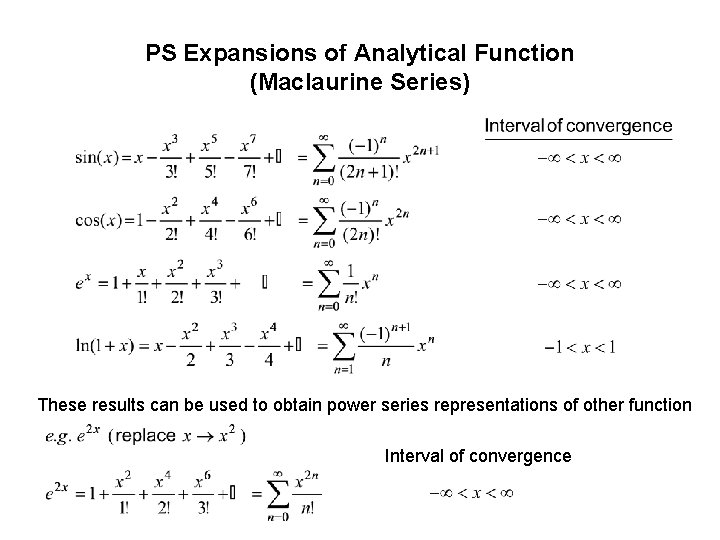
PS Expansions of Analytical Function (Maclaurine Series) These results can be used to obtain power series representations of other function Interval of convergence
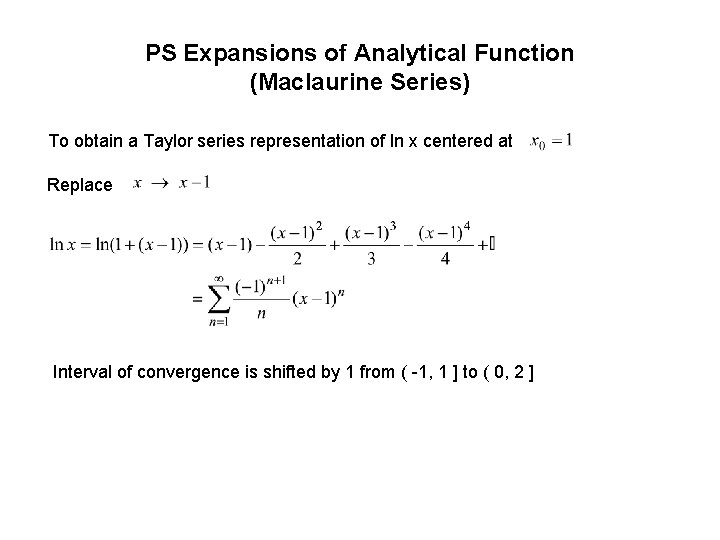
PS Expansions of Analytical Function (Maclaurine Series) To obtain a Taylor series representation of ln x centered at Replace Interval of convergence is shifted by 1 from ( -1, 1 ] to ( 0, 2 ]
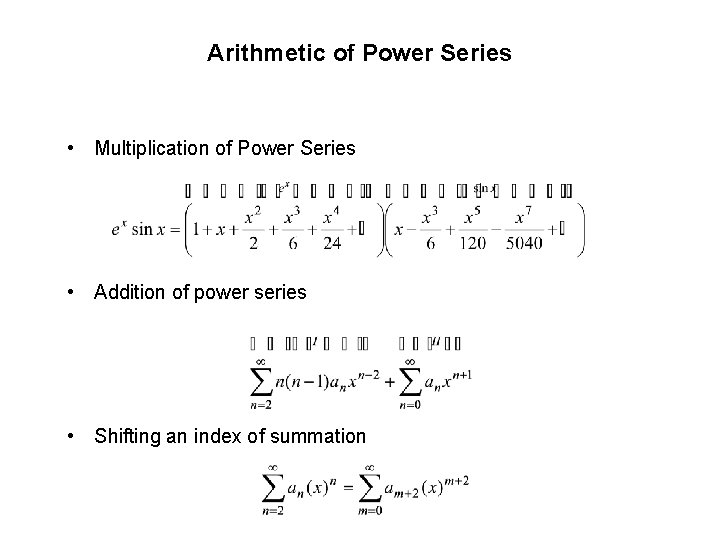
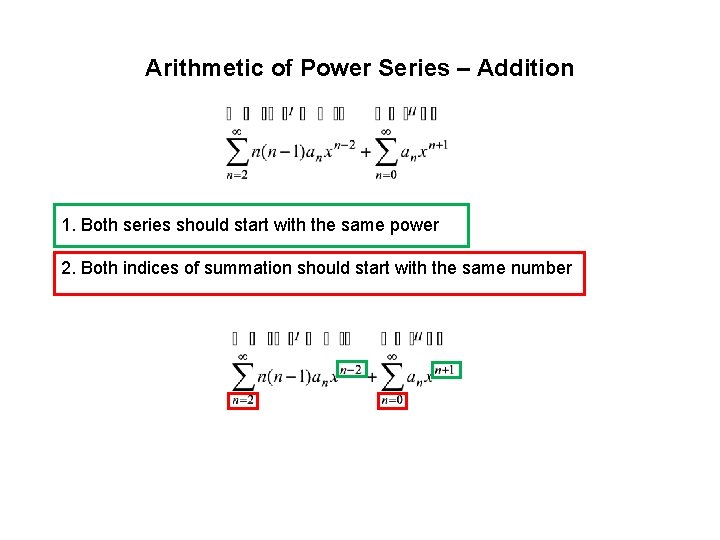
Arithmetic of Power Series • Multiplication of Power Series • Addition of power series • Shifting an index of summation
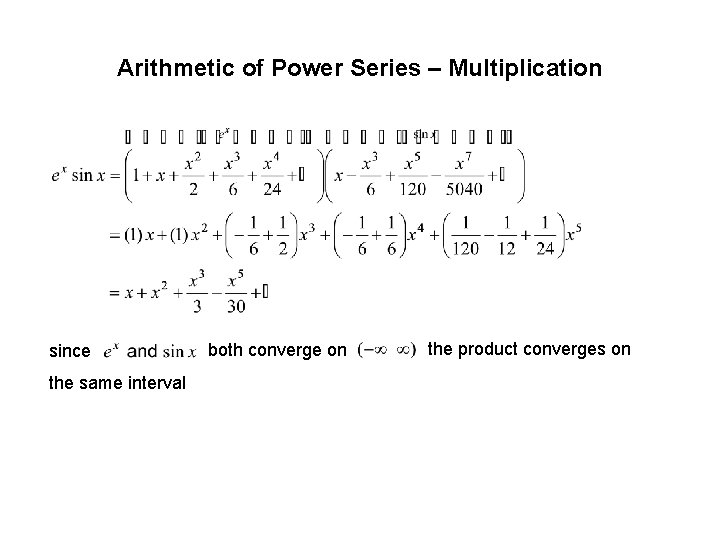
Arithmetic of Power Series – Multiplication since the same interval both converge on the product converges on
Arithmetic of Power Series – Addition 1. Both series should start with the same power 2. Both indices of summation should start with the same number
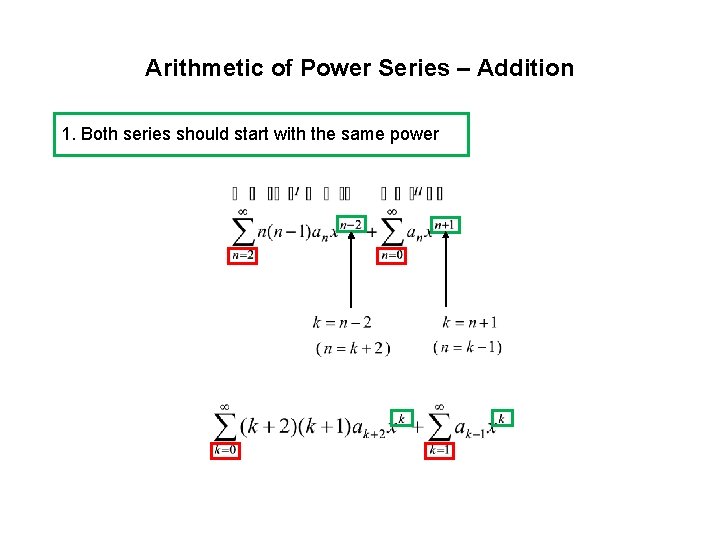
Arithmetic of Power Series – Addition 1. Both series should start with the same power
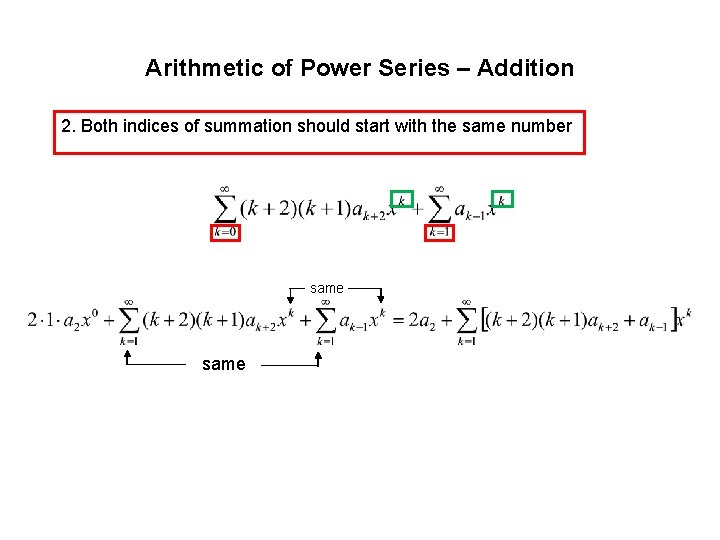
Arithmetic of Power Series – Addition 2. Both indices of summation should start with the same number same
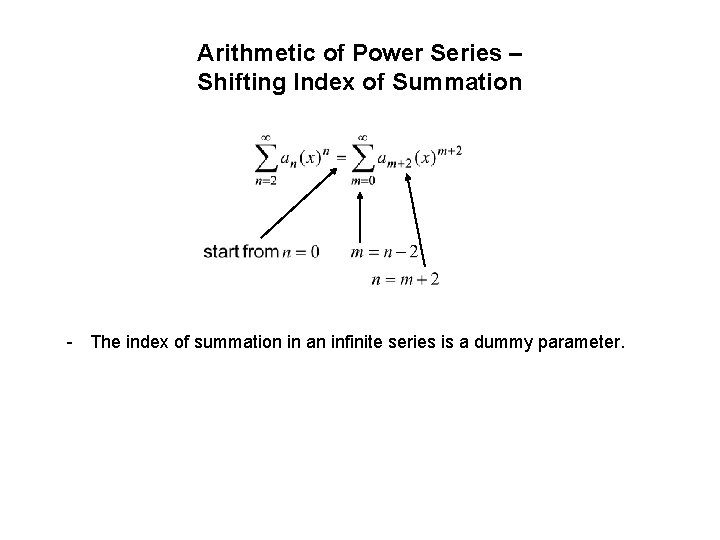
Arithmetic of Power Series – Shifting Index of Summation - The index of summation in an infinite series is a dummy parameter.
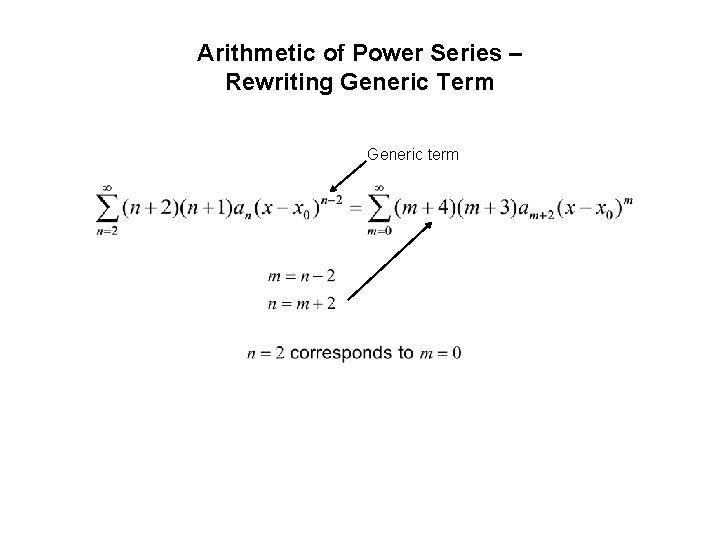
Arithmetic of Power Series – Rewriting Generic Term Generic term
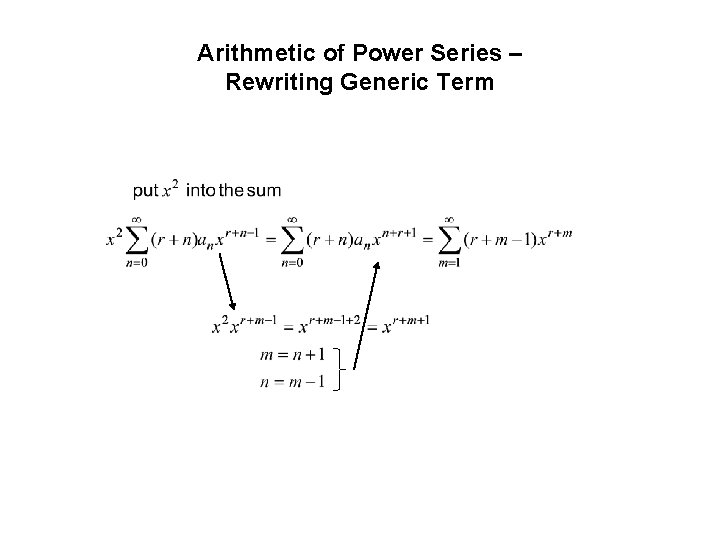
Arithmetic of Power Series – Rewriting Generic Term
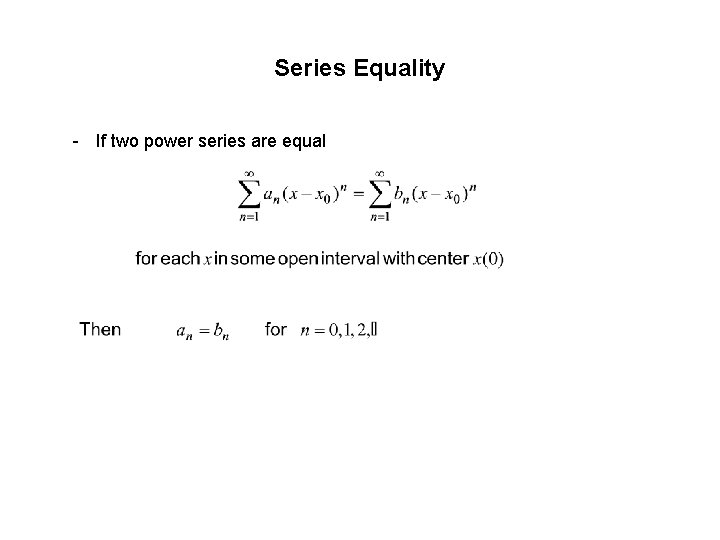
Series Equality - If two power series are equal
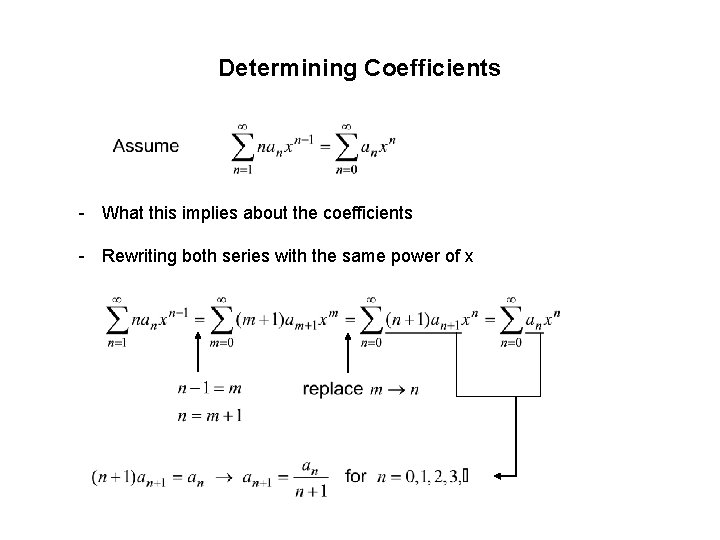
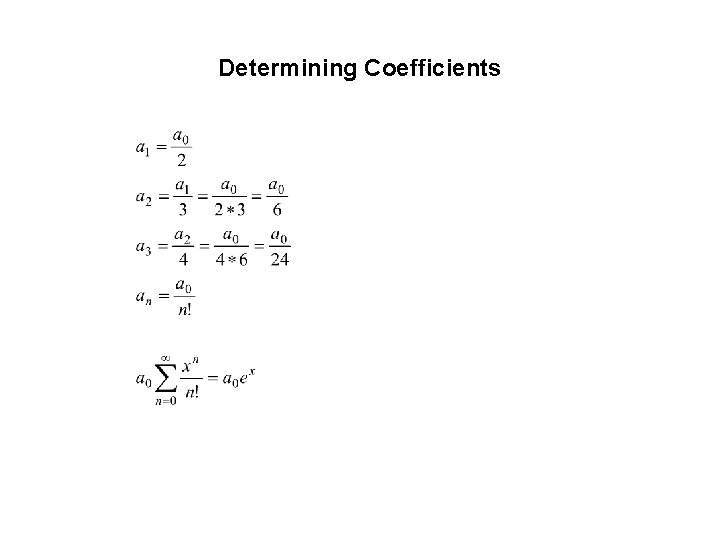
Determining Coefficients - What this implies about the coefficients - Rewriting both series with the same power of x
Determining Coefficients
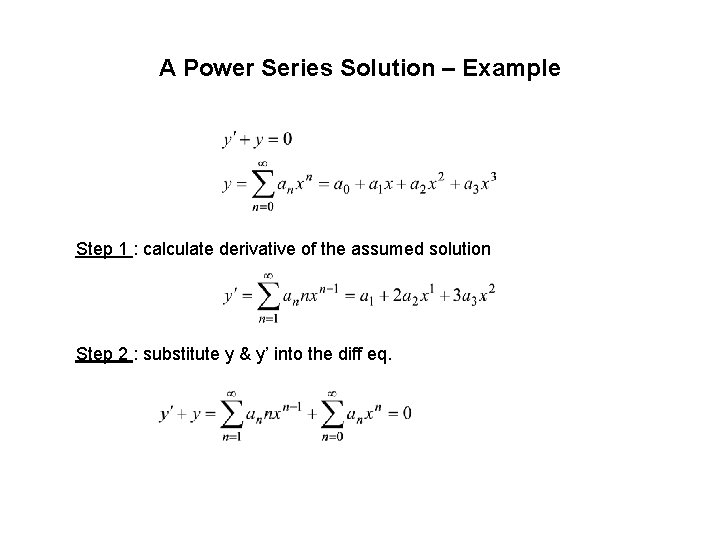
A Power Series Solution – Example Step 1 : calculate derivative of the assumed solution Step 2 : substitute y & y’ into the diff eq.
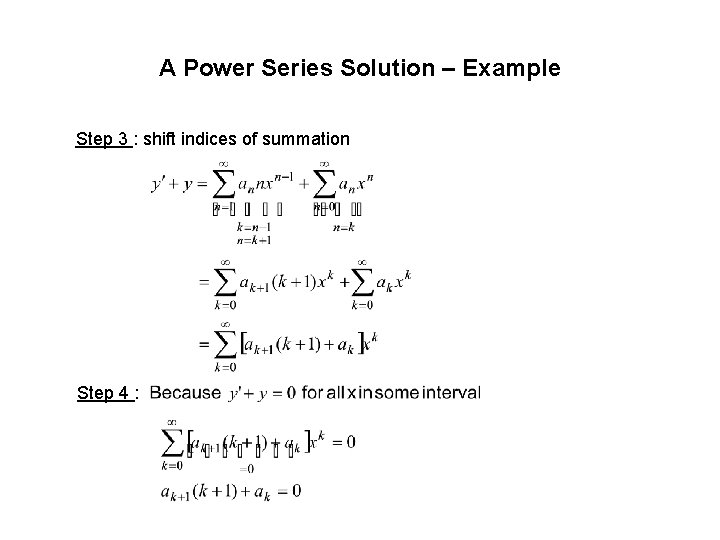
A Power Series Solution – Example Step 3 : shift indices of summation Step 4 :
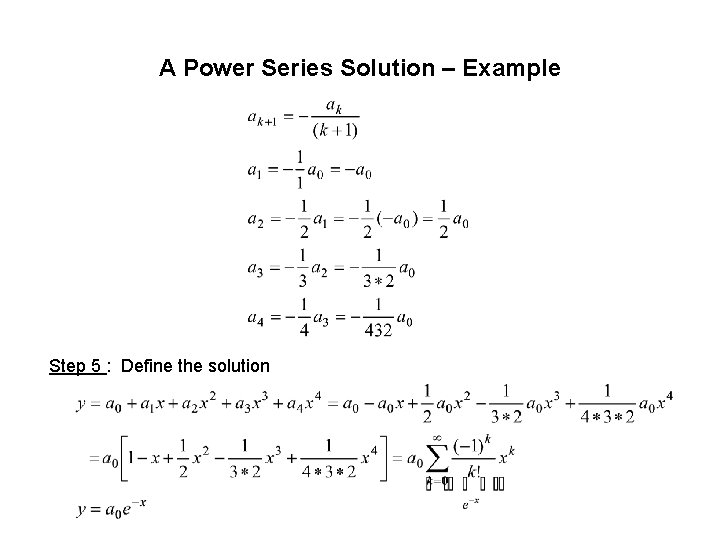
A Power Series Solution – Example Step 5 : Define the solution
A Power Series Solution – Example
Famous Series Solutions