
Chapter 10 Infinite Series Early Results Power Series
- Slides: 34
Chapter 10 Infinite Series • • Early Results Power Series An Interpolation on Interpolation Summation of Series Fractional Power Series Generating Functions The Zeta Function Biographical Notes: Gregory and Euler
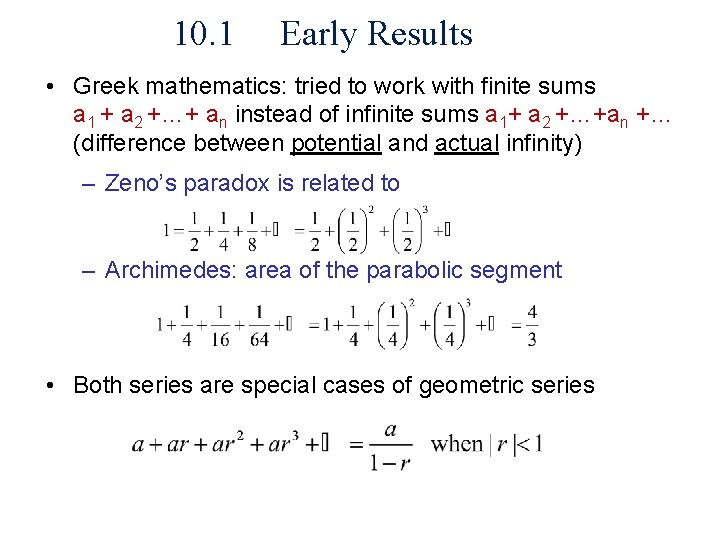
10. 1 Early Results • Greek mathematics: tried to work with finite sums a 1 + a 2 +…+ an instead of infinite sums a 1+ a 2 +…+an +… (difference between potential and actual infinity) – Zeno’s paradox is related to – Archimedes: area of the parabolic segment • Both series are special cases of geometric series
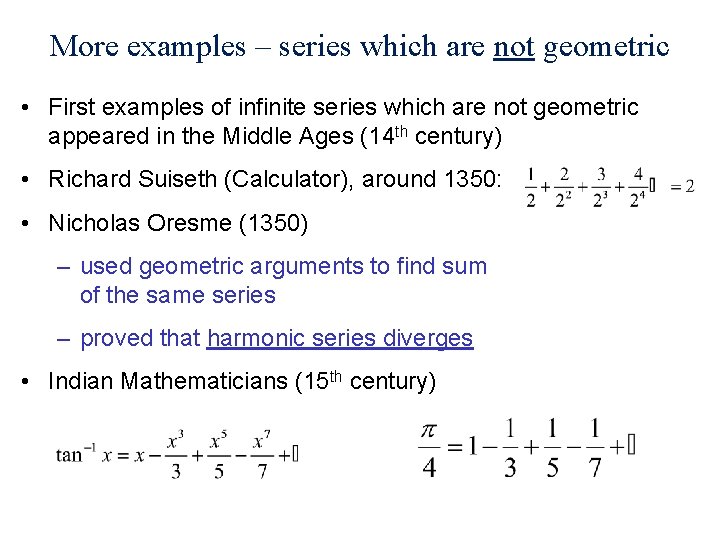
More examples – series which are not geometric • First examples of infinite series which are not geometric appeared in the Middle Ages (14 th century) • Richard Suiseth (Calculator), around 1350: • Nicholas Oresme (1350) – used geometric arguments to find sum of the same series – proved that harmonic series diverges • Indian Mathematicians (15 th century) and
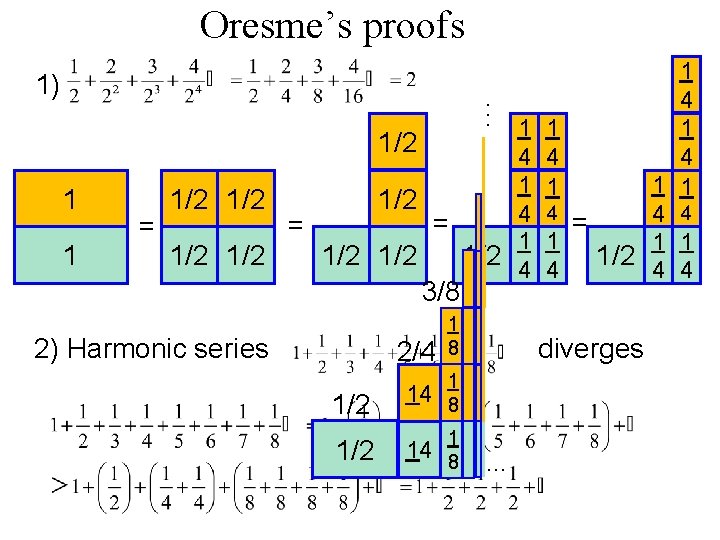
Oresme’s proofs 1) 1 1 1. . 4. 1 1/2 4 4 4 1 1 1/2 1/2 4 4 = = = 1 1 1/2 1/2 1/2 4 4 3/8 2) Harmonic series 2/4 1 8 diverges 1 1/2 14 8 1 …
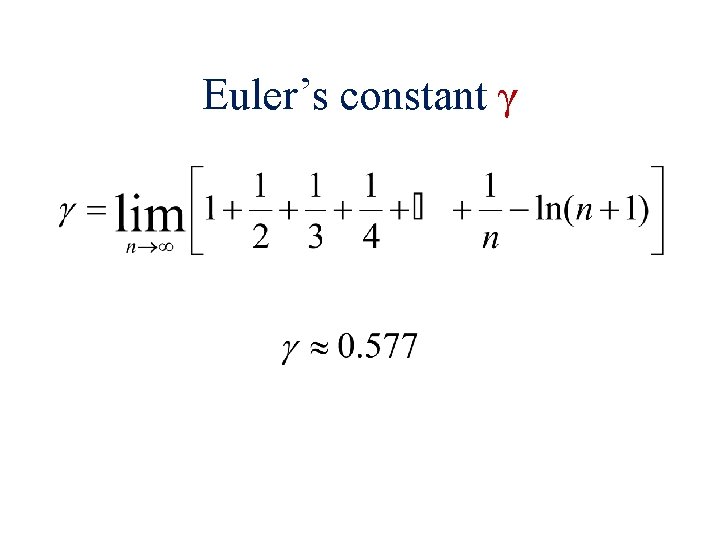
Euler’s constant γ
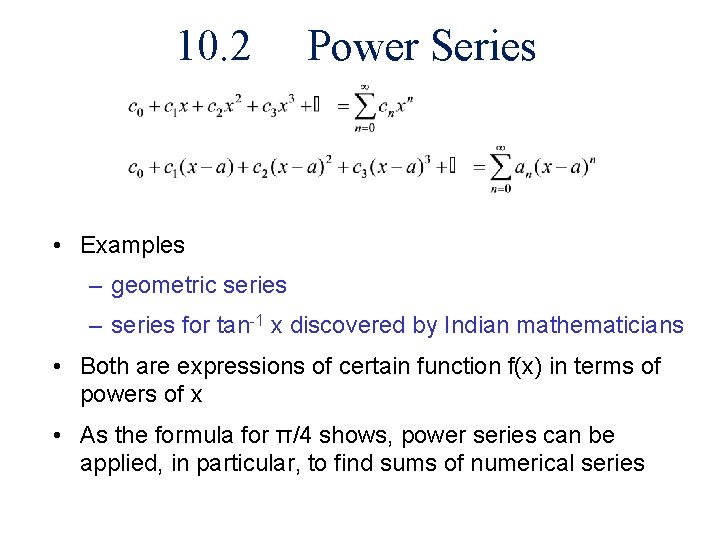
10. 2 Power Series • Examples – geometric series – series for tan-1 x discovered by Indian mathematicians • Both are expressions of certain function f(x) in terms of powers of x • As the formula for π/4 shows, power series can be applied, in particular, to find sums of numerical series
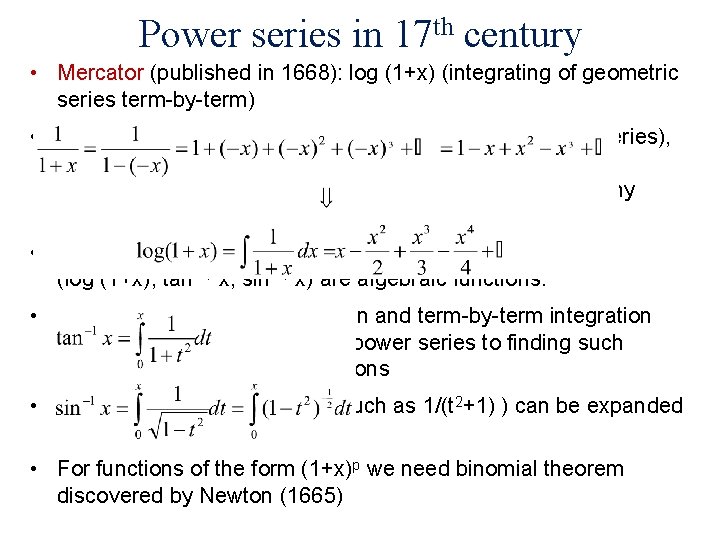
Power series in 17 th century • Mercator (published in 1668): log (1+x) (integrating of geometric series term-by-term) • Already known series (such as log (1+x) and geometric series), Newton’s method of series inversion and term-by-term differentiation and integration lead to power series for many other classical functions • Derivatives of many (inverse) transcendental functions (log (1+x), tan -1 x, sin -1 x) are algebraic functions: • Thus method of series inversion and term-by-term integration reduce the question of finding power series to finding such expansions for algebraic functions • Rational algebraic functions (such as 1/(t 2+1) ) can be expanded using geometric series • For functions of the form (1+x)p we need binomial theorem discovered by Newton (1665)
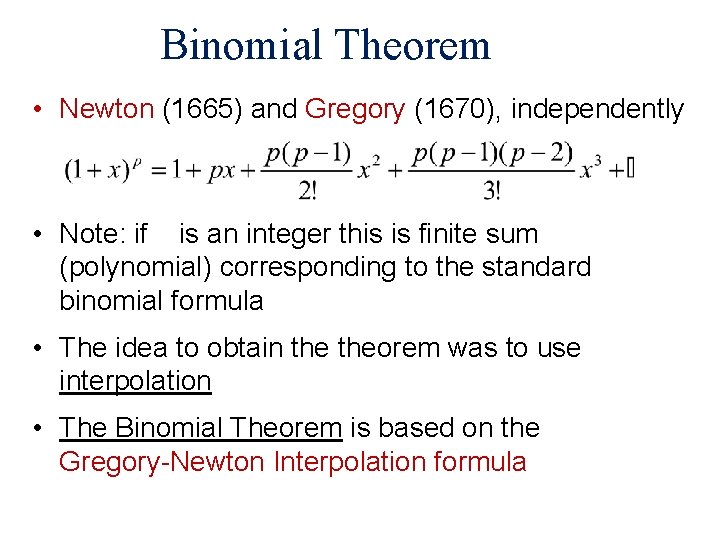
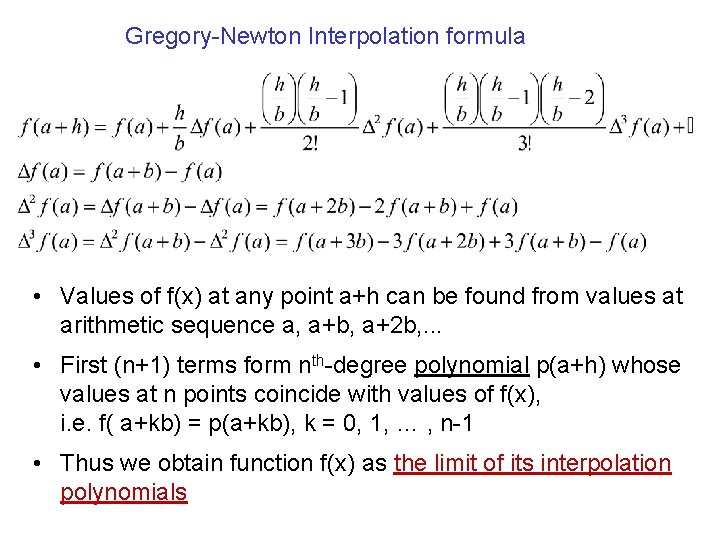
Binomial Theorem • Newton (1665) and Gregory (1670), independently • Note: if p is an integer this is finite sum (polynomial) corresponding to the standard binomial formula • The idea to obtain theorem was to use interpolation • The Binomial Theorem is based on the Gregory-Newton Interpolation formula
Gregory-Newton Interpolation formula • Values of f(x) at any point a+h can be found from values at arithmetic sequence a, a+b, a+2 b, . . . • First (n+1) terms form nth-degree polynomial p(a+h) whose values at n points coincide with values of f(x), i. e. f( a+kb) = p(a+kb), k = 0, 1, … , n-1 • Thus we obtain function f(x) as the limit of its interpolation polynomials
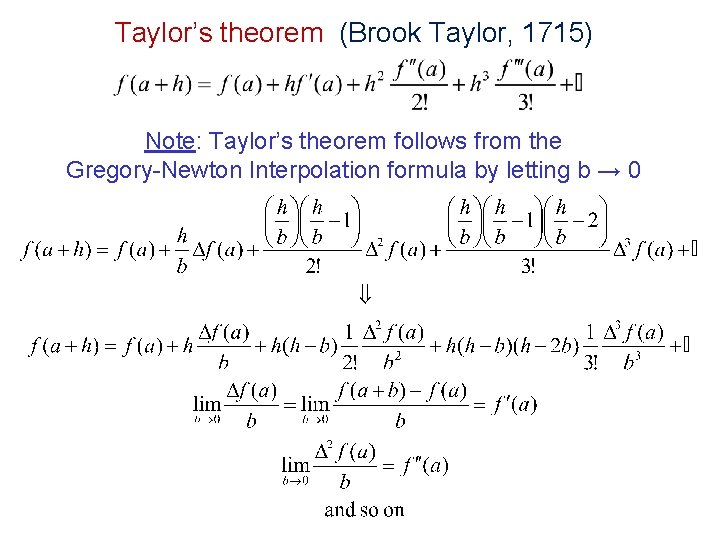
Taylor’s theorem (Brook Taylor, 1715) Note: Taylor’s theorem follows from the Gregory-Newton Interpolation formula by letting b → 0
10. 3 An Interpolation on Interpolation • In contemporary mathematics interpolation is widely used in numerical methods • However, historically it led to the discovery of the Binomial Theorem and Taylor Theorem • First attempts to use interpolation appeared in ancient times • The first idea of “exact” interpolation (i. e. power series expansion of a given function) is due to Thomas Harriot (1560 -1621) and Henry Briggs (1556 -1630) • Briggs’ “Arithmetica logarithmica” (1624) • Briggs created a number of tables to facilitate calculations • In particular, he was working on such tables for logarithms, introduced by John Napier • One of his achievements was the first instance of the binomial series with fractional p: expansion of (x+1)1/2
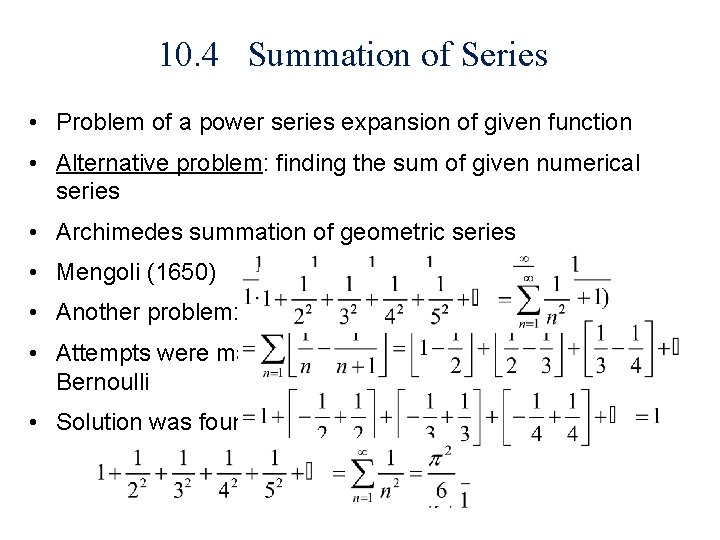
10. 4 Summation of Series • Problem of a power series expansion of given function • Alternative problem: finding the sum of given numerical series • Archimedes summation of geometric series • Mengoli (1650) • Another problem: • Attempts were made by Mengoli and Jakob and Johann Bernoulli • Solution was found by Euler (1734)
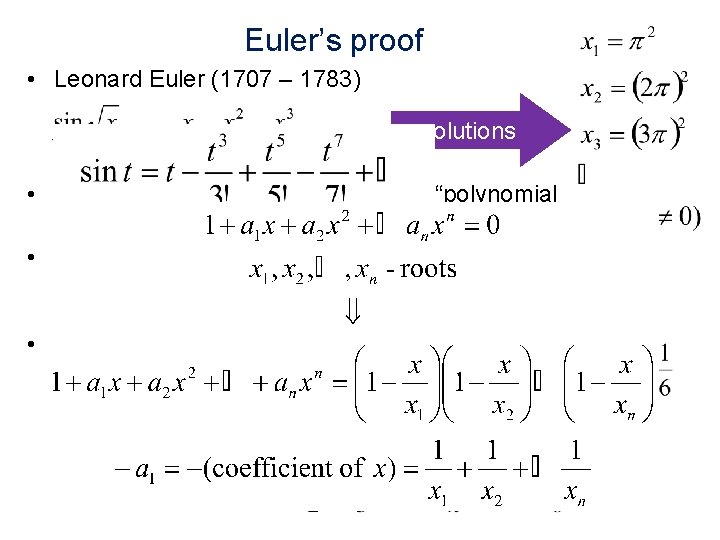
Euler’s proof • Leonard Euler (1707 – 1783) solutions • Assume the same is true for infinite “polynomial equation” • Then • Therefore
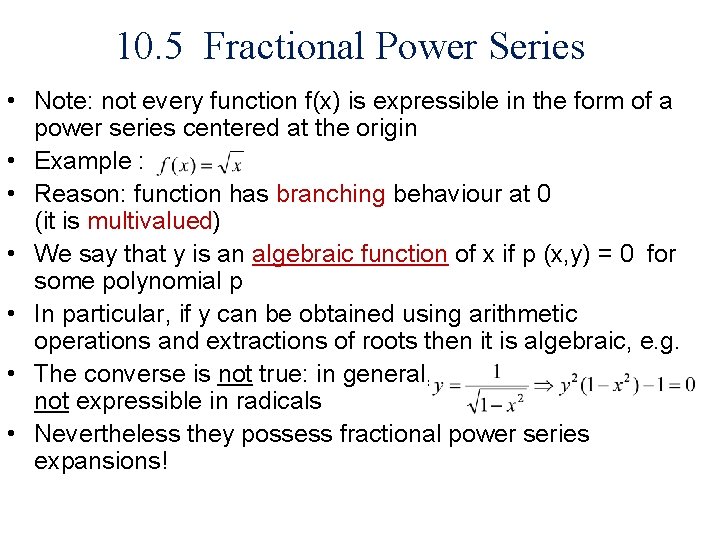
10. 5 Fractional Power Series • Note: not every function f(x) is expressible in the form of a power series centered at the origin • Example : • Reason: function has branching behaviour at 0 (it is multivalued) • We say that y is an algebraic function of x if p (x, y) = 0 for some polynomial p • In particular, if y can be obtained using arithmetic operations and extractions of roots then it is algebraic, e. g. • The converse is not true: in general, algebraic functions are not expressible in radicals • Nevertheless they possess fractional power series expansions!
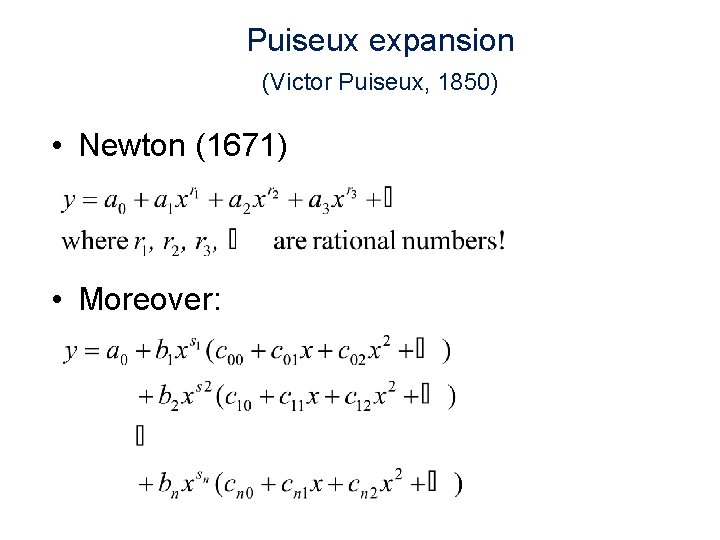
Puiseux expansion (Victor Puiseux, 1850) • Newton (1671) • Moreover:
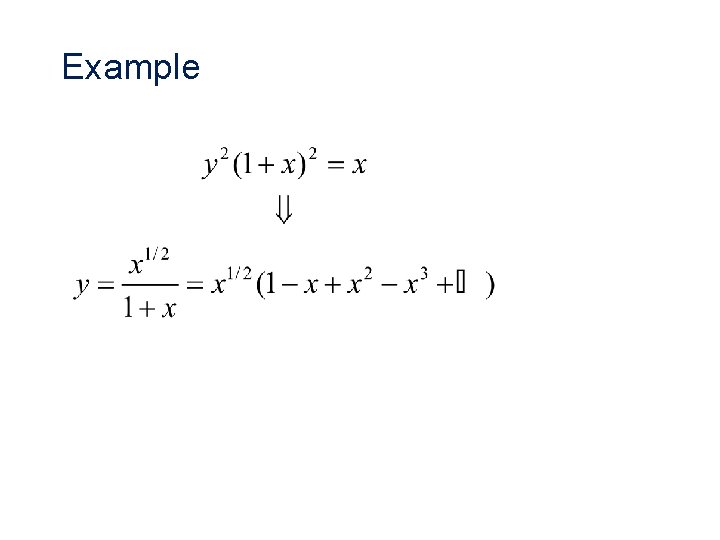
Example
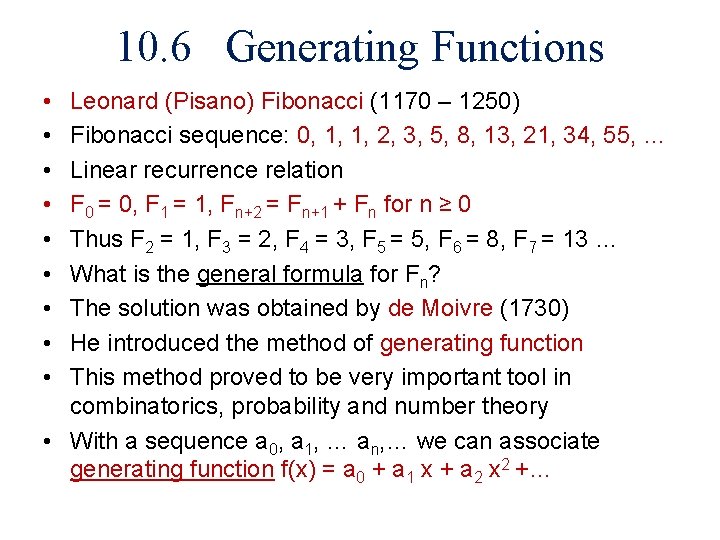
10. 6 Generating Functions • • • Leonard (Pisano) Fibonacci (1170 – 1250) Fibonacci sequence: 0, 1, 1, 2, 3, 5, 8, 13, 21, 34, 55, … Linear recurrence relation F 0 = 0, F 1 = 1, Fn+2 = Fn+1 + Fn for n ≥ 0 Thus F 2 = 1, F 3 = 2, F 4 = 3, F 5 = 5, F 6 = 8, F 7 = 13 … What is the general formula for Fn? The solution was obtained by de Moivre (1730) He introduced the method of generating function This method proved to be very important tool in combinatorics, probability and number theory • With a sequence a 0, a 1, … an, … we can associate generating function f(x) = a 0 + a 1 x + a 2 x 2 +…
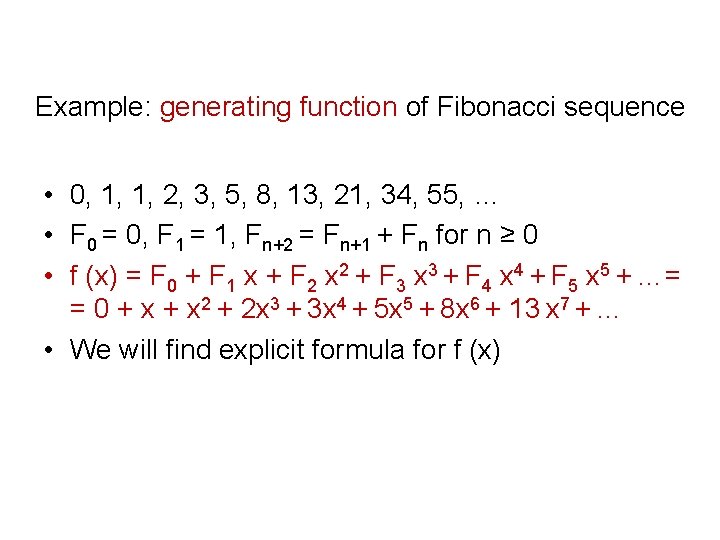
Example: generating function of Fibonacci sequence • 0, 1, 1, 2, 3, 5, 8, 13, 21, 34, 55, … • F 0 = 0, F 1 = 1, Fn+2 = Fn+1 + Fn for n ≥ 0 • f (x) = F 0 + F 1 x + F 2 x 2 + F 3 x 3 + F 4 x 4 + F 5 x 5 + …= = 0 + x 2 + 2 x 3 + 3 x 4 + 5 x 5 + 8 x 6 + 13 x 7 + … • We will find explicit formula for f (x)
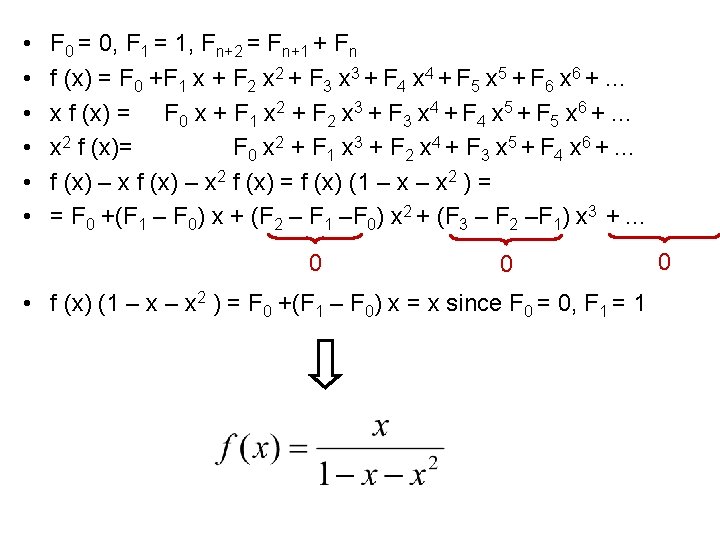
• • • F 0 = 0, F 1 = 1, Fn+2 = Fn+1 + Fn f (x) = F 0 +F 1 x + F 2 x 2 + F 3 x 3 + F 4 x 4 + F 5 x 5 + F 6 x 6 + … x f (x) = F 0 x + F 1 x 2 + F 2 x 3 + F 3 x 4 + F 4 x 5 + F 5 x 6 + … x 2 f (x)= F 0 x 2 + F 1 x 3 + F 2 x 4 + F 3 x 5 + F 4 x 6 + … f (x) – x 2 f (x) = f (x) (1 – x 2 ) = = F 0 +(F 1 – F 0) x + (F 2 – F 1 –F 0) x 2 + (F 3 – F 2 –F 1) x 3 + … 0 0 • f (x) (1 – x 2 ) = F 0 +(F 1 – F 0) x = x since F 0 = 0, F 1 = 1 0
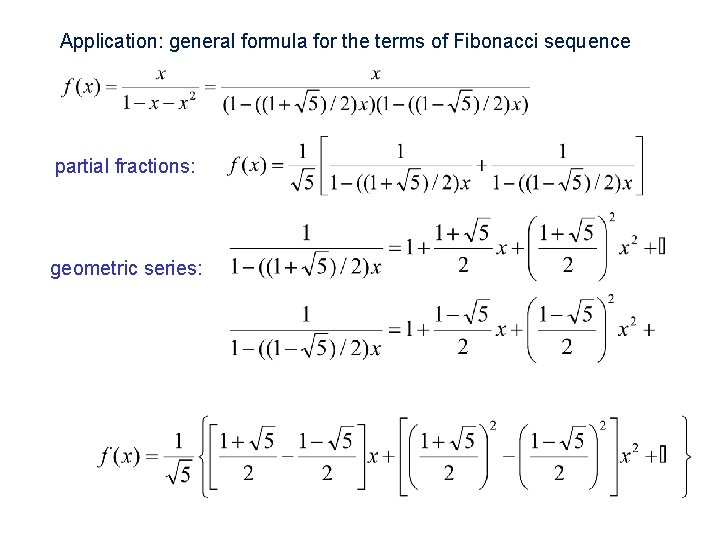
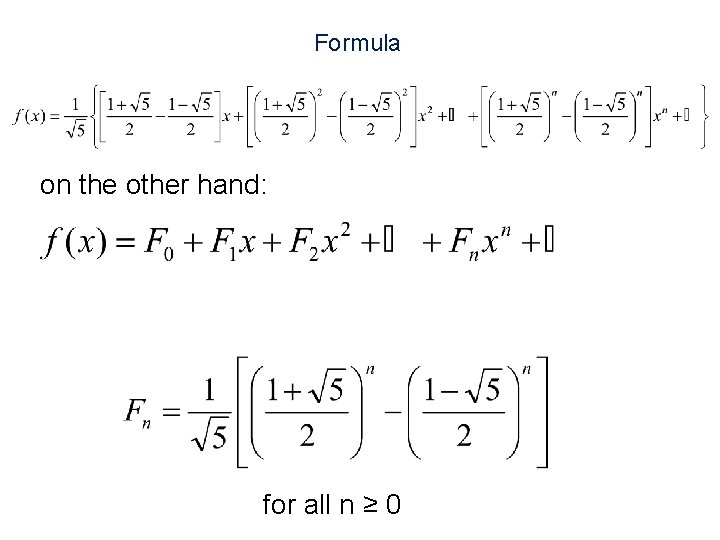
Application: general formula for the terms of Fibonacci sequence partial fractions: geometric series:
Formula on the other hand: for all n ≥ 0
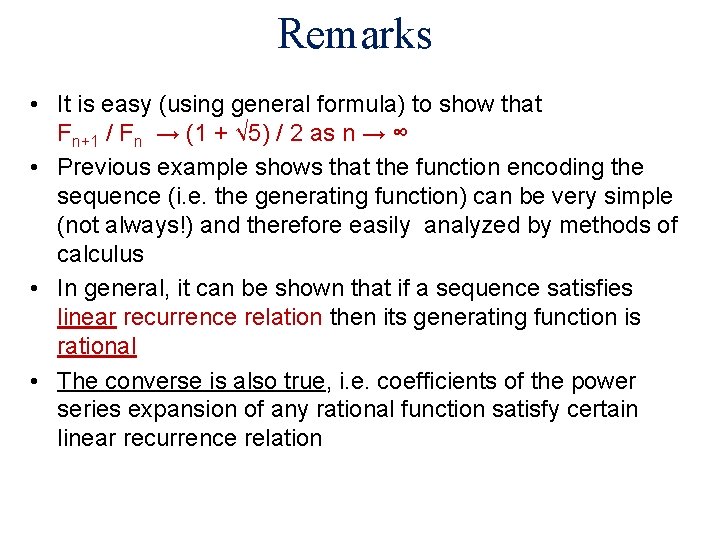
Remarks • It is easy (using general formula) to show that Fn+1 / Fn → (1 + √ 5) / 2 as n → ∞ • Previous example shows that the function encoding the sequence (i. e. the generating function) can be very simple (not always!) and therefore easily analyzed by methods of calculus • In general, it can be shown that if a sequence satisfies linear recurrence relation then its generating function is rational • The converse is also true, i. e. coefficients of the power series expansion of any rational function satisfy certain linear recurrence relation
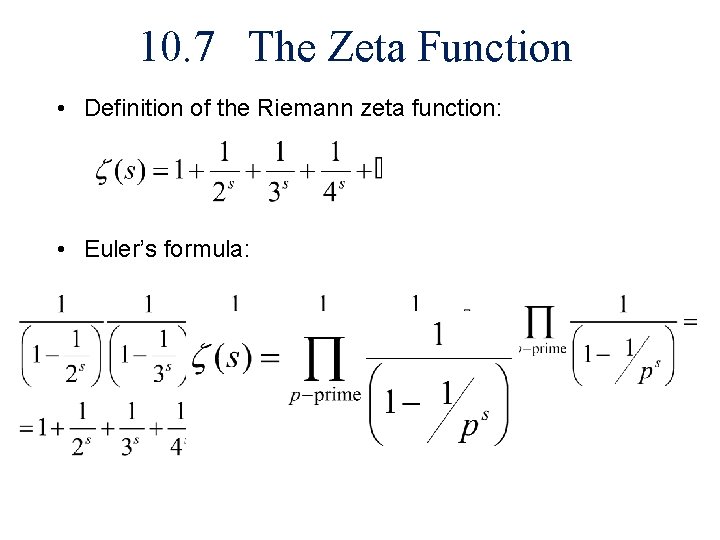
10. 7 The Zeta Function • Definition of the Riemann zeta function: • Euler’s formula:
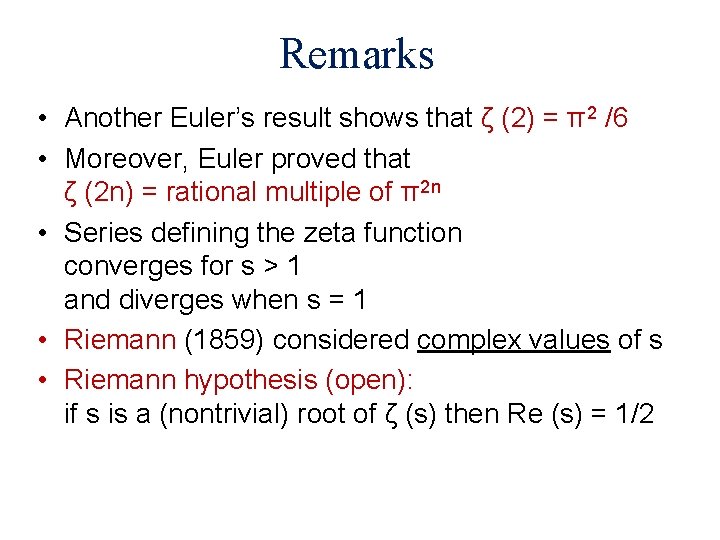
Remarks • Another Euler’s result shows that ζ (2) = π2 /6 • Moreover, Euler proved that ζ (2 n) = rational multiple of π2 n • Series defining the zeta function converges for s > 1 and diverges when s = 1 • Riemann (1859) considered complex values of s • Riemann hypothesis (open): if s is a (nontrivial) root of ζ (s) then Re (s) = 1/2
10. 8 Biographical Notes: Gregory and Euler
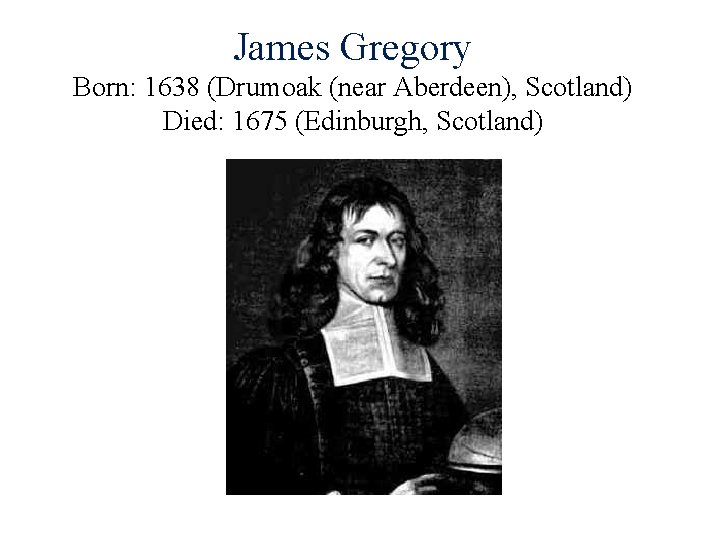
James Gregory Born: 1638 (Drumoak (near Aberdeen), Scotland) Died: 1675 (Edinburgh, Scotland)
• Gregory received his early education from his mother, Janet Anderson • She taught James mathematics (geometry) • Note: Gregory's uncle was a pupil of Viète • When James turned 13 his education was taken over by his brother David (who also had mathematical abilities) • Gregory studied Euclid's Elements • Grammar School • Marischal College (Aberdeen) • Gregory invented reflecting telescope (“Optica Promota”, 1663) • In 1664 Gregory went to Italy (1664 – 1668) • University of Padua • He became familiar with methods of Cavalieri
• 1667: “Vera circuli et hyperbolae quadratura” (“True quadrature of the circle and hyperbola”) – attempt to show that π and e are transcendental (not successful) – first appearance of the concept of convergence (for power series) – distinction between algebraic and transcendental functions • 1668: “Geometriae pars universalis” (“A universal method for measuring curved quantities”) – systematization of results in differentiation and integration – the first published proof of the fundamental theorem of calculus
• During the visit to London on his return from Italy Gregory was elected to the Royal Society • In 1669 Gregory returned to Scotland • He became the Chair of mathematics at St. Andrew’s university • At St. Andrew’s Gregory obtained his important results on series (including Taylor’s theorem) • However, Gregory did not publish these results • He accepted a chair at Edinburgh in 1674
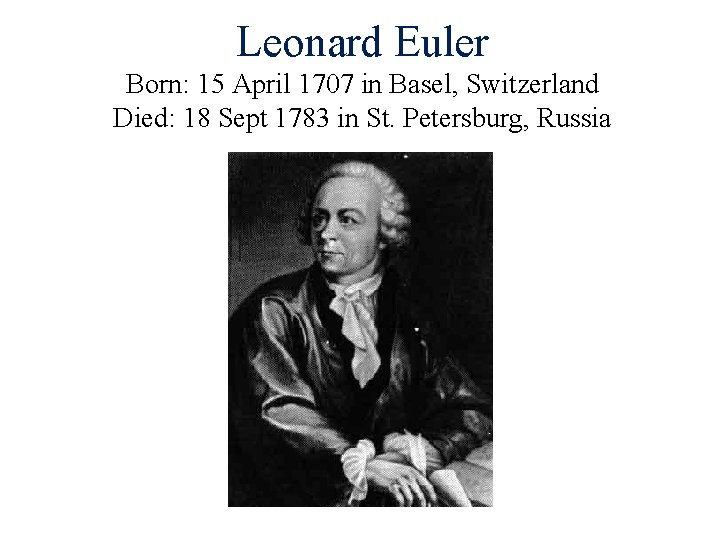
Leonard Euler Born: 15 April 1707 in Basel, Switzerland Died: 18 Sept 1783 in St. Petersburg, Russia
• Euler’s Father, Paul Euler, studied theology at the University of Basel • He attended lectures of Jacob Bernoulli • Leonard received his first education in elementary mathematics from his father. • Later he took private lessons in mathematics • At the age of 13 Leonard entered the University of Basel to study theology • Euler studies were in philosophy and law • Johann Bernoulli was a professor in the University of Basel that time • He advised Euler to study mathematics on his own and also had offered his assistance in case Euler had any difficulties with studying
• Euler began his study of theology in 1723 but then decided to drop this idea in favor of mathematics • He completed his studies in 1726 • Books that Euler read included works by Descartes, Newton, Galileo, Jacob Bernoulli, Taylor and Wallis • He published his first own paper in 1726 • It was not easy to continue mathematical career in Switzerland that time • With the help of Daniel and Nicholas Bernoulli Euler had become appointed to the recently established Russian Academy of Science in St. Petersburg • In 1727 Euler left Basel and went to St. Petersburg
• Euler filled half the pages published by the Academy from 1729 until over 50 years after his death • He made similar contributions to the production of the Berlin Academy between 1746 and 1771 • In total, Euler had about 900 published papers • In 1733 Euler became professor of mathematics and the chair of the Department of Geography (at St. Petersburg) • His duties included the preparation of a map of Russia, which could be one of the reason that eventually led to the lost of sight • In 1740 Euler moved in Berlin, where Frederick the Great had just reorganized the Berlin Academy
• In 1762 Catherine the Great became the ruler of Russia • Euler moved back to St. Petersburg in 1766 • Soon after that Euler became completely blind • He dictated his book “Algebra” (1770) to a servant