CIVICS IN PRACTICE HOLT Chapter 4 Rights and

- Slides: 53
CIVICS IN PRACTICE HOLT Chapter 4 Rights and Responsibilities Section 1: The Bill of Rights Section 2: Guaranteeing Other Rights Section 3: Citizens’ Duties and Responsibilities 1 HOLT, RINEHART AND WINSTON
CIVICS IN PRACTICE HOLT Section 1: The Bill of Rights The Main Idea The freedoms spelled out in the Bill of Rights—the freedoms of religion, speech, the press, and petition, and the right to a speedy and fair trial—are essential to our democratic system. Reading Focus u Why was the Bill of Rights added to the Constitution? u How does the First Amendment protect personal freedoms? u What other rights does the Bill of Rights guarantee? 2 HOLT, RINEHART AND WINSTON
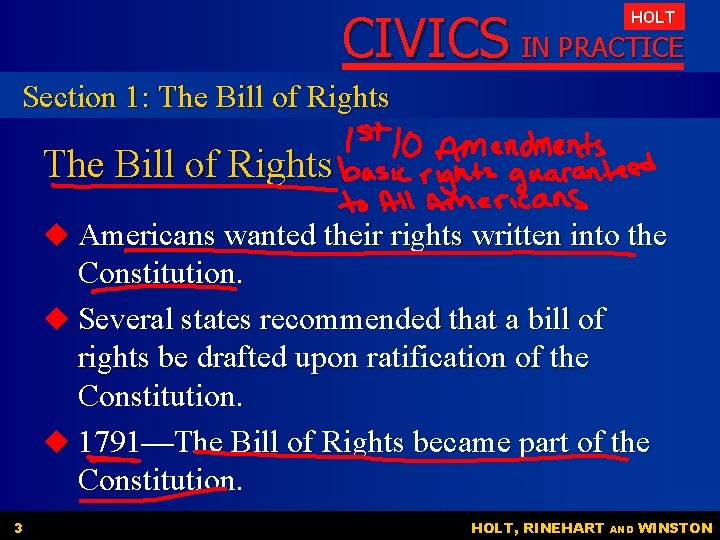
CIVICS IN PRACTICE HOLT Section 1: The Bill of Rights u Americans wanted their rights written into the Constitution. u Several states recommended that a bill of rights be drafted upon ratification of the Constitution. u 1791—The Bill of Rights became part of the Constitution. 3 HOLT, RINEHART AND WINSTON
CIVICS IN PRACTICE HOLT Section 1: The Bill of Rights The First Amendment protects personal freedoms. u Freedom of religion u Freedom of speech u Freedom of the press u Freedom of assembly u Freedom of petition 4 HOLT, RINEHART AND WINSTON
CIVICS IN PRACTICE HOLT Freedom of Religion “Congress shall make no law respecting an establishment of religion, ” u Separation of Church & State- Division between government and religion 5 HOLT, RINEHART AND WINSTON
CIVICS IN PRACTICE HOLT Freedom of Speech “Congress shall make no law. . . abridging (limiting) the freedom of speech. ” u Can criticize government officials u Not an absolute freedom u Clear and present danger u The government can prevent an act of free speech if it is linked to an unlawful act 6 HOLT, RINEHART AND WINSTON
Freedom of the Press CIVICS IN PRACTICE HOLT “Congress shall make no law. . . Abridging the freedom. . . of the press. ” u The right to express one’s ideas and opinions in writing u Press includes u Electronic Media u Books & other written materials u TV & Radio 7 u Libel u Rumors that damage a person’s reputationi u Lies that may harm another person u Americans do not have this right. HOLT, RINEHART AND WINSTON
CIVICS IN PRACTICE HOLT Freedom of Assembly “Congress shall make no law. . . abridging. . . the right of the people peaceably to assemble. ” u Can attend public meetings 8 HOLT, RINEHART AND WINSTON
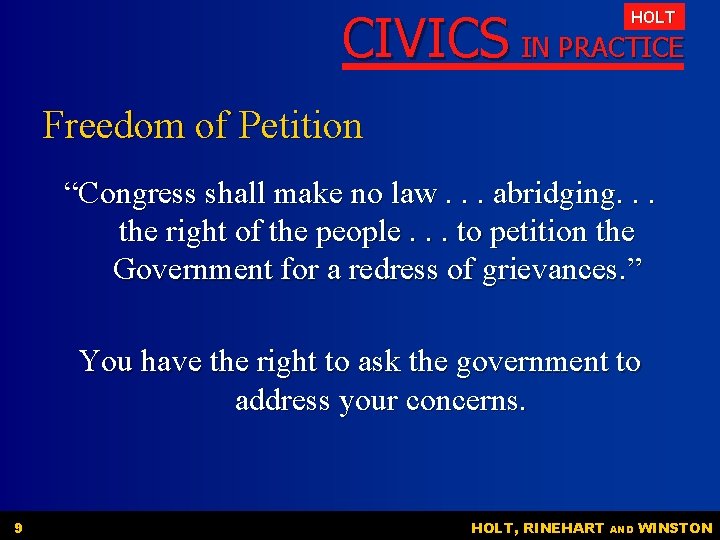
CIVICS IN PRACTICE HOLT Freedom of Petition “Congress shall make no law. . . abridging. . . the right of the people. . . to petition the Government for a redress of grievances. ” You have the right to ask the government to address your concerns. 9 HOLT, RINEHART AND WINSTON
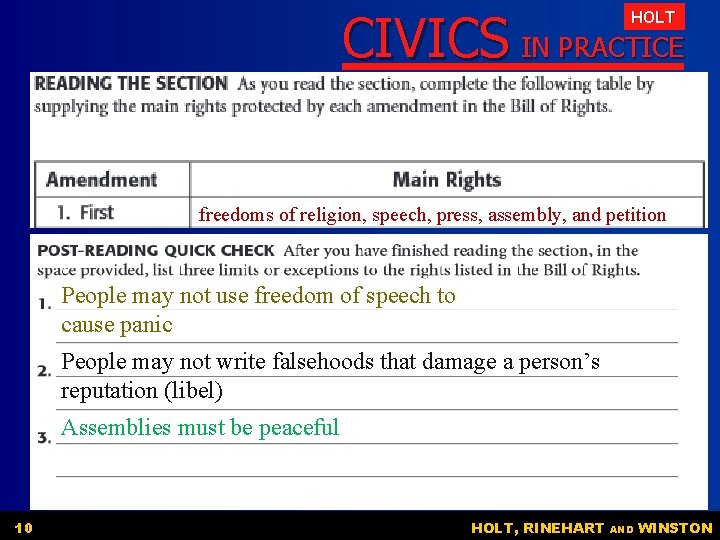
CIVICS IN PRACTICE HOLT freedoms of religion, speech, press, assembly, and petition People may not use freedom of speech to cause panic People may not write falsehoods that damage a person’s reputation (libel) Assemblies must be peaceful. 10 HOLT, RINEHART AND WINSTON
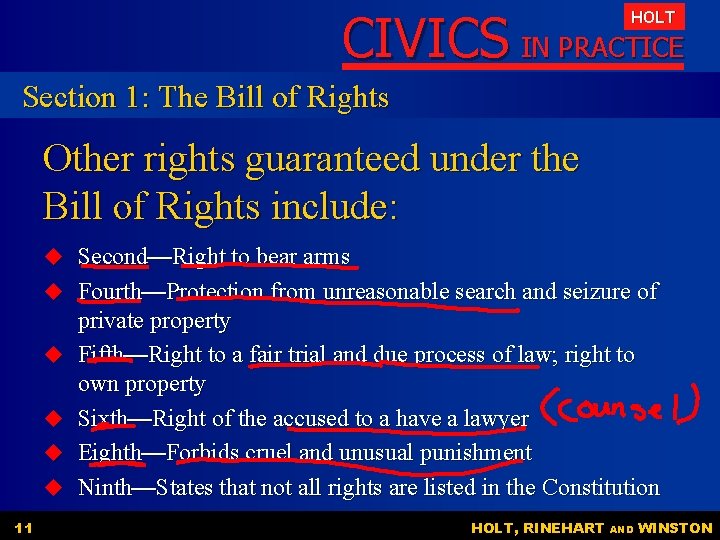
CIVICS IN PRACTICE HOLT Section 1: The Bill of Rights Other rights guaranteed under the Bill of Rights include: u Second—Right to bear arms u Fourth—Protection from unreasonable search and seizure of u u 11 private property Fifth—Right to a fair trial and due process of law; right to own property Sixth—Right of the accused to a have a lawyer Eighth—Forbids cruel and unusual punishment Ninth—States that not all rights are listed in the Constitution HOLT, RINEHART AND WINSTON
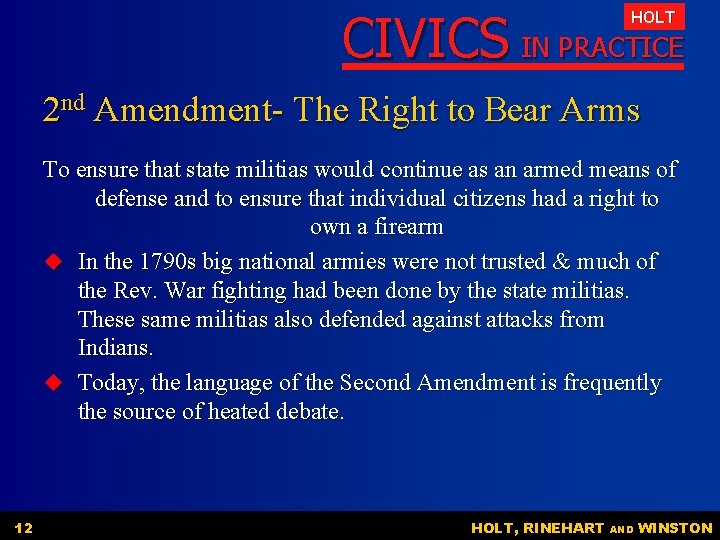
CIVICS IN PRACTICE HOLT 2 nd Amendment- The Right to Bear Arms To ensure that state militias would continue as an armed means of defense and to ensure that individual citizens had a right to own a firearm u In the 1790 s big national armies were not trusted & much of the Rev. War fighting had been done by the state militias. These same militias also defended against attacks from Indians. u Today, the language of the Second Amendment is frequently the source of heated debate. 12 HOLT, RINEHART AND WINSTON
CIVICS IN PRACTICE HOLT Third Amendment u prohibits the quartering of soldiers without permission. u Why? British soldiers could enter homes and force colonists to quarter them, or to give them housing and food 13 HOLT, RINEHART AND WINSTON
CIVICS IN PRACTICE HOLT Rights of the Accused (4 th-8 th) u protect citizens from abuses in the criminal justice system u establish codes of conduct for the police and the courts u Some of our most cherished legal protections 14 HOLT, RINEHART AND WINSTON
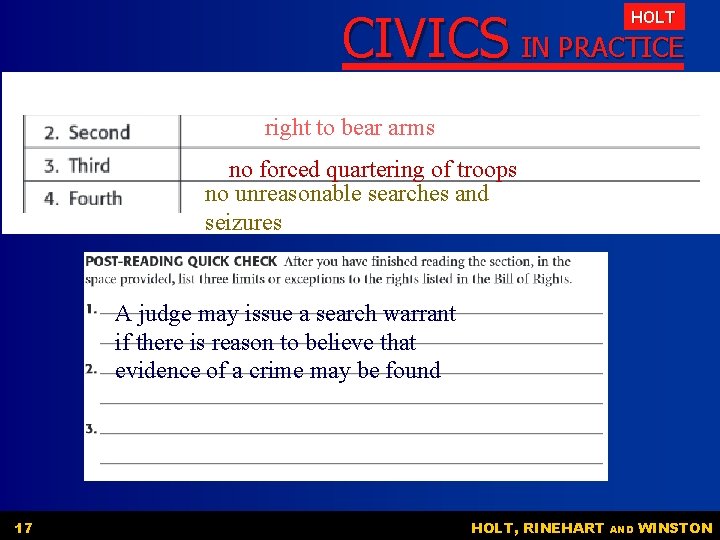
CIVICS IN PRACTICE HOLT Fourth Amendment u protects citizens from unreasonable searches and seizures u In many cases, a search is considered reasonable only if a judge issues a warrant authorizing it. u A search warrant is a legal document that describes the place to be searched and the people or items to be seized u issued only if there is good reason to believe that evidence of a crime will be found u Under some circumstances, however, police officers are allowed to conduct searches without a warrant. u danger to public safety u Criminal activity is involved 15 HOLT, RINEHART AND WINSTON
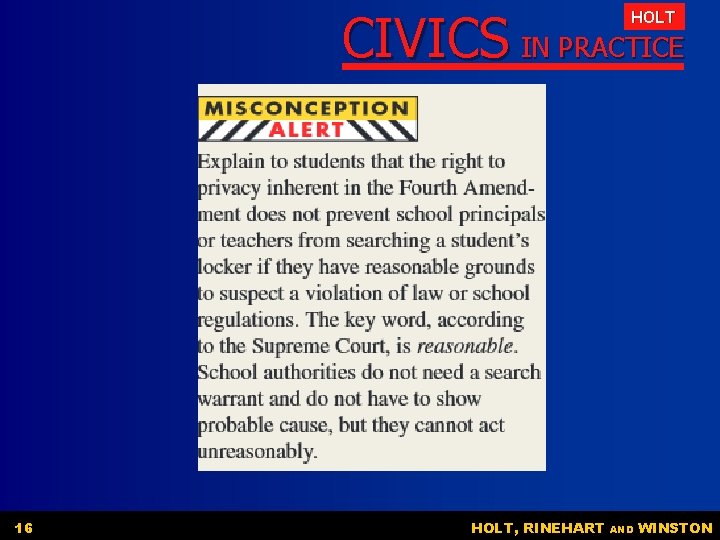
CIVICS IN PRACTICE HOLT 16 HOLT, RINEHART AND WINSTON
CIVICS IN PRACTICE HOLT right to bear arms no forced quartering of troops no unreasonable searches and seizures A judge may issue a search warrant if there is reason to believe that evidence of a crime may be found 17 HOLT, RINEHART AND WINSTON
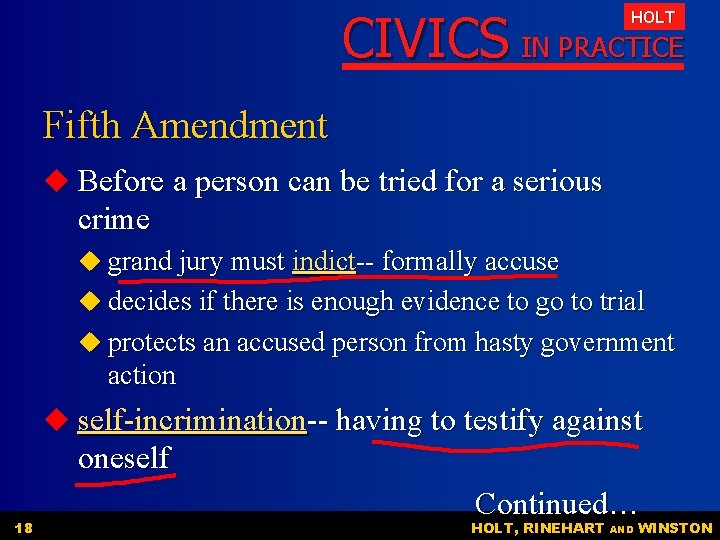
CIVICS IN PRACTICE HOLT Fifth Amendment u Before a person can be tried for a serious crime u grand jury must indict-- formally accuse u decides if there is enough evidence to go to trial u protects an accused person from hasty government action u self-incrimination-- having to testify against oneself 18 Continued… HOLT, RINEHART AND WINSTON
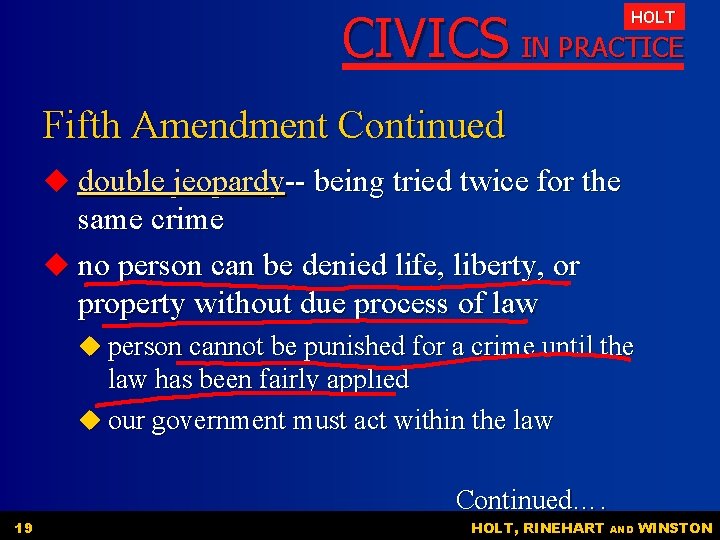
CIVICS IN PRACTICE HOLT Fifth Amendment Continued u double jeopardy-- being tried twice for the same crime u no person can be denied life, liberty, or property without due process of law u person cannot be punished for a crime until the law has been fairly applied u our government must act within the law Continued…. 19 HOLT, RINEHART AND WINSTON
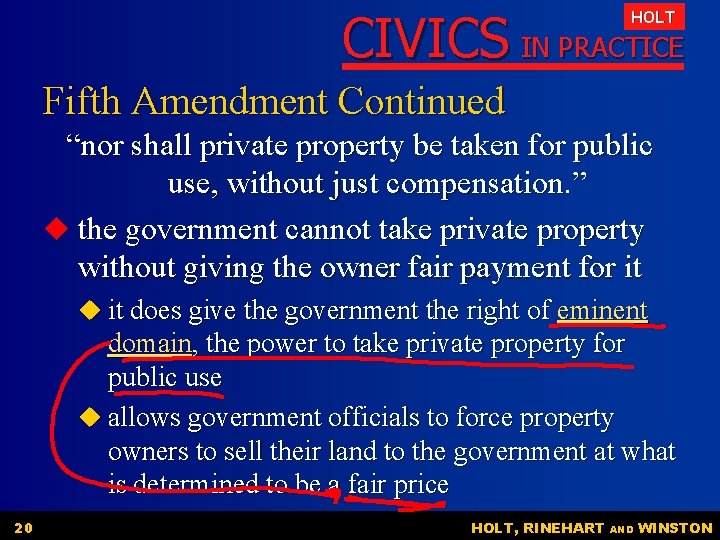
CIVICS IN PRACTICE HOLT Fifth Amendment Continued “nor shall private property be taken for public use, without just compensation. ” u the government cannot take private property without giving the owner fair payment for it u it does give the government the right of eminent domain, the power to take private property for public use u allows government officials to force property owners to sell their land to the government at what is determined to be a fair price 20 HOLT, RINEHART AND WINSTON
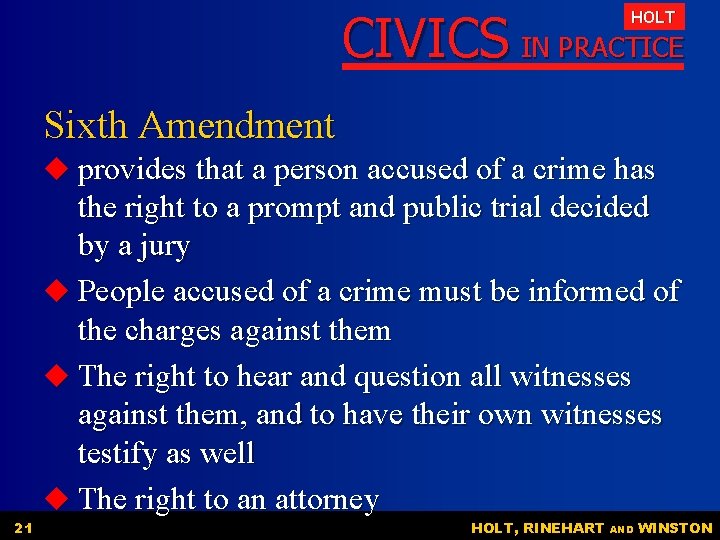
CIVICS IN PRACTICE HOLT Sixth Amendment u provides that a person accused of a crime has the right to a prompt and public trial decided by a jury u People accused of a crime must be informed of the charges against them u The right to hear and question all witnesses against them, and to have their own witnesses testify as well u The right to an attorney 21 HOLT, RINEHART AND WINSTON
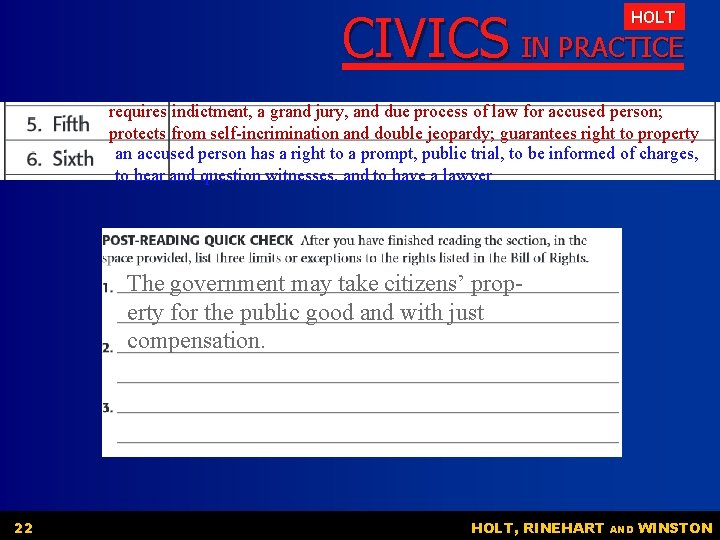
CIVICS IN PRACTICE HOLT requires indictment, a grand jury, and due process of law for accused person; protects from self-incrimination and double jeopardy; guarantees right to property an accused person has a right to a prompt, public trial, to be informed of charges, to hear and question witnesses, and to have a lawyer The government may take citizens’ property for the public good and with just compensation. 22 HOLT, RINEHART AND WINSTON
CIVICS IN PRACTICE HOLT Seventh Amendment provides for a trial by jury in certain kinds of cases involving money or property 23 HOLT, RINEHART AND WINSTON
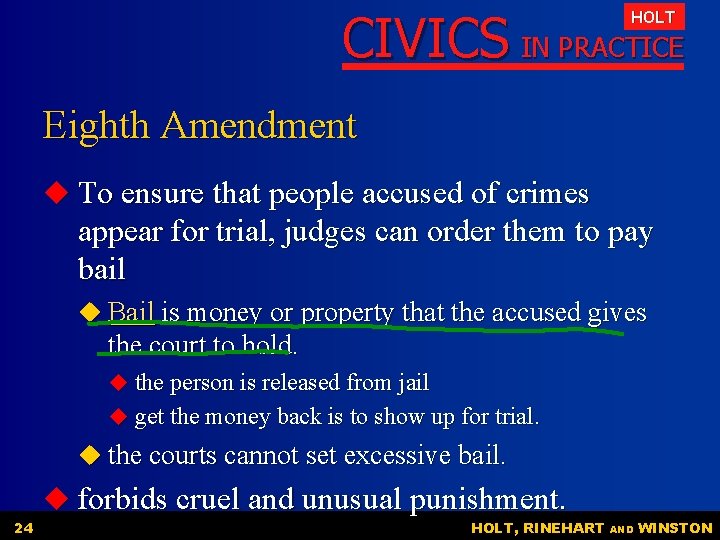
CIVICS IN PRACTICE HOLT Eighth Amendment u To ensure that people accused of crimes appear for trial, judges can order them to pay bail u Bail is money or property that the accused gives the court to hold. u the person is released from jail u get the money back is to show up for trial. u the courts cannot set excessive bail. u forbids cruel and unusual punishment. 24 HOLT, RINEHART AND WINSTON
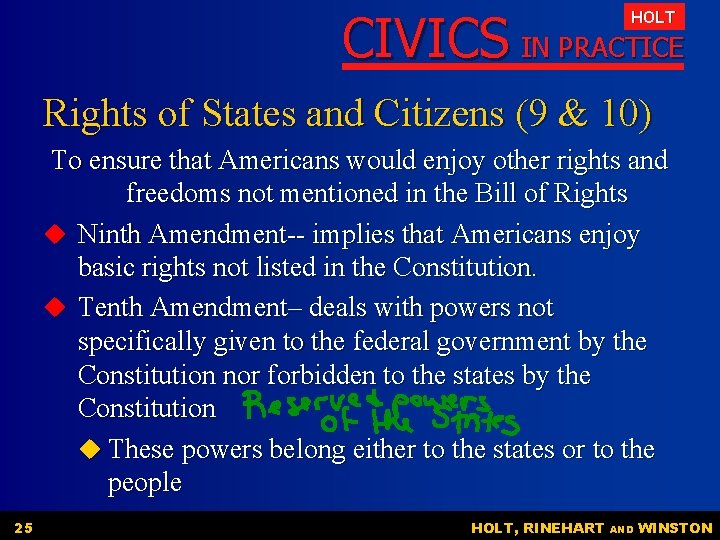
CIVICS IN PRACTICE HOLT Rights of States and Citizens (9 & 10) To ensure that Americans would enjoy other rights and freedoms not mentioned in the Bill of Rights u Ninth Amendment-- implies that Americans enjoy basic rights not listed in the Constitution. u Tenth Amendment– deals with powers not specifically given to the federal government by the Constitution nor forbidden to the states by the Constitution u These powers belong either to the states or to the people 25 HOLT, RINEHART AND WINSTON
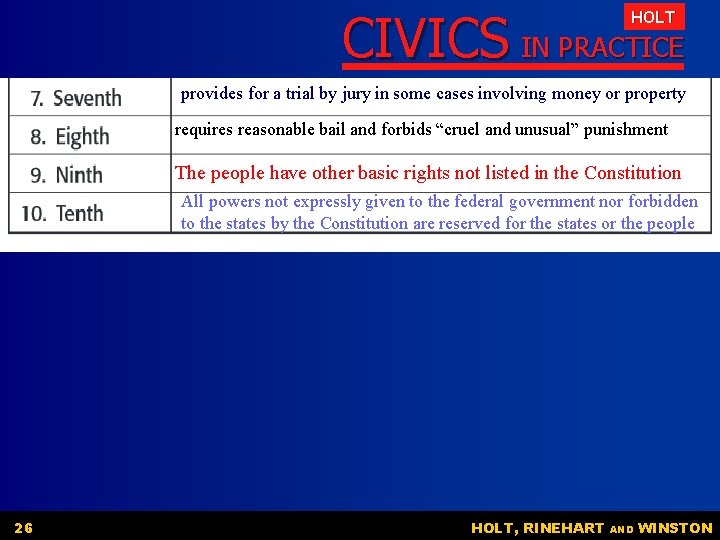
CIVICS IN PRACTICE HOLT provides for a trial by jury in some cases involving money or property requires reasonable bail and forbids “cruel and unusual” punishment The people have other basic rights not listed in the Constitution All powers not expressly given to the federal government nor forbidden to the states by the Constitution are reserved for the states or the people 26 HOLT, RINEHART AND WINSTON
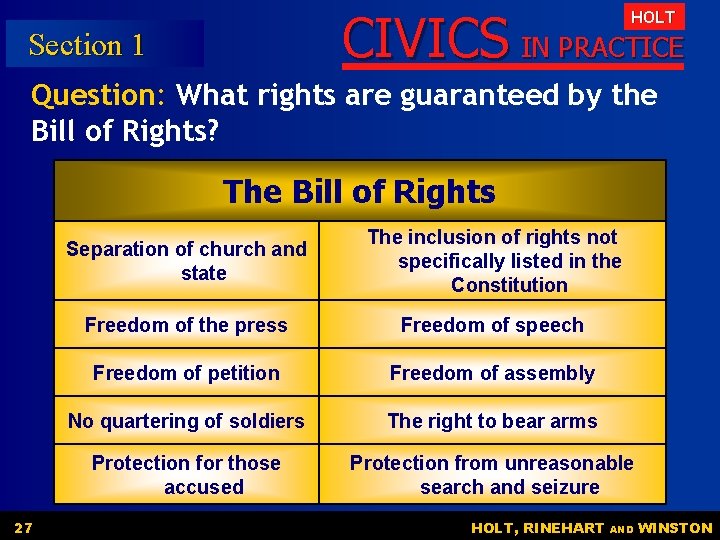
CIVICS IN PRACTICE HOLT Section 1 Question: What rights are guaranteed by the Bill of Rights? The Bill of Rights 27 Separation of church and state The inclusion of rights not specifically listed in the Constitution Freedom of the press Freedom of speech Freedom of petition Freedom of assembly No quartering of soldiers The right to bear arms Protection for those accused Protection from unreasonable search and seizure HOLT, RINEHART AND WINSTON
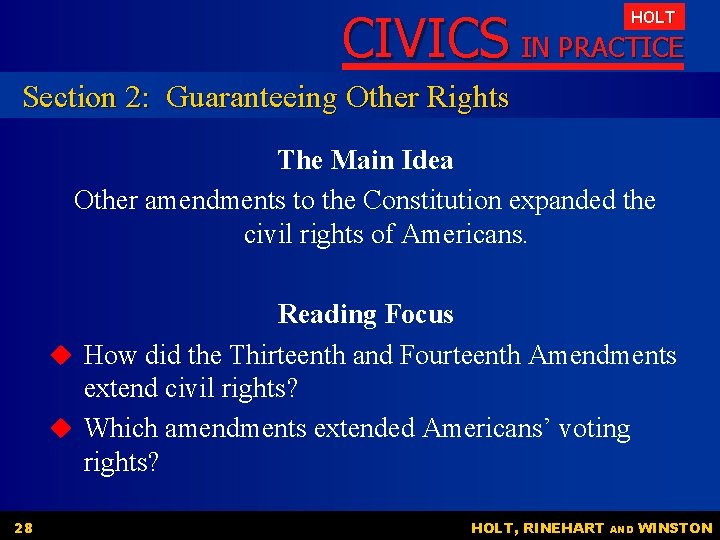
CIVICS IN PRACTICE HOLT Section 2: Guaranteeing Other Rights The Main Idea Other amendments to the Constitution expanded the civil rights of Americans. Reading Focus u How did the Thirteenth and Fourteenth Amendments extend civil rights? u Which amendments extended Americans’ voting rights? 28 HOLT, RINEHART AND WINSTON
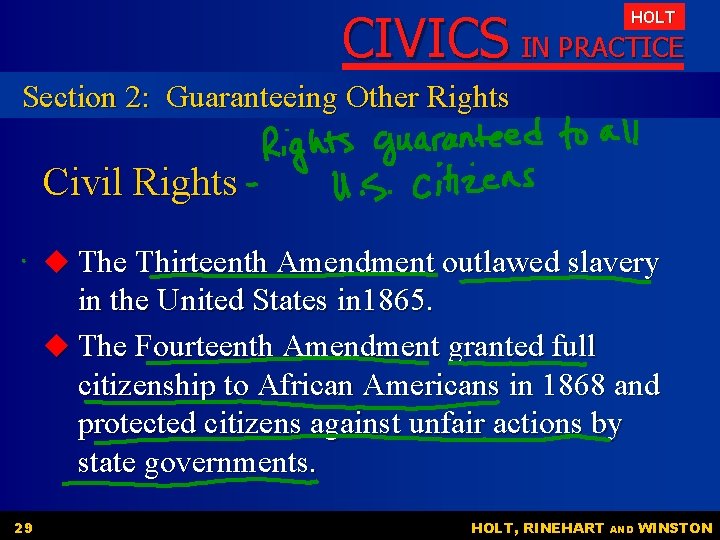
CIVICS IN PRACTICE HOLT Section 2: Guaranteeing Other Rights Civil Rights u The Thirteenth Amendment outlawed slavery in the United States in 1865. u The Fourteenth Amendment granted full citizenship to African Americans in 1868 and protected citizens against unfair actions by state governments. 29 HOLT, RINEHART AND WINSTON
CIVICS IN PRACTICE HOLT Fourteenth Amendment u granted full citizenship to African Americans u declared that no state could take away a citizen’s “life, liberty, or property, without due process of law. ” 30 HOLT, RINEHART AND WINSTON
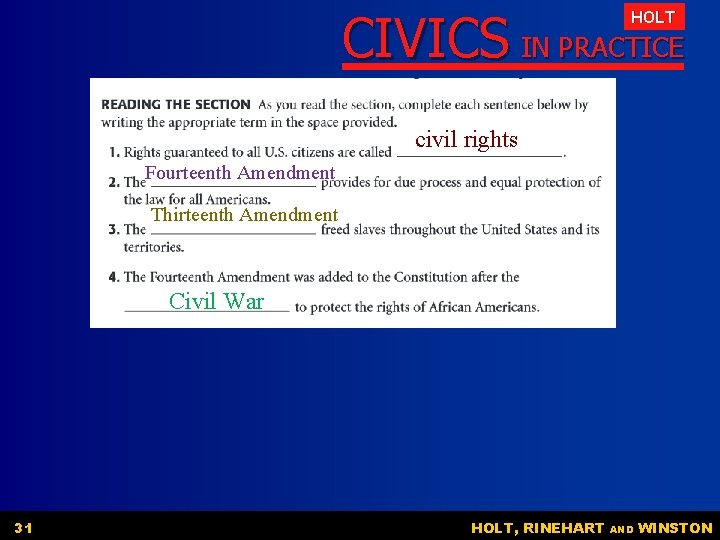
CIVICS IN PRACTICE HOLT civil rights Fourteenth Amendment Thirteenth Amendment Civil War 31 HOLT, RINEHART AND WINSTON
CIVICS IN PRACTICE HOLT Amendments Extend Voting Rights u Voting is one of the most basic principles of citizenship u the Constitution mentioned nothing about voting rights. u Between 1870 and 1971, a series of six constitutional amendments extended suffrage, the right to vote, to all U. S. citizens 32 HOLT, RINEHART AND WINSTON
CIVICS IN PRACTICE HOLT Fifteenth Amendment u no one could be denied suffrage because of race or color u applied only to African American men u Many former Confederate states passed laws to keep African Americans from voting 33 HOLT, RINEHART AND WINSTON
CIVICS IN PRACTICE HOLT Seventeenth Amendment u Under Article I, Section 3 of the Constitution, citizens of each state did not elect their senators. Instead, each state’s legislature elected that state’s senators u direct election of senators u senators answerable to the voters and not to other politicians. 34 HOLT, RINEHART AND WINSTON
CIVICS IN PRACTICE HOLT Nineteenth Amendment u gave all women the right to vote u Susan B. Anthony, Carrie Chapman Catt, Lucretia Mott, and Elizabeth Cady Stanton led the women’s suffrage movement 35 HOLT, RINEHART AND WINSTON
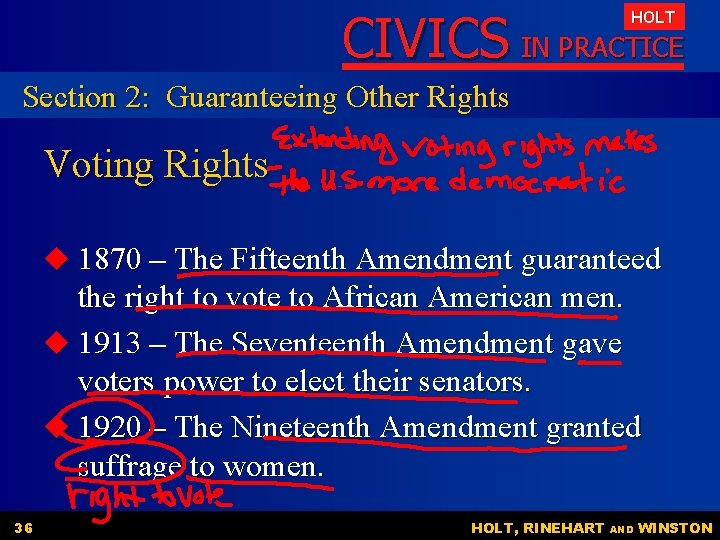
CIVICS IN PRACTICE HOLT Section 2: Guaranteeing Other Rights Voting Rights u 1870 – The Fifteenth Amendment guaranteed the right to vote to African American men. u 1913 – The Seventeenth Amendment gave voters power to elect their senators. u 1920 – The Nineteenth Amendment granted suffrage to women. 36 HOLT, RINEHART AND WINSTON
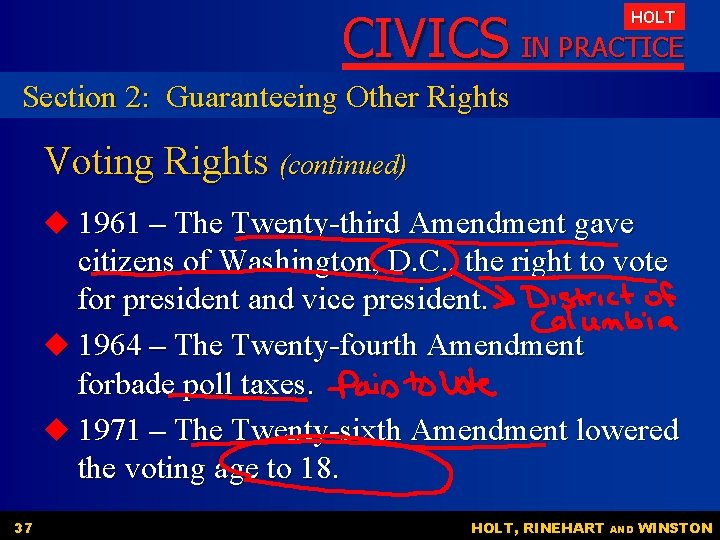
CIVICS IN PRACTICE HOLT Section 2: Guaranteeing Other Rights Voting Rights (continued) u 1961 – The Twenty-third Amendment gave citizens of Washington, D. C. , the right to vote for president and vice president. u 1964 – The Twenty-fourth Amendment forbade poll taxes. u 1971 – The Twenty-sixth Amendment lowered the voting age to 18. 37 HOLT, RINEHART AND WINSTON
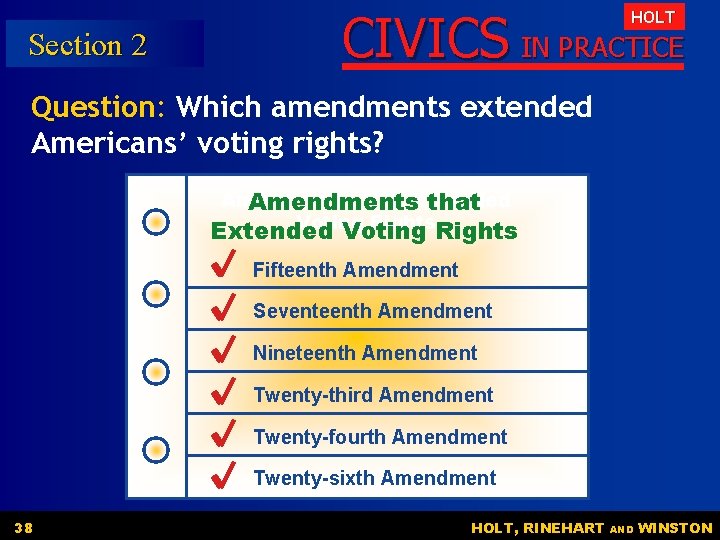
Section 2 CIVICS IN PRACTICE HOLT Question: Which amendments extended Americans’ voting rights? Amendments that Extended Amendments that Voting Rights Extended Voting Fifteenth Amendment Seventeenth Amendment Nineteenth Amendment Twenty-third Amendment Twenty-fourth Amendment Twenty-sixth Amendment 38 HOLT, RINEHART AND WINSTON
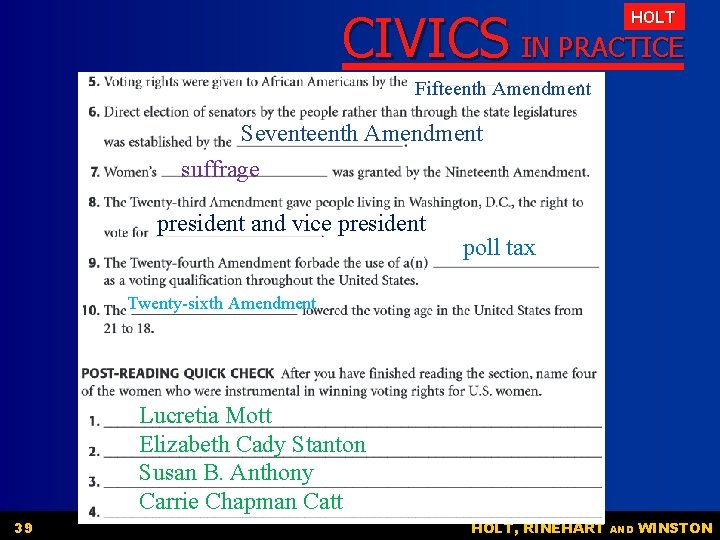
CIVICS IN PRACTICE HOLT Fifteenth Amendment Seventeenth Amendment suffrage president and vice president poll tax Twenty-sixth Amendment Lucretia Mott Elizabeth Cady Stanton Susan B. Anthony Carrie Chapman Catt 39 HOLT, RINEHART AND WINSTON
CIVICS IN PRACTICE HOLT Section 3: Citizens’ Duties and Responsibilities The Main Idea Along with the rights and freedoms of U. S. citizenship come important duties and responsibilities. Reading Focus u What are the duties of citizenship? u What are the responsibilities of citizenship? 40 HOLT, RINEHART AND WINSTON
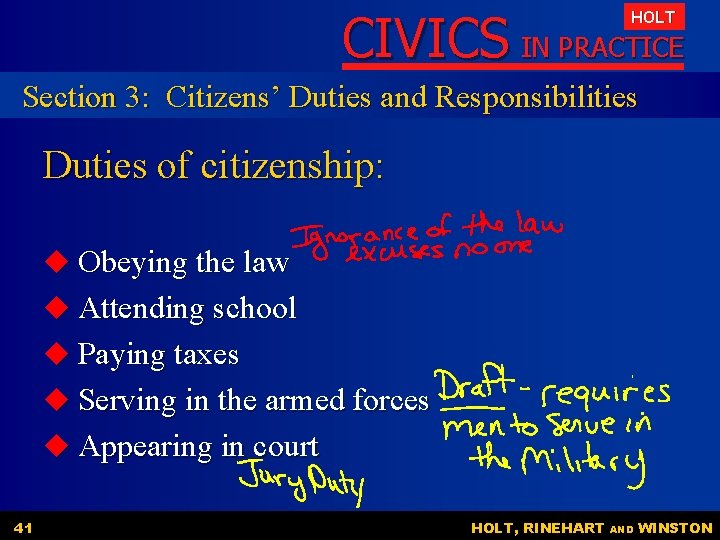
CIVICS IN PRACTICE HOLT Section 3: Citizens’ Duties and Responsibilities Duties of citizenship: u Obeying the law u Attending school u Paying taxes u Serving in the armed forces u Appearing in court 41 HOLT, RINEHART AND WINSTON
CIVICS IN PRACTICE HOLT Obeying the Law u It is your duty to know the Laws Attending School u Mandatory until age 16 u Educated Citizens 42 HOLT, RINEHART AND WINSTON
CIVICS IN PRACTICE HOLT Paying Taxes u Income, sales, property, and more taxes u Taxes provide money to the government in turn the government u operates u Provides services u National security and defense 43 HOLT, RINEHART AND WINSTON
CIVICS IN PRACTICE HOLT Serving in the Armed Forces u Volunteers u When the country has needed huge numbers of 44 soldiers, it sometimes had to establish a draft. u Draft laws (conscription)– require men of certain ages and qualifications to serve in the military u 18 yr old men must register with the selective service u Americans not fighting still participate u Food and goods are rationed (limited by law) at times u Pick up the slack at home HOLT, RINEHART WINSTON AND
CIVICS IN PRACTICE HOLT Appearing in Court u Citizens must report to serve as members of a jury (Jury Duty) u Citizens must also testify in court if called as a witness. 45 HOLT, RINEHART AND WINSTON
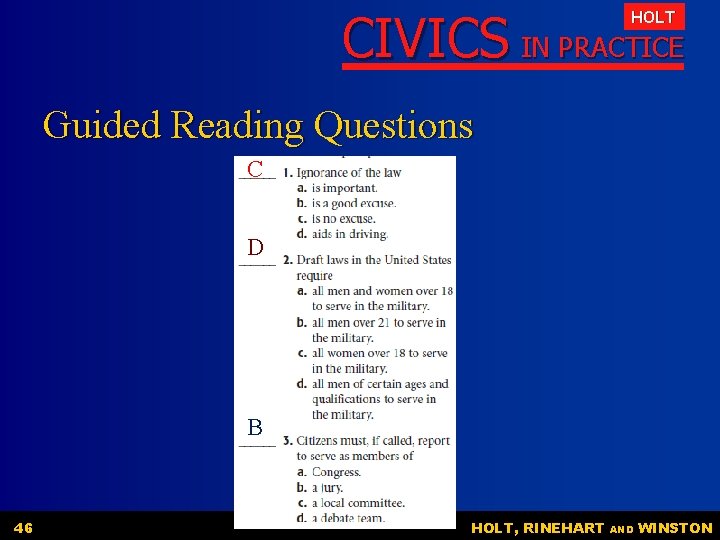
CIVICS IN PRACTICE HOLT Guided Reading Questions C D B 46 HOLT, RINEHART AND WINSTON
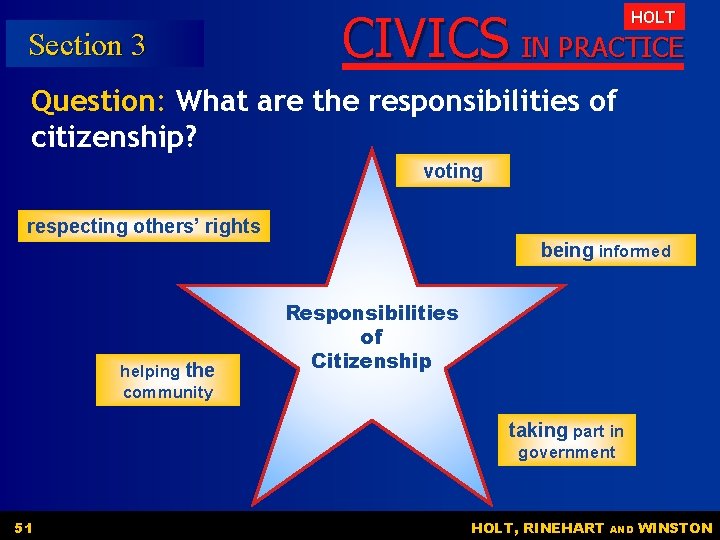
CIVICS IN PRACTICE HOLT Section 3: Citizens’ Duties and Responsibilities of Citizenship u Voting u Being informed u Taking part in government u Helping your community u Respecting and protecting others’ rights 47 HOLT, RINEHART AND WINSTON
CIVICS IN PRACTICE HOLT Voting Our government is based on the consent of the governed. u If you do not vote, you leave the decision to others u Let your legislators know when we approve or disapprove of their actions 48 HOLT, RINEHART AND WINSTON
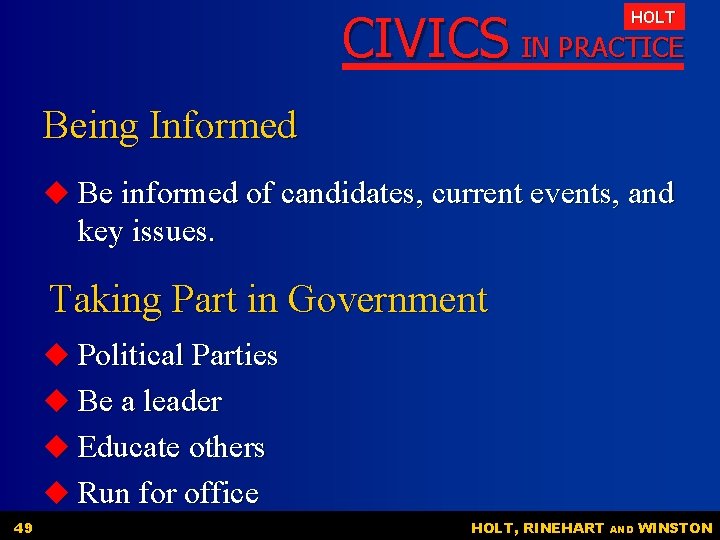
CIVICS IN PRACTICE HOLT Being Informed u Be informed of candidates, current events, and key issues. Taking Part in Government u Political Parties u Be a leader u Educate others u Run for office 49 HOLT, RINEHART AND WINSTON
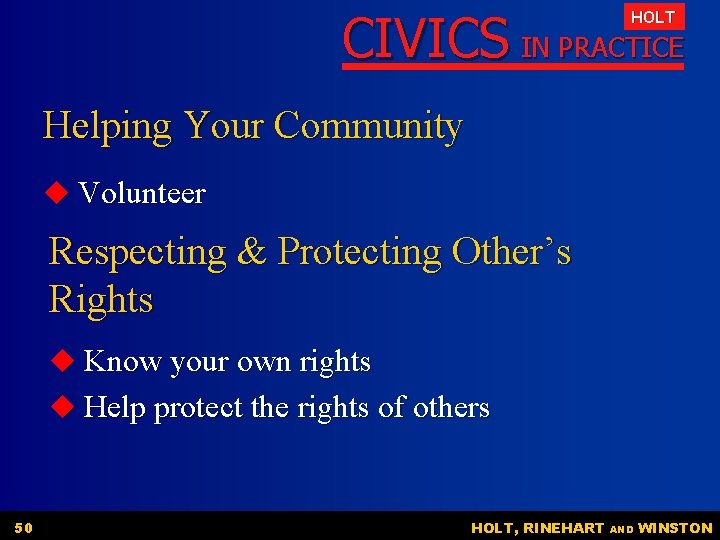
CIVICS IN PRACTICE HOLT Helping Your Community u Volunteer Respecting & Protecting Other’s Rights u Know your own rights u Help protect the rights of others 50 HOLT, RINEHART AND WINSTON
Section 3 CIVICS IN PRACTICE HOLT Question: What are the responsibilities of citizenship? voting respecting others’ rights being informed helping the community Responsibilities of Citizenship taking part in government 51 HOLT, RINEHART AND WINSTON
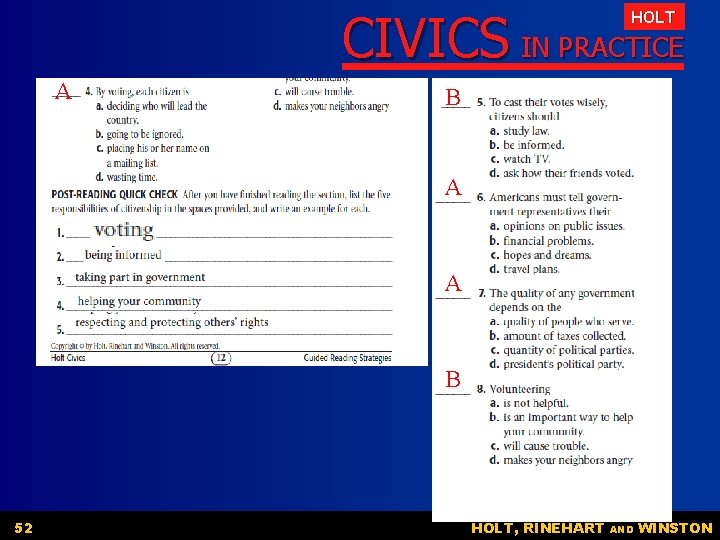
CIVICS IN PRACTICE HOLT A B A A B 52 HOLT, RINEHART AND WINSTON
CIVICS IN PRACTICE HOLT Chapter 4 Wrap-Up 1. Which amendments focus on the rights of people accused of crimes? What rights do these amendments guarantee? 2. Why was the Ninth Amendment included in the Bill of Rights? 3. How did the Thirteenth and Fourteenth Amendments extend the civil rights of Americans? 4. How have voting rights been expanded through constitutional amendments? 5. What are the duties of citizenship? 6. What are the responsibilities of citizenship? 53 HOLT, RINEHART AND WINSTON