
Civics EOC Study Guide 2015 2016 FAILURE IS




























- Slides: 170
Civics EOC Study Guide 2015 -2016 FAILURE IS NOT AN OPTION
Vocabulary • Anarchy—The absence of any form of government. • Anti-Federalists—A group of people in the early United States who opposed ratification of the U. S. Constitution because they feared a strong national government and a lack of protection for individual rights. • Anti-Federalist Papers—A series of essays written to counter and defeat the proposed U. S. Constitution. • Article—A numbered chapter or section of a contract, treaty, or constitution. • Authority—The power to direct the actions of people or to make decisions.
Vocabulary • Citizen—A legal member of a state and/or country. • Common law—Legal precedence based on customs and prior legal decisions and is used in civil cases. • Common or public good—Beliefs or actions that are seen as a benefit to the larger community rather than individual interests. • Compact—An official agreement made by two or more parties. • Consent of the governed—An agreement made by the people to establish a government and abide by its laws.
Vocabulary • Democracy—A system of government in which political power resides with the people.
Vocabulary • Federalist Papers—A series of essays written to explain and defend the proposed U. S. Constitution. • Federalists—A group of people in the early United States who favored the establishment of a strong national government and who worked for ratification of the U. S. Constitution.
Vocabulary • Federalist Papers—A series of essays written to explain and defend the proposed U. S. Constitution. • Federalists—A group of people in the early United States who favored the establishment of a strong national government and who worked for ratification of the U. S. Constitution.
Vocabulary • Independent judiciary—The principle that decisions from the courts are fair and impartial and are not subject to undue influence from the other branches of government.
Vocabulary • Limited monarchy—A system of government in which the king or queen shares authority with an elected legislature and agrees to be bound by a constitution or a set of laws. Also known as a constitutional monarchy.
Vocabulary • Natural rights—The belief that individuals are born with basic rights that cannot be taken away by governments.
Vocabulary • Representative democracy (Republic)—A system of government in which the people elect representatives to make policies and laws for them. • Rule of law—A concept that those who govern are bound by the laws; no one is above the law.
Vocabulary • Social contract—An implied agreement among the people of an organized society that defines the rights, duties, and limitations of the governed and the government. • Socialism—An economic system in which the government owns the primary means of production.
Vocabulary • Unalienable (inalienable) rights—Basic rights of the people that may not be taken away. • Unitary––A system of government in which power resides with the central government.
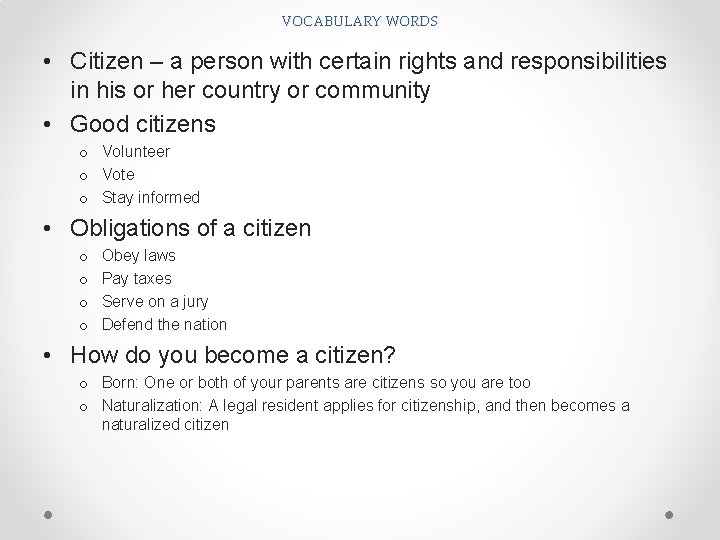
VOCABULARY WORDS • Citizen – a person with certain rights and responsibilities in his or her country or community • Good citizens o Volunteer o Vote o Stay informed • Obligations of a citizen o o Obey laws Pay taxes Serve on a jury Defend the nation • How do you become a citizen? o Born: One or both of your parents are citizens so you are too o Naturalization: A legal resident applies for citizenship, and then becomes a naturalized citizen
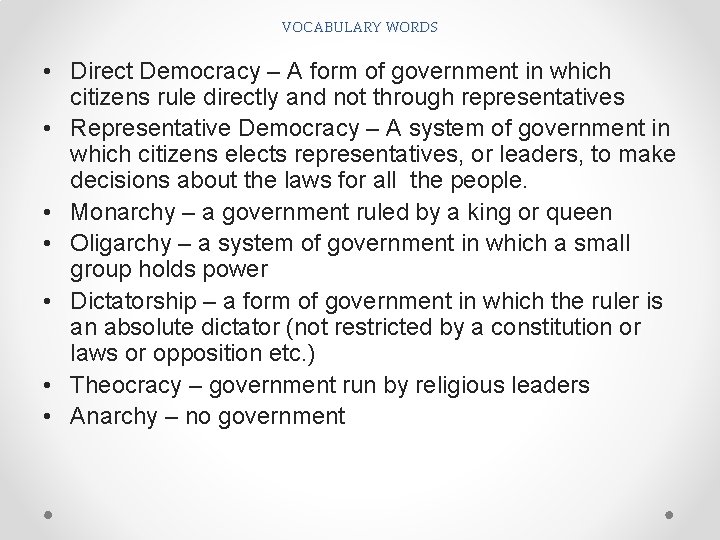
VOCABULARY WORDS • Direct Democracy – A form of government in which citizens rule directly and not through representatives • Representative Democracy – A system of government in which citizens elects representatives, or leaders, to make decisions about the laws for all the people. • Monarchy – a government ruled by a king or queen • Oligarchy – a system of government in which a small group holds power • Dictatorship – a form of government in which the ruler is an absolute dictator (not restricted by a constitution or laws or opposition etc. ) • Theocracy – government run by religious leaders • Anarchy – no government
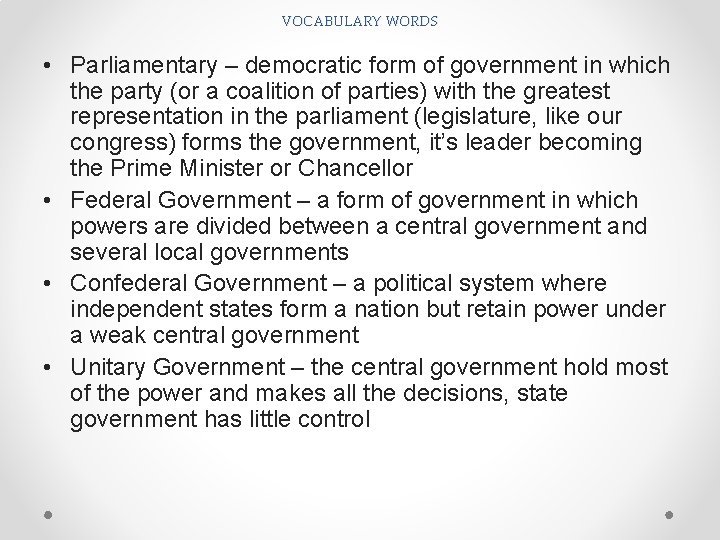
VOCABULARY WORDS • Parliamentary – democratic form of government in which the party (or a coalition of parties) with the greatest representation in the parliament (legislature, like our congress) forms the government, it’s leader becoming the Prime Minister or Chancellor • Federal Government – a form of government in which powers are divided between a central government and several local governments • Confederal Government – a political system where independent states form a nation but retain power under a weak central government • Unitary Government – the central government hold most of the power and makes all the decisions, state government has little control
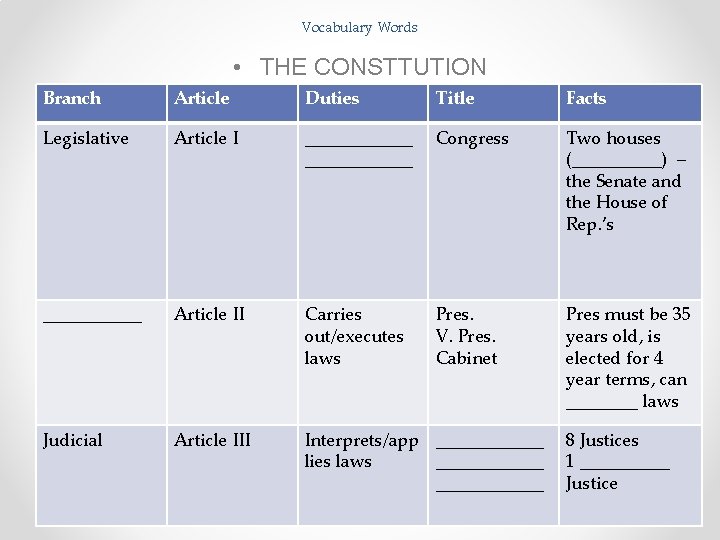
Vocabulary Words • THE CONSTTUTION Branch Article Duties Title Facts Legislative Article I ____________ Congress Two houses (_____) – the Senate and the House of Rep. ’s ______ Article II Carries out/executes laws Pres. V. Pres. Cabinet Pres must be 35 years old, is elected for 4 year terms, can ____ laws Judicial Article III Interprets/app ______ lies laws ____________ 8 Justices 1 _____ Justice
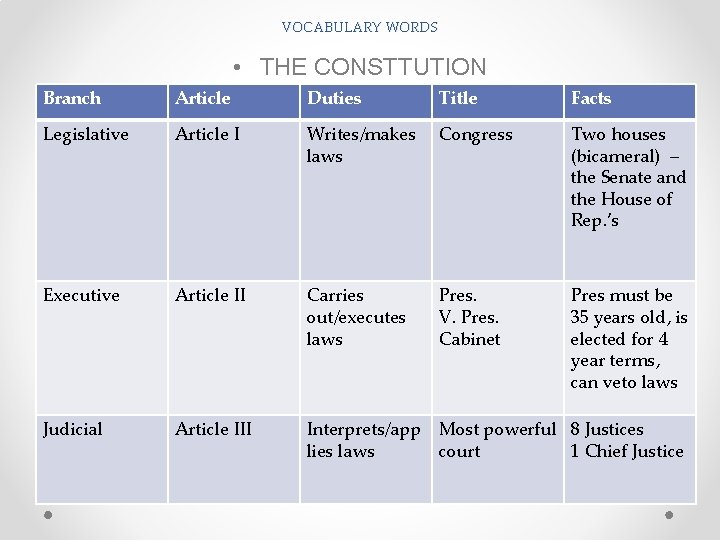
VOCABULARY WORDS • THE CONSTTUTION Branch Article Duties Title Facts Legislative Article I Writes/makes laws Congress Two houses (bicameral) – the Senate and the House of Rep. ’s Executive Article II Carries out/executes laws Pres. V. Pres. Cabinet Pres must be 35 years old, is elected for 4 year terms, can veto laws Judicial Article III Interprets/app Most powerful 8 Justices lies laws court 1 Chief Justice
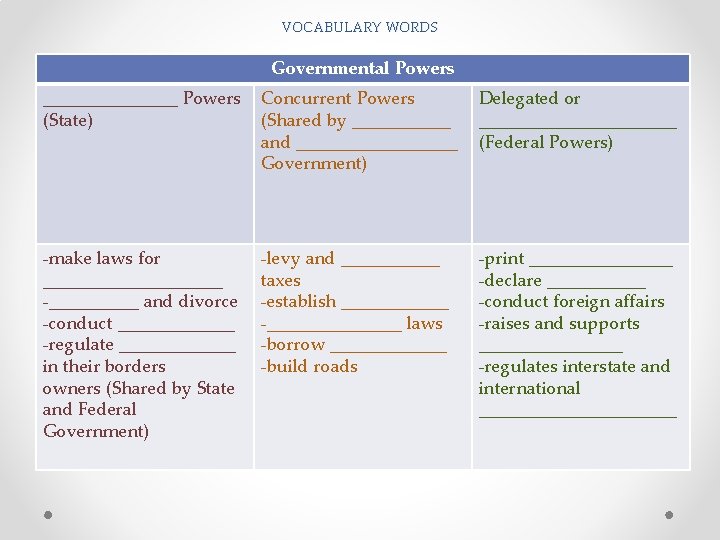
VOCABULARY WORDS Governmental Powers ________ Powers Concurrent Powers Delegated or (State) (Shared by _________________ and _________ (Federal Powers) Government) -make laws for __________ -_____ and divorce -conduct _______ -regulate _______ in their borders owners (Shared by State and Federal Government) -levy and ______ taxes -establish ______ -________ laws -borrow _______ -build roads -print ________ -declare ______ -conduct foreign affairs -raises and supports ________ -regulates interstate and international ___________
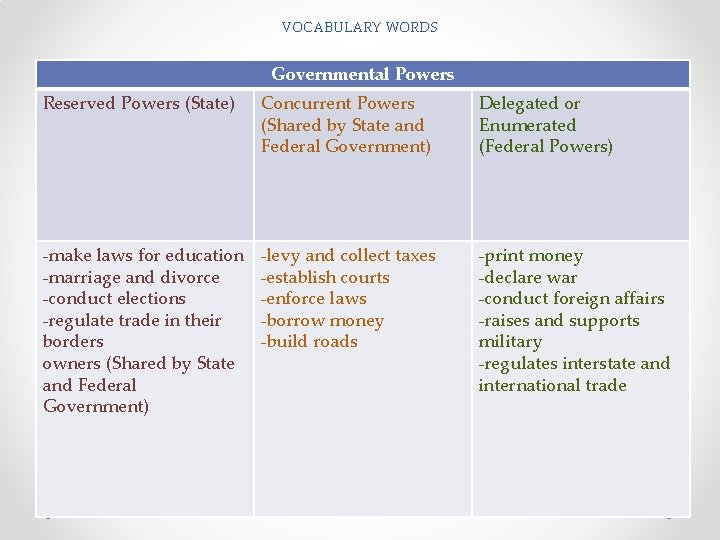
VOCABULARY WORDS Governmental Powers Reserved Powers (State) Concurrent Powers (Shared by State and Federal Government) Delegated or Enumerated (Federal Powers) -make laws for education -marriage and divorce -conduct elections -regulate trade in their borders owners (Shared by State and Federal Government) -levy and collect taxes -establish courts -enforce laws -borrow money -build roads -print money -declare war -conduct foreign affairs -raises and supports military -regulates interstate and international trade
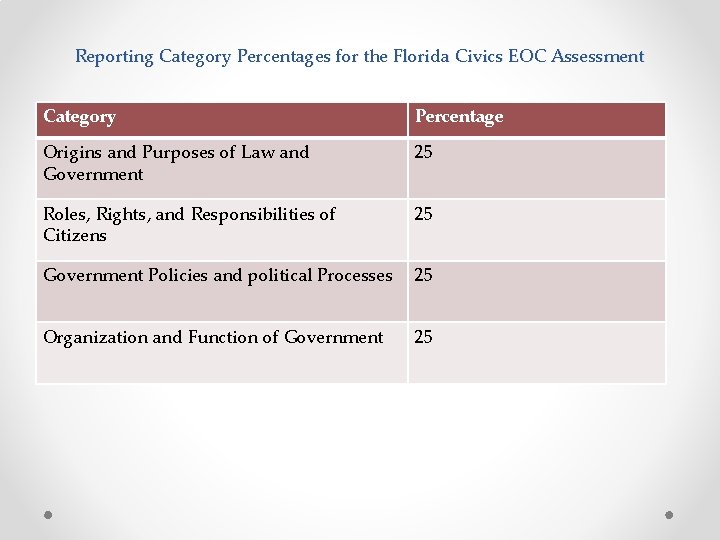
Reporting Category Percentages for the Florida Civics EOC Assessment Category Percentage Origins and Purposes of Law and Government 25 Roles, Rights, and Responsibilities of Citizens 25 Government Policies and political Processes 25 Organization and Function of Government 25
CIVICS AND GOVERNMENT • • Standard 1: Demonstrate an understanding of the origins and purposes of government, law, and the American political system. Standard 2: Evaluate the roles, rights, and responsibilities of United States citizens, and determine methods of active participation in society, government, and the political system. Standard 3: Demonstrate an understanding of the principles, functions, and organization of government. Standard 4: Demonstrate an understanding of contemporary issues in world affairs, and evaluate the role and impact of United States foreign policy.
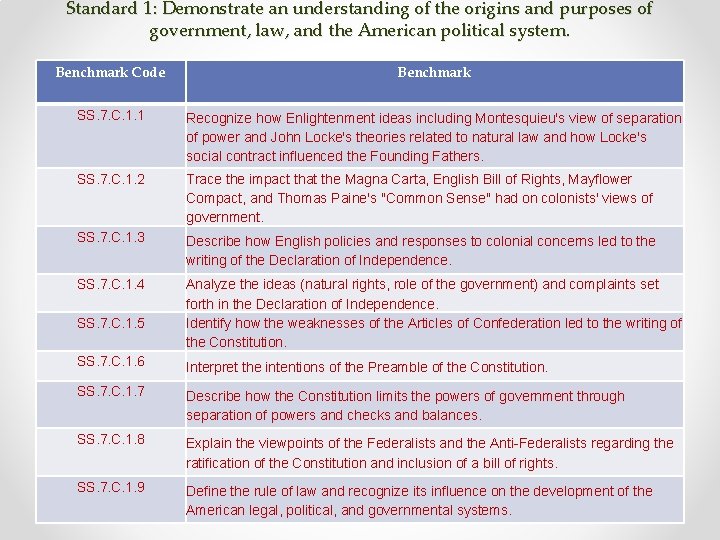
Standard 1: Demonstrate an understanding of the origins and purposes of government, law, and the American political system. Benchmark Code Benchmark SS. 7. C. 1. 1 Recognize how Enlightenment ideas including Montesquieu's view of separation of power and John Locke's theories related to natural law and how Locke's social contract influenced the Founding Fathers. SS. 7. C. 1. 2 Trace the impact that the Magna Carta, English Bill of Rights, Mayflower Compact, and Thomas Paine's "Common Sense" had on colonists' views of government. SS. 7. C. 1. 3 Describe how English policies and responses to colonial concerns led to the writing of the Declaration of Independence. SS. 7. C. 1. 4 Analyze the ideas (natural rights, role of the government) and complaints set forth in the Declaration of Independence. Identify how the weaknesses of the Articles of Confederation led to the writing of the Constitution. SS. 7. C. 1. 5 SS. 7. C. 1. 6 Interpret the intentions of the Preamble of the Constitution. SS. 7. C. 1. 7 Describe how the Constitution limits the powers of government through separation of powers and checks and balances. SS. 7. C. 1. 8 Explain the viewpoints of the Federalists and the Anti-Federalists regarding the ratification of the Constitution and inclusion of a bill of rights. SS. 7. C. 1. 9 Define the rule of law and recognize its influence on the development of the American legal, political, and governmental systems.
The Enlightenment • The Enlightenment was a period of time when people developed new ideas about human existence, including peoples’ basic rights and the level of control they should have over their government and their futures.
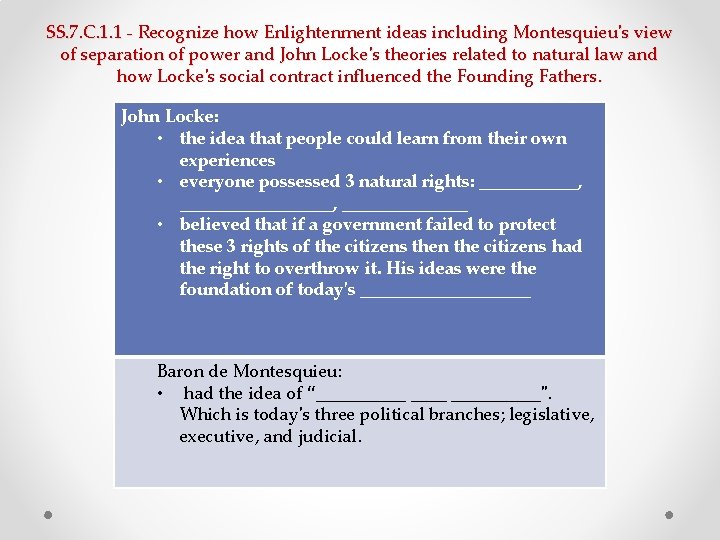
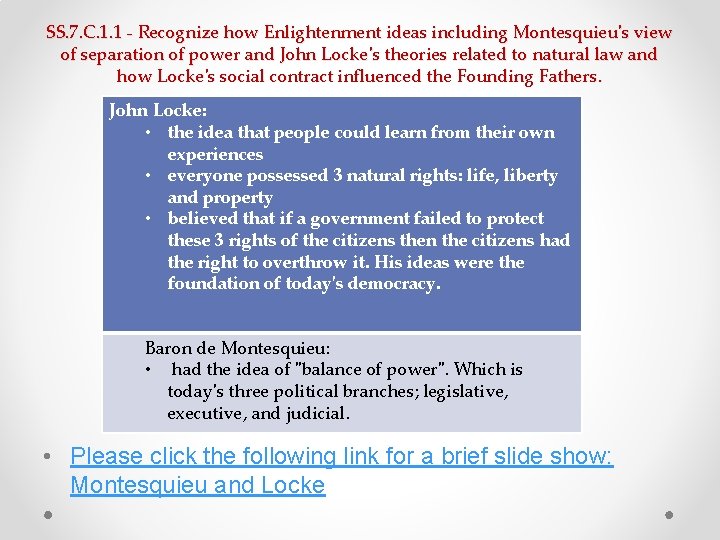
SS. 7. C. 1. 1 - Recognize how Enlightenment ideas including Montesquieu's view of separation of power and John Locke's theories related to natural law and how Locke's social contract influenced the Founding Fathers. John Locke: • the idea that people could learn from their own experiences • everyone possessed 3 natural rights: ______, _________, _______ • believed that if a government failed to protect these 3 rights of the citizens then the citizens had the right to overthrow it. His ideas were the foundation of today's __________ Baron de Montesquieu: • had the idea of “__________". Which is today's three political branches; legislative, executive, and judicial.
SS. 7. C. 1. 1 - Recognize how Enlightenment ideas including Montesquieu's view of separation of power and John Locke's theories related to natural law and how Locke's social contract influenced the Founding Fathers. John Locke: • the idea that people could learn from their own experiences • everyone possessed 3 natural rights: life, liberty and property • believed that if a government failed to protect these 3 rights of the citizens then the citizens had the right to overthrow it. His ideas were the foundation of today's democracy. Baron de Montesquieu: • had the idea of "balance of power". Which is today's three political branches; legislative, executive, and judicial. • Please click the following link for a brief slide show: Montesquieu and Locke
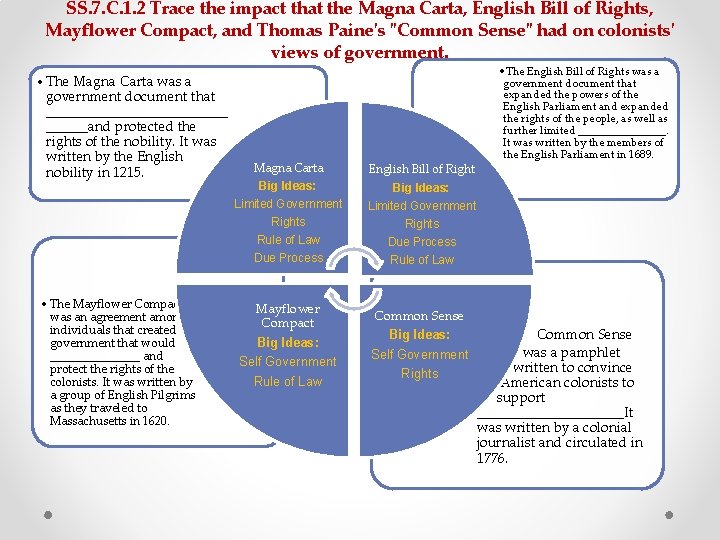
SS. 7. C. 1. 2 Trace the impact that the Magna Carta, English Bill of Rights, Mayflower Compact, and Thomas Paine's "Common Sense" had on colonists' views of government. • The Magna Carta was a government document that _____________and protected the rights of the nobility. It was written by the English nobility in 1215. • The Mayflower Compact was an agreement among individuals that created a government that would ________ and protect the rights of the colonists. It was written by a group of English Pilgrims as they traveled to Massachusetts in 1620. Magna Carta English Bill of Right Big Ideas: Limited Government Rights Rule of Law Due Process Big Ideas: Limited Government Rights Due Process Rule of Law Mayflower Compact Common Sense Big Ideas: Self Government Rule of Law • The English Bill of Rights was a government document that expanded the powers of the English Parliament and expanded the rights of the people, as well as further limited ________. It was written by the members of the English Parliament in 1689. • Common Sense Self Government • was a pamphlet w written to convince Rights the American colonists to s support ___________It was written by a colonial journalist and circulated in 1776. Big Ideas:
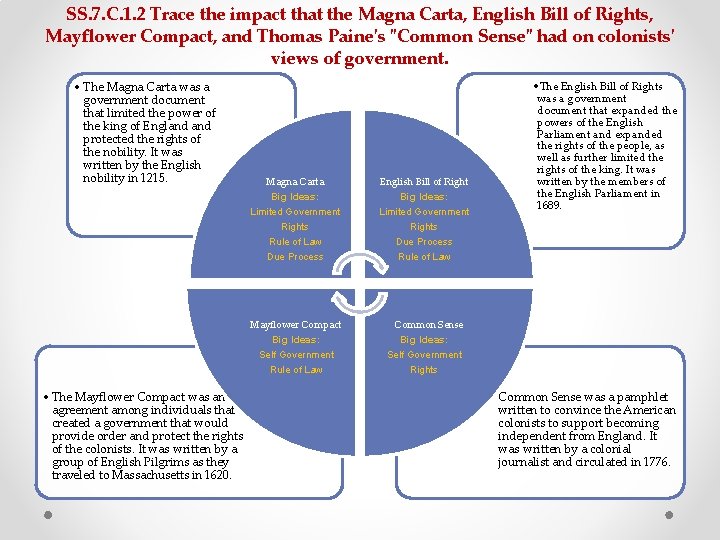
SS. 7. C. 1. 2 Trace the impact that the Magna Carta, English Bill of Rights, Mayflower Compact, and Thomas Paine's "Common Sense" had on colonists' views of government. • The Magna Carta was a government document that limited the power of the king of England protected the rights of the nobility. It was written by the English nobility in 1215. • The Mayflower Compact was an agreement among individuals that created a government that would provide order and protect the rights of the colonists. It was written by a group of English Pilgrims as they traveled to Massachusetts in 1620. Magna Carta English Bill of Right Big Ideas: Limited Government Rights Rule of Law Due Process Big Ideas: Limited Government Rights Due Process Rule of Law Mayflower Compact Common Sense Big Ideas: Self Government Rule of Law Big Ideas: Self Government Rights • The English Bill of Rights was a government document that expanded the powers of the English Parliament and expanded the rights of the people, as well as further limited the rights of the king. It was written by the members of the English Parliament in 1689. • Common Sense was a pamphlet written to convince the American colonists to support becoming independent from England. It was written by a colonial journalist and circulated in 1776.
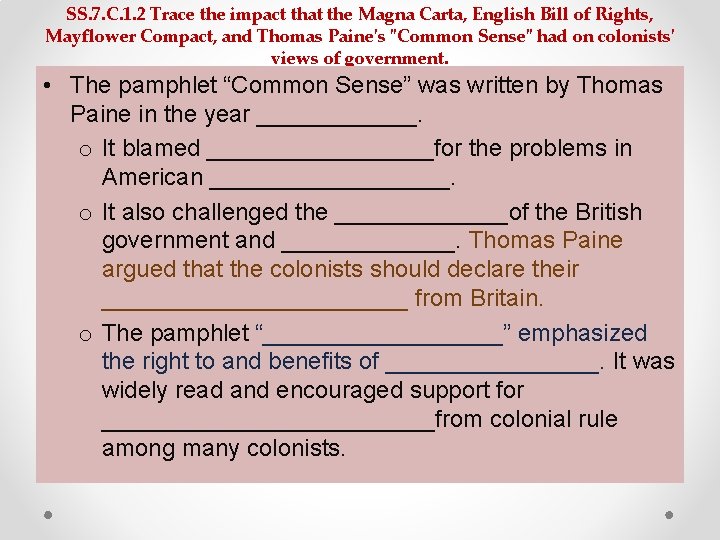
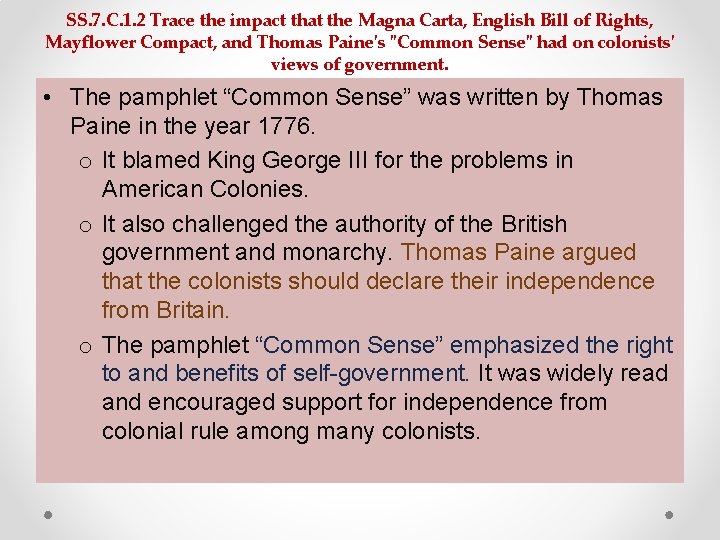
SS. 7. C. 1. 2 Trace the impact that the Magna Carta, English Bill of Rights, Mayflower Compact, and Thomas Paine's "Common Sense" had on colonists' views of government. • The pamphlet “Common Sense” was written by Thomas Paine in the year ______. o It blamed _________for the problems in American _________. o It also challenged the _______of the British government and _______. Thomas Paine argued that the colonists should declare their ____________ from Britain. o The pamphlet “_________” emphasized the right to and benefits of ________. It was widely read and encouraged support for _____________from colonial rule among many colonists.
SS. 7. C. 1. 2 Trace the impact that the Magna Carta, English Bill of Rights, Mayflower Compact, and Thomas Paine's "Common Sense" had on colonists' views of government. • The pamphlet “Common Sense” was written by Thomas Paine in the year 1776. o It blamed King George III for the problems in American Colonies. o It also challenged the authority of the British government and monarchy. Thomas Paine argued that the colonists should declare their independence from Britain. o The pamphlet “Common Sense” emphasized the right to and benefits of self-government. It was widely read and encouraged support for independence from colonial rule among many colonists.
Revolutionary Inspiration • The American Revolution and everything that went with it, the Declaration of Independence, the Constitution, the Bill of Rights, all had much of their background in these four documents, Click on theses links to hear brief audio clips detailing these events. • • English Bill of Rights Magna Carta The Mayflower Compact Thomas Paine
Events the Lead to the Revolution Place the 1 events 2 that 3 Led to the revolution. In order 4 5 6
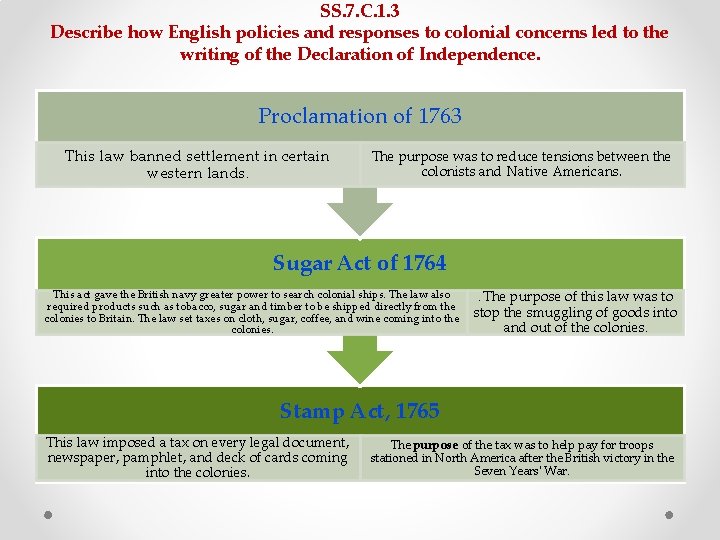
SS. 7. C. 1. 3 Describe how English policies and responses to colonial concerns led to the writing of the Declaration of Independence. Proclamation of 1763 This law banned settlement in certain western lands. The purpose was to reduce tensions between the colonists and Native Americans. Sugar Act of 1764 This act gave the British navy greater power to search colonial ships. The law also required products such as tobacco, sugar and timber to be shipped directly from the colonies to Britain. The law set taxes on cloth, sugar, coffee, and wine coming into the colonies. . The purpose of this law was to stop the smuggling of goods into and out of the colonies. Stamp Act, 1765 This law imposed a tax on every legal document, newspaper, pamphlet, and deck of cards coming into the colonies. The purpose of the tax was to help pay for troops stationed in North America after the British victory in the Seven Years' War.
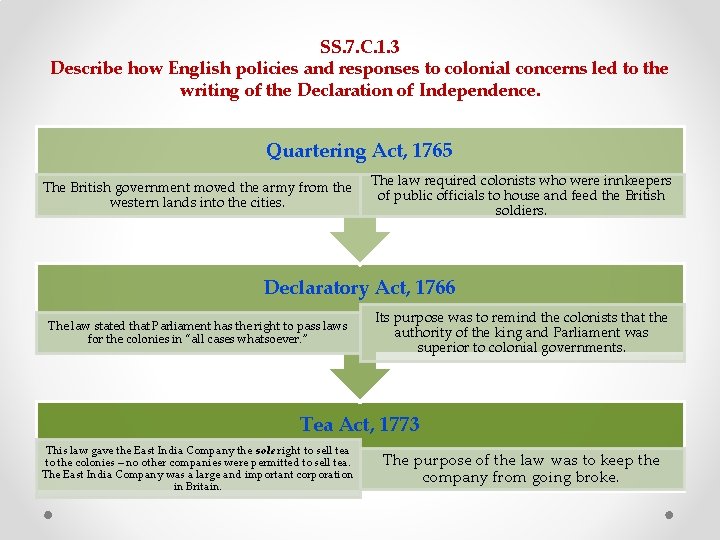
SS. 7. C. 1. 3 Describe how English policies and responses to colonial concerns led to the writing of the Declaration of Independence. Quartering Act, 1765 The British government moved the army from the western lands into the cities. The law required colonists who were innkeepers of public officials to house and feed the British soldiers. Declaratory Act, 1766 The law stated that Parliament has the right to pass laws for the colonies in “all cases whatsoever. ” Its purpose was to remind the colonists that the authority of the king and Parliament was superior to colonial governments. Tea Act, 1773 This law gave the East India Company the sole right to sell tea to the colonies – no other companies were permitted to sell tea. The East India Company was a large and important corporation in Britain. The purpose of the law was to keep the company from going broke.
Events the Lead to the Revolution
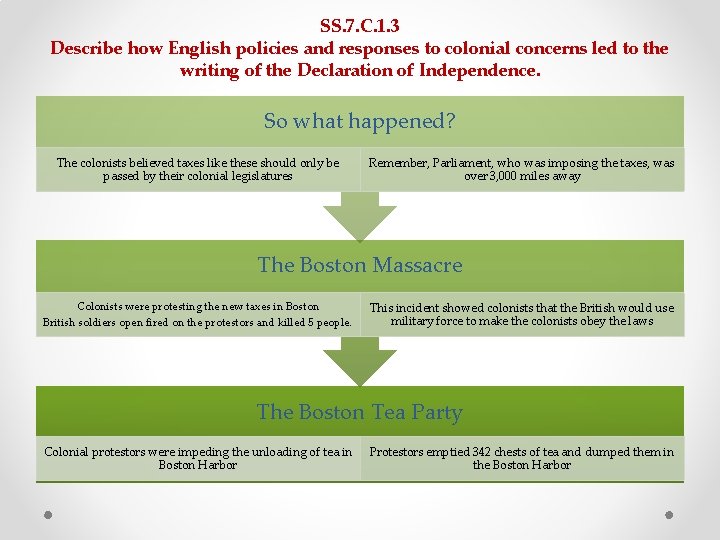
SS. 7. C. 1. 3 Describe how English policies and responses to colonial concerns led to the writing of the Declaration of Independence. So what happened? The colonists believed taxes like these should only be passed by their colonial legislatures Remember, Parliament, who was imposing the taxes, was over 3, 000 miles away The Boston Massacre Colonists were protesting the new taxes in Boston British soldiers open fired on the protestors and killed 5 people. This incident showed colonists that the British would use military force to make the colonists obey the laws The Boston Tea Party Colonial protestors were impeding the unloading of tea in Boston Harbor Protestors emptied 342 chests of tea and dumped them in the Boston Harbor
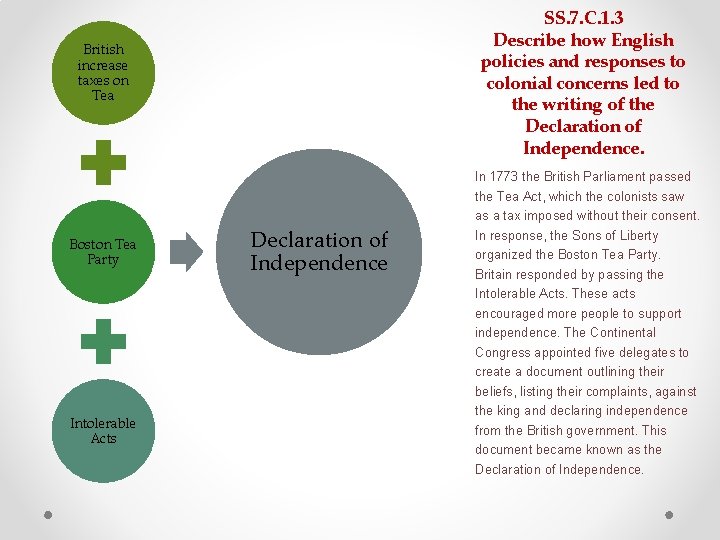
SS. 7. C. 1. 3 Describe how English policies and responses to colonial concerns led to the writing of the Declaration of Independence. British increase taxes on Tea Boston Tea Party Intolerable Acts Declaration of Independence In 1773 the British Parliament passed the Tea Act, which the colonists saw as a tax imposed without their consent. In response, the Sons of Liberty organized the Boston Tea Party. Britain responded by passing the Intolerable Acts. These acts encouraged more people to support independence. The Continental Congress appointed five delegates to create a document outlining their beliefs, listing their complaints, against the king and declaring independence from the British government. This document became known as the Declaration of Independence.
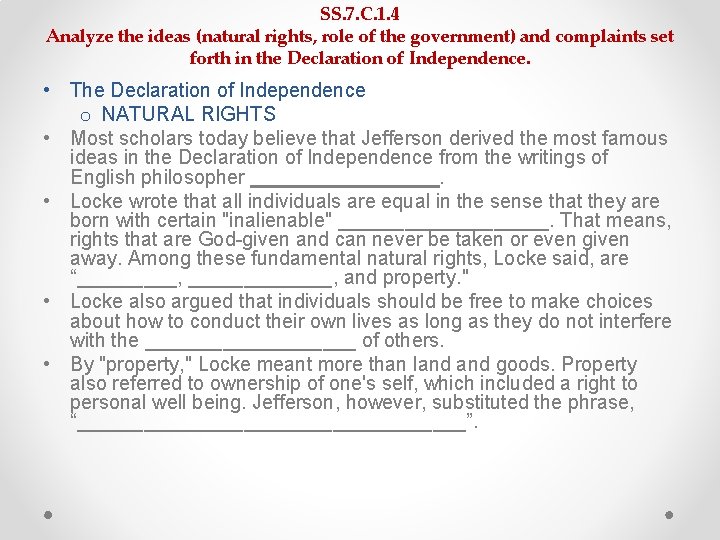
SS. 7. C. 1. 4 Analyze the ideas (natural rights, role of the government) and complaints set forth in the Declaration of Independence. • The Declaration of Independence o NATURAL RIGHTS • Most scholars today believe that Jefferson derived the most famous ideas in the Declaration of Independence from the writings of English philosopher _________. • Locke wrote that all individuals are equal in the sense that they are born with certain "inalienable" __________. That means, rights that are God-given and can never be taken or even given away. Among these fundamental natural rights, Locke said, are “_____, _______, and property. " • Locke also argued that individuals should be free to make choices about how to conduct their own lives as long as they do not interfere with the __________ of others. • By "property, " Locke meant more than land goods. Property also referred to ownership of one's self, which included a right to personal well being. Jefferson, however, substituted the phrase, “__________________”.
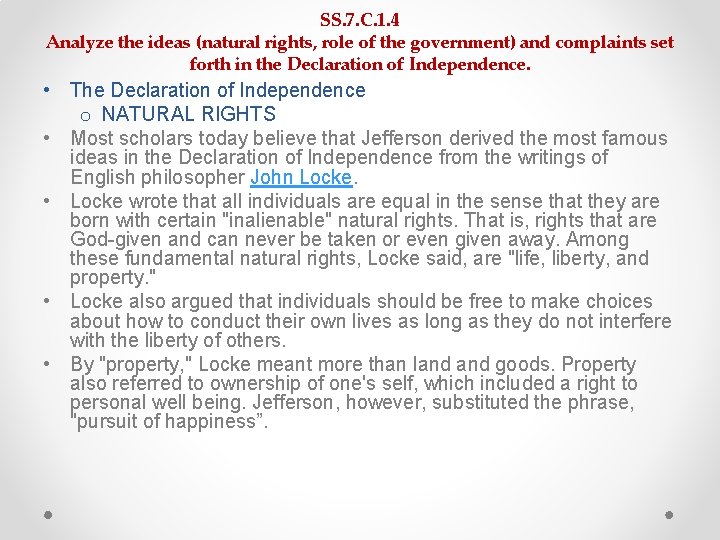
SS. 7. C. 1. 4 Analyze the ideas (natural rights, role of the government) and complaints set forth in the Declaration of Independence. • The Declaration of Independence o NATURAL RIGHTS • Most scholars today believe that Jefferson derived the most famous ideas in the Declaration of Independence from the writings of English philosopher John Locke. • Locke wrote that all individuals are equal in the sense that they are born with certain "inalienable" natural rights. That is, rights that are God-given and can never be taken or even given away. Among these fundamental natural rights, Locke said, are "life, liberty, and property. " • Locke also argued that individuals should be free to make choices about how to conduct their own lives as long as they do not interfere with the liberty of others. • By "property, " Locke meant more than land goods. Property also referred to ownership of one's self, which included a right to personal well being. Jefferson, however, substituted the phrase, "pursuit of happiness”.
SS. 7. C. 1. 4 Analyze the ideas (natural rights, role of the government) and complaints set forth in the Declaration of Independence. • Declaration of Independence o ROLE OF GOVERNMENT
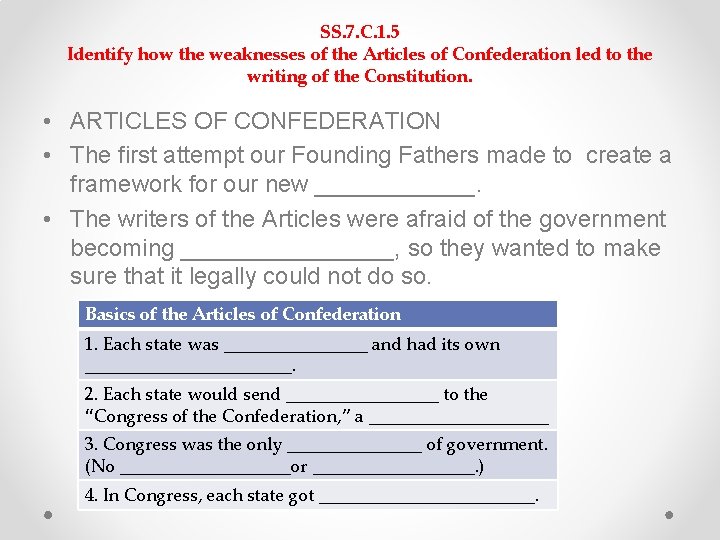
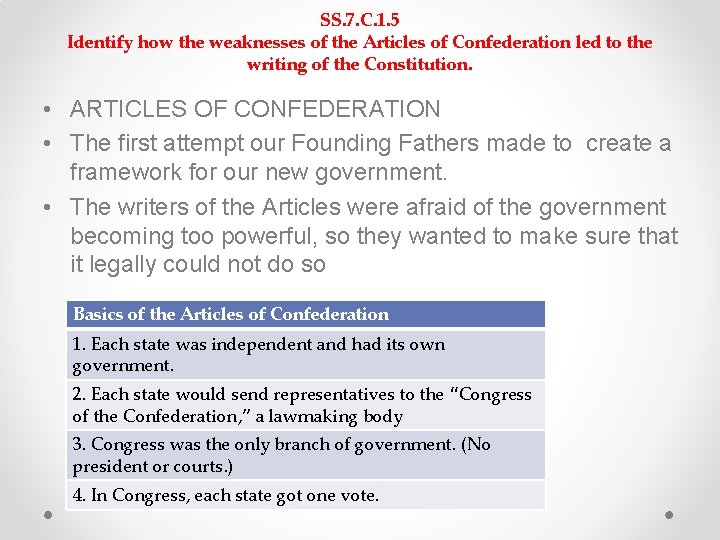
SS. 7. C. 1. 5 Identify how the weaknesses of the Articles of Confederation led to the writing of the Constitution. • ARTICLES OF CONFEDERATION • The first attempt our Founding Fathers made to create a framework for our new ______. • The writers of the Articles were afraid of the government becoming ________, so they wanted to make sure that it legally could not do so. Basics of the Articles of Confederation 1. Each state was ________ and had its own ____________. 2. Each state would send _________ to the “Congress of the Confederation, ” a __________ 3. Congress was the only ________ of government. (No __________or _________. ) 4. In Congress, each state got ____________.
SS. 7. C. 1. 5 Identify how the weaknesses of the Articles of Confederation led to the writing of the Constitution. • ARTICLES OF CONFEDERATION • The first attempt our Founding Fathers made to create a framework for our new government. • The writers of the Articles were afraid of the government becoming too powerful, so they wanted to make sure that it legally could not do so Basics of the Articles of Confederation 1. Each state was independent and had its own government. 2. Each state would send representatives to the “Congress of the Confederation, ” a lawmaking body 3. Congress was the only branch of government. (No president or courts. ) 4. In Congress, each state got one vote.
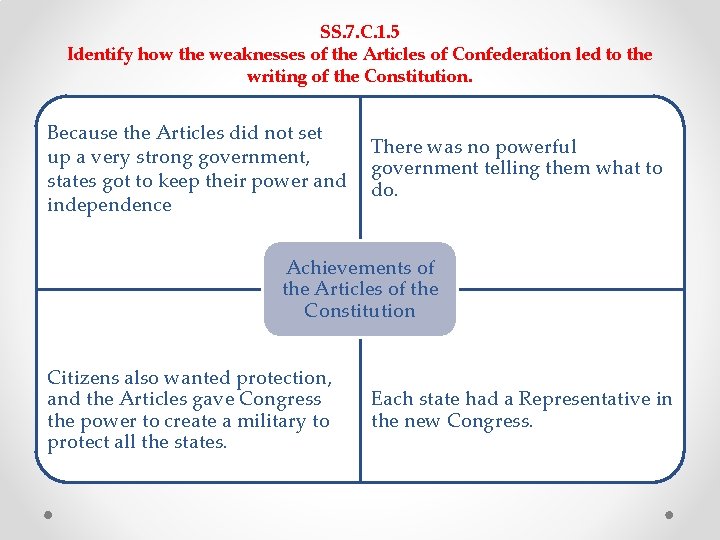
SS. 7. C. 1. 5 Identify how the weaknesses of the Articles of Confederation led to the writing of the Constitution. Because the Articles did not set There was no powerful up a very strong government, government telling them what to states got to keep their power and do. independence Achievements of the Articles of the Constitution Citizens also wanted protection, and the Articles gave Congress the power to create a military to protect all the states. Each state had a Representative in the new Congress.
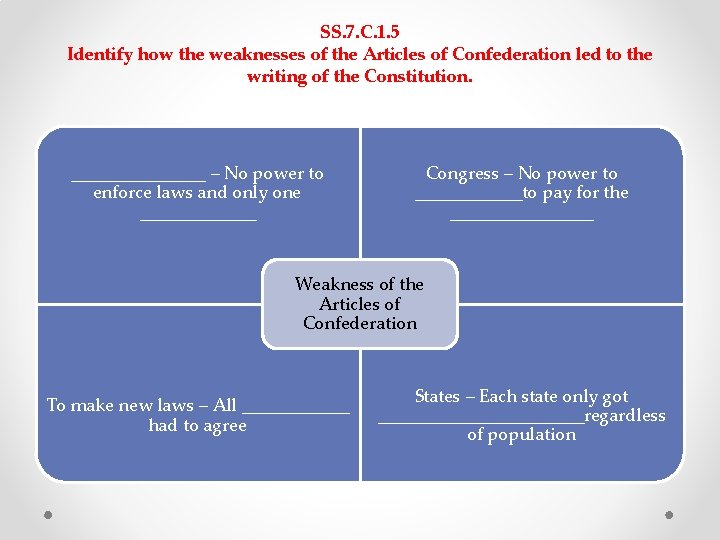
SS. 7. C. 1. 5 Identify how the weaknesses of the Articles of Confederation led to the writing of the Constitution. ________ – No power to enforce laws and only one _______ Congress – No power to ______to pay for the ________ Weakness of the Articles of Confederation To make new laws – All ______ had to agree States – Each state only got ____________regardless of population
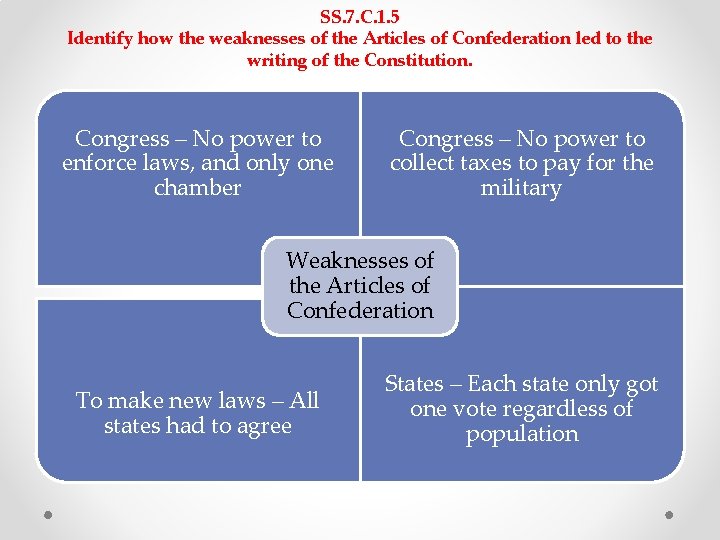
SS. 7. C. 1. 5 Identify how the weaknesses of the Articles of Confederation led to the writing of the Constitution. Congress – No power to enforce laws, and only one chamber Congress – No power to collect taxes to pay for the military Weaknesses of the Articles of Confederation To make new laws – All states had to agree States – Each state only got one vote regardless of population
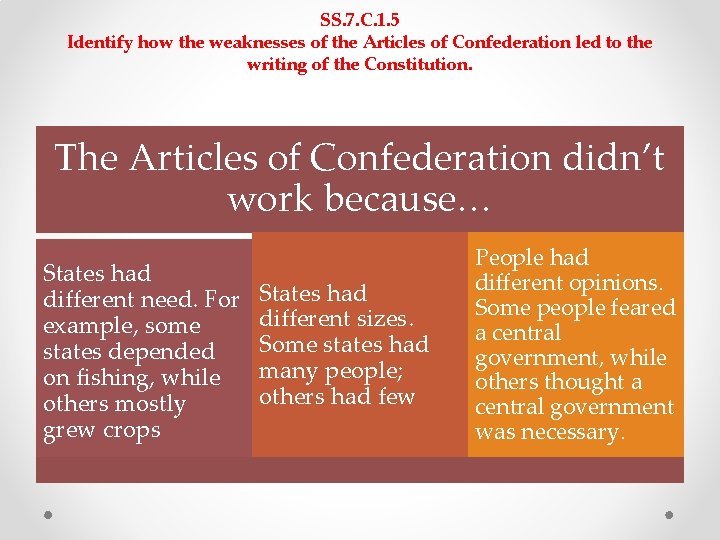
SS. 7. C. 1. 5 Identify how the weaknesses of the Articles of Confederation led to the writing of the Constitution. The Articles of Confederation didn’t work because… States had different need. For example, some states depended on fishing, while others mostly grew crops States had different sizes. Some states had many people; others had few People had different opinions. Some people feared a central government, while others thought a central government was necessary.
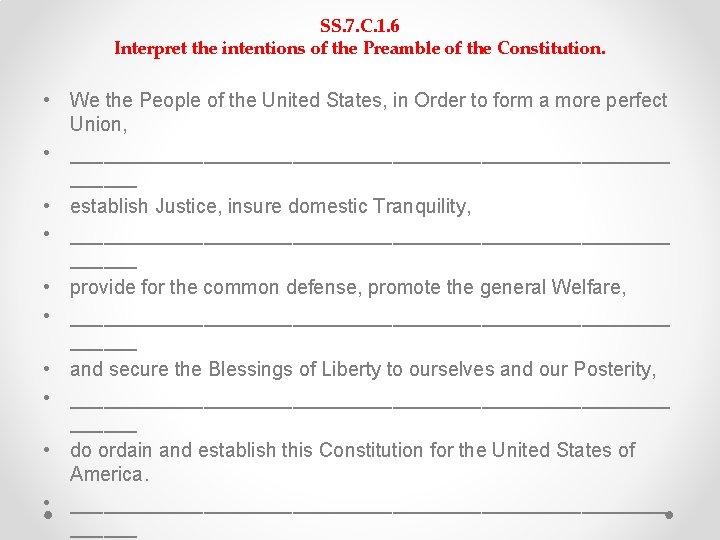
SS. 7. C. 1. 6 Interpret the intentions of the Preamble of the Constitution. • We the People of the United States, in Order to form a more perfect Union, • ___________________________ • establish Justice, insure domestic Tranquility, • ___________________________ • provide for the common defense, promote the general Welfare, • ___________________________ • and secure the Blessings of Liberty to ourselves and our Posterity, • ___________________________ • do ordain and establish this Constitution for the United States of America. • ___________________________
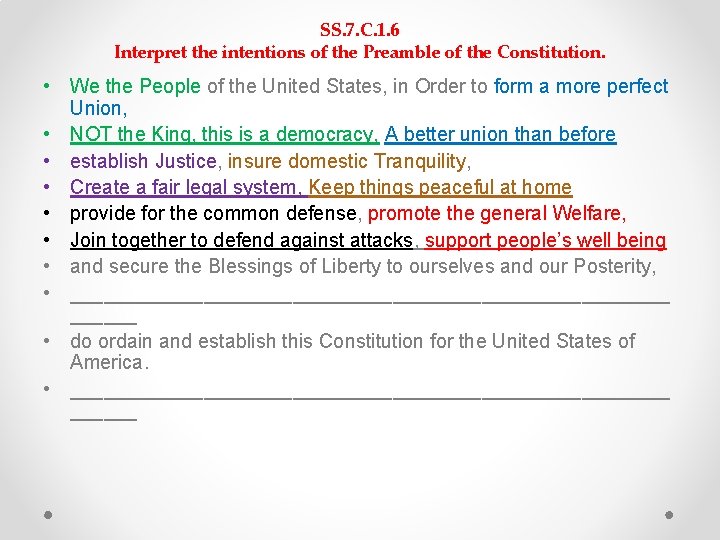
SS. 7. C. 1. 6 Interpret the intentions of the Preamble of the Constitution. • We the People of the United States, in Order to form a more perfect Union, • NOT the King, this is a democracy, A better union than before • establish Justice, insure domestic Tranquility, • Create a fair legal system, Keep things peaceful at home • provide for the common defense, promote the general Welfare, • Join together to defend against attacks, support people’s well being • and secure the Blessings of Liberty to ourselves and our Posterity, • ___________________________ • do ordain and establish this Constitution for the United States of America. • ___________________________
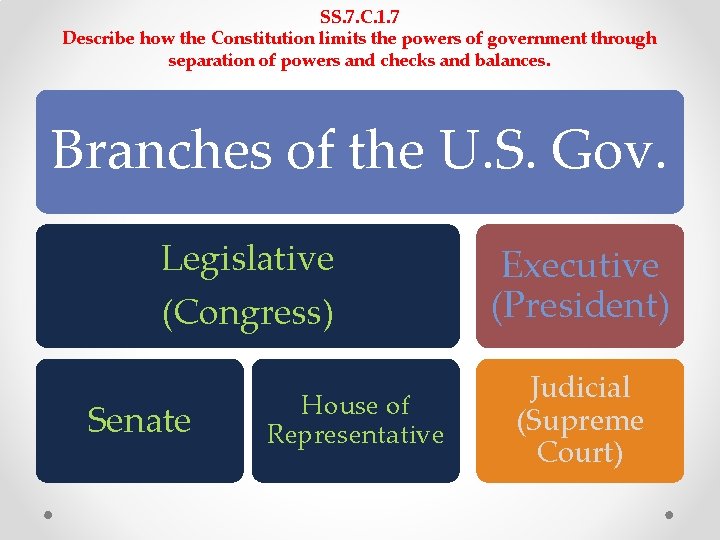
SS. 7. C. 1. 7 Describe how the Constitution limits the powers of government through separation of powers and checks and balances. Branches of the U. S. Gov. Legislative (Congress) Senate House of Representative Executive (President) Judicial (Supreme Court)
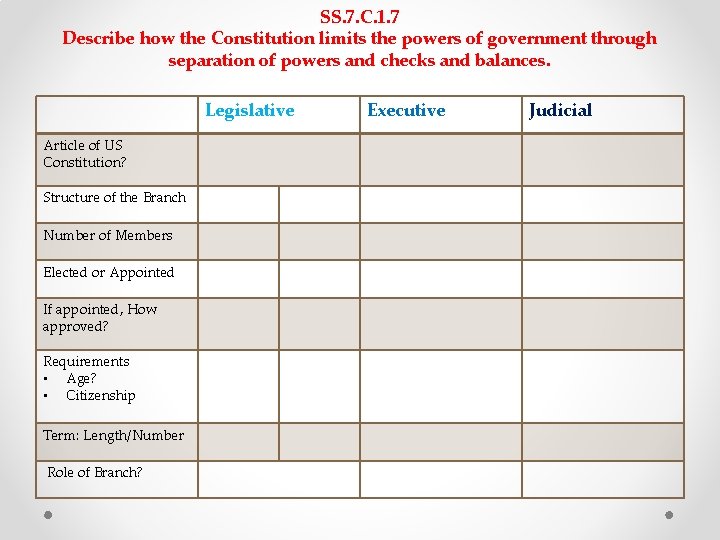
SS. 7. C. 1. 7 Describe how the Constitution limits the powers of government through separation of powers and checks and balances. Legislative Article of US Constitution? Structure of the Branch Number of Members Elected or Appointed If appointed, How approved? Requirements • Age? • Citizenship Term: Length/Number Role of Branch? Executive Judicial
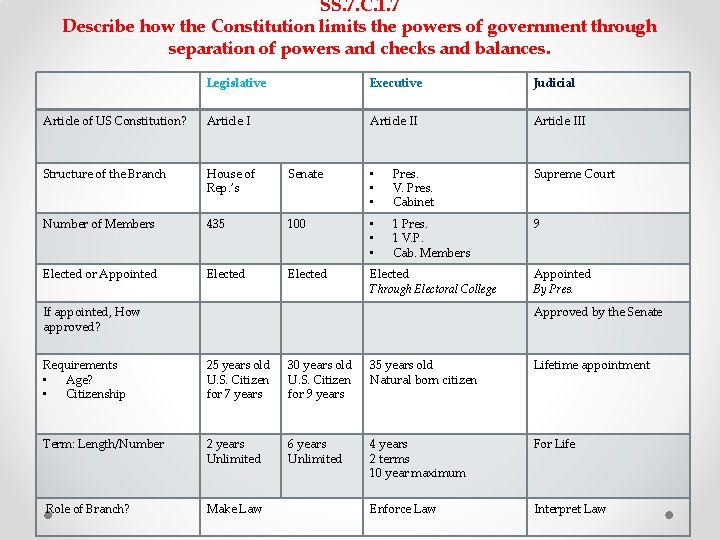
SS. 7. C. 1. 7 Describe how the Constitution limits the powers of government through separation of powers and checks and balances. Legislative Executive Judicial Article of US Constitution? Article III Structure of the Branch House of Rep. ’s Senate • • • Pres. V. Pres. Cabinet Supreme Court Number of Members 435 100 • • • 1 Pres. 1 V. P. Cab. Members 9 Elected or Appointed Elected Through Electoral College If appointed, How approved? Appointed By Pres. Approved by the Senate Requirements • Age? • Citizenship 25 years old U. S. Citizen for 7 years 30 years old U. S. Citizen for 9 years 35 years old Natural born citizen Lifetime appointment Term: Length/Number 2 years Unlimited 6 years Unlimited 4 years 2 terms 10 year maximum For Life Role of Branch? Make Law Enforce Law Interpret Law
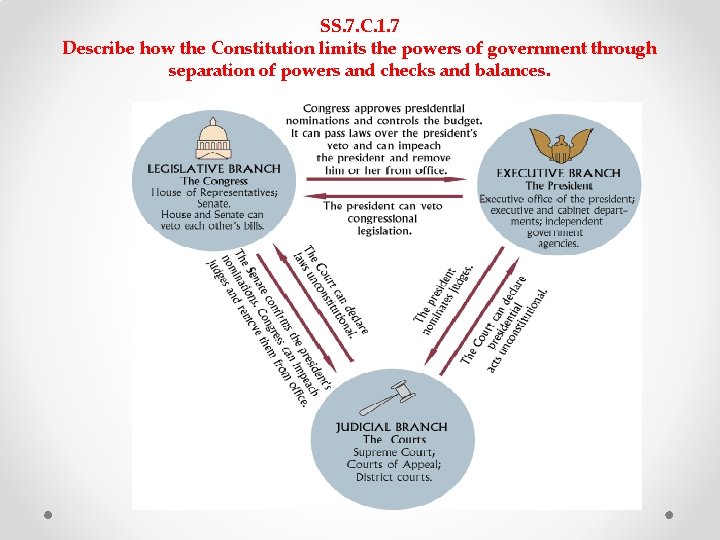
SS. 7. C. 1. 7 Describe how the Constitution limits the powers of government through separation of powers and checks and balances.
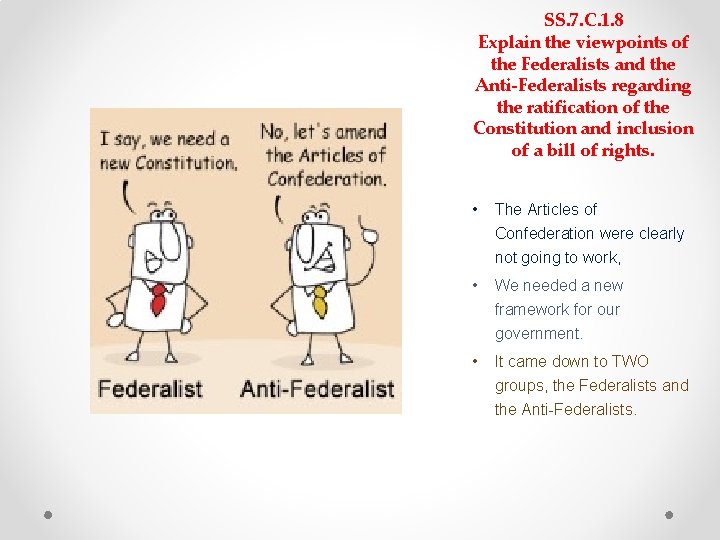
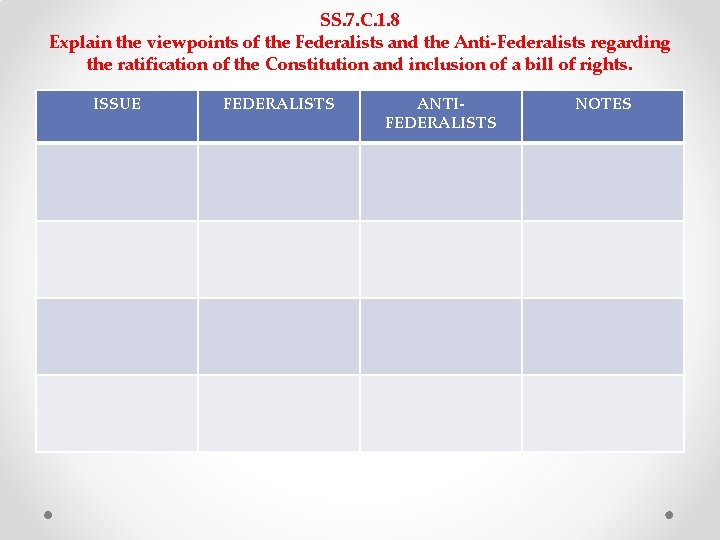
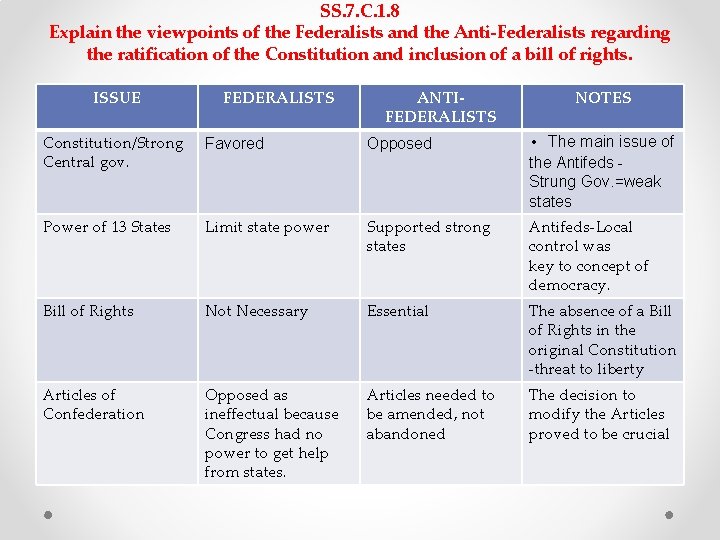
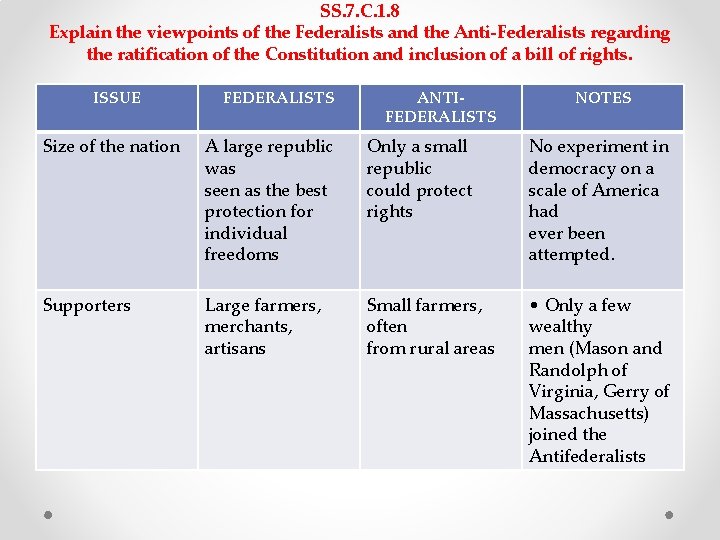
SS. 7. C. 1. 8 Explain the viewpoints of the Federalists and the Anti-Federalists regarding the ratification of the Constitution and inclusion of a bill of rights. • The Articles of Confederation were clearly not going to work, • We needed a new framework for our government. • It came down to TWO groups, the Federalists and the Anti-Federalists.
SS. 7. C. 1. 8 Explain the viewpoints of the Federalists and the Anti-Federalists regarding the ratification of the Constitution and inclusion of a bill of rights. ISSUE FEDERALISTS ANTIFEDERALISTS NOTES
SS. 7. C. 1. 8 Explain the viewpoints of the Federalists and the Anti-Federalists regarding the ratification of the Constitution and inclusion of a bill of rights. ISSUE FEDERALISTS ANTIFEDERALISTS NOTES Constitution/Strong Central gov. Favored Opposed • The main issue of the Antifeds - Strung Gov. =weak states Power of 13 States Limit state power Supported strong states Antifeds-Local control was key to concept of democracy. Bill of Rights Not Necessary Essential The absence of a Bill of Rights in the original Constitution -threat to liberty Articles of Confederation Opposed as ineffectual because Congress had no power to get help from states. Articles needed to be amended, not abandoned The decision to modify the Articles proved to be crucial
SS. 7. C. 1. 8 Explain the viewpoints of the Federalists and the Anti-Federalists regarding the ratification of the Constitution and inclusion of a bill of rights. ISSUE FEDERALISTS ANTIFEDERALISTS NOTES Size of the nation A large republic was seen as the best protection for individual freedoms Only a small republic could protect rights No experiment in democracy on a scale of America had ever been attempted. Supporters Large farmers, merchants, artisans Small farmers, often from rural areas • Only a few wealthy men (Mason and Randolph of Virginia, Gerry of Massachusetts) joined the Antifederalists
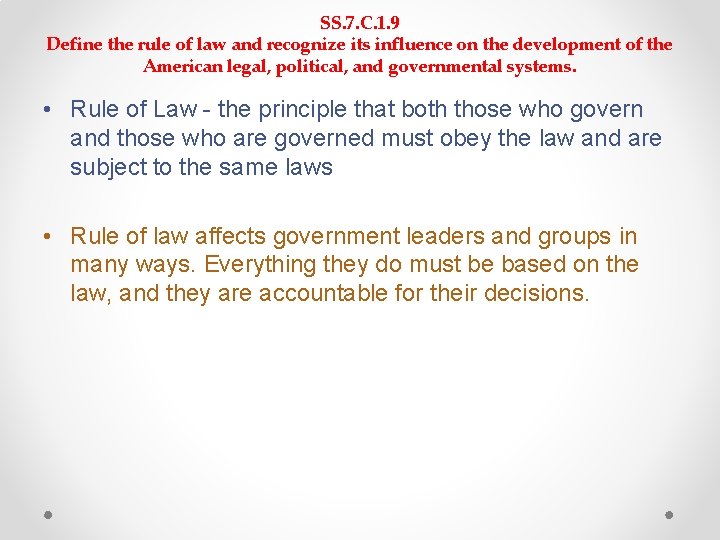
SS. 7. C. 1. 9 Define the rule of law and recognize its influence on the development of the American legal, political, and governmental systems. • Rule of Law - the principle that both those who govern and those who are governed must obey the law and are subject to the same laws • Rule of law affects government leaders and groups in many ways. Everything they do must be based on the law, and they are accountable for their decisions.
SS. 7. C. 1. 9 Define the rule of law and recognize its influence on the development of the American legal, political, and governmental systems.
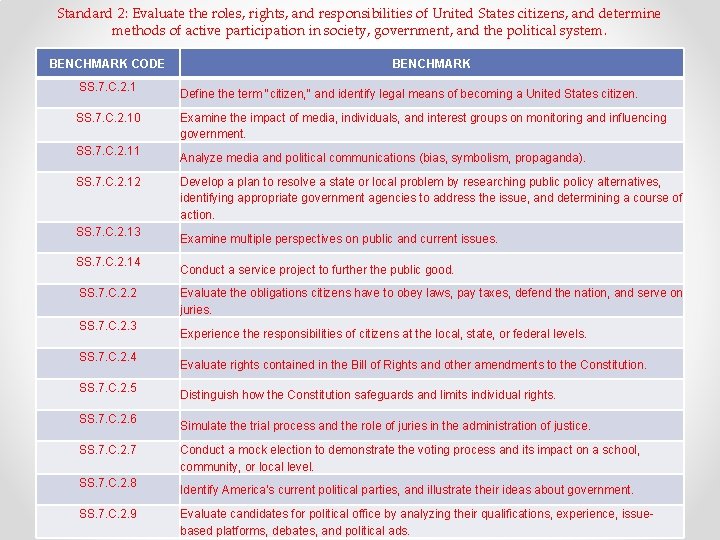
Standard 2: Evaluate the roles, rights, and responsibilities of United States citizens, and determine methods of active participation in society, government, and the political system. BENCHMARK CODE SS. 7. C. 2. 10 SS. 7. C. 2. 11 SS. 7. C. 2. 12 SS. 7. C. 2. 13 SS. 7. C. 2. 14 SS. 7. C. 2. 2 SS. 7. C. 2. 3 SS. 7. C. 2. 4 SS. 7. C. 2. 5 SS. 7. C. 2. 6 SS. 7. C. 2. 7 SS. 7. C. 2. 8 SS. 7. C. 2. 9 BENCHMARK Define the term "citizen, " and identify legal means of becoming a United States citizen. Examine the impact of media, individuals, and interest groups on monitoring and influencing government. Analyze media and political communications (bias, symbolism, propaganda). Develop a plan to resolve a state or local problem by researching public policy alternatives, identifying appropriate government agencies to address the issue, and determining a course of action. Examine multiple perspectives on public and current issues. Conduct a service project to further the public good. Evaluate the obligations citizens have to obey laws, pay taxes, defend the nation, and serve on juries. Experience the responsibilities of citizens at the local, state, or federal levels. Evaluate rights contained in the Bill of Rights and other amendments to the Constitution. Distinguish how the Constitution safeguards and limits individual rights. Simulate the trial process and the role of juries in the administration of justice. Conduct a mock election to demonstrate the voting process and its impact on a school, community, or local level. Identify America's current political parties, and illustrate their ideas about government. Evaluate candidates for political office by analyzing their qualifications, experience, issuebased platforms, debates, and political ads.
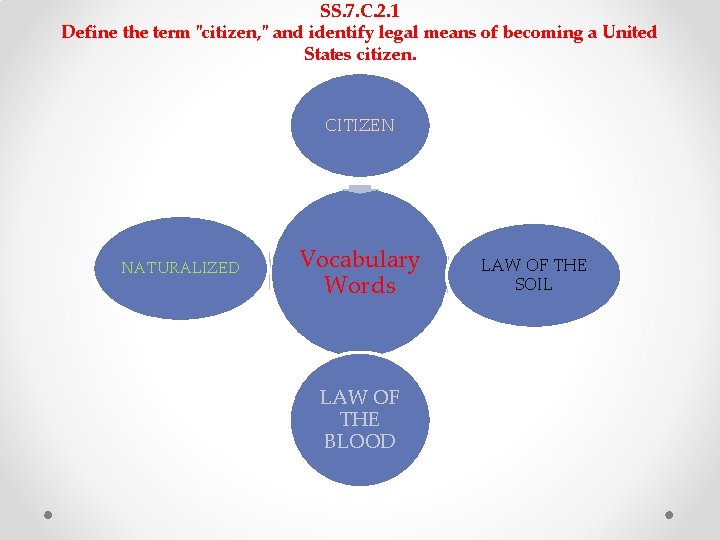
SS. 7. C. 2. 1 Define the term "citizen, " and identify legal means of becoming a United States citizen. CITIZEN NATURALIZED Vocabulary Words LAW OF THE BLOOD LAW OF THE SOIL
SS. 7. C. 2. 1 Define the term "citizen, " and identify legal means of becoming a United States citizen. Vocab Word 1. 2. 3. 4. Definition
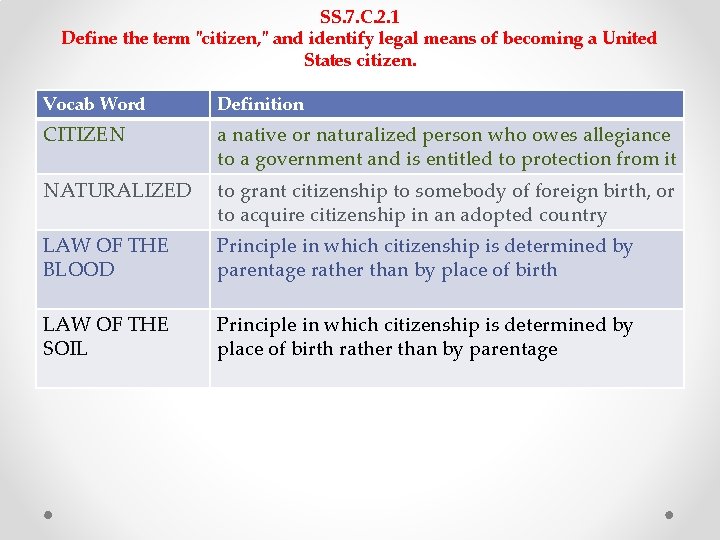
SS. 7. C. 2. 1 Define the term "citizen, " and identify legal means of becoming a United States citizen. Vocab Word Definition CITIZEN a native or naturalized person who owes allegiance to a government and is entitled to protection from it NATURALIZED to grant citizenship to somebody of foreign birth, or to acquire citizenship in an adopted country LAW OF THE BLOOD Principle in which citizenship is determined by parentage rather than by place of birth LAW OF THE SOIL Principle in which citizenship is determined by place of birth rather than by parentage
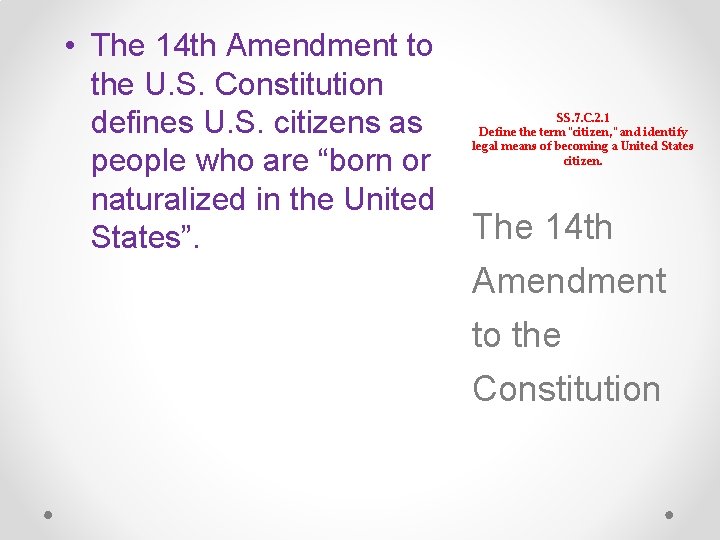
• The 14 th Amendment to the U. S. Constitution defines U. S. citizens as people who are “born or naturalized in the United The 14 th States”. SS. 7. C. 2. 1 Define the term "citizen, " and identify legal means of becoming a United States citizen. Amendment to the Constitution
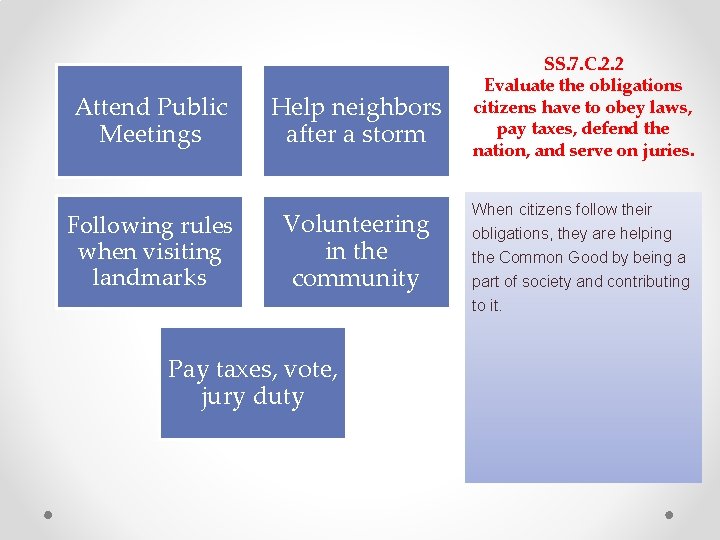
Attend Public Meetings Following rules when visiting landmarks Help neighbors after a storm Volunteering in the community Pay taxes, vote, jury duty SS. 7. C. 2. 2 Evaluate the obligations citizens have to obey laws, pay taxes, defend the nation, and serve on juries. When citizens follow their obligations, they are helping the Common Good by being a part of society and contributing to it.
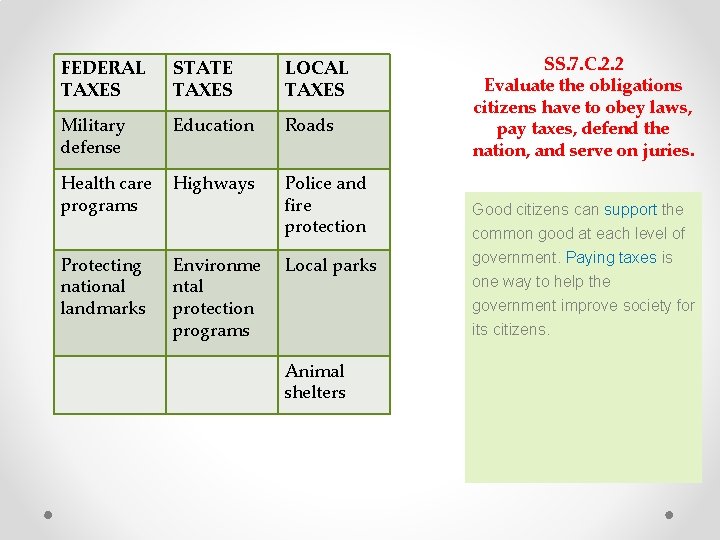
FEDERAL TAXES STATE TAXES LOCAL TAXES Military defense Education Roads Health care Highways programs Police and fire protection Protecting national landmarks Local parks Environme ntal protection programs Animal shelters SS. 7. C. 2. 2 Evaluate the obligations citizens have to obey laws, pay taxes, defend the nation, and serve on juries. Good citizens can support the common good at each level of government. Paying taxes is one way to help the government improve society for its citizens.
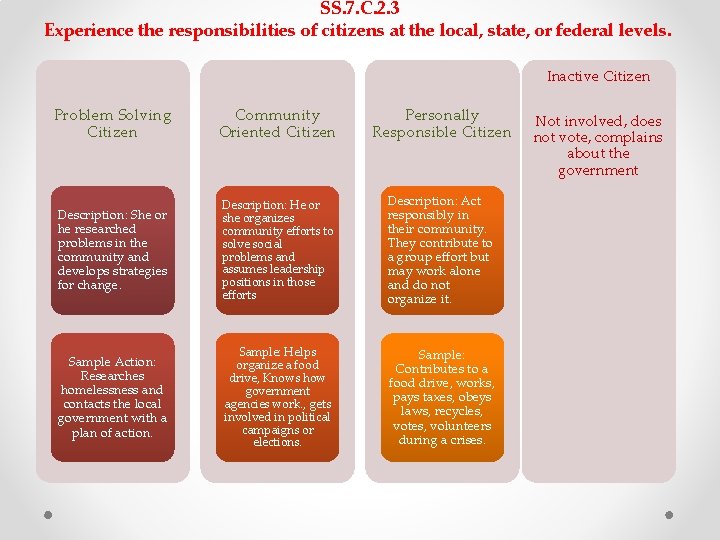
SS. 7. C. 2. 3 Experience the responsibilities of citizens at the local, state, or federal levels. Inactive Citizen Problem Solving Citizen Community Oriented Citizen Personally Responsible Citizen Description: She or he researched problems in the community and develops strategies for change. Description: He or she organizes community efforts to solve social problems and assumes leadership positions in those efforts Description: Act responsibly in their community. They contribute to a group effort but may work alone and do not organize it. Sample Action: Researches homelessness and contacts the local government with a plan of action. Sample: Helps organize a food drive, Knows how government agencies work. , gets involved in political campaigns or elections. Sample: Contributes to a food drive, works, pays taxes, obeys laws, recycles, votes, volunteers during a crises. Not involved, does not vote, complains about the government
SS. 7. C. 2. 3 Experience the responsibilities of citizens at the local, state, or federal levels.
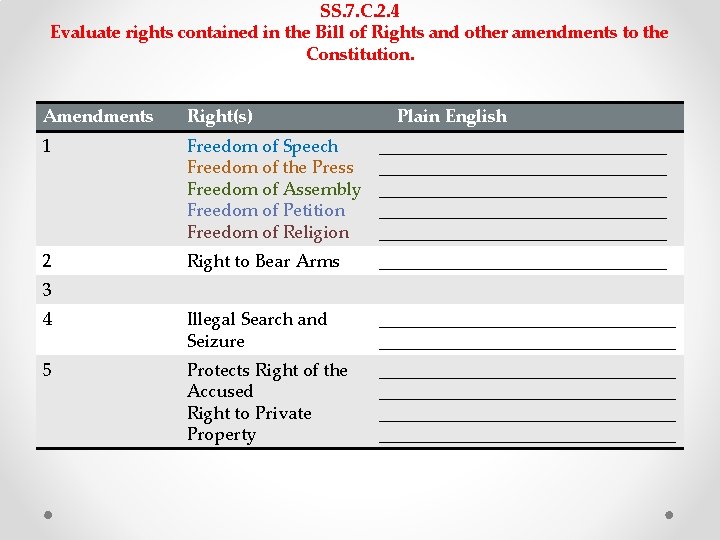
SS. 7. C. 2. 4 Evaluate rights contained in the Bill of Rights and other amendments to the Constitution. Amendments Right(s) Plain English 1 Freedom of Speech Freedom of the Press Freedom of Assembly Freedom of Petition Freedom of Religion ________________________________ ________________ 2 Right to Bear Arms ________________ 4 Illegal Search and Seizure _________________________________ 5 Protects Right of the Accused Right to Private Property _________________________________ 3
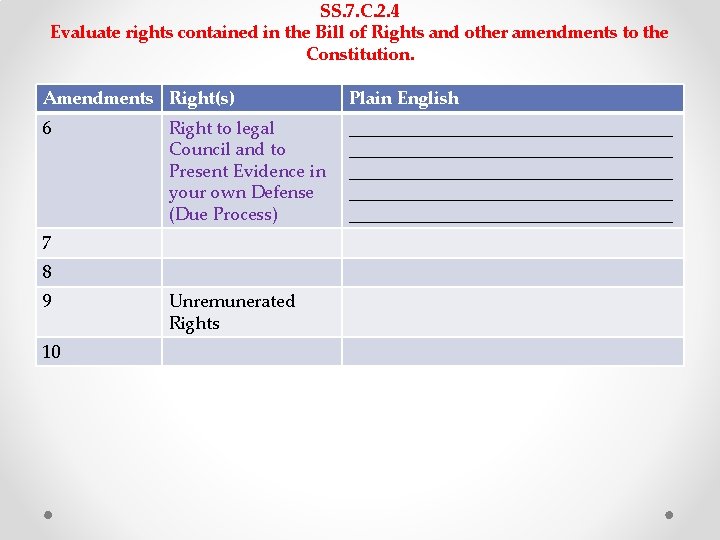
SS. 7. C. 2. 4 Evaluate rights contained in the Bill of Rights and other amendments to the Constitution. Amendments Right(s) Plain English 6 ____________________________________ __________________ Right to legal Council and to Present Evidence in your own Defense (Due Process) 7 8 9 10 Unremunerated Rights
SS. 7. C. 2. 5 Distinguish how the Constitution safeguards and limits individual rights.
SS. 7. C. 2. 5 Distinguish how the Constitution safeguards and limits individual rights.
SS. 7. C. 2. 6 Simulate the trial process and the role of juries in the administration of justice.
SS. 7. C. 2. 6 Simulate the trial process and the role of juries in the administration of justice.
SS. 7. C. 2. 7 Conduct a mock election to demonstrate the voting process and its impact on a school, community, or local level.
SS. 7. C. 2. 7 Conduct a mock election to demonstrate the voting process and its impact on a school, community, or local level.
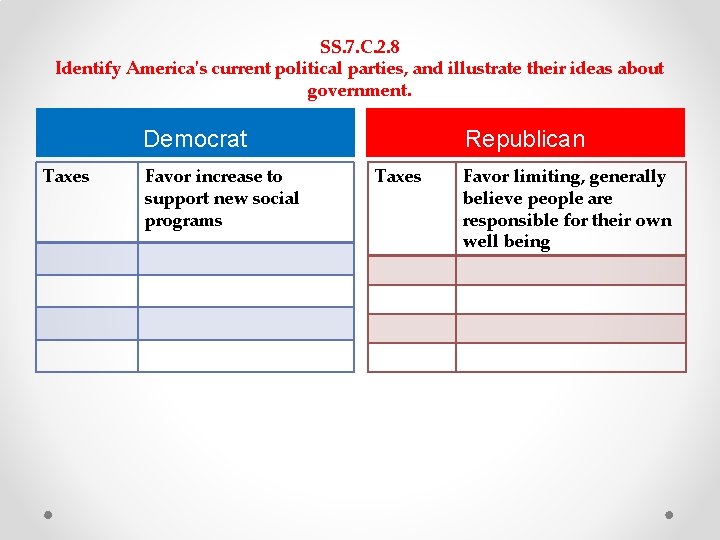
SS. 7. C. 2. 8 Identify America's current political parties, and illustrate their ideas about government. Democrat Taxes Favor increase to support new social programs Republican Taxes Favor limiting, generally believe people are responsible for their own well being
SS. 7. C. 2. 8 Identify America's current political parties, and illustrate their ideas about government.
SS. 7. C. 2. 9 Evaluate candidates for political office by analyzing their qualifications, experience, issue-based platforms, debates, and political ads.
SS. 7. C. 2. 9 Evaluate candidates for political office by analyzing their qualifications, experience, issue-based platforms, debates, and political ads.
SS. 7. C. 2. 10 Examine the impact of media, individuals, and interest groups on monitoring and influencing government.
SS. 7. C. 2. 10 Examine the impact of media, individuals, and interest groups on monitoring and influencing government.
SS. 7. C. 2. 11 Analyze media and political communications (bias, symbolism, propaganda). • Propaganda is information an organization or government sends out to promote a policy, idea, or cause. • Many people think of the word “propaganda” as something bad, but its original meaning is neutral. Propaganda promotes a policy, idea, or cause. It could promote popular or unpopular ideas.
SS. 7. C. 2. 11 Analyze media and political communications (bias, symbolism, propaganda).
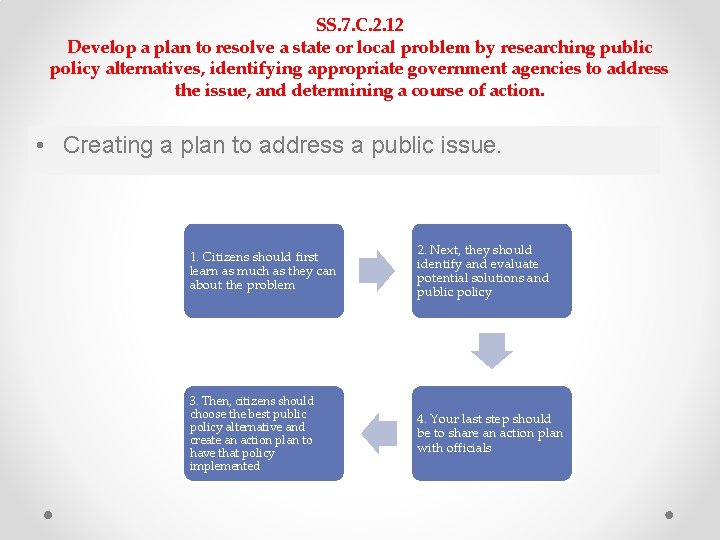
SS. 7. C. 2. 12 Develop a plan to resolve a state or local problem by researching public policy alternatives, identifying appropriate government agencies to address the issue, and determining a course of action. • Creating a plan to address a public issue. 1. Citizens should first learn as much as they can about the problem 2. Next, they should identify and evaluate potential solutions and public policy 3. Then, citizens should choose the best public policy alternative and create an action plan to have that policy implemented 4. Your last step should be to share an action plan with officials
SS. 7. C. 2. 12 Develop a plan to resolve a state or local problem by researching public policy alternatives, identifying appropriate government agencies to address the issue, and determining a course of action.
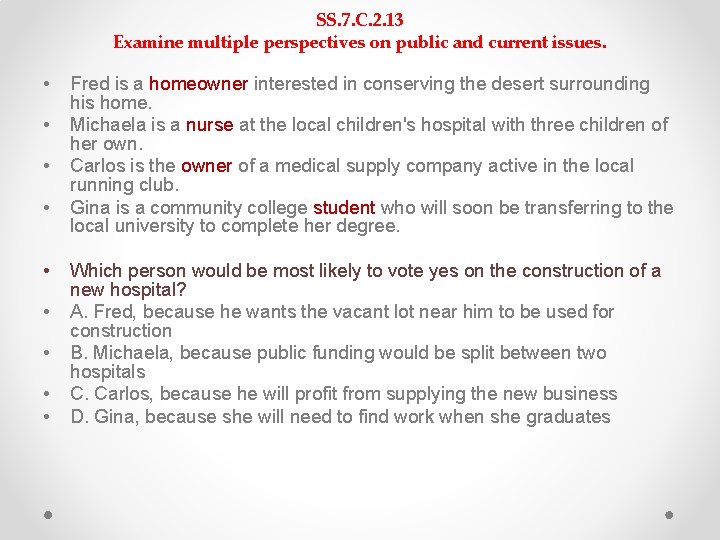
SS. 7. C. 2. 13 Examine multiple perspectives on public and current issues. • • • Fred is a homeowner interested in conserving the desert surrounding his home. Michaela is a nurse at the local children's hospital with three children of her own. Carlos is the owner of a medical supply company active in the local running club. Gina is a community college student who will soon be transferring to the local university to complete her degree. Which person would be most likely to vote yes on the construction of a new hospital? A. Fred, because he wants the vacant lot near him to be used for construction B. Michaela, because public funding would be split between two hospitals C. Carlos, because he will profit from supplying the new business D. Gina, because she will need to find work when she graduates
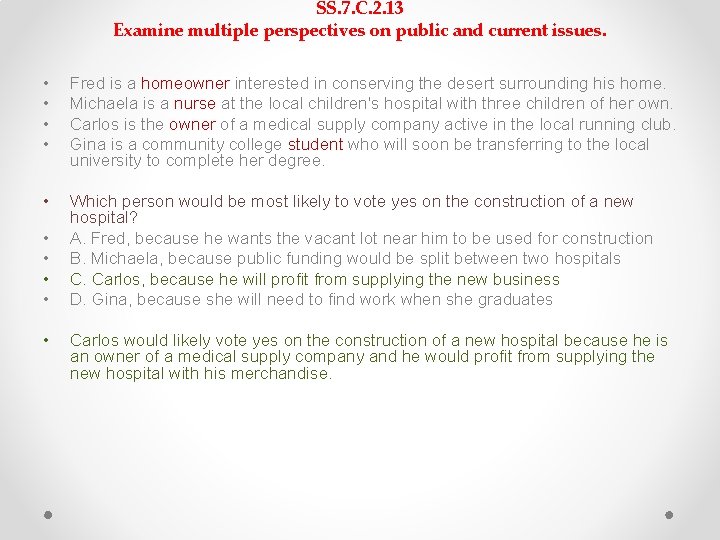
SS. 7. C. 2. 13 Examine multiple perspectives on public and current issues. • • Fred is a homeowner interested in conserving the desert surrounding his home. Michaela is a nurse at the local children's hospital with three children of her own. Carlos is the owner of a medical supply company active in the local running club. Gina is a community college student who will soon be transferring to the local university to complete her degree. • Which person would be most likely to vote yes on the construction of a new hospital? A. Fred, because he wants the vacant lot near him to be used for construction B. Michaela, because public funding would be split between two hospitals C. Carlos, because he will profit from supplying the new business D. Gina, because she will need to find work when she graduates • • • Carlos would likely vote yes on the construction of a new hospital because he is an owner of a medical supply company and he would profit from supplying the new hospital with his merchandise.
SS. 7. C. 2. 14 Conduct a service project to further the public good.
SS. 7. C. 2. 14 Conduct a service project to further the public good.
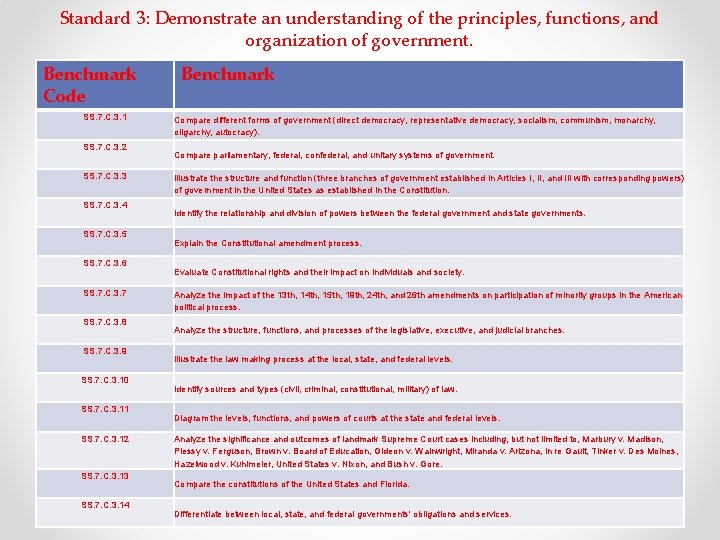
Standard 3: Demonstrate an understanding of the principles, functions, and organization of government. Benchmark Code SS. 7. C. 3. 1 SS. 7. C. 3. 2 SS. 7. C. 3. 3 SS. 7. C. 3. 4 SS. 7. C. 3. 5 SS. 7. C. 3. 6 SS. 7. C. 3. 7 SS. 7. C. 3. 8 SS. 7. C. 3. 9 SS. 7. C. 3. 10 SS. 7. C. 3. 11 SS. 7. C. 3. 12 SS. 7. C. 3. 13 SS. 7. C. 3. 14 Benchmark Compare different forms of government (direct democracy, representative democracy, socialism, communism, monarchy, oligarchy, autocracy). Compare parliamentary, federal, confederal, and unitary systems of government. Illustrate the structure and function (three branches of government established in Articles I, II, and III with corresponding powers) of government in the United States as established in the Constitution. Identify the relationship and division of powers between the federal government and state governments. Explain the Constitutional amendment process. Evaluate Constitutional rights and their impact on individuals and society. Analyze the impact of the 13 th, 14 th, 15 th, 19 th, 24 th, and 26 th amendments on participation of minority groups in the American political process. Analyze the structure, functions, and processes of the legislative, executive, and judicial branches. Illustrate the law making process at the local, state, and federal levels. Identify sources and types (civil, criminal, constitutional, military) of law. Diagram the levels, functions, and powers of courts at the state and federal levels. Analyze the significance and outcomes of landmark Supreme Court cases including, but not limited to, Marbury v. Madison, Plessy v. Ferguson, Brown v. Board of Education, Gideon v. Wainwright, Miranda v. Arizona, in re Gault, Tinker v. Des Moines, Hazelwood v. Kuhlmeier, United States v. Nixon, and Bush v. Gore. Compare the constitutions of the United States and Florida. Differentiate between local, state, and federal governments' obligations and services.
1. ________ __ 2. ________ __ 3. ________ __ 4. ________ __ 5. ________ __ 6. ________ SS. 7. C. 3. 1 Compare different forms of government (direct democracy, representative democracy, socialism, communism, monarchy, oligarchy, autocracy). There are many different forms of government.
• Direct Democracy • Representative Democracy • Socialism • Communism • Monarchy • Oligarchy • Autocracy SS. 7. C. 3. 1 Compare different forms of government (direct democracy, representative democracy, socialism, communism, monarchy, oligarchy, autocracy). There are many different forms of government.
SS. 7. C. 3. 1 Compare different forms of government (direct democracy, representative democracy, socialism, communism, monarchy, oligarchy, autocracy).
SS. 7. C. 3. 2 Compare parliamentary, federal, confederal, and unitary systems of government.
SS. 7. C. 3. 2 Compare parliamentary, federal, confederal, and unitary systems of government. Parliamentary Federal Confederal Unitary
SS. 7. C. 3. 3 Illustrate the structure and function (three branches of government established in Articles I, II, and III with corresponding powers) of government in the United States as established in the Constitution.
SS. 7. C. 3. 3 Illustrate the structure and function (three branches of government established in Articles I, II, and III with corresponding powers) of government in the United States as established in the Constitution.
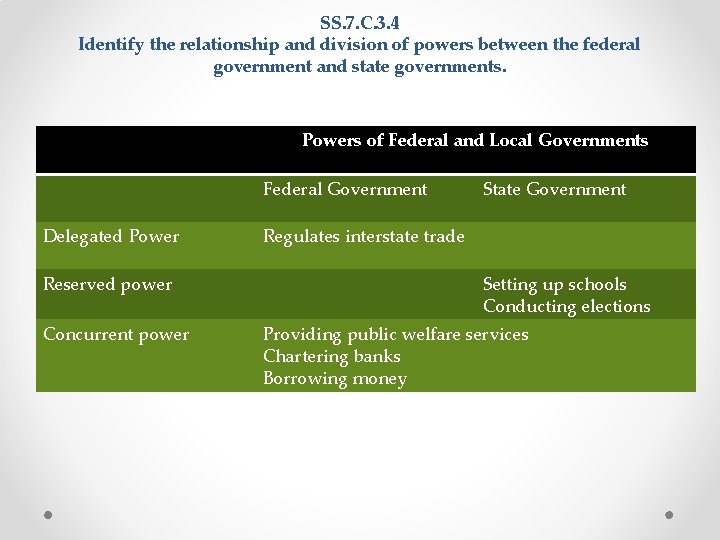
SS. 7. C. 3. 4 Identify the relationship and division of powers between the federal government and state governments. Powers of Federal and Local Governments Federal Government Delegated Power Reserved power Concurrent power State Government Regulates interstate trade Setting up schools Conducting elections Providing public welfare services Chartering banks Borrowing money
SS. 7. C. 3. 4 Identify the relationship and division of powers between the federal government and state governments.
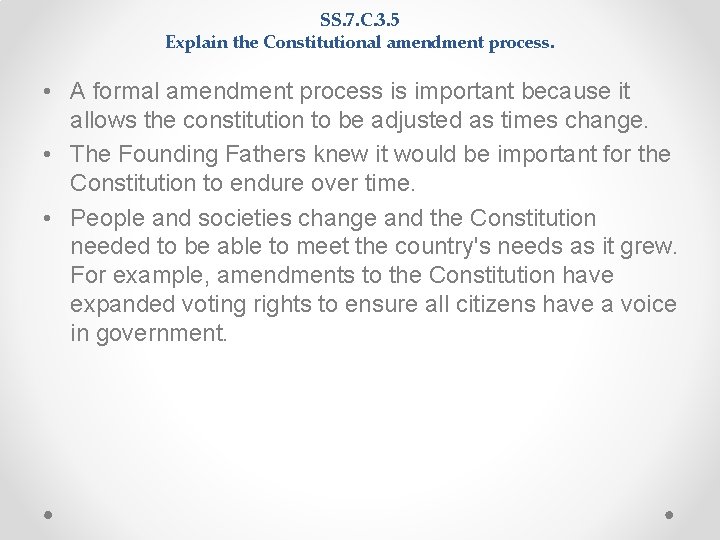
SS. 7. C. 3. 5 Explain the Constitutional amendment process. • A formal amendment process is important because it allows the constitution to be adjusted as times change. • The Founding Fathers knew it would be important for the Constitution to endure over time. • People and societies change and the Constitution needed to be able to meet the country's needs as it grew. For example, amendments to the Constitution have expanded voting rights to ensure all citizens have a voice in government.
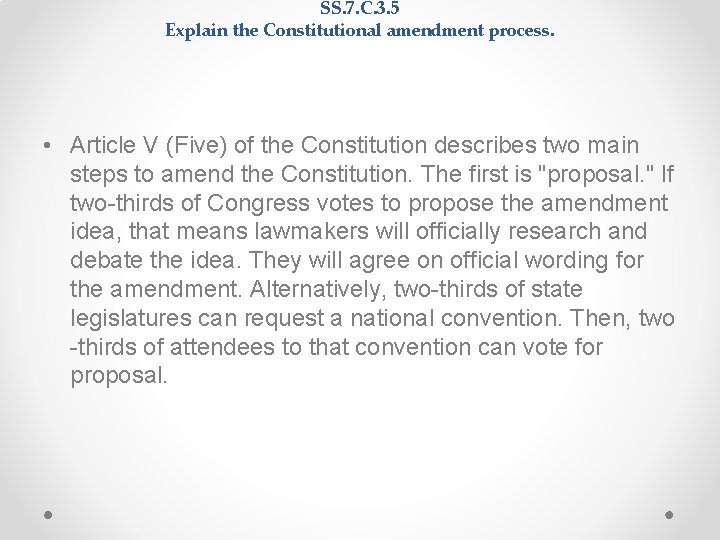
SS. 7. C. 3. 5 Explain the Constitutional amendment process. • Article V (Five) of the Constitution describes two main steps to amend the Constitution. The first is "proposal. " If two-thirds of Congress votes to propose the amendment idea, that means lawmakers will officially research and debate the idea. They will agree on official wording for the amendment. Alternatively, two-thirds of state legislatures can request a national convention. Then, two -thirds of attendees to that convention can vote for proposal.
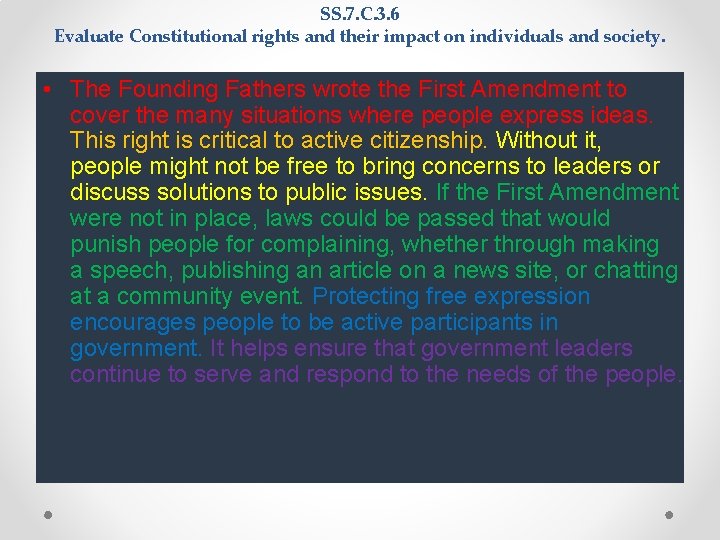
SS. 7. C. 3. 6 Evaluate Constitutional rights and their impact on individuals and society. • The Founding Fathers wrote the First Amendment to cover the many situations where people express ideas. This right is critical to active citizenship. Without it, people might not be free to bring concerns to leaders or discuss solutions to public issues. If the First Amendment were not in place, laws could be passed that would punish people for complaining, whether through making a speech, publishing an article on a news site, or chatting at a community event. Protecting free expression encourages people to be active participants in government. It helps ensure that government leaders continue to serve and respond to the needs of the people.
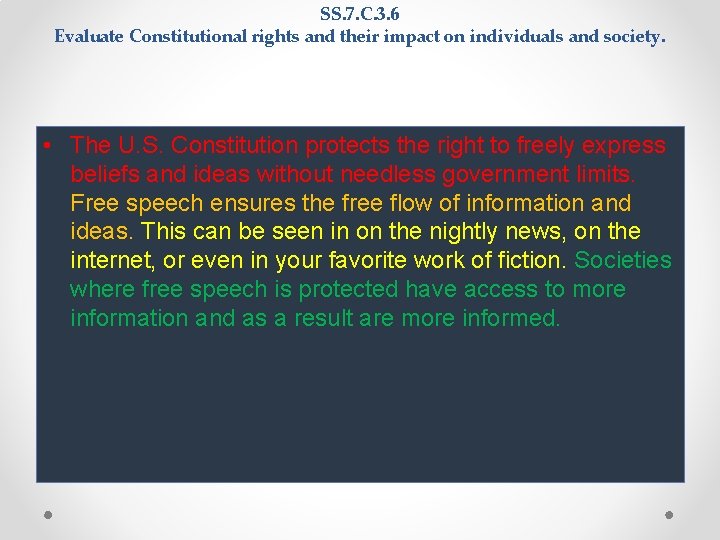
SS. 7. C. 3. 6 Evaluate Constitutional rights and their impact on individuals and society. • The U. S. Constitution protects the right to freely express beliefs and ideas without needless government limits. Free speech ensures the free flow of information and ideas. This can be seen in on the nightly news, on the internet, or even in your favorite work of fiction. Societies where free speech is protected have access to more information and as a result are more informed.
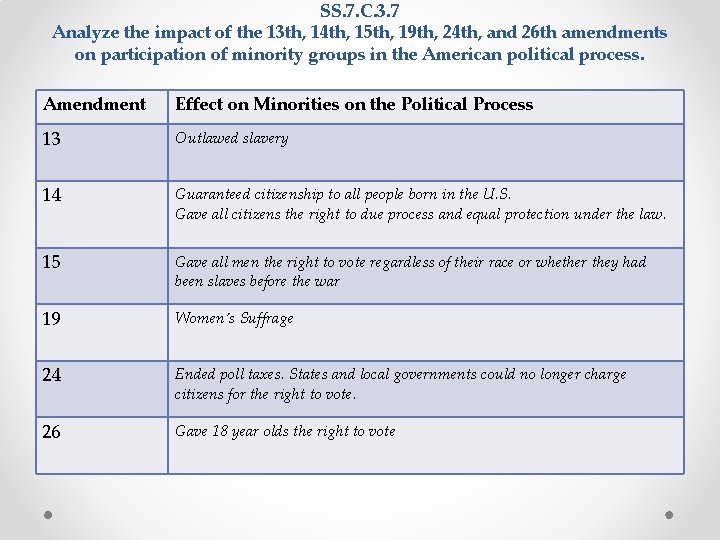
SS. 7. C. 3. 7 Analyze the impact of the 13 th, 14 th, 15 th, 19 th, 24 th, and 26 th amendments on participation of minority groups in the American political process. Amendment Effect on Minorities on the Political Process 13 Outlawed slavery 14 Guaranteed citizenship to all people born in the U. S. Gave all citizens the right to due process and equal protection under the law. 15 Gave all men the right to vote regardless of their race or whether they had been slaves before the war 19 Women’s Suffrage 24 Ended poll taxes. States and local governments could no longer charge citizens for the right to vote. 26 Gave 18 year olds the right to vote
SS. 7. C. 3. 7 Analyze the impact of the 13 th, 14 th, 15 th, 19 th, 24 th, and 26 th amendments on participation of minority groups in the American political process.
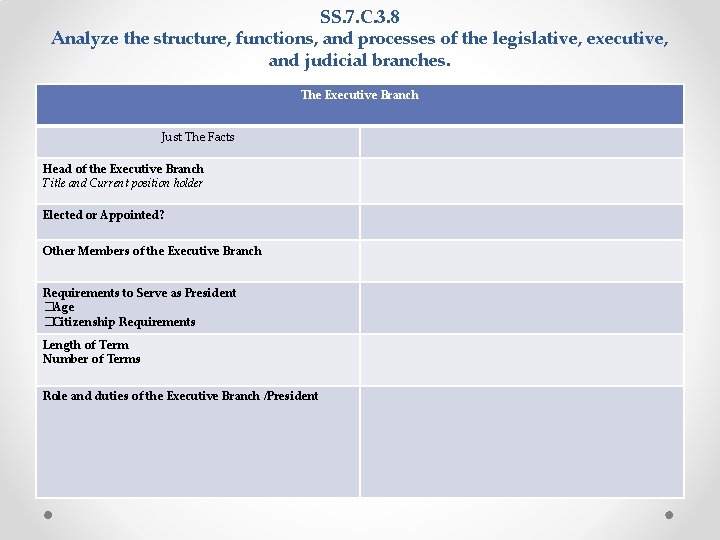
SS. 7. C. 3. 8 Analyze the structure, functions, and processes of the legislative, executive, and judicial branches. The Executive Branch Just The Facts Head of the Executive Branch Title and Current position holder Elected or Appointed? Other Members of the Executive Branch Requirements to Serve as President � Age � Citizenship Requirements Length of Term Number of Terms Role and duties of the Executive Branch /President
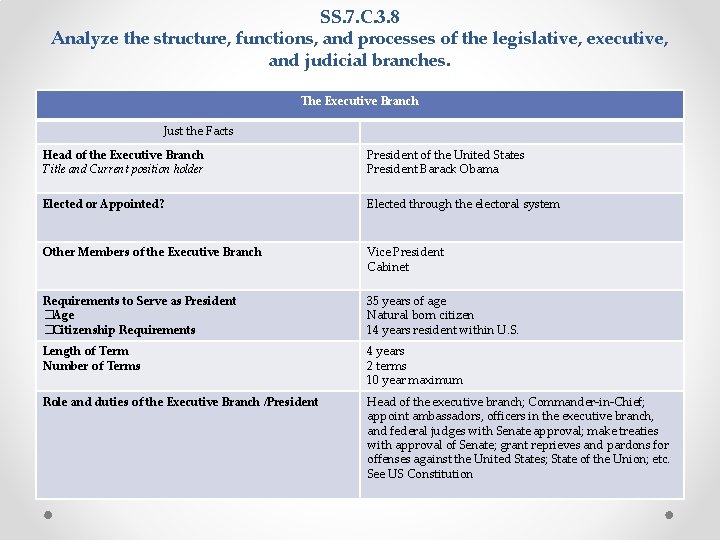
SS. 7. C. 3. 8 Analyze the structure, functions, and processes of the legislative, executive, and judicial branches. The Executive Branch Just the Facts Head of the Executive Branch Title and Current position holder President of the United States President Barack Obama Elected or Appointed? Elected through the electoral system Other Members of the Executive Branch Vice President Cabinet Requirements to Serve as President � Age � Citizenship Requirements 35 years of age Natural born citizen 14 years resident within U. S. Length of Term Number of Terms 4 years 2 terms 10 year maximum Role and duties of the Executive Branch /President Head of the executive branch; Commander-in-Chief; appoint ambassadors, officers in the executive branch, and federal judges with Senate approval; make treaties with approval of Senate; grant reprieves and pardons for offenses against the United States; State of the Union; etc. See US Constitution
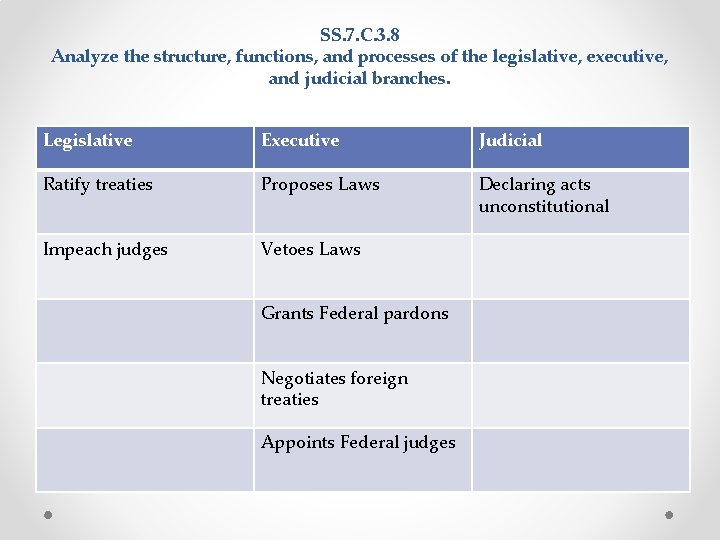
SS. 7. C. 3. 8 Analyze the structure, functions, and processes of the legislative, executive, and judicial branches. Legislative Executive Judicial Ratify treaties Proposes Laws Declaring acts unconstitutional Impeach judges Vetoes Laws Grants Federal pardons Negotiates foreign treaties Appoints Federal judges
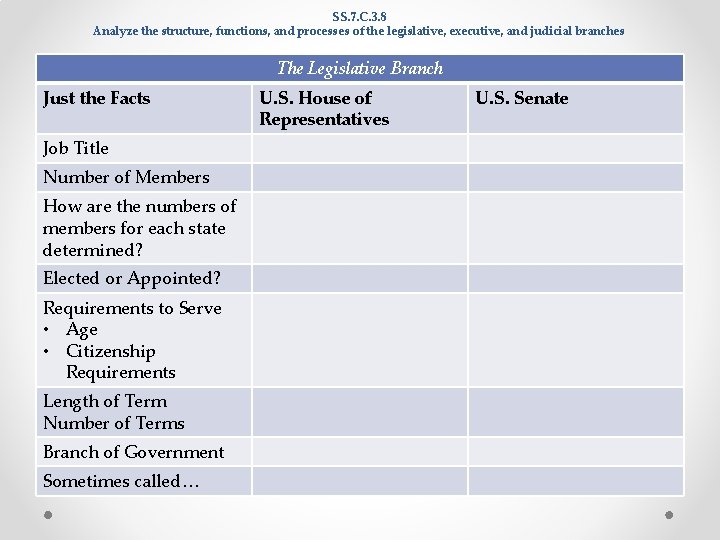
SS. 7. C. 3. 8 Analyze the structure, functions, and processes of the legislative, executive, and judicial branches The Legislative Branch Just the Facts Job Title Number of Members How are the numbers of members for each state determined? Elected or Appointed? Requirements to Serve • Age • Citizenship Requirements Length of Term Number of Terms Branch of Government Sometimes called… U. S. House of Representatives U. S. Senate
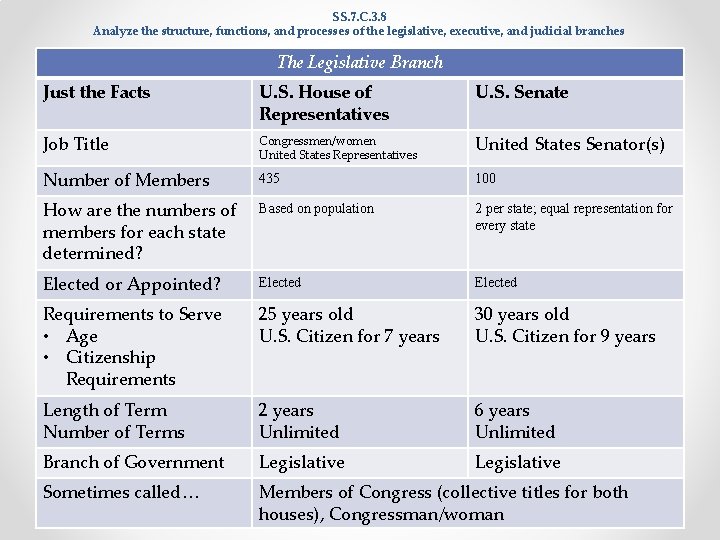
SS. 7. C. 3. 8 Analyze the structure, functions, and processes of the legislative, executive, and judicial branches The Legislative Branch Just the Facts U. S. House of Representatives U. S. Senate Job Title Congressmen/women United States Representatives United States Senator(s) Number of Members 435 100 How are the numbers of members for each state determined? Based on population 2 per state; equal representation for every state Elected or Appointed? Elected Requirements to Serve • Age • Citizenship Requirements 25 years old U. S. Citizen for 7 years 30 years old U. S. Citizen for 9 years Length of Term Number of Terms 2 years Unlimited 6 years Unlimited Branch of Government Legislative Sometimes called… Members of Congress (collective titles for both houses), Congressman/woman
SS. 7. C. 3. 9 Illustrate the law making process at the local, state, and federal levels.
SS. 7. C. 3. 9 Illustrate the law making process at the local, state, and federal levels.
SS. 7. C. 3. 10 Identify sources and types (civil, criminal, constitutional, military) of law.
SS. 7. C. 3. 10 Identify sources and types (civil, criminal, constitutional, military) of law.
SS. 7. C. 3. 11 Diagram the levels, functions, and powers of courts at the state and federal levels.
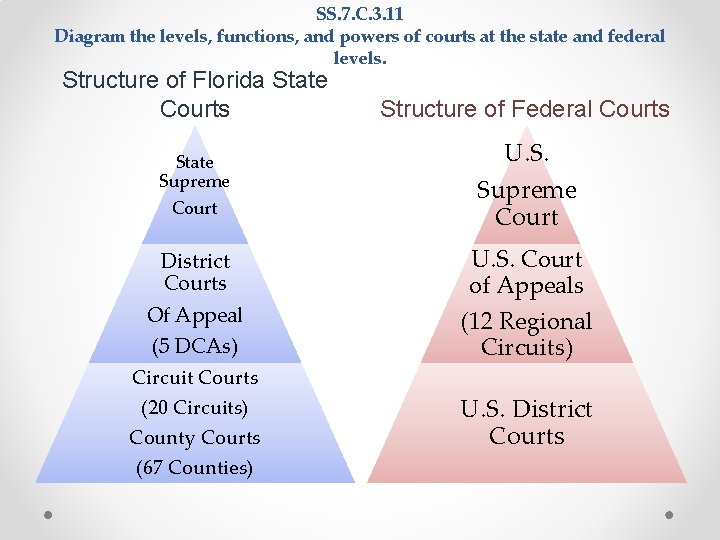
SS. 7. C. 3. 11 Diagram the levels, functions, and powers of courts at the state and federal levels. Structure of Florida State Courts Structure of Federal Courts State Supreme Court U. S. Supreme Court District Courts U. S. Court of Appeals Of Appeal (5 DCAs) Circuit Courts (20 Circuits) County Courts (67 Counties) (12 Regional Circuits) U. S. District Courts
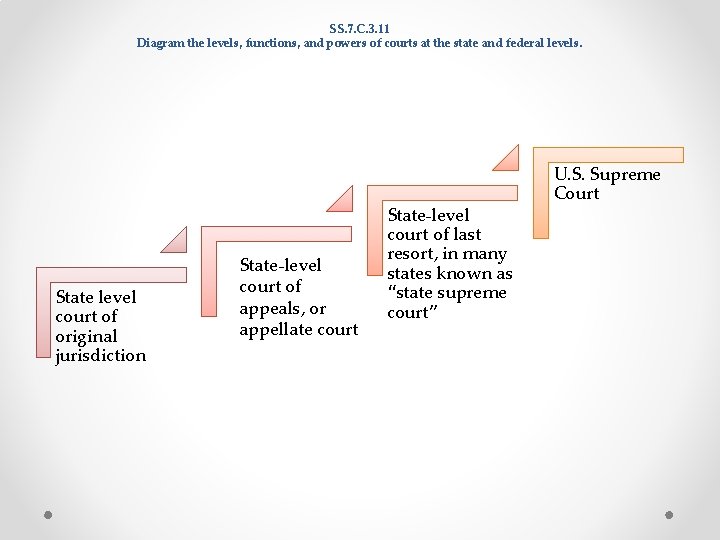
SS. 7. C. 3. 11 Diagram the levels, functions, and powers of courts at the state and federal levels. State level court of original jurisdiction State-level court of appeals, or appellate court State-level court of last resort, in many states known as “state supreme court” U. S. Supreme Court
SS. 7. C. 3. 11 Diagram the levels, functions, and powers of courts at the state and federal levels. • Small Claims Court – civil disputes for amounts $5, 000 or less.
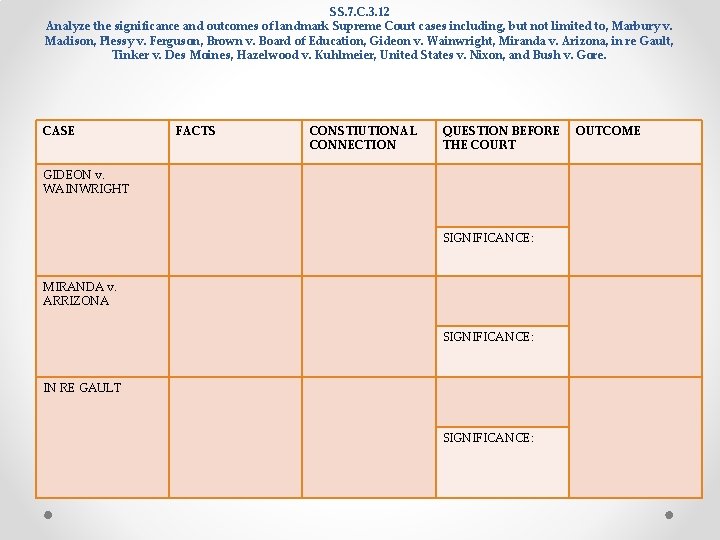
SS. 7. C. 3. 12 Analyze the significance and outcomes of landmark Supreme Court cases including, but not limited to, Marbury v. Madison, Plessy v. Ferguson, Brown v. Board of Education, Gideon v. Wainwright, Miranda v. Arizona, in re Gault, Tinker v. Des Moines, Hazelwood v. Kuhlmeier, United States v. Nixon, and Bush v. Gore. CASE FACTS CONSTIUTIONAL CONNECTION QUESTION BEFORE THE COURT GIDEON v. WAINWRIGHT SIGNIFICANCE: MIRANDA v. ARRIZONA SIGNIFICANCE: IN RE GAULT SIGNIFICANCE: OUTCOME
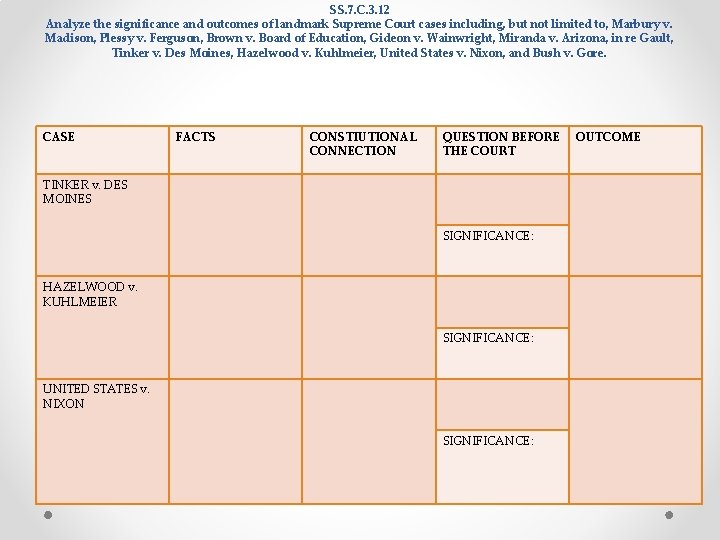
SS. 7. C. 3. 12 Analyze the significance and outcomes of landmark Supreme Court cases including, but not limited to, Marbury v. Madison, Plessy v. Ferguson, Brown v. Board of Education, Gideon v. Wainwright, Miranda v. Arizona, in re Gault, Tinker v. Des Moines, Hazelwood v. Kuhlmeier, United States v. Nixon, and Bush v. Gore. CASE FACTS CONSTIUTIONAL CONNECTION QUESTION BEFORE THE COURT TINKER v. DES MOINES SIGNIFICANCE: HAZELWOOD v. KUHLMEIER SIGNIFICANCE: UNITED STATES v. NIXON SIGNIFICANCE: OUTCOME
SS. 7. C. 3. 12 Analyze the significance and outcomes of landmark Supreme Court cases including, but not limited to, Marbury v. Madison, Plessy v. Ferguson, Brown v. Board of Education, Gideon v. Wainwright, Miranda v. Arizona, in re Gault, Tinker v. Des Moines, Hazelwood v. Kuhlmeier, United States v. Nixon, and Bush v. Gore.
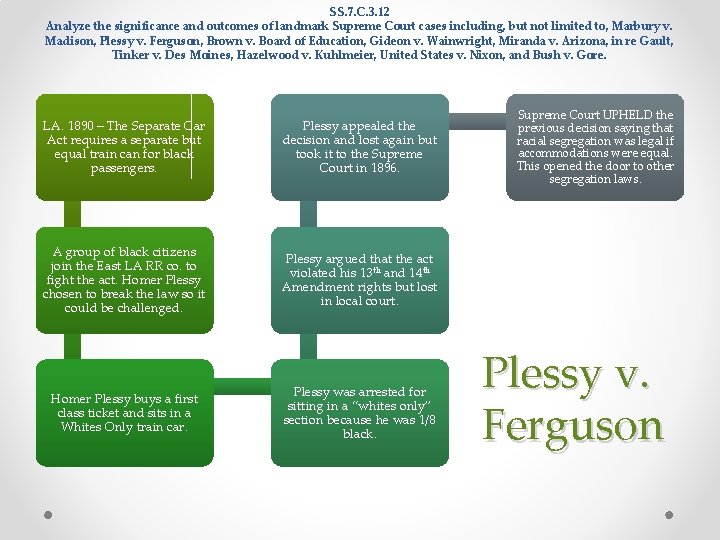
SS. 7. C. 3. 12 Analyze the significance and outcomes of landmark Supreme Court cases including, but not limited to, Marbury v. Madison, Plessy v. Ferguson, Brown v. Board of Education, Gideon v. Wainwright, Miranda v. Arizona, in re Gault, Tinker v. Des Moines, Hazelwood v. Kuhlmeier, United States v. Nixon, and Bush v. Gore. LA. 1890 – The Separate Car Act requires a separate but equal train can for black passengers. Plessy appealed the decision and lost again but took it to the Supreme Court in 1896. A group of black citizens join the East LA RR co. to fight the act. Homer Plessy chosen to break the law so it could be challenged. Plessy argued that the act violated his 13 th and 14 th Amendment rights but lost in local court. Homer Plessy buys a first class ticket and sits in a Whites Only train car. Plessy was arrested for sitting in a “whites only” section because he was 1/8 black. Supreme Court UPHELD the previous decision saying that racial segregation was legal if accommodations were equal. This opened the door to other segregation laws. Plessy v. Ferguson
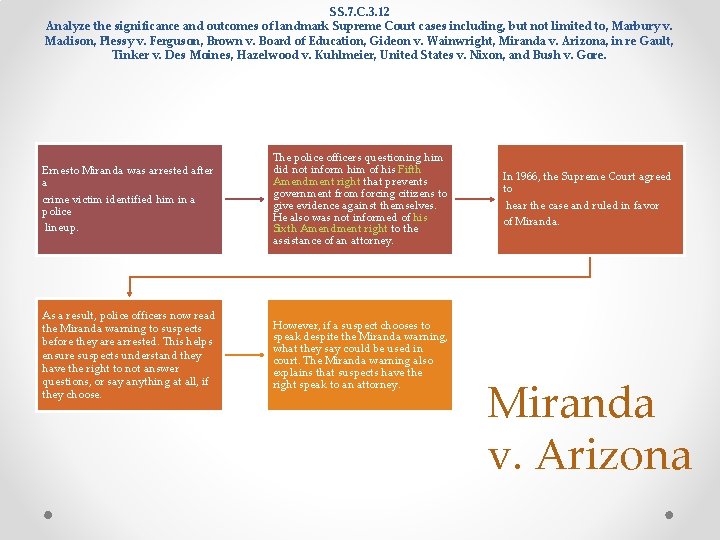
SS. 7. C. 3. 12 Analyze the significance and outcomes of landmark Supreme Court cases including, but not limited to, Marbury v. Madison, Plessy v. Ferguson, Brown v. Board of Education, Gideon v. Wainwright, Miranda v. Arizona, in re Gault, Tinker v. Des Moines, Hazelwood v. Kuhlmeier, United States v. Nixon, and Bush v. Gore. Ernesto Miranda was arrested after a crime victim identified him in a police lineup. The police officers questioning him did not inform him of his Fifth Amendment right that prevents government from forcing citizens to give evidence against themselves. He also was not informed of his Sixth Amendment right to the assistance of an attorney. As a result, police officers now read the Miranda warning to suspects before they are arrested. This helps ensure suspects understand they have the right to not answer questions, or say anything at all, if they choose. However, if a suspect chooses to speak despite the Miranda warning, what they say could be used in court. The Miranda warning also explains that suspects have the right speak to an attorney. In 1966, the Supreme Court agreed to hear the case and ruled in favor of Miranda v. Arizona
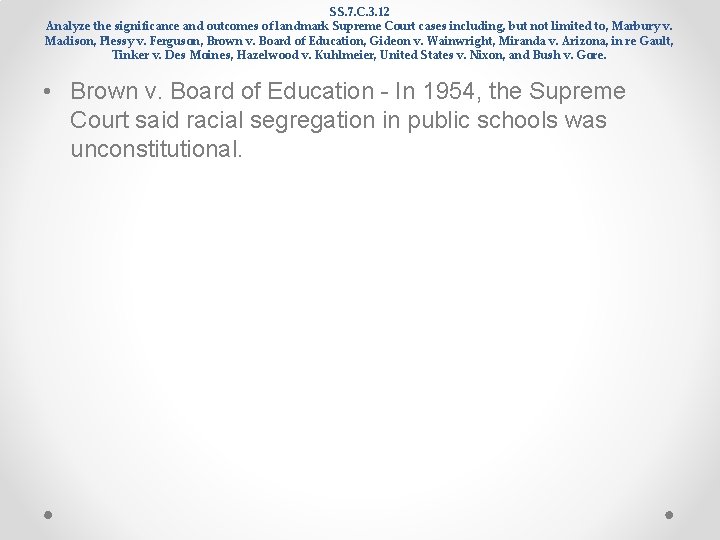
SS. 7. C. 3. 12 Analyze the significance and outcomes of landmark Supreme Court cases including, but not limited to, Marbury v. Madison, Plessy v. Ferguson, Brown v. Board of Education, Gideon v. Wainwright, Miranda v. Arizona, in re Gault, Tinker v. Des Moines, Hazelwood v. Kuhlmeier, United States v. Nixon, and Bush v. Gore. • Brown v. Board of Education - In 1954, the Supreme Court said racial segregation in public schools was unconstitutional.
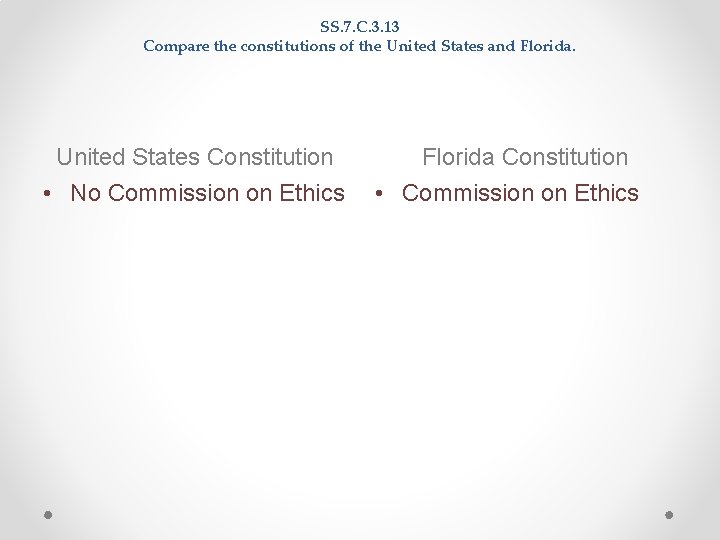
SS. 7. C. 3. 13 Compare the constitutions of the United States and Florida. United States Constitution • No Commission on Ethics Florida Constitution • Commission on Ethics
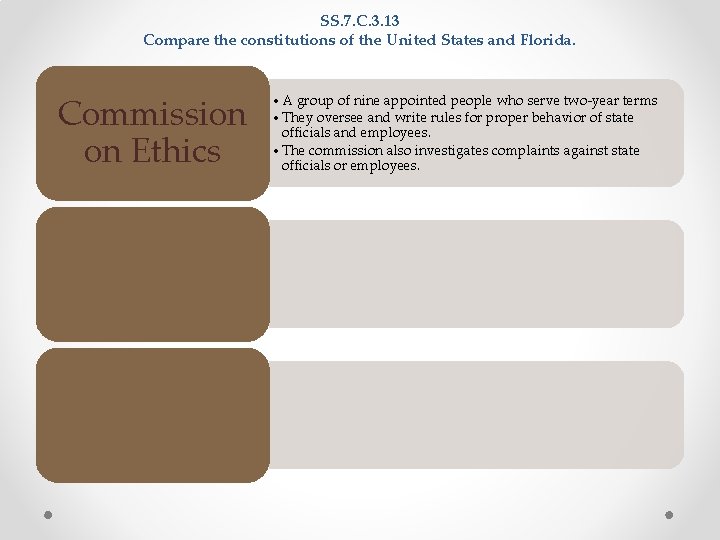
SS. 7. C. 3. 13 Compare the constitutions of the United States and Florida. Commission on Ethics • A group of nine appointed people who serve two-year terms • They oversee and write rules for proper behavior of state officials and employees. • The commission also investigates complaints against state officials or employees.
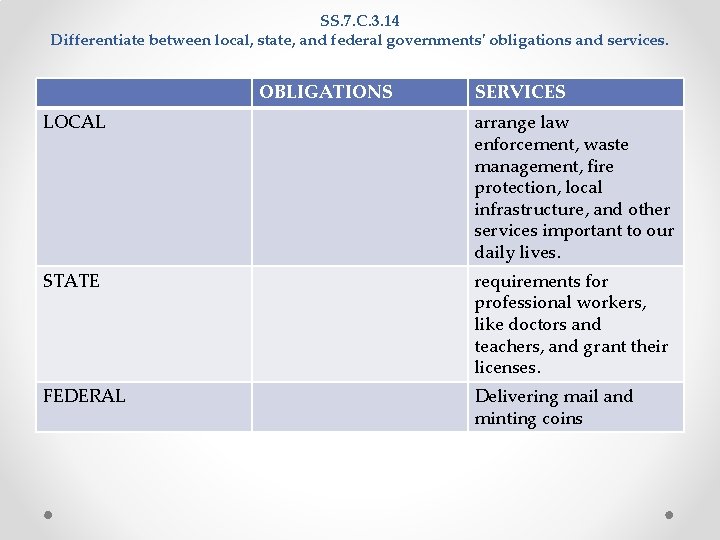
SS. 7. C. 3. 14 Differentiate between local, state, and federal governments' obligations and services. OBLIGATIONS SERVICES LOCAL arrange law enforcement, waste management, fire protection, local infrastructure, and other services important to our daily lives. STATE requirements for professional workers, like doctors and teachers, and grant their licenses. FEDERAL Delivering mail and minting coins
SS. 7. C. 3. 14 Differentiate between local, state, and federal governments' obligations and services.
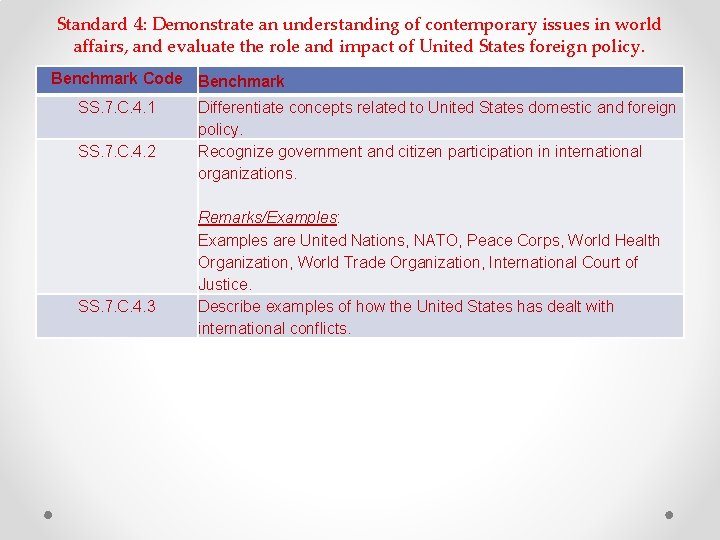
Standard 4: Demonstrate an understanding of contemporary issues in world affairs, and evaluate the role and impact of United States foreign policy. Benchmark Code Benchmark SS. 7. C. 4. 1 SS. 7. C. 4. 2 SS. 7. C. 4. 3 Differentiate concepts related to United States domestic and foreign policy. Recognize government and citizen participation in international organizations. Remarks/Examples: Examples are United Nations, NATO, Peace Corps, World Health Organization, World Trade Organization, International Court of Justice. Describe examples of how the United States has dealt with international conflicts.
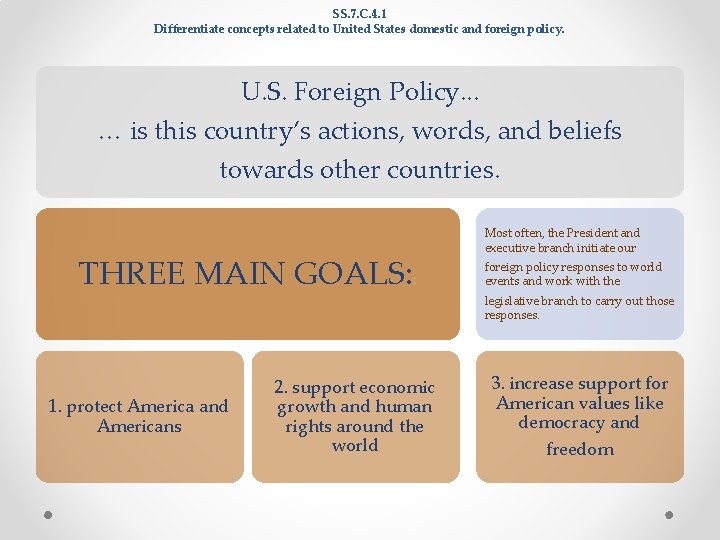
SS. 7. C. 4. 1 Differentiate concepts related to United States domestic and foreign policy. U. S. Foreign Policy. . . … is this country’s actions, words, and beliefs towards other countries. THREE MAIN GOALS: : 1. protect America and Americans 2. support economic growth and human rights around the world Most often, the President and executive branch initiate our foreign policy responses to world events and work with the legislative branch to carry out those responses. 3. increase support for American values like democracy and freedom
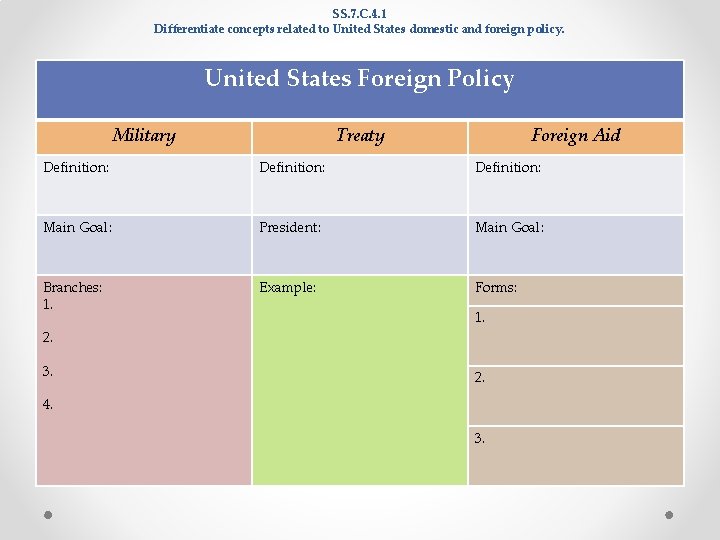
SS. 7. C. 4. 1 Differentiate concepts related to United States domestic and foreign policy. United States Foreign Policy Military Treaty Foreign Aid Definition: Main Goal: President: Main Goal: Branches: 1. Example: Forms: 1. 2. 3. 2. 4. 3.
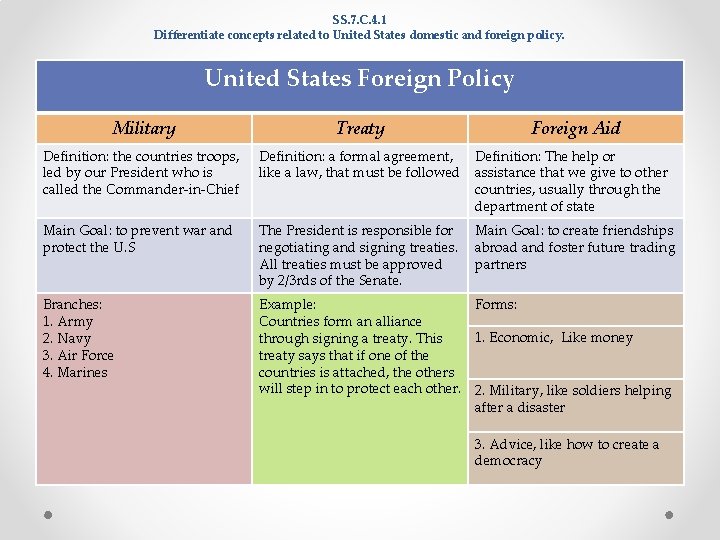
SS. 7. C. 4. 1 Differentiate concepts related to United States domestic and foreign policy. United States Foreign Policy Military Treaty Foreign Aid Definition: the countries troops, led by our President who is called the Commander-in-Chief Definition: a formal agreement, like a law, that must be followed Definition: The help or assistance that we give to other countries, usually through the department of state Main Goal: to prevent war and protect the U. S The President is responsible for Main Goal: to create friendships negotiating and signing treaties. abroad and foster future trading All treaties must be approved partners by 2/3 rds of the Senate. Branches: 1. Army 2. Navy 3. Air Force 4. Marines Example: Forms: Countries form an alliance 1. Economic, Like money through signing a treaty. This treaty says that if one of the countries is attached, the others will step in to protect each other. 2. Military, like soldiers helping after a disaster 3. Advice, like how to create a democracy
SS. 7. C. 4. 1 Differentiate concepts related to United States domestic and foreign policy.
SS. 7. C. 4. 2 Recognize government and citizen participation in international organizations.
SS. 7. C. 4. 2 Recognize government and citizen participation in international organizations.
SS. 7. C. 4. 3 Describe examples of how the United States has dealt with international conflicts.
SS. 7. C. 4. 3 Describe examples of how the United States has dealt with international conflicts.
ECONOMICS • • • Standard 1: Understand the fundamental concepts relevant to the development of a market economy. Standard 2: Understand the fundamental concepts relevant to the institutions, structure, and functions of a national economy. Standard 3: Understand the fundamental concepts and interrelationships of the United States economy in the international marketplace.
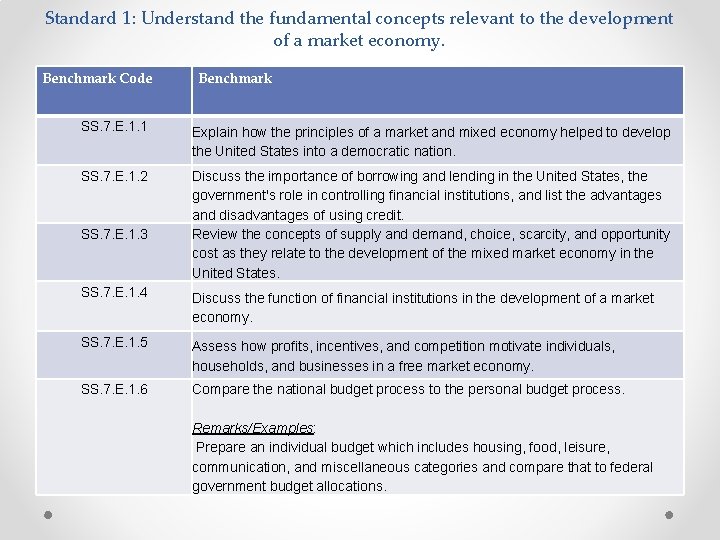
Standard 1: Understand the fundamental concepts relevant to the development of a market economy. Benchmark Code Benchmark SS. 7. E. 1. 1 Explain how the principles of a market and mixed economy helped to develop the United States into a democratic nation. SS. 7. E. 1. 2 Discuss the importance of borrowing and lending in the United States, the government's role in controlling financial institutions, and list the advantages and disadvantages of using credit. Review the concepts of supply and demand, choice, scarcity, and opportunity cost as they relate to the development of the mixed market economy in the United States. SS. 7. E. 1. 3 SS. 7. E. 1. 4 Discuss the function of financial institutions in the development of a market economy. SS. 7. E. 1. 5 Assess how profits, incentives, and competition motivate individuals, households, and businesses in a free market economy. SS. 7. E. 1. 6 Compare the national budget process to the personal budget process. Remarks/Examples: Prepare an individual budget which includes housing, food, leisure, communication, and miscellaneous categories and compare that to federal government budget allocations.
SS. 7. E. 1. 2 Discuss the importance of borrowing and lending in the United States, the government's role in controlling financial institutions, and list the advantages and disadvantages of using credit.
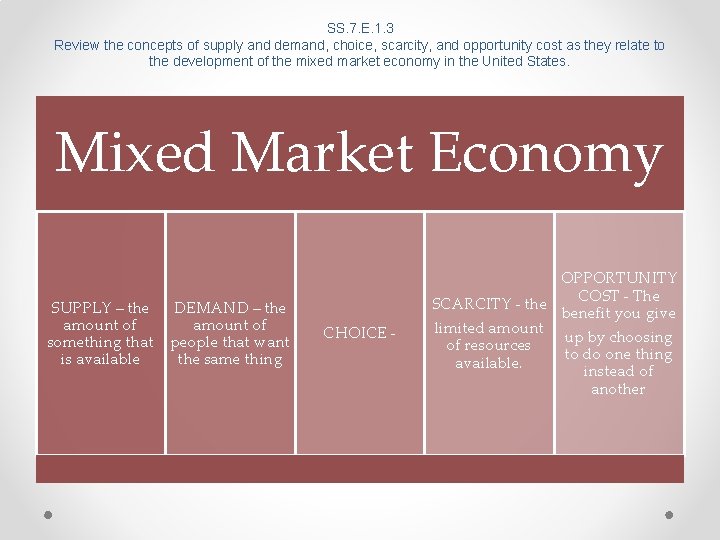
SS. 7. E. 1. 3 Review the concepts of supply and demand, choice, scarcity, and opportunity cost as they relate to the development of the mixed market economy in the United States. Mixed Market Economy SUPPLY – the DEMAND – the amount of something that people that want is available the same thing CHOICE - OPPORTUNITY COST - The SCARCITY - the benefit you give limited amount up by choosing of resources to do one thing available. instead of another
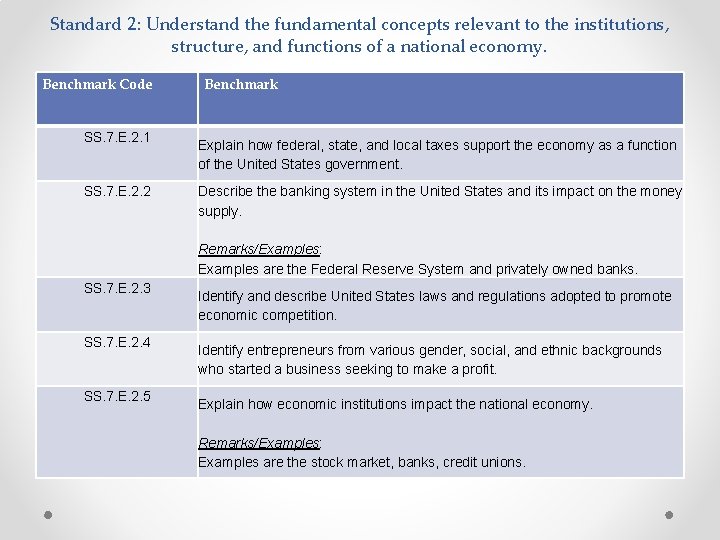
Standard 2: Understand the fundamental concepts relevant to the institutions, structure, and functions of a national economy. Benchmark Code SS. 7. E. 2. 1 SS. 7. E. 2. 2 Benchmark Explain how federal, state, and local taxes support the economy as a function of the United States government. Describe the banking system in the United States and its impact on the money supply. Remarks/Examples: Examples are the Federal Reserve System and privately owned banks. SS. 7. E. 2. 3 SS. 7. E. 2. 4 SS. 7. E. 2. 5 Identify and describe United States laws and regulations adopted to promote economic competition. Identify entrepreneurs from various gender, social, and ethnic backgrounds who started a business seeking to make a profit. Explain how economic institutions impact the national economy. Remarks/Examples: Examples are the stock market, banks, credit unions.
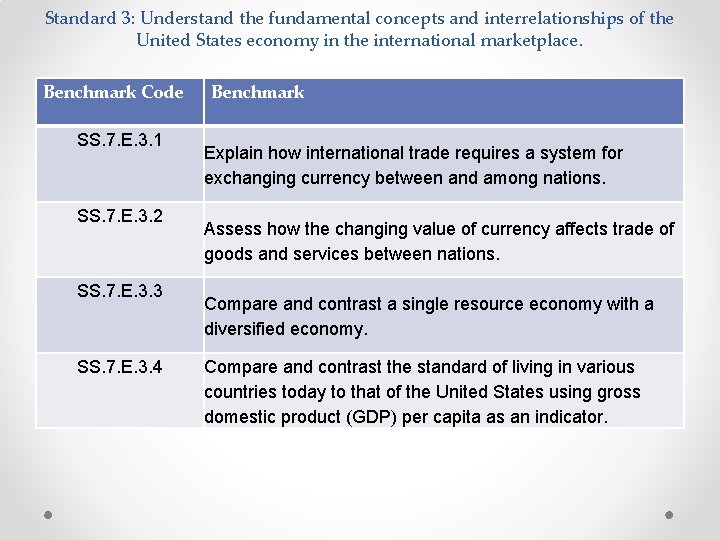
Standard 3: Understand the fundamental concepts and interrelationships of the United States economy in the international marketplace. Benchmark Code SS. 7. E. 3. 1 SS. 7. E. 3. 2 SS. 7. E. 3. 3 SS. 7. E. 3. 4 Benchmark Explain how international trade requires a system for exchanging currency between and among nations. Assess how the changing value of currency affects trade of goods and services between nations. Compare and contrast a single resource economy with a diversified economy. Compare and contrast the standard of living in various countries today to that of the United States using gross domestic product (GDP) per capita as an indicator.