
Case Study The margin of safety can be
Case Study
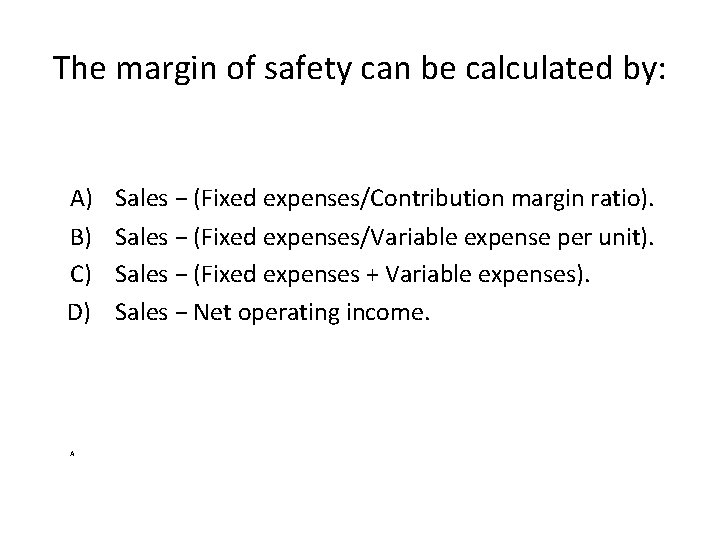
The margin of safety can be calculated by: A) Sales − (Fixed expenses/Contribution margin ratio). B) Sales − (Fixed expenses/Variable expense per unit). C) Sales − (Fixed expenses + Variable expenses). D) Sales − Net operating income. A
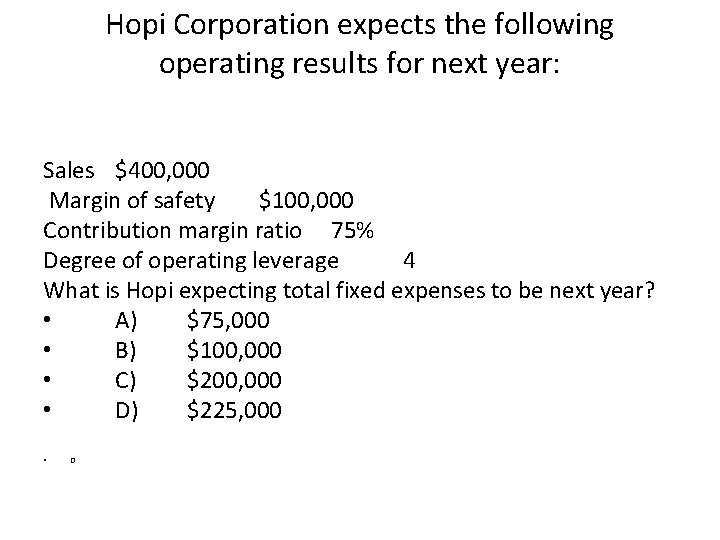
Hopi Corporation expects the following operating results for next year: Sales $400, 000 Margin of safety $100, 000 Contribution margin ratio 75% Degree of operating leverage 4 What is Hopi expecting total fixed expenses to be next year? • A) $75, 000 • B) $100, 000 • C) $200, 000 • D) $225, 000 • D
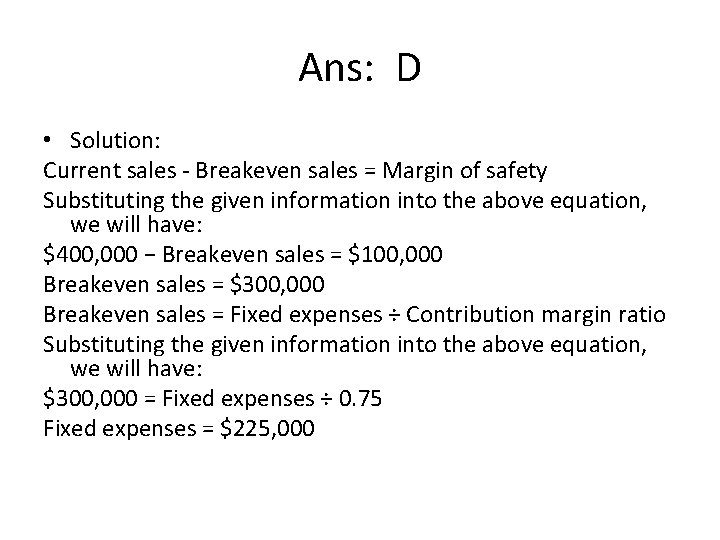
Ans: D • Solution: Current sales - Breakeven sales = Margin of safety Substituting the given information into the above equation, we will have: $400, 000 − Breakeven sales = $100, 000 Breakeven sales = $300, 000 Breakeven sales = Fixed expenses ÷ Contribution margin ratio Substituting the given information into the above equation, we will have: $300, 000 = Fixed expenses ÷ 0. 75 Fixed expenses = $225, 000
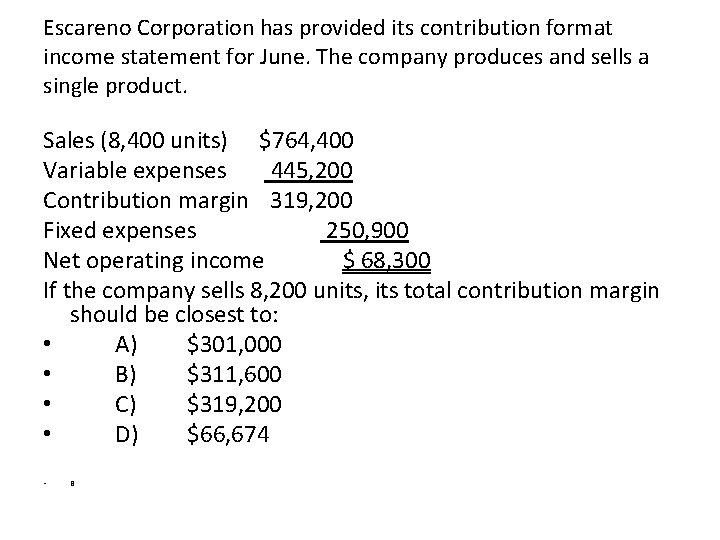
Escareno Corporation has provided its contribution format income statement for June. The company produces and sells a single product. Sales (8, 400 units) $764, 400 Variable expenses 445, 200 Contribution margin 319, 200 Fixed expenses 250, 900 Net operating income $ 68, 300 If the company sells 8, 200 units, its total contribution margin should be closest to: • A) $301, 000 • B) $311, 600 • C) $319, 200 • D) $66, 674 • B
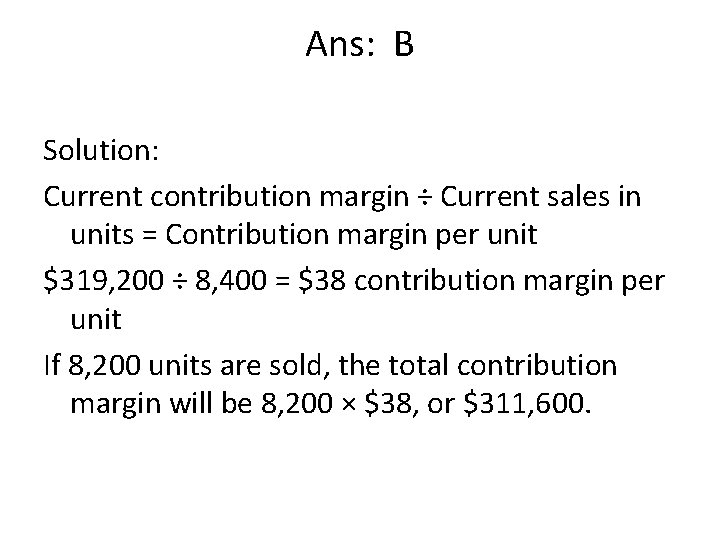
Ans: B Solution: Current contribution margin ÷ Current sales in units = Contribution margin per unit $319, 200 ÷ 8, 400 = $38 contribution margin per unit If 8, 200 units are sold, the total contribution margin will be 8, 200 × $38, or $311, 600.
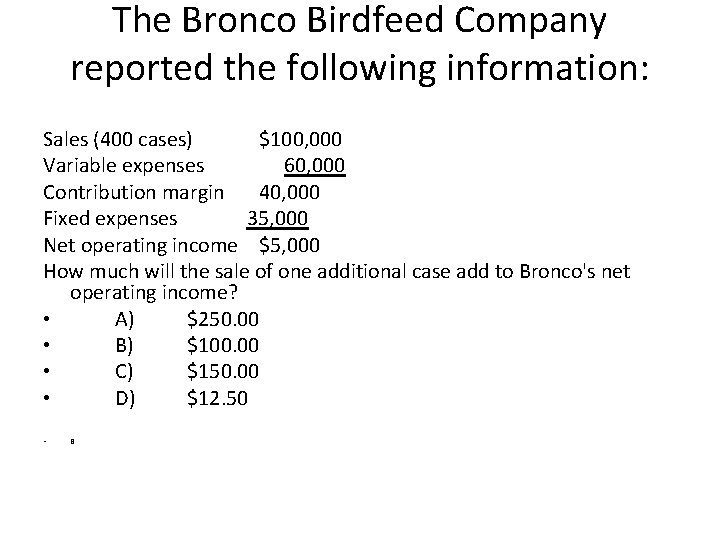
The Bronco Birdfeed Company reported the following information: Sales (400 cases) $100, 000 Variable expenses 60, 000 Contribution margin 40, 000 Fixed expenses 35, 000 Net operating income $5, 000 How much will the sale of one additional case add to Bronco's net operating income? • A) $250. 00 • B) $100. 00 • C) $150. 00 • D) $12. 50 • B
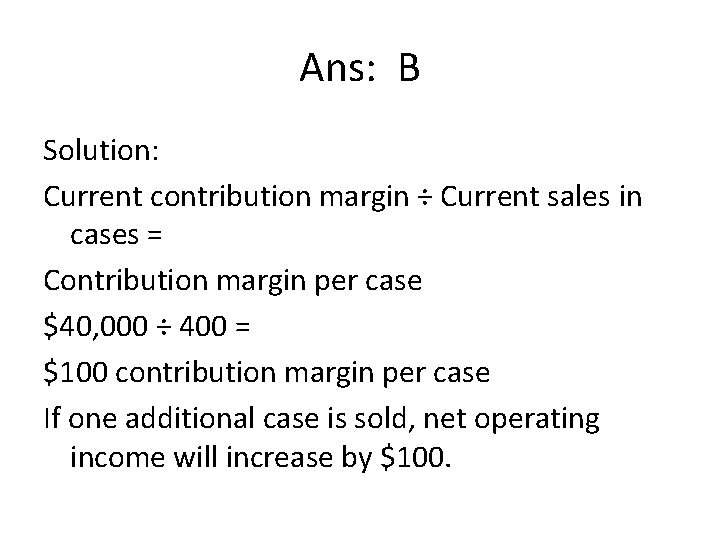
Ans: B Solution: Current contribution margin ÷ Current sales in cases = Contribution margin per case $40, 000 ÷ 400 = $100 contribution margin per case If one additional case is sold, net operating income will increase by $100.
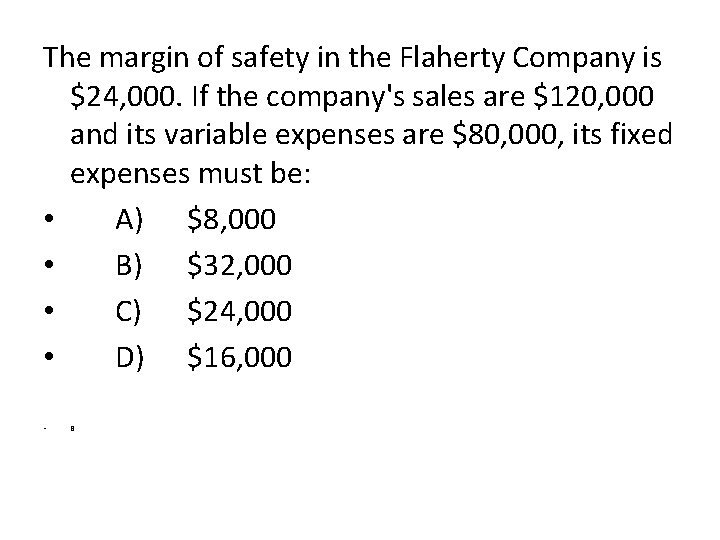
The margin of safety in the Flaherty Company is $24, 000. If the company's sales are $120, 000 and its variable expenses are $80, 000, its fixed expenses must be: • A) $8, 000 • B) $32, 000 • C) $24, 000 • D) $16, 000 • B
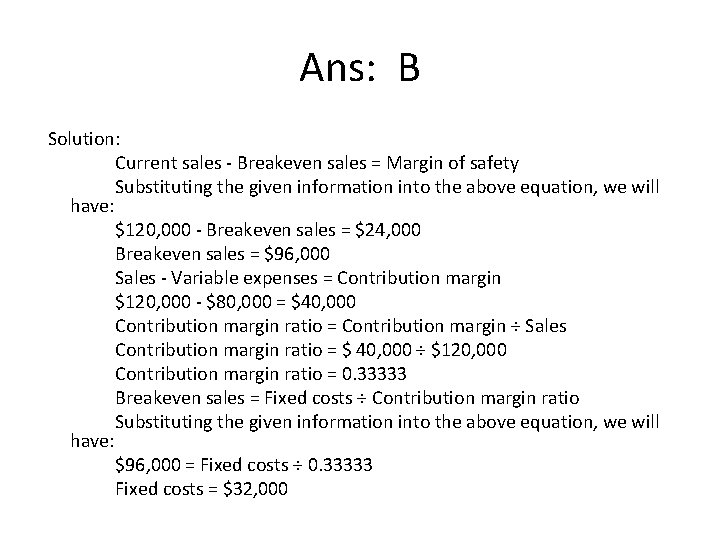
Ans: B Solution: Current sales - Breakeven sales = Margin of safety Substituting the given information into the above equation, we will have: $120, 000 - Breakeven sales = $24, 000 Breakeven sales = $96, 000 Sales - Variable expenses = Contribution margin $120, 000 - $80, 000 = $40, 000 Contribution margin ratio = Contribution margin ÷ Sales Contribution margin ratio = $ 40, 000 ÷ $120, 000 Contribution margin ratio = 0. 33333 Breakeven sales = Fixed costs ÷ Contribution margin ratio Substituting the given information into the above equation, we will have: $96, 000 = Fixed costs ÷ 0. 33333 Fixed costs = $32, 000
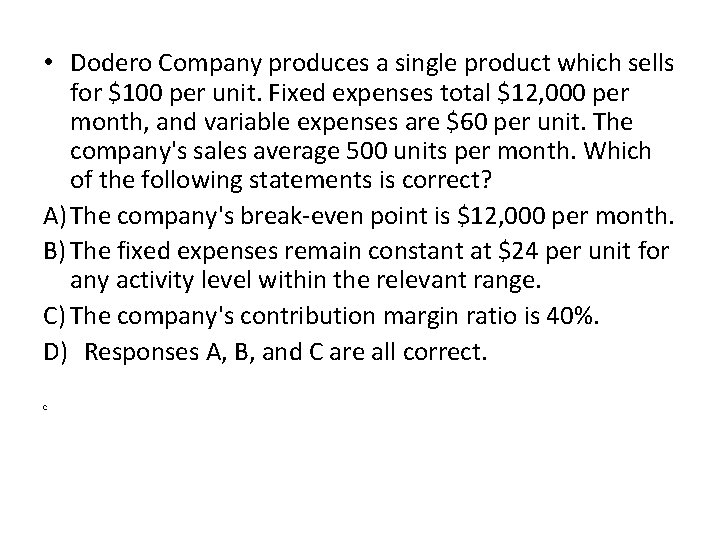
• Dodero Company produces a single product which sells for $100 per unit. Fixed expenses total $12, 000 per month, and variable expenses are $60 per unit. The company's sales average 500 units per month. Which of the following statements is correct? A) The company's break-even point is $12, 000 per month. B) The fixed expenses remain constant at $24 per unit for any activity level within the relevant range. C) The company's contribution margin ratio is 40%. D) Responses A, B, and C are all correct. C
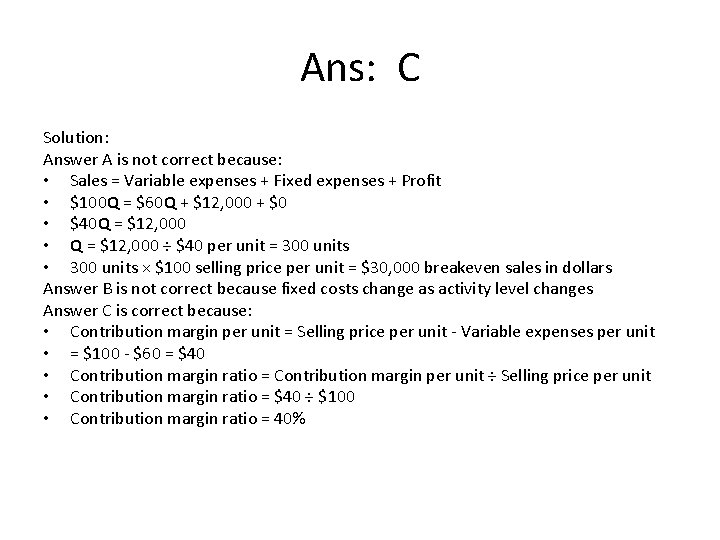
Ans: C Solution: Answer A is not correct because: • Sales = Variable expenses + Fixed expenses + Profit • $100 Q = $60 Q + $12, 000 + $0 • $40 Q = $12, 000 • Q = $12, 000 ÷ $40 per unit = 300 units • 300 units × $100 selling price per unit = $30, 000 breakeven sales in dollars Answer B is not correct because fixed costs change as activity level changes Answer C is correct because: • Contribution margin per unit = Selling price per unit - Variable expenses per unit • = $100 - $60 = $40 • Contribution margin ratio = Contribution margin per unit ÷ Selling price per unit • Contribution margin ratio = $40 ÷ $100 • Contribution margin ratio = 40%
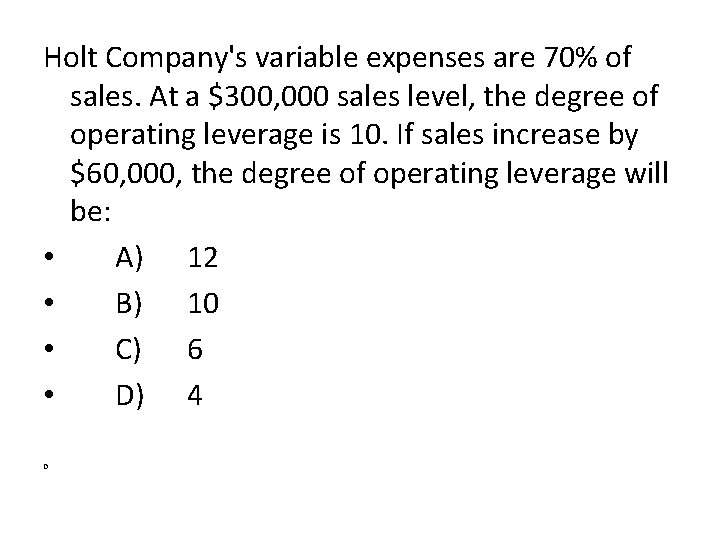
Holt Company's variable expenses are 70% of sales. At a $300, 000 sales level, the degree of operating leverage is 10. If sales increase by $60, 000, the degree of operating leverage will be: • A) 12 • B) 10 • C) 6 • D) 4 D
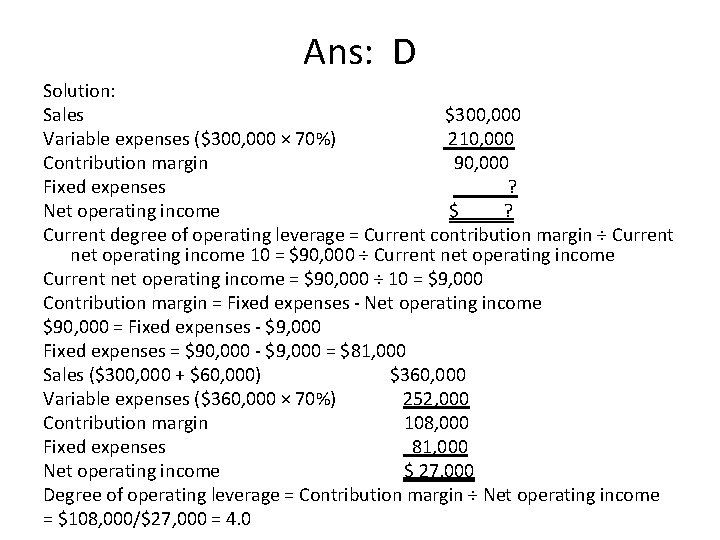
Ans: D Solution: Sales $300, 000 Variable expenses ($300, 000 × 70%) 210, 000 Contribution margin 90, 000 Fixed expenses ? Net operating income $ ? Current degree of operating leverage = Current contribution margin ÷ Current net operating income 10 = $90, 000 ÷ Current net operating income = $90, 000 ÷ 10 = $9, 000 Contribution margin = Fixed expenses - Net operating income $90, 000 = Fixed expenses - $9, 000 Fixed expenses = $90, 000 - $9, 000 = $81, 000 Sales ($300, 000 + $60, 000) $360, 000 Variable expenses ($360, 000 × 70%) 252, 000 Contribution margin 108, 000 Fixed expenses 81, 000 Net operating income $ 27, 000 Degree of operating leverage = Contribution margin ÷ Net operating income = $108, 000/$27, 000 = 4. 0
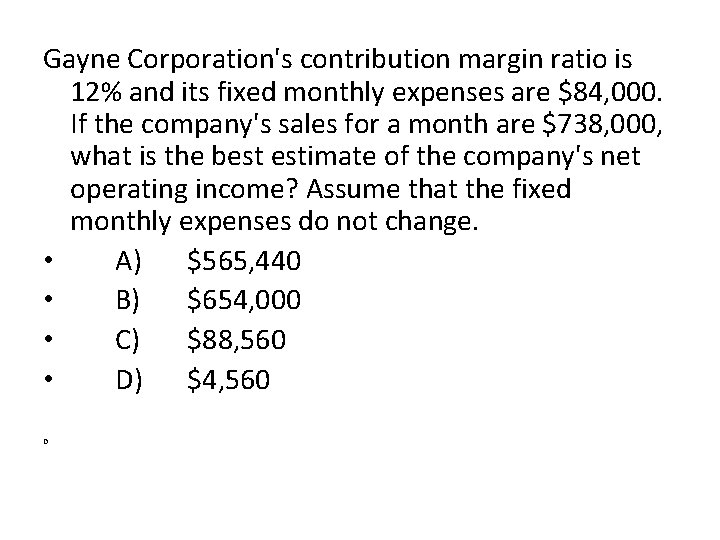
Gayne Corporation's contribution margin ratio is 12% and its fixed monthly expenses are $84, 000. If the company's sales for a month are $738, 000, what is the best estimate of the company's net operating income? Assume that the fixed monthly expenses do not change. • A) $565, 440 • B) $654, 000 • C) $88, 560 • D) $4, 560 D
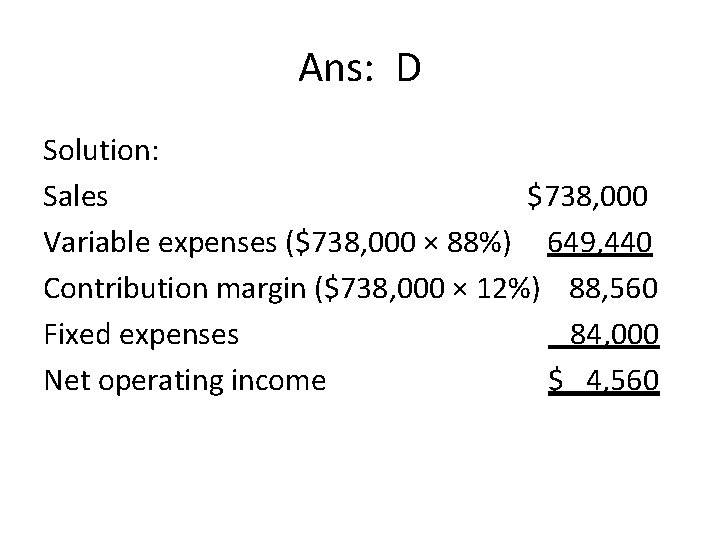
Ans: D Solution: Sales $738, 000 Variable expenses ($738, 000 × 88%) 649, 440 Contribution margin ($738, 000 × 12%) 88, 560 Fixed expenses 84, 000 Net operating income $ 4, 560
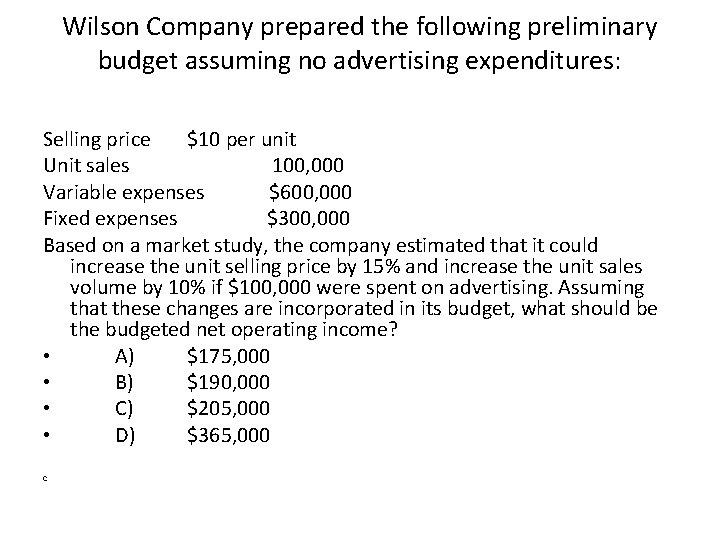
Wilson Company prepared the following preliminary budget assuming no advertising expenditures: Selling price $10 per unit Unit sales 100, 000 Variable expenses $600, 000 Fixed expenses $300, 000 Based on a market study, the company estimated that it could increase the unit selling price by 15% and increase the unit sales volume by 10% if $100, 000 were spent on advertising. Assuming that these changes are incorporated in its budget, what should be the budgeted net operating income? • A) $175, 000 • B) $190, 000 • C) $205, 000 • D) $365, 000 C
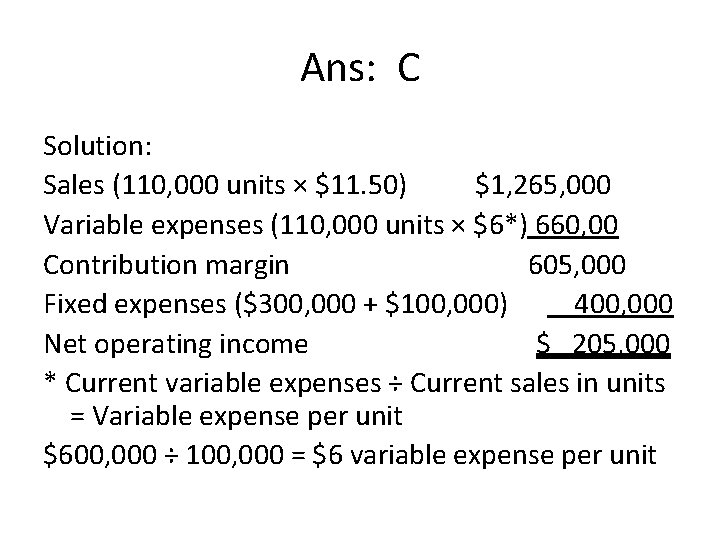
Ans: C Solution: Sales (110, 000 units × $11. 50) $1, 265, 000 Variable expenses (110, 000 units × $6*) 660, 00 Contribution margin 605, 000 Fixed expenses ($300, 000 + $100, 000) 400, 000 Net operating income $ 205, 000 * Current variable expenses ÷ Current sales in units = Variable expense per unit $600, 000 ÷ 100, 000 = $6 variable expense per unit
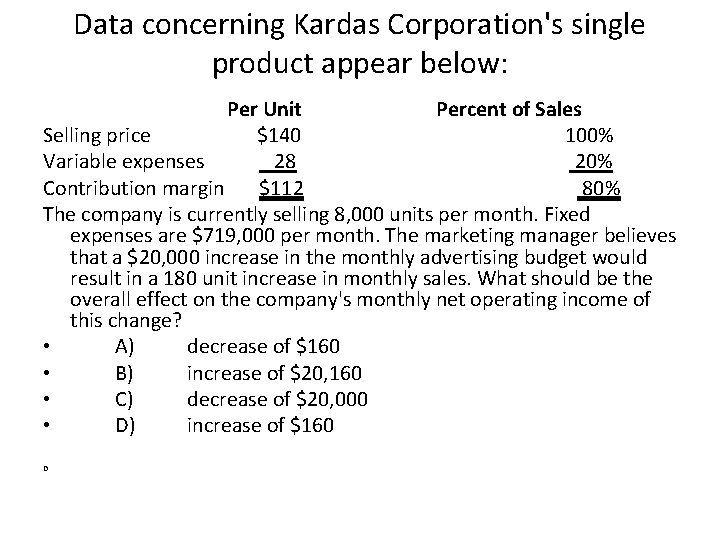
Data concerning Kardas Corporation's single product appear below: Per Unit Percent of Sales Selling price $140 100% Variable expenses 28 20% Contribution margin $112 80% The company is currently selling 8, 000 units per month. Fixed expenses are $719, 000 per month. The marketing manager believes that a $20, 000 increase in the monthly advertising budget would result in a 180 unit increase in monthly sales. What should be the overall effect on the company's monthly net operating income of this change? • A) decrease of $160 • B) increase of $20, 160 • C) decrease of $20, 000 • D) increase of $160 D
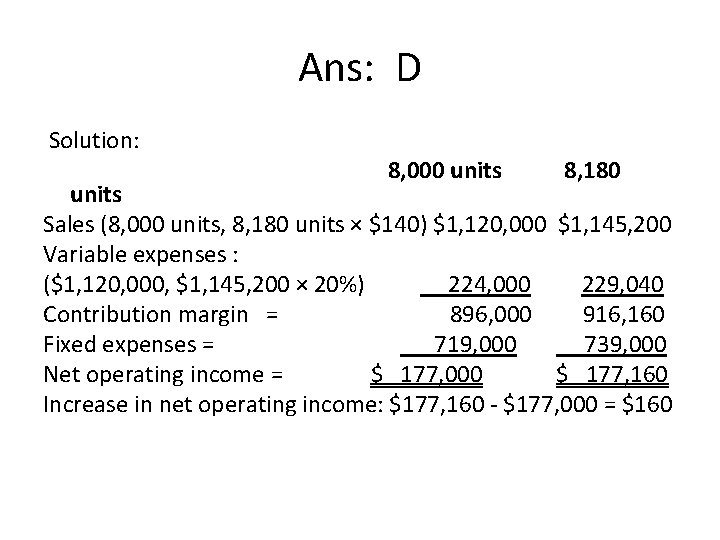
Ans: D Solution: 8, 000 units 8, 180 units Sales (8, 000 units, 8, 180 units × $140) $1, 120, 000 $1, 145, 200 Variable expenses : ($1, 120, 000, $1, 145, 200 × 20%) 224, 000 229, 040 Contribution margin = 896, 000 916, 160 Fixed expenses = 719, 000 739, 000 Net operating income = $ 177, 000 $ 177, 160 Increase in net operating income: $177, 160 - $177, 000 = $160
- Slides: 20