China Chapter 8 Section One Making of Modern
- Slides: 60
China Chapter 8
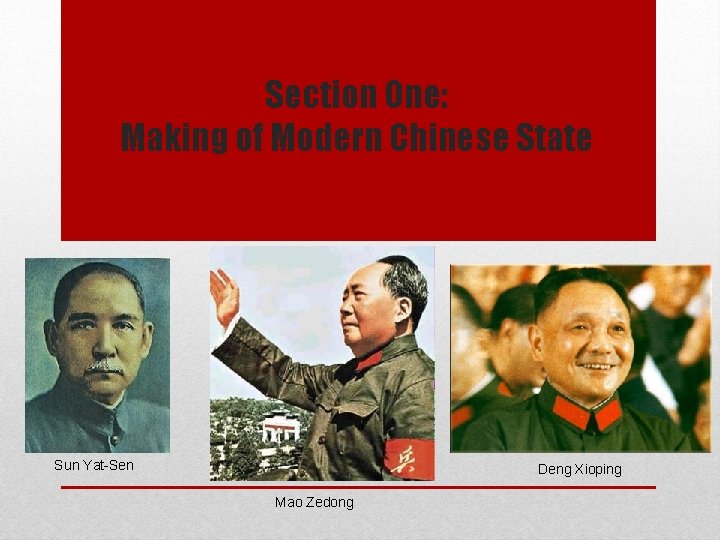
Section One: Making of Modern Chinese State Sun Yat-Sen Deng Xioping Mao Zedong
Politics in Action • 2008 Beijing Olympics seen as signifying global recognition of China as rising world power but couldn’t hide the truth • China ruled by repressive communist party • Dissidents harassed or detained prior to games • Tibet protest crushed – afraid Dalai Lama has too much autonomy; since 1959 Chinese government took strong control • Xinjiang suicide attack killed 16 • Mid-1970 s People’s Republic of China (PRC) - poor with tyrannical political system • Political and economic improvements since then • Still remains communist party state • Rift between authoritarian political system and modern society
Geographic Setting • • • Eastern part of mainland Asia Land borders with more than twelve countries Isolated and contributed to sense of “Middle Kingdom” West – sparse population but huge area North East – much like USA plains states South – warm with year round agriculture China is rich in natural resources 4 x the population of the USA Population centered around eastern seaboard, three rivers 92% are ethnic Han but over 50 ethnic minorities living in border regions
From Empire to Republic : 221 B. C. – 1911 A. D. • One of oldest, strongest, richest cultures in existence • Ruled by family-based dynasties for 4, 000 years – went through dynastic cycles of power • Power for 12 different family based dynasties determined through Mandate of Heaven • Power rested in hands of emperor and elaborate bureaucracy • Their political culture is inherited from centuries of dynastic rule centered on Confucian values like order, harmony, strong sense of hierarchy
From Empire to Republic : Continued • Imperial system lasted until 1911 for various reasons: • Authoritarian in Power – based on Mandate • Influence of Confucianism - importance of group over individual, deference to superiors, importance of education, need to maintain social harmony • National government with merit-based bureaucracy • Traditional economy was strong to the economy • Structure of traditional Chinese society in million of small villages • Belief they were the Middle Kingdom • China was dominant political, military, cultural force
From Empire to Republic : Continued • Centuries of expansion/invasion led to tension between Han and other ethnic groups • Late 18 th and 19 th century empire faced combination of internal crises and external challenges • Population explosion led to economic stagnation • Corruption, exploitation • European powers surpassed China in development • Opium War defeat forced China to sign unequal treaties to open borders
Warlords, Nationalists, and Communists 1912 -1949 • Strong sense of cultural identity developed into nationalism – secured by Revolution of 1911 • Republic of China 1912 Sun Yat-Sen; weak and couldn’t hold power from warlords – wanted to start another revolution with Nationalists • Chinese Communist Party organized 1921; joined Nationalists to fight warlords until 1927 • Chiang Kai-shek leader of Nationalists turned against communist partners; unified Republic under his personal rule
Warlords, Nationalists - Continued • CCP relocated into countryside – created Mao Zedong’s rise to power • Was idealistic and egalitarian – believed in mass line • 1934 Long March into NW China 6, 000 miles – 90% mortality • CCP implemented land reform to benefit peasants • WWII stopped Civil War temporarily but CCP fought on frontlines • 1945 Nationalists cut off from most of China, unpopular • Civil War resumes – CCP wins over US backed Nationalists – October 1, 1949 Mao takes power
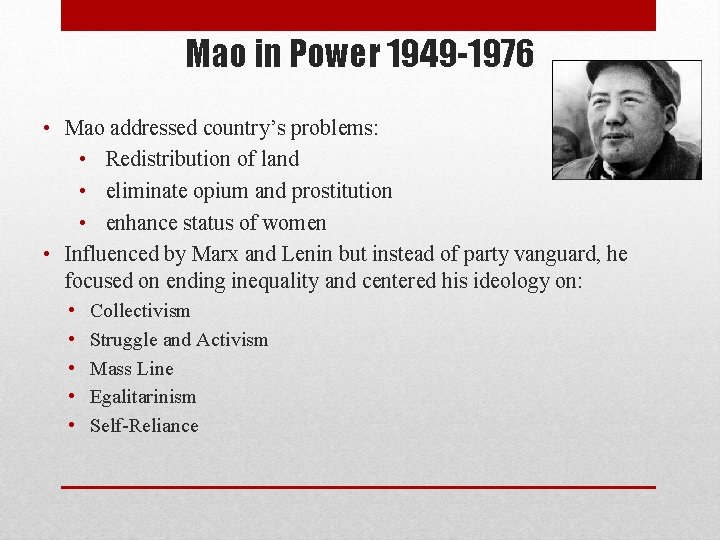
Mao in Power 1949 -1976 • Mao addressed country’s problems: • Redistribution of land • eliminate opium and prostitution • enhance status of women • Influenced by Marx and Lenin but instead of party vanguard, he focused on ending inequality and centered his ideology on: • • • Collectivism Struggle and Activism Mass Line Egalitarinism Self-Reliance
Mao in Power 1949 -1976: continued • Implemented five-year economic plan 1953 -1957 - nationalization, collectivization • Hundred Flowers Movement 1956 -asked people to offer opinions on CCP’s governance, encourage participation; criticism indicated resentment toward dictatorship • Anti-Rightist Campaign 1957 – crack down to Hundred Flowers • Great Leap Forward (1958 -1960) - accelerate economic development, move toward true communism; horrible plan, 30 million dead and industrial depression followed • Early 1960 s Liu Shaoqi and Deng Xiaoping took charge - abandoned Great Leap for combo of government planning and market-oriented policies; revived Chinese economy • Mao unhappy with consequences of China’s development - resurgence of inequality • Led to Cultural Revolution (1966 -1976) –crusade to purify party; Mao Zedong Thought • 1 st phase (1966 -1969) - Red Guard rampage • 2 nd phase (1969 -1971) – PLA restore political order • 3 rd phase (1972 -1976) - Factional conflict over Mao’s successor • Mao died 1976 - Moderate leaders staged coup, arrested Gang of Four, end of Cultural Revolution
Deng Xiaoping - 1977 -1997 • Since Mao’s death – Politburo of CCP is legitimate source of power in China • New leaders restored veterans to power • Deng powerful leader but appointed younger, loyal men to positions • Reduced state economic controls, increased market forces • Encouraged private enterprise, foreign investment • Increased freedom of artistic expression • Inflation, corruption, desire for political freedom challenged CCP 1989 • Large scale demonstrations, media coverage, CCP internally divided about how to handle until used force used at Tiananmen Square • Deng took steps to accelerate economic reform, avoid collapse of communist system in 1992 “It doesn’t matter if a cat is black or white as long as it catches mice”
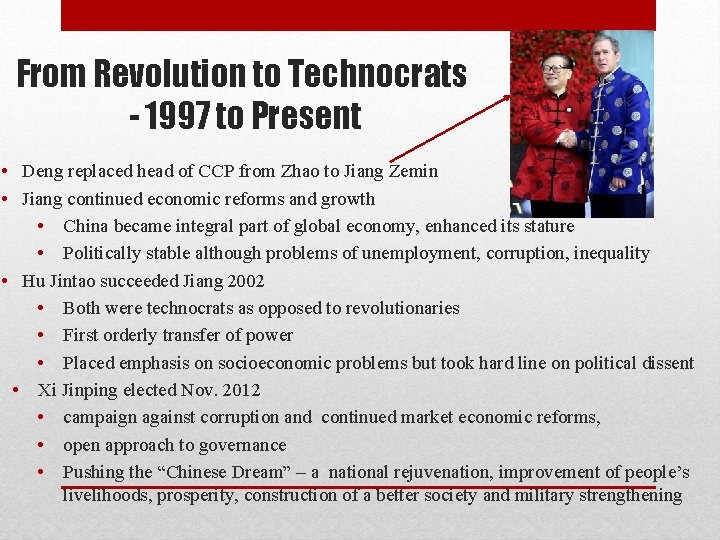
From Revolution to Technocrats - 1997 to Present • Deng replaced head of CCP from Zhao to Jiang Zemin • Jiang continued economic reforms and growth • China became integral part of global economy, enhanced its stature • Politically stable although problems of unemployment, corruption, inequality • Hu Jintao succeeded Jiang 2002 • Both were technocrats as opposed to revolutionaries • First orderly transfer of power • Placed emphasis on socioeconomic problems but took hard line on political dissent • Xi Jinping elected Nov. 2012 • campaign against corruption and continued market economic reforms, • open approach to governance • Pushing the “Chinese Dream” – a national rejuvenation, improvement of people’s livelihoods, prosperity, construction of a better society and military strengthening
Importance of Informal Relationships • Among political elite power and respect depend not on official positions as on who has what connections to whom - guanxi • During early PRC, ties were largely based on reputations established during the Large March • Factions of their followers still compete for power and informal relationships define each change in leadership • This informal network is not apparent to casual outsider so when new leaders begin, often hard to predict how policymaking will be affected
Chinese Nationalism • Identity of Han goes back to ancient times • China has become increasingly involved in world politics since Deng Xiaoping’s rule • 2008 Olympics was intended to show off China to the world • Tibetan people and other minority groups seen as inferior to nationalists Attitudes Toward the West • Early 20 th century tension among Chinese leaders who promoted Chinese self-reliance and those seeking modernization • Mao rejected western notions of human rights and electoral democracy • Since late 1970 s China has opened up to western trade and culture • 2012 accused western efforts to export democracy and human rights in China as new form of colonialism
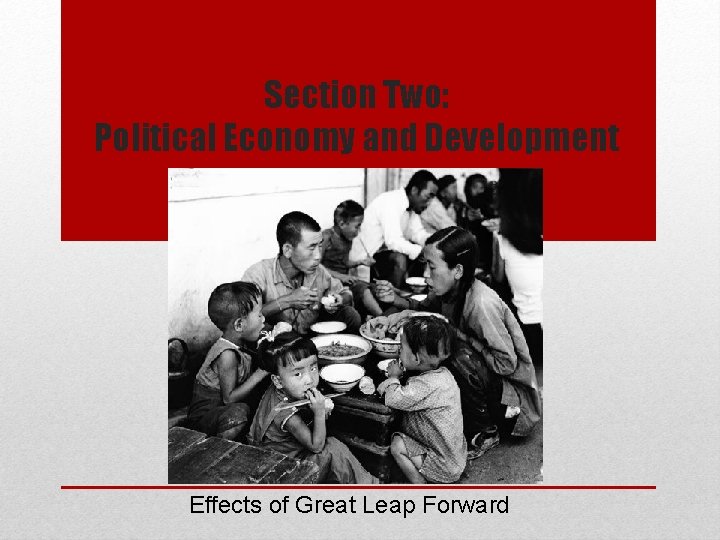
Section Two: Political Economy and Development Effects of Great Leap Forward
Change Before 1949 • Economic growth since 1970 s economic miracle; 10% a year for 30 years – 2 nd largest world economy • China rose to regional hegemony early on – dynastic cycles explained patterns of political and economic change in China • Interrupted by Mongol invasion in 13 th century until Ming restored Han control • Two disruptive influences threatened the stability and provided challenges to modern China: • Imperialism – fell prey to foreign influence • Revolutions of 1911 and 1949 – rise in nationalism created Nationalist Party and CCP, followed in footsteps of USSR initially
Maoist Economy • Long March solidified Mao as hero • Chiang fled to Taiwan and “Two Chinas” created – CCP had to face failing economy due to rebellion, invasion, civil war, bad government • Attempted reform in two phases • Soviet Model • Land Reform • Civil Reform • Five Year Plans • Chinese Model • Great Leap Forward • All around development • Mass mobilization • Political unanimity and zeal • Decentralization
Maoist Economy • Cultural Revolution • Enacted political, social, and economic change to purify the party • Wanted to remove all vestiges of Old China • Scholars sent to fields to work, libraries destroyed • Emphasized only elementary education • Mao died and left groups in factions • Radicals - arrested • Military • Moderates – they won
Deng Xiaoping's Modernizations • Began Four Modernizations: industry, agriculture, science, military • Under Deng, politics and ideology second to economic goals • Introduced free market policies • Redefined role of CCP in governing economy; now families/factory managers made economic decisions – not bureaucrats; profit incentive restored • In most sectors government no longer dictates economic decisions - SOEs still employ over 60 million workers but most turn a profit or will be restructured • • 2004 Constitution amended to guarantee property rights Consumer revolution with emerging middle class Claims to have “socialist market economy” – not fully free market Household responsibility system put into place – biggest reason for economic growth • TVEs were big in 1980 s and 1990 s but today most are privatized due to market forces
Society and Economy • Society made more diverse & open by market reform/globalization • Economic change also caused social problems of crime, prostitution, drugs • Economic reform changed social welfare system – was the iron rice bowl; government guaranteed employment, standard of living, benefits • Reformers believed costly and poor motivators • Income and employment no longer guaranteed • Rural social services safety net disappearing • Public health system, once a model, now in shambles • Breaking iron rice bowl improved motivation but increased unemployment and increased labor unrest is this a political time bomb for CCP?
Society and Economy: Continued • Market reforms created flood of rural migrants; could become politically destabilizing –pressure on urban housing/social services • Has created opportunities for corruption; rule of law weaker than personal connections (guanxi) • Has created inequalities between urban and rural areas – contradiction to communist ideal; government working on this • Hu Jintao promoted “harmonious socialist society” • Gender inequalities have also increased • Have had environmental impacts • Dealing with negative consequences of growth main challenge facing China; limited ability for citizens to address problems in order to keep tight control on political life
China in the Global Economy • Not a major trading nation in 1978 • Opening China one of Deng’s major goals • China now 2 nd largest trading nation - Enormous growth but lack of effective regulation in many sectors – led to massive recalls of Chinese goods in 2007 – 2008 • Much of China’s trade is in E. Asia • Foreign investment in China increased due to low labor costs, large domestic market – one of largest targets foreign direct investment • Economic decline of 2008 did not spare China but impact less severe • China is economically and technically Third World but superpower size
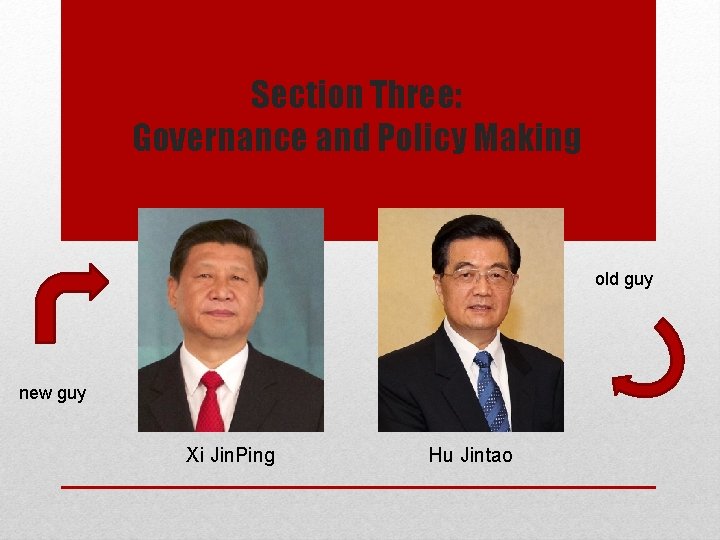
Section Three: Governance and Policy Making old guy new guy Xi Jin. Ping Hu Jintao
Organization of the State • CCP claims only it can govern best interests of entire nation; wants to create egalitarian and classless communist society • Political regime best described as authoritarian • Says “disruption of socialist system by an individual is prohibited” • Imply people enjoy democratic rights/privileges under party guidance • CCP says Mao made fundamental contribution to communism, adapted Marxism-Leninism to China; emphasized role of peasants in revolution, admits he made mistakes but praises “Mao Zedong Thought” • Constitution more a political statement than governing document • Unitary state “under the unified leadership of central authorities” • CCP claims to represent interests of all people of China, control government structures, describes PRC as socialist democracy • PRC see this as superior to democracy in capitalist countries • As China has moved from command economy to market economy, has worked on decentralization to subnational governments
Political Parties and the Party System • Has political parties in addition to CCP but do not challenge its authority • CCP recruiting new members from “new social stratum” – Red Capitalists • Chinese Communist Party • • Grown steady since 1949 except during Cultural Revolution Largest political party in the world Supreme Leader at the top – today called General Secretary Central bodies are: • National Party Congress • Central Committee • Politburo and Standing Committee – top leaders live in Zhongnanhai • Other executive organizations are • Secretariat • Central Commission for Discipline Inspection (CCDI)
China’s Noncommunist Democratic Parties • China describes political system as one of multiparty cooperation • 8 non CCP parties are called democratic parties – all founded before CCP came to power in 1949 and don’t contest for power from CCP • Express views on national policy through Chinese People’s Political Consultative Conference – advisory body that operates under the guidance of CCP • Meets in full session once a year for about two weeks • Do not express serious dissent from the party line • New political parties are not allowed to form
Elections • Used to give legitimacy to CCP • Most elections are indirect • Members of one body elect those who will serve in next higher body • Direct elections most common at village level, although some experiments at township level but CCP wants to prevent elections from becoming forum for dissent • Most significant progress toward democratic representation in villages • Since 1980 s provide for direct election of village head • Generally multi-candidate with primaries and run-offs • Given voters more power in local affairs to make leaders more responsive and to remove corrupt and incompetent people • Real power in villages in CCP branch and party secretary • Some feel is a seed for democracy, others feel only façade to appease international critics
Political Elite • Mao’s friends were Old Guard • China recruits leaders through nomenklatura but communicate each other through guanxi • Have been a cause of factions within the party • Radicals • Military • Reformers • Deng’s death in 1997 showed factional strife apparent within the leadership between: • Conservatives • Liberals • Other factions are: • Shanghai Gang • Princelings • Chinese Communist Youth League
Corruption • Combination of guanxi and economic boom has brought about rampant corruption – bribes are common • Hu Jintao punished thousands for corruption • 2007 government embarrassed by international publicity about tainted food, health products, and drugs – head of FDA arrested, imprisoned, executed • 2012 scandal around Bo Xilai’s wife – biggest political shakeup in China’s ruling elite in decades • 2012 Xi Jinping announced new anti-corruption program
Interest Groups • Rural areas were regulated hukou system – principal way to control population • Families must have residence permits to live and work in areas • Market reform led to breakdown of hukou system – began reform in 2007 • Urban areas regulated by danwei system – center of economic, social, political lives, held meetings to discuss official line on important policies and events • Government control mechanisms are weakening as China continues to change • Structures of political system are designed more to extend party-state control – use guanxi to ease contacts with bureaucrats • Truly independent interest groups not allowed but do have groups that act as official lobby in promoting nonpolitical interests – huge surge in NGOs • Must register with local authorities and have official government agency as its sponsor – called its mother-in-law
Media • 1949 to 1980 almost all were state run, some independent media has emerged • Official press agency is Xinhua • People’s Daily is official paper of the CCP • CCTV is state TV broadcaster • Internet is used – internet cafes are popular • All media outlets are subject to heavy censorship by the government
Institutions of Government • Political structure has three parallel hierarchies • Communist Party • The State • The People’s Liberation Army • The party dominates all three and controlled by principle of dual role – vertical supervision and horizontal supervision • Policymaking is governed more directly by factions and personal relationships • Rapid economic development has encouraged some devolution to sub -governments • Has three branches but all branches are controlled by the party
The Legislature • Constitution gives National People’s Congress powers • Enact/amend laws, approve/monitor budget, declare/end war, elect/approve officials, laws passed with large majorities • Powers only exercised as allowed by CCP • Unicameral legislature, meets two weeks every March, 5 year term • Never addresses sensitive political issues, but increasingly active • When National People’s Congress not in session, state power exercised by NPC Standing Committee – its chair is also a member of the CCP Standing Committee • NPC never deals with sensitive issues; legislation passed with huge majority – is a rubber stamp • Its meetings are important in that the Politburo’s decisions are formally announced during them
The Executive • Government of PRC organizationally and functionally different from CCP • PRC consists of president and prime minister • CCP led by general secretary • Real executive power lies in CCP - exercises direct or indirect control over all government organizations and personnel, all high ranking officials are party members • PRC is essentially the agency for carrying out and enforcing CCP policies
The Government Executive • In theory National People’s Congress (NPC) is top government authority empowered to supervise work of the “people’s government” in executive branch but really are more accountable to CCP than People’s Congress • NPC formally elects president and VPs but only 1 candidate chosen by CCP for each position – ceremonial held by senior CCP member • President’s term is five years, concurrent with congress, with twoterm limit; meets and negotiates with world leaders • Premier (PM) has authority over bureaucracy, policy implementation • Appointed by president, although candidate decided by CCP • Five year term with two-term limit; always held by high ranking CCP Standing Committee member
The Government Executive - continued • State Council - highest state administration; directed by Premier • Appointed by NPC, but membership determined by CCP leadership • Functions like cabinet; size varies • Subordinate bureaucracy implements policy • China is challenged to create independent regulatory agencies to set and enforce policy standards but their functioning compromised by state owned enterprises • Bureaucracy is immense • Not all cadres (people in authority paid by government) are party members and most work at county level or below • Moves toward professionalizing bureaucracy and limits have been placed on positions
The Judiciary • Four tiered system: Supreme Court at top then provincial, city, and county/township levels • Supreme Court supervises lower courts: no judicial review • People’s Procuratorate – prosecutors and defenders with investigatory functions • Judicial system and rule of law accused of elitism and revisionism during Cultural Revolution and revoked but has been revitalized • Legal advisory offices have been established • Laws and regulations enacted to regularize legal system • Increased number of lawsuits filed and won against businesses, local officials, government agencies; avenue for non-political grievances • Criminal justice swift and harsh; 99% conviction rate, death penalty must be approved by Supreme People’s Court – largest number in world • Reform due to demands of a more market driven economy
The Military and the Police • People’s Liberation Army (PLA) encompasses ground, air, naval, reserves • World’s largest; service is considered prestigious • Military Service Law allows draft of men and women 18 -22 • Military spending continuously increasing • Military Commissions of CCP and PRC are in charge of armed forces • On paper different but overlap in membership and function and membership determined by CCP Standing Committee • Chair is commander in chief; almost always head of party • Internal security consists of several organizations • People’s Armed Police; Ministry of State Security; Ministry of Public Security; local public security bureaus • Ministry of Public Security also maintains regular prisons and labor camps • Public Security Bureaus have authority to detain indefinitely without making formal charge
Subnational Government • Four layers below central government: provinces, cities, counties, towns • Each level has people’s congress that meets infrequently • Government authority becoming more decentralized but central government retains power to intervene in local affairs when wanted • Some argue PRC better with federal system but inconsistent with structure of a communist party state • Majority of population lives in one of 700, 000 rural villages • Technically self-governing, but CCP most powerful actor • Increasingly competitive elections and vocal legislatures
Section Four: Citizens, Society, and the State
Ethnic Cleavage • Relationship of Chinese citizens to the state has changed profoundly • Under Maoism no civil society was allowed • With transition to market-based economy, important transformations occurring in citizen-state relationships • Most citizens no longer see communist idelogy as central to their lives so CCP appeals to patriotism and traditional pride in being Chinese • Citizens are primarily Han but 8% minority through conquest and expansion • Minority groups have long history of resistance to Chinese government • Government encourages their economic development and suppresses their expressions of dissent • Most minorities are in Guangxi, Inner Mongolia, Ningxia, Tiber, Xinjiang
Ethnic Cleavage - Continued • Tibet • • • Some have never reconized Chinese authority Others demand enhanced autonomy under China Rally around Dalai Lama – fled to India 1959 after failed uprising 2008 riots and demonstrations in Tibet on 49 th anniversary of the uprising Cause highlighted in 2008 when protests greeting Olympic torch 2013 crackdown on illegal publications to crack down on Dalai Lama • Uyghurs • Live in Xinjiang • Want separate Islamic state and have used violence to support their cause • Post 9/11 China concerned with Muslim dissidents • Linguistic Diversity • Have tried to make Mandarin official language – repressing other dialects • Those in pubic sector jobs must speak Mandarin
Urban-Rural Cleavages • • • Important emerging divide Gap between two is creating a new “Two Chinas” 1980 s 80% living in rural area – today 47% Includes social lifestyles differences Have begun a “new socialist countryside” to life lagging rural economy Urban-rural resentments abound
Political Culture, Citizenship, and Identity • PRC’s official culture is based on communist ideology • Maoist era Mao Zedong Thought center of power but by mid-1970 s debacle of Mao years tarnished appeal of communist ideology • 1978 Deng Xiaoping came to power – tried to restore legitimacy of CCP through economic reforms – after Deng’s death in 1997 CCP amended party constitution to add Deng Xiaoping Theory: promote economic development and Four Cardinal Principles • Jiang Zemin – offered Three Represents in 2000 • Hu Jintao began harmonious socialist society • CCP still controls education and media, no true freedom of the press but can publish some human interest stories • Much less direct censorship in the arts – Central Propaganda Department remains powerful • Schools used to instill political values in citizens – expansion of educaiton at all levels is one of the greatest successes of the PRC
Political Culture, Citizenship, and Identity • Academic freedom in China expanded and college sites of unconstrained discussions but teachers/students still monitored • Consumerism most widely shared value in China today • Religious organizations operate more freely than they have in decades but still closely controlled and limited to officially approved organizations Political Participation • Before 1949 tradition was citizens were subjects of government, not participants • Communist state redifined partiipaton by creating relatioinshp between citizns and CCP • Guanxi still governs personal ties
Political Participation • • • CCP largest political party in the world Only those seen as fully committed are allowed to join Party membership is growing through CCP’s Youth League During Maoist era cadres depended on party loyalty and ideological purity Since Deng’s reforms technocrats increasingly lead the party Today few party members come from peasantry but still largest single group in CCP • Women do not have a strong leadership role in the CCP • As of 2001 capitalists were allowed to become members
Civil Society and Citizen Protest • Control mechanisms of party have loosened recently • Communications have made it more difficult for party-state to monitor citizens • Civil society is growing – a new trend • Hu Jintao’s harmonious development allows the state to solicit public opinion • Citizens still complain state lacks transparency • By 1990 s NGO’s allowed to register with the government
Protest and the Party-State • Tianamen • 1989 – showed limits of protest in China • Brutal suppression of democracy – pro-democracy groups driving underground • Tibet • Series of riots and demonstrations took place in Lhasa • March 2008 protest became violent – rioting, looting, burning, killing • Wen Jiabao accused Dalai Lama of orchestrating it, denied by Dalai Lama • 2008 Torch Relay also espoused ritos • Riots in Xinjiang • July 2009 over handling of deaths of two Uyghur workers • After three days, military called in • Death toll reported at 197
Protest and the Party-State • Falun Gong • Biggest and most continuous protest carried out by this group • Spiritual movement founded in early 1990 s • Outlawed as evil cult that spreads lies • Labor Unrest • More frequent in recent years due • Due to unsafe working conditions and/or low wages • 2007 law passed to enhance workers’ rights and protect against dangerous working conditions • Protests in rural areas have happened over corruption, high taxes, extralegal fees, government’s failure to pay on time, attacked illegal land seizures – land reform of 2008 designed to prevent this • Urban unrest is now more common – partly due to hukou and overcrowded cities
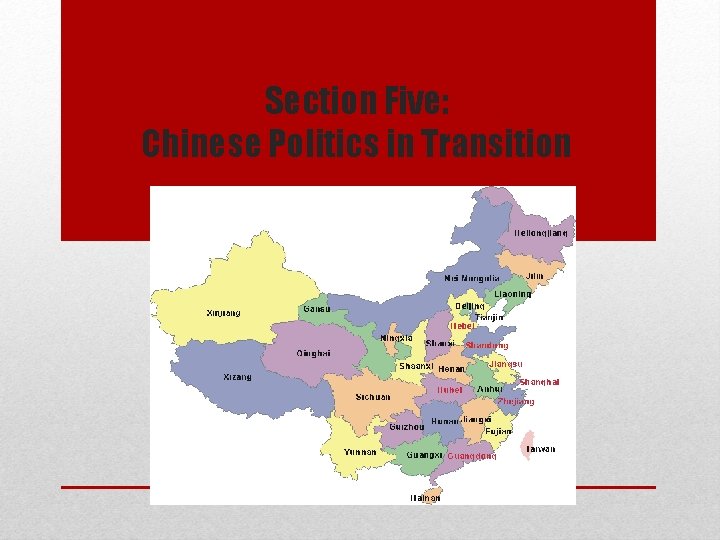
Section Five: Chinese Politics in Transition
The Policy-making Process • Mao was in command of policy making • Cultural Revolution – policy outcomes result of factional and ideological struggles with political elite • Since Deng – centered on reconciling centralized political authority with marketization and privatization of the economy • Today fragmented authoritarianism but still ultimately under CCP control • CCP influences policy also by cadre list or nomenklautra system • Guanxi can help cut red tape and increase efficiency or bolser organizaitonal rigidity and feed corruption • Tensions within the systm evidenced in fang-shou
Divergent Landscape • China a lot more modern and urban in recent years but still largely rural country with most people in countryside • Huaxi, Jiangsu Province: richest region, looks like US suburb • Nanliang, Shaanzi Province: third-world, per capita income less than $75 a year • Beihe, Shandong Province: a typcial Chinese village
Democracy and Human Rights • Some democratic reforms can be seen • Some input from National People’s Congress is allowed by Politburo • More emphasis is placed on laws and legal procedures • Village elections are semi-competitive, with choices of candidates and some freedom from party’s control • Politburo did have bad image from Tiananmen Crisis when they sent PLA in to shut down the protests • Since then have been under pressure from international human rights organizations • 2010 Nobel Peace Prize for Liu Xiaobo became huge controverty
Rule of Law • Based on belief that rulers should not have absolute power over subjects and actions should be constrained by same • • • principles as ordinary citizens Early communist saw law was as bourgeoisie suppress proletariat Since 1978 legal codes revived due to economic growth Criminal law developed as new opportunities for bribery, theft, etc. created 1982 Constitution commits party to the authority of law Number of executions in China has fallen from 12, 000 in 2002 to 3, 000 in 2012
Civil Rights and Liberties • Few signs of changing the government’s basic political policies • Status of rights widely debated Population Policy • Mao in 1974 said population policies were imperialist tools – at his death in 1976 China had about 850 million people with birth rate of 25 • See population growth was consuming increase in GDP so introduced 2 child policy • Deng Xiaoping then began 1 child policy with incentives and penalties • 1984 policy relaxed in rural areas but reinstated in 2002 • 1986 birthrate fell to 18 – has seen rise in female infanticide • China’s population is dramatically aging – some easing of couples who are only children
Economic Management, Social Tension, and Political Legitimacy • 1949 to 1978 followed command economy based on democratic centralism – Mao called it iron-rice bowl • When failed Deng began series of economic reforms to make up a socialist market economy • Agriculture – organized into collective farms then Great Leap Forward were merged into communes • Household Responsibility System – dismantled communes and put families in charge • 1980 s created category of private business in National People’s Congress • Private business has grown more dynamically than state owned ones • TVEs helped slow migration of peasants to the countryside
Economic Management - Continued • Economic problems due to reforms • Unemployment and inequality • Inefficiency of the state sector • Pollution • Product safety • CCP betting solid economy will literally buy it legitimacy • Failure to keep inequality under control could lead to social instability • Public health is horrible, AIDS is growing, graying population, lacks any kind of pension or social security
Foreign Policy and International Trade • Continue to threaten to invade Taiwan • With trade has integrated into world community • Under Mao – foreign policy based on giving support to 3 rd world movements, late 1950 s broke away from USSR • US/China relations warmed with Nixon visiting China 1972, today US imports more from China than it exports, internet hacking an issue • China opened after death of Mao Special Economic Zones foreign investors • Since 1978 China’s trade and industry expanded – has become member of WTO, has “most favored nation status” with USA
Hong Kong and Taiwan • Hong Kong • Operates since 1997 as “one country, two systems” agreement • Is subject to Chinese rule but enjoys “high degree of autonomy” • Maintains capitalist system, legal system, ways of life, same civil liberties as under British rule • Taiwan • Destination of Chiang Kai-shek • Claims to be Republic of China • Its autonomy protected by the USA and until 1970 s seen as sole legitimate representative of China • 1971 lost membership in UN and seat on Security Council to China • China wants Taiwan back • 2008 restored three links: transportation, communication, commerce • 2013 China offered 31 measures to better integrate Taiwan economically