Chapter 9 Natural Convection Yoav Peles Department of


- Slides: 56
Chapter 9: Natural Convection Yoav Peles Department of Mechanical, Aerospace and Nuclear Engineering Rensselaer Polytechnic Institute Copyright © The Mc. Graw-Hill Companies, Inc. Permission required for reproduction or display.
Objectives When you finish studying this chapter, you should be able to: • Understand the physical mechanism of natural convection, • Derive the governing equations of natural convection, and obtain the dimensionless Grashof number by nondimensionalizing them, • Evaluate the Nusselt number for natural convection associated with vertical, horizontal, and inclined plates as well as cylinders and spheres, • Examine natural convection from finned surfaces, and determine the optimum fin spacing, • Analyze natural convection inside enclosures such as double-pane windows, and • Consider combined natural and forced convection, and assess the relative importance of each mode.
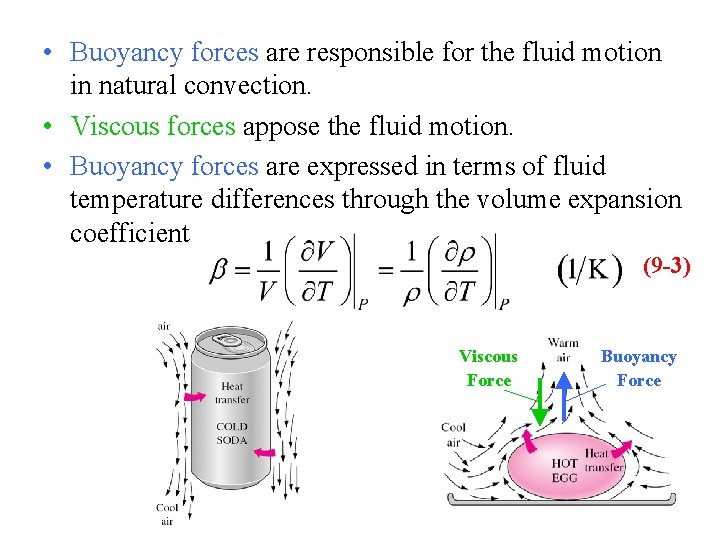
• Buoyancy forces are responsible for the fluid motion in natural convection. • Viscous forces appose the fluid motion. • Buoyancy forces are expressed in terms of fluid temperature differences through the volume expansion coefficient (9 -3) Viscous Force Buoyancy Force
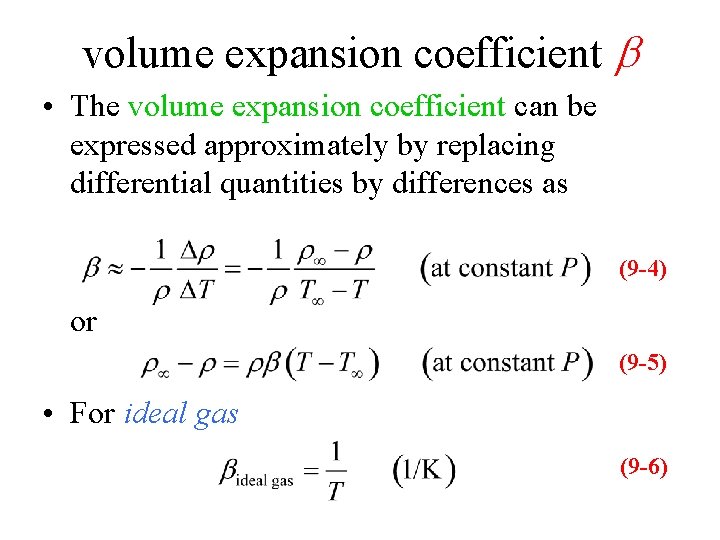
volume expansion coefficient b • The volume expansion coefficient can be expressed approximately by replacing differential quantities by differences as (9 -4) or (9 -5) • For ideal gas (9 -6)
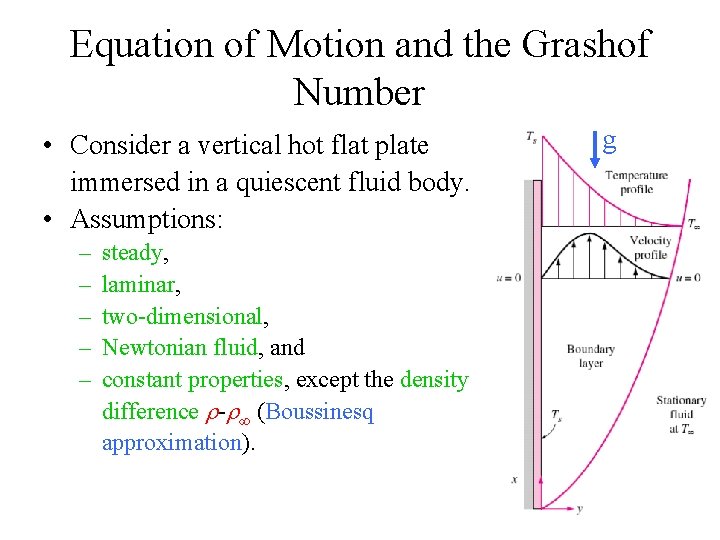
Equation of Motion and the Grashof Number • Consider a vertical hot flat plate immersed in a quiescent fluid body. • Assumptions: – – – steady, laminar, two-dimensional, Newtonian fluid, and constant properties, except the density difference r-r∞ (Boussinesq approximation). g
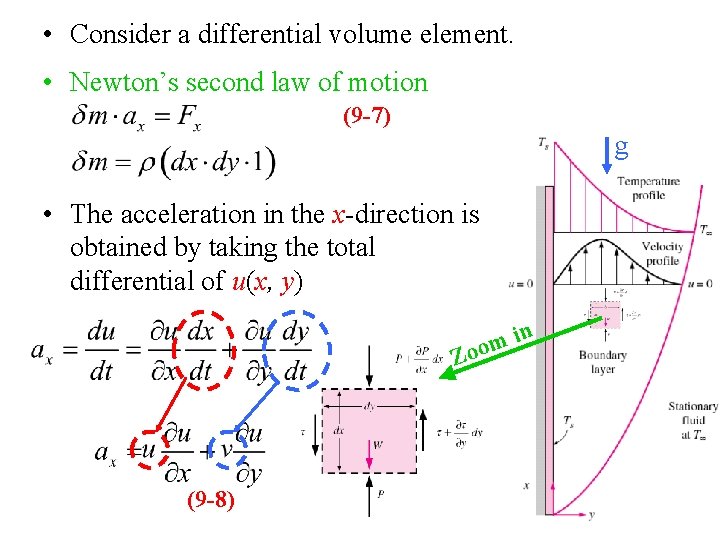
• Consider a differential volume element. • Newton’s second law of motion (9 -7) g • The acceleration in the x-direction is obtained by taking the total differential of u(x, y) in m Zoo (9 -8)
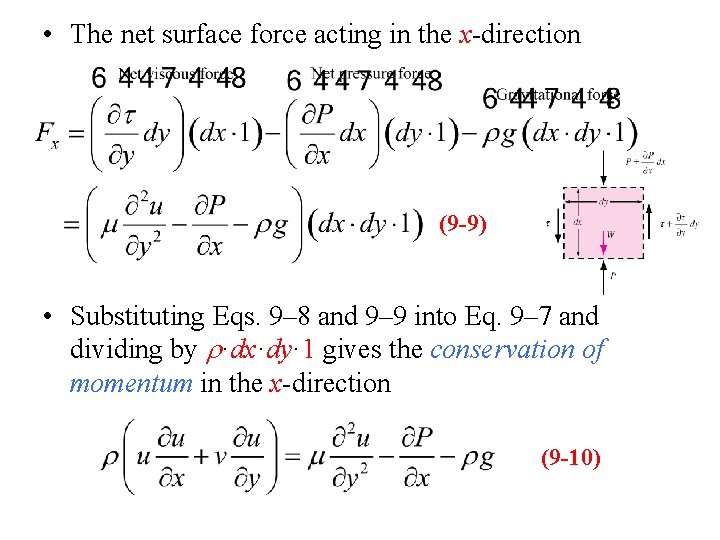
• The net surface force acting in the x-direction (9 -9) • Substituting Eqs. 9– 8 and 9– 9 into Eq. 9– 7 and dividing by r·dx·dy· 1 gives the conservation of momentum in the x-direction (9 -10)
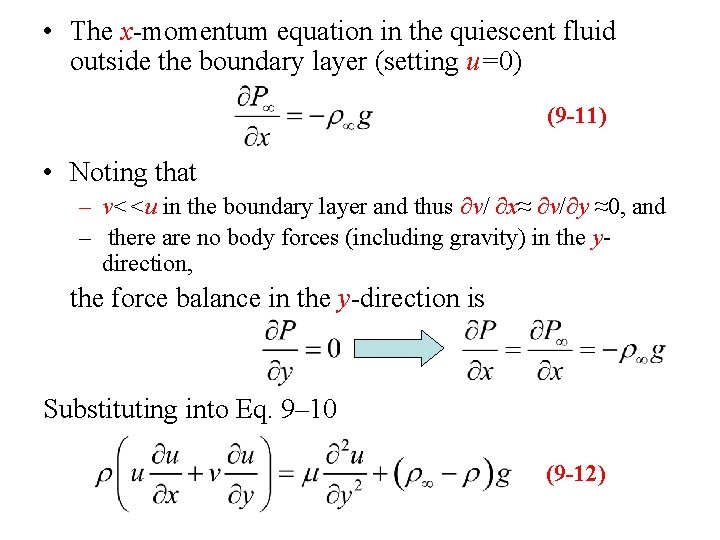
• The x-momentum equation in the quiescent fluid outside the boundary layer (setting u=0) (9 -11) • Noting that – v<<u in the boundary layer and thus ∂v/ ∂x≈ ∂v/∂y ≈0, and – there are no body forces (including gravity) in the ydirection, the force balance in the y-direction is Substituting into Eq. 9– 10 (9 -12)
• Substituting Eq. 9 -5 it into Eq. 9 -12 and dividing both sides by r gives (9 -13) • The momentum equation involves the temperature, and thus the momentum and energy equations must be solved simultaneously. • The set of three partial differential equations (the continuity, momentum, and the energy equations) that govern natural convection flow over vertical isothermal plates can be reduced to a set of two ordinary nonlinear differential equations by the introduction of a similarity variable.
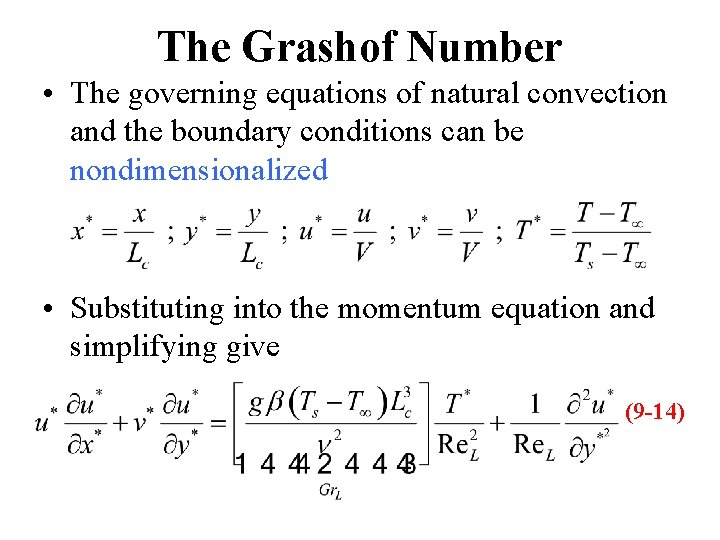
The Grashof Number • The governing equations of natural convection and the boundary conditions can be nondimensionalized • Substituting into the momentum equation and simplifying give (9 -14)
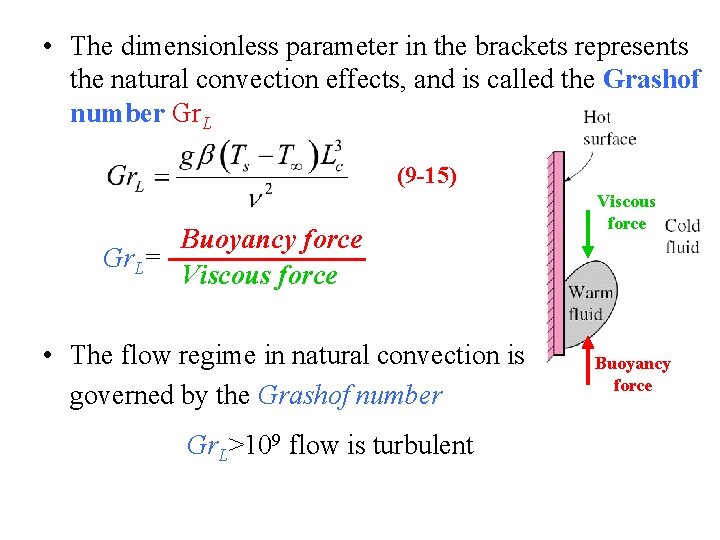
• The dimensionless parameter in the brackets represents the natural convection effects, and is called the Grashof number Gr. L (9 -15) Buoyancy force Gr. L= Viscous force • The flow regime in natural convection is governed by the Grashof number Gr. L>109 flow is turbulent Viscous force Buoyancy force
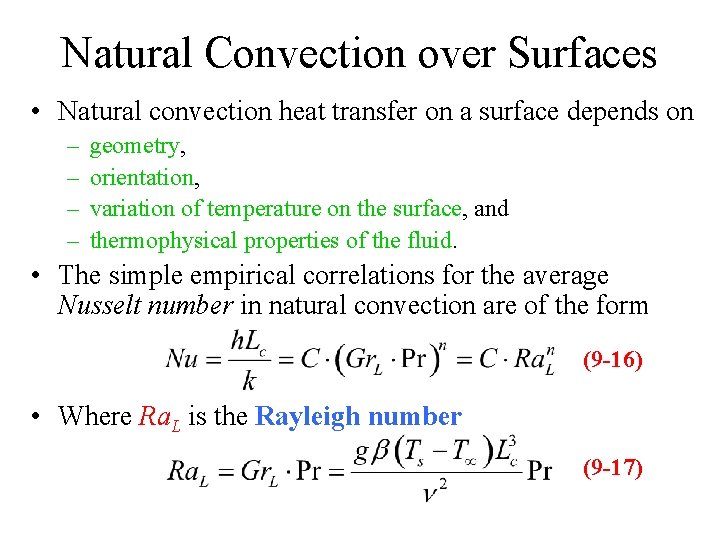
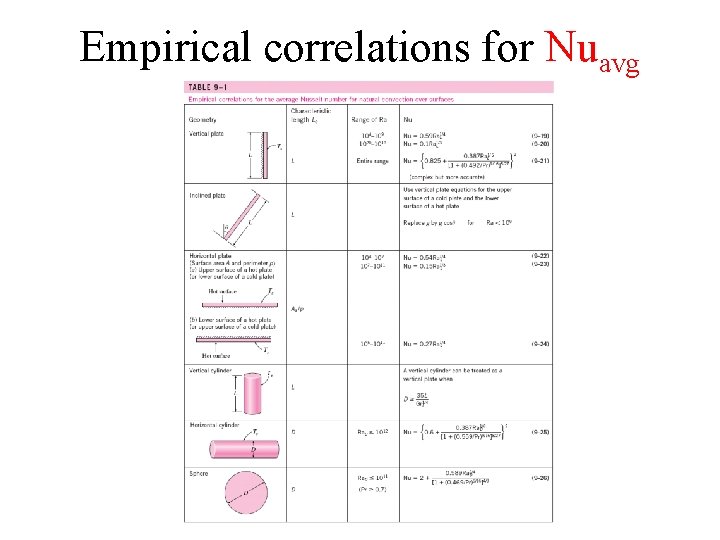
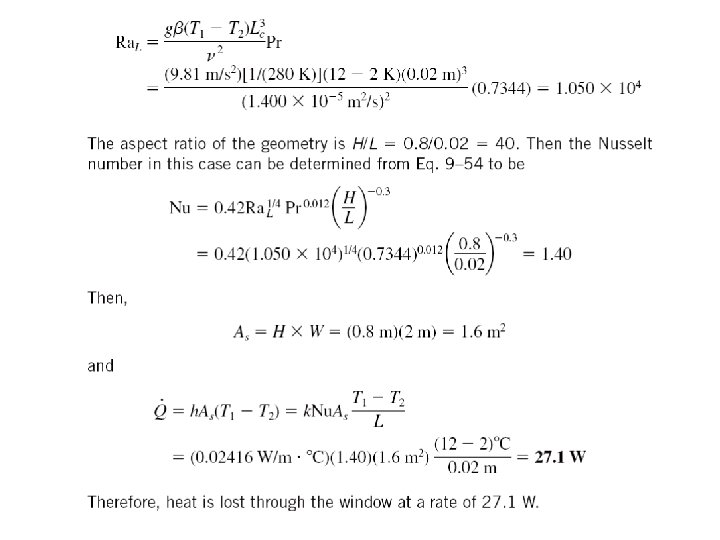
Natural Convection over Surfaces • Natural convection heat transfer on a surface depends on – – geometry, orientation, variation of temperature on the surface, and thermophysical properties of the fluid. • The simple empirical correlations for the average Nusselt number in natural convection are of the form (9 -16) • Where Ra. L is the Rayleigh number (9 -17)
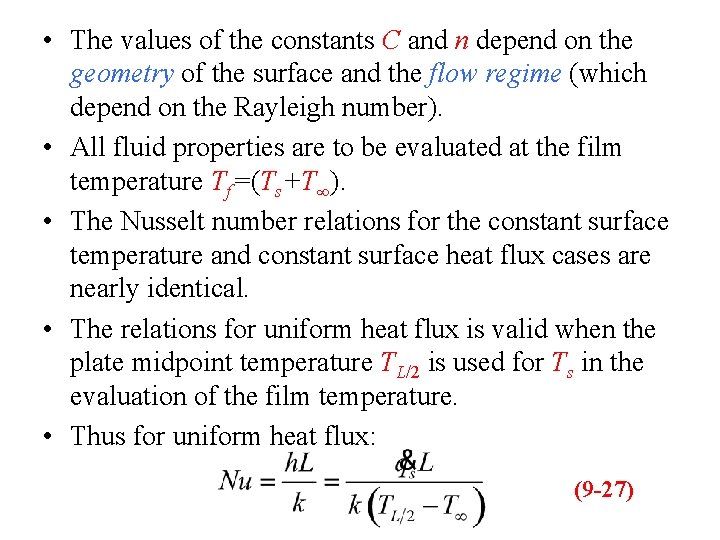
• The values of the constants C and n depend on the geometry of the surface and the flow regime (which depend on the Rayleigh number). • All fluid properties are to be evaluated at the film temperature Tf=(Ts+T∞). • The Nusselt number relations for the constant surface temperature and constant surface heat flux cases are nearly identical. • The relations for uniform heat flux is valid when the plate midpoint temperature TL/2 is used for Ts in the evaluation of the film temperature. • Thus for uniform heat flux: (9 -27)
Empirical correlations for Nuavg
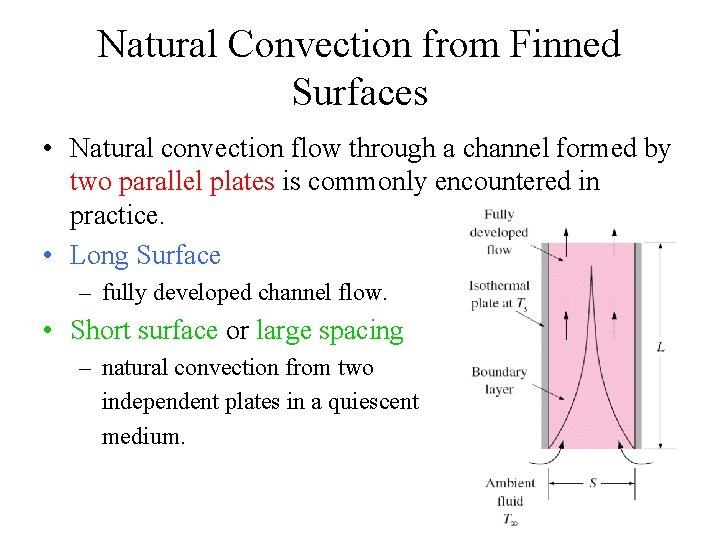
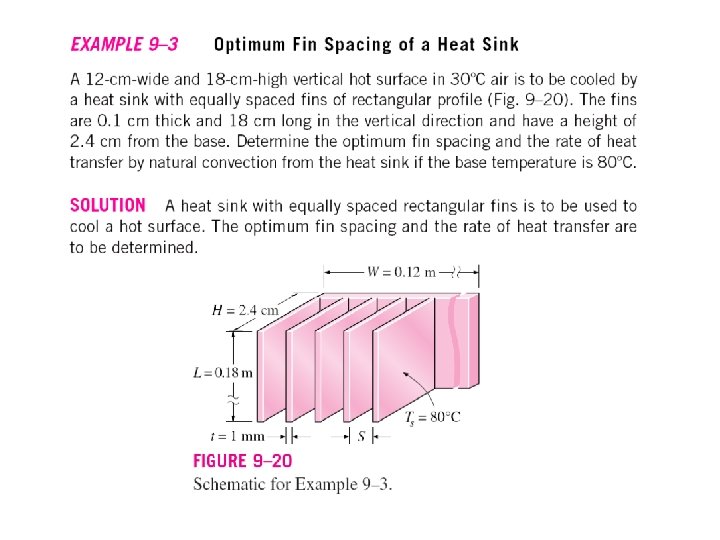
Natural Convection from Finned Surfaces • Natural convection flow through a channel formed by two parallel plates is commonly encountered in practice. • Long Surface – fully developed channel flow. • Short surface or large spacing – natural convection from two independent plates in a quiescent medium.
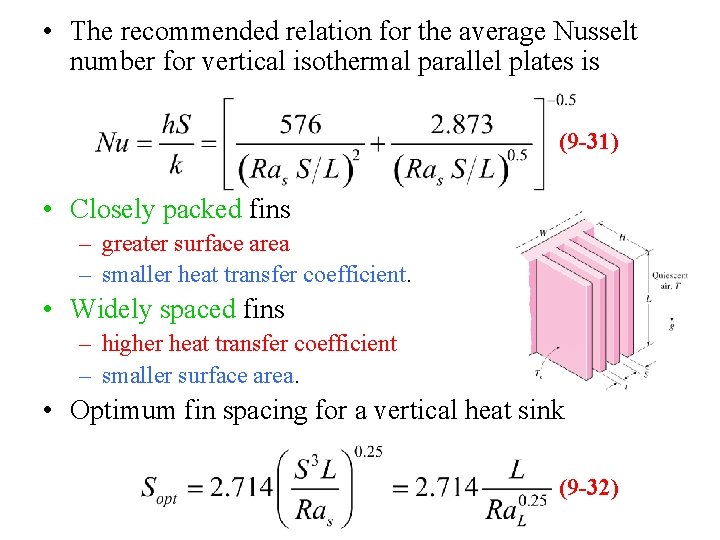
• The recommended relation for the average Nusselt number for vertical isothermal parallel plates is (9 -31) • Closely packed fins – greater surface area – smaller heat transfer coefficient. • Widely spaced fins – higher heat transfer coefficient – smaller surface area. • Optimum fin spacing for a vertical heat sink (9 -32)
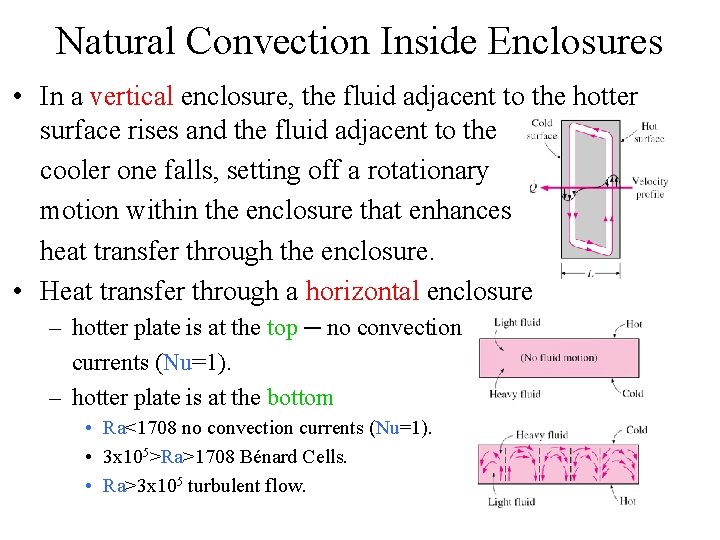
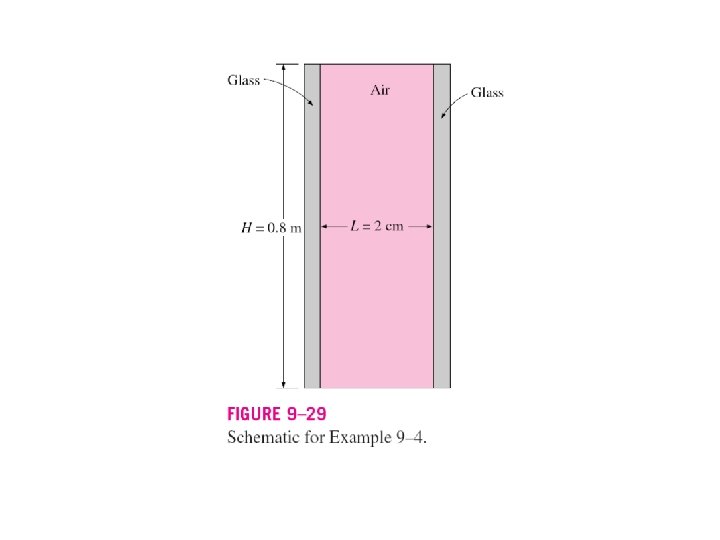
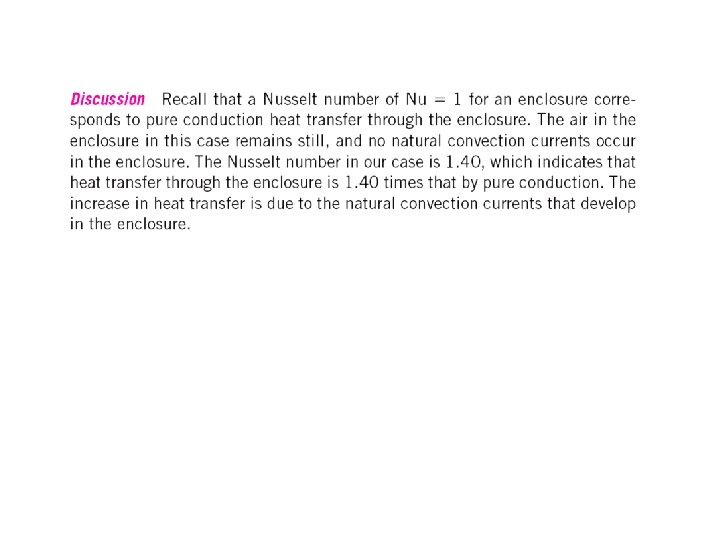
Natural Convection Inside Enclosures • In a vertical enclosure, the fluid adjacent to the hotter surface rises and the fluid adjacent to the cooler one falls, setting off a rotationary motion within the enclosure that enhances heat transfer through the enclosure. • Heat transfer through a horizontal enclosure – hotter plate is at the top ─ no convection currents (Nu=1). – hotter plate is at the bottom • Ra<1708 no convection currents (Nu=1). • 3 x 10⁵>Ra>1708 Bénard Cells. • Ra>3 x 10⁵ turbulent flow.
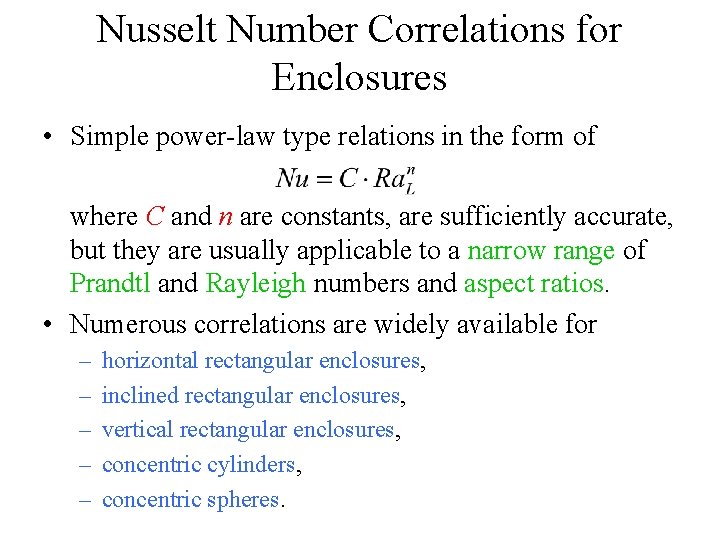
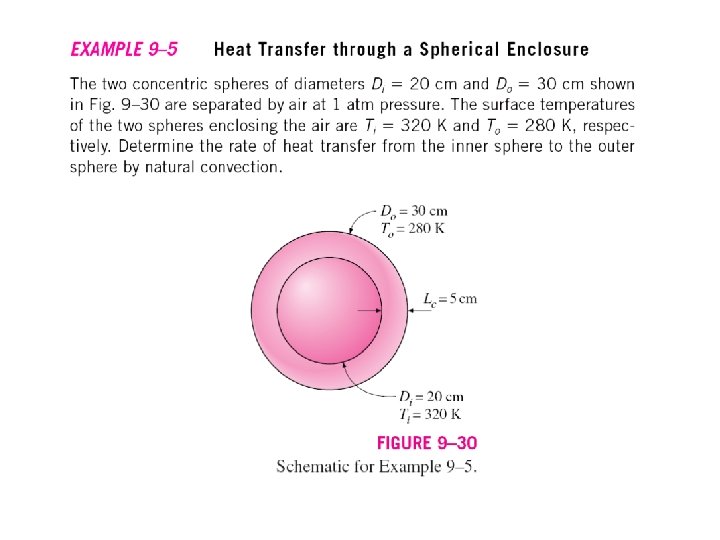
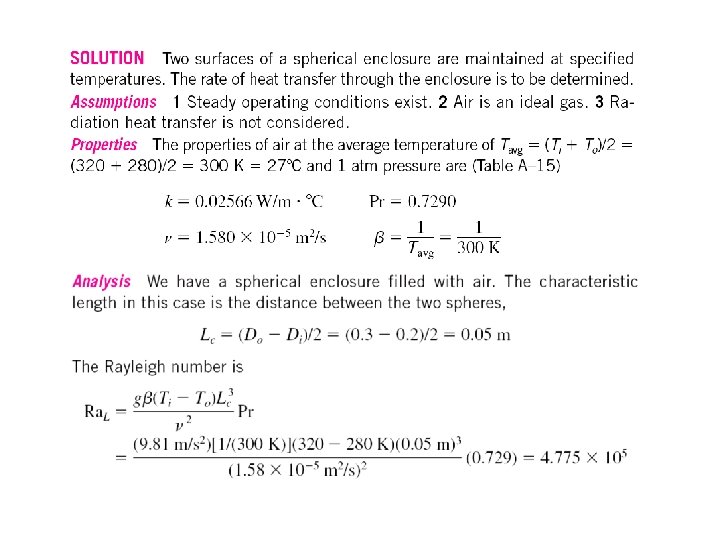
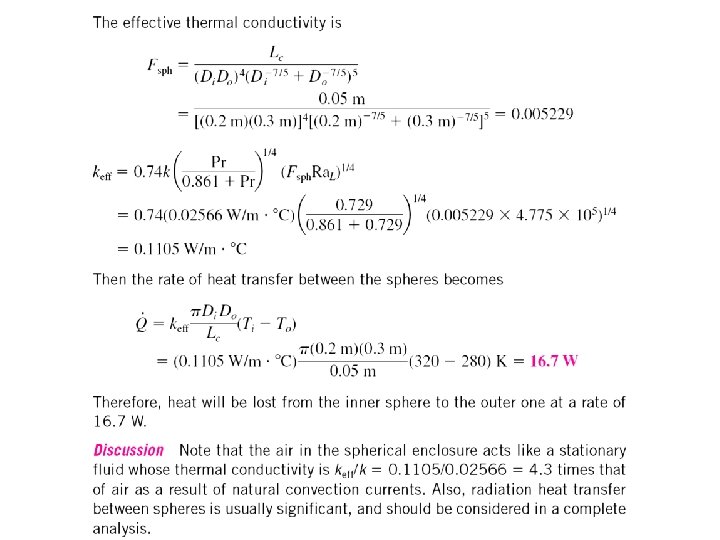
Nusselt Number Correlations for Enclosures • Simple power-law type relations in the form of where C and n are constants, are sufficiently accurate, but they are usually applicable to a narrow range of Prandtl and Rayleigh numbers and aspect ratios. • Numerous correlations are widely available for – – – horizontal rectangular enclosures, inclined rectangular enclosures, vertical rectangular enclosures, concentric cylinders, concentric spheres.
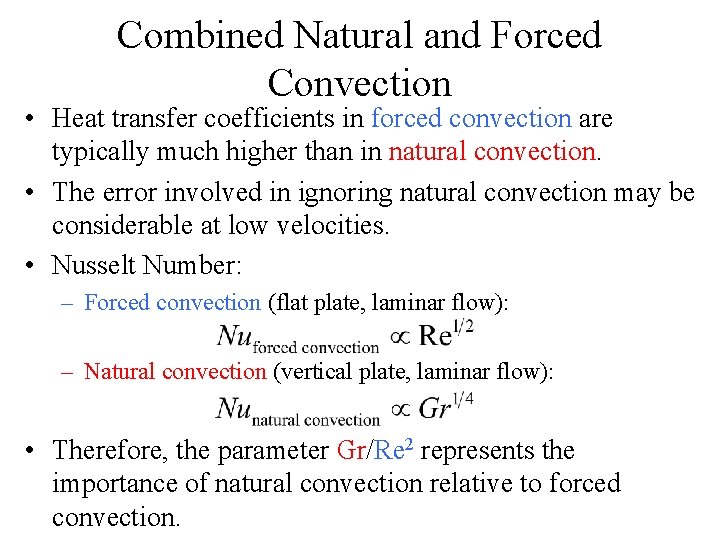
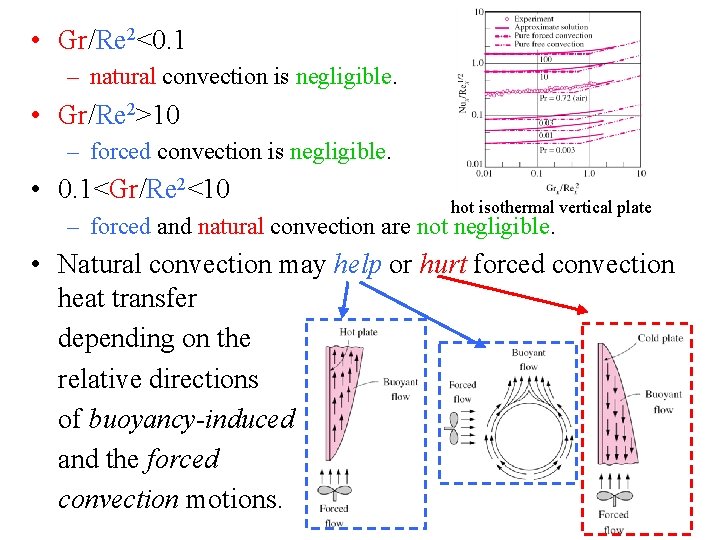
Combined Natural and Forced Convection • Heat transfer coefficients in forced convection are typically much higher than in natural convection. • The error involved in ignoring natural convection may be considerable at low velocities. • Nusselt Number: – Forced convection (flat plate, laminar flow): – Natural convection (vertical plate, laminar flow): • Therefore, the parameter Gr/Re 2 represents the importance of natural convection relative to forced convection.
• Gr/Re 2<0. 1 – natural convection is negligible. • Gr/Re 2>10 – forced convection is negligible. • 0. 1<Gr/Re 2<10 hot isothermal vertical plate – forced and natural convection are not negligible. • Natural convection may help or hurt forced convection heat transfer depending on the relative directions of buoyancy-induced and the forced convection motions.
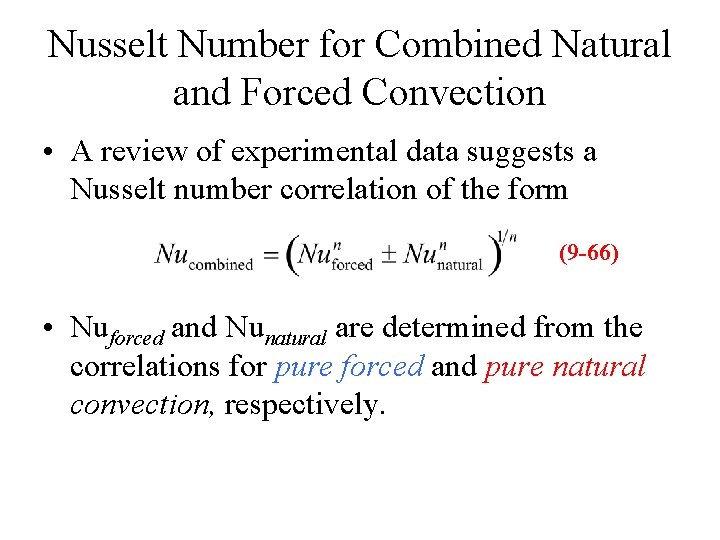
Nusselt Number for Combined Natural and Forced Convection • A review of experimental data suggests a Nusselt number correlation of the form (9 -66) • Nuforced and Nunatural are determined from the correlations for pure forced and pure natural convection, respectively.