Chapter 5 Nutrition Guidelines Learning Outcomes After studying



- Slides: 37
Chapter 5 Nutrition Guidelines
Learning Outcomes After studying this chapter, you will be able to • differentiate among the six types of Dietary Reference Intakes (DRIs); • summarize the eating pattern advice offered in the Dietary Guidelines for Americans 2015– 2020; • apply the My. Plate food guidance system to make healthy eating choices; (continued) Copyright Goodheart-Willcox Co. , Inc. May not be posted to a publicly accessible website.
Learning Outcomes • identify the equivalent amounts commonly used to estimate portion size in each of the five food groups; • use information on food labels to make healthful food choices; and • identify how to analyze and improve your eating patterns by using a variety of dietary planning tools. Copyright Goodheart-Willcox Co. , Inc. May not be posted to a publicly accessible website.
Chapter Warm-Up • List five foods that you eat most often for meals or snacks. • Would you describe your eating pattern as healthy? Copyright Goodheart-Willcox Co. , Inc. May not be posted to a publicly accessible website.
Dietary Reference Intakes • The six Dietary Reference Intakes (DRI) are nutrient reference values – intended for use by health professionals, policy makers, and scientists – used for planning and evaluating diets of groups of people – used by nutritionists to develop menus that meet nutritional requirements for specific groups (continued) Copyright Goodheart-Willcox Co. , Inc. May not be posted to a publicly accessible website.
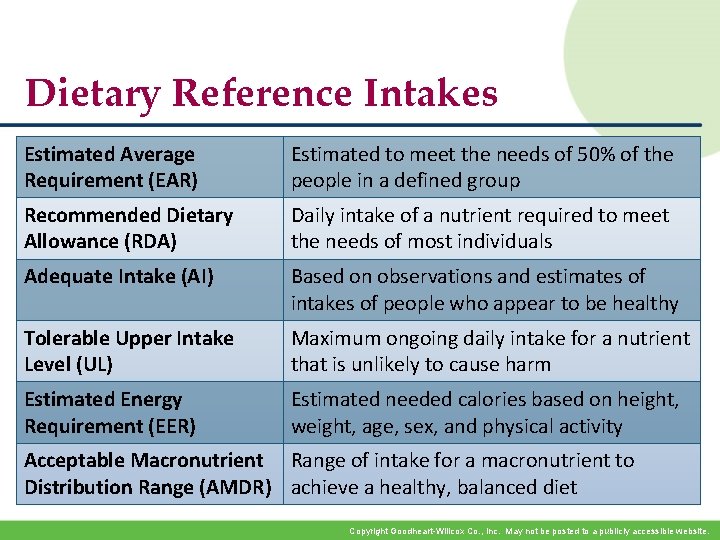
Dietary Reference Intakes Estimated Average Requirement (EAR) Estimated to meet the needs of 50% of the people in a defined group Recommended Dietary Allowance (RDA) Daily intake of a nutrient required to meet the needs of most individuals Adequate Intake (AI) Based on observations and estimates of intakes of people who appear to be healthy Tolerable Upper Intake Level (UL) Maximum ongoing daily intake for a nutrient that is unlikely to cause harm Estimated Energy Requirement (EER) Estimated needed calories based on height, weight, age, sex, and physical activity Acceptable Macronutrient Range of intake for a macronutrient to Distribution Range (AMDR) achieve a healthy, balanced diet Copyright Goodheart-Willcox Co. , Inc. May not be posted to a publicly accessible website.
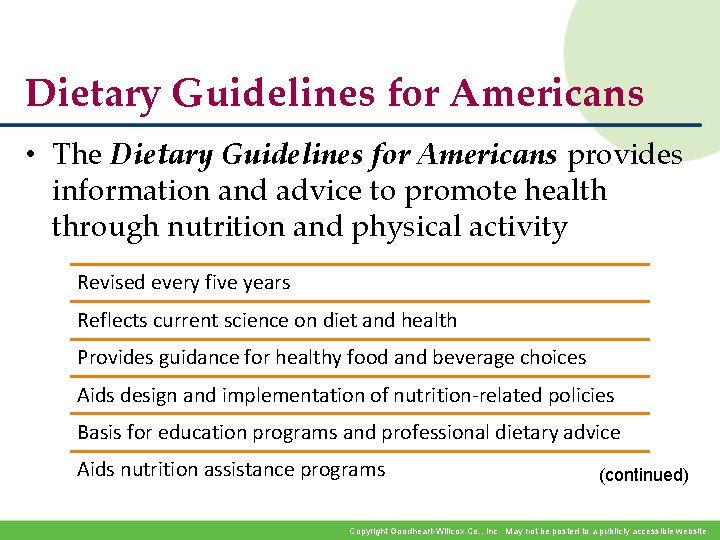
Dietary Guidelines for Americans • The Dietary Guidelines for Americans provides information and advice to promote health through nutrition and physical activity Revised every five years Reflects current science on diet and health Provides guidance for healthy food and beverage choices Aids design and implementation of nutrition-related policies Basis for education programs and professional dietary advice Aids nutrition assistance programs (continued) Copyright Goodheart-Willcox Co. , Inc. May not be posted to a publicly accessible website.
Dietary Guidelines for Americans • The 2015– 2020 Dietary Guidelines focuses on overall eating and physical activity patterns and their relationship to health and risk of disease – The goal is for Americans to meet the nutrient levels established in the DRIs by consuming a variety of foods – The guidelines follow five basic themes (continued) Copyright Goodheart-Willcox Co. , Inc. May not be posted to a publicly accessible website.
Dietary Guidelines for Americans 1. Follow a healthy eating pattern throughout life – Balance the amount and types of foods you eat with physical activity 2. Focus on variety, nutrient density, and amount – Recommended amounts from each food group – Nutrient-dense foods provide vitamins, minerals, and other substances that contribute to adequate nutrition and contain little or no solid fats, added sugars, refined starches, and sodium (continued) Copyright Goodheart-Willcox Co. , Inc. May not be posted to a publicly accessible website.
The Nutrition & Wellness Conversation • What foods have a high amount of sodium, solid fat, refined starch, or added sugar? • What are some examples of nutrient-dense foods? Copyright Goodheart-Willcox Co. , Inc. May not be posted to a publicly accessible website.
Dietary Guidelines for Americans 3. Limit sodium, added sugars, and saturated fats – May cause calorie imbalance or weight gain 4. Shift to healthier food and beverage choices – Make small changes over time 5. Support healthy eating patterns for all – Home, school, work, communities, and healthcare providers can encourage healthy eating behaviors (continued) Copyright Goodheart-Willcox Co. , Inc. May not be posted to a publicly accessible website.
Dietary Guidelines for Americans • The Dietary Guidelines addresses the importance of physical activity for calorie balance and reduction of risk for chronic disease – Encourages Americans to meet the Physical Activity Guidelines for Americans Copyright Goodheart-Willcox Co. , Inc. May not be posted to a publicly accessible website.
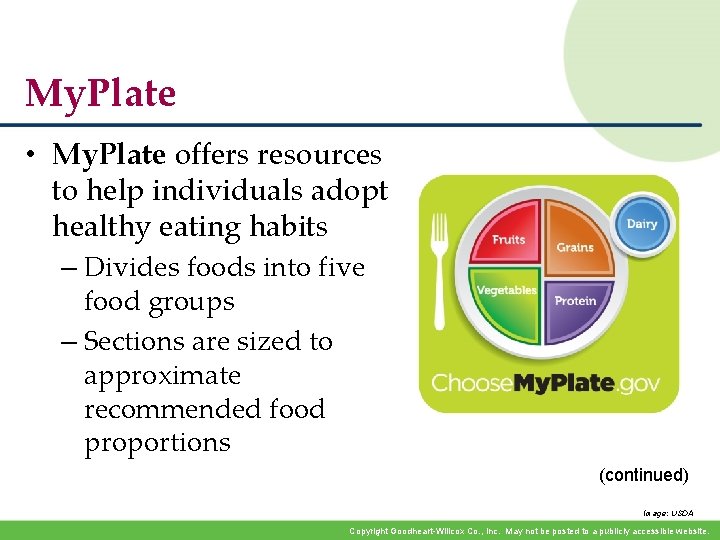
My. Plate • My. Plate offers resources to help individuals adopt healthy eating habits – Divides foods into five food groups – Sections are sized to approximate recommended food proportions (continued) Image: USDA Copyright Goodheart-Willcox Co. , Inc. May not be posted to a publicly accessible website.
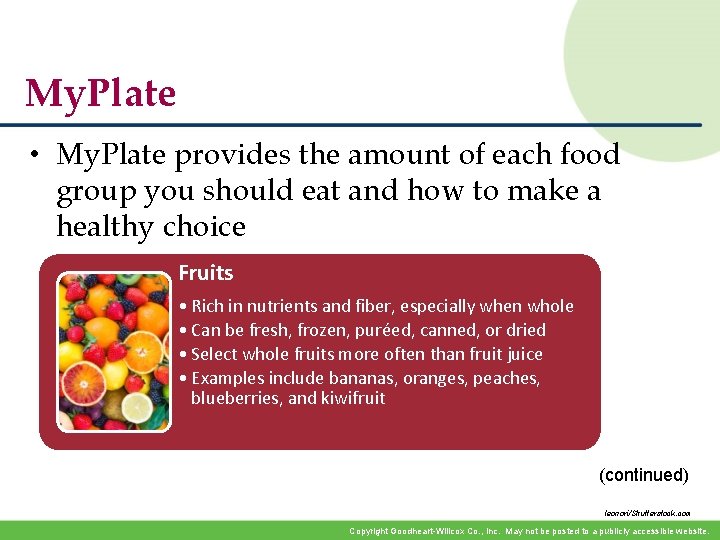
My. Plate • My. Plate provides the amount of each food group you should eat and how to make a healthy choice Fruits • Rich in nutrients and fiber, especially when whole • Can be fresh, frozen, puréed, canned, or dried • Select whole fruits more often than fruit juice • Examples include bananas, oranges, peaches, blueberries, and kiwifruit (continued) leonori/Shutterstock. com Copyright Goodheart-Willcox Co. , Inc. May not be posted to a publicly accessible website.
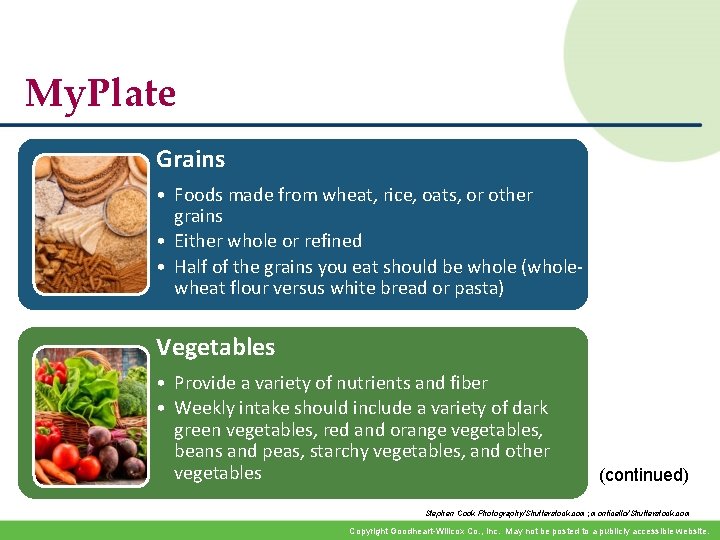
My. Plate Grains • Foods made from wheat, rice, oats, or other grains • Either whole or refined • Half of the grains you eat should be whole (wholewheat flour versus white bread or pasta) Vegetables • Provide a variety of nutrients and fiber • Weekly intake should include a variety of dark green vegetables, red and orange vegetables, beans and peas, starchy vegetables, and other vegetables (continued) Stephen Cook Photography/Shutterstock. com; monticello/Shutterstock. com Copyright Goodheart-Willcox Co. , Inc. May not be posted to a publicly accessible website.
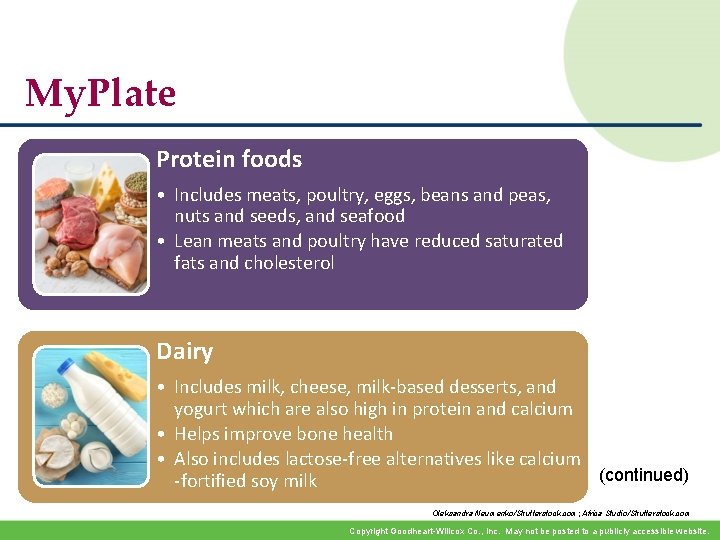
My. Plate Protein foods • Includes meats, poultry, eggs, beans and peas, nuts and seeds, and seafood • Lean meats and poultry have reduced saturated fats and cholesterol Dairy • Includes milk, cheese, milk-based desserts, and yogurt which are also high in protein and calcium • Helps improve bone health • Also includes lactose-free alternatives like calcium (continued) -fortified soy milk Oleksandra Neumenko/Shutterstock. com; Africa Studio/Shutterstock. com Copyright Goodheart-Willcox Co. , Inc. May not be posted to a publicly accessible website.
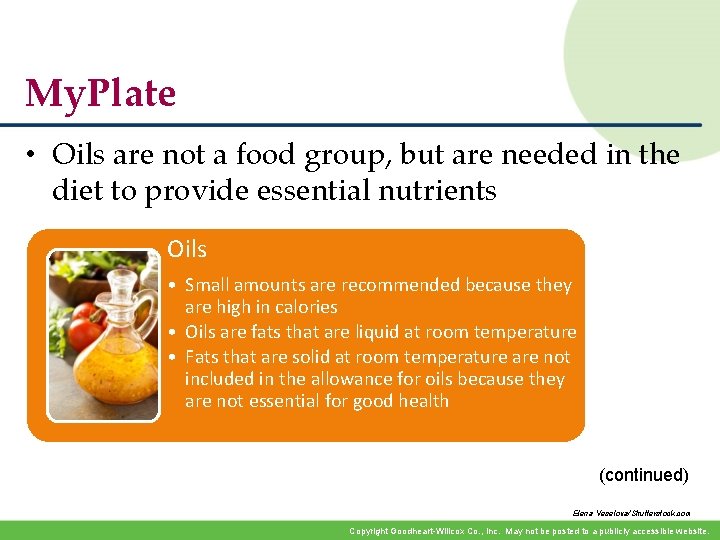
My. Plate • Oils are not a food group, but are needed in the diet to provide essential nutrients Oils • Small amounts are recommended because they are high in calories • Oils are fats that are liquid at room temperature • Fats that are solid at room temperature are not included in the allowance for oils because they are not essential for good health (continued) Elena Veselova/Shutterstock. com Copyright Goodheart-Willcox Co. , Inc. May not be posted to a publicly accessible website.
My. Plate • The My. Plate Daily Checklist tool helps individuals create a personalized food plan – Based on age, sex, height, weight, and activity level – Shows how much you should eat from each food group to stay within your calorie allowance – Provides recommendations for physical activity (continued) Copyright Goodheart-Willcox Co. , Inc. May not be posted to a publicly accessible website.
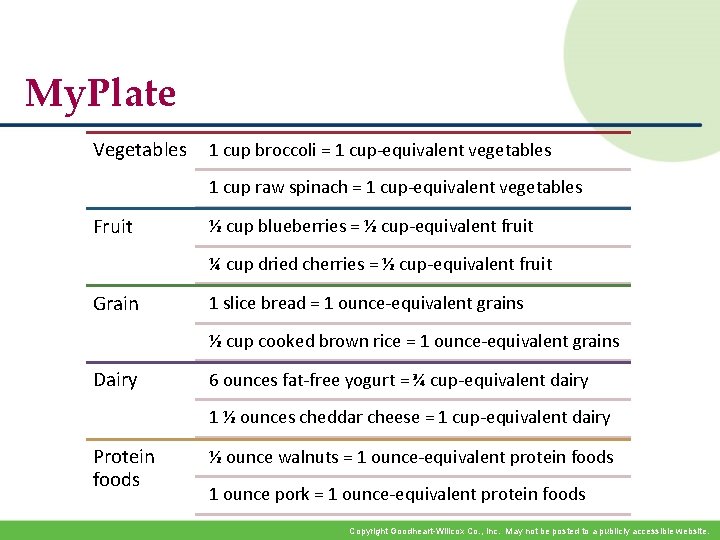
My. Plate • My. Plate uses volume and weight measures to describe the amounts of food people should eat – Restaurants often serve larger portions than those recommended on your My. Plate Daily Checklist – Serving sizes on food labels are the amounts that people typically consume, not recommended amounts (continued) Copyright Goodheart-Willcox Co. , Inc. May not be posted to a publicly accessible website.
My. Plate Vegetables 1 cup broccoli = 1 cup-equivalent vegetables 1 cup raw spinach = 1 cup-equivalent vegetables Fruit ½ cup blueberries = ½ cup-equivalent fruit ¼ cup dried cherries = ½ cup-equivalent fruit Grain 1 slice bread = 1 ounce-equivalent grains ½ cup cooked brown rice = 1 ounce-equivalent grains Dairy 6 ounces fat-free yogurt = ¾ cup-equivalent dairy 1 ½ ounces cheddar cheese = 1 cup-equivalent dairy Protein foods ½ ounce walnuts = 1 ounce-equivalent protein foods 1 ounce pork = 1 ounce-equivalent protein foods Copyright Goodheart-Willcox Co. , Inc. May not be posted to a publicly accessible website.
DASH Diet • The DASH (Dietary Approaches to Stop Hypertension) diet is a healthy eating plan for people at any age – Reduces risk for high blood pressure, obesity, certain cancers, heart disease, and diabetes – Rich in fruits, vegetables, and whole grains – Encourages low-fat or nonfat dairy – Limits refined grains, sugars, and saturated fats Copyright Goodheart-Willcox Co. , Inc. May not be posted to a publicly accessible website.
Food Lists • The Choose Your Foods: Food Lists system groups foods of similar nutrient and caloric content Developed by the Academy of Nutrition and Dietetics and the American Diabetes Association Can be used to balance protein, carbohydrates, fat, and calories eaten each day for weight management First requires knowledge of your particular dietary requirements and your daily calorie needs Copyright Goodheart-Willcox Co. , Inc. May not be posted to a publicly accessible website.
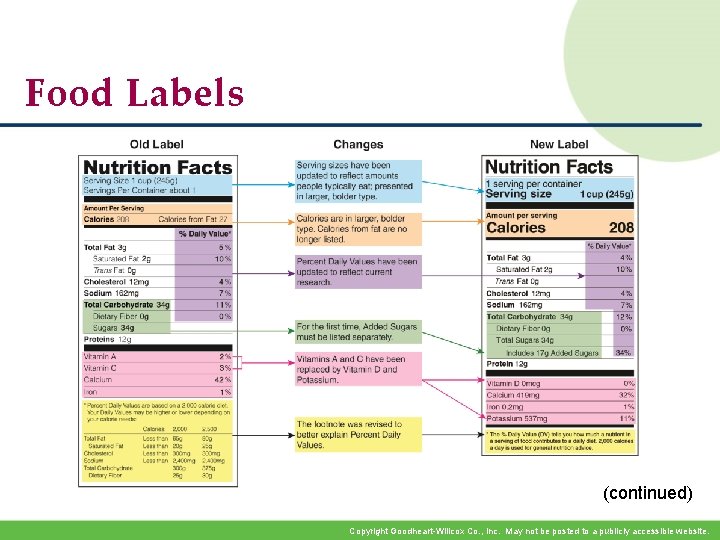
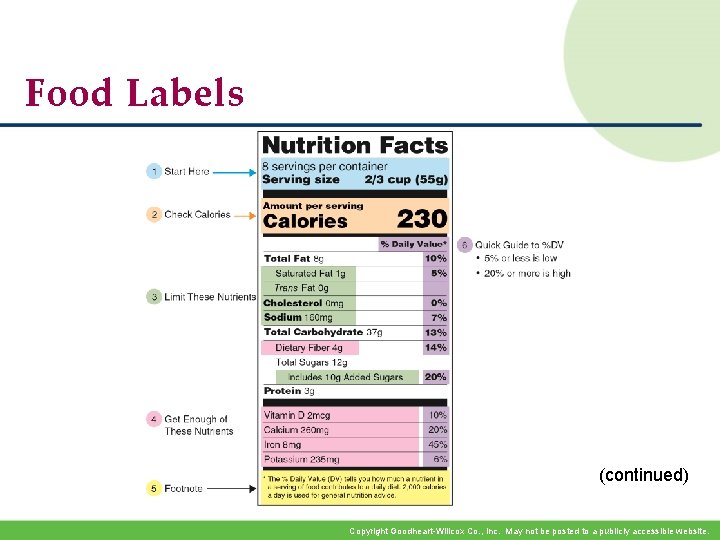
Food Labels • Most foods require nutrition labeling – Serving size and calories are important to know when making healthy food choices – Nutrition Facts labels can be used to compare two similar products or to select foods for a particular diet, such as low-sodium or high-fiber – Lists nutrients that should be limited and others that are necessary in sufficient quantities (continued) Copyright Goodheart-Willcox Co. , Inc. May not be posted to a publicly accessible website.
Food Labels • The Percent Daily Values (%DV) are recommended nutrient intakes developed to represent the needs of a typical individual – Based on a 2, 000 calorie per day diet – Help people understand how a food serving fits into their daily nutrient needs (continued) Copyright Goodheart-Willcox Co. , Inc. May not be posted to a publicly accessible website.
Food Labels • In 2016, the Nutrition Labeling and Education Act was amended and the Nutrition Facts label was updated – Revised to reflect new scientific information on nutrient needs – Changes make the label easier for consumers to read (continued) Copyright Goodheart-Willcox Co. , Inc. May not be posted to a publicly accessible website.
Food Labels (continued) Copyright Goodheart-Willcox Co. , Inc. May not be posted to a publicly accessible website.
Food Labels (continued) Copyright Goodheart-Willcox Co. , Inc. May not be posted to a publicly accessible website.
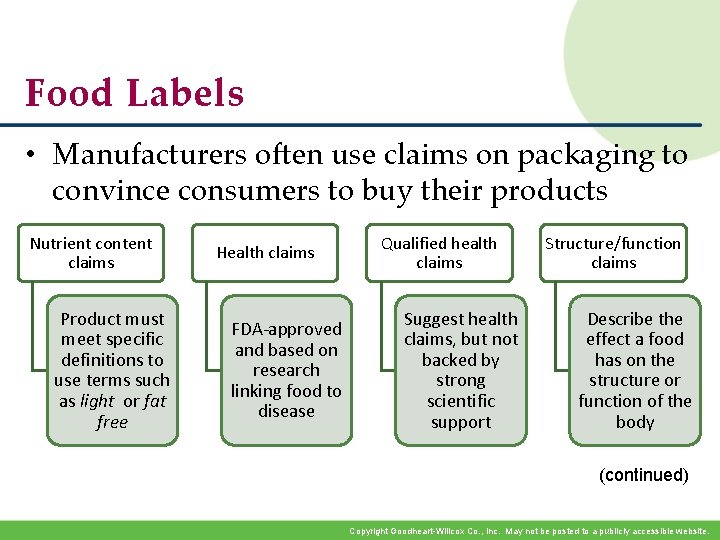
Food Labels • Manufacturers often use claims on packaging to convince consumers to buy their products Nutrient content claims Product must meet specific definitions to use terms such as light or fat free Health claims FDA-approved and based on research linking food to disease Qualified health claims Suggest health claims, but not backed by strong scientific support Structure/function claims Describe the effect a food has on the structure or function of the body (continued) Copyright Goodheart-Willcox Co. , Inc. May not be posted to a publicly accessible website.
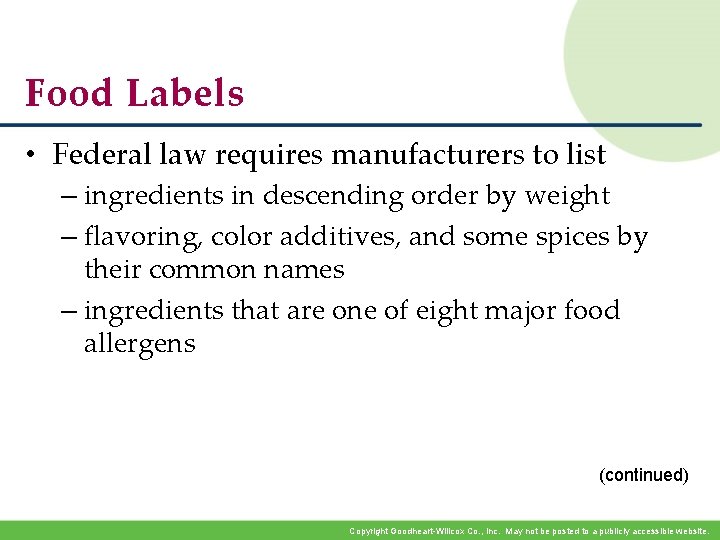
Food Labels • Federal law requires manufacturers to list – ingredients in descending order by weight – flavoring, color additives, and some spices by their common names – ingredients that are one of eight major food allergens (continued) Copyright Goodheart-Willcox Co. , Inc. May not be posted to a publicly accessible website.
Food Labels • USDA recommends manufacturers provide a “Best if Used By” date on foods – Indicates when the food product will be of best flavor and quality • Some foods include country-of-origin labeling (COOL) – Fresh and frozen fruits and vegetables – Peanuts, pecans, and macadamia nuts – Fish and shellfish, and certain meats Copyright Goodheart-Willcox Co. , Inc. May not be posted to a publicly accessible website.
The Nutrition & Wellness Conversation • Name an example of each of the following that you might see on food packaging: – Nutrient content claim – Health claim – Qualified health claim – Structure/function claim • Which of these is the most reliable? Copyright Goodheart-Willcox Co. , Inc. May not be posted to a publicly accessible website.
Using Food Recommendations and Guidelines • Keep a food journal of kinds and amounts of food and drink consumed over several days – Includes foods, beverages, snacks, and condiments eaten throughout the day – Use the information to determine whether you are meeting your daily nutrient needs (continued) Anem. Style/Shutterstock. com Copyright Goodheart-Willcox Co. , Inc. May not be posted to a publicly accessible website.
Using Food Recommendations and Guidelines • A number of software programs are available to help you analyze your diet – Enter your information into the USDA Food Composition Database to generate a detailed analysis of your diet • You can also calculate an analysis manually – Record the calories and major nutrients you consume and compare the total amounts to the respective RDAs and AIs (continued) Copyright Goodheart-Willcox Co. , Inc. May not be posted to a publicly accessible website.
Using Food Recommendations and Guidelines • Plan menus using the My. Plate Daily Checklist to ensure you are getting the right amounts from each food group – Guides you in selecting foods low in saturated fats, sodium, and added sugars, and high in fiber and other nutrients (continued) Copyright Goodheart-Willcox Co. , Inc. May not be posted to a publicly accessible website.
Using Food Recommendations and Guidelines • My. Plate Daily Checklist accommodates various lifestyles, cultural backgrounds, and religious beliefs Nejron Photo/Shutterstock. com Copyright Goodheart-Willcox Co. , Inc. May not be posted to a publicly accessible website.
Review • _____ is the Dietary Reference Intake based on estimates and observations. – Adequate Intake (AI) • How often is the Dietary Guidelines revised? – every five years • What are the five My. Plate food groups? – fruits, vegetables, grains, protein foods, dairy • Percent Daily Values are based on a person who requires _____ calories per day. – 2, 000 Copyright Goodheart-Willcox Co. , Inc. May not be posted to a publicly accessible website.