Chapter 5 Language and Communication 2017 Cengage Learning

- Slides: 37
Chapter 5 Language and Communication © 2017 Cengage Learning. All Rights Reserved.
In this chapter you will learn to: • Define language and distinguish between sign and symbol. • Specify the three branches of linguistic anthropology. • Observe cross-cultural differences in nonverbal means of communication. • Trace the emergence of language, speech, and writing. • Assess the close relationship between culture and language. • Discuss the significance of literacy and telecommunication in today’s world. © 2017 Cengage Learning. All Rights Reserved.
Language and Communication • Language is a system of communication using symbolic sounds, gestures, or marks that are put together according to certain rules, resulting in meanings that are intelligible to all who share that language. • A signal, unlike a culturally learned symbol, or meaningful sign, is an instinctive sound or gesture that has a natural or self-evident meaning. © 2017 Cengage Learning. All Rights Reserved.
Linguistic Research and the Nature of Language (1 of 2) • Any human language—Chinese, English, Swahili, or whatever—is a means of transmitting information and sharing with others both collective and individual experiences. • The vast array of languages in the world— some 6, 000 or so distinctive ones—may well astound us by their complexity and great differences, yet language experts have found that each is organized in similar ways. © 2017 Cengage Learning. All Rights Reserved.
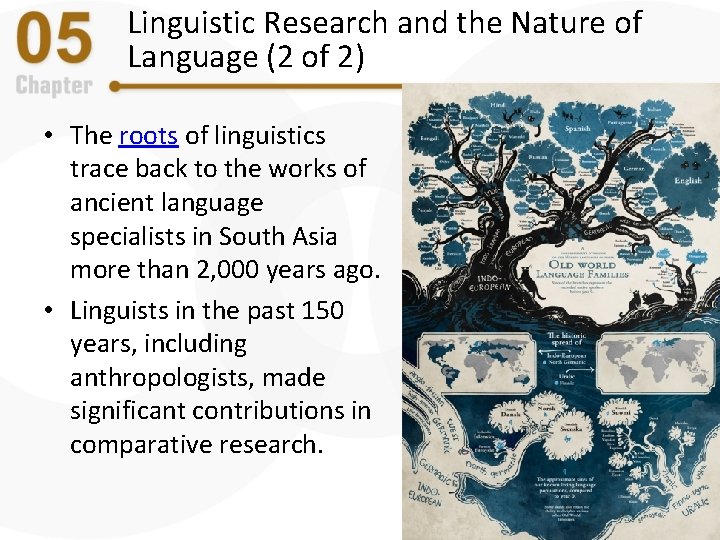
Linguistic Research and the Nature of Language (2 of 2) • The roots of linguistics trace back to the works of ancient language specialists in South Asia more than 2, 000 years ago. • Linguists in the past 150 years, including anthropologists, made significant contributions in comparative research.
Descriptive Linguistics • Descriptive linguistics involves unraveling a language by recording, describing, and analyzing all of its features. • The process of unlocking the underlying rules of a spoken language requires a trained ear and a thorough understanding of how multiple different speech sounds are produced. © 2017 Cengage Learning. All Rights Reserved.
Descriptive Linguistics: Phonology • Phonology is the study of language sounds. – Phonetics is the systematic identification and description of the distinctive sounds in a language. • While collecting speech sounds or utterances, the linguist works to isolate the phoneme— the smallest unit of sound that makes a difference in meaning but has no meaning by itself. © 2017 Cengage Learning. All Rights Reserved.
Descriptive Linguistics: Morphology, Syntax, and Grammar (1 of 2) • Morphology is the study of the patterns or rules of word formation in a language (including rules concerning verb tense, pluralization, and compound words). • A morpheme (the smallest unit of sound that carries meaning in a language) is distinct from a phoneme, which can change a word but which has no meaning by itself. © 2017 Cengage Learning. All Rights Reserved.
Descriptive Linguistics: Morphology, Syntax, and Grammar (2 of 2) • The next step in unraveling a language is to identify its syntax—the patterns or rules by which morphemes are arranged into phrases and sentences. • The grammar of the language will ultimately consist of all observations about its morphemes and syntax. © 2017 Cengage Learning. All Rights Reserved.
Historical Linguistics (1 of 2) • In addition to deciphering “dead” languages that are no longer spoken, historical linguists investigate relationships between earlier and later forms of the same language, study older languages to track the processes of change into modern ones, and examine interrelationships among older languages. © 2017 Cengage Learning. All Rights Reserved.
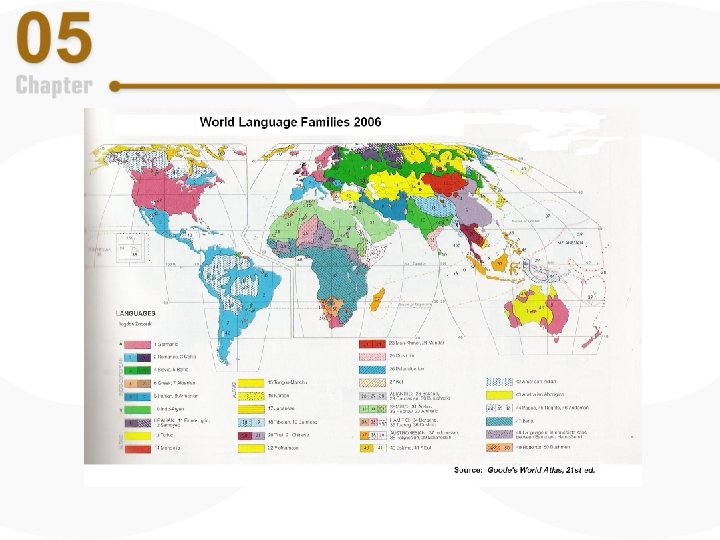
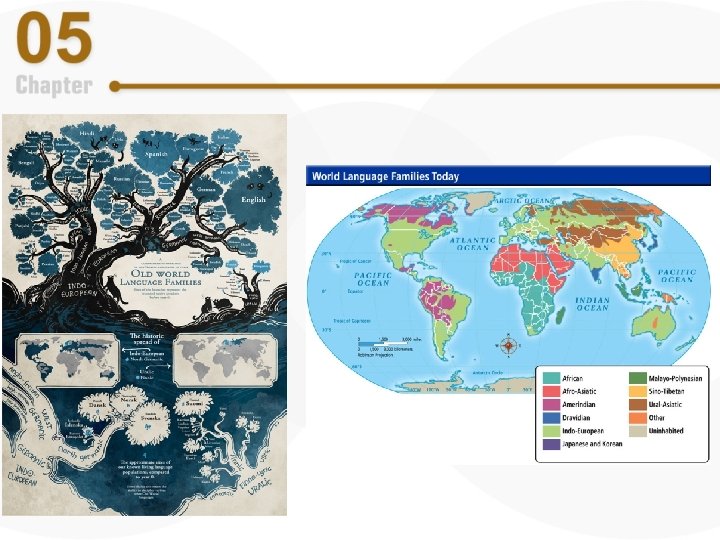
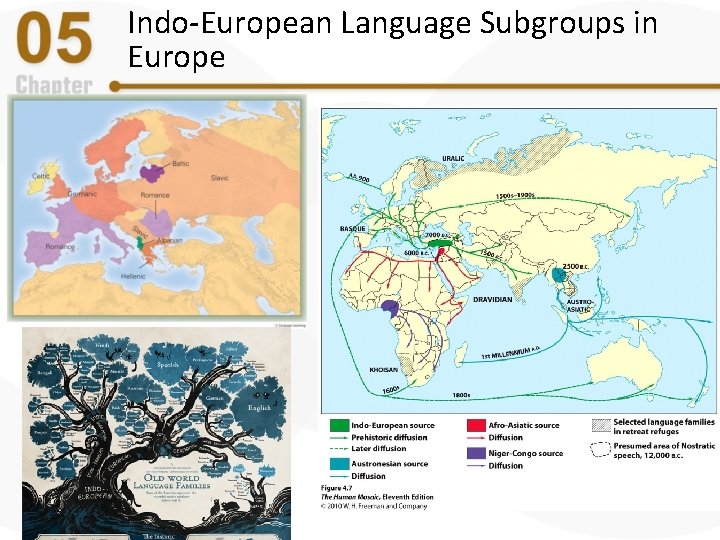
Historical Linguistics (2 of 2) • A language family is a group of languages descended from a single ancestral language. • This family is subdivided into some 11 subgroups indicating that there has been a long period of linguistic divergence from an ancient unified language into separate “daughter” languages. © 2017 Cengage Learning. All Rights Reserved.
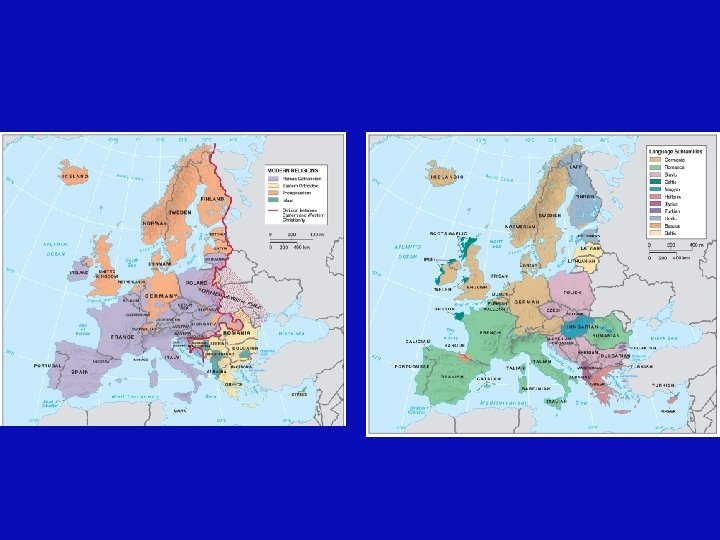
Indo-European Language Subgroups in Europe © 2017 Cengage Learning. All Rights Reserved.
Historical Linguistics: Processes of Linguistic Divergence • One force for change is selective borrowing between languages. • The electronic revolution that brought us radio, television, computers, and mobile phones has created entirely new vocabularies. • Internet use has widened the meaning of a host of already existing English words—from hacking and surfing to spam and troll. © 2017 Cengage Learning. All Rights Reserved.
Critical Thought • Can you think of any “new” words or meanings of words that have been revolutionized by the Internet, social media, texting, instant messaging, etc. ? © 2017 Cengage Learning. All Rights Reserved.
Historical Linguistics: Language Loss and Revival (1 of 2) • Perhaps the most powerful force for linguistic change is the domination of one society over another. • Over the last 500 years, about half of the world’s 12, 000 or so languages have become extinct as a direct result of warfare, epidemics, and forced assimilation brought on by colonial powers and other aggressive outsiders. © 2017 Cengage Learning. All Rights Reserved.
Historical Linguistics: Language Loss and Revival (2 of 2) • In reaction to a real or perceived threat of cultural dominance by powerful foreign societies, ethnic groups and even entire countries may seek to maintain or reclaim their unique identity by purging their vocabularies of “foreign” terms. • Emerging as a significant force for linguistic change, such linguistic nationalism is particularly characteristic of former colonial countries of Africa and Asia today. © 2017 Cengage Learning. All Rights Reserved.
Language in Its Social and Cultural Settings: Sociolinguistics (1 of 3) • Sociolinguistics, the study of the relationship between language and society, examines how social categories (such as age, gender, ethnicity, religion, occupation, and class) influence the use and significance of distinctive styles of speech. • Gendered speech is distinct male and female speech patterns, which vary across social and cultural settings. © 2017 Cengage Learning. All Rights Reserved.
Language in Its Social and Cultural Settings: Sociolinguistics (2 of 3) • Sociolinguists are also interested in dialect—the varying form of a language that reflects a particular region, occupation, or social class and that is similar enough to be mutually intelligible. • Technically, all dialects are languages—there is nothing partial or sublinguistic about them—and the point at which two different dialects become distinctly different languages is roughly the point at which speakers of one are almost totally unable to communicate with speakers of the other. • The distinction between language and dialect is not always objective and can be a political issue. © 2017 Cengage Learning. All Rights Reserved.
Language in Its Social and Cultural Settings: Sociolinguistics (3 of 3) • Code switching is the process of changing from one language mode to another as the situation demands, whether from one language to another or from one dialect of a language to another. © 2017 Cengage Learning. All Rights Reserved.
Language in Its Social and Cultural Settings: Ethnolinguistics • Ethnolinguistics is the study of the relationships between language and culture, and how they mutually influence and inform each other. • The idea that the words and grammar of a language are directly linked to culture and affect how speakers of the language perceive and think about the world is termed linguistic relativity. © 2017 Cengage Learning. All Rights Reserved.
Language Versatility • In most societies, it is not unusual for individuals to be fluent in two, three, or more languages. • The ability to comprehend two languages but express oneself in only one is known as receptive or passive bilingualism. • In our globalized world, being bilingual or multilingual may open doors of communication not only for trade but for work, diplomacy, art, and friendship. © 2017 Cengage Learning. All Rights Reserved.
Which is better? • Big Words vs. Small Words
Beyond Words: The Gesture–Call System: Nonverbal Communication (1 of 3) • The gesture component of the gesture–call system consists of facial expressions and body postures and motions that convey intended as well as subconscious messages. • The study of nonverbal signals is known as kinesics. • Humanity’s repertoire of body language is enormous. • Often, gestural messages complement spoken messages. © 2017 Cengage Learning. All Rights Reserved.
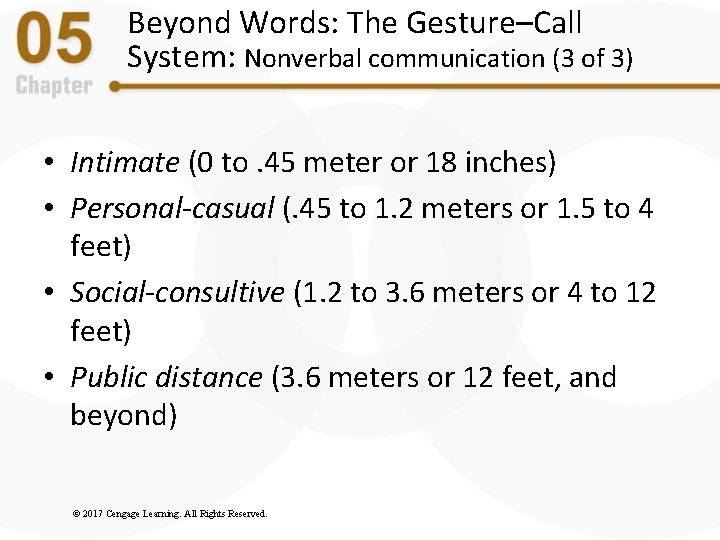
Beyond Words: The Gesture–Call System: Nonverbal communication (2 of 3) • Another aspect of body language has to do with social space: how people position themselves physically in relation to others. • Proxemics, the cross-cultural study of social space, came to the fore through the work of Edward Hall. • He identified the range of cultural variation in four categories of proxemically relevant social spaces. © 2017 Cengage Learning. All Rights Reserved.
Beyond Words: The Gesture–Call System: Nonverbal communication (3 of 3) • Intimate (0 to. 45 meter or 18 inches) • Personal-casual (. 45 to 1. 2 meters or 1. 5 to 4 feet) • Social-consultive (1. 2 to 3. 6 meters or 4 to 12 feet) • Public distance (3. 6 meters or 12 feet, and beyond) © 2017 Cengage Learning. All Rights Reserved.
Beyond Words: The Gesture–Call System: Paralanguage • The second component of the gesture–call system is paralanguage—specific voice effects that accompany speech and contribute to communication. • These vocalizations include: giggling, groaning, or sighing, as well as voice qualities such as volume, intensity, pitch, and tempo. © 2017 Cengage Learning. All Rights Reserved.
Tonal Languages • About 70% of the world’s languages are a tonal language in which the various distinctive sound pitches of spoken words are not only an essential part of their pronunciation but are also key to their meaning. • Worldwide, at least 1/3 of the population speaks a tonal language, including many in Africa, Central America, and East Asia. • In nontonal languages such as English, tone can be used to convey attitude or to change a statement into a question. © 2017 Cengage Learning. All Rights Reserved.
Talking Drums and Whistled Speech • Another traditional telecommunication system used to expand acoustic space is whistled speech, or whistled language—an exchange of whistled words using a phonetic emulation of the sounds produced in spoken voice. • Whistled speech can be more effective across greater distances than shouted talk because it occurs at a higher pitch or frequency range. • Like the talking drum, whistled speech is an endangered tradition—disappearing in part because the communities where the practice once thrived are no longer isolated or because the ancestral lifeways are vanishing or already gone. © 2017 Cengage Learning. All Rights Reserved.
The Origins of Language • Cultures all around the world have sacred stories or myths addressing the age-old question of the origins of human language. • Cultural groups tend to locate the place of origin in their own ancestral homelands and believe that the first humans also spoke their language. • Because human language is embedded within a gesture– call system of a type that we share with nonhuman primates, anthropologists have gained considerable insight into human language by observing the communication systems of fellow primates. © 2017 Cengage Learning. All Rights Reserved.
From Speech to Writing (1 of 3) • Although different peoples invented a variety of graphic styles, anthropologists distinguish an actual writing system as a set of visible or tactile signs used to represent units of language in a systematic way. • Symbols carved into 8, 600 -year-old tortoise shells recently found in western China may represent the world’s earliest evidence of elementary writing. • A fully developed early writing system is Egyptian hieroglyphics, developed some 5, 000 years ago and in use for about 3, 500 years. © 2017 Cengage Learning. All Rights Reserved.
From Speech to Writing (2 of 3) • Another very old system is cuneiform, an arrangement of wedge-shaped imprints developed primarily in Mesopotamia which lasted nearly as long. • Cuneiform writing stands out among other early forms in that it led to the first phonetic writing system—that is, an alphabet or series of symbols representing the sounds of a language. © 2017 Cengage Learning. All Rights Reserved.
From Speech to Writing (3 of 3) This polished granitelike stele, inscribed with a royal decree in three scripts, was placed in an Egyptian temple over 2, 200 years ago. © 2017 Cengage Learning. All Rights Reserved.
Literacy and Modern Telecommunication • Today one in five adults, 775 million people, cannot read and write. • The global telecommunications revolution has reached the most remote villagers on earth. • Mobile phones are more than a means of communication. They have become survival tools. • People use their mobiles to get and give information, to send and receive money, to express their individuality, and to stay in touch. © 2017 Cengage Learning. All Rights Reserved.