Chapter 3 Transmission Media Visit to more Learning
- Slides: 57
Chapter 3 Transmission Media Visit to more Learning Resources
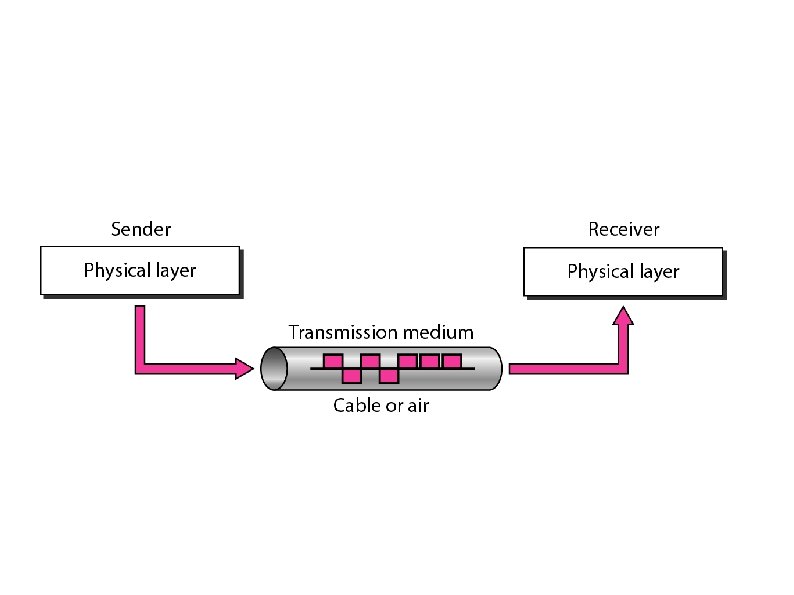
● ● ● Transmission media is a medium over which information travels from the sender to receiver. Different media have different properties and used in different environments for different purpose. The purpose of physical layer is to transport a raw bit stream from one computer to other.
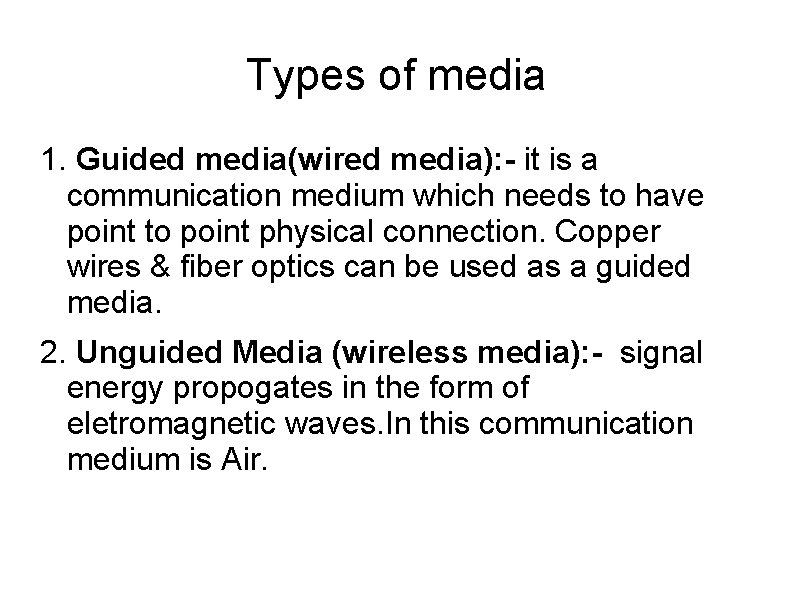
Types of media 1. Guided media(wired media): - it is a communication medium which needs to have point to point physical connection. Copper wires & fiber optics can be used as a guided media. 2. Unguided Media (wireless media): - signal energy propogates in the form of eletromagnetic waves. In this communication medium is Air.
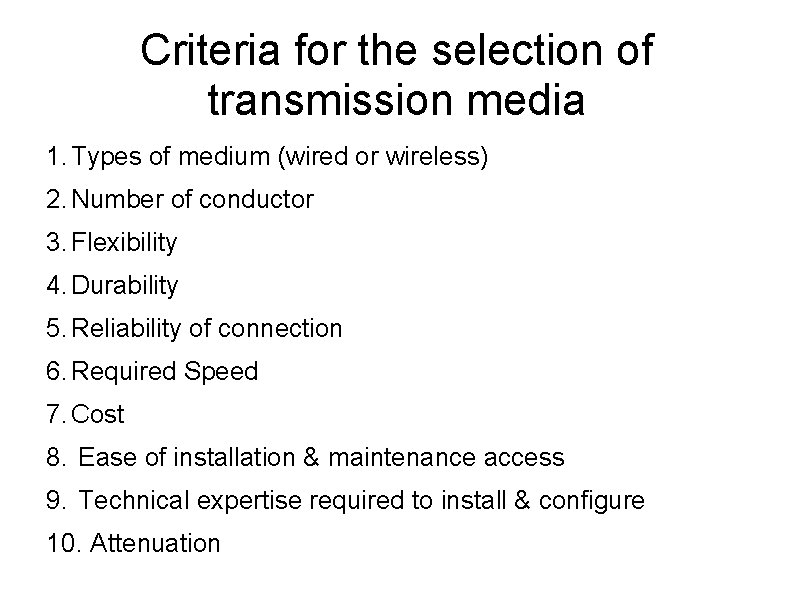
Criteria for the selection of transmission media 1. Types of medium (wired or wireless) 2. Number of conductor 3. Flexibility 4. Durability 5. Reliability of connection 6. Required Speed 7. Cost 8. Ease of installation & maintenance access 9. Technical expertise required to install & configure 10. Attenuation
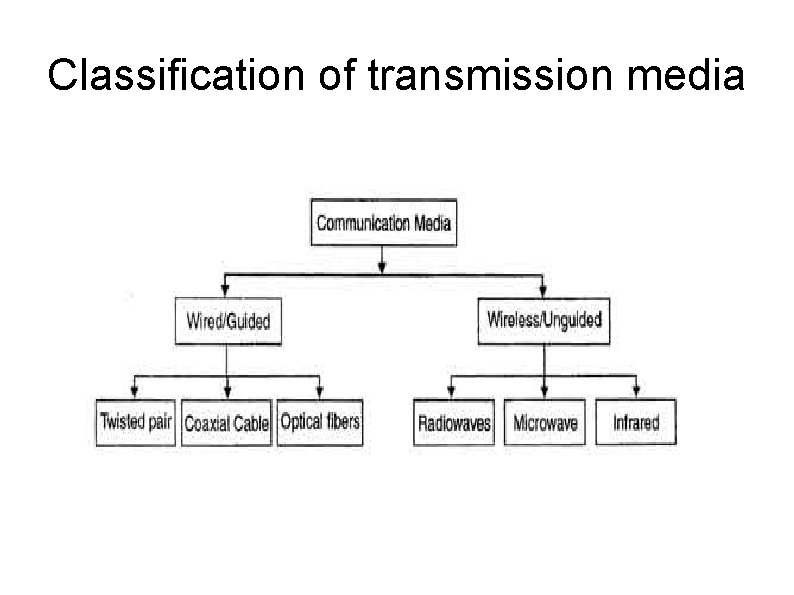
Classification of transmission media
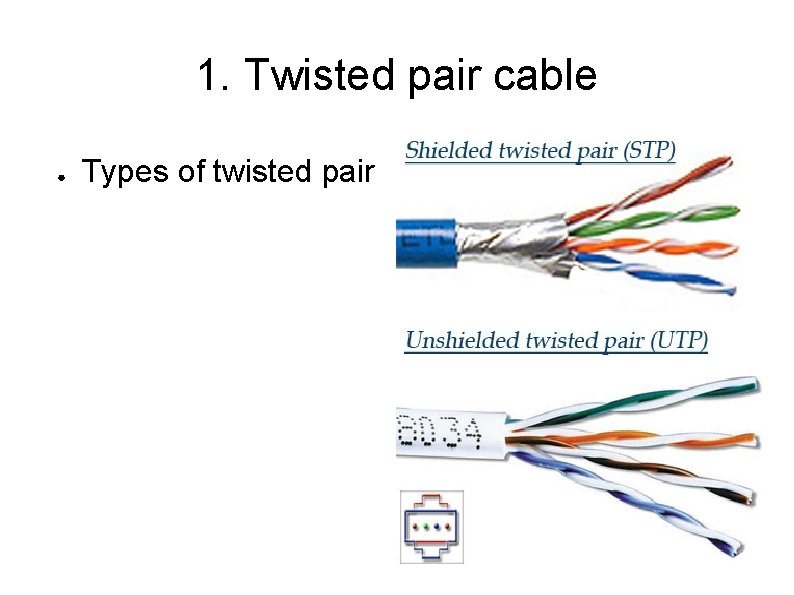
1. Twisted pair cable ● Types of twisted pair
Shielded twisted pair ● ● ● STP has a metal foil or braided mesh to cover each pair of insulating conductors known as metal shield. It reduces the interference of the noise but makes the cable bulky and expensive. So practically UTP is more used than STP. Twisted pair can be either used for analog or digital transmission. The bandwidth supported by the wire depends on the thickness of the wire and the distance travelled.
Characteristics of STP ● Twisted conductors are shielded to reduce noise. ● Low cost medium ● Used only for IBM computers ● Supports data rates upto mbps.
UTP ● ● Twisted pair consist of two insulated conductor twisted together in the spiral form as shown in fig. UTP cables are very cheap and easy to install. But they are badly affceted by the noise interference.
Why to twist the wires? ● ● Twisting of wires will reduce the effect of noise or external interference. Number of twists per unit length will determine the quality of cable. More twist means better quality.
Characteristics of UTP ● Shielding is not used. ● Noise interference is high. ● Low cost medium. ● Can support data rate of several mbps ● Installation is easy ● Used in telephone, DSL(Digital Subscriber Line) modem, LAN, ISDN(Integrated Services Digital Network).
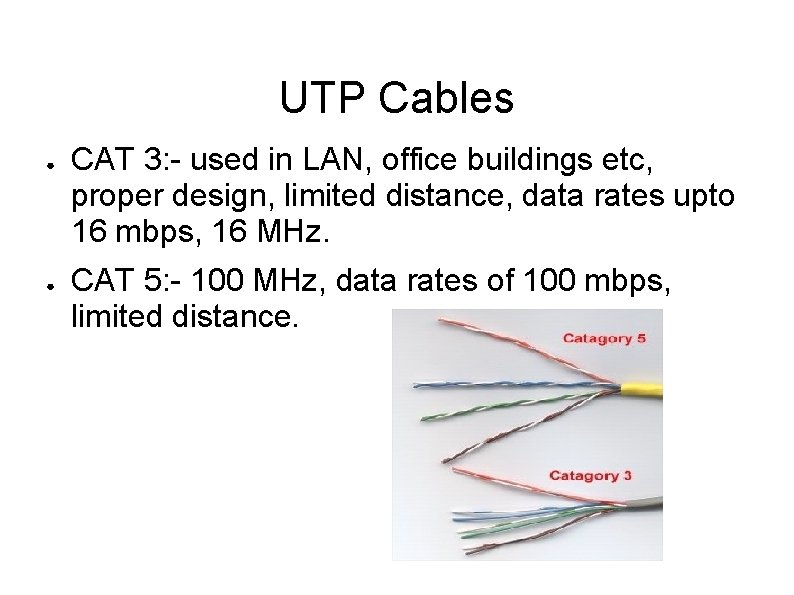
UTP Cables ● ● CAT 3: - used in LAN, office buildings etc, proper design, limited distance, data rates upto 16 mbps, 16 MHz. CAT 5: - 100 MHz, data rates of 100 mbps, limited distance.
Application of twisted pair ● In telephone lines to carry voice and data signals ● In LAN ● In the DSL ● ISDN
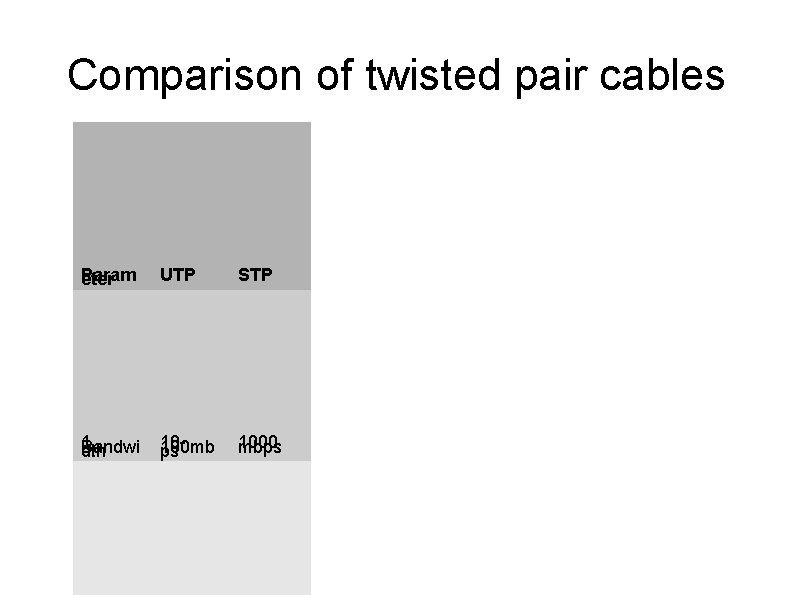
Comparison of twisted pair cables Param eter UTP STP 1. Bandwi dth 10100 mb ps 1000 mbps
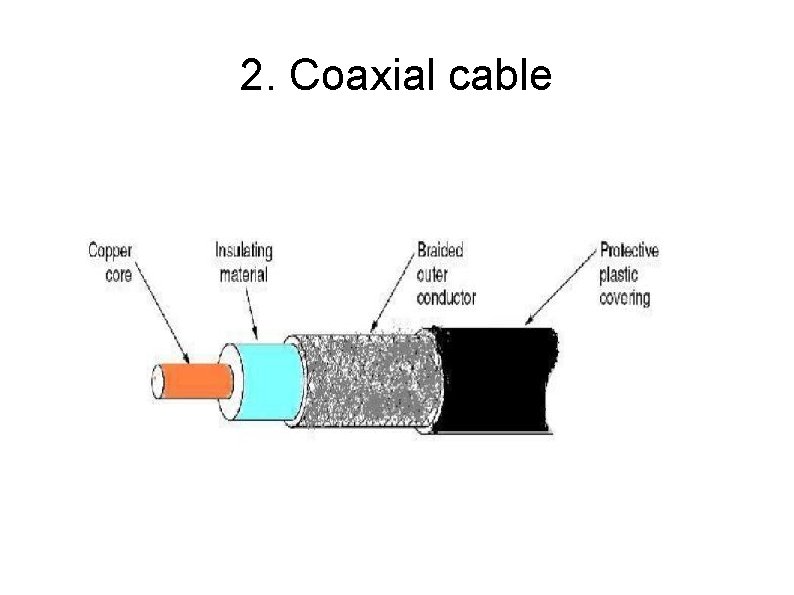
2. Coaxial cable
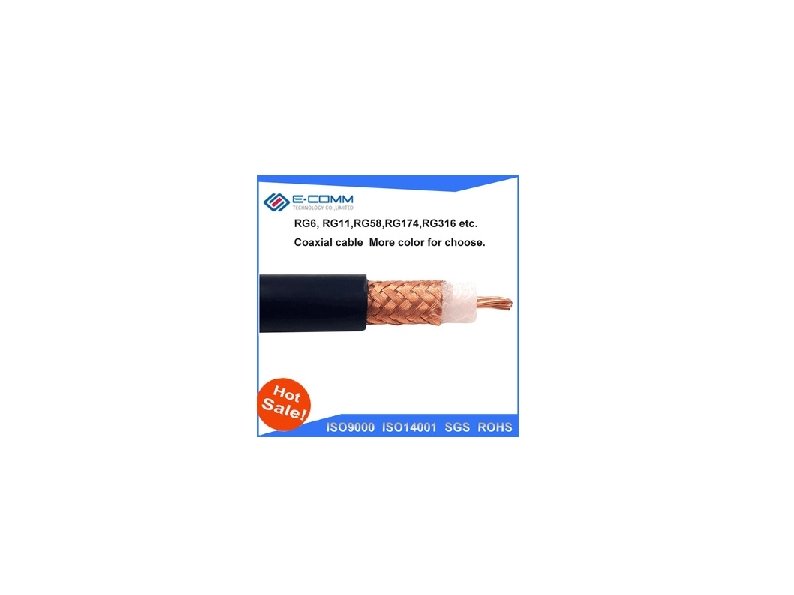
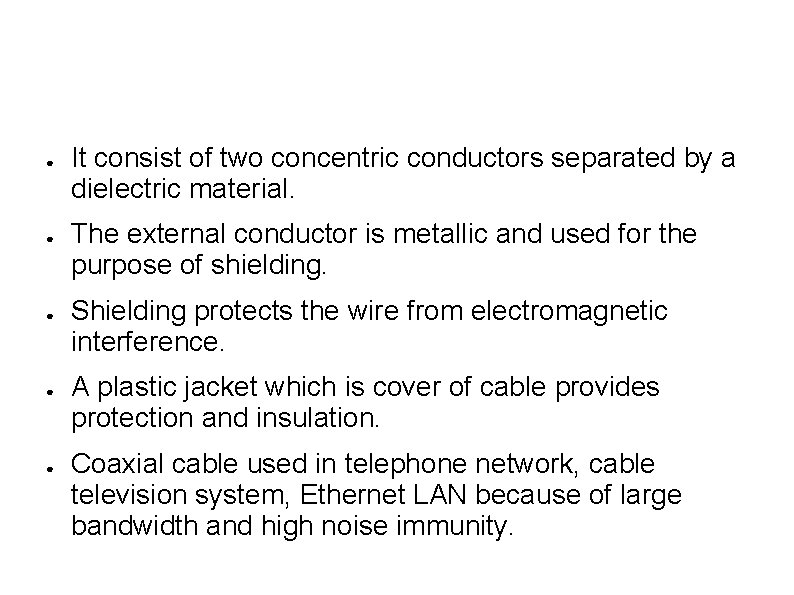
● ● ● It consist of two concentric conductors separated by a dielectric material. The external conductor is metallic and used for the purpose of shielding. Shielding protects the wire from electromagnetic interference. A plastic jacket which is cover of cable provides protection and insulation. Coaxial cable used in telephone network, cable television system, Ethernet LAN because of large bandwidth and high noise immunity.
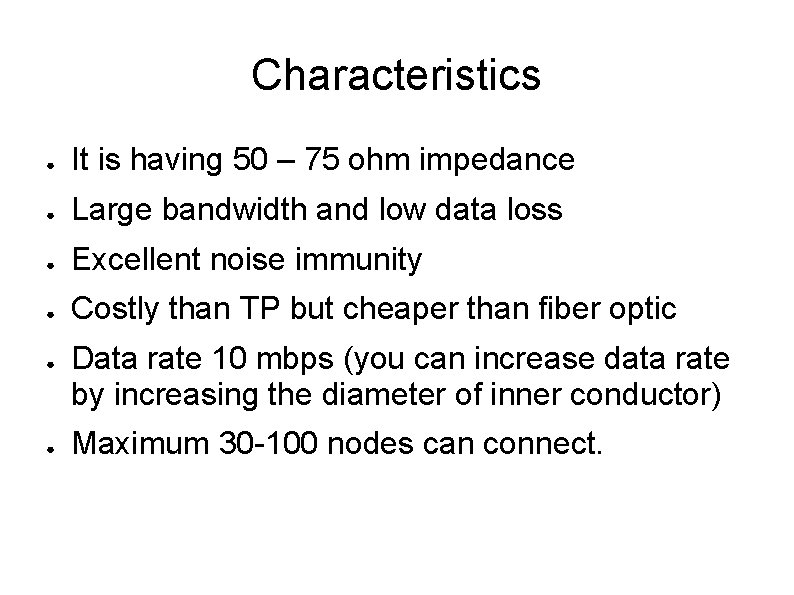
Characteristics ● It is having 50 – 75 ohm impedance ● Large bandwidth and low data loss ● Excellent noise immunity ● Costly than TP but cheaper than fiber optic ● ● Data rate 10 mbps (you can increase data rate by increasing the diameter of inner conductor) Maximum 30 -100 nodes can connect.
Applications ● Analog Telephone system Digital phone system ● Cable TV ● Ethernet LAN ● Digital transmission ●
Advantages ● Excellent noise immunity due to shielding ● Large bandwidth ● Data losses are small ● High data transfer rate ● Less attenuation ● Easy to install
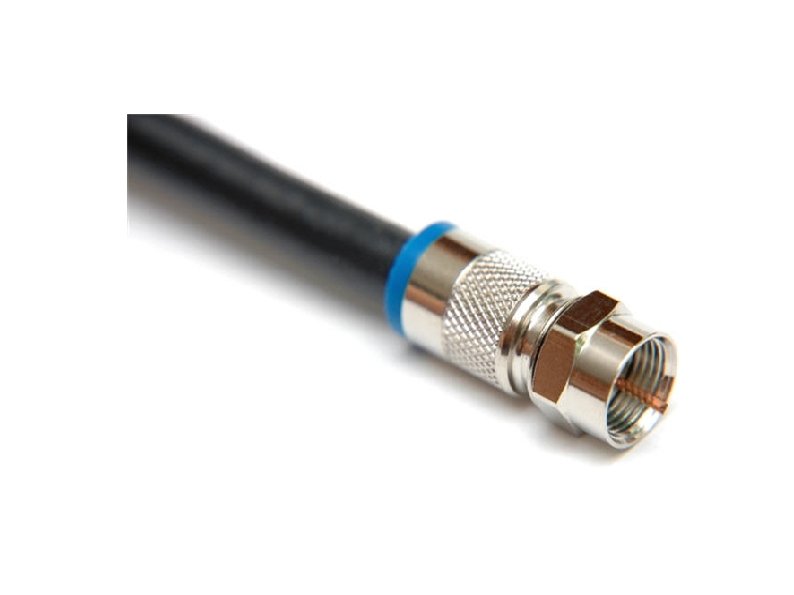
Disadvantages ● Expensive than TP cable ● BNC connector are required for connection
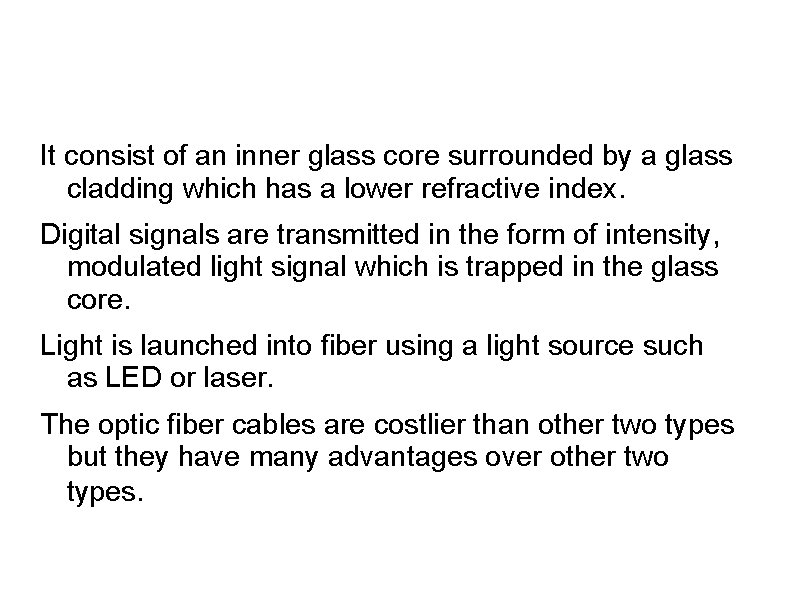
3. Optical fiber cables
It consist of an inner glass core surrounded by a glass cladding which has a lower refractive index. Digital signals are transmitted in the form of intensity, modulated light signal which is trapped in the glass core. Light is launched into fiber using a light source such as LED or laser. The optic fiber cables are costlier than other two types but they have many advantages over other two types.
Characteristics 1. High bandwidth (100 mbps to 2 gbps) 2. Light has much higher frequency than electricity. 3. Number of nodes support does not depend on its length. 4. Lower attenuation 5. Can carry signals to longer distance without amplifiers and repeaters. 6. Not affected by EMI 7. Cost is high compared to other 2 types. 8. Installation of fiber optic cable is difficult and tedious.
Advantages 1. Small size and lightweight 2. Easy availability and low cost 3. No electrical or electromagnetic interference 4. Large bandwidth 5. No crosstalk 6. Signal can be sent up to 100 times faster 7. Intermediate amplifiers not required 8. Fiber optic cable is flexible 9. Not affected by drastic environmental conditions.
Disadvantages 1. Initial cost is high 2. Joining the fiber optic is a difficult job.
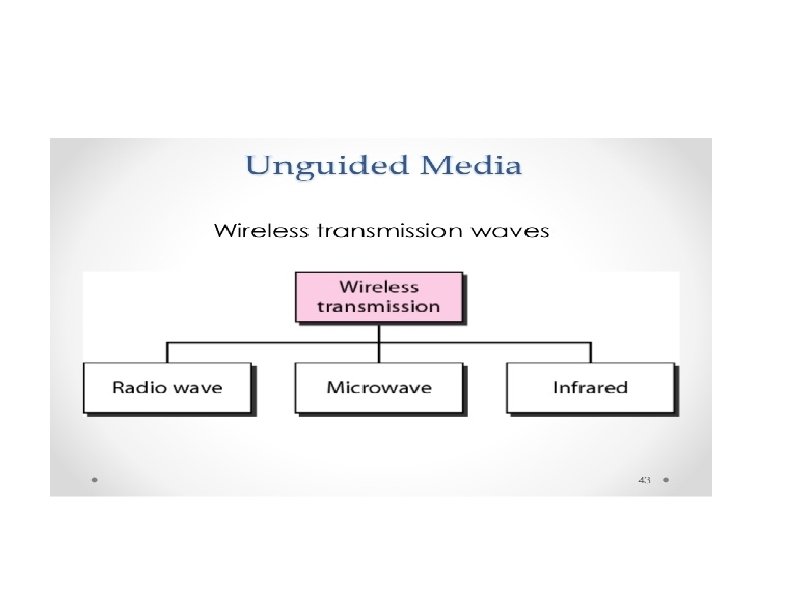
Unguided(wireless) media Unguided media does not use a conductor or wire as a communication medium, it uses air or vacuum. The transmitter first converts data signal into electromagnetic waves and transmits them using a suitable antenna. The receiver receives them using a receiving antenna and converts the EM waves into data signal again.
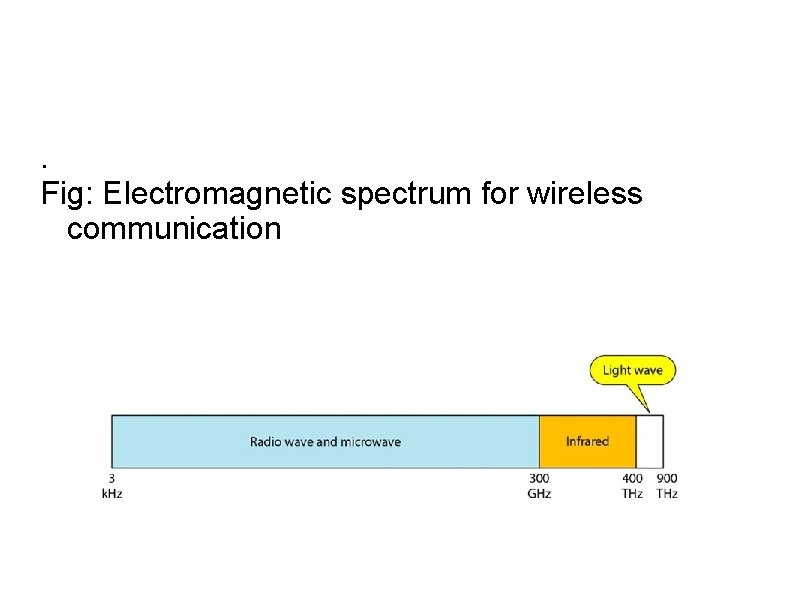
. Fig: Electromagnetic spectrum for wireless communication
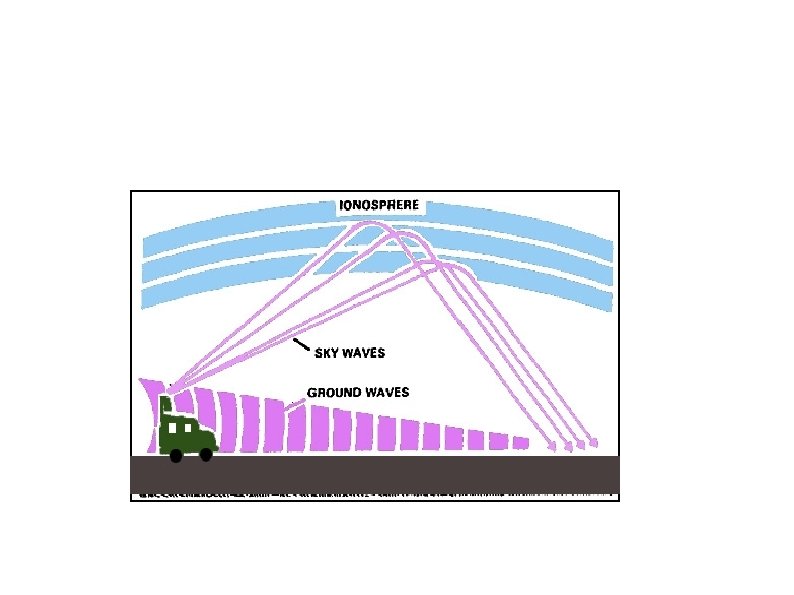
1. Radio Wave transmission Radio Waves are easy to generate, can travel long distance and can penetrate buildings easily so they are widely used for communication both indoors and outdoors. They are broadcast omnidirectionally meaning that they travel in all directions from the source. Hence, transmitter and receiver do not have to be carefully aligned physically. This waves have Frequency between 10 k. Hz & 1 GHz
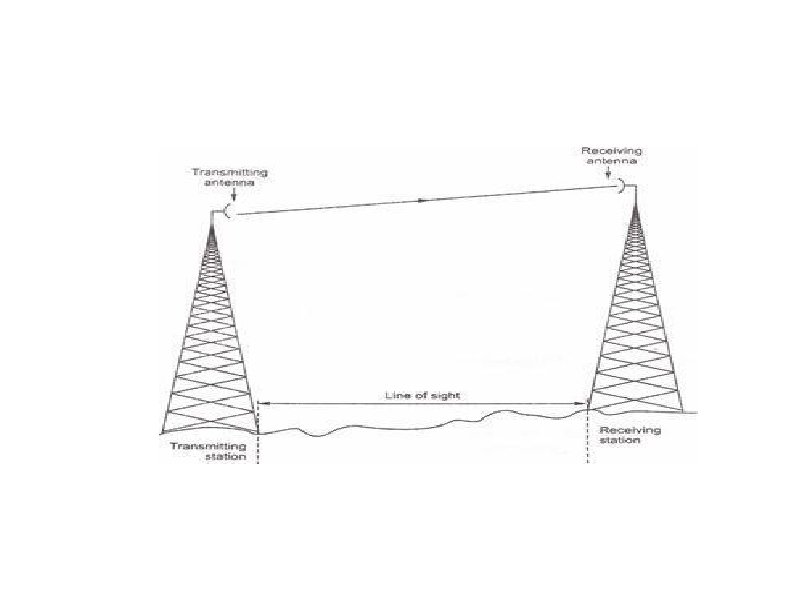
2. Microwave transmission system --Microwaves are unidirectional electromagnetic waves with a frequency range from 1 to 300 GHz. --Microwaves use space wave Propagation. Also it is line of sight communication. --Large Bandwidth, also it support high data rates.
Application of Microwave transmission --One to one communication --In celluar phones --In satellite n/w's --In the wireless LAN's
3. Infrared transmission system --These waves having frequency 300 GHz to 400 THz. --IR waves uses line of sight propogation. --IR light is that it can't penetrate walls. That means it can be easily contained within room. --Large Bandwidth --It is used in very high speed in wireless LAN in future. --It will communicate point to point & Boradcast also
--For communication between keyboard, mouse, PC's & Printers.
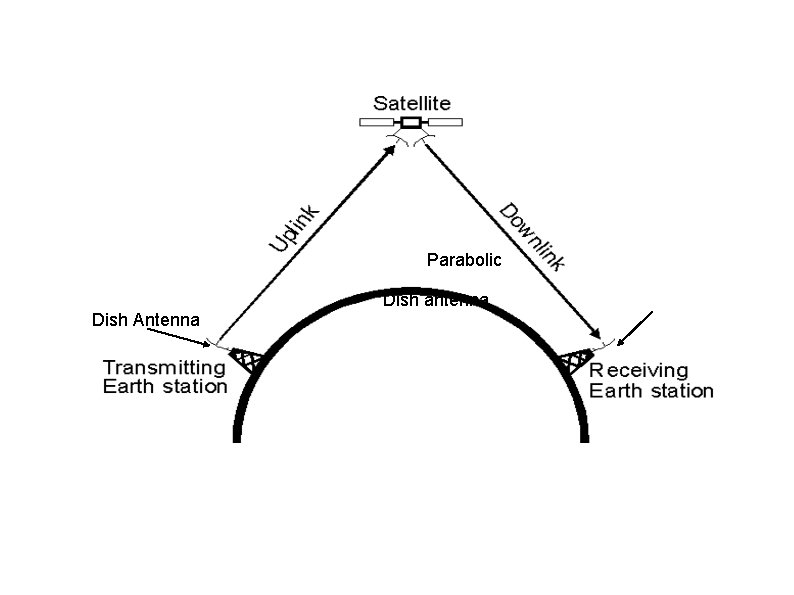
Satellite Communication --An artificial satellite orbits or revolves around the earth. --A geostationary communication satellite is basically a relay station in space. --An earth station transmits information signal to the satellite using a highly directional dish antenna. --Satellite receives signal from one earth station amplifies it, improves the signal quality & radiates the signal back to other earth stations towards parabollic dish antenna. --The signal which being transmitted upwards to the satellite is called 'uplink' with normally frequency 6 GHz. --The signal which is transmitted back to the receiving earth station is called 'downlink' with frequency of 4 GHz.
Parabolic Dish Antenna Dish antenna
Characteristics Satellite Communication -- Geostationary satellite can cover the entire earth. -- It supports bandwidth 1 to 10 Mbps. --Attenuation depends on frequency, power, antenna size & atmospheric condition. --The installation of satellite is extremely difficult & alignment of each station antenna must be perfectly aligned. --The cost of building & launching is very expensive.
Latest Technologies in Wireless Networks: Bluetooth --Bluetooth is a wireless LAN technology which can connect devices such as telephones, computers, printers, cameras etc. Without using wires. --It connect one device to another with radio link. --Based on IEEE 802. 15 standard. --short range(10 meters) --Limited speed --Low power --Low cost --Low complexity Bluetooth Architecture defines 2 types of n/w's 1. Piconets 2. Scatternet
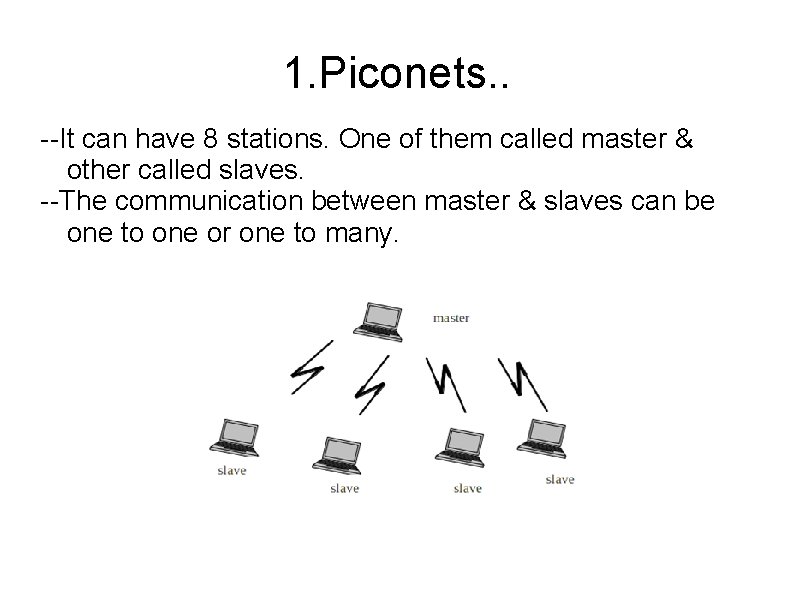
1. Piconets. . --It can have 8 stations. One of them called master & other called slaves. --The communication between master & slaves can be one to one or one to many.
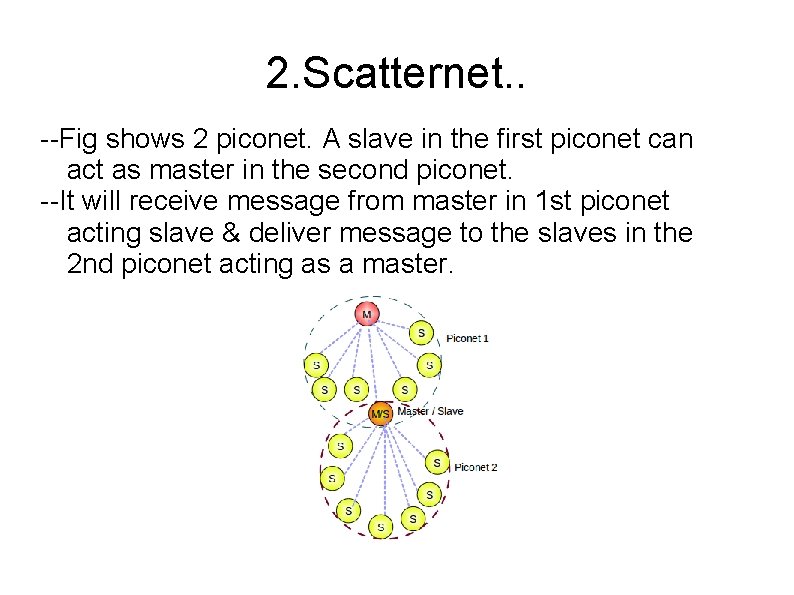
2. Scatternet. . --Fig shows 2 piconet. A slave in the first piconet can act as master in the second piconet. --It will receive message from master in 1 st piconet acting slave & deliver message to the slaves in the 2 nd piconet acting as a master.
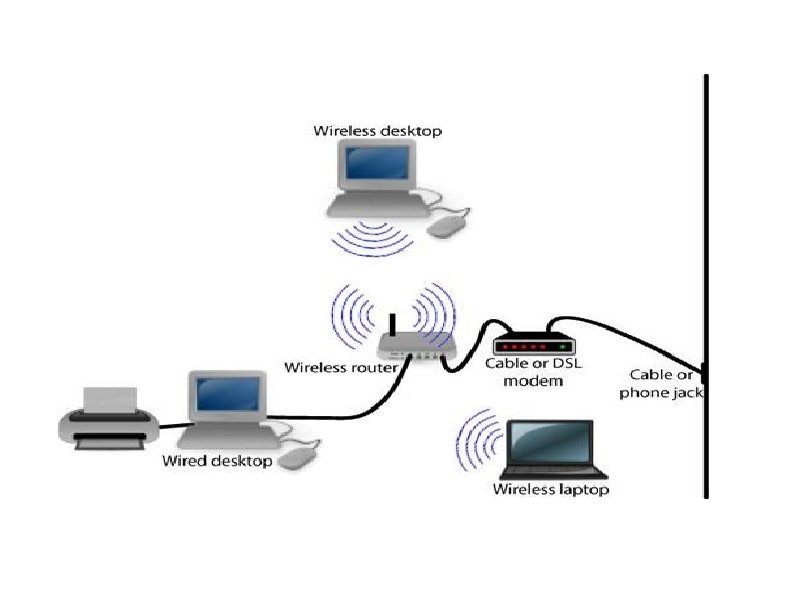
Wi-Fi --Wi-fi is a popular technology which allows an electronic devices to exchange data or to connect to the internet using radio waves. --Wi-Fi stands for wireless fidelity. --Personal Computer, Smart phone, some digital cameras, Tablet use wifi --Based on IEEE 802. 11 standards. --Wireless LAN are used in office building, colleges, Public areas.
Wi-Fi. . Advantages 1) Easy to use. 2) Easy and simple to expandability. 3) Easy to install and setup. 4) No requirement of wires Disadvantage 1) The range of Wi-Fi is limited 2) Security is less in Wi-Fi connections as compared with others.
Wi-Max --Long Form is Worldwide Interoperability for Microwave Access. --It is wireless communication standard provide data rates upto 1 Gbps. --Less cost Uses/Application--Provide portable mobile broadband connectivity. --Provide services voice on IP(Vo. IP) --Provide source of Internet connectivity --It is alternative to cable, digital subscriber line(DSL) for providing a broadband access.
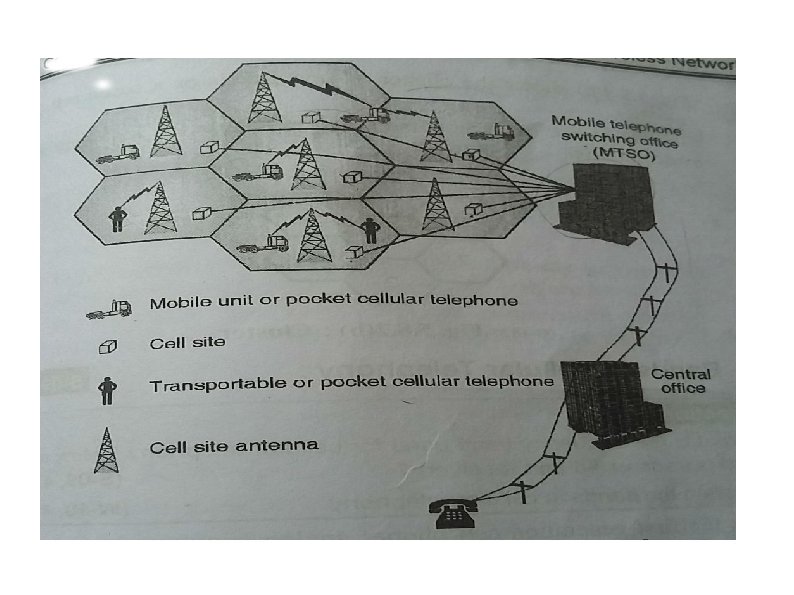
Cellular(Mobile) Telephone System --Wireless communication --cell phone is not restricted to a one location can travel city, outside city --city is divided into small areas called ‘cell(around 10 sq km)’ --Each cell linked to MTSO, MTSO coordinates all mobile calls between an area of cell sites & central office. --Time & billing information for each mobile unit is accounted by MTSO --Cell site base station is provided transmit, receive & switch calls to & from any mobile unit within the cell to the MTSO.
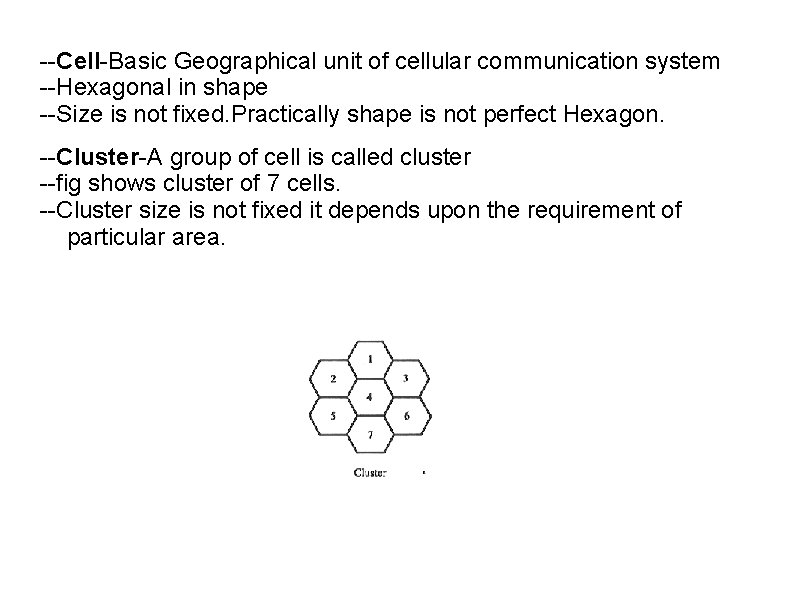
--Cell-Basic Geographical unit of cellular communication system --Hexagonal in shape --Size is not fixed. Practically shape is not perfect Hexagon. --Cluster-A group of cell is called cluster --fig shows cluster of 7 cells. --Cluster size is not fixed it depends upon the requirement of particular area.
Bands in Cellular Telephony -- In cell phone Analog communication used --Frequency modulation(FM) is used for communication between mobile phone & cell office. --2 frequency bands were allocated. One for the communication initiated by cell phone & another for land phone. --Full Duplex operation is possible by separating transmit & receive signals into separate frequency bands --Cellular phone units transmit in the lower band of frequencies i. e 825 to 845 MHz & receive higher band 870 to 890 MHz. --Within these 2 bands 666 channels (333 channels per band) have been assigned for voice & control. Each channel occupies 30 k. Hz bandwidth.
Calls using Mobile Phones -- Case 1: Call initiated by mobile phone: When we make a call 10 digit no. the sequence events takes place as follows: 1. The phone itself scans the band & seeks a channel to set up the call 2. It sends this no. to the closest cell office 3. This cell office sends this no. to MTSO 4. MTSO sends it to the CTO(central Telephone office) 5. If the called person available, then CTO informs this to MTSO 6. MTSO will allocate an empty voice channel to the cell phone to establish the connection & conversation begins
-- Case 2: A Land phone calls a mobile phone: When call is initiated by land line phone the sequence of events as follows 1. The telephone central office sends the no. to MTSO. 2. The MTSO performs a lookup to see the current location of mobile phone sending query signals to all the cells. This is called Paging 3. The cell where the mobile phone is currently located responds to MTSO 4. The MTSO then transmit the incoming call signal to that mobile phone. 5. When the mobile phone answers the MTSO assigns a voice channel to the call & conversation begins.
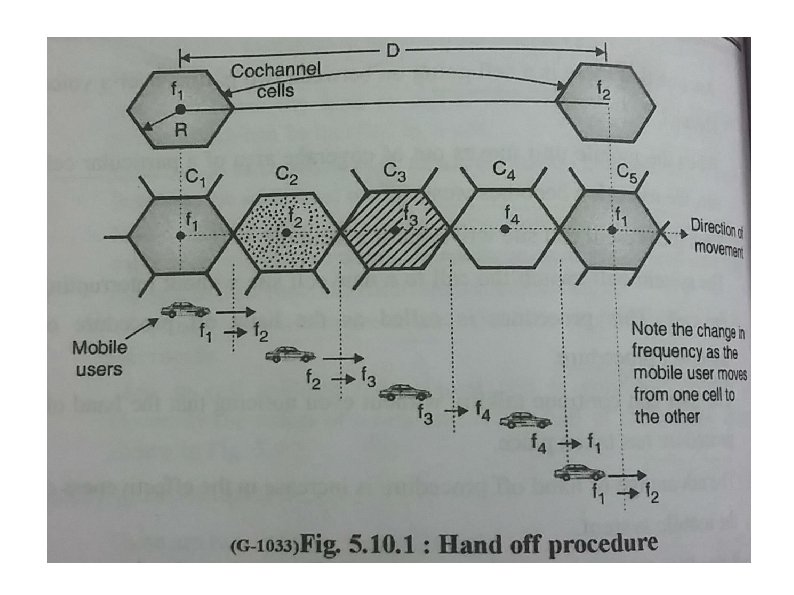
Hand Off Procedure --Assume that Between two Persons cell is going on over voice channel, mobile unit moves out of coverage area of a particular cell site, the reception becomes weak. --Present cell site will request a hand off, the system will switch the call site without interrupting the call. This Procedure is called as the Handoff Procedure. --It is increase the effectiveness of mobile system. --fig shows 2 cochannel cells separated by a distance D & using frequency f 1. --Suppose a mobile unit initiate a call in cell C 1 & moves to cell C 2. Then as it starts going away from C 1 the call is dropped & reinitiated in the frequency channel from f 1 & f 2 when the mobile unit moves from C 1 to C 2. --The Process of changing the frequency is done automatically by the system & user does notice it
Hand Off Types 1) Hard Handoff-A hard handoff technique used with a cellular network that requires a user's connection to be entirely broken with the existing base station before being switched to another base station. 2) Soft Hand off- If the MS starts communication with a new base station without stopping the communication with the older base station. 3) Delayed Hand off-In many situation instead of one level a 2 level handoff procedure is used in order to provide a high oppurtunity for a successful handoff. A handoff can be delayed if on avalable cell take the call. 4) Forced Handoff-The Handoff which would normally occure but prevented from happening or the handoff that should not occure but it forced to happen. 5) Queued Handoff-The MTSO arrange the handoff request in a queue instead of rejecting them, if the new call sites are busy. For more Details Contact Us