Chapter 13 Ions in Aqueous Solutions and Colligative
- Slides: 26
Chapter 13 – Ions in Aqueous Solutions and Colligative Properties This chapter is part of the foundational knowledge to understand how acids work (Chapter 14). This chapter is relatively short (Test on Tuesday, March 28) Colligative Property: a property that is determined by the number of particles present in a system, but that is independent of the properties of the particles themselves.
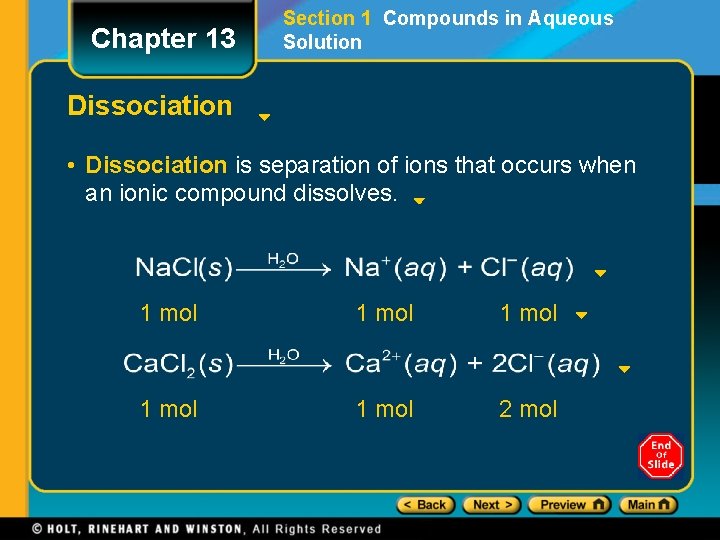
Chapter 13 Section 1 Compounds in Aqueous Solution Dissociation • Dissociation is separation of ions that occurs when an ionic compound dissolves. 1 mol 1 mol 2 mol
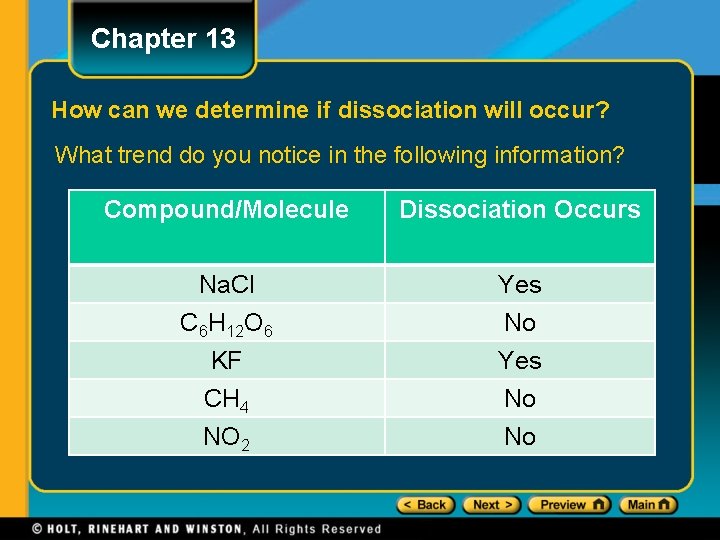
Chapter 13 How can we determine if dissociation will occur? What trend do you notice in the following information? Compound/Molecule Dissociation Occurs Na. Cl Yes C 6 H 12 O 6 No KF Yes CH 4 No NO 2 No
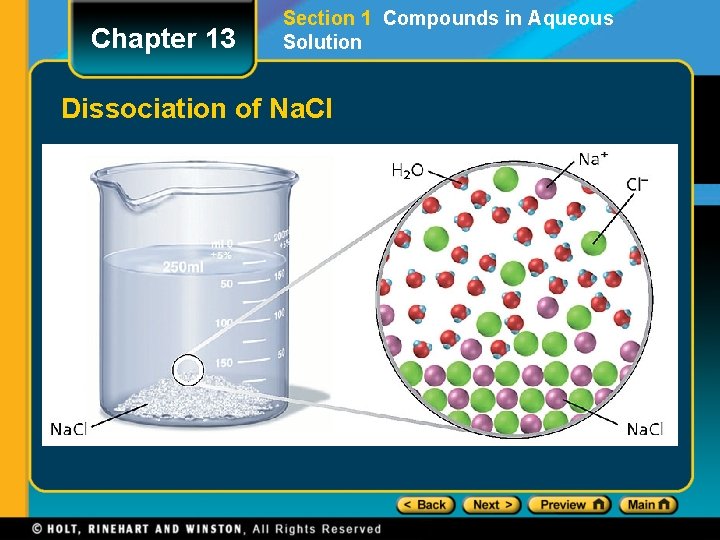
Chapter 13 Section 1 Compounds in Aqueous Solution Dissociation of Na. Cl
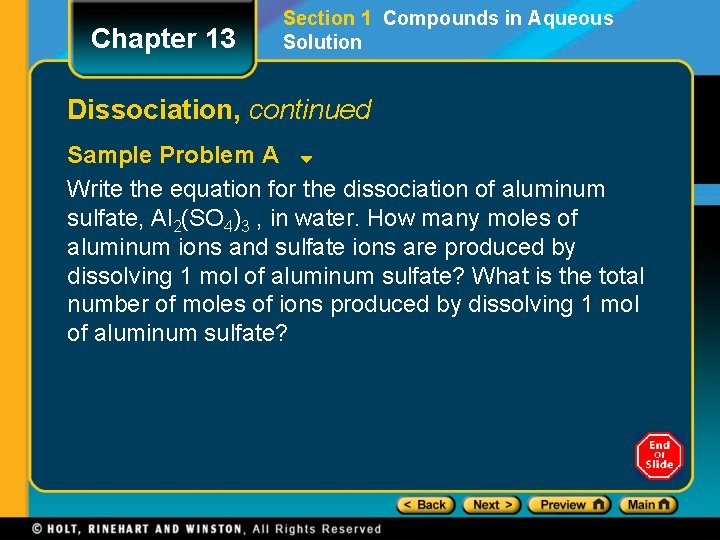
Chapter 13 Section 1 Compounds in Aqueous Solution Dissociation, continued Sample Problem A Write the equation for the dissociation of aluminum sulfate, Al 2(SO 4)3 , in water. How many moles of aluminum ions and sulfate ions are produced by dissolving 1 mol of aluminum sulfate? What is the total number of moles of ions produced by dissolving 1 mol of aluminum sulfate?
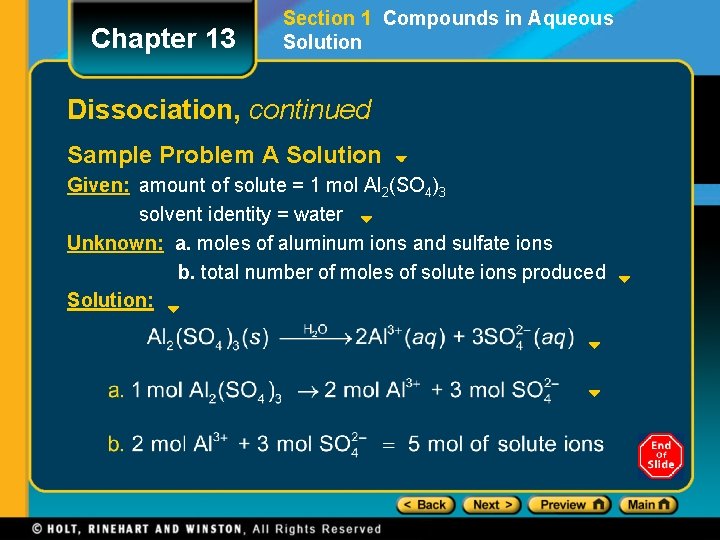
Chapter 13 Section 1 Compounds in Aqueous Solution Dissociation, continued Sample Problem A Solution Given: amount of solute = 1 mol Al 2(SO 4)3 solvent identity = water Unknown: a. moles of aluminum ions and sulfate ions b. total number of moles of solute ions produced Solution:
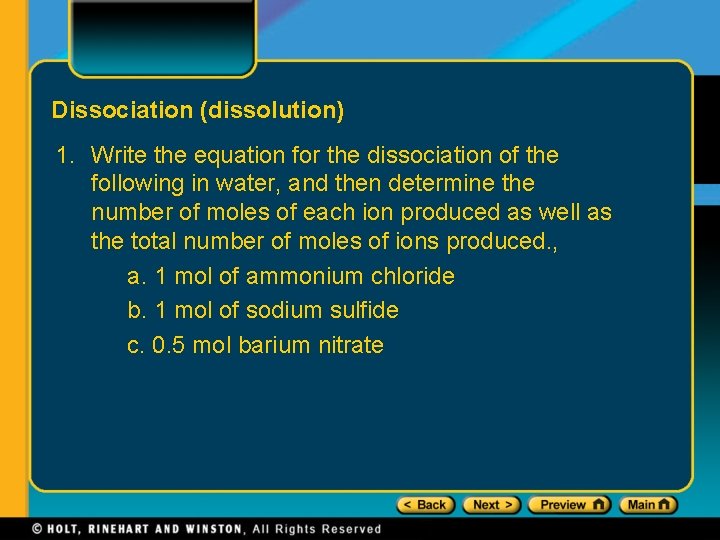
Dissociation (dissolution) 1. Write the equation for the dissociation of the following in water, and then determine the number of moles of each ion produced as well as the total number of moles of ions produced. , a. 1 mol of ammonium chloride b. 1 mol of sodium sulfide c. 0. 5 mol barium nitrate
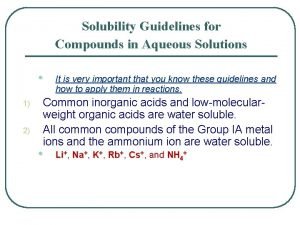
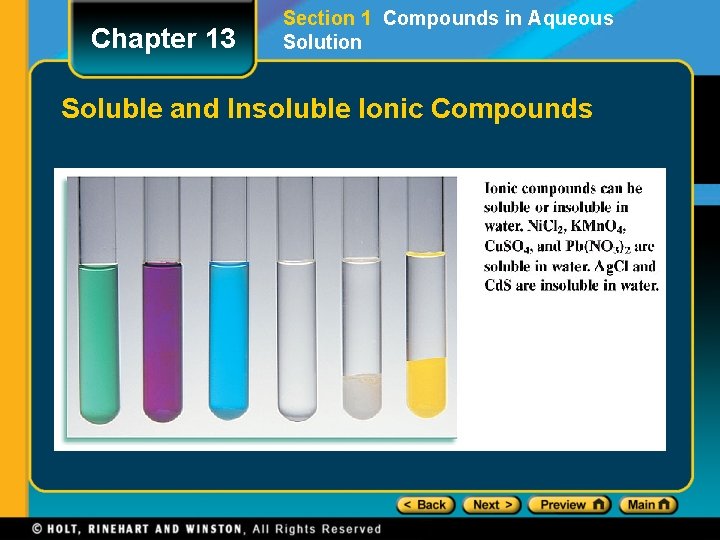
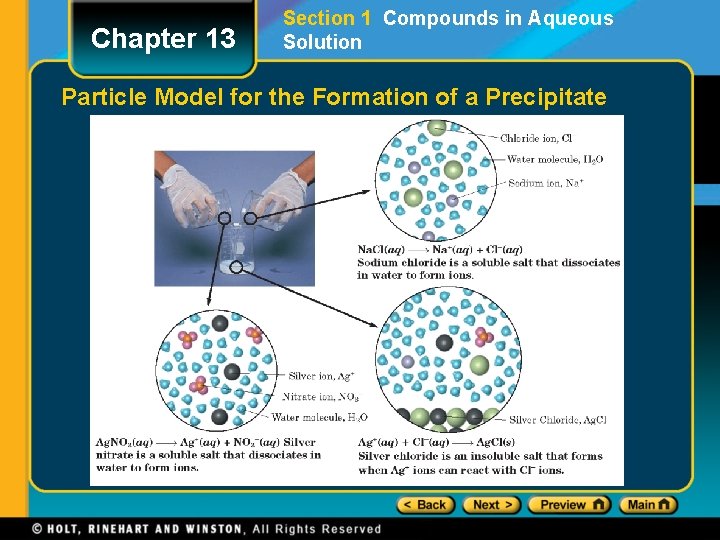
Chapter 13 Section 1 Compounds in Aqueous Solution Dissociation, continued Precipitation Reactions • Although no ionic compound is completely insoluble, compounds of very low solubility can be considered insoluble for most practical purposes.
Chapter 13 Section 1 Compounds in Aqueous Solution Soluble and Insoluble Ionic Compounds
Chapter 13 Section 1 Compounds in Aqueous Solution Particle Model for the Formation of a Precipitate
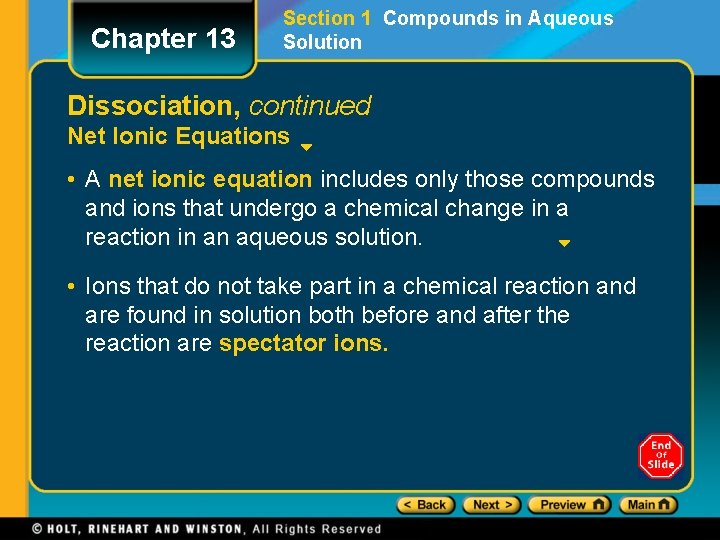
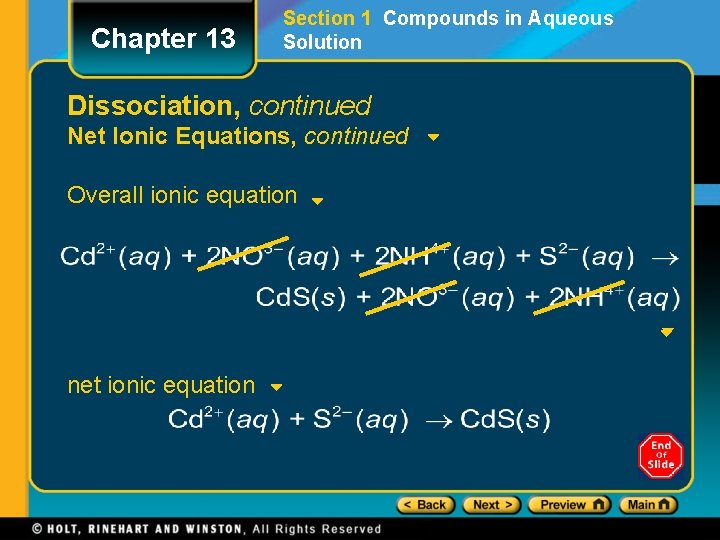
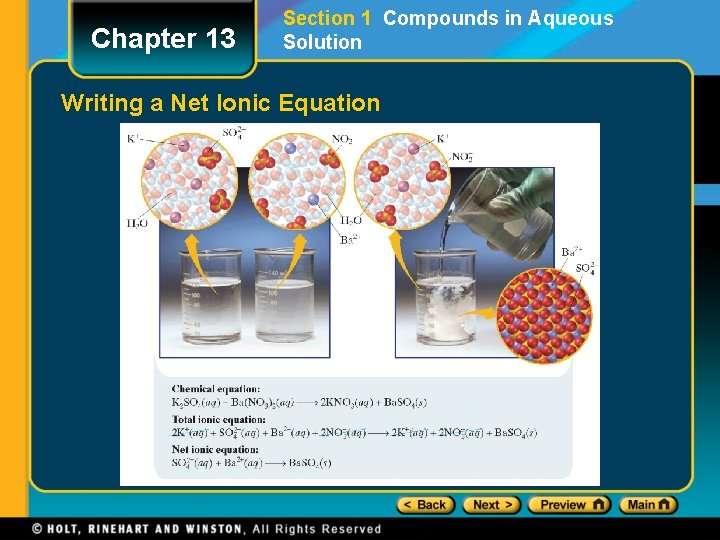
Chapter 13 Section 1 Compounds in Aqueous Solution Dissociation, continued Net Ionic Equations • A net ionic equation includes only those compounds and ions that undergo a chemical change in a reaction in an aqueous solution. • Ions that do not take part in a chemical reaction and are found in solution both before and after the reaction are spectator ions.
Chapter 13 Section 1 Compounds in Aqueous Solution Dissociation, continued Net Ionic Equations, continued Overall ionic equation net ionic equation
Chapter 13 Section 1 Compounds in Aqueous Solution Writing a Net Ionic Equation
Chapter 13 Section 1 Compounds in Aqueous Solution Dissociation, continued Net Ionic Equations, continued Sample Problem B Identify the precipitate that forms when aqueous solutions of lead (II) nitrate and sodium chloride are combined. Write the equation for the possible doubledisplacement reaction. Then write the formula equation, overall ionic equation, and net ionic equation for the reaction.
Chapter 13 Section 1 Compounds in Aqueous Solution Dissociation, continued Net Ionic Equations, continued Sample Problem B Solution Given: identity of reactants: lead (II) nitrate and sodium chloride reaction medium: aqueous solution Unknown: a. equation for the possible double-displacement reaction b. identity of the precipitate c. formula equation d. overall ionic equation e. net ionic equation
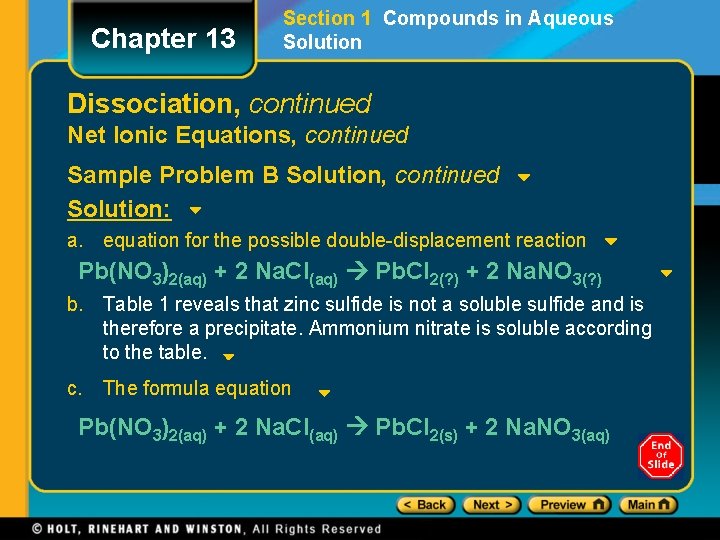
Chapter 13 Section 1 Compounds in Aqueous Solution Dissociation, continued Net Ionic Equations, continued Sample Problem B Solution, continued Solution: a. equation for the possible double-displacement reaction Pb(NO 3)2(aq) + 2 Na. Cl(aq) Pb. Cl 2(? ) + 2 Na. NO 3(? ) b. Table 1 reveals that zinc sulfide is not a soluble sulfide and is therefore a precipitate. Ammonium nitrate is soluble according to the table. c. The formula equation Pb(NO 3)2(aq) + 2 Na. Cl(aq) Pb. Cl 2(s) + 2 Na. NO 3(aq)
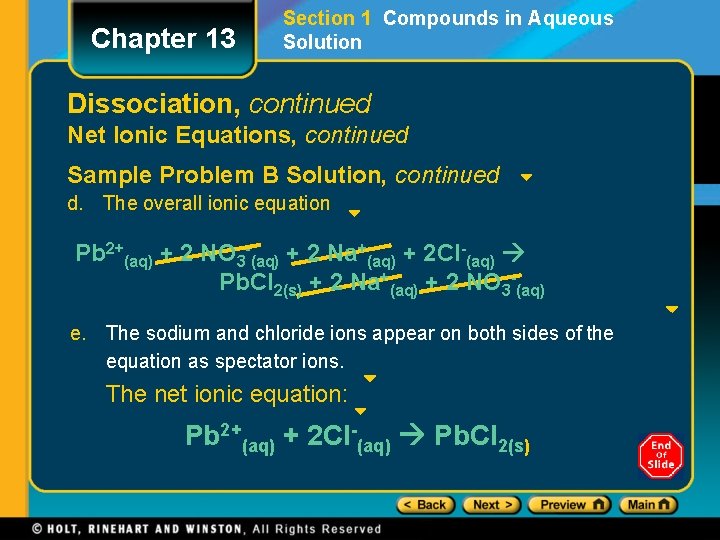
Chapter 13 Section 1 Compounds in Aqueous Solution Dissociation, continued Net Ionic Equations, continued Sample Problem B Solution, continued d. The overall ionic equation Pb 2+(aq) + 2 NO 3 -(aq) + 2 Na+(aq) + 2 Cl-(aq) Pb. Cl 2(s) + 2 Na+(aq) + 2 NO 3 -(aq) e. The sodium and chloride ions appear on both sides of the equation as spectator ions. The net ionic equation: Pb 2+(aq) + 2 Cl-(aq) Pb. Cl 2(s)
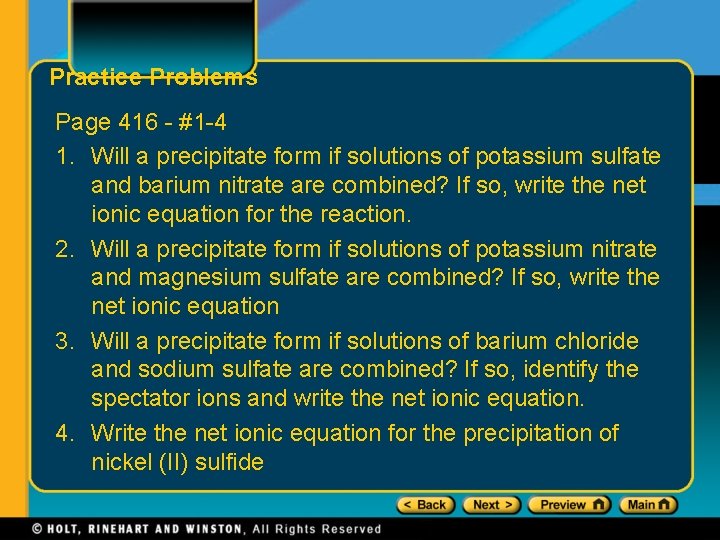
Practice Problems Page 416 - #1 -4 1. Will a precipitate form if solutions of potassium sulfate and barium nitrate are combined? If so, write the net ionic equation for the reaction. 2. Will a precipitate form if solutions of potassium nitrate and magnesium sulfate are combined? If so, write the net ionic equation 3. Will a precipitate form if solutions of barium chloride and sodium sulfate are combined? If so, identify the spectator ions and write the net ionic equation. 4. Write the net ionic equation for the precipitation of nickel (II) sulfide
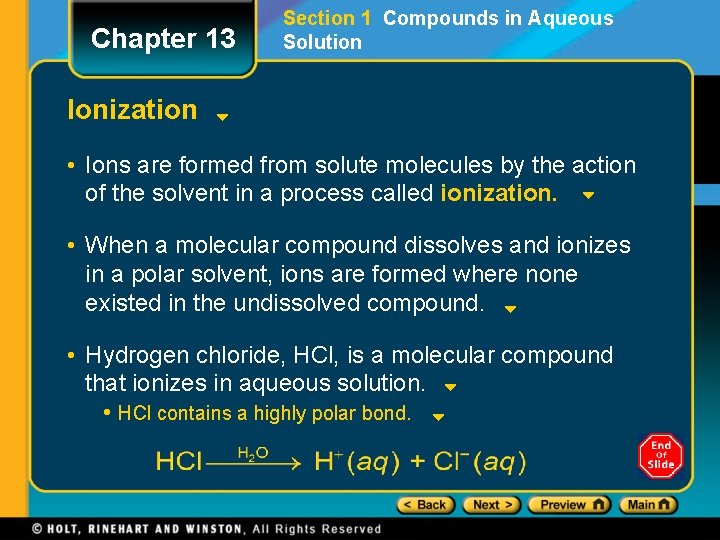
Chapter 13 Section 1 Compounds in Aqueous Solution Ionization • Ions are formed from solute molecules by the action of the solvent in a process called ionization. • When a molecular compound dissolves and ionizes in a polar solvent, ions are formed where none existed in the undissolved compound. • Hydrogen chloride, HCl, is a molecular compound that ionizes in aqueous solution. • HCl contains a highly polar bond.
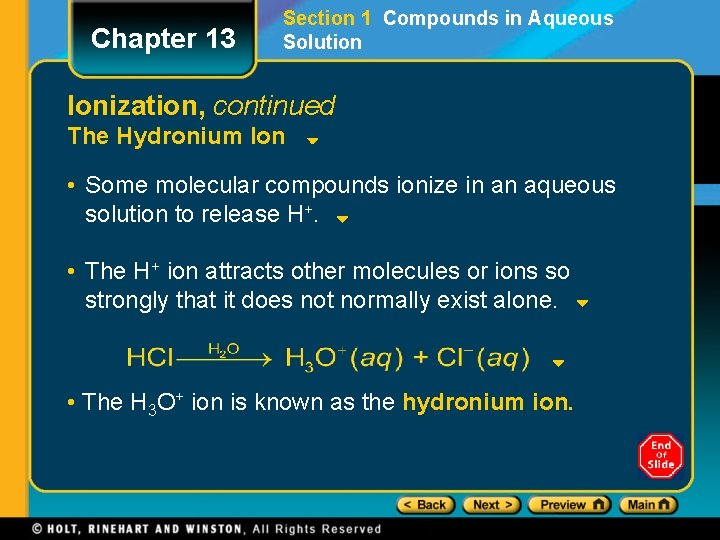
Chapter 13 Section 1 Compounds in Aqueous Solution Ionization, continued The Hydronium Ion • Some molecular compounds ionize in an aqueous solution to release H+. • The H+ ion attracts other molecules or ions so strongly that it does not normally exist alone. • The H 3 O+ ion is known as the hydronium ion.
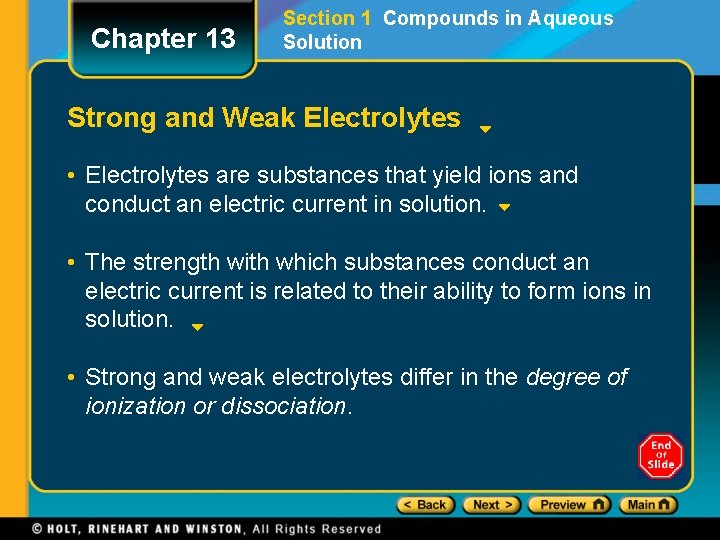
Chapter 13 Section 1 Compounds in Aqueous Solution Strong and Weak Electrolytes • Electrolytes are substances that yield ions and conduct an electric current in solution. • The strength with which substances conduct an electric current is related to their ability to form ions in solution. • Strong and weak electrolytes differ in the degree of ionization or dissociation.
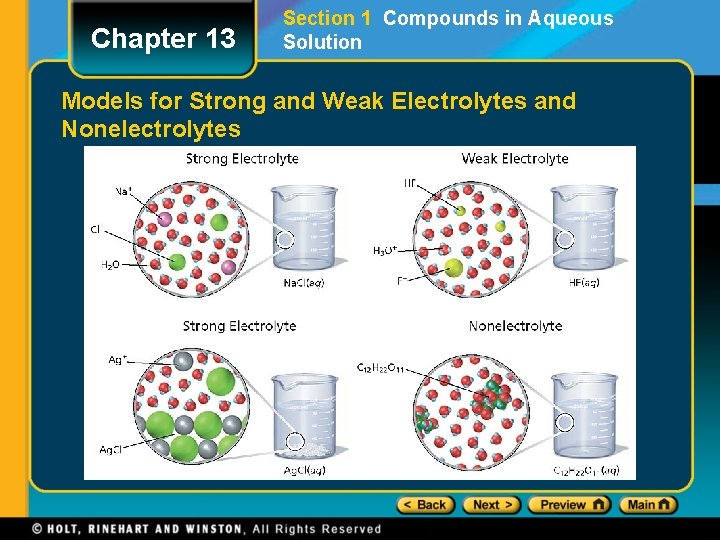
Chapter 13 Section 1 Compounds in Aqueous Solution Models for Strong and Weak Electrolytes and Nonelectrolytes
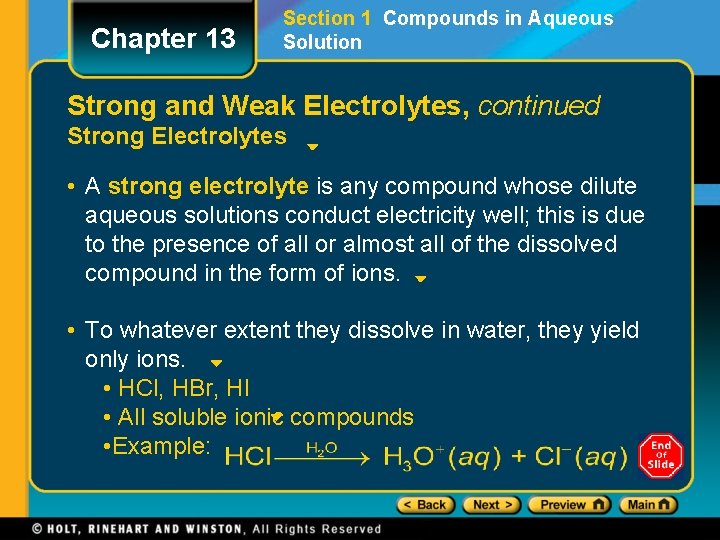
Chapter 13 Section 1 Compounds in Aqueous Solution Strong and Weak Electrolytes, continued Strong Electrolytes • A strong electrolyte is any compound whose dilute aqueous solutions conduct electricity well; this is due to the presence of all or almost all of the dissolved compound in the form of ions. • To whatever extent they dissolve in water, they yield only ions. • HCl, HBr, HI • All soluble ionic compounds • Example:
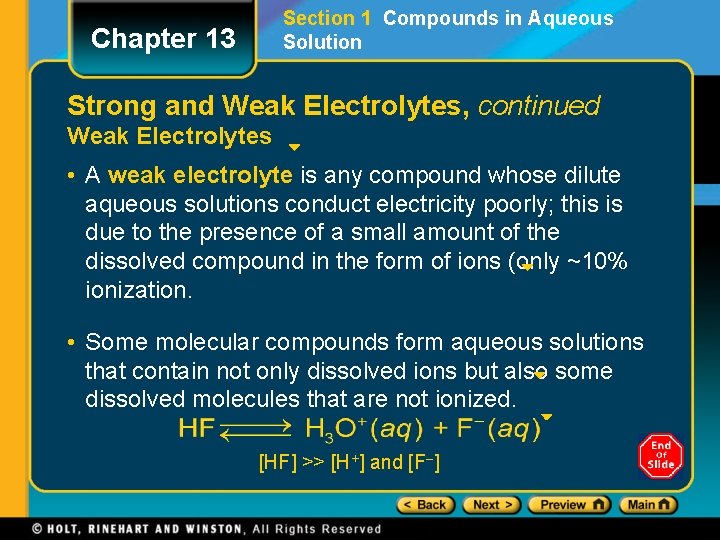
Section 1 Compounds in Aqueous Solution Chapter 13 Strong and Weak Electrolytes, continued Weak Electrolytes • A weak electrolyte is any compound whose dilute aqueous solutions conduct electricity poorly; this is due to the presence of a small amount of the dissolved compound in the form of ions (only ~10% ionization. • Some molecular compounds form aqueous solutions that contain not only dissolved ions but also some dissolved molecules that are not ionized. [HF] >> [H+] and [F–]
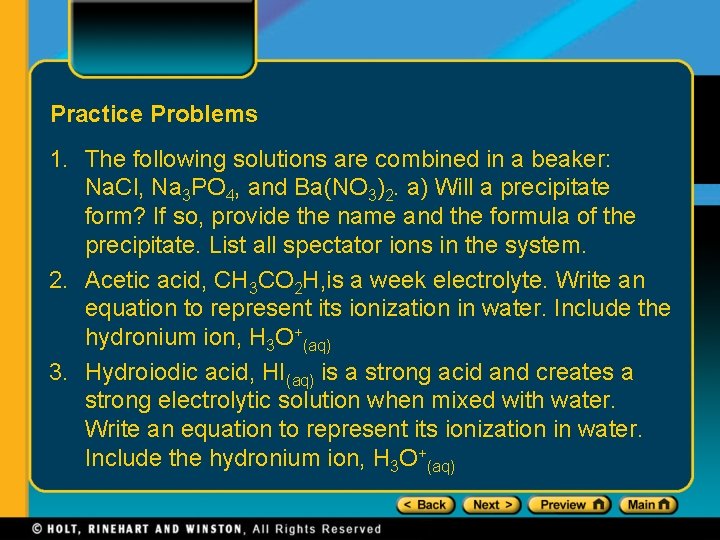
Practice Problems 1. The following solutions are combined in a beaker: Na. Cl, Na 3 PO 4, and Ba(NO 3)2. a) Will a precipitate form? If so, provide the name and the formula of the precipitate. List all spectator ions in the system. 2. Acetic acid, CH 3 CO 2 H, is a week electrolyte. Write an equation to represent its ionization in water. Include the hydronium ion, H 3 O+(aq) 3. Hydroiodic acid, HI(aq) is a strong acid and creates a strong electrolytic solution when mixed with water. Write an equation to represent its ionization in water. Include the hydronium ion, H 3 O+(aq)
End of Chapter 13 -1 Show