
Reactions in Aqueous solutions General Properties of Aqueous

- Slides: 40
Reactions in Aqueous solutions
General Properties of Aqueous Soultions ▪ A solution is a homogeneous mixture of two or more substances. The substance present in greatest quantity is called the solvent and the other substance are the solutes. ▪ Electrolytes and nonelectrolytes– A substance (such as Na. Cl) whose aqueous solutions contain ions are called an electrolyte. A substance such as C 12 H 22 O 11 that does not form ions in solutions is called a nonelectrolyte. The different classifications occur because sodium chloride is an ionic compound and sugar is a molecular compound.
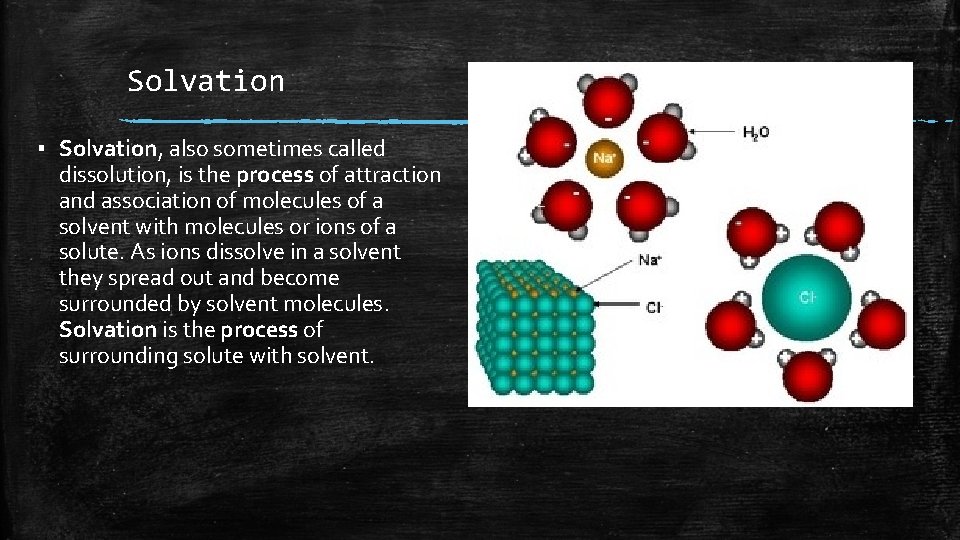
How compounds dissolve in water ▪ Water is a very effective solvent for ionic compounds. Although water is an electrically neutral molecule, the O atom is rich in electrons and has a partial negative charge, while each hydrogen has a partial positive charge. Cations are therefore attracted to the negative end of water and the anions are attracted to the positive end. As an ionic compound dissolves the ions become surrounded by water molecules. The ions are said to be SOLVATED. In chemical equations, we denote the solvated ions by writing them as Na+ (aq) and Cl- (aq).
Solvation ▪ Solvation, also sometimes called dissolution, is the process of attraction and association of molecules of a solvent with molecules or ions of a solute. As ions dissolve in a solvent they spread out and become surrounded by solvent molecules. Solvation is the process of surrounding solute with solvent.
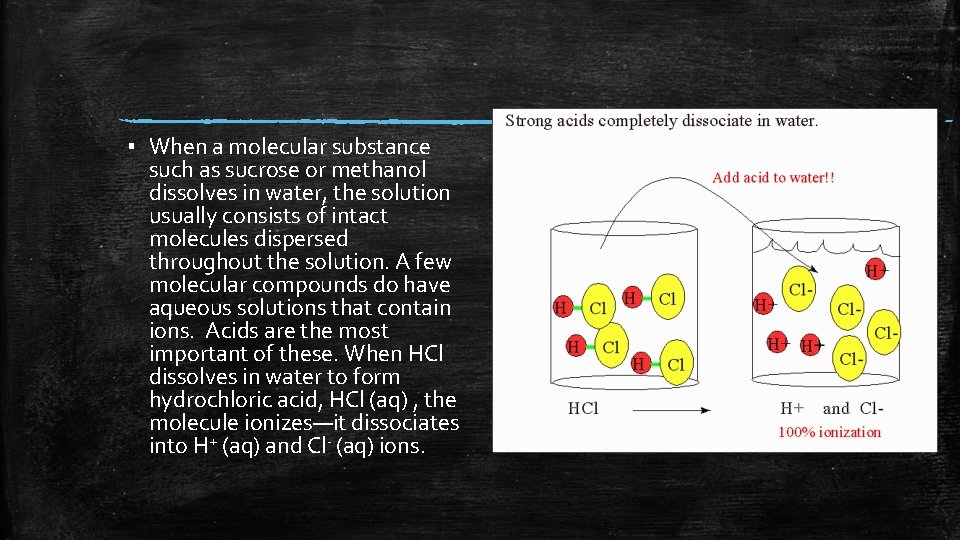
▪ When a molecular substance such as sucrose or methanol dissolves in water, the solution usually consists of intact molecules dispersed throughout the solution. A few molecular compounds do have aqueous solutions that contain ions. Acids are the most important of these. When HCl dissolves in water to form hydrochloric acid, HCl (aq) , the molecule ionizes—it dissociates into H+ (aq) and Cl- (aq) ions.
Strong and Weak Electrolytes ▪ Electrolytes differ in the extent to which they conduct electricity. ▪ Weak electrolytes are those solutes that exist in solution mostly in the form of neutral molecules with only a small fraction in the form of ions. ▪ Acetic acid (CH 3 COOH) most of the solute is present as CH 3 COOH (aq) molecules. Only a small fraction, about 1% of the acetic acid has dissolved into H+ (aq) and CH 3 COO- (aq) ions.
Strong and Weak Electrolytes ▪ Do not confuse the extent to which an electrolyte dissolves (its solubility) with whether it is strong or weak. Acetic Acid is extremely soluble in water but it is a weak electrolyte. Calcium hydroxide is not very soluble in water, but the amount that does dissolve dissociates almost completely. So calcium hydroxide is a strong electrolyte.
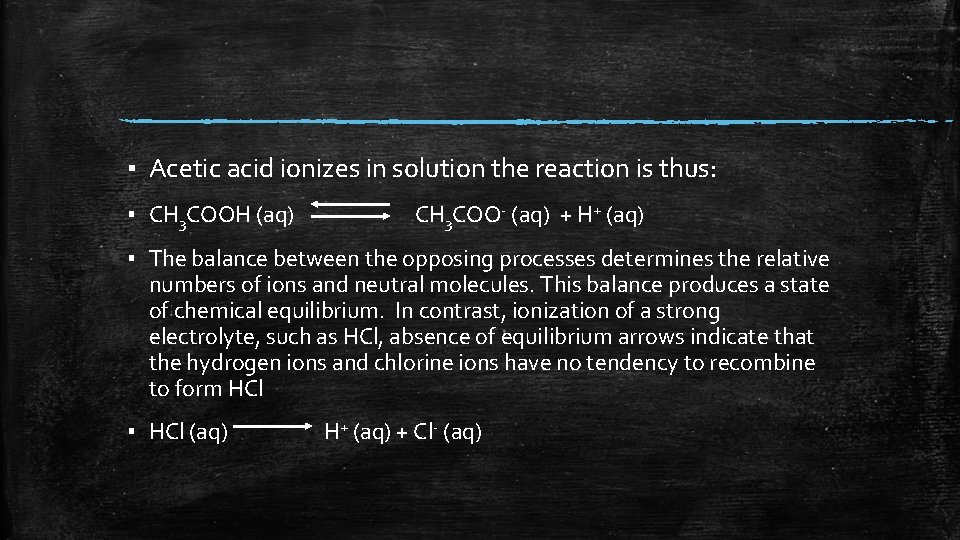
▪ Acetic acid ionizes in solution the reaction is thus: ▪ CH 3 COOH (aq) CH 3 COO- (aq) + H+ (aq) ▪ The balance between the opposing processes determines the relative numbers of ions and neutral molecules. This balance produces a state of chemical equilibrium. In contrast, ionization of a strong electrolyte, such as HCl, absence of equilibrium arrows indicate that the hydrogen ions and chlorine ions have no tendency to recombine to form HCl ▪ HCl (aq) H+ (aq) + Cl- (aq)
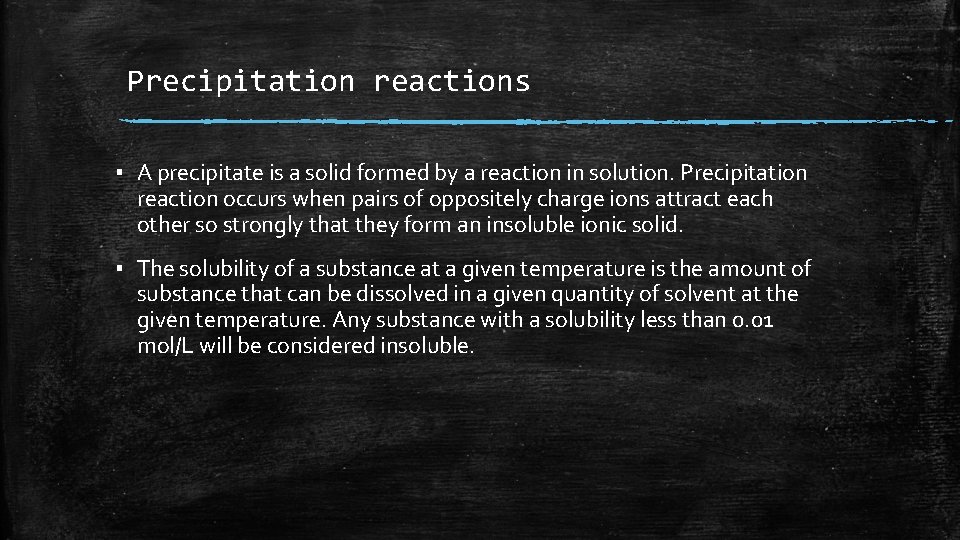
Precipitation reactions ▪ A precipitate is a solid formed by a reaction in solution. Precipitation reaction occurs when pairs of oppositely charge ions attract each other so strongly that they form an insoluble ionic solid. ▪ The solubility of a substance at a given temperature is the amount of substance that can be dissolved in a given quantity of solvent at the given temperature. Any substance with a solubility less than 0. 01 mol/L will be considered insoluble.
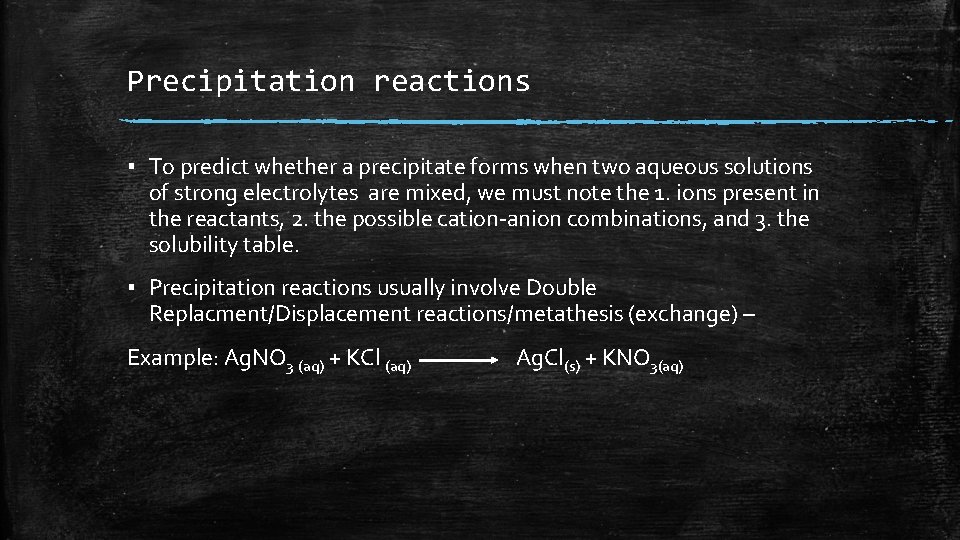
Precipitation reactions ▪ To predict whether a precipitate forms when two aqueous solutions of strong electrolytes are mixed, we must note the 1. ions present in the reactants, 2. the possible cation-anion combinations, and 3. the solubility table. ▪ Precipitation reactions usually involve Double Replacment/Displacement reactions/metathesis (exchange) – Example: Ag. NO 3 (aq) + KCl (aq) Ag. Cl(s) + KNO 3(aq)
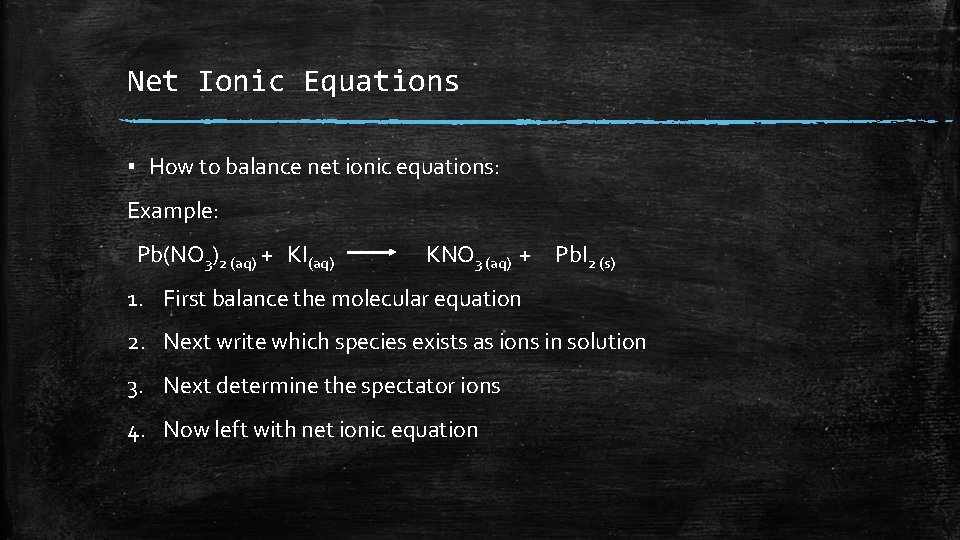
Net Ionic Equations ▪ How to balance net ionic equations: Example: Pb(NO 3)2 (aq) + KI(aq) KNO 3 (aq) + Pb. I 2 (s) 1. First balance the molecular equation 2. Next write which species exists as ions in solution 3. Next determine the spectator ions 4. Now left with net ionic equation
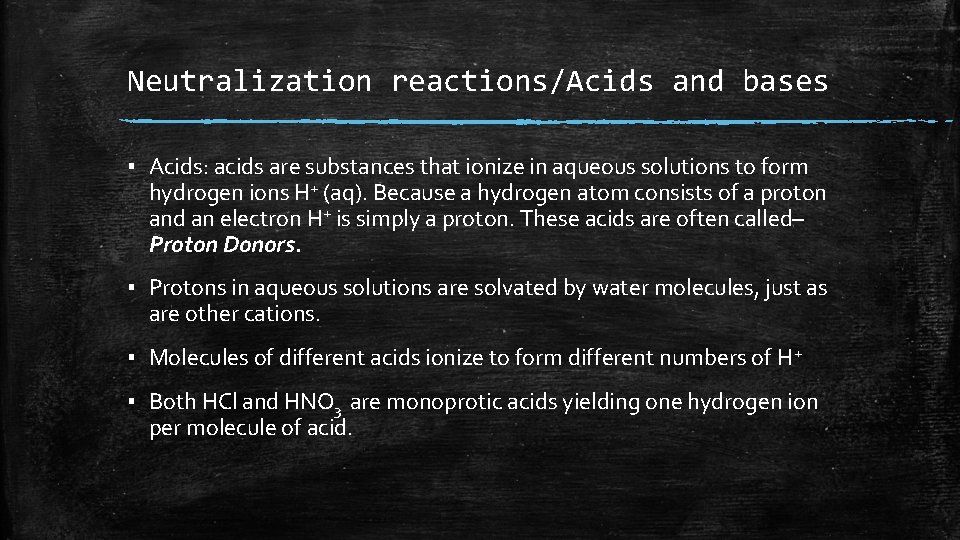
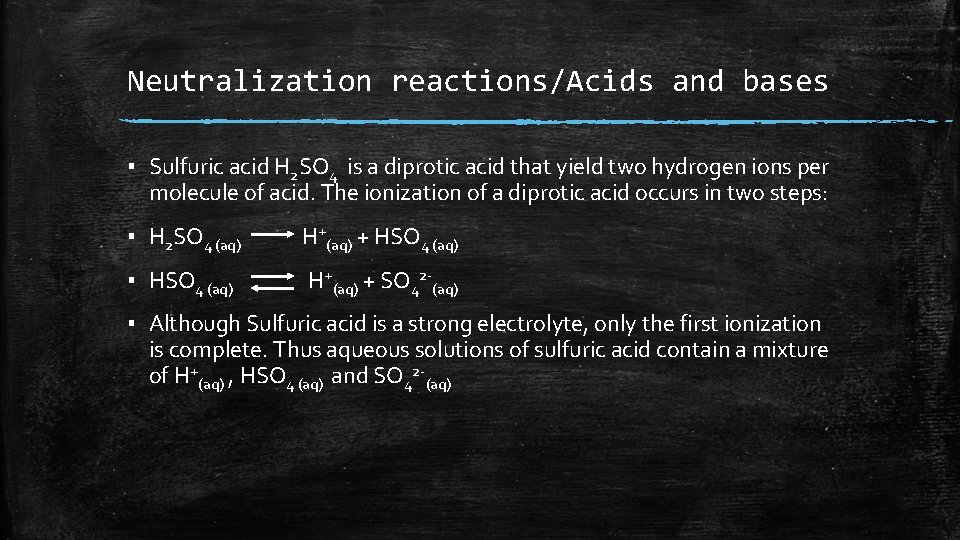
Neutralization reactions/Acids and bases ▪ Acids: acids are substances that ionize in aqueous solutions to form hydrogen ions H+ (aq). Because a hydrogen atom consists of a proton and an electron H+ is simply a proton. These acids are often called– Proton Donors. ▪ Protons in aqueous solutions are solvated by water molecules, just as are other cations. ▪ Molecules of different acids ionize to form different numbers of H + ▪ Both HCl and HNO 3 are monoprotic acids yielding one hydrogen ion per molecule of acid.
Neutralization reactions/Acids and bases ▪ Sulfuric acid H 2 SO 4 is a diprotic acid that yield two hydrogen ions per molecule of acid. The ionization of a diprotic acid occurs in two steps: ▪ H 2 SO 4 (aq) H+(aq) + HSO 4 (aq) ▪ HSO 4 (aq) H+(aq) + SO 42 -(aq) ▪ Although Sulfuric acid is a strong electrolyte, only the first ionization is complete. Thus aqueous solutions of sulfuric acid contain a mixture of H+(aq) , HSO 4 (aq) and SO 42 -(aq)
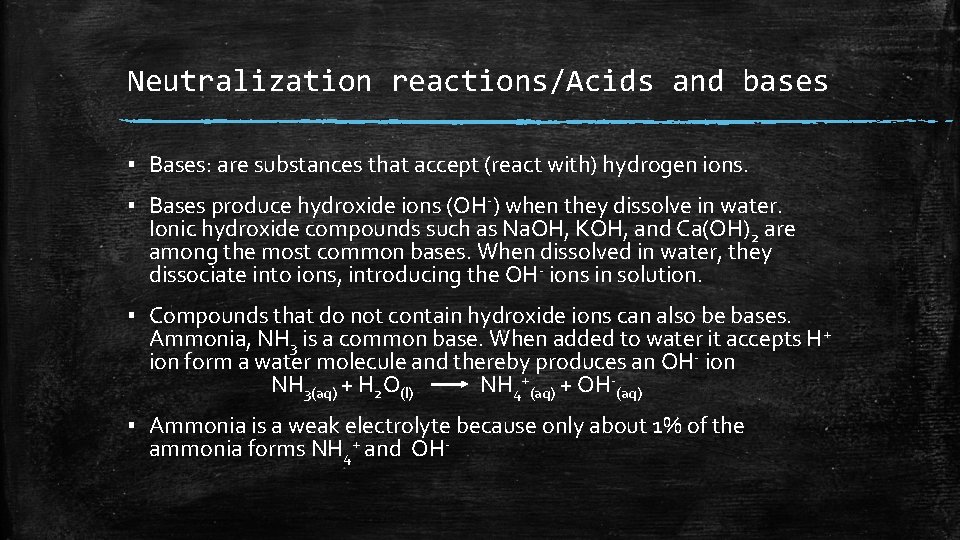
Neutralization reactions/Acids and bases ▪ Bases: are substances that accept (react with) hydrogen ions. ▪ Bases produce hydroxide ions (OH-) when they dissolve in water. Ionic hydroxide compounds such as Na. OH, KOH, and Ca(OH)2 are among the most common bases. When dissolved in water, they dissociate into ions, introducing the OH- ions in solution. ▪ Compounds that do not contain hydroxide ions can also be bases. Ammonia, NH 3 is a common base. When added to water it accepts H+ ion form a water molecule and thereby produces an OH- ion NH 3(aq) + H 2 O(l) NH 4+(aq) + OH-(aq) ▪ Ammonia is a weak electrolyte because only about 1% of the ammonia forms NH 4+ and OH-
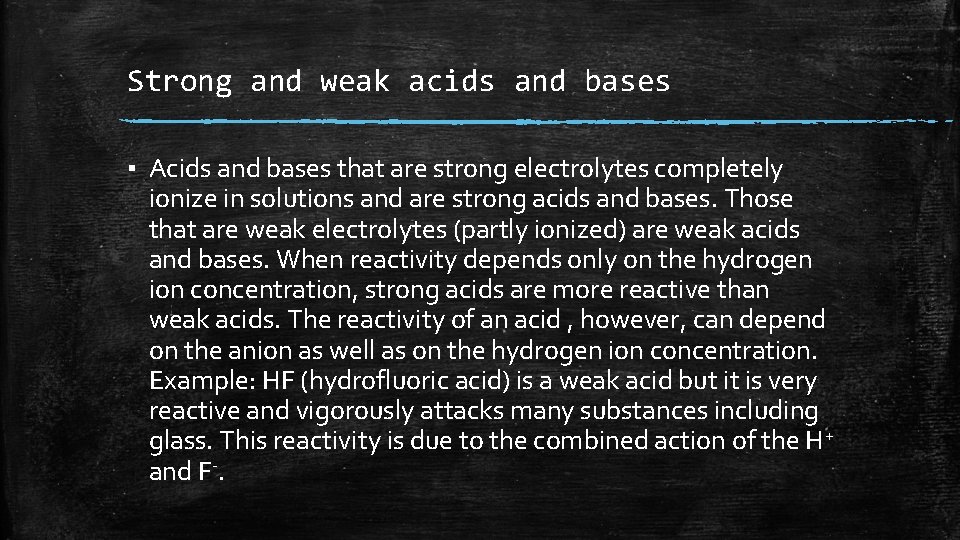
Strong and weak acids and bases ▪ Acids and bases that are strong electrolytes completely ionize in solutions and are strong acids and bases. Those that are weak electrolytes (partly ionized) are weak acids and bases. When reactivity depends only on the hydrogen ion concentration, strong acids are more reactive than weak acids. The reactivity of an acid , however, can depend on the anion as well as on the hydrogen ion concentration. Example: HF (hydrofluoric acid) is a weak acid but it is very reactive and vigorously attacks many substances including glass. This reactivity is due to the combined action of the H+ and F-.
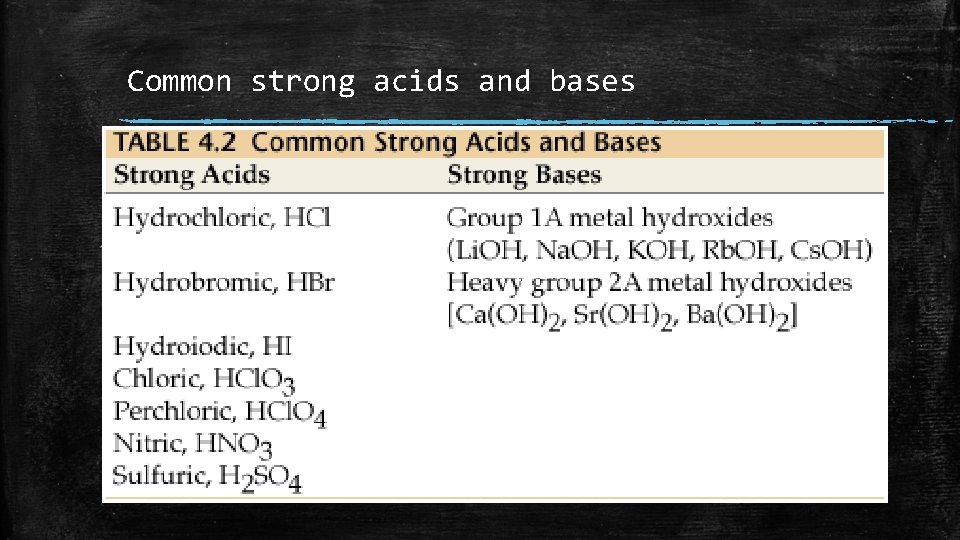
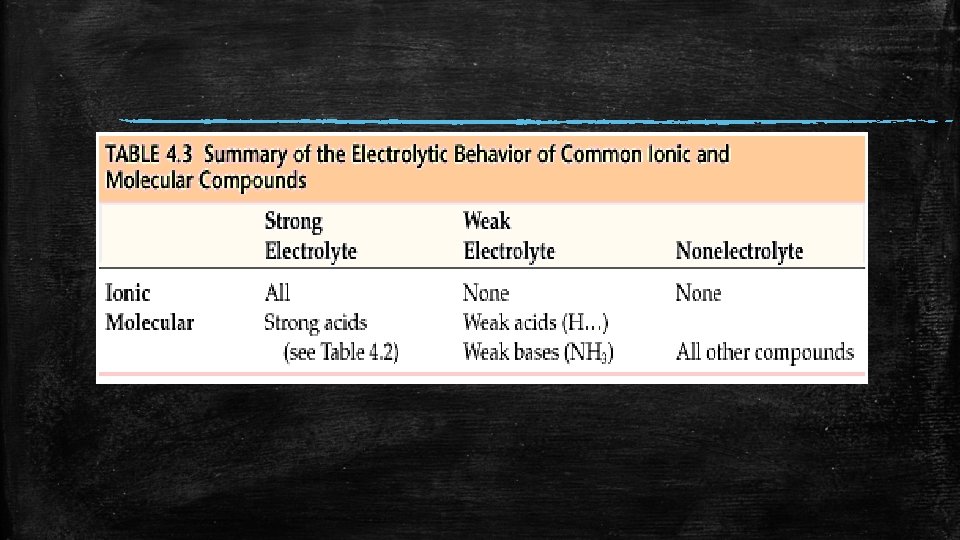
Common strong acids and bases
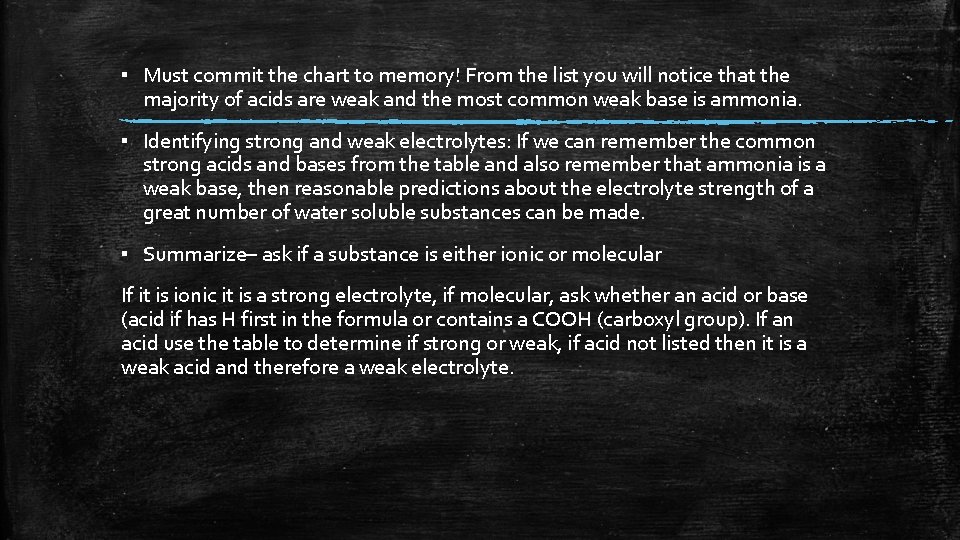
▪ Must commit the chart to memory! From the list you will notice that the majority of acids are weak and the most common weak base is ammonia. ▪ Identifying strong and weak electrolytes: If we can remember the common strong acids and bases from the table and also remember that ammonia is a weak base, then reasonable predictions about the electrolyte strength of a great number of water soluble substances can be made. ▪ Summarize– ask if a substance is either ionic or molecular If it is ionic it is a strong electrolyte, if molecular, ask whether an acid or base (acid if has H first in the formula or contains a COOH (carboxyl group). If an acid use the table to determine if strong or weak, if acid not listed then it is a weak acid and therefore a weak electrolyte.
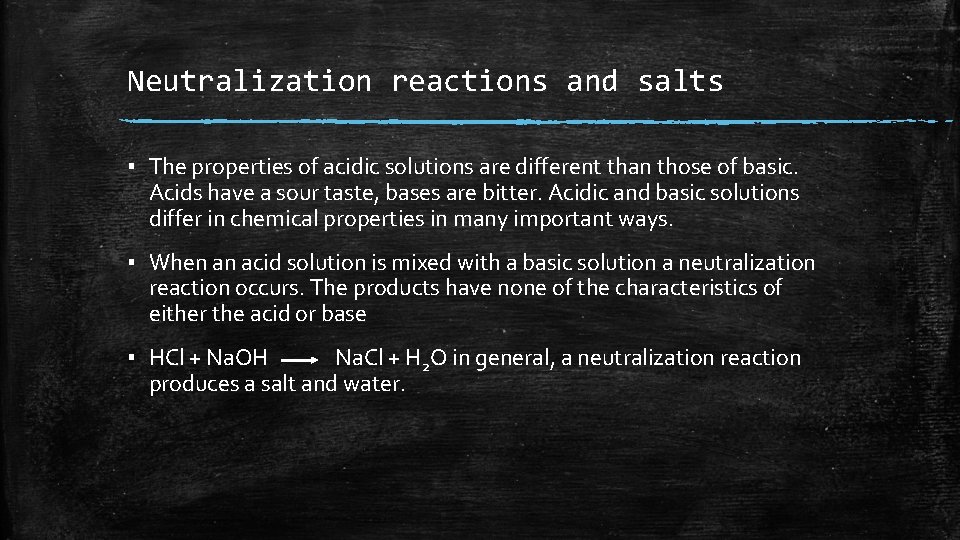
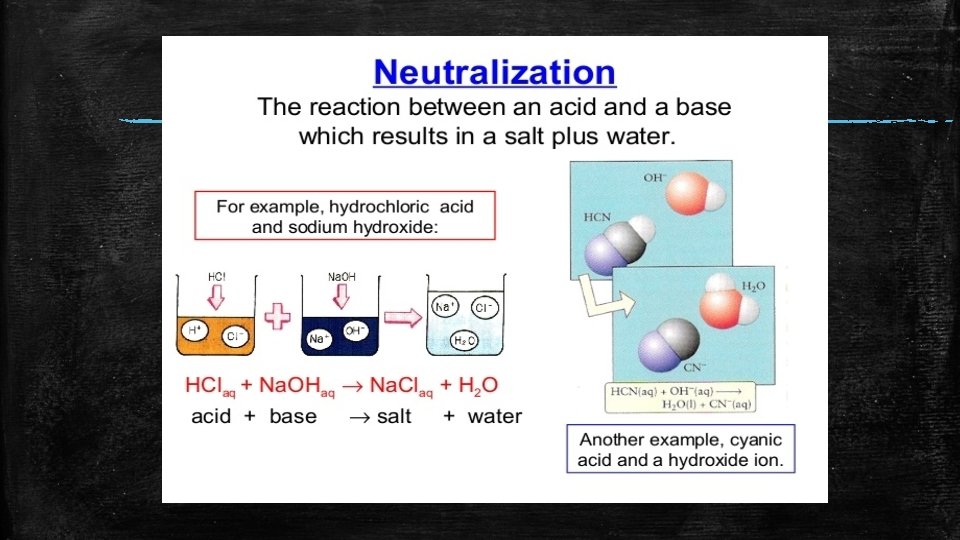
Neutralization reactions and salts ▪ The properties of acidic solutions are different than those of basic. Acids have a sour taste, bases are bitter. Acidic and basic solutions differ in chemical properties in many important ways. ▪ When an acid solution is mixed with a basic solution a neutralization reaction occurs. The products have none of the characteristics of either the acid or base ▪ HCl + Na. OH Na. Cl + H 2 O in general, a neutralization reaction produces a salt and water.
Oxidation-Reduction Reactions ▪ In precipitation reactions cations and anions come together to form an insoluble ionic compound. In neutralization reactions, protons are transferred from one reaction to another. ▪ A third type of reaction in which electrons are transferred from one reactant to another. These reactions are called Oxidation-reduction or Redox Reactions.
Redox Reactions ▪ Redox Reactions are critical in biological and geological processes, they also form the basis for energy related technology such as batteries and fuel cells. ▪ One of the most familiar redox reaction is corrosion of a metal. Corrosion is sometimes limited to the surface of the metal as is the case with the green coating that forms on copper roofs and statutes. Other instances the corrosion goes deeper compromising the structural integrity of the metal such as with the rusting of iron.
Redox Reactions ▪ Corrosion a a conversion of a metal into a metal compound by the reaction of the metal with some substance from the environment. ▪ When a metal corrodes, each metal atom loses electrons and forms a cation which can combine with an anion to form an ionic compound. ▪ The green coating on the statute of Liberty contains copper II ions combined with carbonate and hydroxide ions. Rust contains iron III combined with oxide and hydroxide ions, silver tarnish is silver ions with sulfide anions.
Redox Reactions ▪ When an atom loses an electron and becomes positively charged, it has been oxidized. Loss of electrons is called oxidation--▪ When an atom , ion or molecule becomes more negatively charged (gains electrons), it is reduced. The gain of electrons is called reduction. ▪ Oxidation of one substance is accompanied by reduction of some other substance.
Redox Reactions ▪ There is a book-keeping system of keeping track of the substance being reduced (electrons gained) and electrons lost by the substance being reduced. ▪ The concept of oxidation numbers (oxidation states) was devised for this purpose. Each atom in a neutral substance or ion is assigned an oxidation number. For monoatomic ions the oxidation number is the same as the charge. For neutral molecules and polyatomic ions, the oxidation number of a given atom is a hypothetical charge. The charge is assigned by dividing up the electrons among the atoms in the molecule or ion. ▪ See handout for rules for assigning oxidation numbers!
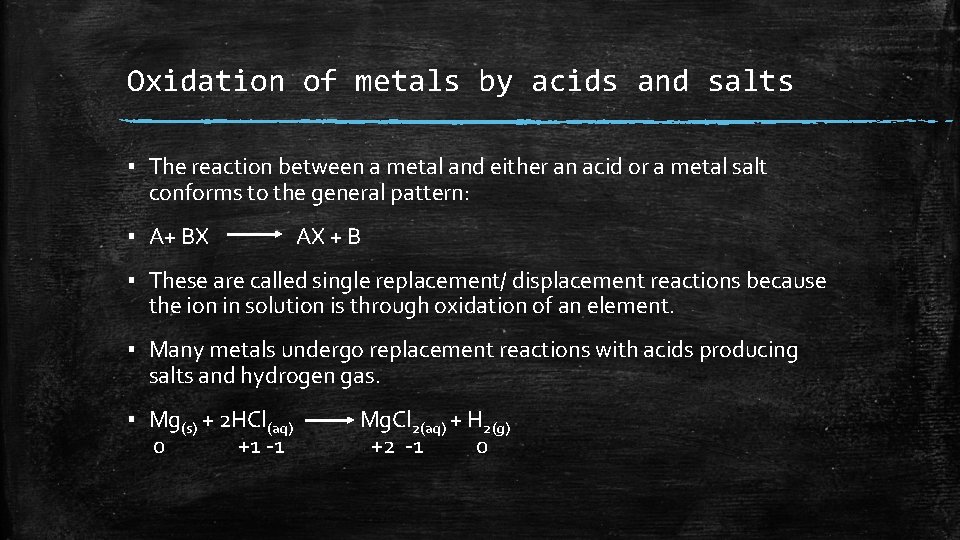
Oxidation of metals by acids and salts ▪ The reaction between a metal and either an acid or a metal salt conforms to the general pattern: ▪ A+ BX AX + B ▪ These are called single replacement/ displacement reactions because the ion in solution is through oxidation of an element. ▪ Many metals undergo replacement reactions with acids producing salts and hydrogen gas. ▪ Mg(s) + 2 HCl(aq) Mg. Cl 2(aq) + H 2(g) 0 +1 -1 +2 -1 0
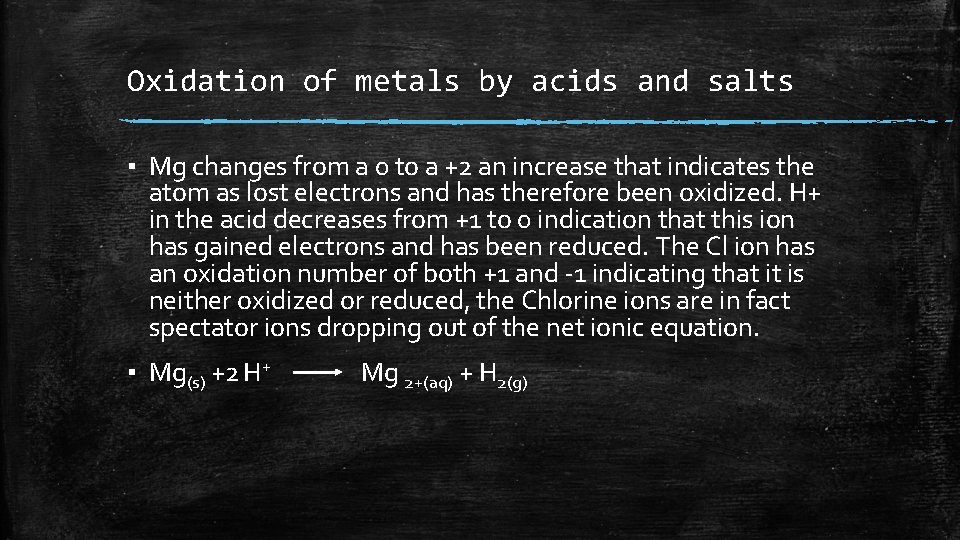
Oxidation of metals by acids and salts ▪ Mg changes from a 0 to a +2 an increase that indicates the atom as lost electrons and has therefore been oxidized. H+ in the acid decreases from +1 to 0 indication that this ion has gained electrons and has been reduced. The Cl ion has an oxidation number of both +1 and -1 indicating that it is neither oxidized or reduced, the Chlorine ions are in fact spectator ions dropping out of the net ionic equation. ▪ Mg(s) +2 H+ Mg 2+(aq) + H 2(g)
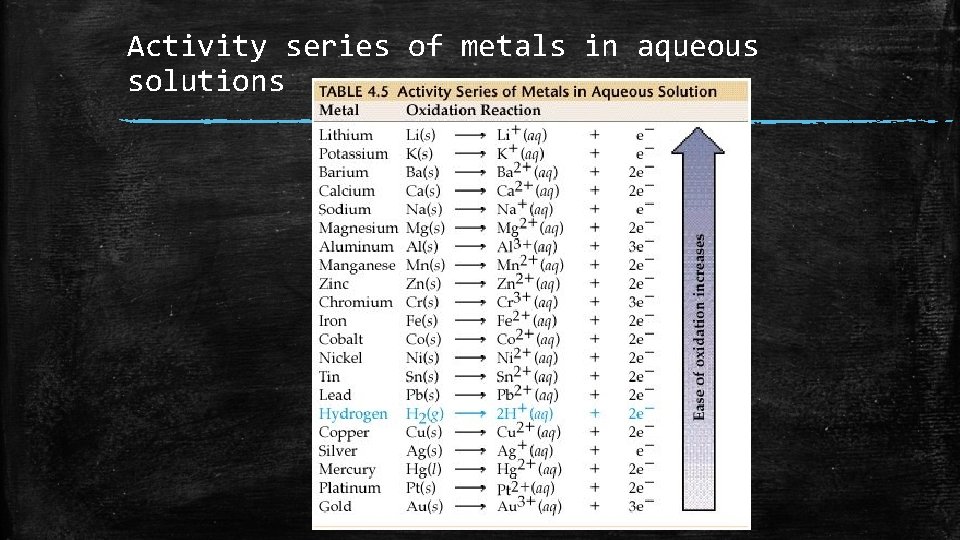
The activity Series ▪ The activity series can be used to predict the outcome of reactions with metals and either metal salts or acids. ▪ Any metal on the list can be oxidized by the ions of the metals below it.
Activity series of metals in aqueous solutions
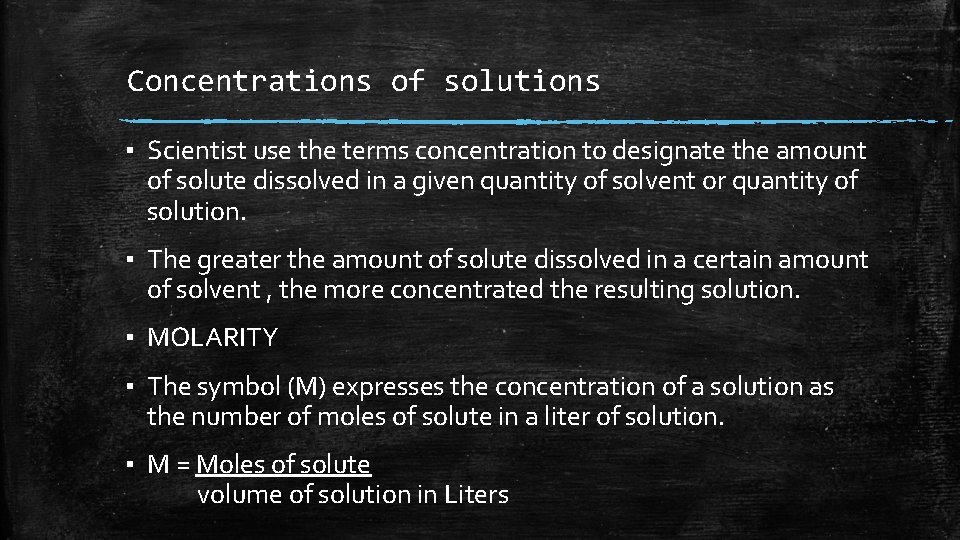
Concentrations of solutions ▪ Scientist use the terms concentration to designate the amount of solute dissolved in a given quantity of solvent or quantity of solution. ▪ The greater the amount of solute dissolved in a certain amount of solvent , the more concentrated the resulting solution. ▪ MOLARITY ▪ The symbol (M) expresses the concentration of a solution as the number of moles of solute in a liter of solution. ▪ M = Moles of solute volume of solution in Liters
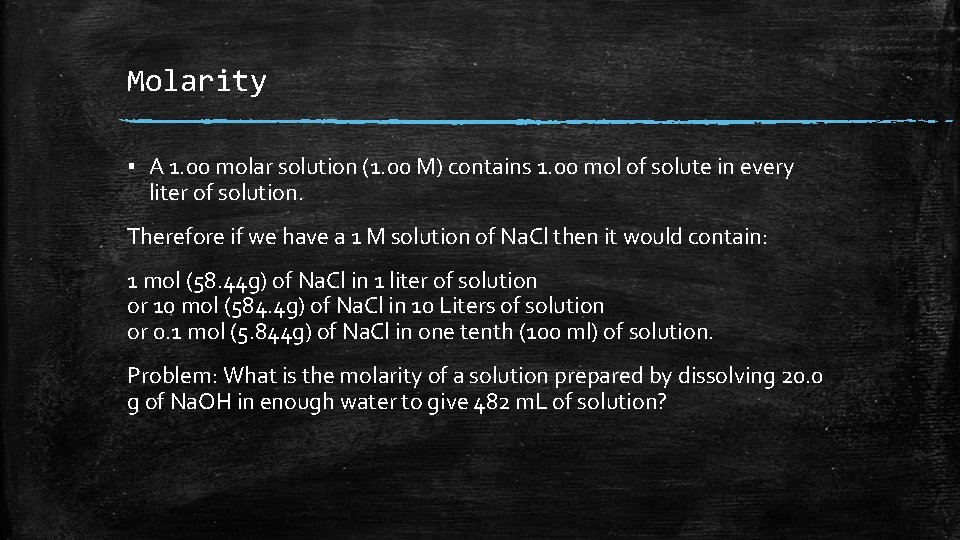
Molarity ▪ A 1. 00 molar solution (1. 00 M) contains 1. 00 mol of solute in every liter of solution. Therefore if we have a 1 M solution of Na. Cl then it would contain: 1 mol (58. 44 g) of Na. Cl in 1 liter of solution or 10 mol (584. 4 g) of Na. Cl in 10 Liters of solution or 0. 1 mol (5. 844 g) of Na. Cl in one tenth (100 ml) of solution. Problem: What is the molarity of a solution prepared by dissolving 20. 0 g of Na. OH in enough water to give 482 m. L of solution?
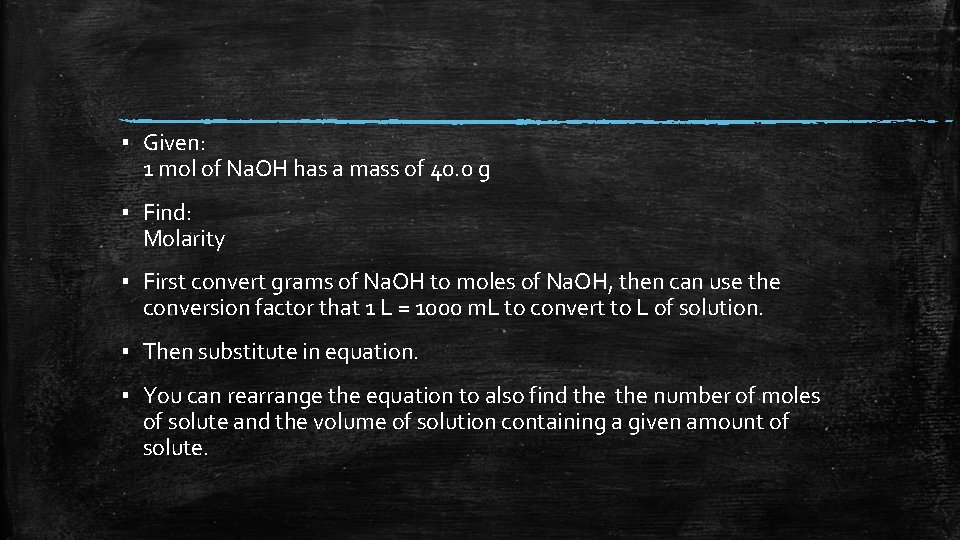
▪ Given: 1 mol of Na. OH has a mass of 40. 0 g ▪ Find: Molarity ▪ First convert grams of Na. OH to moles of Na. OH, then can use the conversion factor that 1 L = 1000 m. L to convert to L of solution. ▪ Then substitute in equation. ▪ You can rearrange the equation to also find the number of moles of solute and the volume of solution containing a given amount of solute.
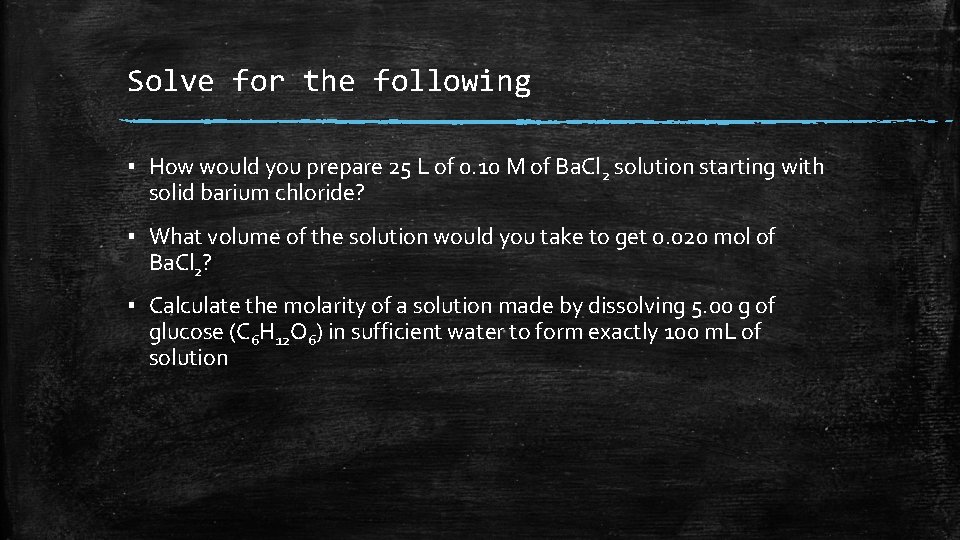
Solve for the following ▪ How would you prepare 25 L of 0. 10 M of Ba. Cl 2 solution starting with solid barium chloride? ▪ What volume of the solution would you take to get 0. 020 mol of Ba. Cl 2? ▪ Calculate the molarity of a solution made by dissolving 5. 00 g of glucose (C 6 H 12 O 6) in sufficient water to form exactly 100 m. L of solution
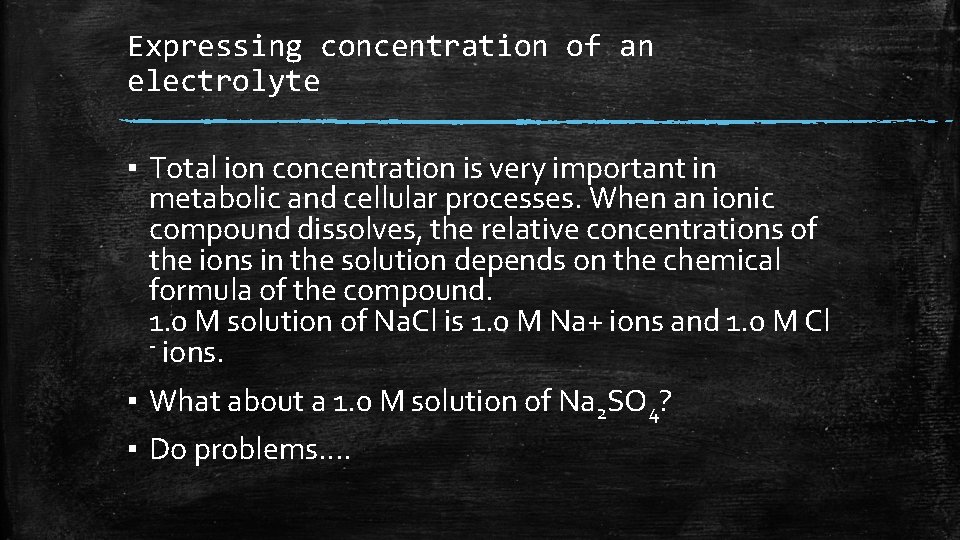
Expressing concentration of an electrolyte ▪ Total ion concentration is very important in metabolic and cellular processes. When an ionic compound dissolves, the relative concentrations of the ions in the solution depends on the chemical formula of the compound. 1. 0 M solution of Na. Cl is 1. 0 M Na+ ions and 1. 0 M Cl - ions. ▪ What about a 1. 0 M solution of Na 2 SO 4? ▪ Do problems….
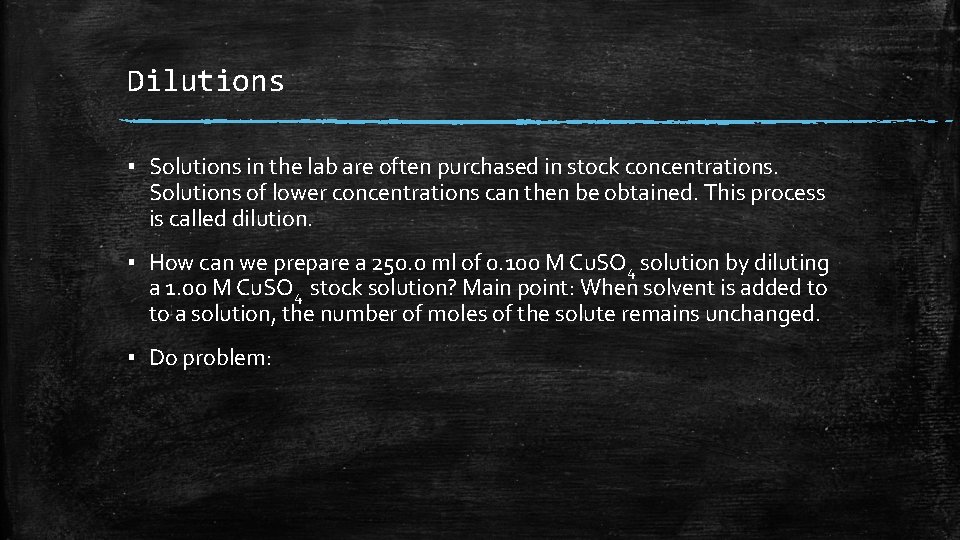
Dilutions ▪ Solutions in the lab are often purchased in stock concentrations. Solutions of lower concentrations can then be obtained. This process is called dilution. ▪ How can we prepare a 250. 0 ml of 0. 100 M Cu. SO 4 solution by diluting a 1. 00 M Cu. SO 4 stock solution? Main point: When solvent is added to to a solution, the number of moles of the solute remains unchanged. ▪ Do problem:
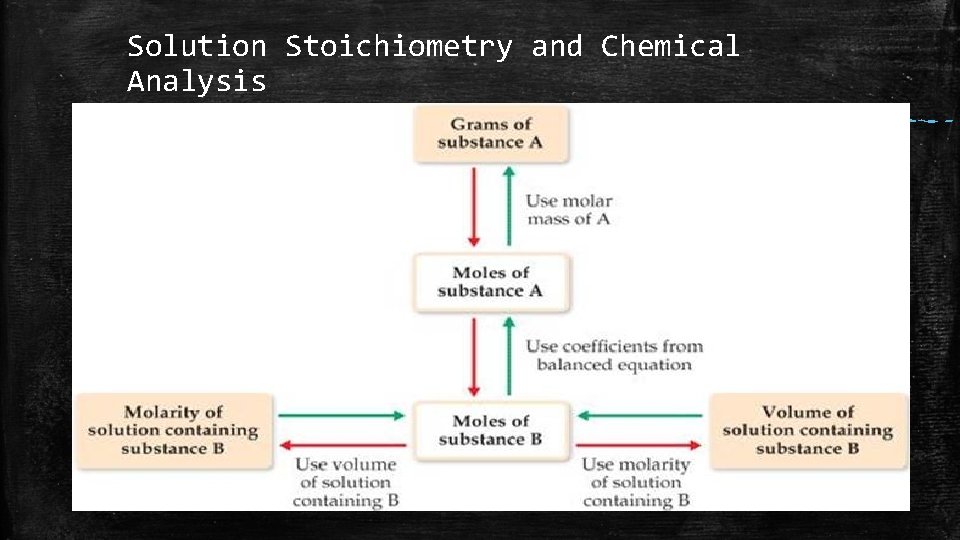
Solution Stoichiometry and Chemical Analysis
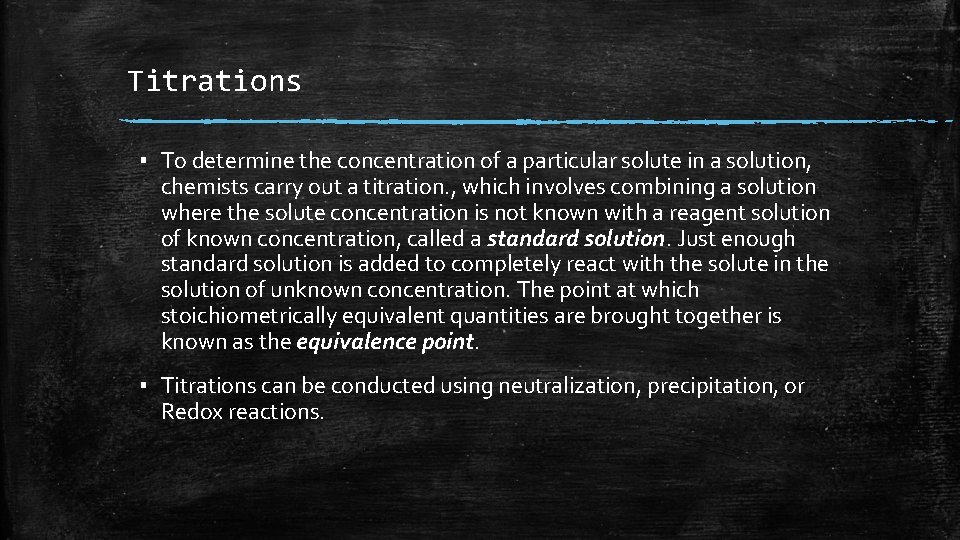
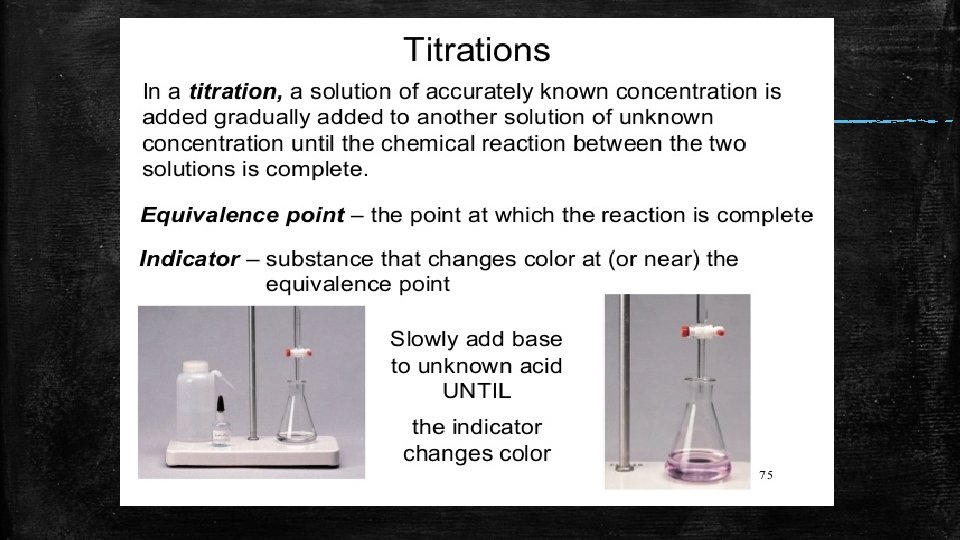
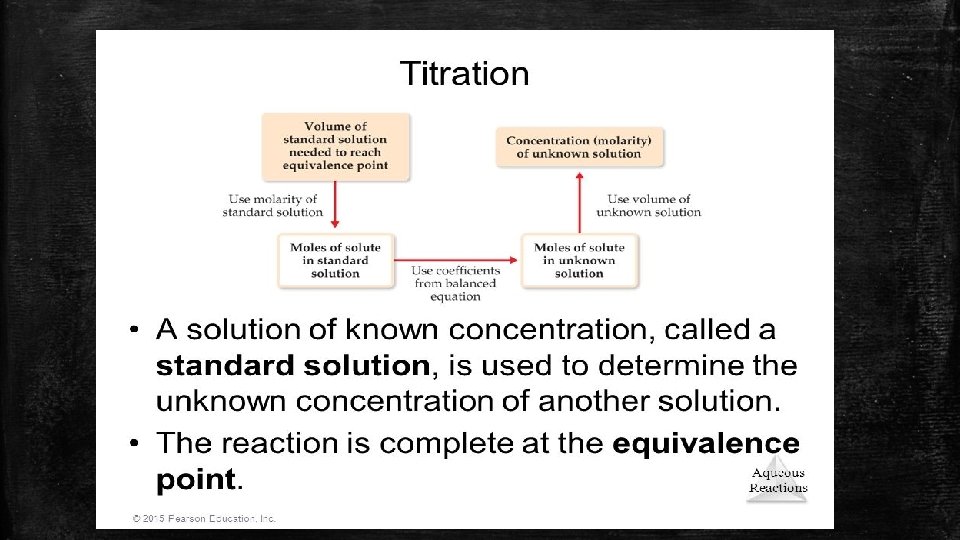
Titrations ▪ To determine the concentration of a particular solute in a solution, chemists carry out a titration. , which involves combining a solution where the solute concentration is not known with a reagent solution of known concentration, called a standard solution. Just enough standard solution is added to completely react with the solute in the solution of unknown concentration. The point at which stoichiometrically equivalent quantities are brought together is known as the equivalence point. ▪ Titrations can be conducted using neutralization, precipitation, or Redox reactions.
PROBLEMS ▪ Problems for class and homework: Will review