Chapter 11 Disjoint Set Outline n n n

- Slides: 60
Chapter 11: Disjoint Set
Outline n n n Equivalence Relation and Equivalence Class (等价关系与等价类) Disjoint Set (不相交集) Implementation of Disjoint Set Class Application of Disjoint Set
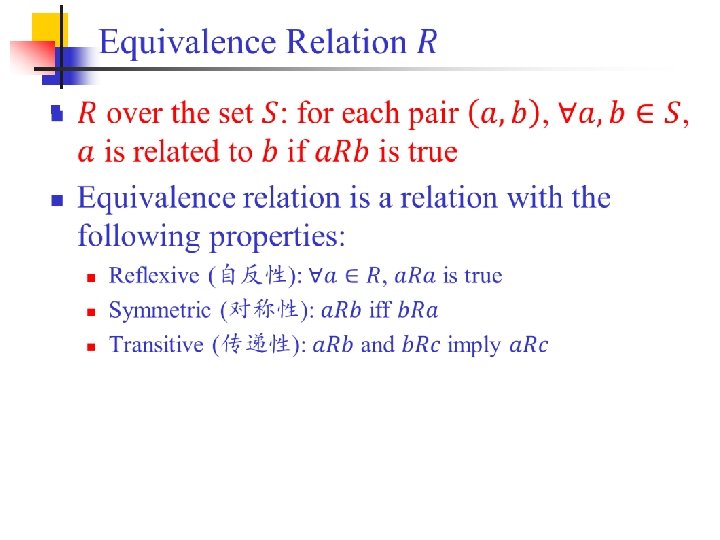
n
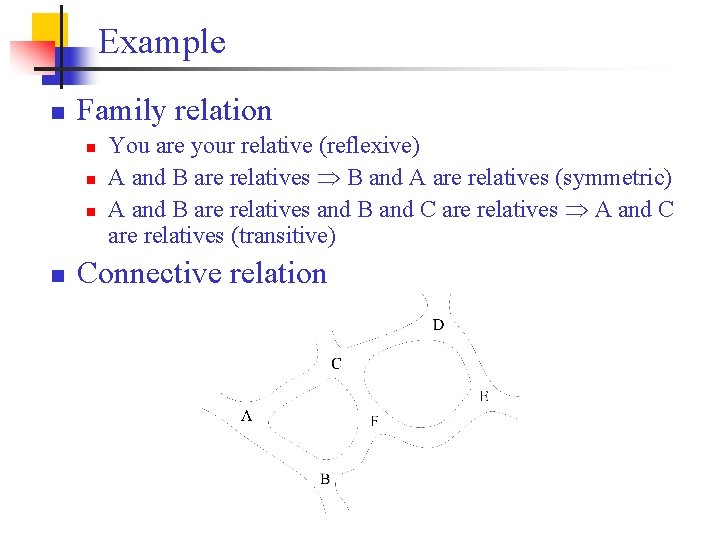
Example n Family relation n n You are your relative (reflexive) A and B are relatives B and A are relatives (symmetric) A and B are relatives and B and C are relatives A and C are relatives (transitive) Connective relation
Operations on the Equivalent Class n n Check if two elements are equivalent Add equivalence relationship between two elements
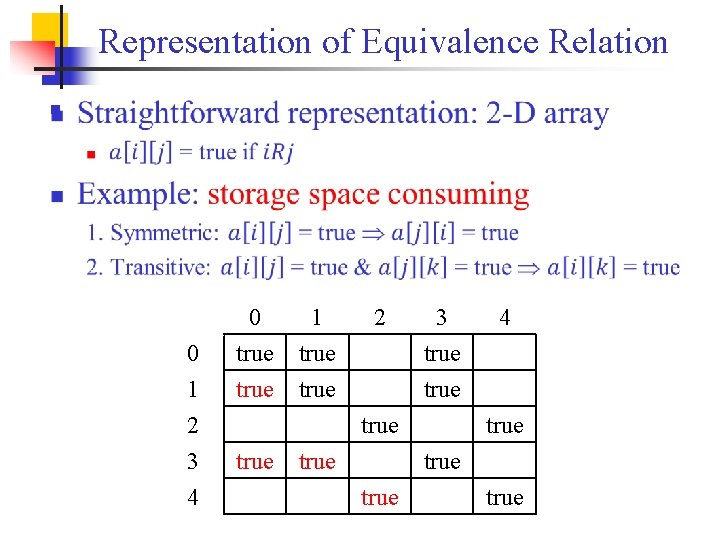
Representation of Equivalence Relation n 0 1 2 3 4 0 true 1 true 2 3 true true 4 true
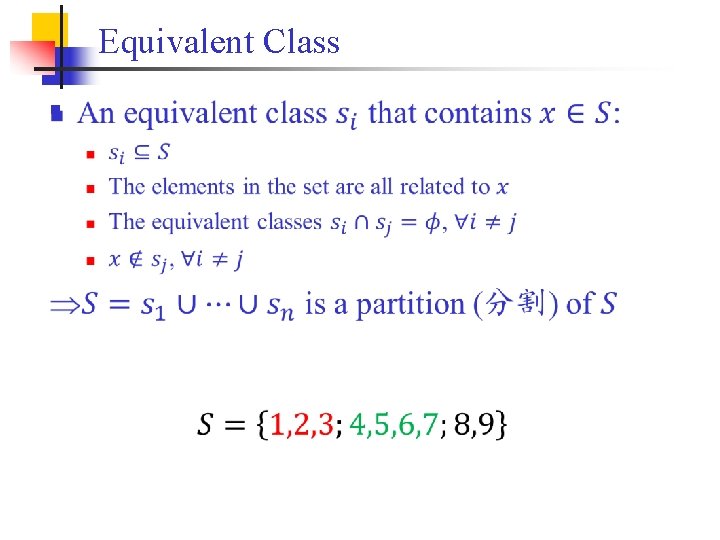
Equivalent Class n
Outline n n n Equivalence Relation and Equivalence Class ( 等价关系与等价类) Disjoint Set (不相交集或并查集) Implementation of Disjoint Set Class Application of Disjoint Set
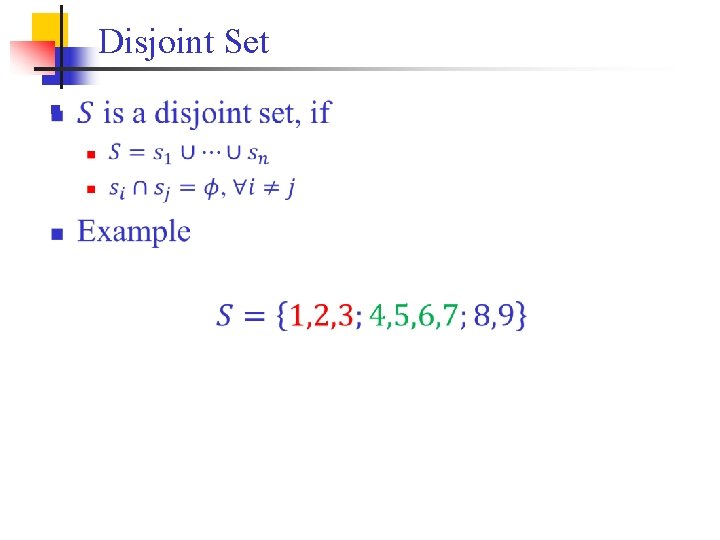
Disjoint Set n
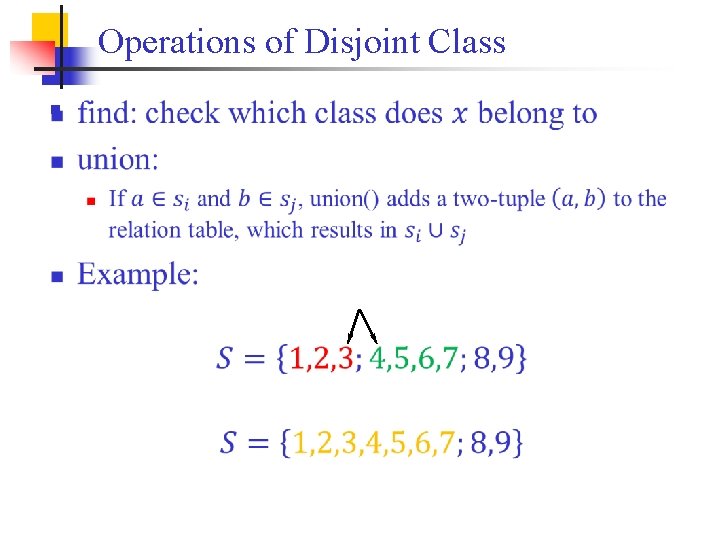
Operations of Disjoint Class n
Outline n n n Equivalence Relation and Equivalence Class ( 等价关系与等价类) Disjoint Set (不相交集) Implementation of Disjoint Set n n Storage Operations Implementation of Disjoint Set Class Application of Disjoint Set
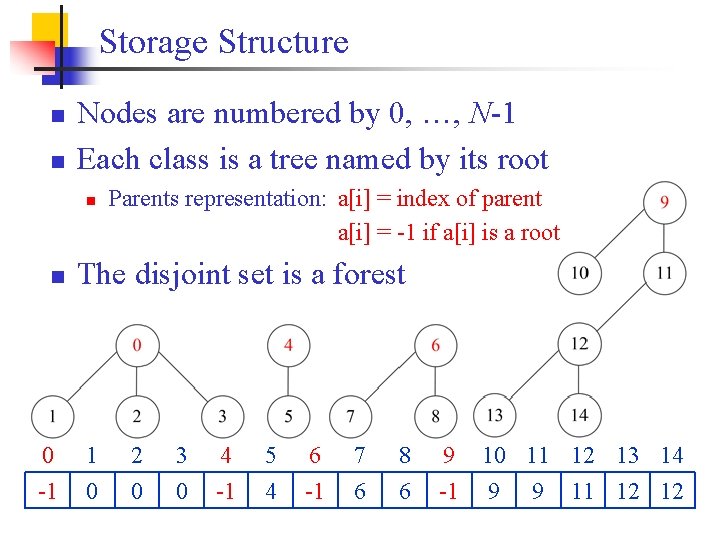
Storage Structure n n Nodes are numbered by 0, …, N-1 Each class is a tree named by its root n n Parents representation: a[i] = index of parent a[i] = -1 if a[i] is a root The disjoint set is a forest 0 1 2 3 4 5 6 7 8 9 10 11 12 13 14 -1 0 0 0 -1 4 -1 6 6 -1 9 9 11 12 12
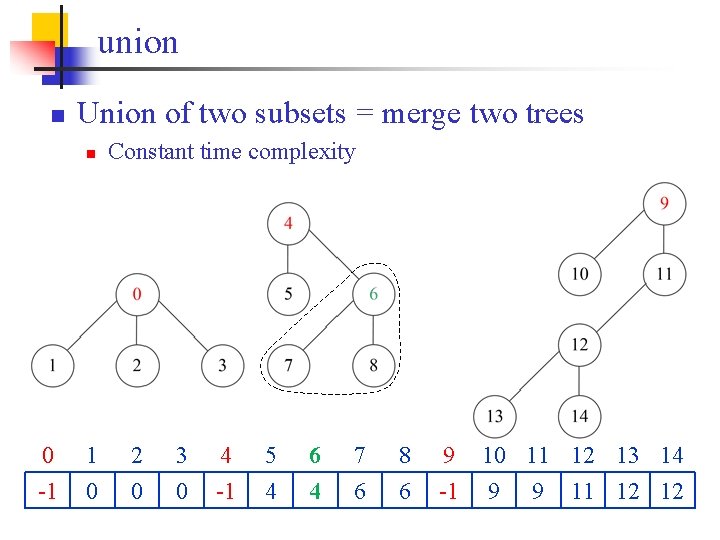
union n Union of two subsets = merge two trees n Constant time complexity 0 1 2 3 4 5 6 7 8 9 10 11 12 13 14 -1 0 0 0 -1 4 4 6 6 -1 9 9 11 12 12
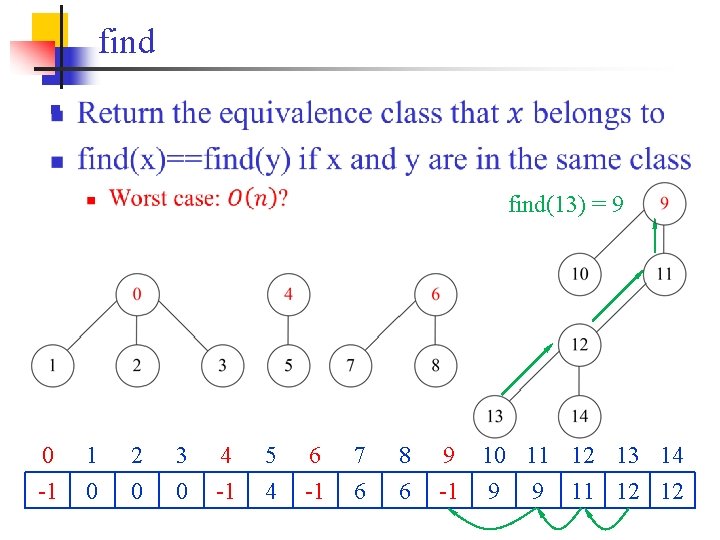
find n find(13) = 9 0 1 2 3 4 5 6 7 8 9 10 11 12 13 14 -1 0 0 0 -1 4 -1 6 6 -1 9 9 11 12 12
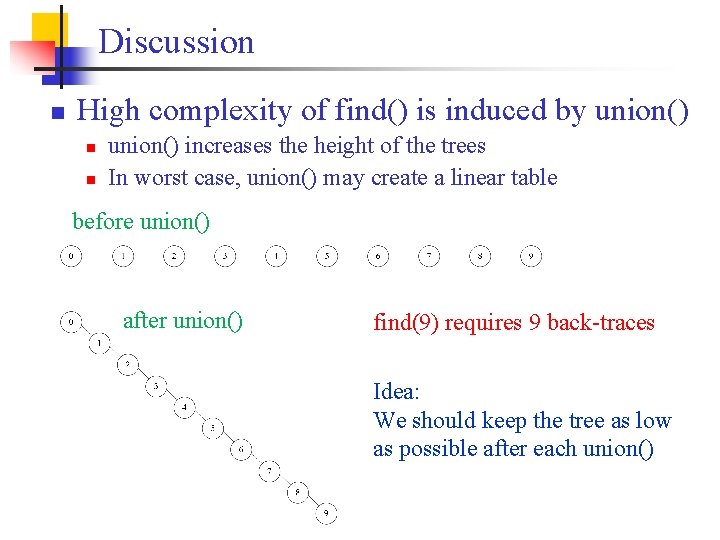
Discussion n High complexity of find() is induced by union() n n union() increases the height of the trees In worst case, union() may create a linear table before union() after union() find(9) requires 9 back-traces Idea: We should keep the tree as low as possible after each union()
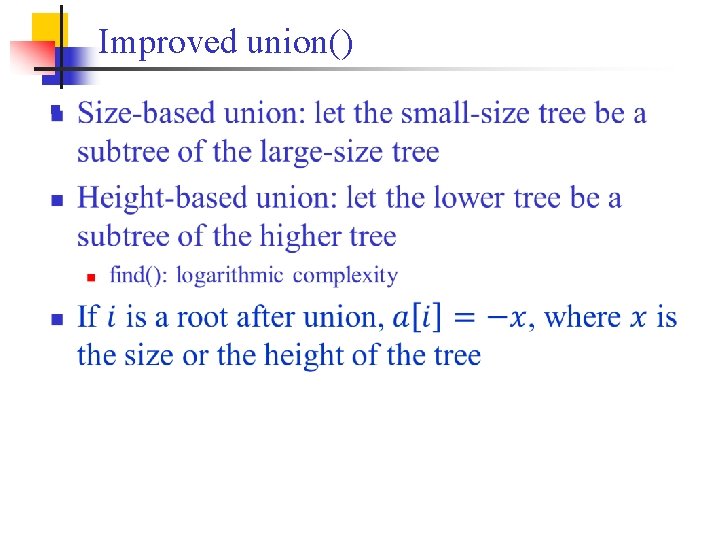
Improved union() n
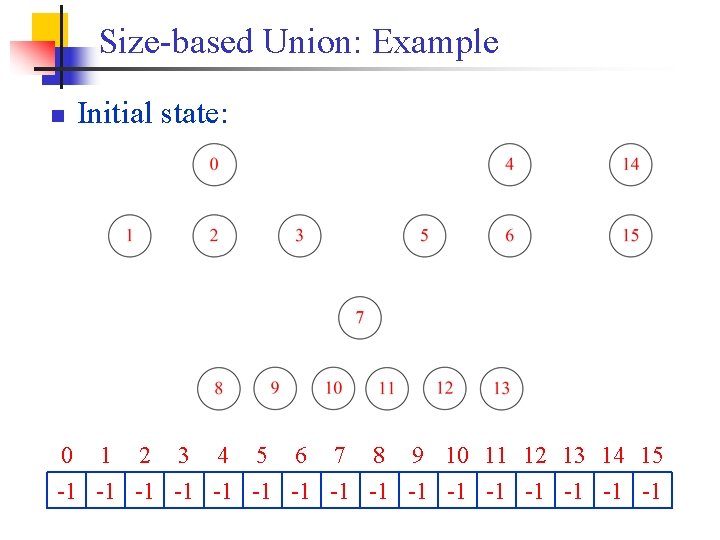
Size-based Union: Example n 0 Initial state: 1 2 3 4 5 6 7 8 9 10 11 12 13 14 15 -1 -1 -1 -1
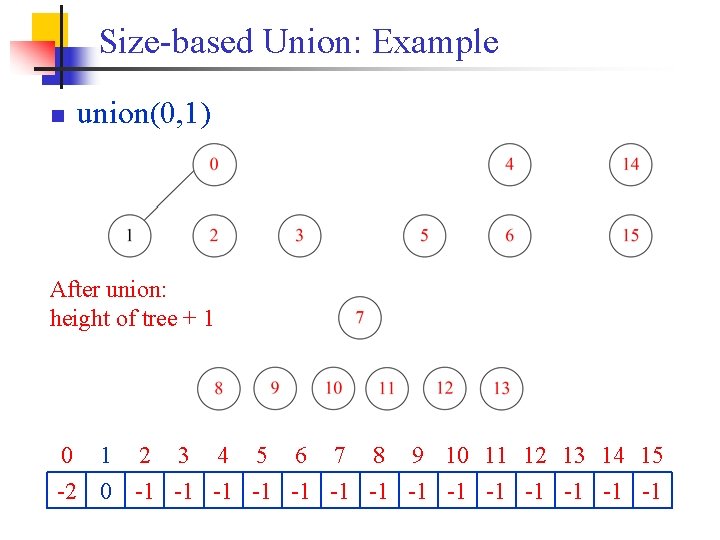
Size-based Union: Example n union(0, 1) After union: height of tree + 1 0 1 2 3 4 5 6 7 8 9 10 11 12 13 14 15 -2 0 -1 -1 -1 -1
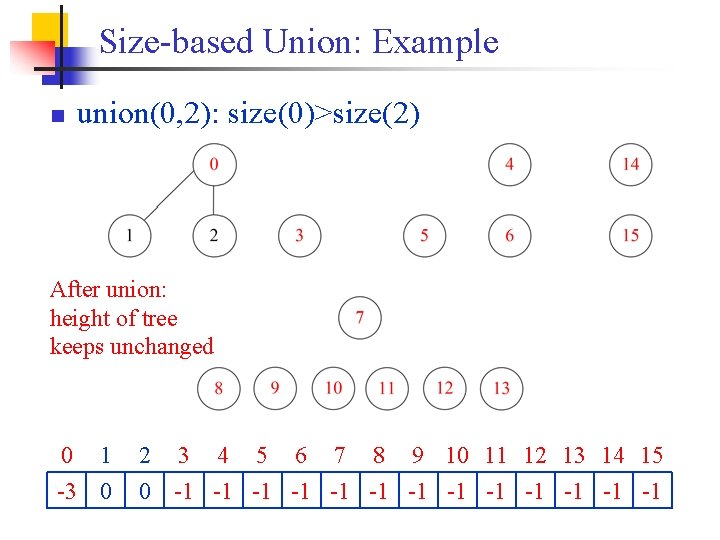
Size-based Union: Example n union(0, 2): size(0)>size(2) After union: height of tree keeps unchanged 0 1 -3 0 2 3 4 5 6 7 8 9 10 11 12 13 14 15 0 -1 -1 -1 -1
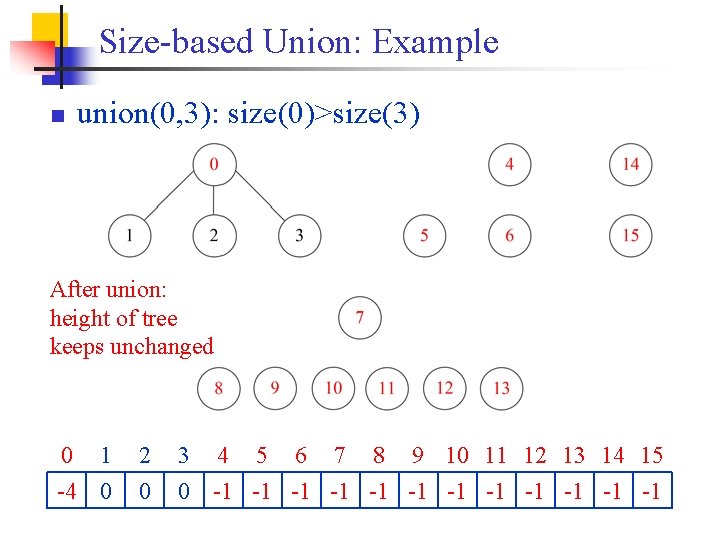
Size-based Union: Example n union(0, 3): size(0)>size(3) After union: height of tree keeps unchanged 0 1 2 3 4 5 6 7 8 9 10 11 12 13 14 15 -4 0 0 0 -1 -1 -1
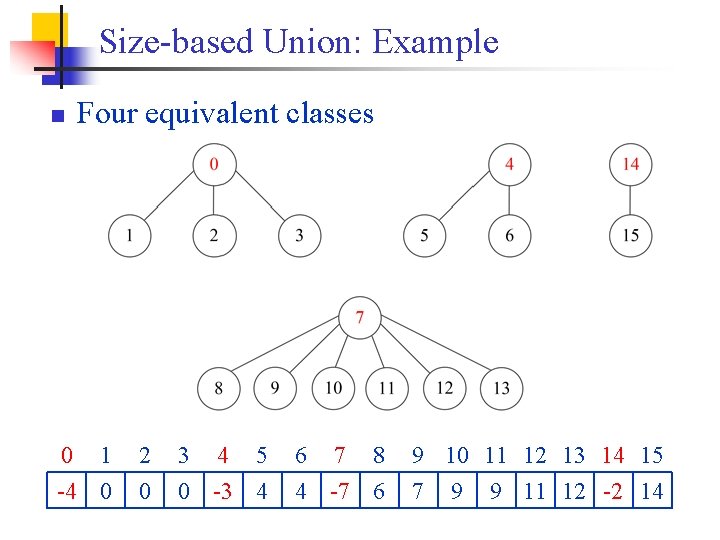
Size-based Union: Example n 0 Four equivalent classes 1 2 3 4 5 -4 0 0 0 -3 4 6 7 8 4 -7 6 9 10 11 12 13 14 15 7 9 9 11 12 -2 14
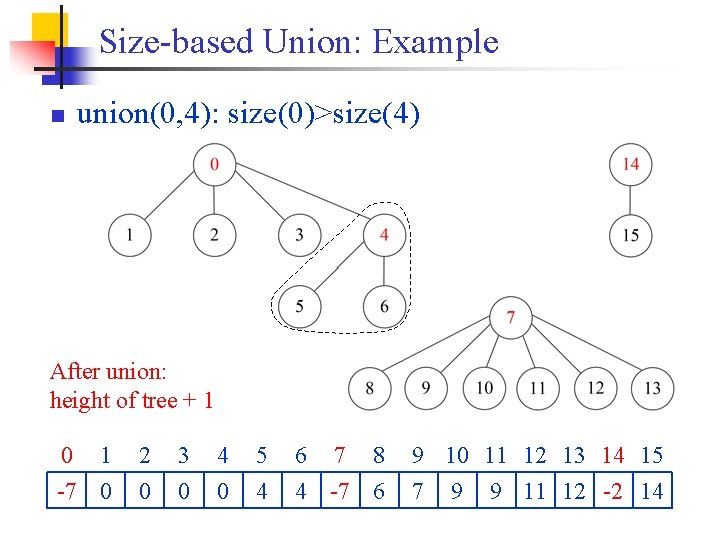
Size-based Union: Example n union(0, 4): size(0)>size(4) After union: height of tree + 1 0 1 2 3 4 5 6 7 8 -7 0 0 4 4 -7 6 9 10 11 12 13 14 15 7 9 9 11 12 -2 14
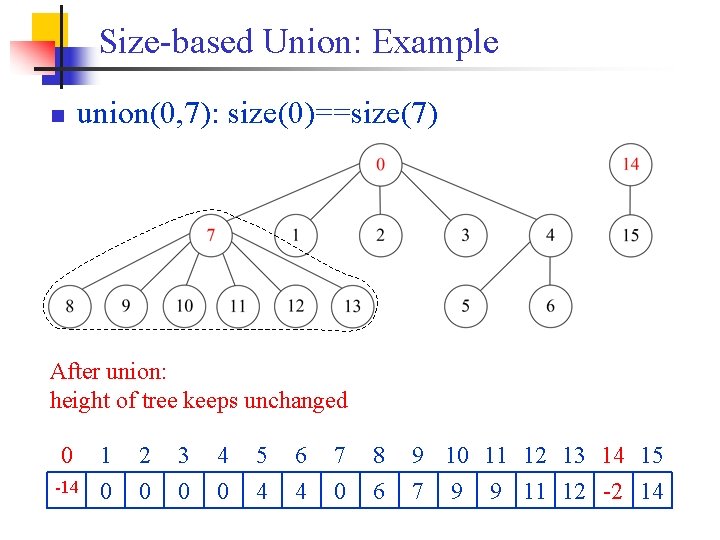
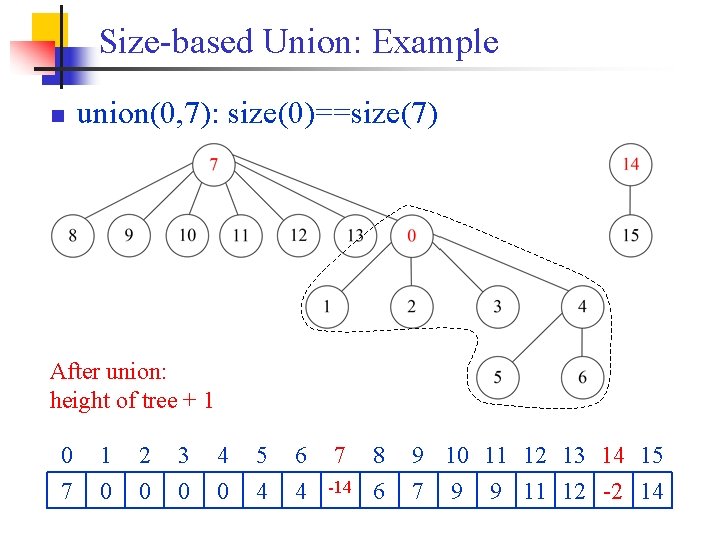
Size-based Union: Example n union(0, 7): size(0)==size(7) After union: height of tree keeps unchanged 0 1 2 3 4 5 6 7 8 9 10 11 12 13 14 15 -14 0 0 4 4 0 6 7 9 9 11 12 -2 14
Size-based Union: Example n union(0, 7): size(0)==size(7) After union: height of tree + 1 0 1 2 3 4 5 6 7 8 9 10 11 12 13 14 15 7 0 0 4 4 -14 6 7 9 9 11 12 -2 14
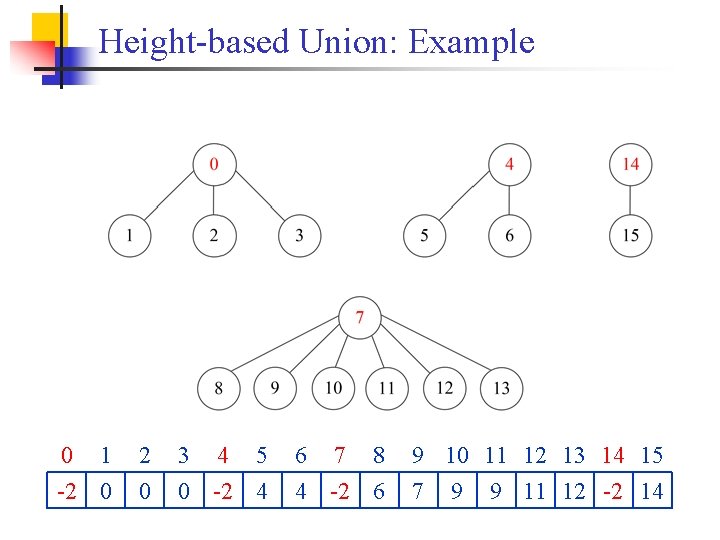
Height-based Union: Example 0 1 2 3 4 5 -2 0 0 0 -2 4 6 7 8 4 -2 6 9 10 11 12 13 14 15 7 9 9 11 12 -2 14
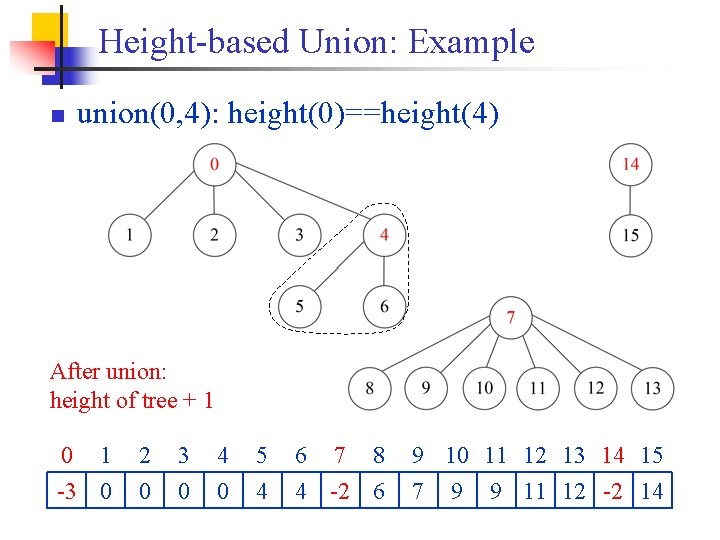
Height-based Union: Example n union(0, 4): height(0)==height(4) After union: height of tree + 1 0 1 2 3 4 5 6 7 8 -3 0 0 4 4 -2 6 9 10 11 12 13 14 15 7 9 9 11 12 -2 14
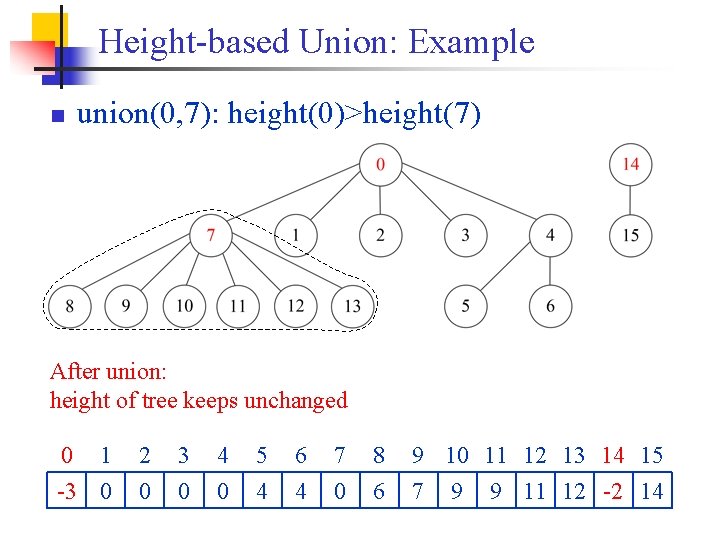
Height-based Union: Example n union(0, 7): height(0)>height(7) After union: height of tree keeps unchanged 0 1 2 3 4 5 6 7 8 9 10 11 12 13 14 15 -3 0 0 4 4 0 6 7 9 9 11 12 -2 14
Improved Union n Height of the tree increases slowly n Worst case for height-based merge: two trees involved in merge have the same height n Height increases by 1 after merge
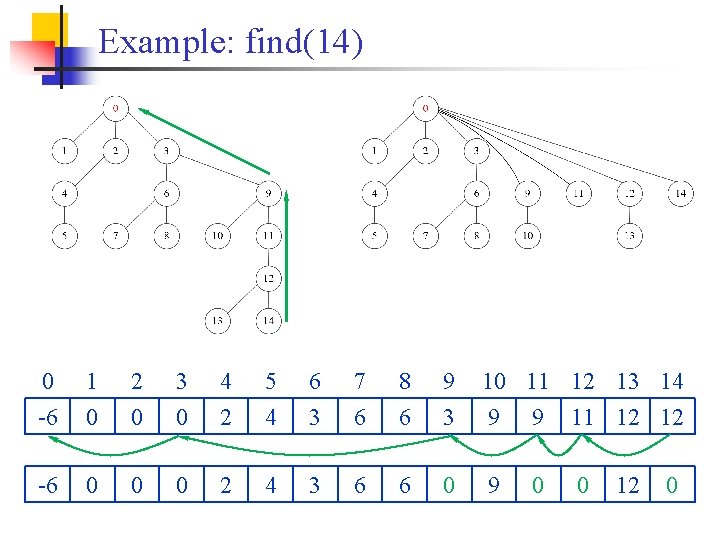
Improved find(): Path Compression n n Motivation: if all trees are two-layer, find() will be most efficient Algorithm modification: n once a node is visited, its parent = root
Example: find(14) 0 1 2 3 4 5 6 7 8 9 10 11 12 13 14 -6 0 0 0 2 4 3 6 6 3 9 9 11 12 12 -6 0 0 0 2 4 3 6 6 0 9 0 0 12 0
Comments n Modified find() is compatible with the sizebased union n n Path compression does not change the tree’s size Modified find() is not compatible with the height-based union n How to update the height of the tree after path compression is difficult
Outline n n n Equivalence Relation and Equivalence Class ( 等价关系与等价类) Disjoint Set (不相交集) Implementation of Disjoint Set Class Application of Disjoint Set
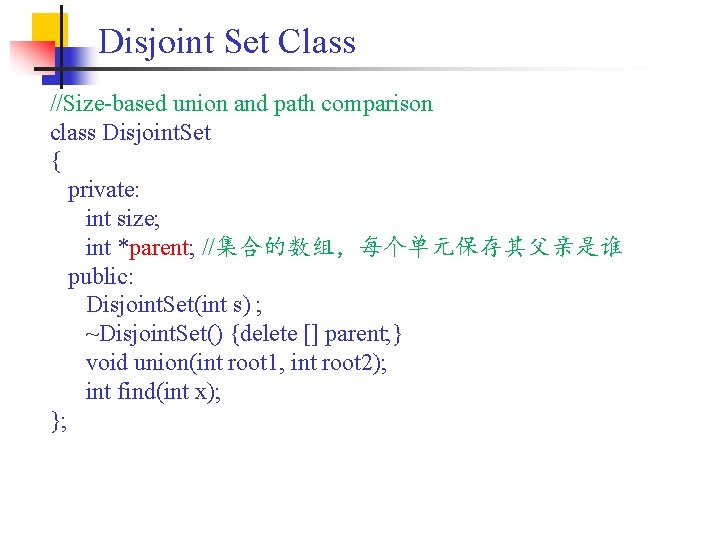
Disjoint Set Class //Size-based union and path comparison class Disjoint. Set { private: int size; int *parent; //集合的数组,每个单元保存其父亲是谁 public: Disjoint. Set(int s) ; ~Disjoint. Set() {delete [] parent; } void union(int root 1, int root 2); int find(int x); };
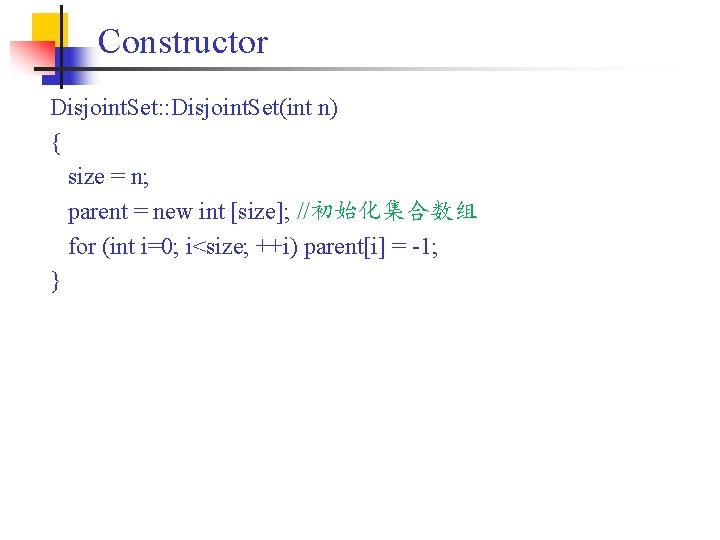
Constructor Disjoint. Set: : Disjoint. Set(int n) { size = n; parent = new int [size]; //初始化集合数组 for (int i=0; i<size; ++i) parent[i] = -1; }
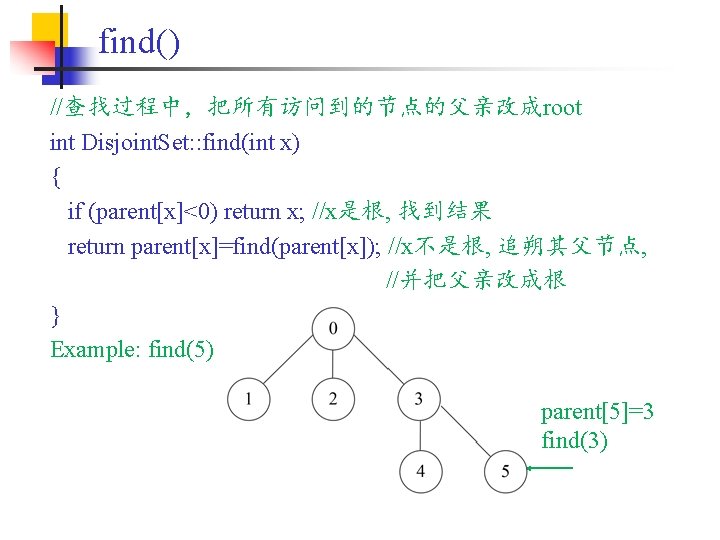
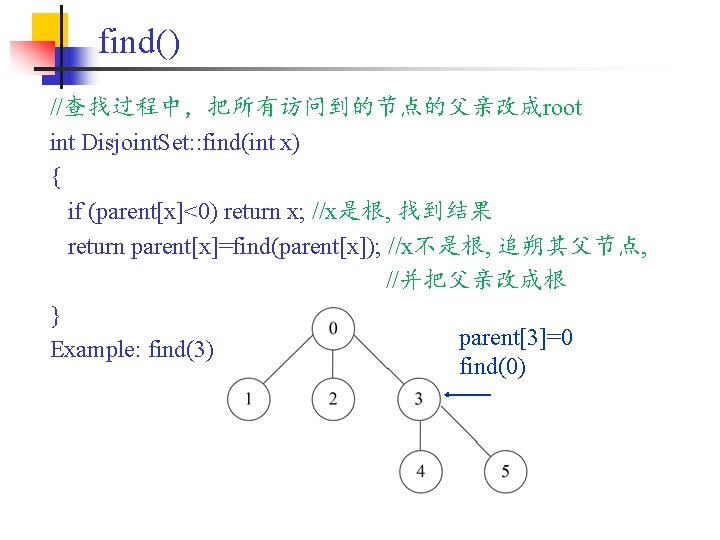
find() //查找过程中,把所有访问到的节点的父亲改成root int Disjoint. Set: : find(int x) { if (parent[x]<0) return x; //x是根, 找到结果 return parent[x]=find(parent[x]); //x不是根, 追朔其父节点, //并把父亲改成根 } Example: find(5) parent[5]=3 find(3)
find() //查找过程中,把所有访问到的节点的父亲改成root int Disjoint. Set: : find(int x) { if (parent[x]<0) return x; //x是根, 找到结果 return parent[x]=find(parent[x]); //x不是根, 追朔其父节点, //并把父亲改成根 } parent[3]=0 Example: find(3) find(0)
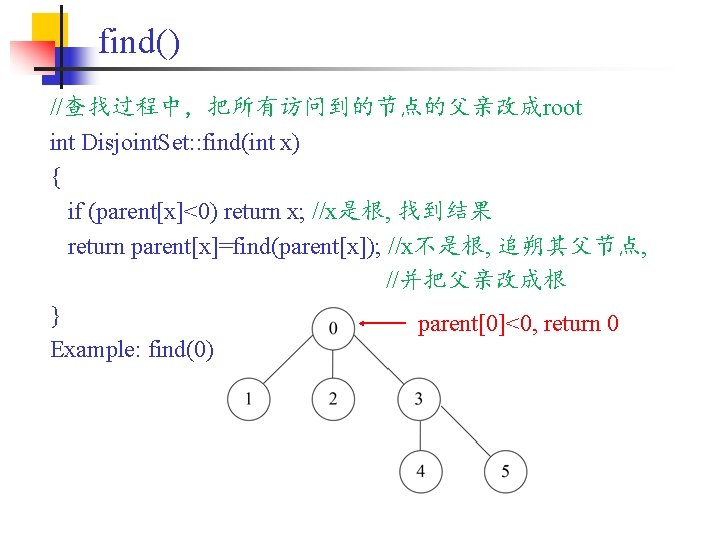
find() //查找过程中,把所有访问到的节点的父亲改成root int Disjoint. Set: : find(int x) { if (parent[x]<0) return x; //x是根, 找到结果 return parent[x]=find(parent[x]); //x不是根, 追朔其父节点, //并把父亲改成根 } parent[0]<0, return 0 Example: find(0)
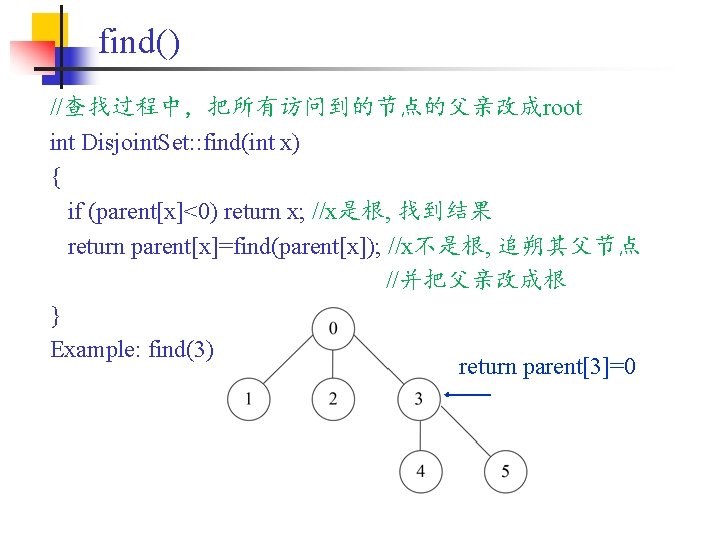
find() //查找过程中,把所有访问到的节点的父亲改成root int Disjoint. Set: : find(int x) { if (parent[x]<0) return x; //x是根, 找到结果 return parent[x]=find(parent[x]); //x不是根, 追朔其父节点 //并把父亲改成根 } Example: find(3) return parent[3]=0
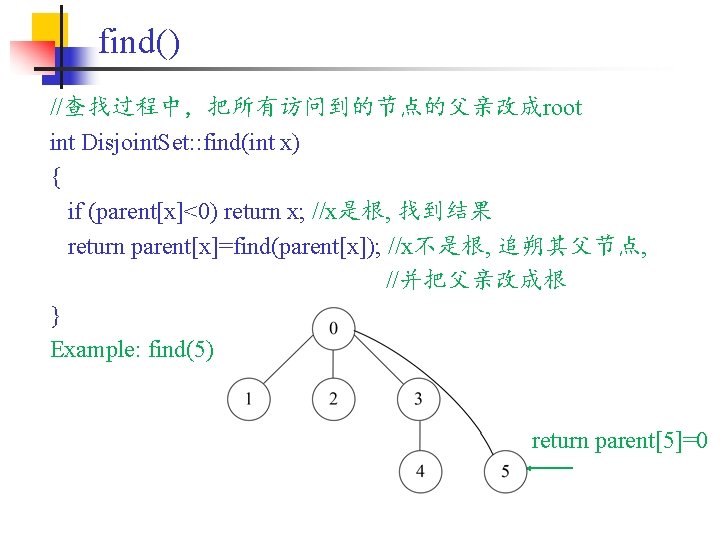
find() //查找过程中,把所有访问到的节点的父亲改成root int Disjoint. Set: : find(int x) { if (parent[x]<0) return x; //x是根, 找到结果 return parent[x]=find(parent[x]); //x不是根, 追朔其父节点, //并把父亲改成根 } Example: find(5) return parent[5]=0
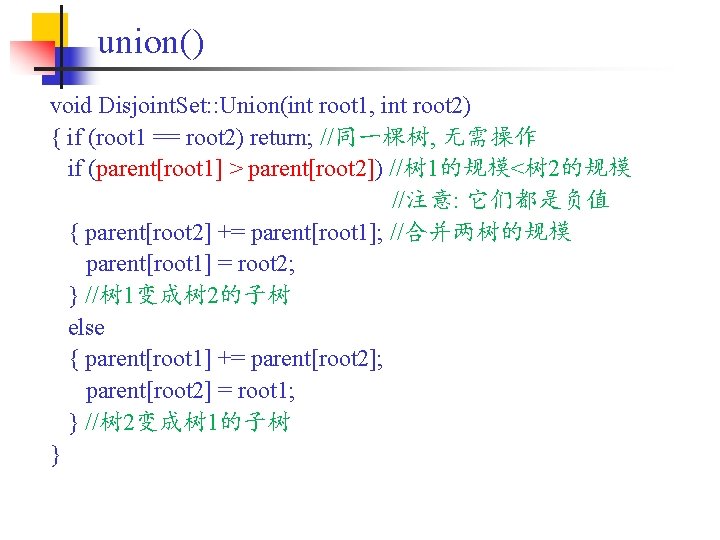
union() void Disjoint. Set: : Union(int root 1, int root 2) { if (root 1 == root 2) return; //同一棵树, 无需操作 if (parent[root 1] > parent[root 2]) //树 1的规模<树 2的规模 //注意: 它们都是负值 { parent[root 2] += parent[root 1]; //合并两树的规模 parent[root 1] = root 2; } //树 1变成树 2的子树 else { parent[root 1] += parent[root 2]; parent[root 2] = root 1; } //树 2变成树 1的子树 }
Outline n n n Equivalence Relation and Equivalence Class ( 等价关系与等价类) Disjoint Set (不相交集) Implementation of Disjoint Set Class Application of Disjoint Set n n Maze problem (迷宫问题) Last Common Ancestor (最近共同祖先问题)
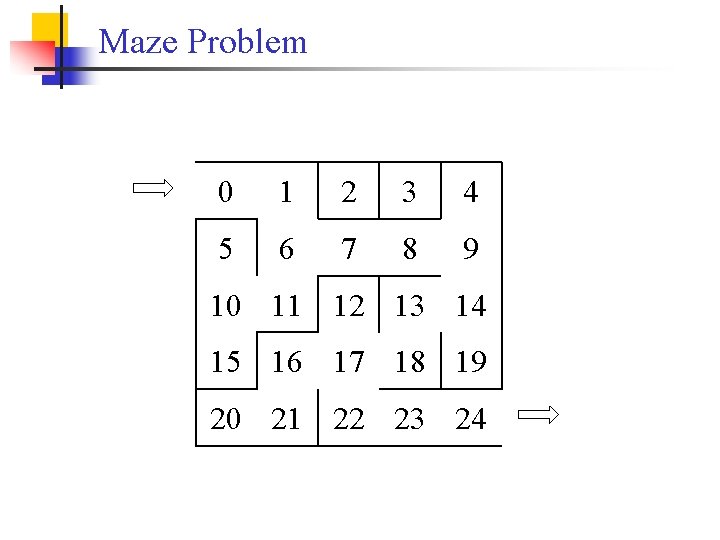
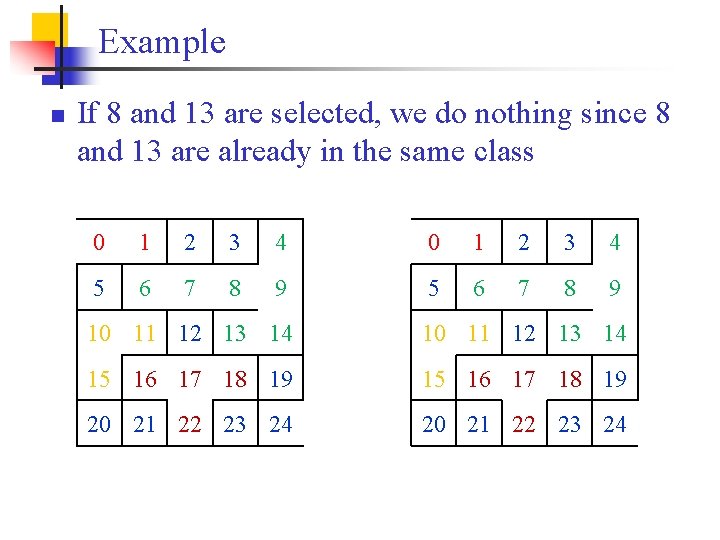
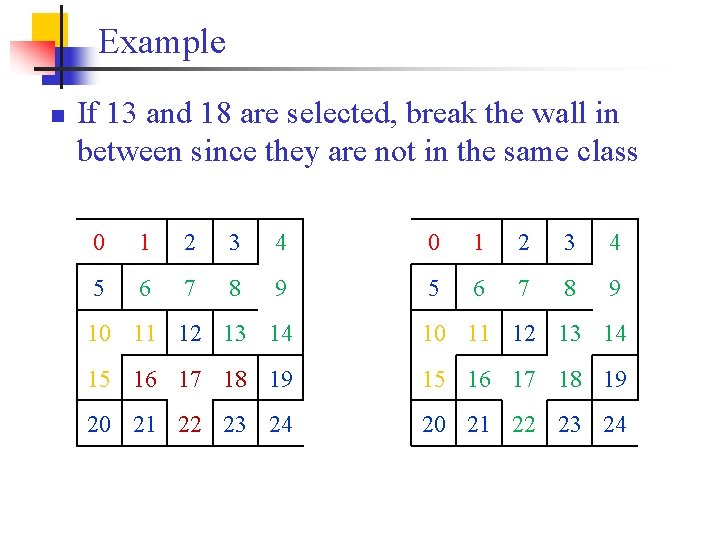
Maze Problem 0 1 2 3 4 5 6 7 8 9 10 11 12 13 14 15 16 17 18 19 20 21 22 23 24
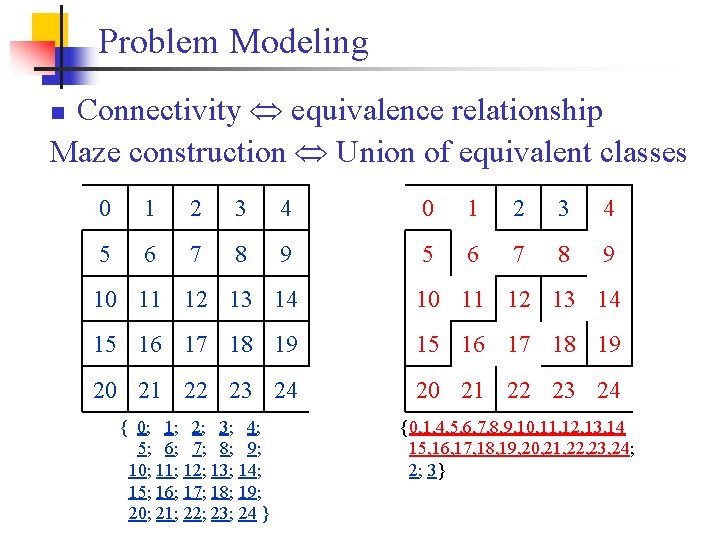
Problem Modeling Connectivity equivalence relationship Maze construction Union of equivalent classes n 0 1 2 3 4 5 6 7 8 9 10 11 12 13 14 15 16 17 18 19 20 21 22 23 24 { 0; 1; 2; 3; 4; 5; 6; 7; 8; 9; 10; 11; 12; 13; 14; 15; 16; 17; 18; 19; 20; 21; 22; 23; 24 } {0, 1, 4, 5, 6, 7, 8, 9, 10, 11, 12, 13, 14 15, 16, 17, 18, 19, 20, 21, 22, 23, 24; 2; 3}
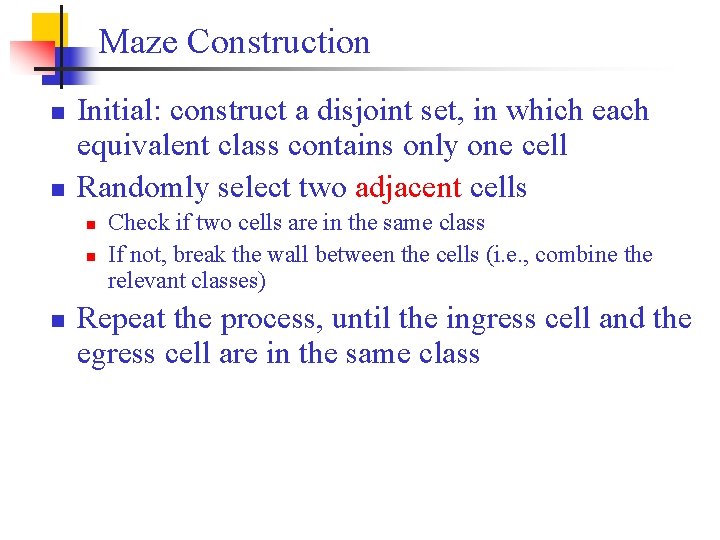
Maze Construction n n Initial: construct a disjoint set, in which each equivalent class contains only one cell Randomly select two adjacent cells n n n Check if two cells are in the same class If not, break the wall between the cells (i. e. , combine the relevant classes) Repeat the process, until the ingress cell and the egress cell are in the same class
Example n If 8 and 13 are selected, we do nothing since 8 and 13 are already in the same class 0 1 2 3 4 5 6 7 8 9 10 11 12 13 14 15 16 17 18 19 20 21 22 23 24
Example n If 13 and 18 are selected, break the wall in between since they are not in the same class 0 1 2 3 4 5 6 7 8 9 10 11 12 13 14 15 16 17 18 19 20 21 22 23 24
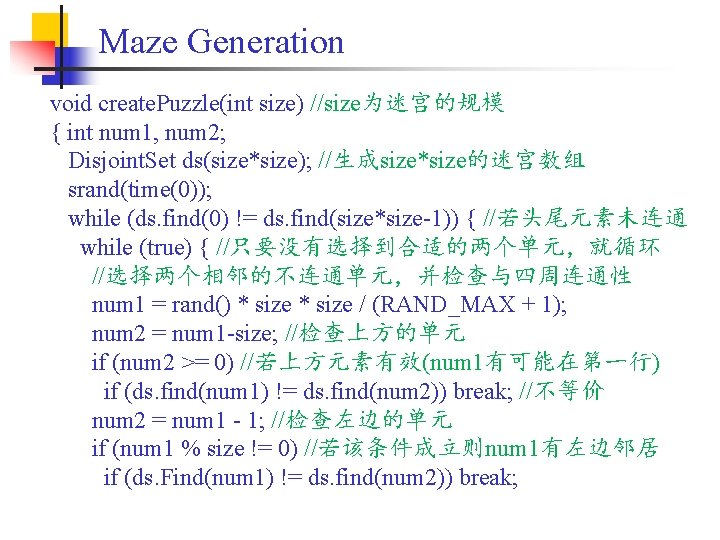
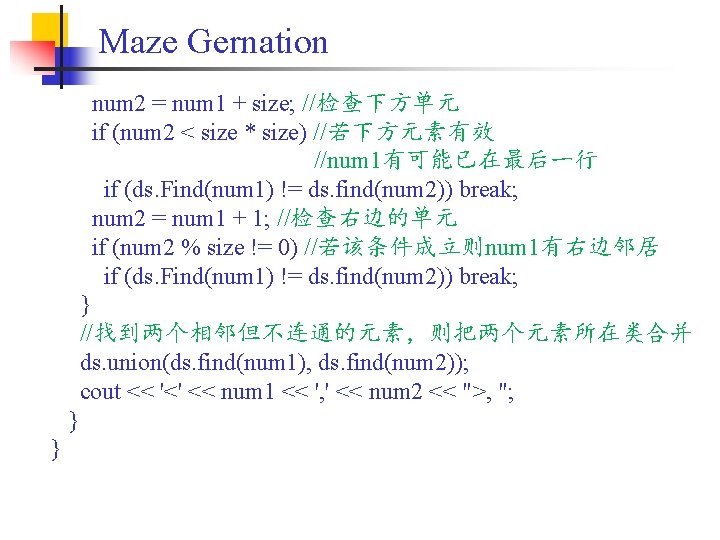
Maze Generation void create. Puzzle(int size) //size为迷宫的规模 { int num 1, num 2; Disjoint. Set ds(size*size); //生成size*size的迷宫数组 srand(time(0)); while (ds. find(0) != ds. find(size*size-1)) { //若头尾元素未连通 while (true) { //只要没有选择到合适的两个单元,就循环 //选择两个相邻的不连通单元,并检查与四周连通性 num 1 = rand() * size / (RAND_MAX + 1); num 2 = num 1 -size; //检查上方的单元 if (num 2 >= 0) //若上方元素有效(num 1有可能在第一行) if (ds. find(num 1) != ds. find(num 2)) break; //不等价 num 2 = num 1 - 1; //检查左边的单元 if (num 1 % size != 0) //若该条件成立则num 1有左边邻居 if (ds. Find(num 1) != ds. find(num 2)) break;
Outline n n n Equivalence Relation and Equivalence Class ( 等价关系与等价类) Disjoint Set (不相交集) Implementation of Disjoint Set Class Application of Disjoint Set n n Maze problem (迷宫问题) Last Common Ancestor (最近共同祖先问题)
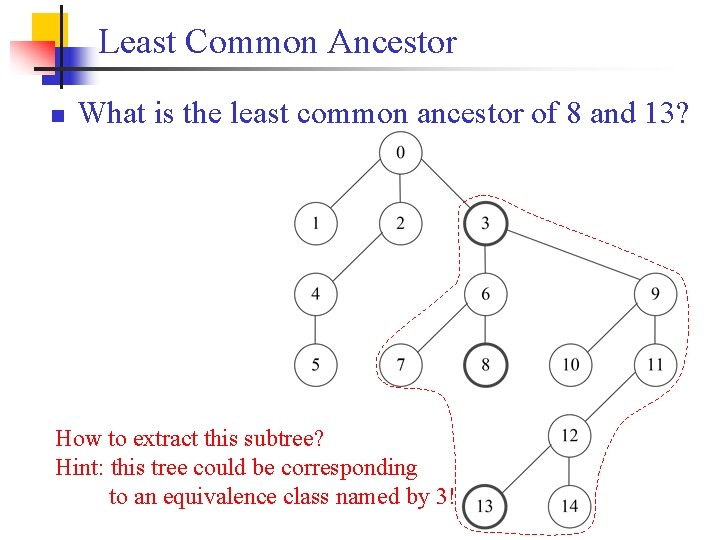
Least Common Ancestor n What is the least common ancestor of 8 and 13? How to extract this subtree? Hint: this tree could be corresponding to an equivalence class named by 3!
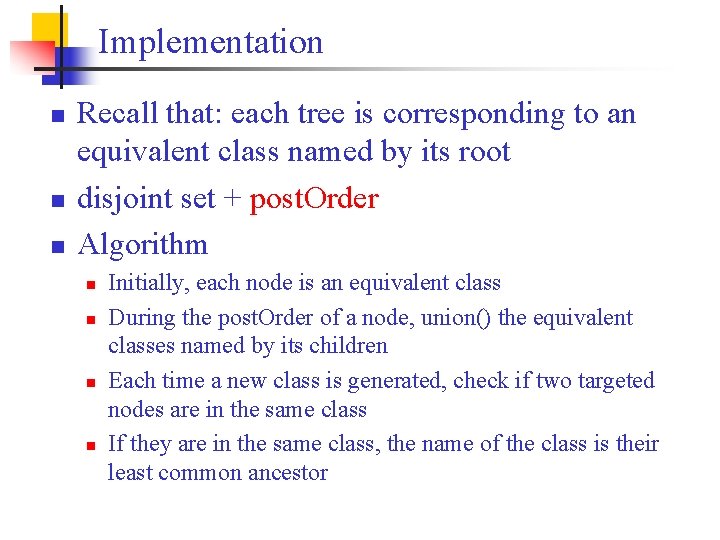
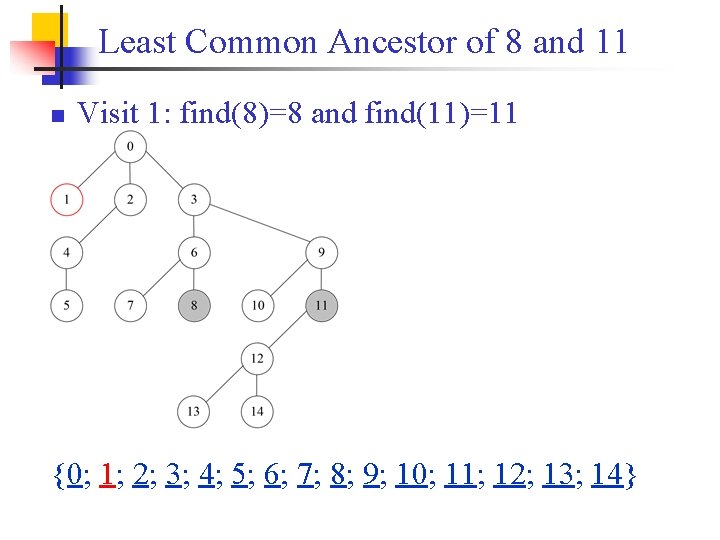
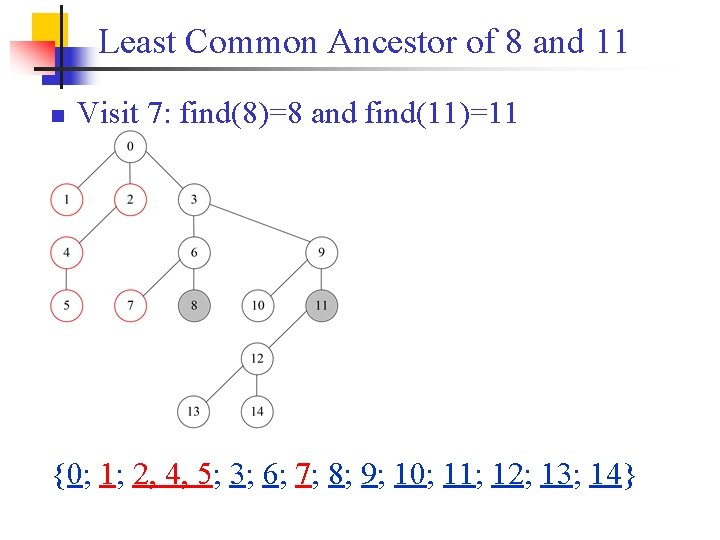
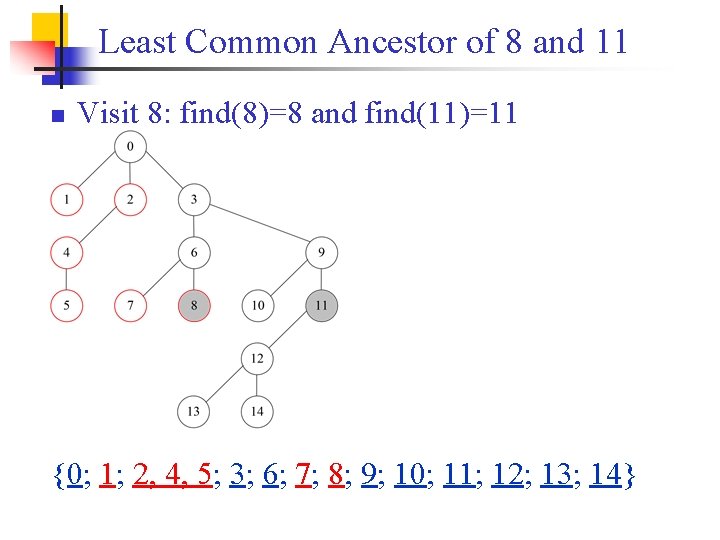
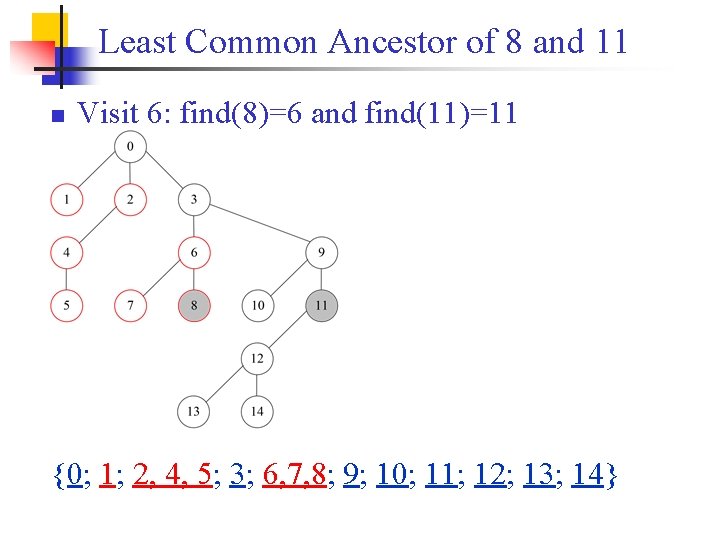
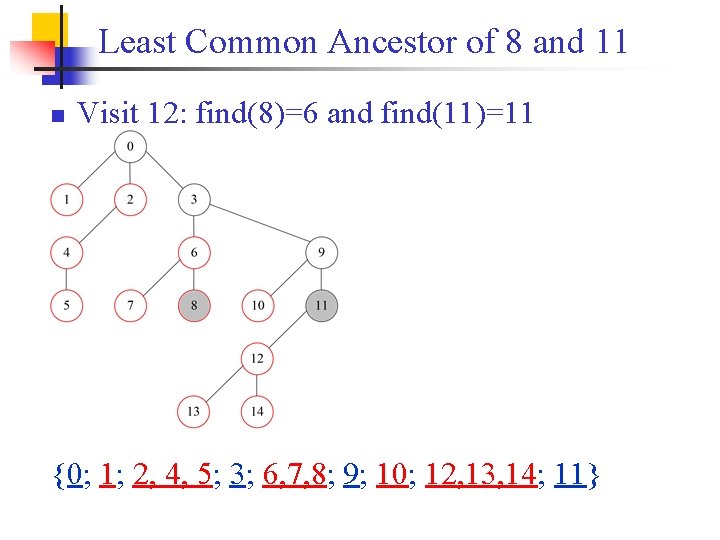
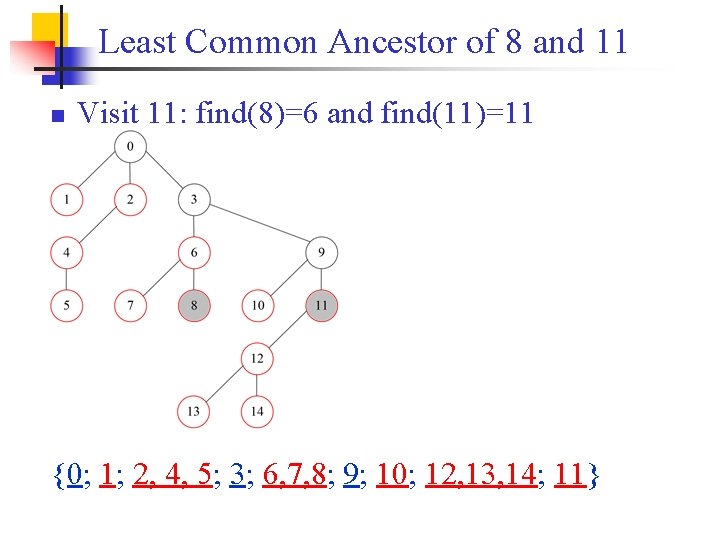
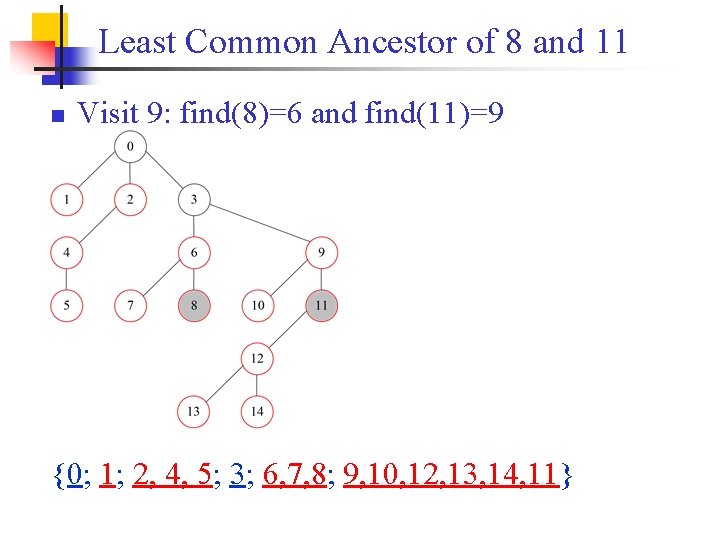
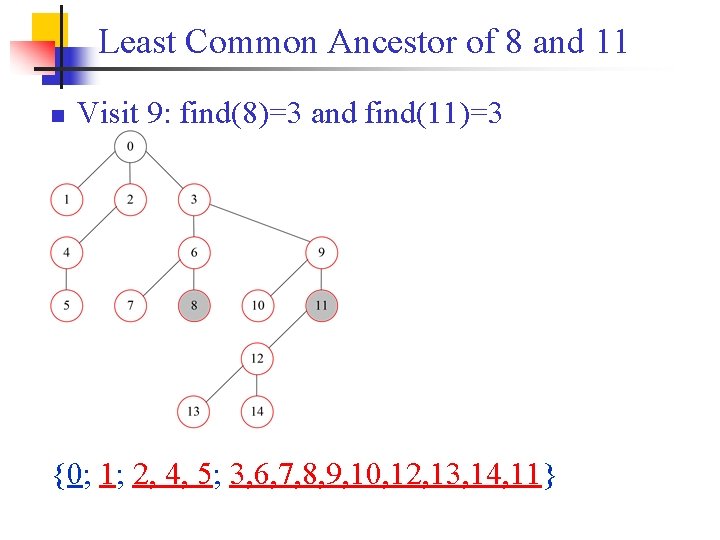
Implementation n Recall that: each tree is corresponding to an equivalent class named by its root disjoint set + post. Order Algorithm n n Initially, each node is an equivalent class During the post. Order of a node, union() the equivalent classes named by its children Each time a new class is generated, check if two targeted nodes are in the same class If they are in the same class, the name of the class is their least common ancestor
Least Common Ancestor of 8 and 11 n Visit 1: find(8)=8 and find(11)=11 {0; 1; 2; 3; 4; 5; 6; 7; 8; 9; 10; 11; 12; 13; 14}
Least Common Ancestor of 8 and 11 n Visit 7: find(8)=8 and find(11)=11 {0; 1; 2, 4, 5; 3; 6; 7; 8; 9; 10; 11; 12; 13; 14}
Least Common Ancestor of 8 and 11 n Visit 8: find(8)=8 and find(11)=11 {0; 1; 2, 4, 5; 3; 6; 7; 8; 9; 10; 11; 12; 13; 14}
Least Common Ancestor of 8 and 11 n Visit 6: find(8)=6 and find(11)=11 {0; 1; 2, 4, 5; 3; 6, 7, 8; 9; 10; 11; 12; 13; 14}
Least Common Ancestor of 8 and 11 n Visit 12: find(8)=6 and find(11)=11 {0; 1; 2, 4, 5; 3; 6, 7, 8; 9; 10; 12, 13, 14; 11}
Least Common Ancestor of 8 and 11 n Visit 11: find(8)=6 and find(11)=11 {0; 1; 2, 4, 5; 3; 6, 7, 8; 9; 10; 12, 13, 14; 11}
Least Common Ancestor of 8 and 11 n Visit 9: find(8)=6 and find(11)=9 {0; 1; 2, 4, 5; 3; 6, 7, 8; 9, 10, 12, 13, 14, 11}
Least Common Ancestor of 8 and 11 n Visit 9: find(8)=3 and find(11)=3 {0; 1; 2, 4, 5; 3, 6, 7, 8, 9, 10, 12, 13, 14, 11}
Homework n 2、3、5