Societies at Crossroads Chapter 31 Intro The Ottoman

- Slides: 40
Societies at Crossroads Chapter 31
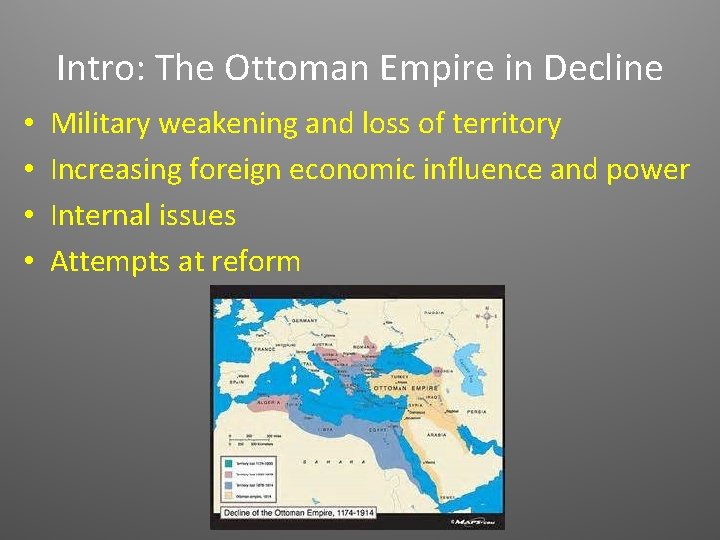
Intro: The Ottoman Empire in Decline • • Military weakening and loss of territory Increasing foreign economic influence and power Internal issues Attempts at reform
The Nature of Decline • Military Decline: expansion was over and began losing territory • Due to outdated training, tech, tactics, strategy, and breakdown of Janisseries • -> increasing vulnerability and decreasing effectiveness (private armies in provinces, provincial autonomy, including tax collection) • -> territorial losses: to Russia, to Austria, in Balkans, Egypt
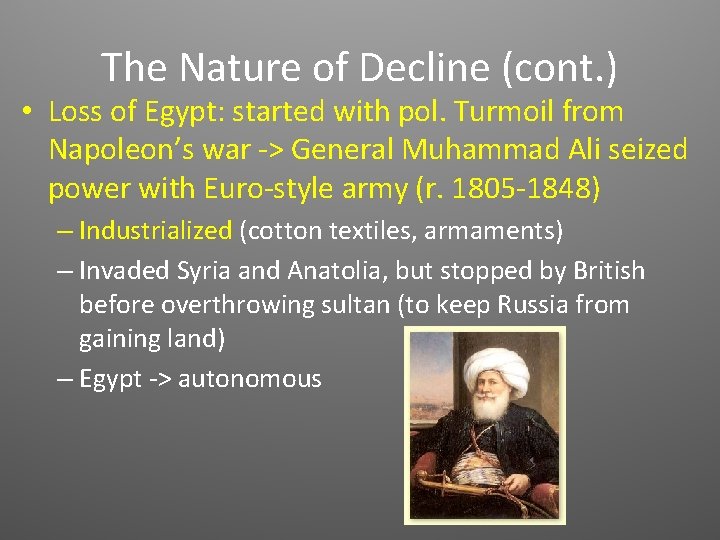
The Nature of Decline (cont. ) • Loss of Egypt: started with pol. Turmoil from Napoleon’s war -> General Muhammad Ali seized power with Euro-style army (r. 1805 -1848) – Industrialized (cotton textiles, armaments) – Invaded Syria and Anatolia, but stopped by British before overthrowing sultan (to keep Russia from gaining land) – Egypt -> autonomous
The Nature of Decline (cont. ) • Economic difficulties: decreasing volume of trade (due to direct trade between Europe and Asia and shift to Atlantic basin) – 18 th/19 th centuries: importing cheap European items > hurt local producers -> riots – Exports = raw materials -> fiscal insolvency and financial dependency on foreign loans (with lots of interest -> inability to pay debts -> foreign administration of debts)
The Nature of Decline (cont. ) • -> European extraterritoriality (= exemption from Ottoman law in empire) = intrusion on sovereignty • By early 20 th century: couldn’t maintain bureaucracy -> decreasing morale, increasing corruption, increasing taxes -> peasant issues
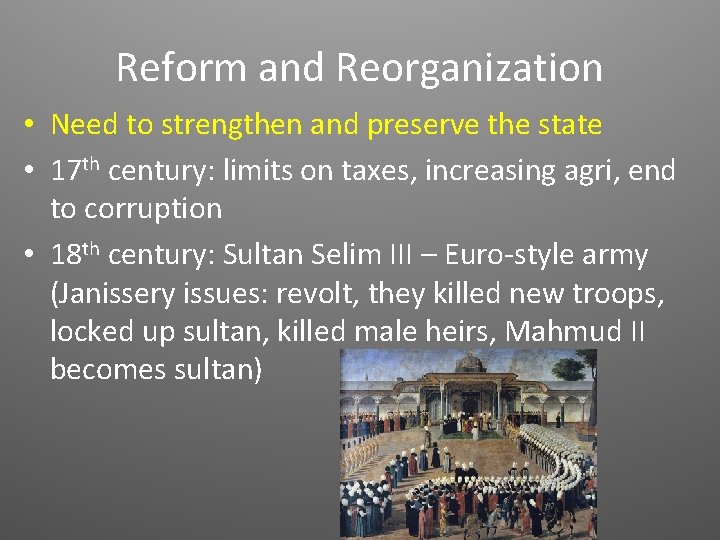
Reform and Reorganization • Need to strengthen and preserve the state • 17 th century: limits on taxes, increasing agri, end to corruption • 18 th century: Sultan Selim III – Euro-style army (Janissery issues: revolt, they killed new troops, locked up sultan, killed male heirs, Mahmud II becomes sultan)
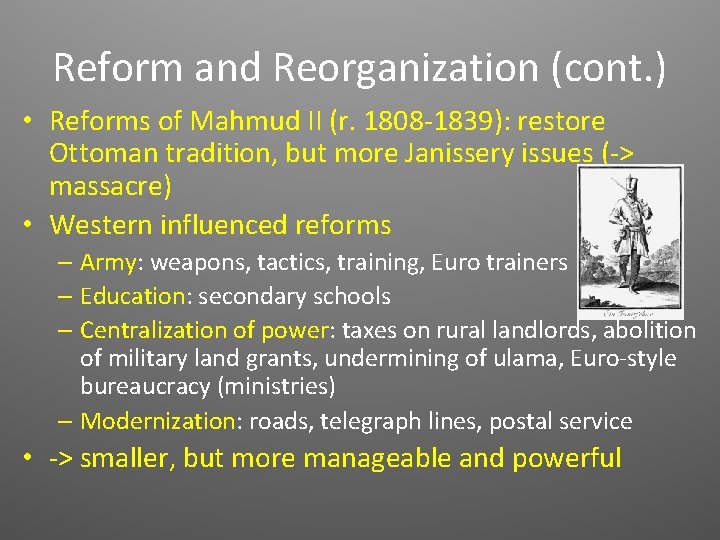
Reform and Reorganization (cont. ) • Reforms of Mahmud II (r. 1808 -1839): restore Ottoman tradition, but more Janissery issues (-> massacre) • Western influenced reforms – Army: weapons, tactics, training, Euro trainers – Education: secondary schools – Centralization of power: taxes on rural landlords, abolition of military land grants, undermining of ulama, Euro-style bureaucracy (ministries) – Modernization: roads, telegraph lines, postal service • -> smaller, but more manageable and powerful
Reform and Reorganization (cont. ) • Tanzimat era (1838 -1876): even more reform (inspired by Enlightenment, constitutional states) – Army – Legal system (to reduce need for extraterr. ): Frenchstyle law codes; protect indiv. Rights, still some religious law, but undermined ulama, enhanced state power – Education: primary, secondary, and university system; primary became free and compulsory
Reform and Reorganization (cont. ) • Opposition to Tanzimat reforms: – Religious conservatives: = threat to Islam (esp. equality of Jews and Christians) – Minority leaders: = took their power as intermediaries – Young Ottomans: wanted indiv. Freedoms, local autonomy, and political decentralization; constitutional gov’t – Ottoman bureaucrats: wanted constitution to check sultan’s power
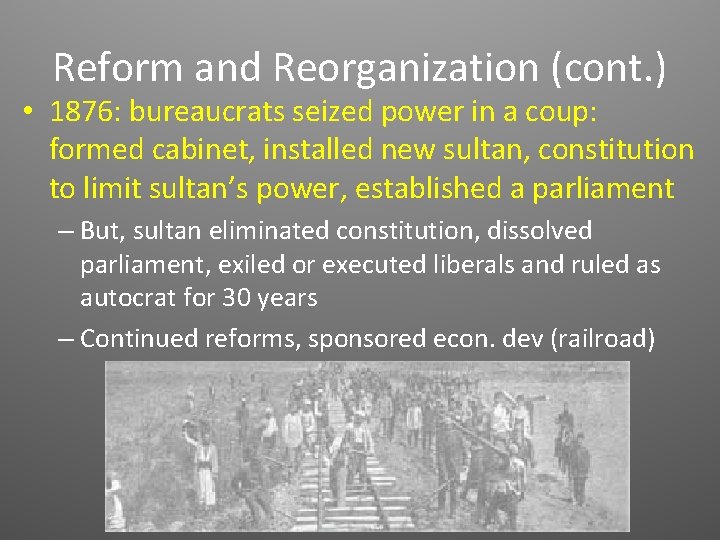
Reform and Reorganization (cont. ) • 1876: bureaucrats seized power in a coup: formed cabinet, installed new sultan, constitution to limit sultan’s power, established a parliament – But, sultan eliminated constitution, dissolved parliament, exiled or executed liberals and ruled as autocrat for 30 years – Continued reforms, sponsored econ. dev (railroad)
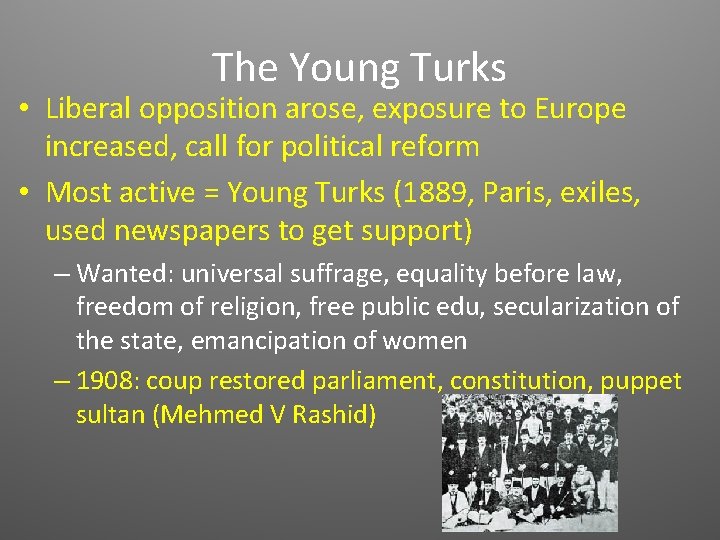
The Young Turks • Liberal opposition arose, exposure to Europe increased, call for political reform • Most active = Young Turks (1889, Paris, exiles, used newspapers to get support) – Wanted: universal suffrage, equality before law, freedom of religion, free public edu, secularization of the state, emancipation of women – 1908: coup restored parliament, constitution, puppet sultan (Mehmed V Rashid)
The Young Turks (cont. ) • But, in trying to maintain empire, pushed for Turkish as official language -> tension and Arab resistance • Reforms couldn’t stop decline: lost more wars, subjects wanted autonomy or independence • Only survived because Europe feared imbalance of power if Ottoman Empire collapsed
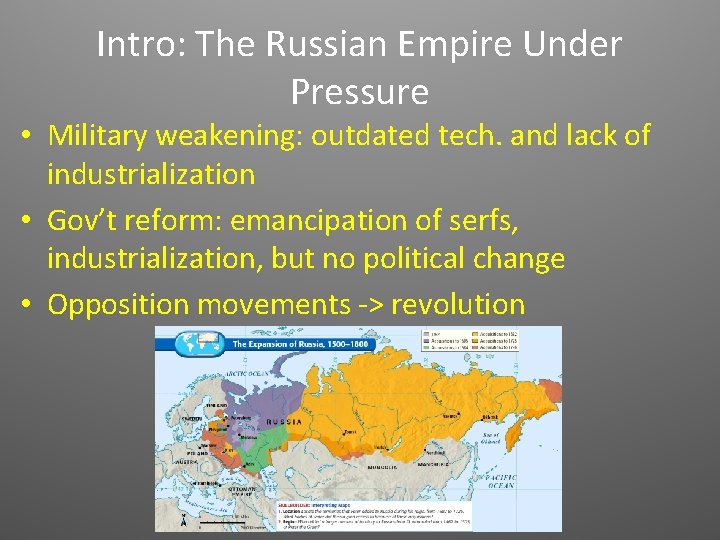
Intro: The Russian Empire Under Pressure • Military weakening: outdated tech. and lack of industrialization • Gov’t reform: emancipation of serfs, industrialization, but no political change • Opposition movements -> revolution
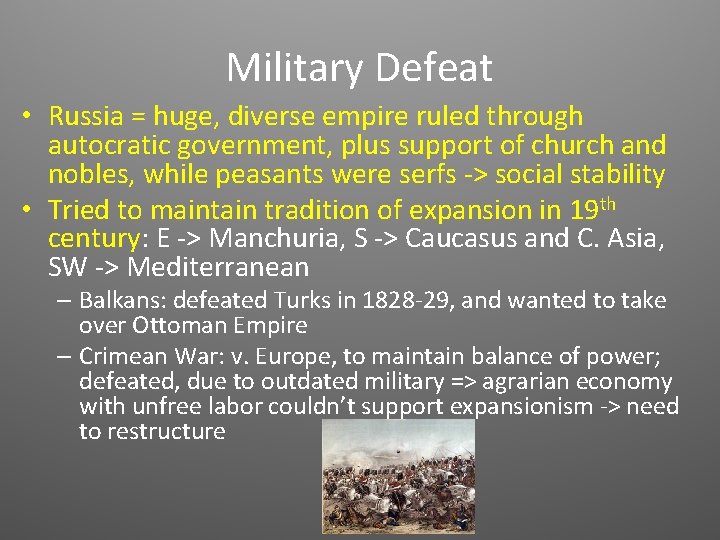
Military Defeat • Russia = huge, diverse empire ruled through autocratic government, plus support of church and nobles, while peasants were serfs -> social stability • Tried to maintain tradition of expansion in 19 th century: E -> Manchuria, S -> Caucasus and C. Asia, SW -> Mediterranean – Balkans: defeated Turks in 1828 -29, and wanted to take over Ottoman Empire – Crimean War: v. Europe, to maintain balance of power; defeated, due to outdated military => agrarian economy with unfree labor couldn’t support expansionism -> need to restructure
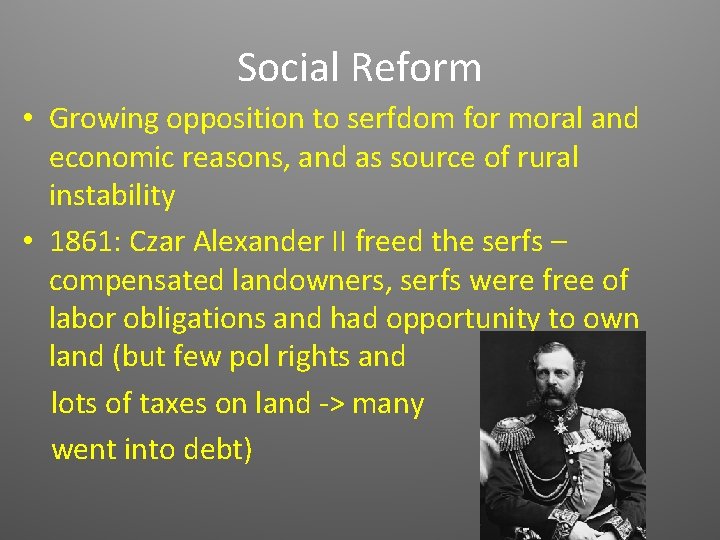
Social Reform • Growing opposition to serfdom for moral and economic reasons, and as source of rural instability • 1861: Czar Alexander II freed the serfs – compensated landowners, serfs were free of labor obligations and had opportunity to own land (but few pol rights and lots of taxes on land -> many went into debt)
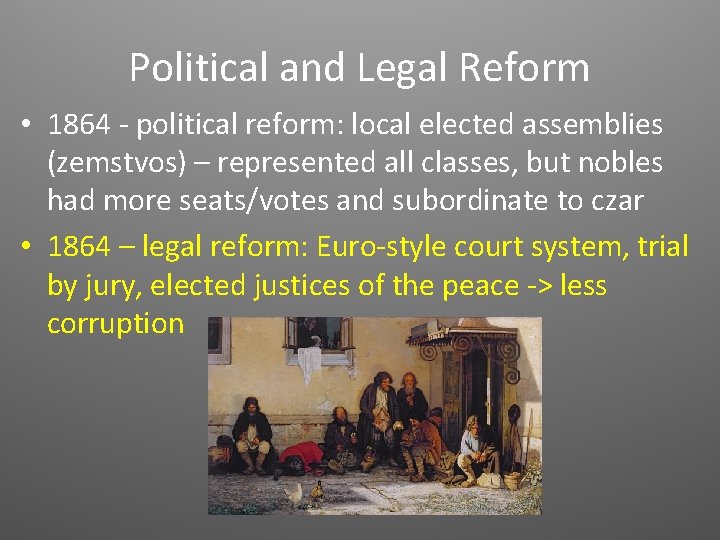
Political and Legal Reform • 1864 - political reform: local elected assemblies (zemstvos) – represented all classes, but nobles had more seats/votes and subordinate to czar • 1864 – legal reform: Euro-style court system, trial by jury, elected justices of the peace -> less corruption
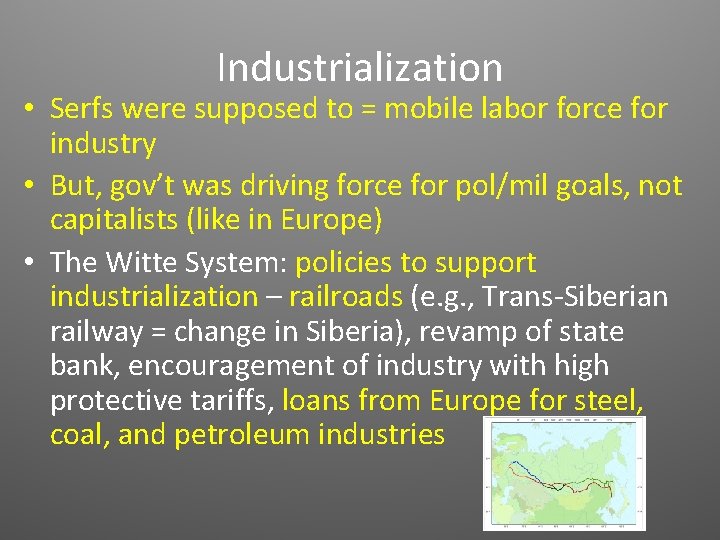
Industrialization • Serfs were supposed to = mobile labor force for industry • But, gov’t was driving force for pol/mil goals, not capitalists (like in Europe) • The Witte System: policies to support industrialization – railroads (e. g. , Trans-Siberian railway = change in Siberia), revamp of state bank, encouragement of industry with high protective tariffs, loans from Europe for steel, coal, and petroleum industries
Industrial Discontent • Workers had low standard of living and discontent over factory work, urban conditions, gov’t ban on unions and strikes-> strikes, rebellions – This, plus lack of pol freedom -> receptive of revolutionary ideas -> underground movements • The growing business class, however, prospered so didn’t challenge the government
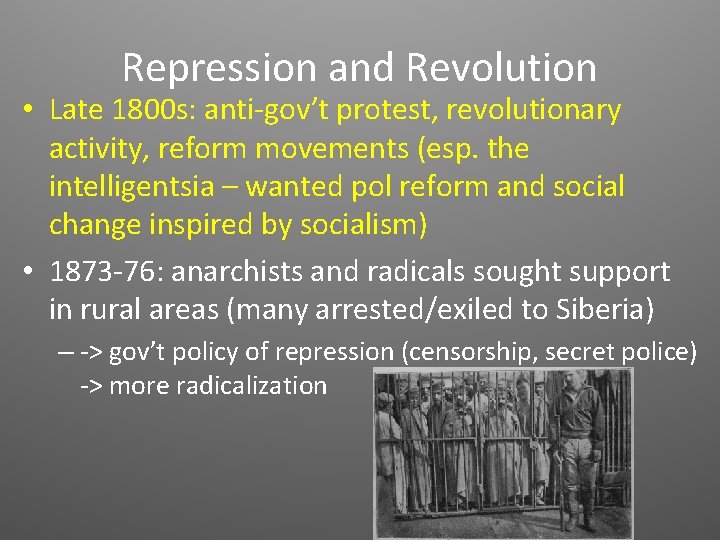
Repression and Revolution • Late 1800 s: anti-gov’t protest, revolutionary activity, reform movements (esp. the intelligentsia – wanted pol reform and social change inspired by socialism) • 1873 -76: anarchists and radicals sought support in rural areas (many arrested/exiled to Siberia) – -> gov’t policy of repression (censorship, secret police) -> more radicalization
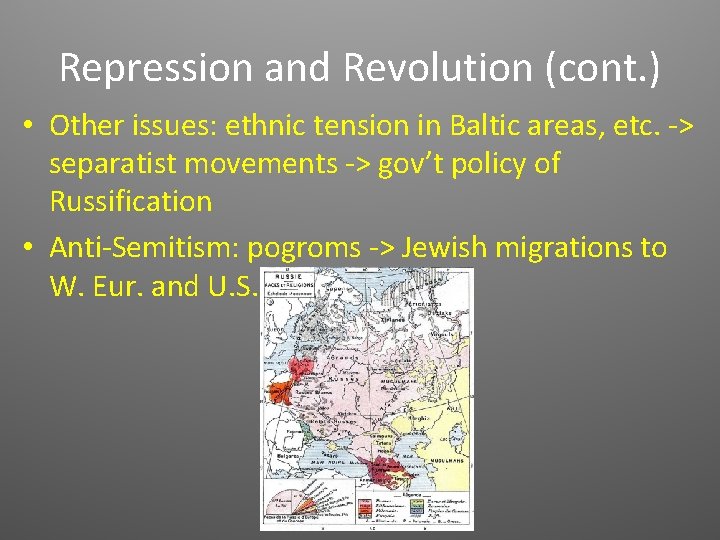
Repression and Revolution (cont. ) • Other issues: ethnic tension in Baltic areas, etc. -> separatist movements -> gov’t policy of Russification • Anti-Semitism: pogroms -> Jewish migrations to W. Eur. and U. S.
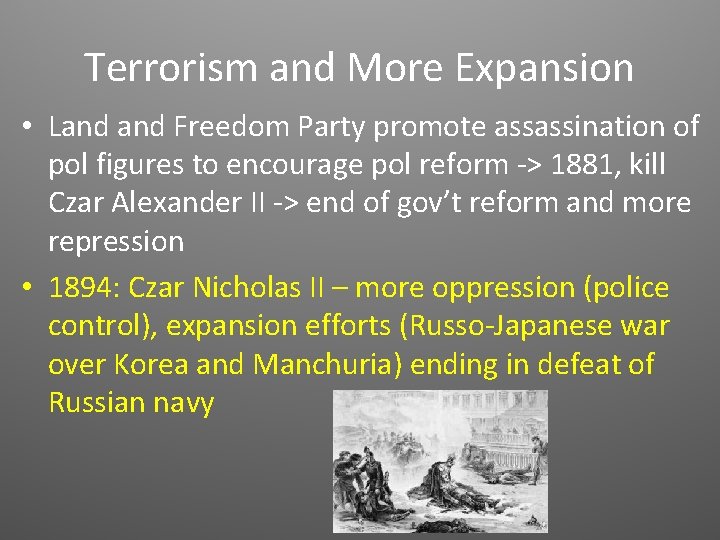
Terrorism and More Expansion • Land Freedom Party promote assassination of pol figures to encourage pol reform -> 1881, kill Czar Alexander II -> end of gov’t reform and more repression • 1894: Czar Nicholas II – more oppression (police control), expansion efforts (Russo-Japanese war over Korea and Manchuria) ending in defeat of Russian navy
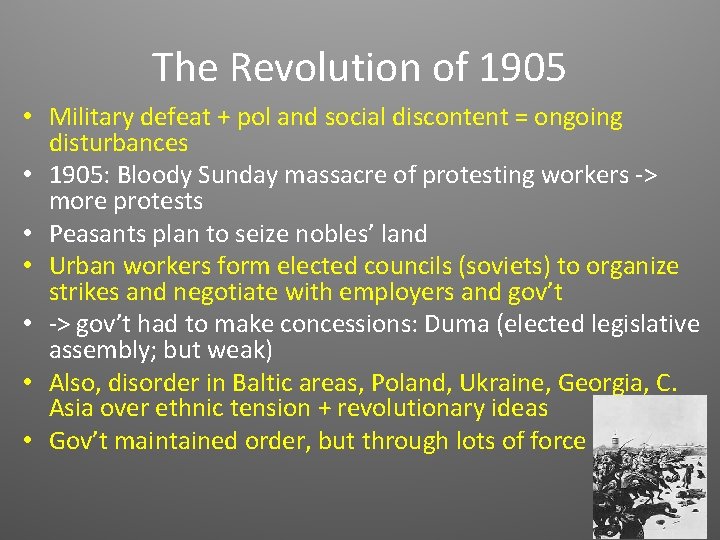
The Revolution of 1905 • Military defeat + pol and social discontent = ongoing disturbances • 1905: Bloody Sunday massacre of protesting workers -> more protests • Peasants plan to seize nobles’ land • Urban workers form elected councils (soviets) to organize strikes and negotiate with employers and gov’t • -> gov’t had to make concessions: Duma (elected legislative assembly; but weak) • Also, disorder in Baltic areas, Poland, Ukraine, Georgia, C. Asia over ethnic tension + revolutionary ideas • Gov’t maintained order, but through lots of force
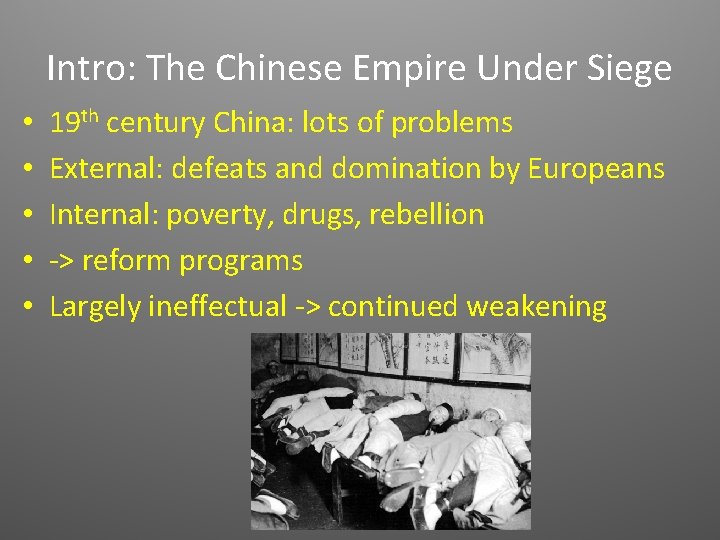
Intro: The Chinese Empire Under Siege • • • 19 th century China: lots of problems External: defeats and domination by Europeans Internal: poverty, drugs, rebellion -> reform programs Largely ineffectual -> continued weakening
Opium • Late 1700 s: restrictions and control of foreign trade and little demand foreign goods (-> traded in silver bullion) = isolationism • British East India Company wanted more profit -> began trading in opium (for goods plus silver) -> rapid expansion (=addiction) • Illegal, but corruption kept gov’t from doing anything • By 1830 s, = huge problem: draining silver, social problems • 1838 -39: gov’t tried to stop trade by destroying lots of opium form BEI Co. warehouses
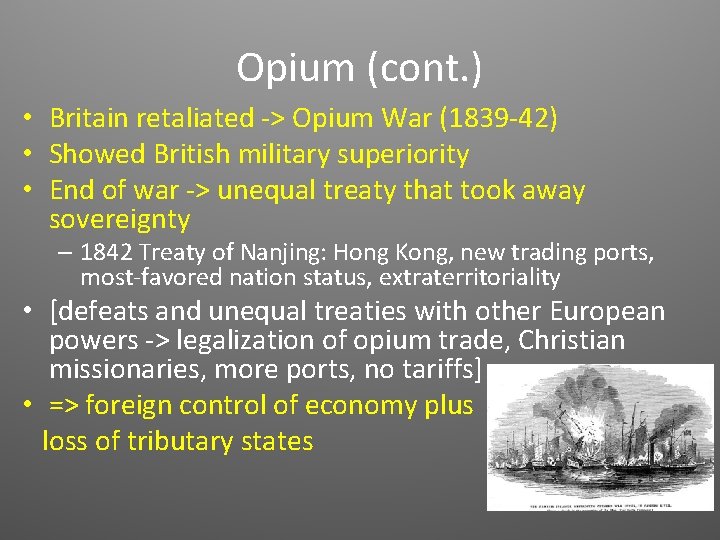
Opium (cont. ) • Britain retaliated -> Opium War (1839 -42) • Showed British military superiority • End of war -> unequal treaty that took away sovereignty – 1842 Treaty of Nanjing: Hong Kong, new trading ports, most-favored nation status, extraterritoriality • [defeats and unequal treaties with other European powers -> legalization of opium trade, Christian missionaries, more ports, no tariffs] • => foreign control of economy plus loss of tributary states
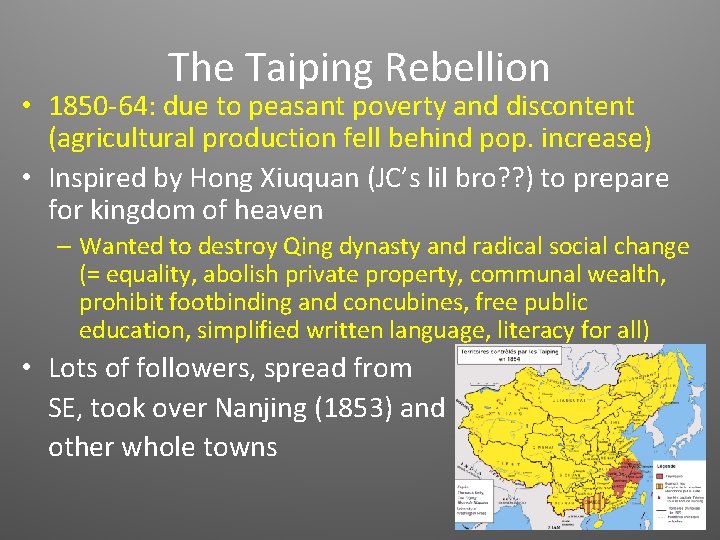
The Taiping Rebellion • 1850 -64: due to peasant poverty and discontent (agricultural production fell behind pop. increase) • Inspired by Hong Xiuquan (JC’s lil bro? ? ) to prepare for kingdom of heaven – Wanted to destroy Qing dynasty and radical social change (= equality, abolish private property, communal wealth, prohibit footbinding and concubines, free public education, simplified written language, literacy for all) • Lots of followers, spread from SE, took over Nanjing (1853) and other whole towns
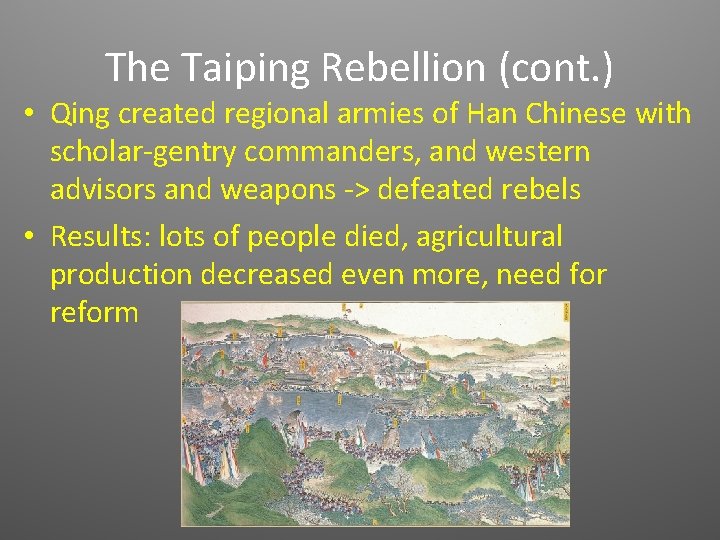
The Taiping Rebellion (cont. ) • Qing created regional armies of Han Chinese with scholar-gentry commanders, and western advisors and weapons -> defeated rebels • Results: lots of people died, agricultural production decreased even more, need for reform
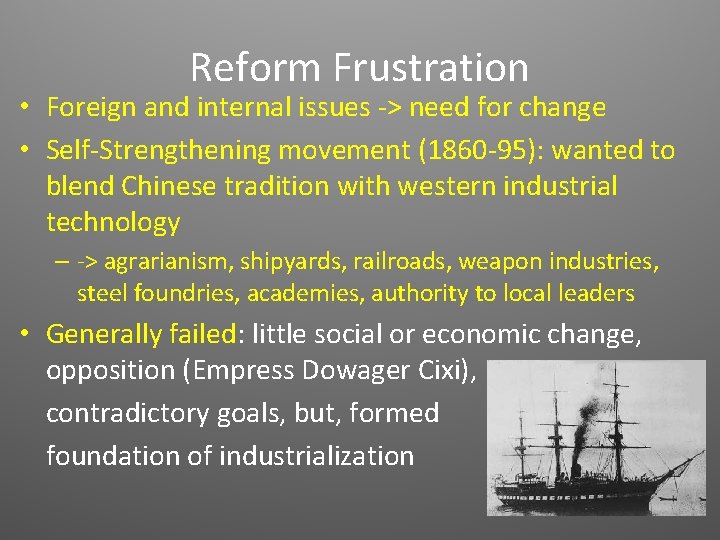
Reform Frustration • Foreign and internal issues -> need for change • Self-Strengthening movement (1860 -95): wanted to blend Chinese tradition with western industrial technology – -> agrarianism, shipyards, railroads, weapon industries, steel foundries, academies, authority to local leaders • Generally failed: little social or economic change, opposition (Empress Dowager Cixi), contradictory goals, but, formed foundation of industrialization
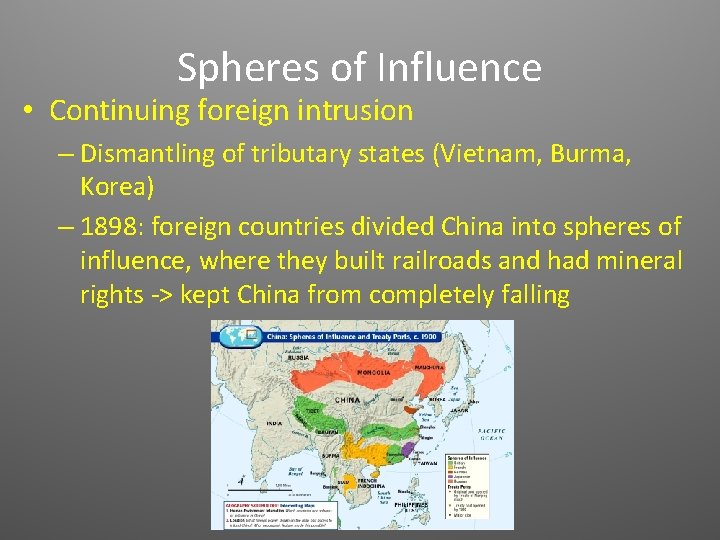
Spheres of Influence • Continuing foreign intrusion – Dismantling of tributary states (Vietnam, Burma, Korea) – 1898: foreign countries divided China into spheres of influence, where they built railroads and had mineral rights -> kept China from completely falling
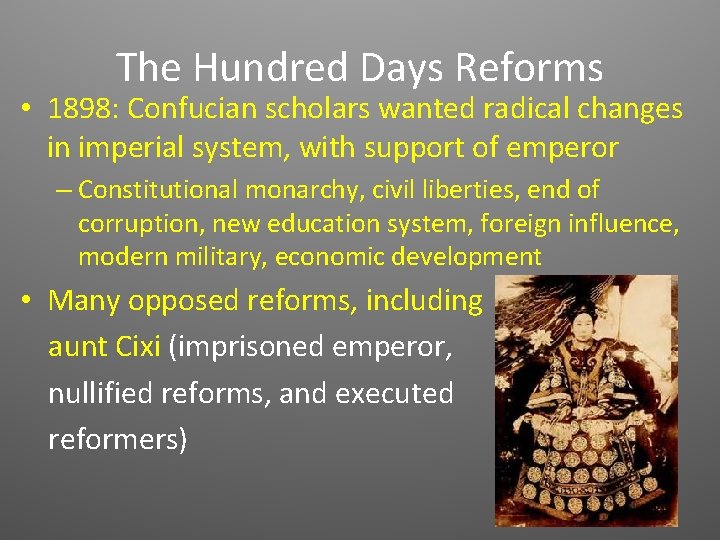
The Hundred Days Reforms • 1898: Confucian scholars wanted radical changes in imperial system, with support of emperor – Constitutional monarchy, civil liberties, end of corruption, new education system, foreign influence, modern military, economic development • Many opposed reforms, including aunt Cixi (imprisoned emperor, nullified reforms, and executed reformers)
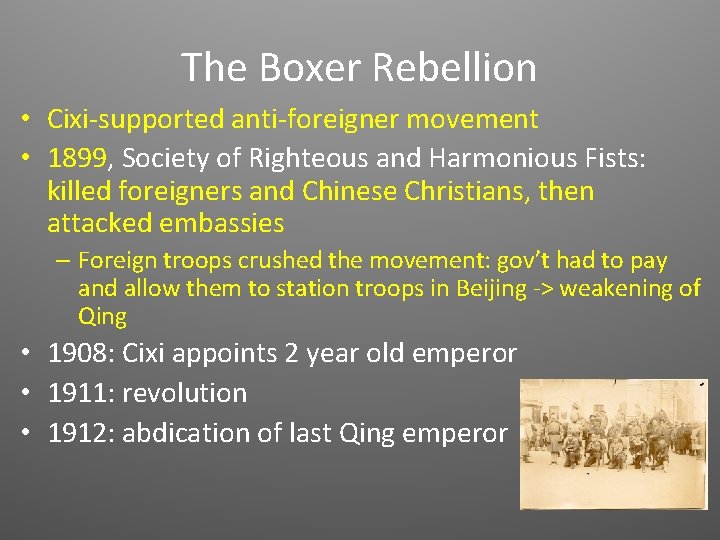
The Boxer Rebellion • Cixi-supported anti-foreigner movement • 1899, Society of Righteous and Harmonious Fists: killed foreigners and Chinese Christians, then attacked embassies – Foreign troops crushed the movement: gov’t had to pay and allow them to station troops in Beijing -> weakening of Qing • 1908: Cixi appoints 2 year old emperor • 1911: revolution • 1912: abdication of last Qing emperor
The Transformation of Japan • Crisis: early 1800 s – turmoil (decreasing agricultural production, crop failures, high taxes > poverty, starvation) -> many sold land became tenant farmers, others moved to cities – Even daimyo and samurai were in debt • -> protest and reform • Reform: 1841 -43 – cancelled daimyo and samurai debts, abolished merchant guilds, pushed peasants back to the countryside to grow rice – Largely ineffective and lots of opposition
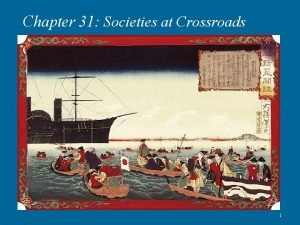
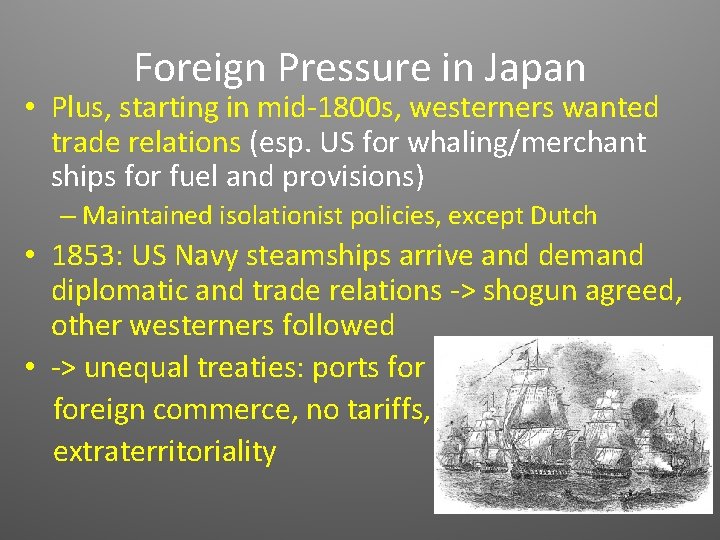
Foreign Pressure in Japan • Plus, starting in mid-1800 s, westerners wanted trade relations (esp. US for whaling/merchant ships for fuel and provisions) – Maintained isolationist policies, except Dutch • 1853: US Navy steamships arrive and demand diplomatic and trade relations -> shogun agreed, other westerners followed • -> unequal treaties: ports foreign commerce, no tariffs, extraterritoriality
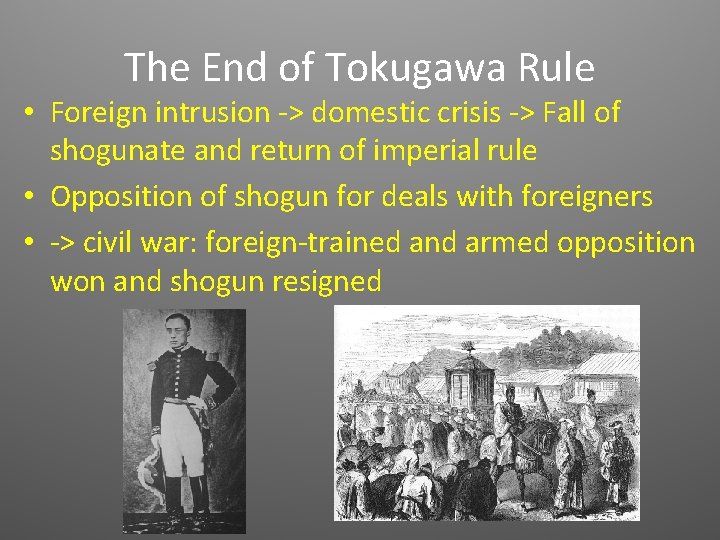
The End of Tokugawa Rule • Foreign intrusion -> domestic crisis -> Fall of shogunate and return of imperial rule • Opposition of shogun for deals with foreigners • -> civil war: foreign-trained and armed opposition won and shogun resigned
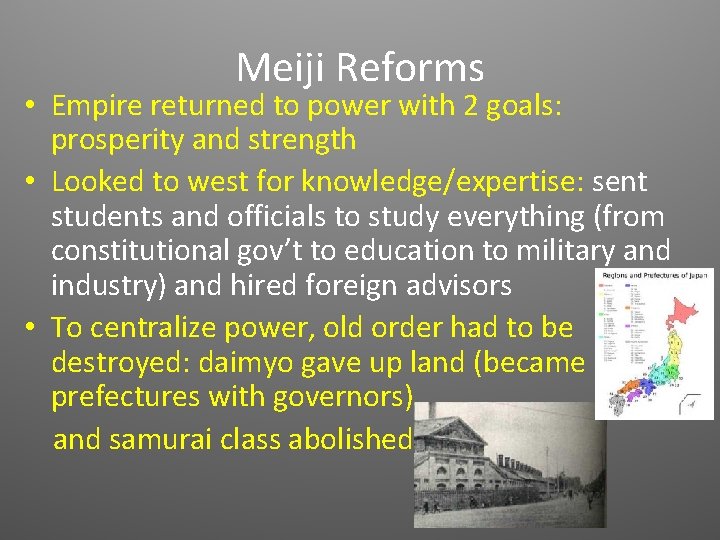
Meiji Reforms • Empire returned to power with 2 goals: prosperity and strength • Looked to west for knowledge/expertise: sent students and officials to study everything (from constitutional gov’t to education to military and industry) and hired foreign advisors • To centralize power, old order had to be destroyed: daimyo gave up land (became prefectures with governors) and samurai class abolished
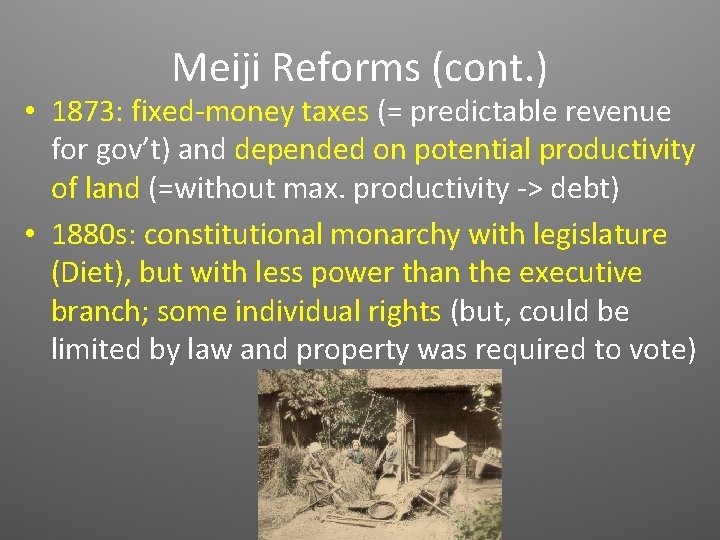
Meiji Reforms (cont. ) • 1873: fixed-money taxes (= predictable revenue for gov’t) and depended on potential productivity of land (=without max. productivity -> debt) • 1880 s: constitutional monarchy with legislature (Diet), but with less power than the executive branch; some individual rights (but, could be limited by law and property was required to vote)
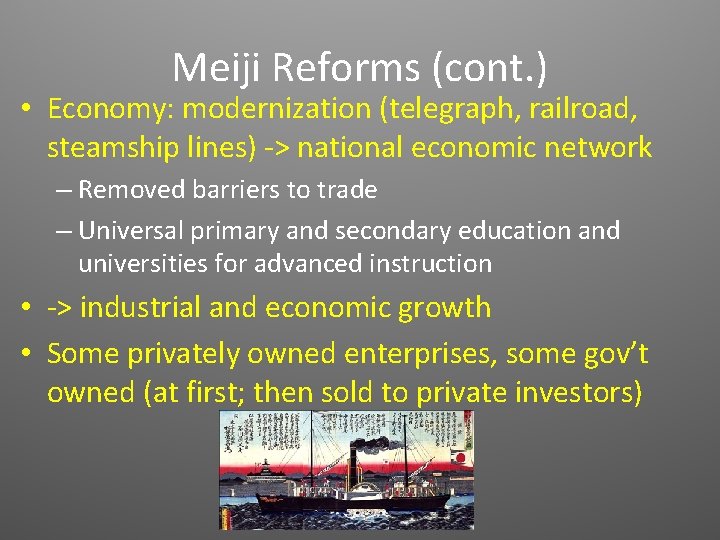
Meiji Reforms (cont. ) • Economy: modernization (telegraph, railroad, steamship lines) -> national economic network – Removed barriers to trade – Universal primary and secondary education and universities for advanced instruction • -> industrial and economic growth • Some privately owned enterprises, some gov’t owned (at first; then sold to private investors)
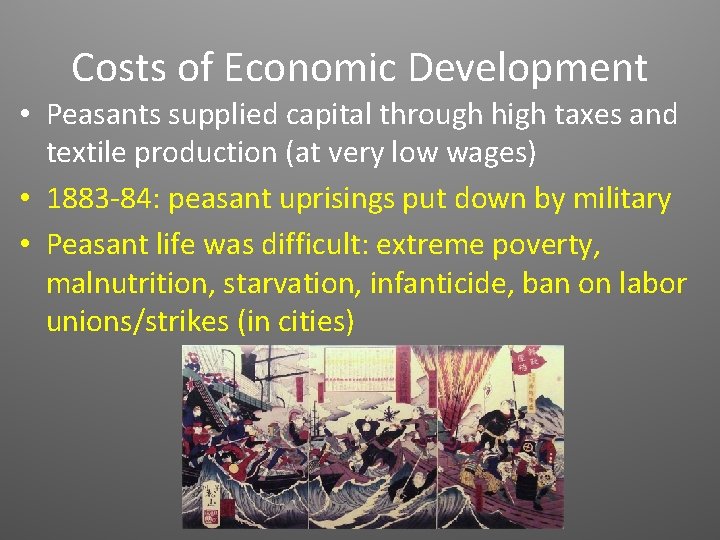
Costs of Economic Development • Peasants supplied capital through high taxes and textile production (at very low wages) • 1883 -84: peasant uprisings put down by military • Peasant life was difficult: extreme poverty, malnutrition, starvation, infanticide, ban on labor unions/strikes (in cities)
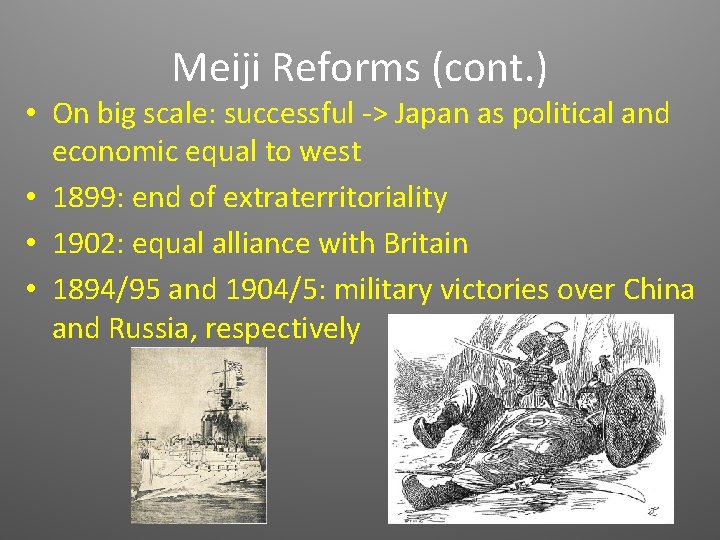
Meiji Reforms (cont. ) • On big scale: successful -> Japan as political and economic equal to west • 1899: end of extraterritoriality • 1902: equal alliance with Britain • 1894/95 and 1904/5: military victories over China and Russia, respectively