
Totally Disjoint Multipath Routing in Multihop Wireless Networks
- Slides: 16
Totally Disjoint Multipath Routing in Multihop Wireless Networks Sonia Waharte and Raoef Boutaba Presented by: Anthony Calce
Overview Ø Ø Introduction Problem Definition Design Assumptions Throughput Estimation • Multipath vs. Single Path Routing Comparison • Single Source-Destination Scenario - Analysis - Validation • Multiple Source-Destination Scenario Ø Conclusion 2
Introduction Ø Multipath Routing • Multiple paths are kept track of • Saves time by not doing route discovery when broken path Ø Previous Works • Optimizing path reliability [Lee, Nasipuri, Raju] • Lower power consumption [Ganesan, Liu] • Optimized load Distribution [Lee, Pearman] Ø Performance Metrics Analyzed • Node mobility, energy limitations, high density 3
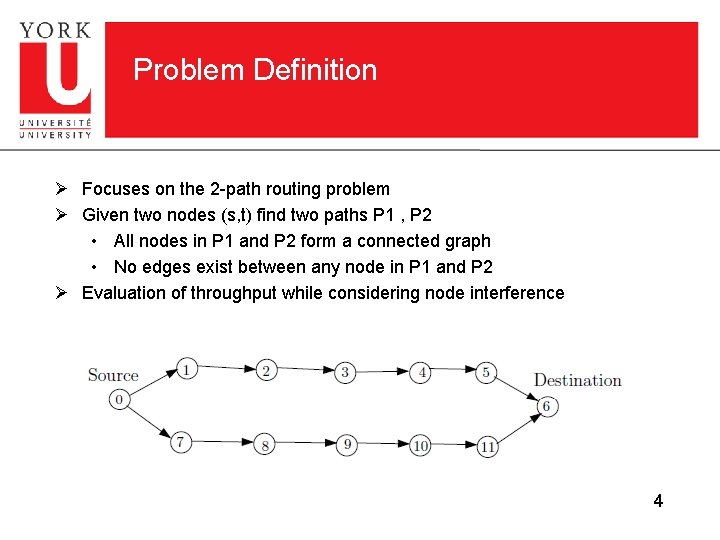
Problem Definition Ø Focuses on the 2 -path routing problem Ø Given two nodes (s, t) find two paths P 1 , P 2 • All nodes in P 1 and P 2 form a connected graph • No edges exist between any node in P 1 and P 2 Ø Evaluation of throughput while considering node interference 4
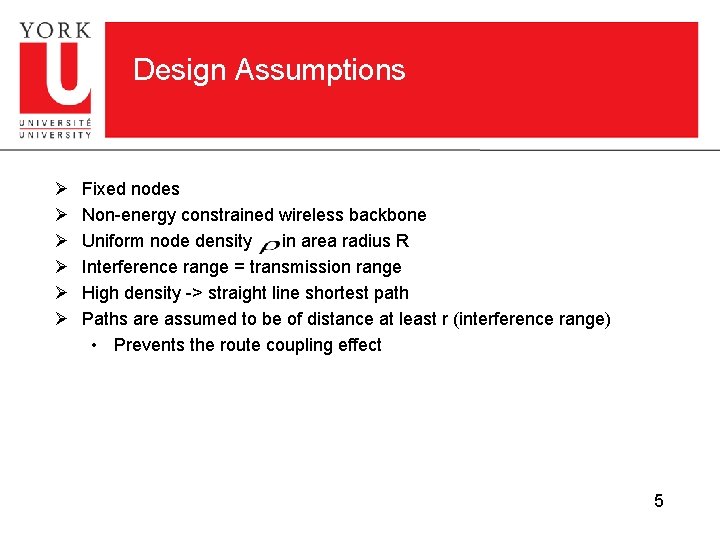
Design Assumptions Ø Ø Ø Fixed nodes Non-energy constrained wireless backbone Uniform node density in area radius R Interference range = transmission range High density -> straight line shortest path Paths are assumed to be of distance at least r (interference range) • Prevents the route coupling effect 5
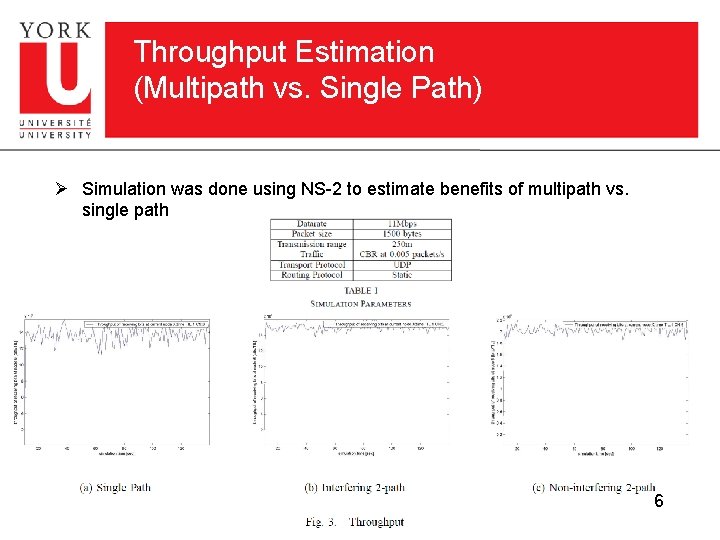
Throughput Estimation (Multipath vs. Single Path) Ø Simulation was done using NS-2 to estimate benefits of multipath vs. single path 6
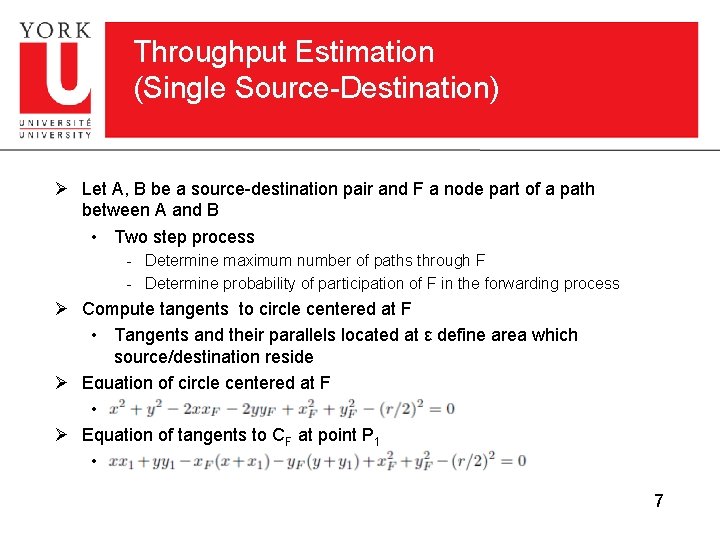
Throughput Estimation (Single Source-Destination) Ø Let A, B be a source-destination pair and F a node part of a path between A and B • Two step process - Determine maximum number of paths through F - Determine probability of participation of F in the forwarding process Ø Compute tangents to circle centered at F • Tangents and their parallels located at ε define area which source/destination reside Ø Equation of circle centered at F • Ø Equation of tangents to CF at point P 1 • 7
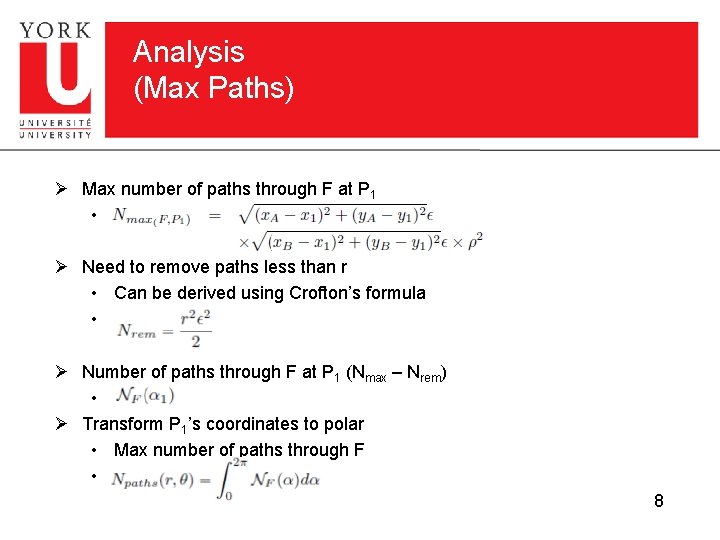
Analysis (Max Paths) Ø Max number of paths through F at P 1 • Ø Need to remove paths less than r • Can be derived using Crofton’s formula • Ø Number of paths through F at P 1 (Nmax – Nrem) • Ø Transform P 1’s coordinates to polar • Max number of paths through F • 8
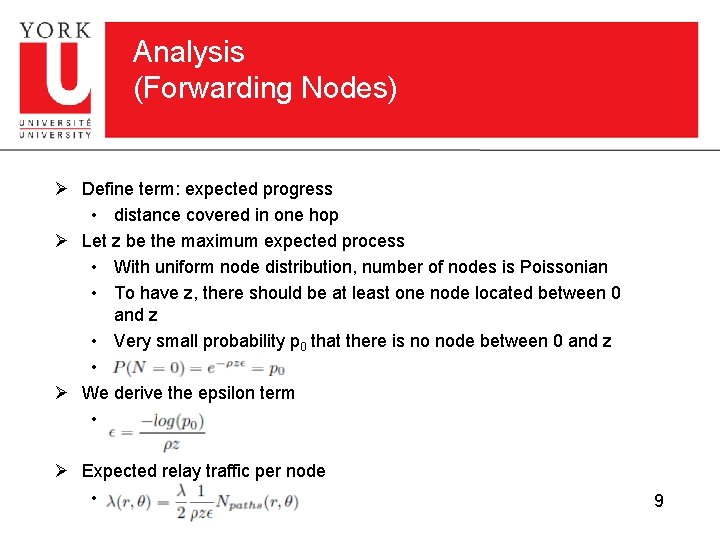
Analysis (Forwarding Nodes) Ø Define term: expected progress • distance covered in one hop Ø Let z be the maximum expected process • With uniform node distribution, number of nodes is Poissonian • To have z, there should be at least one node located between 0 and z • Very small probability p 0 that there is no node between 0 and z • Ø We derive the epsilon term • Ø Expected relay traffic per node • 9
Validation Ø Two methods to validate analysis • Implement a routing algorithm based on node positioning • Compute total relay traffic in single path routing and compare against total relay traffic in 2 -path routing 10
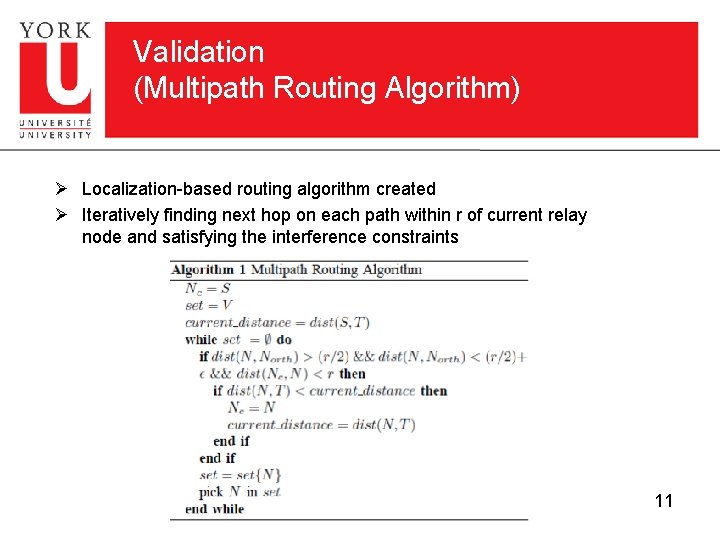
Validation (Multipath Routing Algorithm) Ø Localization-based routing algorithm created Ø Iteratively finding next hop on each path within r of current relay node and satisfying the interference constraints 11
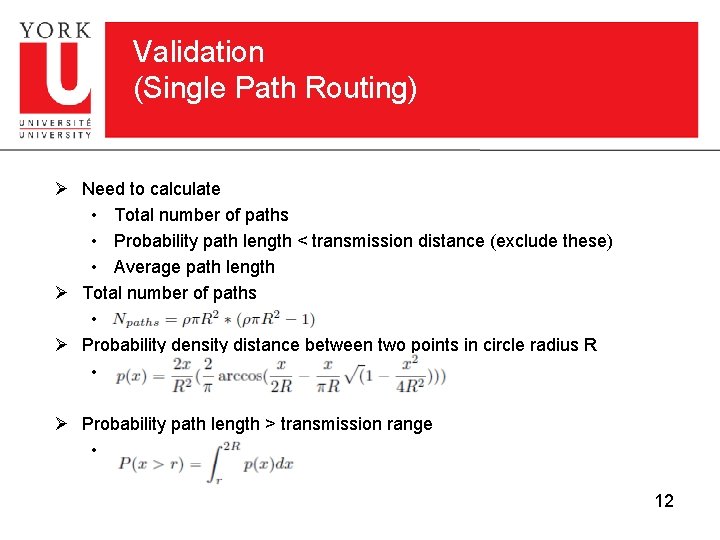
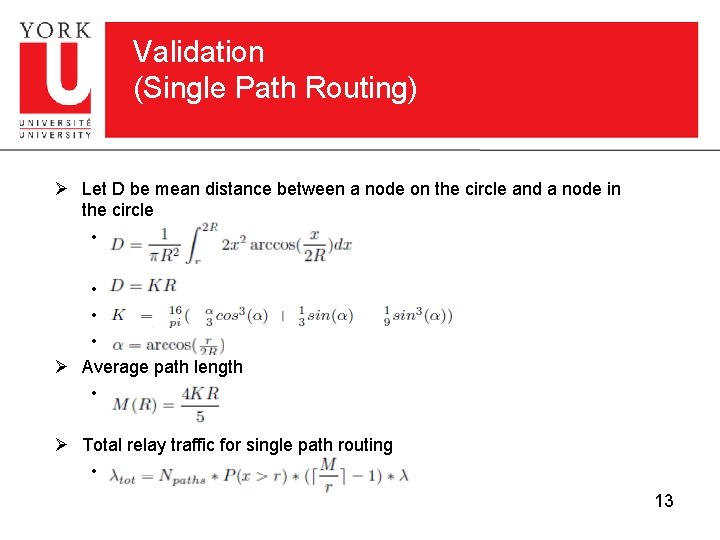
Validation (Single Path Routing) Ø Need to calculate • Total number of paths • Probability path length < transmission distance (exclude these) • Average path length Ø Total number of paths • Ø Probability density distance between two points in circle radius R • Ø Probability path length > transmission range • 12
Validation (Single Path Routing) Ø Let D be mean distance between a node on the circle and a node in the circle • • Ø Average path length • Ø Total relay traffic for single path routing • 13
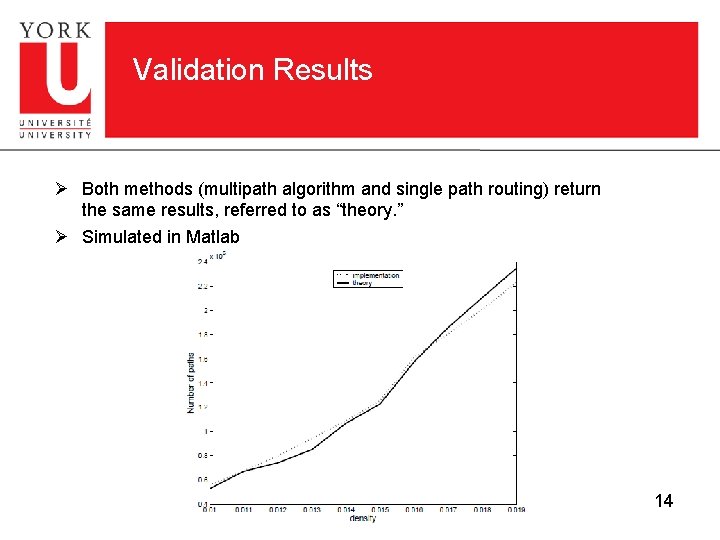
Validation Results Ø Both methods (multipath algorithm and single path routing) return the same results, referred to as “theory. ” Ø Simulated in Matlab 14
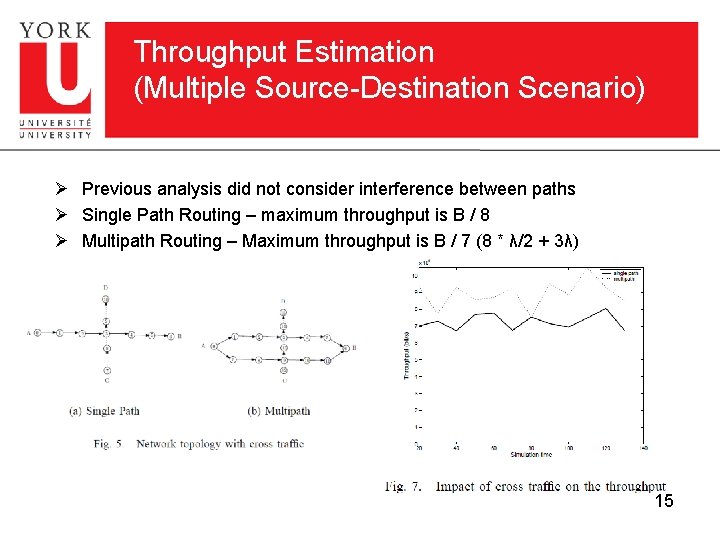
Throughput Estimation (Multiple Source-Destination Scenario) Ø Previous analysis did not consider interference between paths Ø Single Path Routing – maximum throughput is B / 8 Ø Multipath Routing – Maximum throughput is B / 7 (8 * λ/2 + 3λ) 15
Conclusion Ø Two problems were looked at • Estimation of throughput of the interference of single sourcedestination pair • Impact of interference of multiple source-destination pairs Ø Multipath routing only slightly better performance than single path routing when interference is considered Ø This benefit becomes almost insignificant when actual cost of path establishment is considered. Ø In the context of path interference, multipath routing is not a sound strategy 16