cern chrflectures SUPERFISH EXERCISE 14 1662010 CAS RF








- Slides: 32
cern. ch/rf-lectures SUPERFISH EXERCISE 14 -16/6/2010 CAS RF Denmark - Superfish Exercise 1
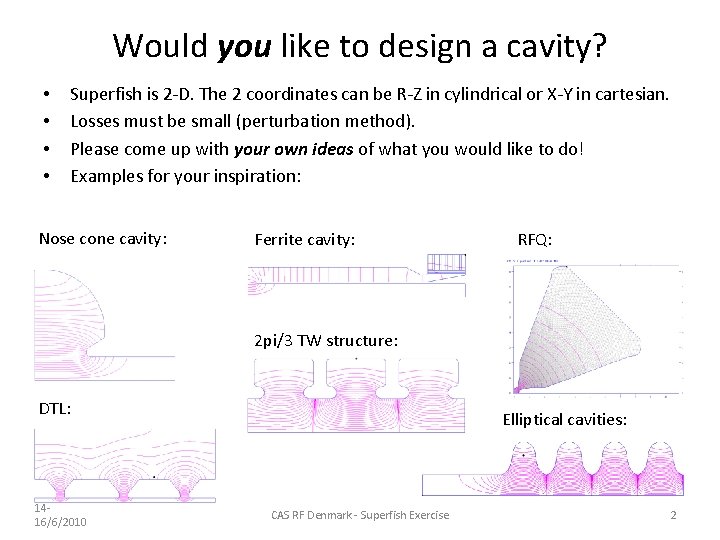
Would you like to design a cavity? • • Superfish is 2 -D. The 2 coordinates can be R-Z in cylindrical or X-Y in cartesian. Losses must be small (perturbation method). Please come up with your own ideas of what you would like to do! Examples for your inspiration: Nose cone cavity: Ferrite cavity: RFQ: 2 pi/3 TW structure: DTL: 1416/6/2010 Elliptical cavities: CAS RF Denmark - Superfish Exercise 2
Poisson/Superfish The history of these codes starts in the sixties at LBL with Jim Spoerl who wrote the codes “MESH” and “FIELD”. They already solved Poisson’s equation in a triangular mesh. Ron Holsinger, Klaus Halbach and others from LBL improved the codes significantly; the codes were now called “LATTICE”, “TEKPLOT” and “POISSON”. From 1975, when Holsinger came to Los Alamos, development continued there and Superfish came to life (French poisson = English fish). It could do eigenfrequencies! Since 1986, the Los Alamos Accelerator Code Group (LAACG) has received funding from the U. S. Department of Energy to maintain and document a standard version of these codes. In 1999, Lloyd Young, Harunori Takeda, and James Billen took over the support of accelerator design codes, which were heavily used in the design of the SNS. The codes were ported to DOS/Windows from the early nineties, the latest version 7 is from 2003. To my knowledge, other versions are presently not supported. To install and run in other environments, please see here: http: //www. winehq. org/ The Los Alamos Accelerator Code group maintain these codes still today with competence and free of charge. http: //laacg 1. lanl. gov/laacg/services. phtml 14 -16/6/2010 CAS RF Denmark - Superfish Exercise 3
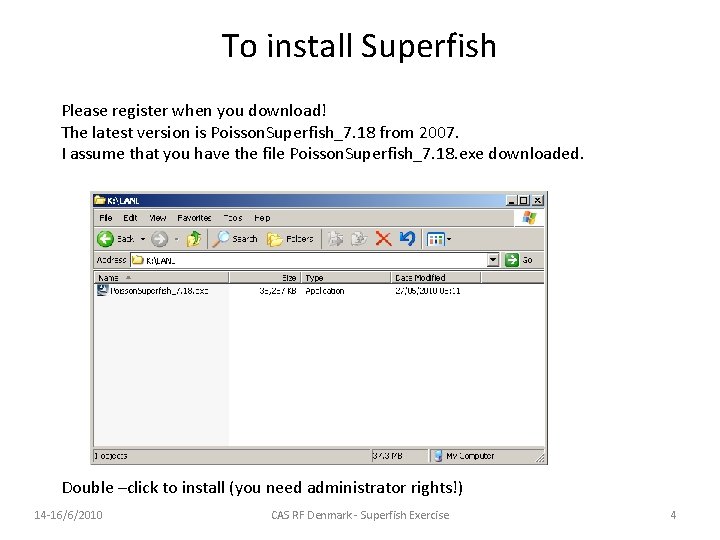
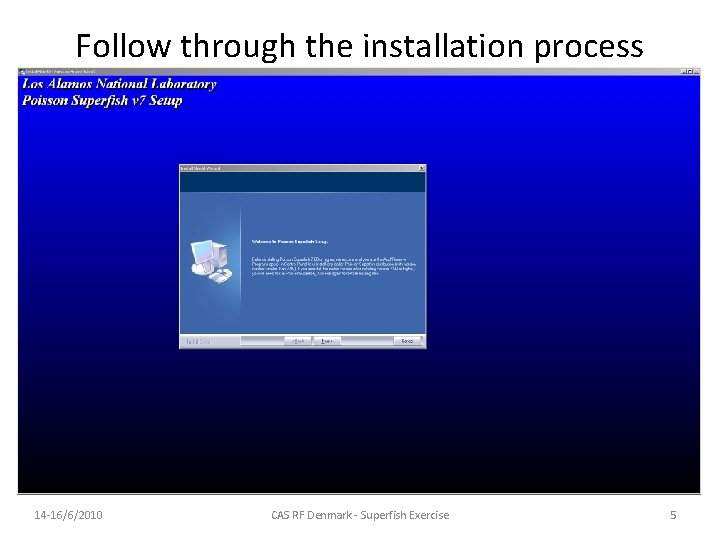
To install Superfish Please register when you download! The latest version is Poisson. Superfish_7. 18 from 2007. I assume that you have the file Poisson. Superfish_7. 18. exe downloaded. Double –click to install (you need administrator rights!) 14 -16/6/2010 CAS RF Denmark - Superfish Exercise 4
Follow through the installation process 14 -16/6/2010 CAS RF Denmark - Superfish Exercise 5
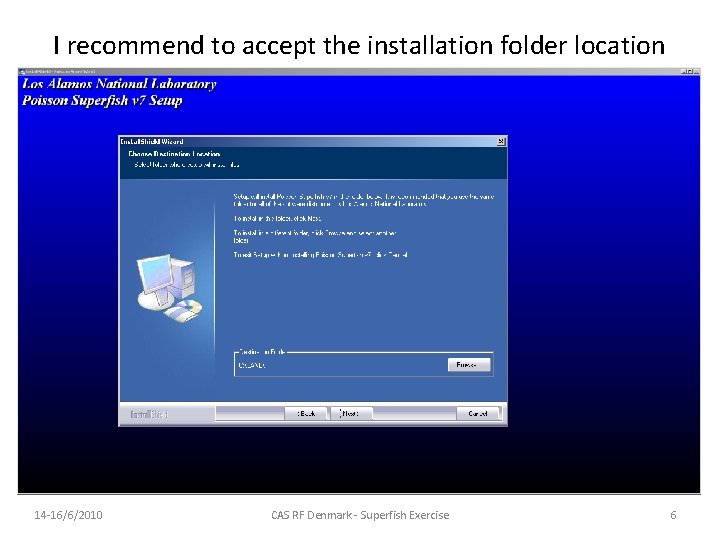
I recommend to accept the installation folder location 14 -16/6/2010 CAS RF Denmark - Superfish Exercise 6
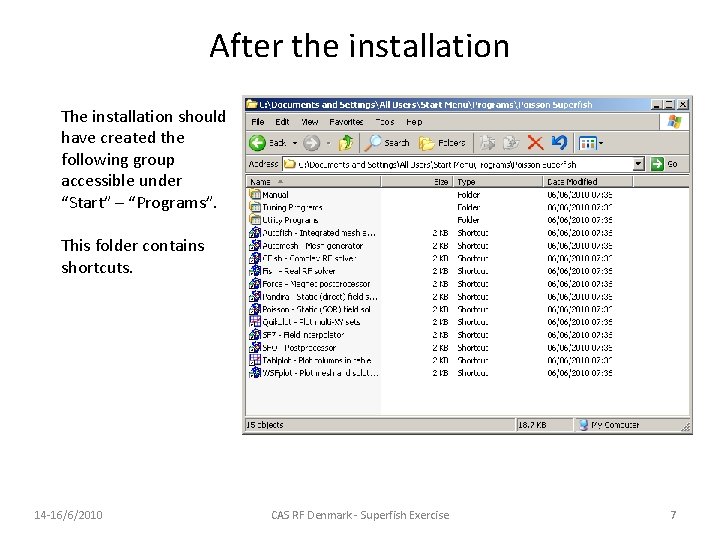
After the installation The installation should have created the following group accessible under “Start” – “Programs”. This folder contains shortcuts. 14 -16/6/2010 CAS RF Denmark - Superfish Exercise 7
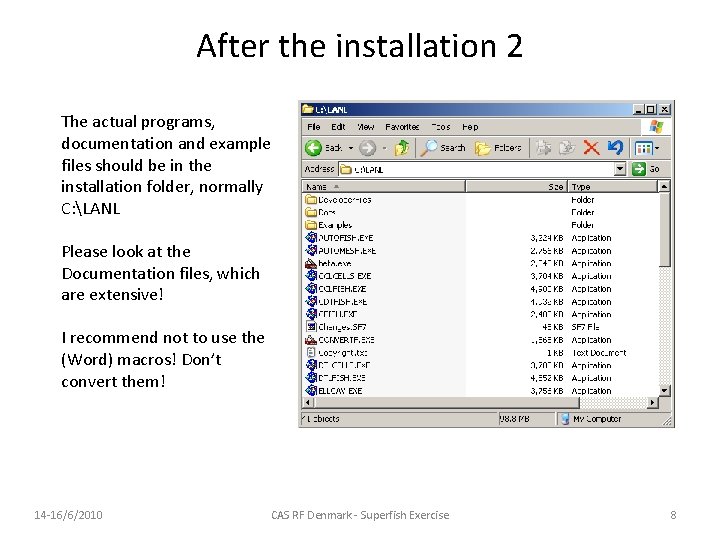
After the installation 2 The actual programs, documentation and example files should be in the installation folder, normally C: LANL Please look at the Documentation files, which are extensive! I recommend not to use the (Word) macros! Don’t convert them! 14 -16/6/2010 CAS RF Denmark - Superfish Exercise 8
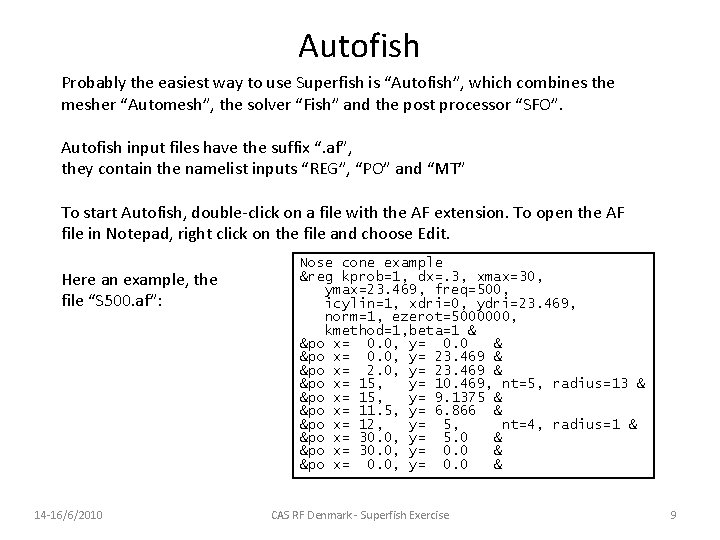
Autofish Probably the easiest way to use Superfish is “Autofish”, which combines the mesher “Automesh”, the solver “Fish” and the post processor “SFO”. Autofish input files have the suffix “. af”, they contain the namelist inputs “REG”, “PO” and “MT” To start Autofish, double-click on a file with the AF extension. To open the AF file in Notepad, right click on the file and choose Edit. Here an example, the file “S 500. af”: 14 -16/6/2010 Nose cone example ® kprob=1, dx=. 3, xmax=30, ymax=23. 469, freq=500, icylin=1, xdri=0, ydri=23. 469, norm=1, ezerot=5000000, kmethod=1, beta=1 & &po x= 0. 0, y= 0. 0 & &po x= 0. 0, y= 23. 469 & &po x= 2. 0, y= 23. 469 & &po x= 15, y= 10. 469, nt=5, radius=13 & &po x= 15, y= 9. 1375 & &po x= 11. 5, y= 6. 866 & &po x= 12, y= 5, nt=4, radius=1 & &po x= 30. 0, y= 5. 0 & &po x= 30. 0, y= 0. 0 & &po x= 0. 0, y= 0. 0 & CAS RF Denmark - Superfish Exercise 9
Namelist input Superfish passes a number of parameters with so-called namelists; this is an old FORTRAN concept that allows relatively free-format input. The format is &keyword {variable=value, . . . } & Accelerating cavity with an elliptical segment ! a Comment ® KPROB = 1, FREQ = 700. 0, DX =. 1, ! KPROB=1 > Superfish NBSUP = 1, NBSLO = 0, NBSRT = 1, NBSLF = 0, ICYLIN = 1, CCL = 1 IRTYPE = 1, RMASS = 2. 0, TEMPK = 2. 0, TC = 9. 2, RESIDR = 0. 10 E 07, XDRI = 5. 1350, YDRI = 18. 600 & &PO X = 0. 00, Y = 0. 00 & &PO X = 0. 00, Y = 5. 00 & &PO NT = 2, X 0 = 0, Y 0 = 8, A = 1. 5, B = 3, X = 1. 4918, Y = 0. 3127 & &PO X = 1. 903, Y = 15. 533 & &PO NT = 2, X 0 = 5. 1350, Y 0 = 15. 36350, X = 0. 00, Y = 3. 23650 & &PO X = 5. 1350, Y = 0. 00 & &PO X = 0. 00, Y = 0. 00 & 14 -16/6/2010 CAS RF Denmark - Superfish Exercise 10
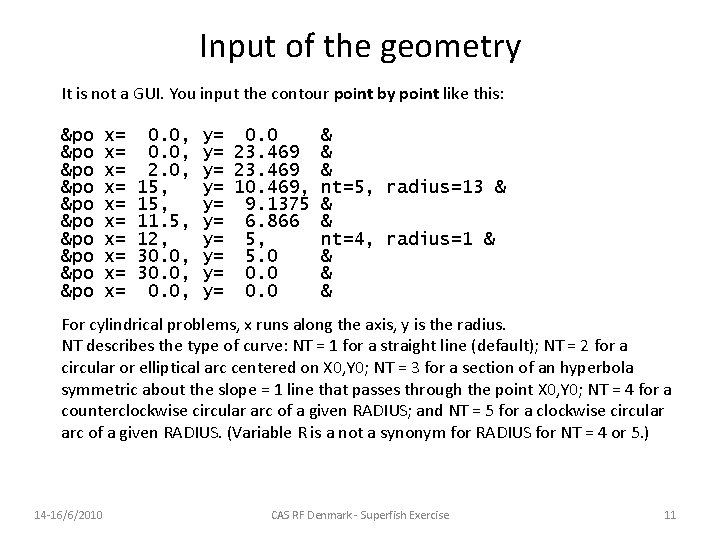
Input of the geometry It is not a GUI. You input the contour point by point like this: &po &po &po x= x= x= 0. 0, 2. 0, 15, 11. 5, 12, 30. 0, y= 0. 0 y= 23. 469 y= 10. 469, y= 9. 1375 y= 6. 866 y= 5, y= 5. 0 y= 0. 0 & & & nt=5, radius=13 & & & nt=4, radius=1 & & For cylindrical problems, x runs along the axis, y is the radius. NT describes the type of curve: NT = 1 for a straight line (default); NT = 2 for a circular or elliptical arc centered on X 0, Y 0; NT = 3 for a section of an hyperbola symmetric about the slope = 1 line that passes through the point X 0, Y 0; NT = 4 for a counterclockwise circular arc of a given RADIUS; and NT = 5 for a clockwise circular arc of a given RADIUS. (Variable R is a not a synonym for RADIUS for NT = 4 or 5. ) 14 -16/6/2010 CAS RF Denmark - Superfish Exercise 11
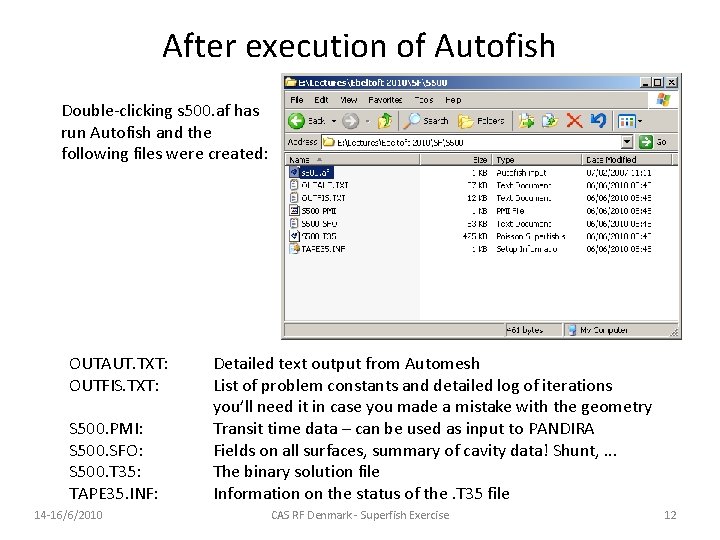
After execution of Autofish Double-clicking s 500. af has run Autofish and the following files were created: OUTAUT. TXT: OUTFIS. TXT: S 500. PMI: S 500. SFO: S 500. T 35: TAPE 35. INF: 14 -16/6/2010 Detailed text output from Automesh List of problem constants and detailed log of iterations you’ll need it in case you made a mistake with the geometry Transit time data – can be used as input to PANDIRA Fields on all surfaces, summary of cavity data! Shunt, . . . The binary solution file Information on the status of the. T 35 file CAS RF Denmark - Superfish Exercise 12
WSFPlot WSFplots output from programs Automesh, Fish, CFish, Poisson, and Pandira. It reads the and plots the problem geometry boundaries plus mesh lines, field contours, arrows, or circles. For complex rf fields, WSFplots the real and imaginary parts in different colors. For Superfish problems, WSFplots the drive point as a black dot. WSFplot also displays the field components at the location of the cursor. You can explore the field distribution in the problem geometry by moving the mouse or by pressing the arrow keys. To start WSFPlot, just double-click on the “. T 35” file. 14 -16/6/2010 CAS RF Denmark - Superfish Exercise 13
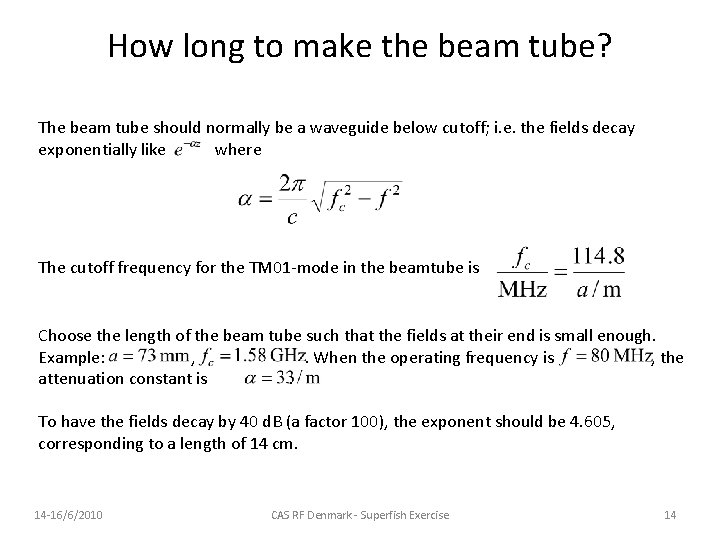
How long to make the beam tube? The beam tube should normally be a waveguide below cutoff; i. e. the fields decay exponentially like where The cutoff frequency for the TM 01 -mode in the beamtube is Choose the length of the beam tube such that the fields at their end is small enough. Example: , . When the operating frequency is , the attenuation constant is . To have the fields decay by 40 d. B (a factor 100), the exponent should be 4. 605, corresponding to a length of 14 cm. 14 -16/6/2010 CAS RF Denmark - Superfish Exercise 14
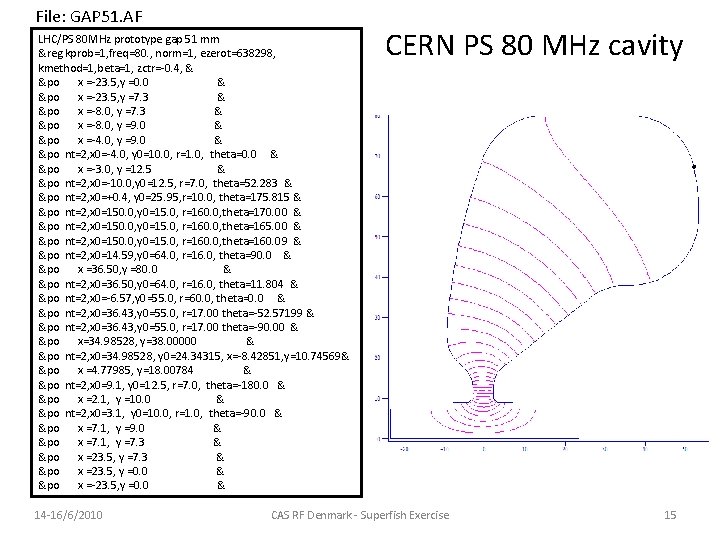
File: GAP 51. AF LHC/PS 80 MHz prototype gap 51 mm ® kprob=1, freq=80. , norm=1, ezerot=638298, kmethod=1, beta=1, zctr=-0. 4, & &po x =-23. 5, y =0. 0 & &po x =-23. 5, y =7. 3 & &po x =-8. 0, y =9. 0 & &po x =-4. 0, y =9. 0 & &po nt=2, x 0=-4. 0, y 0=10. 0, r=1. 0, theta=0. 0 & &po x =-3. 0, y =12. 5 & &po nt=2, x 0=-10. 0, y 0=12. 5, r=7. 0, theta=52. 283 & &po nt=2, x 0=+0. 4, y 0=25. 95, r=10. 0, theta=175. 815 & &po nt=2, x 0=150. 0, y 0=15. 0, r=160. 0, theta=170. 00 & &po nt=2, x 0=150. 0, y 0=15. 0, r=160. 0, theta=165. 00 & &po nt=2, x 0=150. 0, y 0=15. 0, r=160. 0, theta=160. 09 & &po nt=2, x 0=14. 59, y 0=64. 0, r=16. 0, theta=90. 0 & &po x =36. 50, y =80. 0 & &po nt=2, x 0=36. 50, y 0=64. 0, r=16. 0, theta=11. 804 & &po nt=2, x 0=-6. 57, y 0=55. 0, r=60. 0, theta=0. 0 & &po nt=2, x 0=36. 43, y 0=55. 0, r=17. 00 theta=-52. 57199 & &po nt=2, x 0=36. 43, y 0=55. 0, r=17. 00 theta=-90. 00 & &po x=34. 98528, y=38. 00000 & &po nt=2, x 0=34. 98528, y 0=24. 34315, x=-8. 42851, y=10. 74569& &po x =4. 77985, y=18. 00784 & &po nt=2, x 0=9. 1, y 0=12. 5, r=7. 0, theta=-180. 0 & &po x =2. 1, y =10. 0 & &po nt=2, x 0=3. 1, y 0=10. 0, r=1. 0, theta=-90. 0 & &po x =7. 1, y =9. 0 & &po x =7. 1, y =7. 3 & &po x =23. 5, y =7. 3 &po x =23. 5, y =0. 0 &po x =-23. 5, y =0. 0 & 14 -16/6/2010 CERN PS 80 MHz cavity CAS RF Denmark - Superfish Exercise 15
1 st exercise: Input the geometry! All dimensions in mm! r=250 Tip: Write your namelist into a file named “filename. am”, and start it like Your title line ® kprob=1 & &po … 20 100 r=50 This will allow you to test it just double-clicking on it. r=50 Length to be determined for an operating frequency well below cutoff – beam tube radius 50 mm, field should have decayed by at least 40 d. B. 14 -16/6/2010 CAS RF Denmark - Superfish Exercise 16
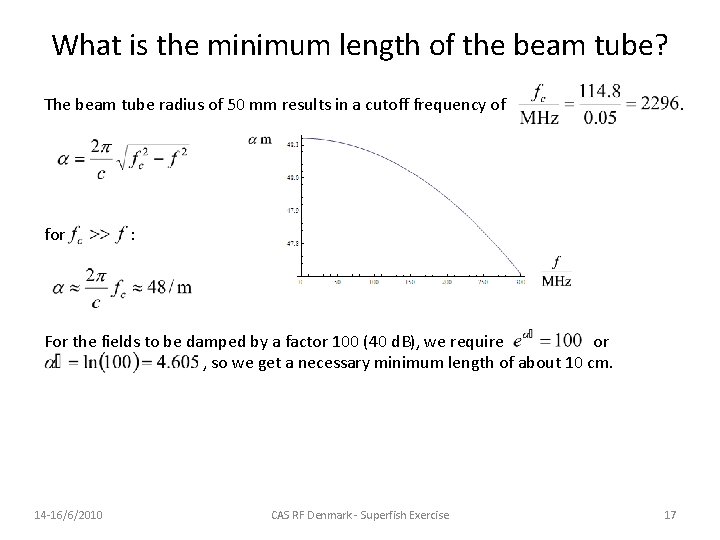
What is the minimum length of the beam tube? The beam tube radius of 50 mm results in a cutoff frequency of . for : For the fields to be damped by a factor 100 (40 d. B), we require or , so we get a necessary minimum length of about 10 cm. 14 -16/6/2010 CAS RF Denmark - Superfish Exercise 17
A possible solution: Ebeltoft cavity ® kprob=1, dx=3, freq=150, icylin=1, norm=1, ezerot=5000000, kmethod=1, beta=1, conv=0. 1 & &po x= 0. 0, y= 0. 0 & &po x= 0. 0, y=470. 0 & &po x=250. 0, y=220. 0, nt=5, radius=250. 0 & &po x=250. 0, y=200. 0 & &po x=200. 0, y=150. 0, nt=5, radius= 50. 0 & &po x=100. 0, y=150. 0 & &po x=100. 0, y= 50. 0, nt=4, radius= 50. 0 & &po x=250. 0, y= 0. 0 & &po x= 0. 0, y= 0. 0 & If this is input to a file “filename. af”, you may directly run it by double-clicking it. 14 -16/6/2010 CAS RF Denmark - Superfish Exercise 18
Solution summary Superfish output summary for problem description: Ebeltoft cavity Problem file: C: EBELTOFT 2010NUMERICALSFEXERCISETEST 0. AF 6 -15 -2010 5: 45: 28 ---------------------------------------All calculated values below refer to the mesh geometry only. Field normalization (NORM = 1): EZEROT = 5. 00000 MV/m Frequency = 157. 56044 MHz Particle rest mass energy = 938. 272029 Me. V Beta = 1. 0000000 Normalization factor for E 0 = 5. 081 MV/m = 36452. 569 Transit-time factor = 0. 9840418 Stored energy = 15. 1276087 Joules Using standard room-temperature copper. Surface resistance = 3. 27480 milli. Ohm Normal-conductor resistivity = 1. 72410 micro. Ohm-cm Operating temperature = 20. 0000 C Power dissipation = 413. 7217 k. W Q = 36198. 4 Shunt impedance = 15. 601 MOhm/m Rs*Q = 118. 542 Ohm Z*T*T = 15. 107 MOhm/m r/Q = 104. 333 Ohm Wake loss parameter = 0. 02582 V/p. C Average magnetic field on the outer wall = 9682. 62 A/m, 15. 3511 W/cm^2 Maximum H (at Z, R = 205. 84, 150. 342) = 26461. 5 A/m, 114. 652 W/cm^2 Maximum E (at Z, R = 50. 255, 105. 044) = 32. 3177 MV/m, 2. 40527 Kilp. Ratio of peak fields Bmax/Emax = 1. 0289 m. T/(MV/m) Peak-to-average ratio Emax/E 0 = 6. 3604 As you see from the “Superfish output summary” at the end of the SFO file, Superfish has interpreted the segment # 3 as a “half-stem”. This is not what we intended! To fix this create a file “filename. seg” and indicate explicitly the wall segments. 14 -16/6/2010 CAS RF Denmark - Superfish Exercise 19
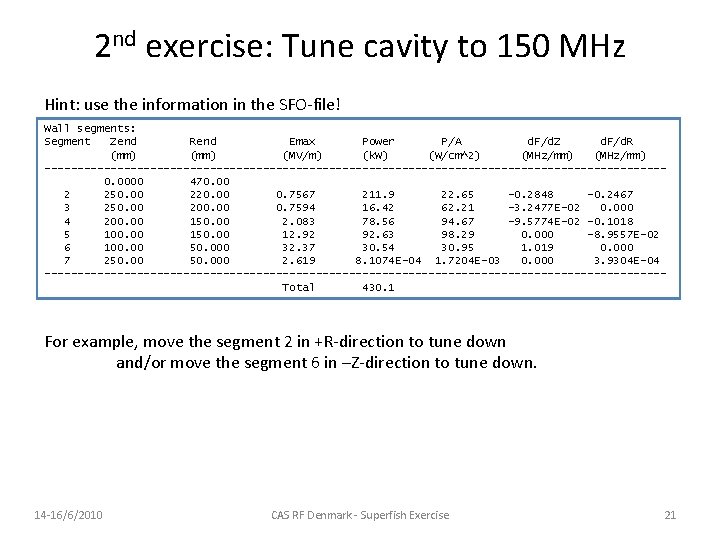
“SEG-file” The SEG-file indicates which boundary segments are metall, which are stems, which are symmetry planes. Here the minimum SEG-file to our example: “filename. seg”: Field. Segments 2 3 4 End. Data End 5 6 7 After having defined the SEG-file, the losses are correctly calculated as indicated at the end of the SFO-file: Wall segments: Segment Zend Rend Emax Power P/A d. F/d. Z d. F/d. R (mm) (MV/m) (k. W) (W/cm^2) (MHz/mm) -----------------------------------------------0. 0000 470. 00 2 250. 00 220. 00 0. 7567 211. 9 22. 65 -0. 2848 -0. 2467 3 250. 00 200. 00 0. 7594 16. 42 62. 21 -3. 2477 E-02 0. 000 4 200. 00 150. 00 2. 083 78. 56 94. 67 -9. 5774 E-02 -0. 1018 5 100. 00 150. 00 12. 92 92. 63 98. 29 0. 000 -8. 9557 E-02 6 100. 00 50. 000 32. 37 30. 54 30. 95 1. 019 0. 000 7 250. 000 2. 619 8. 1074 E-04 1. 7204 E-03 0. 000 3. 9304 E-04 -----------------------------------------------Total 430. 1 14 -16/6/2010 CAS RF Denmark - Superfish Exercise 20
2 nd exercise: Tune cavity to 150 MHz Hint: use the information in the SFO-file! Wall segments: Segment Zend Rend Emax Power P/A d. F/d. Z d. F/d. R (mm) (MV/m) (k. W) (W/cm^2) (MHz/mm) -----------------------------------------------0. 0000 470. 00 2 250. 00 220. 00 0. 7567 211. 9 22. 65 -0. 2848 -0. 2467 3 250. 00 200. 00 0. 7594 16. 42 62. 21 -3. 2477 E-02 0. 000 4 200. 00 150. 00 2. 083 78. 56 94. 67 -9. 5774 E-02 -0. 1018 5 100. 00 150. 00 12. 92 92. 63 98. 29 0. 000 -8. 9557 E-02 6 100. 00 50. 000 32. 37 30. 54 30. 95 1. 019 0. 000 7 250. 000 2. 619 8. 1074 E-04 1. 7204 E-03 0. 000 3. 9304 E-04 -----------------------------------------------Total 430. 1 For example, move the segment 2 in +R-direction to tune down and/or move the segment 6 in –Z-direction to tune down. 14 -16/6/2010 CAS RF Denmark - Superfish Exercise 21
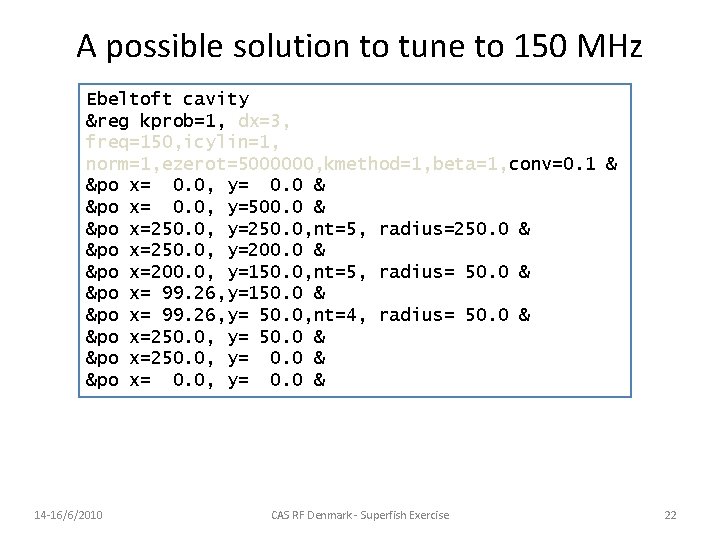
A possible solution to tune to 150 MHz Ebeltoft cavity ® kprob=1, dx=3, freq=150, icylin=1, norm=1, ezerot=5000000, kmethod=1, beta=1, conv=0. 1 & &po x= 0. 0, y= 0. 0 & &po x= 0. 0, y=500. 0 & &po x=250. 0, y=250. 0, nt=5, radius=250. 0 & &po x=250. 0, y=200. 0 & &po x=200. 0, y=150. 0, nt=5, radius= 50. 0 & &po x= 99. 26, y=150. 0 & &po x= 99. 26, y= 50. 0, nt=4, radius= 50. 0 & &po x=250. 0, y= 0. 0 & &po x= 0. 0, y= 0. 0 & 14 -16/6/2010 CAS RF Denmark - Superfish Exercise 22
Other parameters set in REG-namelist: KPROB=1 CONV=0. 1 DX=3 FREQ=150 NORM=1, EZEROT=5000000 KMETHOD=1, BETA=1 14 -16/6/2010 ; indicates a Superfish problem. ; sets geometric scale to mm (mm/cm=0. 1) ; sets mesh size to 3 mm ; sets starting value for eigenfrequency search ; normalizes fields to 5 MV/m accelerating gradient (including transit time effects) ; forces the particle velocity to the speed of light. CAS RF Denmark - Superfish Exercise 23
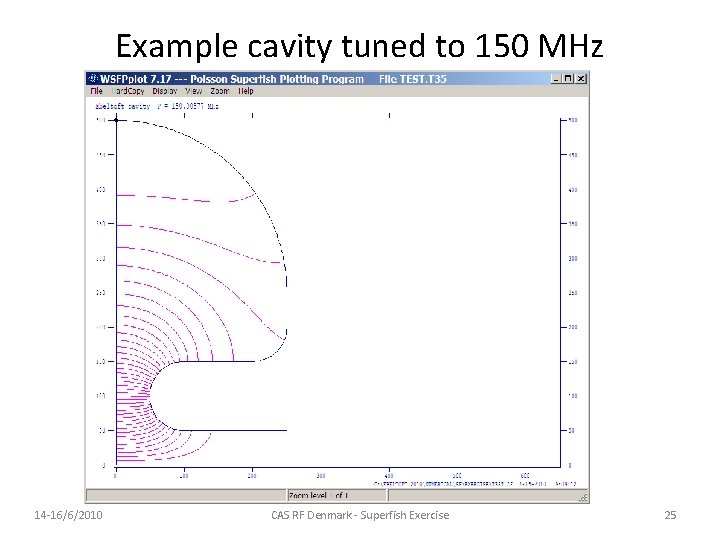
Solution summary: All calculated values below refer to the mesh geometry only. Field normalization (NORM = 1): EZEROT = 5. 00000 MV/m Frequency = 150. 00577 MHz Particle rest mass energy = 938. 272029 Me. V Beta = 1. 0000000 Normalization factor for E 0 = 5. 073 MV/m = 34383. 609 Transit-time factor = 0. 9856796 Stored energy = 15. 7073852 Joules Using standard room-temperature copper. Surface resistance = 3. 19533 milli. Ohm Normal-conductor resistivity = 1. 72410 micro. Ohm-cm Operating temperature = 20. 0000 C Power dissipation = 408. 5964 k. W Q = 36232. 4 Shunt impedance = 15. 744 MOhm/m Rs*Q = 115. 774 Ohm Z*T*T = 15. 296 MOhm/m r/Q = 105. 543 Ohm Wake loss parameter = 0. 02487 V/p. C Average magnetic field on the outer wall = 9132. 51 A/m, 13. 3249 W/cm^2 Maximum H (at Z, R = 205. 831, 150. 341) = 25537. 2 A/m, 104. 192 W/cm^2 Maximum E (at Z, R = 49. 399, 103. 725) = 32. 7996 MV/m, 2. 48702 Kilp. Ratio of peak fields Bmax/Emax = 0. 9784 m. T/(MV/m) Peak-to-average ratio Emax/E 0 = 6. 4660 14 -16/6/2010 CAS RF Denmark - Superfish Exercise 24
Example cavity tuned to 150 MHz 14 -16/6/2010 CAS RF Denmark - Superfish Exercise 25
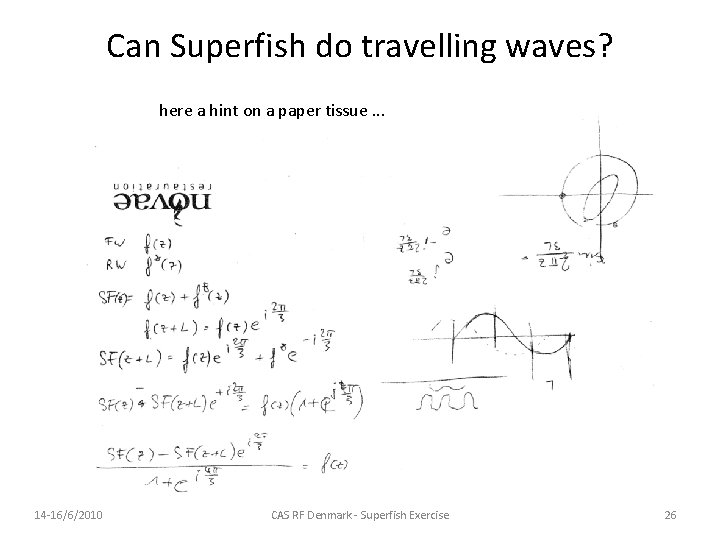
Can Superfish do travelling waves? here a hint on a paper tissue. . . 14 -16/6/2010 CAS RF Denmark - Superfish Exercise 26
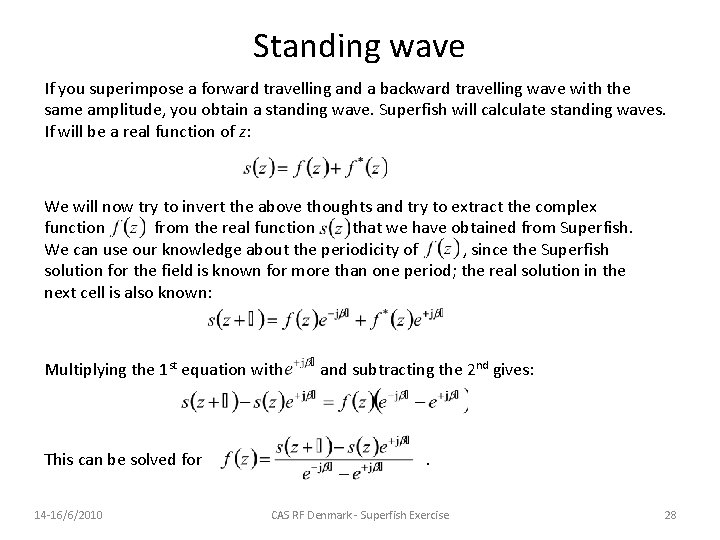
3 rd exercise: How to construct a TW solution from a SW solution? Floquet’s theorem: For a periodic structure with period , Floquet’s theorem states that it has solutions that are similar from one period to the next, their difference can be characterized by just a complex factor. These solutions are the “modes” of the periodic structure (also “Bloch waves”). If we restrict ourselves to a lossless structure, then for a propagating mode the complex factor has the absolute value 1 and is characterized by just a rotation in phase; for this reason, let us write the factor as . It describes the field of a forward travelling wave. Floquet’s theorem further states that if there is a solution , there is also the complex conjugate solution . The complex conjugate of the above describes the backward travelling wave: is the phase advance per cell. 14 -16/6/2010 CAS RF Denmark - Superfish Exercise 27
Standing wave If you superimpose a forward travelling and a backward travelling wave with the same amplitude, you obtain a standing wave. Superfish will calculate standing waves. If will be a real function of z: We will now try to invert the above thoughts and try to extract the complex function from the real function that we have obtained from Superfish. We can use our knowledge about the periodicity of , since the Superfish solution for the field is known for more than one period; the real solution in the next cell is also known: Multiplying the 1 st equation with and subtracting the 2 nd gives: This can be solved for . 14 -16/6/2010 CAS RF Denmark - Superfish Exercise 28
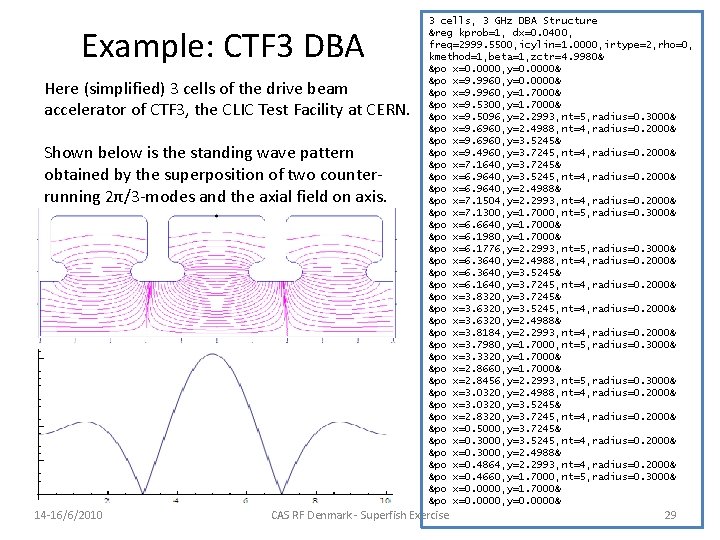
Example: CTF 3 DBA Here (simplified) 3 cells of the drive beam accelerator of CTF 3, the CLIC Test Facility at CERN. Shown below is the standing wave pattern obtained by the superposition of two counterrunning 2π/3 -modes and the axial field on axis. 14 -16/6/2010 3 cells, 3 GHz DBA Structure ® kprob=1, dx=0. 0400, freq=2999. 5500, icylin=1. 0000, irtype=2, rho=0, kmethod=1, beta=1, zctr=4. 9980& &po x=0. 0000, y=0. 0000& &po x=9. 9960, y=1. 7000& &po x=9. 5300, y=1. 7000& &po x=9. 5096, y=2. 2993, nt=5, radius=0. 3000& &po x=9. 6960, y=2. 4988, nt=4, radius=0. 2000& &po x=9. 6960, y=3. 5245& &po x=9. 4960, y=3. 7245, nt=4, radius=0. 2000& &po x=7. 1640, y=3. 7245& &po x=6. 9640, y=3. 5245, nt=4, radius=0. 2000& &po x=6. 9640, y=2. 4988& &po x=7. 1504, y=2. 2993, nt=4, radius=0. 2000& &po x=7. 1300, y=1. 7000, nt=5, radius=0. 3000& &po x=6. 6640, y=1. 7000& &po x=6. 1980, y=1. 7000& &po x=6. 1776, y=2. 2993, nt=5, radius=0. 3000& &po x=6. 3640, y=2. 4988, nt=4, radius=0. 2000& &po x=6. 3640, y=3. 5245& &po x=6. 1640, y=3. 7245, nt=4, radius=0. 2000& &po x=3. 8320, y=3. 7245& &po x=3. 6320, y=3. 5245, nt=4, radius=0. 2000& &po x=3. 6320, y=2. 4988& &po x=3. 8184, y=2. 2993, nt=4, radius=0. 2000& &po x=3. 7980, y=1. 7000, nt=5, radius=0. 3000& &po x=3. 3320, y=1. 7000& &po x=2. 8660, y=1. 7000& &po x=2. 8456, y=2. 2993, nt=5, radius=0. 3000& &po x=3. 0320, y=2. 4988, nt=4, radius=0. 2000& &po x=3. 0320, y=3. 5245& &po x=2. 8320, y=3. 7245, nt=4, radius=0. 2000& &po x=0. 5000, y=3. 7245& &po x=0. 3000, y=3. 5245, nt=4, radius=0. 2000& &po x=0. 3000, y=2. 4988& &po x=0. 4864, y=2. 2993, nt=4, radius=0. 2000& &po x=0. 4660, y=1. 7000, nt=5, radius=0. 3000& &po x=0. 0000, y=1. 7000& &po x=0. 0000, y=0. 0000& CAS RF Denmark - Superfish Exercise 29
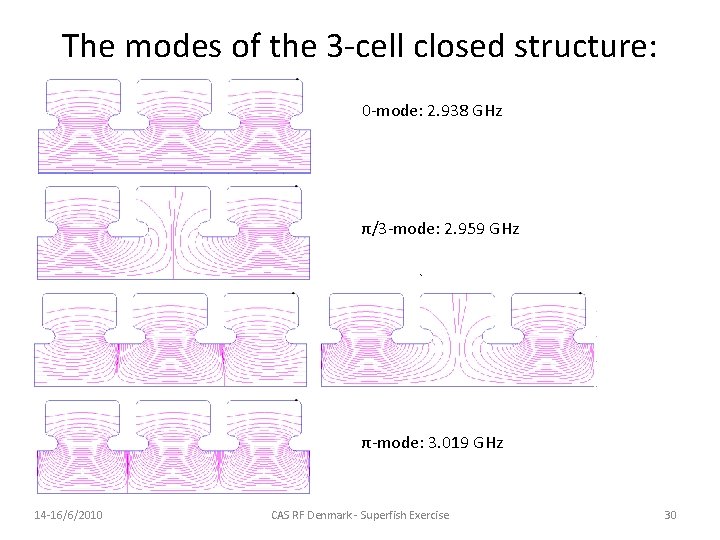
The modes of the 3 -cell closed structure: 0 -mode: 2. 938 GHz π/3 -mode: 2. 959 GHz 2π/3 -mode: 2. 999 GHz π-mode: 3. 019 GHz 14 -16/6/2010 CAS RF Denmark - Superfish Exercise 30
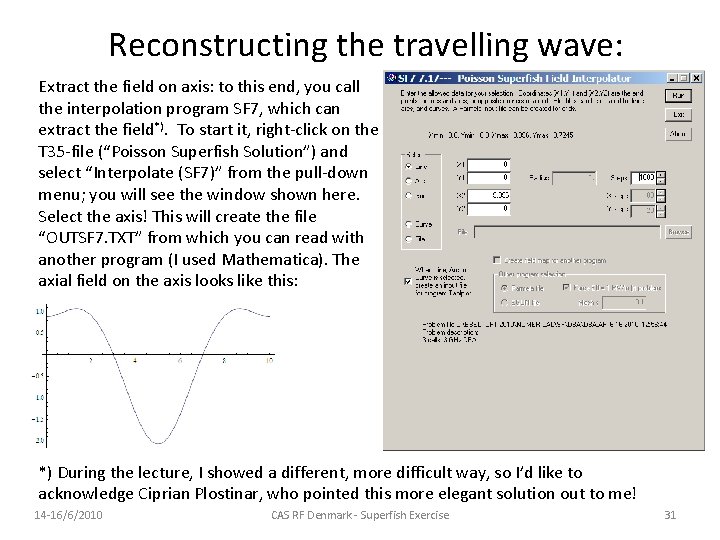
Reconstructing the travelling wave: Extract the field on axis: to this end, you call the interpolation program SF 7, which can extract the field*). To start it, right-click on the T 35 -file (“Poisson Superfish Solution”) and select “Interpolate (SF 7)” from the pull-down menu; you will see the window shown here. Select the axis! This will create the file “OUTSF 7. TXT” from which you can read with another program (I used Mathematica). The axial field on the axis looks like this: *) During the lecture, I showed a different, more difficult way, so I’d like to acknowledge Ciprian Plostinar, who pointed this more elegant solution out to me! 14 -16/6/2010 CAS RF Denmark - Superfish Exercise 31
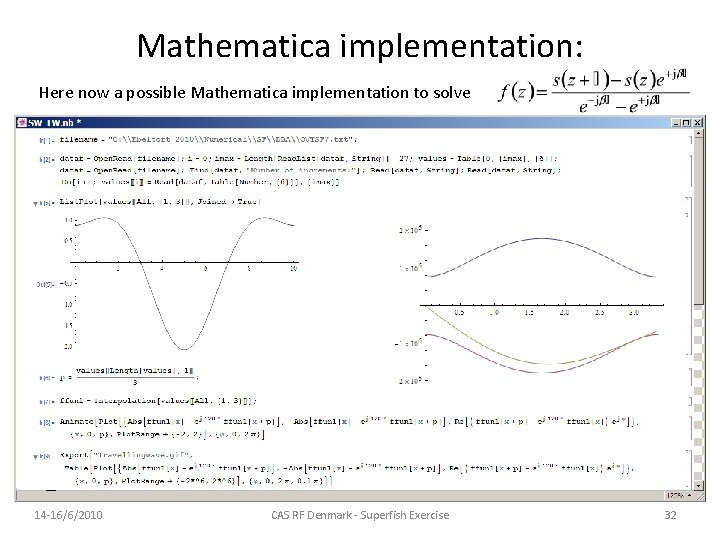
Mathematica implementation: Here now a possible Mathematica implementation to solve 14 -16/6/2010 CAS RF Denmark - Superfish Exercise 32