CAPITALIZATION STRUCTURE AND COST OF CAPITAL FERNANDO DIZ
- Slides: 34
CAPITALIZATION STRUCTURE AND COST OF CAPITAL FERNANDO DIZ
RECAP • Growth in book value per share + dividends over time is a good proxy for wealth creation by the business. • “if” we are very price conscious, and buy securities at “low” price to book ratios, that is, low relative to historical experience for the particular issue, over longer periods of time we can almost be sure to make money by buying common stocks this way. • The only caveat: we have to be patient; gains are not guaranteed in the short term but only over significant periods of time.
RECAP • We also learned that book value growth per share + dividends over time can be tightly related to return on equity (ROE). • I say can, because we also learned in class, that what managements do in resource conversion activities can and will affect this relationship. • Managements can destroy value or they can create additional value through these activities, and it is our job to make appraisals of management to try to predict whether their actions will be detracting from value creation or contributing to value creation.
RECAP • But, if we become good at selecting companies whose management’s actions will contribute to value creation, then we can count on ROE being a good proxy, or an approximation of how much value will be created periodically in the future, i. e. how fast book value per share + dividends will grow and add to our wealth as passive shareholders.
RECAP • We also learned that ROE is a function of three factors: • 1) Profitability; • 2) Efficiency, and • 3) Leverage. • Leverage relates to how the business is financed in a broad sense. It can play an important role in the generation of high rates of ROE and the question arises as to why different businesses may use a different financing mix.
WHY DO CORPORATIONS CHOOSE A PARTICULAR FINANCING MIX? • A particular capitalization is something that arises out of a process that involves meeting the needs and desires of a multiplicity of constituencies, including regulators, various creditors, rating agencies, the company itself, control groups and outside passive minority investors. • Weight must be given to each and every factor if one wishes to understand how a particular capitalization exists • A particular capitalization cannot be viewed as arising from a general principle (academics) but only by reference to the particular circumstances of a specific case.
• Graham and Dodd (since 1934) and Modigliani and Miller (in 1958 and then corrected in 1963) study a very different question. A DIFFERENT QUESTION • How different financing mixes may affect the valuation of the enterprise. • Unfortunately, academics have taken the understanding of this problem as tantamount to understanding corporate behavior. • It is not.
WHY STUDYING THE “THEORETICAL EFFECT” OF FINANCING ON ENTERPRISE VALUATION? I. Will help us understand some of the valuation tools. II. Will help us understand how the use of debt can make otherwise unfeasible businesses, feasible. III. Introduces the concept of the existence of an “optimal capital structure”
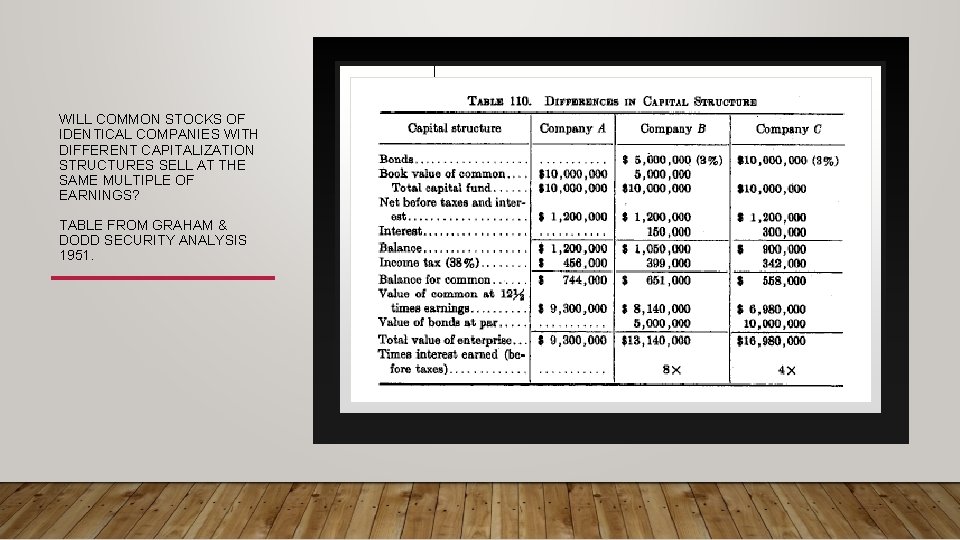
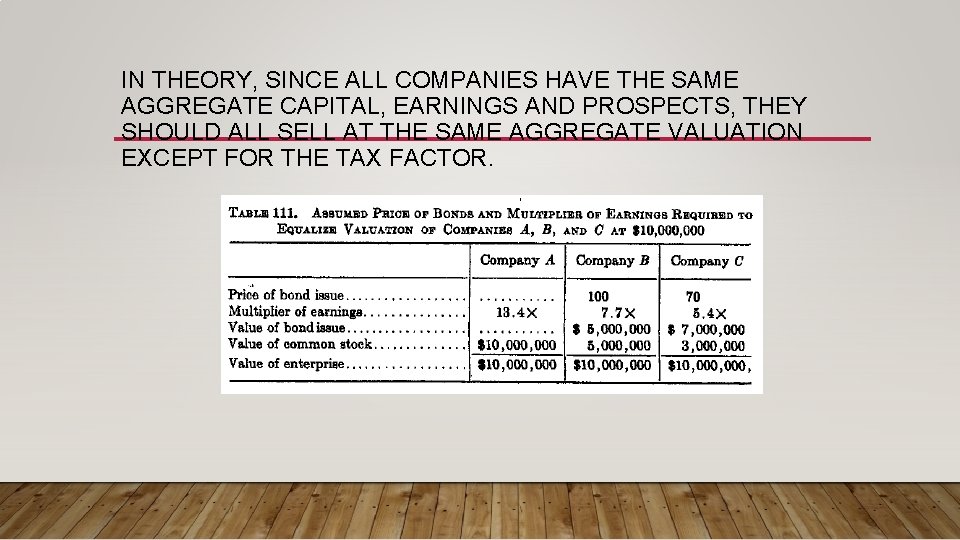
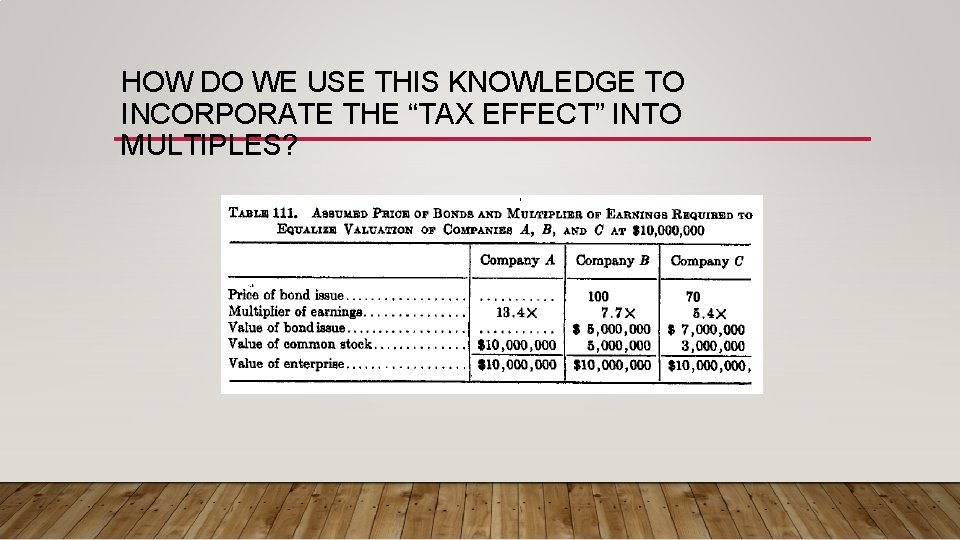
WILL COMMON STOCKS OF IDENTICAL COMPANIES WITH DIFFERENT CAPITALIZATION STRUCTURES SELL AT THE SAME MULTIPLE OF EARNINGS? TABLE FROM GRAHAM & DODD SECURITY ANALYSIS 1951.
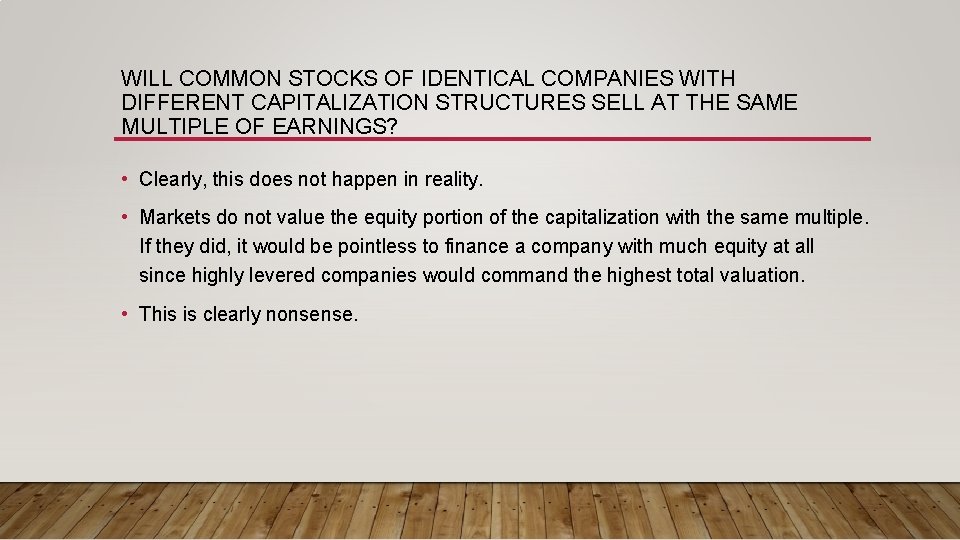
WILL COMMON STOCKS OF IDENTICAL COMPANIES WITH DIFFERENT CAPITALIZATION STRUCTURES SELL AT THE SAME MULTIPLE OF EARNINGS? • Clearly, this does not happen in reality. • Markets do not value the equity portion of the capitalization with the same multiple. If they did, it would be pointless to finance a company with much equity at all since highly levered companies would command the highest total valuation. • This is clearly nonsense.
WHAT IS THE ALTERNATIVE HYPOTHESIS? • That companies with the same characteristics, i. e. operating performance would TEND to be valued at roughly the same EV regardless of their capitalization as shown in the next table from Graham & Dodd (1951).
IN THEORY, SINCE ALL COMPANIES HAVE THE SAME AGGREGATE CAPITAL, EARNINGS AND PROSPECTS, THEY SHOULD ALL SELL AT THE SAME AGGREGATE VALUATION EXCEPT FOR THE TAX FACTOR.
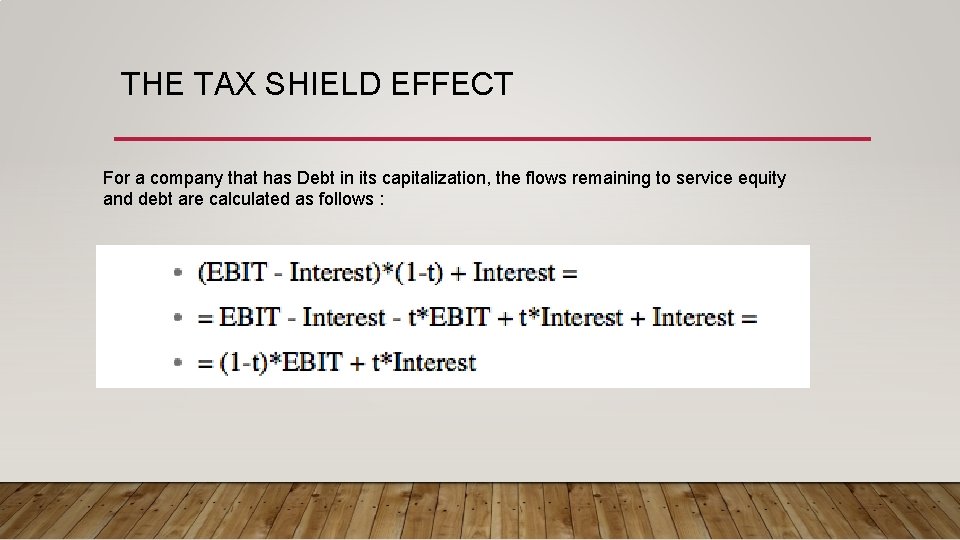
MODIGLIANI AND MILLER CONTRIBUTION TO KNOWLEDGE • Modigliani and Miller’s added to our knowledge of how the “tax factor” affects the aggregate valuation of the enterprise. • They explicitly formulated the tax effect mathematically and were able to quantify this effect more precisely.
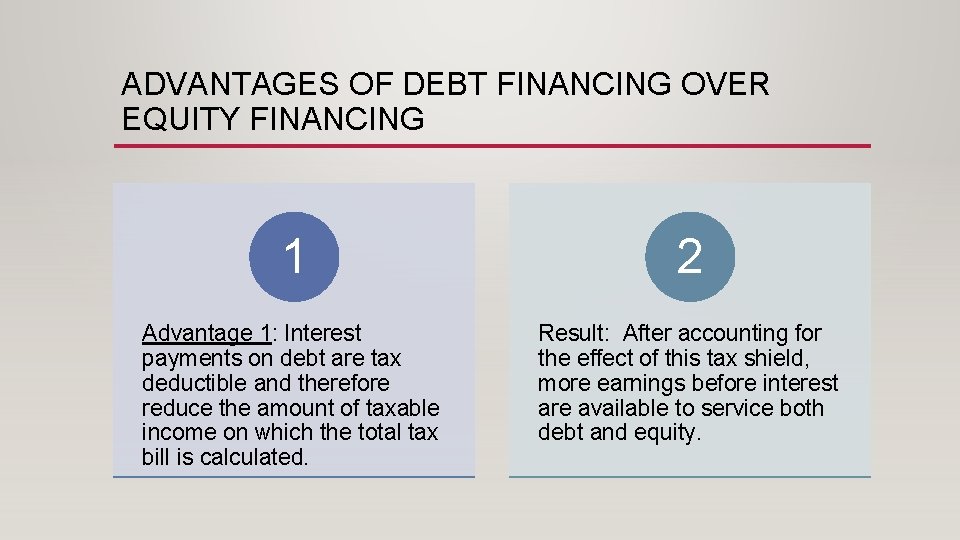
ADVANTAGES OF DEBT FINANCING OVER EQUITY FINANCING 1 2 Advantage 1: Interest payments on debt are tax deductible and therefore reduce the amount of taxable income on which the total tax bill is calculated. Result: After accounting for the effect of this tax shield, more earnings before interest are available to service both debt and equity.
THE TAX SHIELD EFFECT For a company that has Debt in its capitalization, the flows remaining to service equity and debt are calculated as follows :
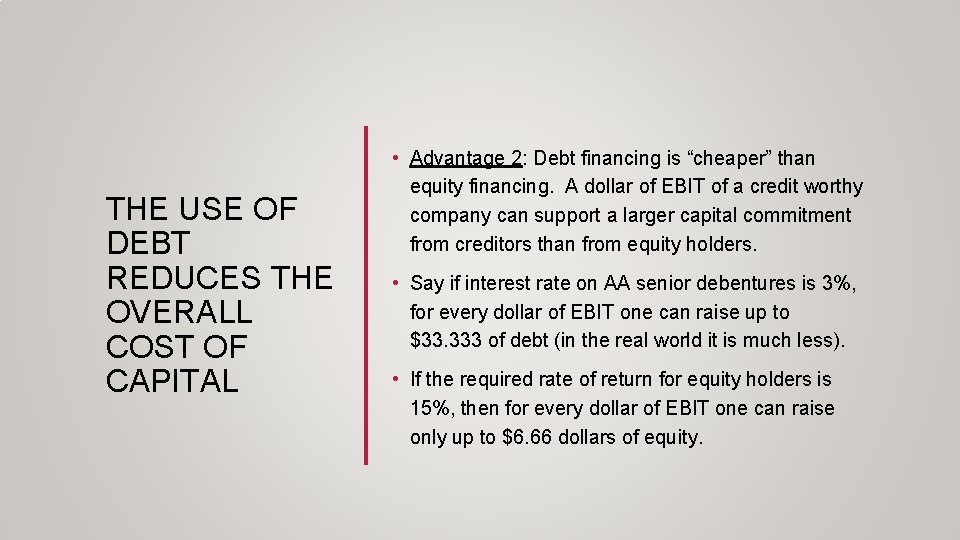
THE USE OF DEBT REDUCES THE OVERALL COST OF CAPITAL • Advantage 2: Debt financing is “cheaper” than equity financing. A dollar of EBIT of a credit worthy company can support a larger capital commitment from creditors than from equity holders. • Say if interest rate on AA senior debentures is 3%, for every dollar of EBIT one can raise up to $33. 333 of debt (in the real world it is much less). • If the required rate of return for equity holders is 15%, then for every dollar of EBIT one can raise only up to $6. 66 dollars of equity.
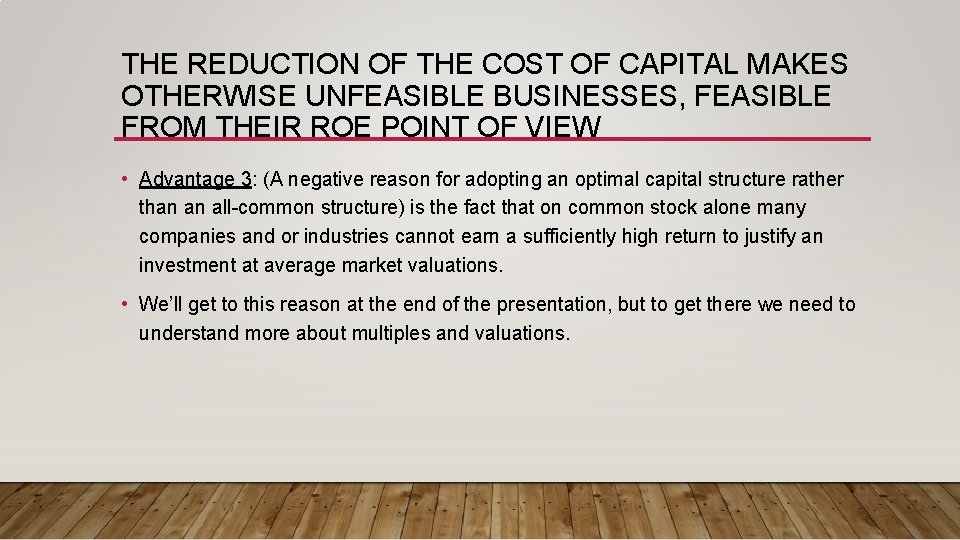
THE REDUCTION OF THE COST OF CAPITAL MAKES OTHERWISE UNFEASIBLE BUSINESSES, FEASIBLE FROM THEIR ROE POINT OF VIEW • Advantage 3: (A negative reason for adopting an optimal capital structure rather than an all-common structure) is the fact that on common stock alone many companies and or industries cannot earn a sufficiently high return to justify an investment at average market valuations. • We’ll get to this reason at the end of the presentation, but to get there we need to understand more about multiples and valuations.
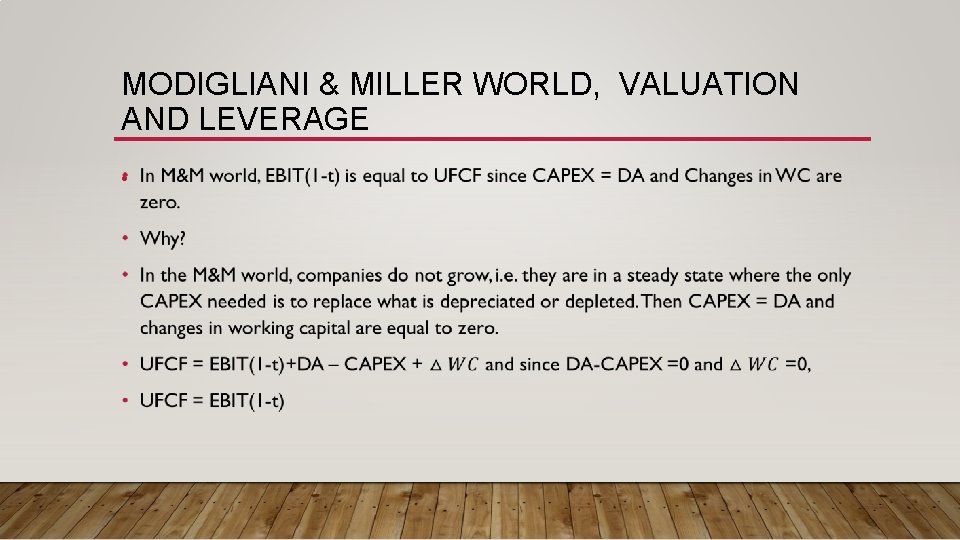
MODIGLIANI & MILLER WORLD, VALUATION AND LEVERAGE •
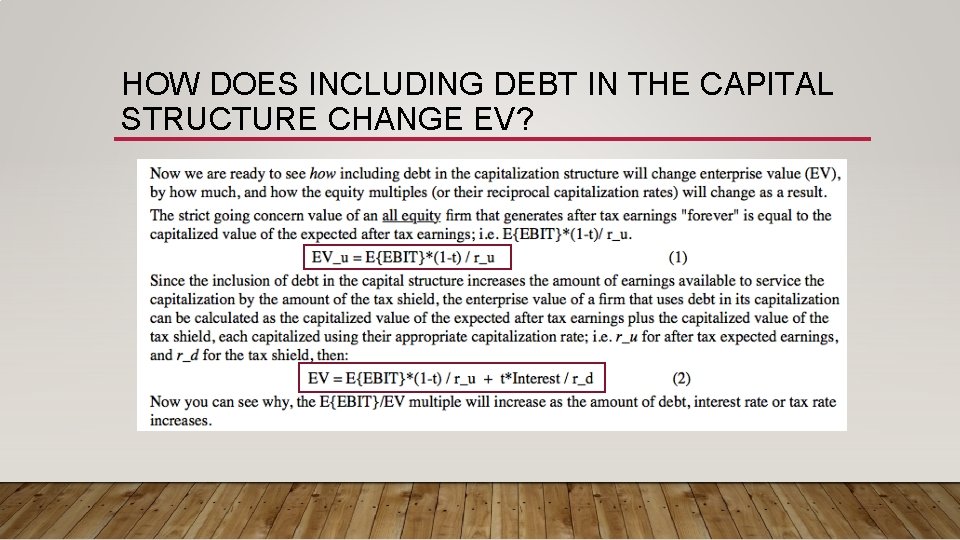
HOW DOES INCLUDING DEBT IN THE CAPITAL STRUCTURE CHANGE EV?
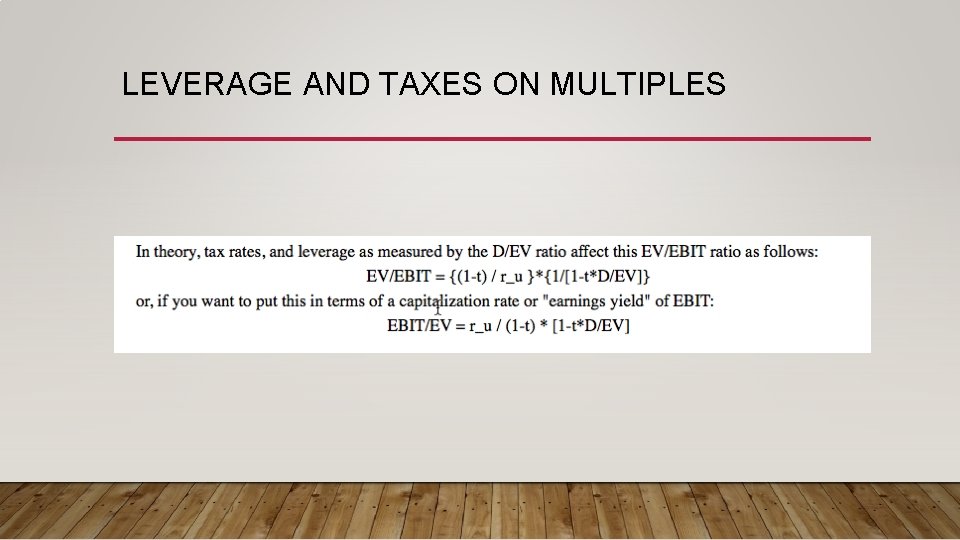
HOW DO WE USE THIS KNOWLEDGE TO INCORPORATE THE “TAX EFFECT” INTO MULTIPLES?
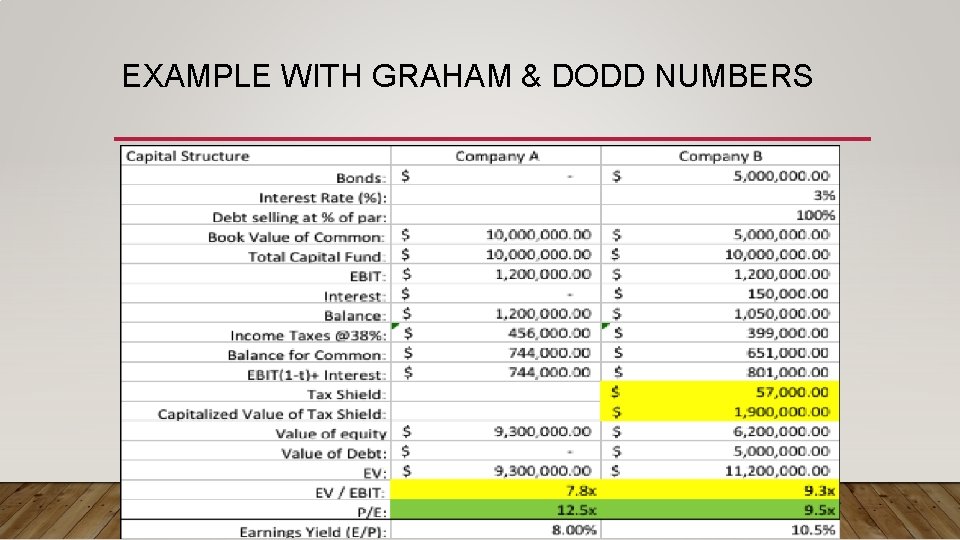
EXAMPLE WITH GRAHAM & DODD NUMBERS
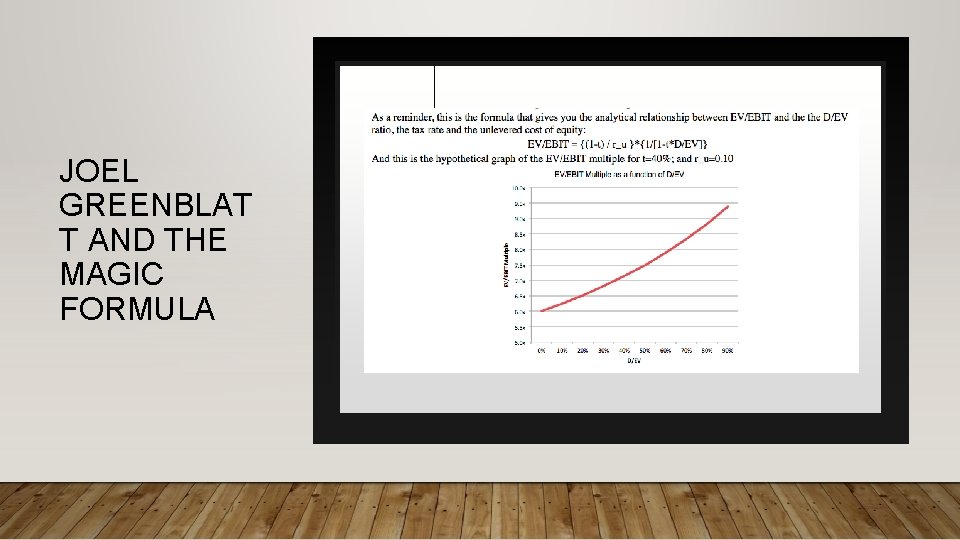
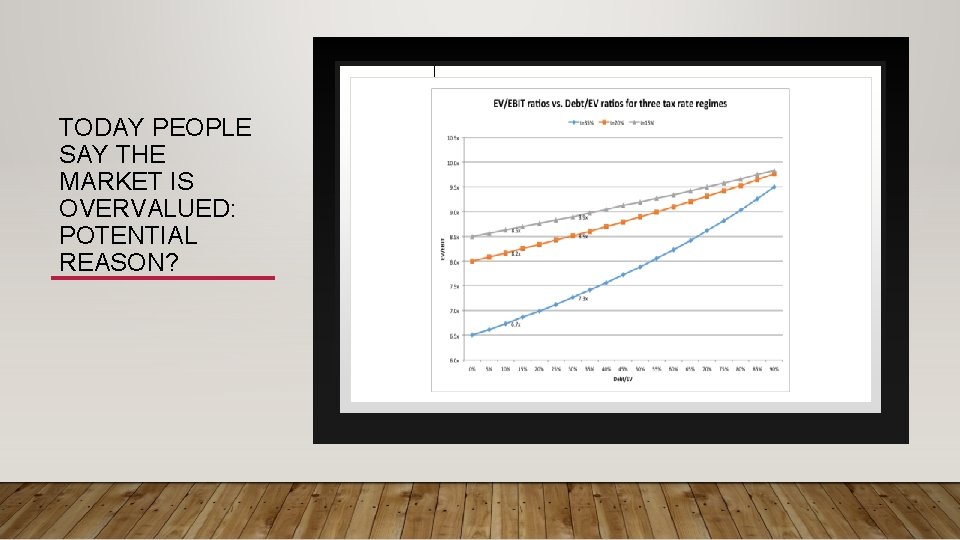
LEVERAGE AND TAXES ON MULTIPLES
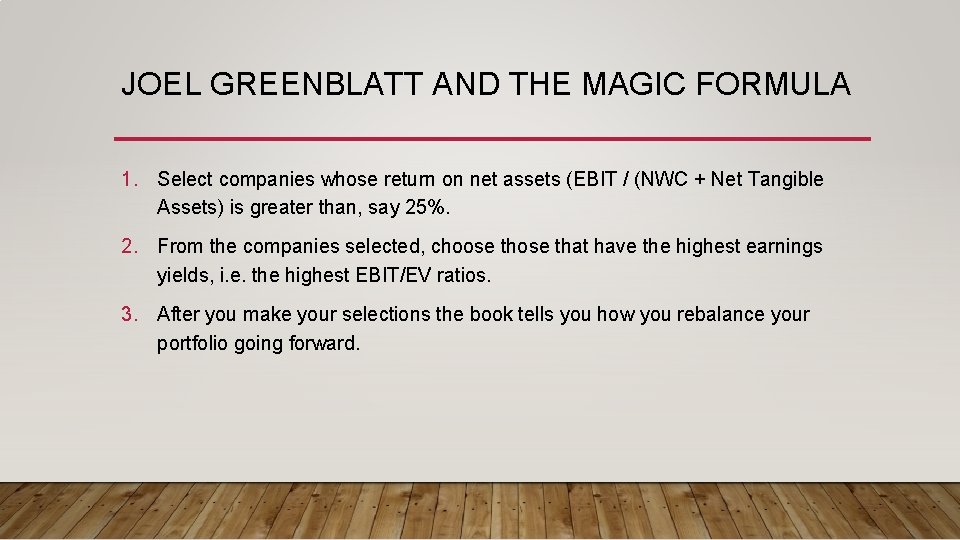
JOEL GREENBLATT AND THE MAGIC FORMULA 1. Select companies whose return on net assets (EBIT / (NWC + Net Tangible Assets) is greater than, say 25%. 2. From the companies selected, choose that have the highest earnings yields, i. e. the highest EBIT/EV ratios. 3. After you make your selections the book tells you how you rebalance your portfolio going forward.
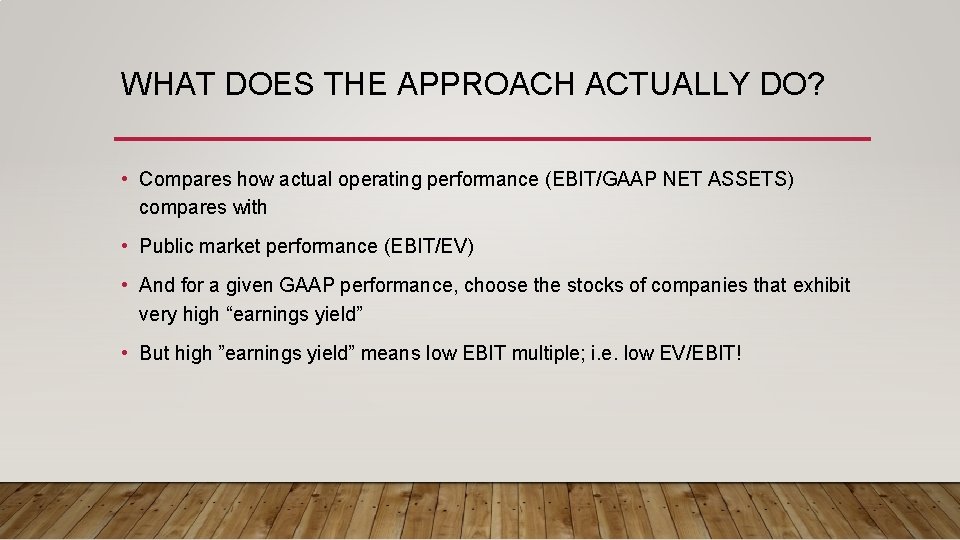
WHAT DOES THE APPROACH ACTUALLY DO? • Compares how actual operating performance (EBIT/GAAP NET ASSETS) compares with • Public market performance (EBIT/EV) • And for a given GAAP performance, choose the stocks of companies that exhibit very high “earnings yield” • But high ”earnings yield” means low EBIT multiple; i. e. low EV/EBIT!
JOEL GREENBLAT T AND THE MAGIC FORMULA
TODAY PEOPLE SAY THE MARKET IS OVERVALUED: POTENTIAL REASON?
TODAY PEOPLE SAY THE MARKET IS OVERVALUED: POTENTIAL REASON? • Expectations of tax rates going down can significantly influence the pricing of securities even though the capitalized tax shields may not be as large in an environment of lower tax rates.
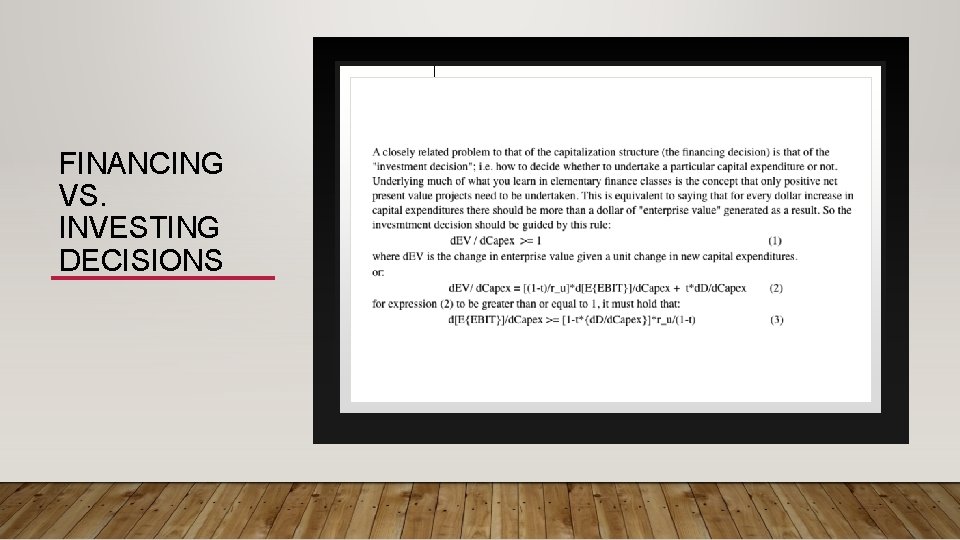
FINANCING VS. INVESTING DECISIONS
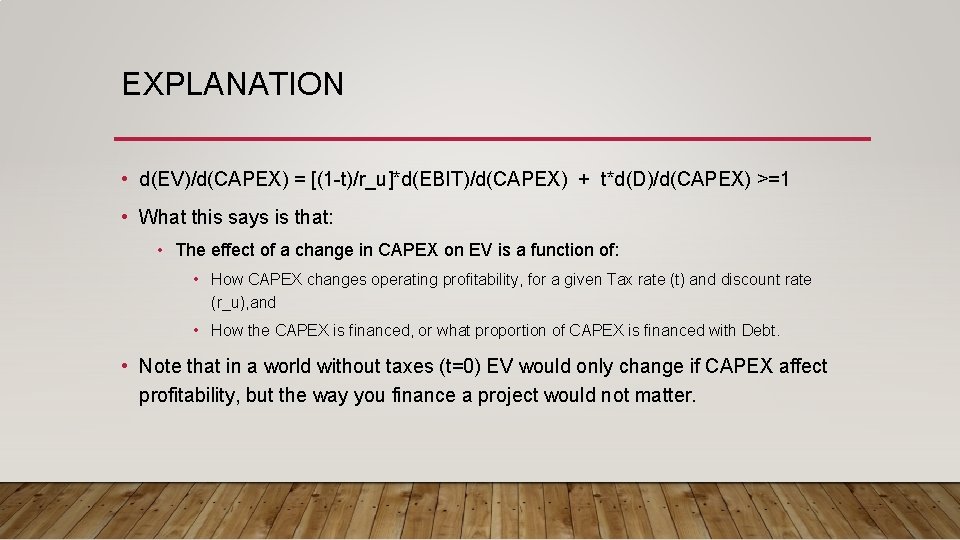
EXPLANATION • EV = EBIT*(1 -t) / r_u + t*D. • In Modigliani & Miller’s world EV is the pure going concern value of the assets of the business. • EV is the Discounted value of Cash Flows remaining to service the Capitalization. • In Modigliani & Miller’s world, EBIT(1 -t) is Unlevered Free Cash Flow (UFCF), because DA = CAPEX, and Changes in NWC = 0 • Explain:
EXPLANATION • d(EV)/d(CAPEX) = [(1 -t)/r_u]*d(EBIT)/d(CAPEX) + t*d(D)/d(CAPEX) >=1 • What this says is that: • The effect of a change in CAPEX on EV is a function of: • How CAPEX changes operating profitability, for a given Tax rate (t) and discount rate (r_u), and • How the CAPEX is financed, or what proportion of CAPEX is financed with Debt. • Note that in a world without taxes (t=0) EV would only change if CAPEX affect profitability, but the way you finance a project would not matter.
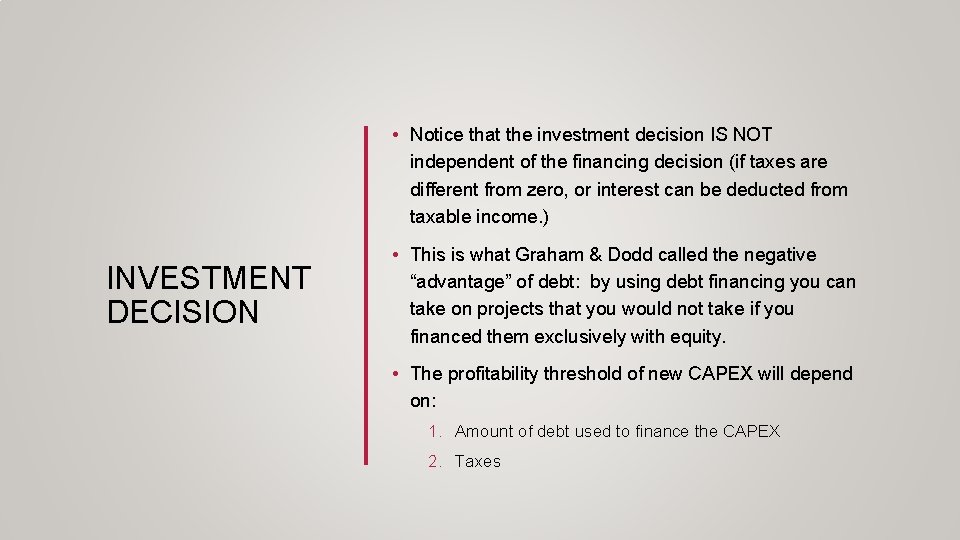
• Notice that the investment decision IS NOT independent of the financing decision (if taxes are different from zero, or interest can be deducted from taxable income. ) INVESTMENT DECISION • This is what Graham & Dodd called the negative “advantage” of debt: by using debt financing you can take on projects that you would not take if you financed them exclusively with equity. • The profitability threshold of new CAPEX will depend on: 1. Amount of debt used to finance the CAPEX 2. Taxes
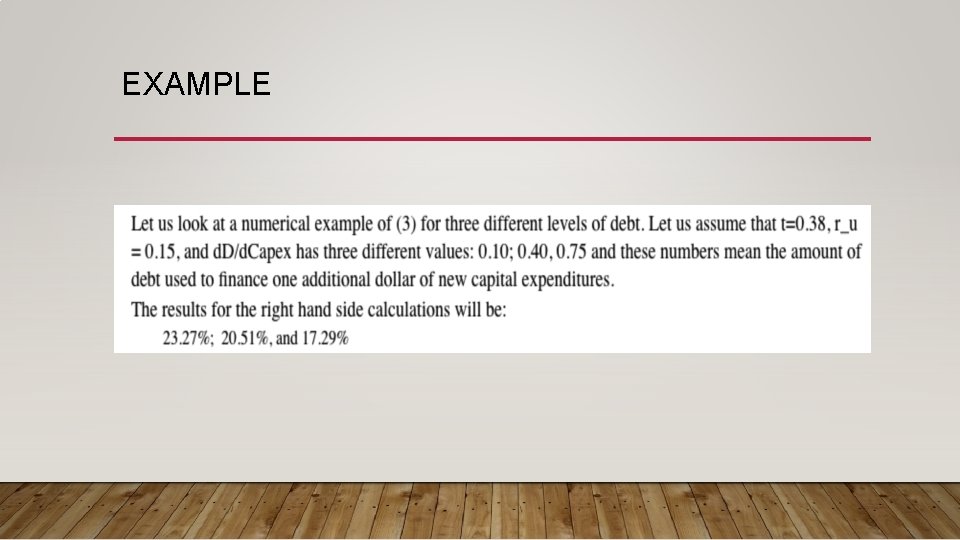
EXAMPLE
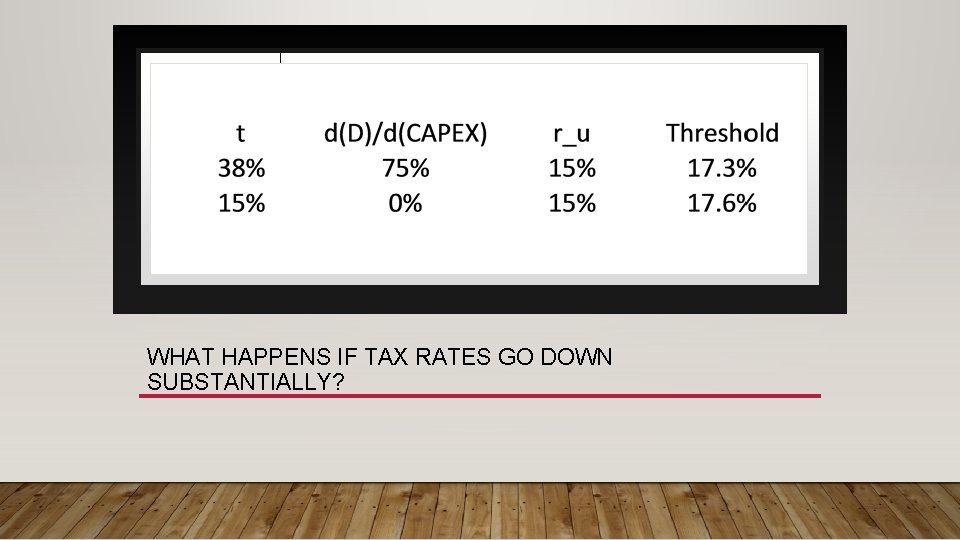
WHAT HAPPENS IF TAX RATES GO DOWN SUBSTANTIALLY?
• In a world with lower taxes, companies will be able to profitably invest in lower profitability projects • Stock prices are likely to rise substantially on the anticipation of lower taxes CONCLUSION? • The rise in stock prices will be due to large multiple expansions in anticipation of better “after tax” financial results. • Perhaps as a result, companies may focus on longer term very profitable projects?