
The Human Face Beauty ESSENTIAL QUESTION What is
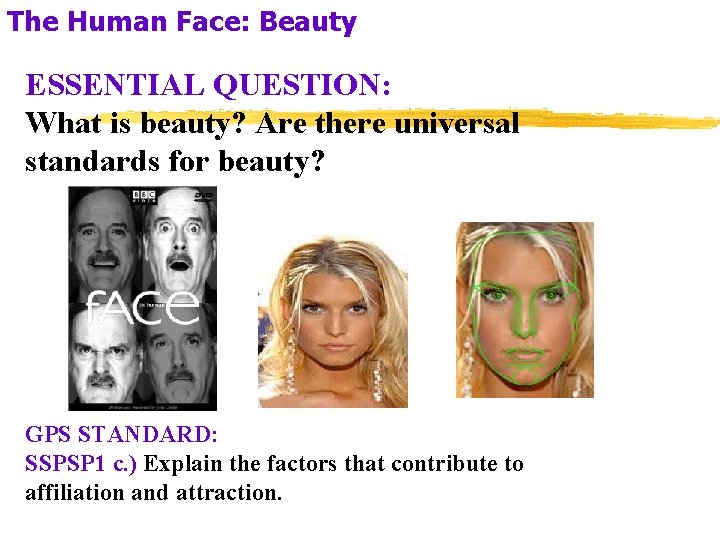
The Human Face: Beauty ESSENTIAL QUESTION: What is beauty? Are there universal standards for beauty? GPS STANDARD: SSPSP 1 c. ) Explain the factors that contribute to affiliation and attraction.
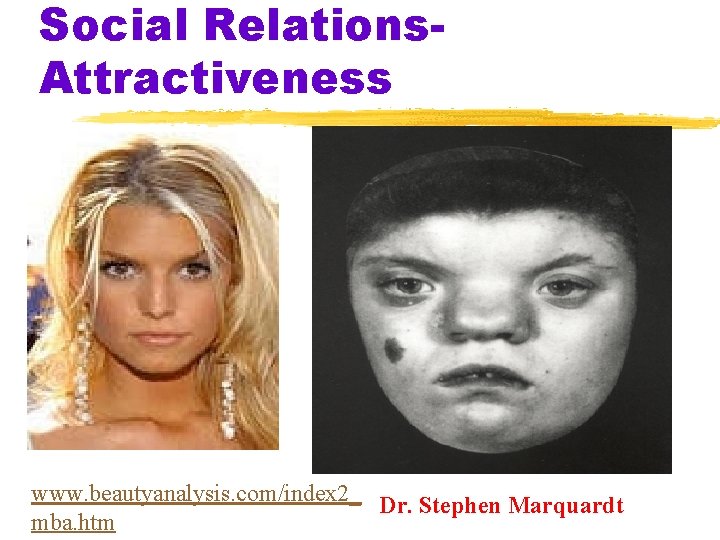
Social Relations. Attractiveness www. beautyanalysis. com/index 2_ Dr. Stephen Marquardt mba. htm
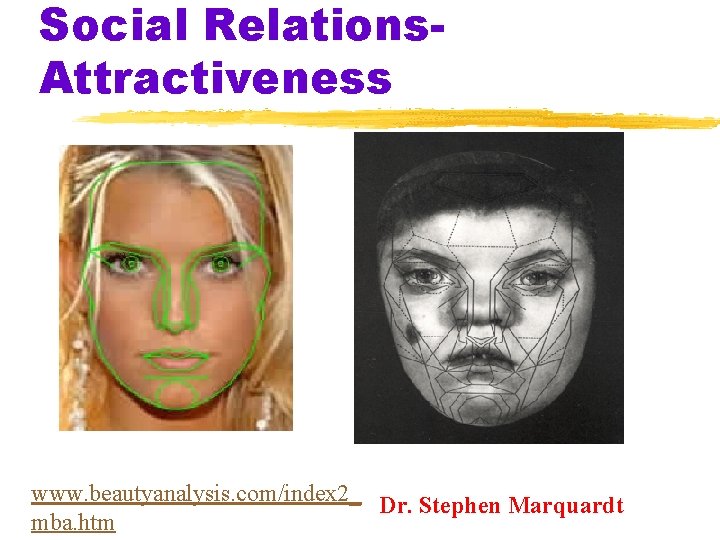
Social Relations. Attractiveness www. beautyanalysis. com/index 2_ Dr. Stephen Marquardt mba. htm
Social Relations. Attractiveness § Interpersonal Attraction § theories concerning attraction seek to explain why people like or love other people § folklore and myth tells us that “opposites attract” but it also states that “birds of a feather flock together”
Social Relations. Attractiveness § Keys to Attraction § The Environment § physical proximity is an important determinant of attraction § as long as you do not initially dislike a person, your liking for him or her will increase with additional contact (mere exposure effect) § the circumstances under which people first meet also influence attraction § you are much more likely to be attracted to a stranger that you meet in comfortable as opposed to uncomfortable circumstances
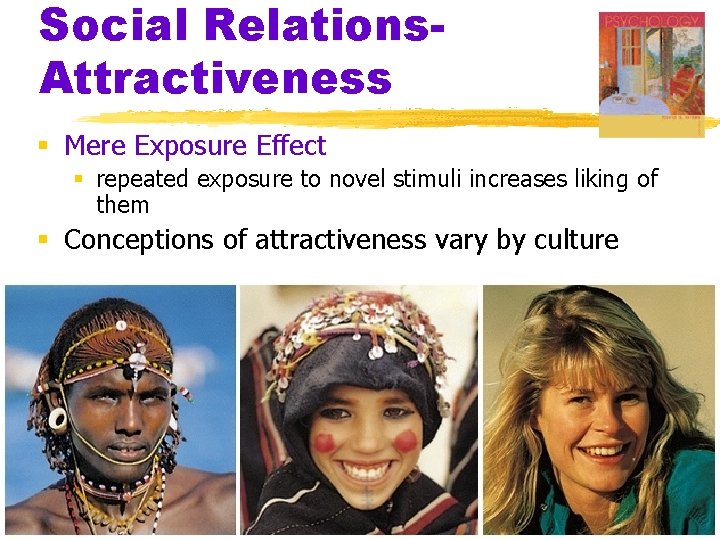
Social Relations. Attractiveness § Mere Exposure Effect § repeated exposure to novel stimuli increases liking of them § Conceptions of attractiveness vary by culture
Social Relations. Attractiveness § Keys to Attraction § Similarity § people also tend to like those whom they perceive as similar to themselves on variables such as age, religion, smoking or drinking habits, or being a “morning” or “evening” person § Similarity in attitudes and beliefs is also an especially important influence on attraction
Social Relations. Attractiveness § Keys to Attraction § Similarity continued… § one reason why we like people with similar views of the world is that we expect such people to think highly of us § you might like someone because you like the person’s attitudes because they are similar to yours, but it is also possible that, as a result of liking the person your attitudes have become more similar to that person’s attitude
Social Relations. Attractiveness § Keys to Attraction § Physical attractiveness § physical characteristics are another important factor in attraction, particularly during the early stages of a relationship § from preschool through adulthood, physical attractiveness is a key to popularity with members of both sexes
Social Relations. Attractiveness § Keys to Attraction § Physical attractiveness cont… § consistent with a concept called the matching hypothesis of interpersonal attraction, people tend to date, marry, or form other relationships with those who are similar in physical attractiveness § people tend to be attracted to those with the greatest physical appeal; however, they also want to avoid rejection by people who have great physical attractiveness
Social Relations- Intimate Relationships & Love § Intimate relationships § people who are attracted to each other usually become interdependent § this means that the thoughts, emotions, and behaviors of one person affect the thoughts, emotions, and behaviors of the other person
Social Relations- Intimate Relationships & Love § Intimate relationships cont… § interdependence occurs as the thoughts and values of one person become part of the self-concept of the other person § this makes interdependence one of the defining characteristics of intimate relationships
Social Relations- Intimate Relationships & Love § Intimate relationships cont… § another key component of successful intimate relationships is commitment to the relationship § commitment is the extent to which each party is psychologically attached to and wants to remain in the relationship
Social Relations- Intimate Relationships & Love § Intimate relationships cont… § People feel committed to a relationship when: § they are satisfied with the rewards they receive from it § they have invested considerable resources into it § there are few attractive alternative relationships available to them
Social Relations. Analyzing Love § Affection, emotional expressiveness, social support, cohesiveness, sexuality § These characteristics make up: LOVE § Intimacy and love are not synonomous § There are several different types of love
Social Relations- A Triangular Theory of Love § p. 629 in Bernstein’s Psychology, (the Purple and Green book) § Draw A triangular theory of love figure 17. 10 § Color A triangular theory of love figure 17. 10
Social Relations § A Triangular Theory of Love § Robert Sternberg (1988) § offered his comprehensive analysis of love § According to his Triangular Theory of Love, love includes three basic components: § Passion § Intimacy § Commitment
Social Relations § Passionate Love usually present at the beginning of a love relationship § Passionate Love is intense, arousing, and includes both a strong physical attraction and deep emotional attachment § a couple is intensely absorbed by one another
Social Relations § Passionate Love cont… § sexual feelings are very strong § thoughts of the other person constantly “intrude” on one’s awareness § characterized by deep mutual concern for the well-being of the other person
Social Relations § Companionate Love § deep affectionate attachment we feel for those with whom our lives are intertwined § there is a great deal of intimacy but little passion § it is like an extremely close friendship
Social Relations § Consummate Love § is the most complete and satisfying form of love § it is the most complete form of love because it includes high levels of all three components of love: § Passion § Intimacy § Commitment
The Love Bank § The Love Bank (Dr. Willard F. Harley, Jr. ) § Everyone Has a Love Bank § figuratively speaking each of us has a Love Bank § it contains many different accounts, one for each person we know § each person either makes deposits or withdrawals whenever we interact with him or her § Pleasurable interactions cause deposits § Painful interactions cause withdrawals
His Needs Her Needs § His Needs § § § sexual fulfillment recreational companionship physical attractiveness admiration domestic support
His Needs Her Needs § § § affection conversation honesty and openness financial support family commitment
Myers’ PSYCHOLOGY (7 th Ed) Chapter 18 Social Psychology

Unbreakable Psychological Analysis Ideas for my comic book project Sociology, Eleventh Edition
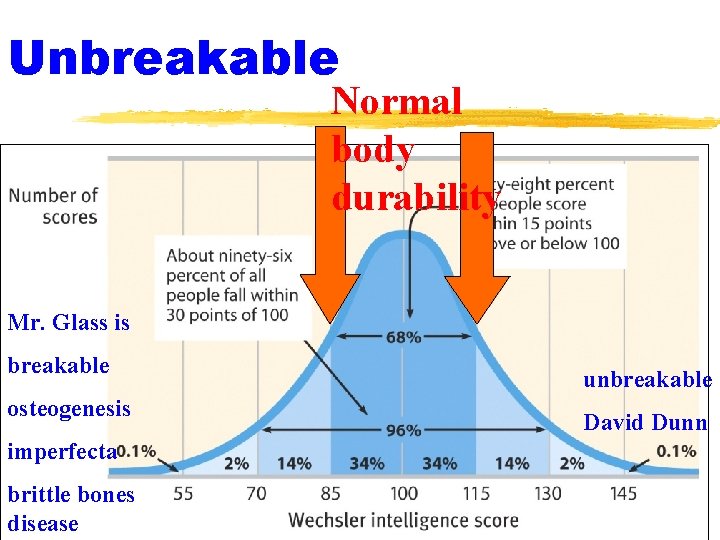
Unbreakable Normal body durability Mr. Glass is breakable unbreakable osteogenesis David Dunn imperfecta brittle bones disease Sociology, Eleventh Edition

Unbreakable Psychological Analysis Ideas for my comic book project Sociology, Eleventh Edition
Social Relations § Altruism § unselfish regard for the welfare of others
Social Relations: Cooperation § Superordinate Goals § shared goals that override differences among people and require their cooperation § Example- p. 767 (2 nd, 3 rd, & 4 th paragraph under cooperation)
Social Relations § Graduated and Reciprocated Initiatives in Tension-reduction (GRIT) § a strategy designed to decrease international tensions § one side announces recognition of mutual interests and initiates a small conciliatory act § opens door for reciprocation by other party § Read Conciliation p. 769 -770
Social Thinking § Social Psychology § scientific study of how we think about, influence, and relate to one another § Attribution Theory § tendency to give a causal explanation for someone’s behavior, often by crediting either the situation or the person’s disposition
Social Thinking § Fundamental Attribution Error § tendency for observers, when analyzing another’s behavior, to underestimate the impact of the situation and to overestimate the impact of personal disposition § Attitude § belief and feeling that predisposes one to respond in a particular way to objects, people and events
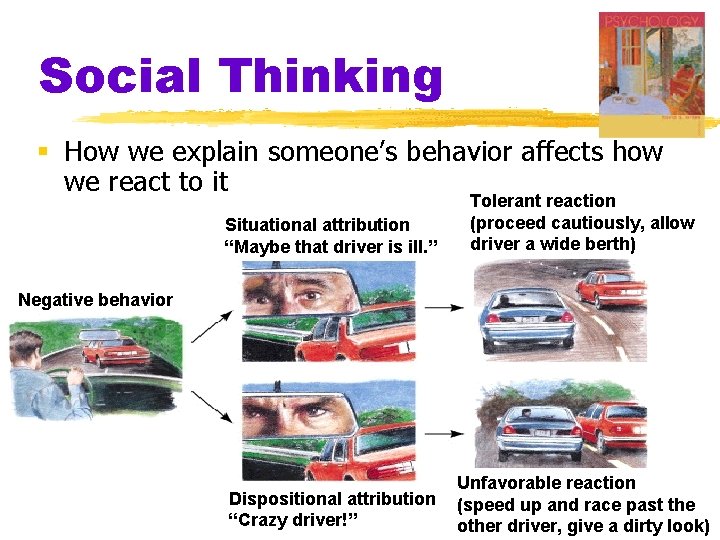
Social Thinking § How we explain someone’s behavior affects how we react to it Situational attribution “Maybe that driver is ill. ” Tolerant reaction (proceed cautiously, allow driver a wide berth) Dispositional attribution “Crazy driver!” Unfavorable reaction (speed up and race past the other driver, give a dirty look) Negative behavior
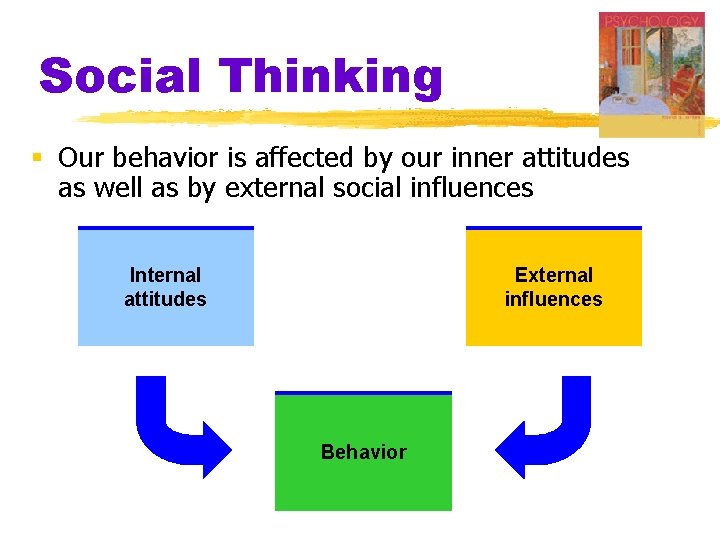
Social Thinking § Our behavior is affected by our inner attitudes as well as by external social influences Internal attitudes External influences Behavior
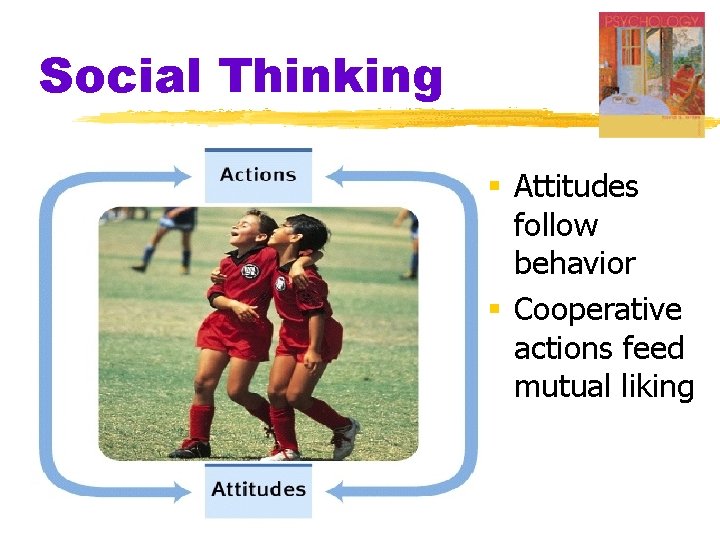
Social Thinking § Attitudes follow behavior § Cooperative actions feed mutual liking
Social Thinking § Foot-in-the-Door Phenomenon § tendency for people who have first agreed to a small request to comply later with a larger request § Role § set of expectations about a social position § defines how those in the position ought to behave
Social Thinking § Cognitive Dissonance Theory § we act to reduce the discomfort (dissonance) we feel when two of our thoughts (cognitions) are inconsistent § example- when we become aware that our attitudes and our actions clash, we can reduce the resulting dissonance by changing our attitudes
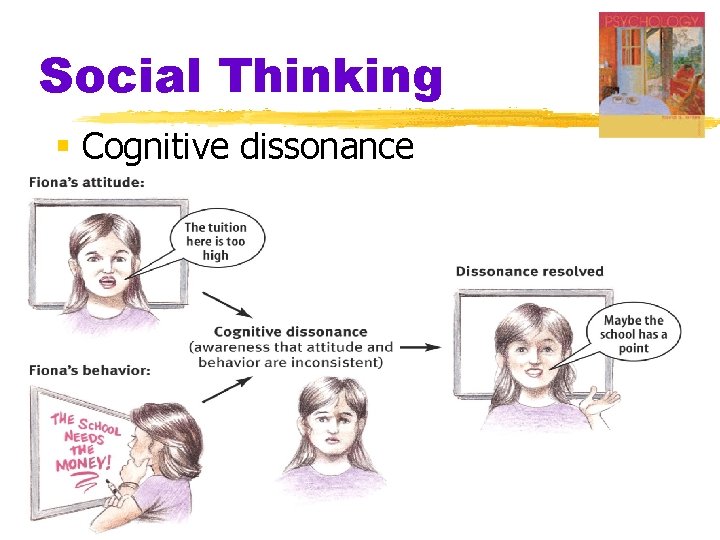
Social Thinking § Cognitive dissonance
Social Influence § Conformity § adjusting one’s behavior or thinking to coincide with a group standard § Normative Social Influence § influence resulting from a person’s desire to gain approval or avoid disapproval
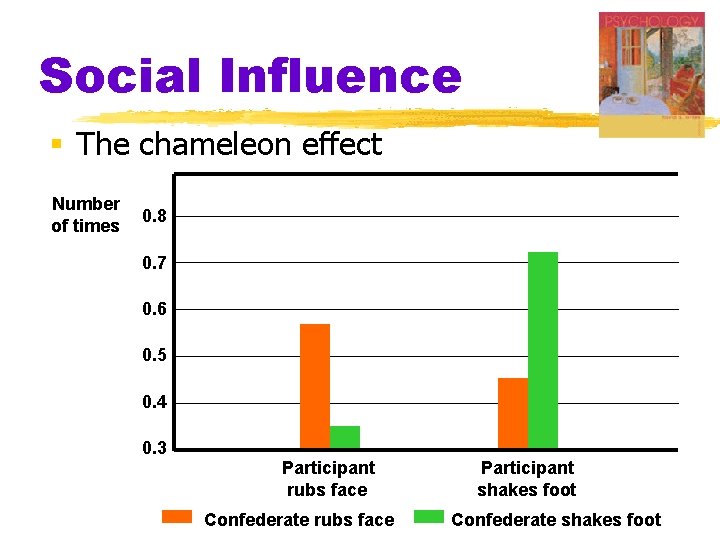
Social Influence § The chameleon effect Number of times 0. 8 0. 7 0. 6 0. 5 0. 4 0. 3 Participant rubs face Confederate rubs face Participant shakes foot Confederate shakes foot
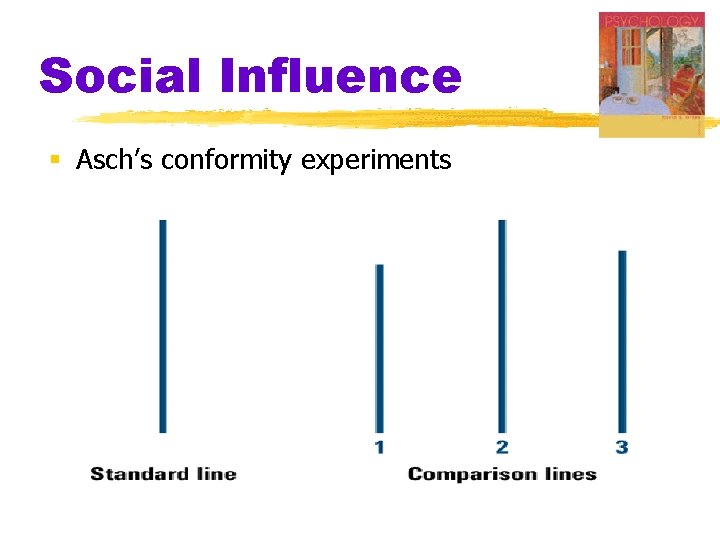
Social Influence § Asch’s conformity experiments
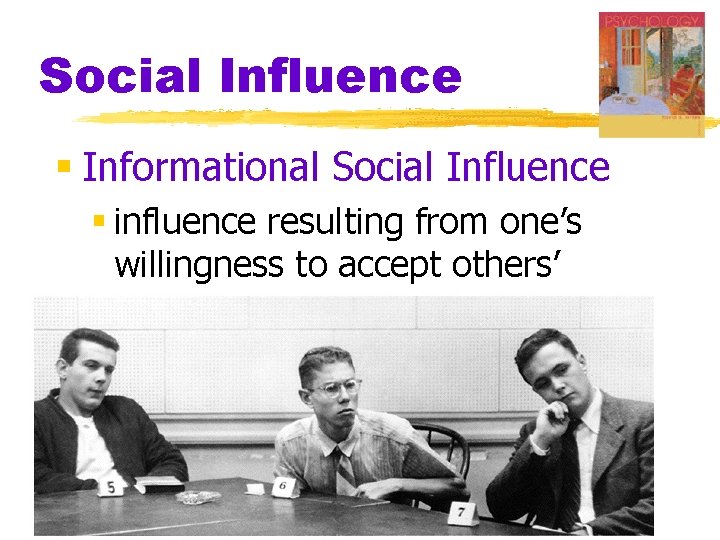
Social Influence § Informational Social Influence § influence resulting from one’s willingness to accept others’ opinions about reality
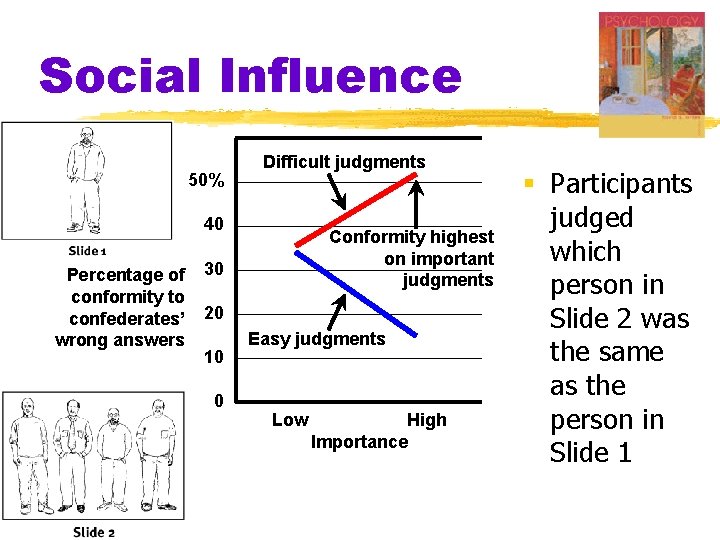
Social Influence 50% Difficult judgments 40 Percentage of conformity to confederates’ wrong answers Conformity highest on important judgments 30 20 10 0 Easy judgments Low High Importance § Participants judged which person in Slide 2 was the same as the person in Slide 1
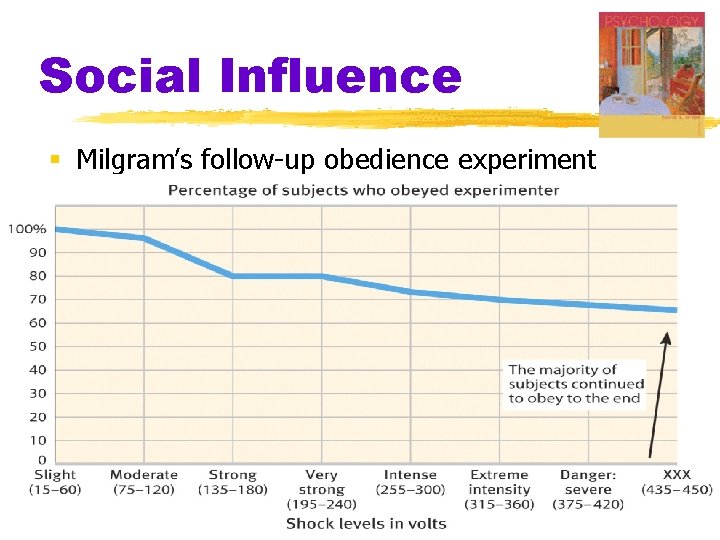
Social Influence § Milgram’s follow-up obedience experiment
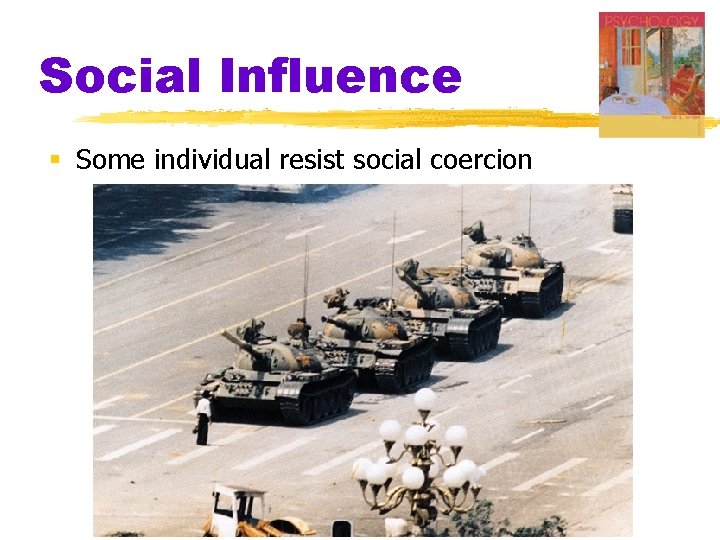
Social Influence § Some individual resist social coercion
Social Influence § Social Facilitation § improved performance of tasks in the presence of others § occurs with simple or well-learned tasks but not with tasks that are difficult or not yet mastered § Social Loafing § tendency for people in a group to exert less effort when pooling their efforts toward attaining a common goal than when individually accountable
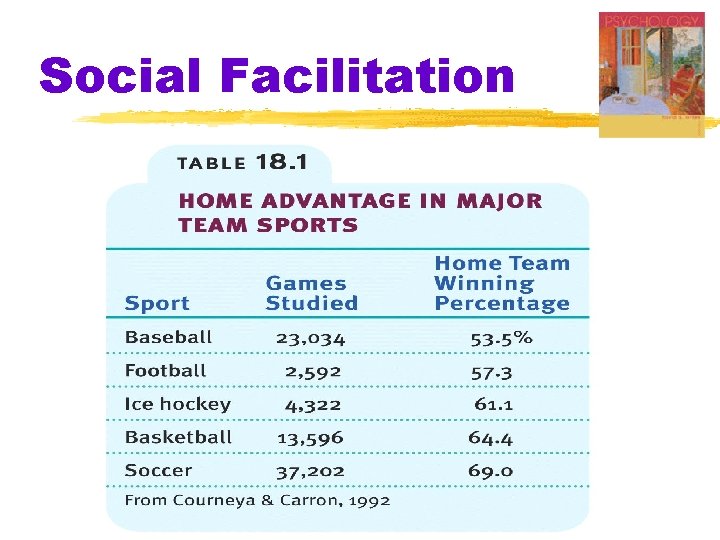
Social Facilitation
Social Influence § Deindividuation § loss of self-awareness and selfrestraint in group situations that foster arousal and anonymity
Social Influence § Group Polarization § enhancement of a group’s prevailing attitudes through discussion within the group § Groupthink § mode of thinking that occurs when the desire for harmony in a decision-making group overrides realistic appraisal of alternatives
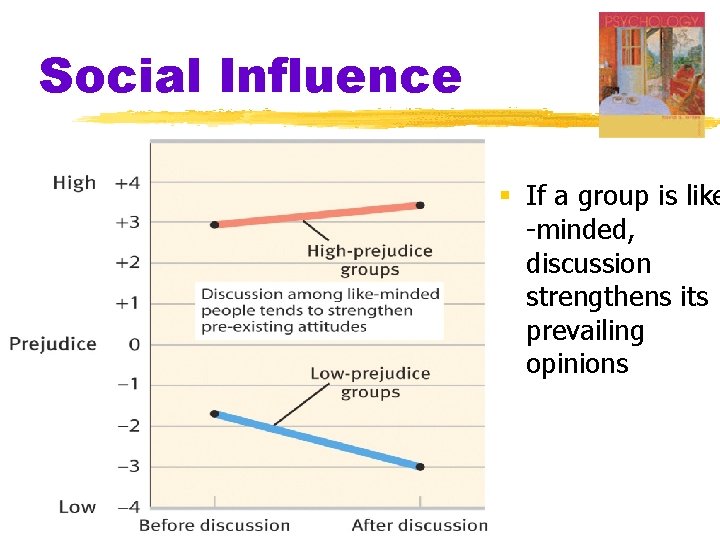
Social Influence § If a group is like -minded, discussion strengthens its prevailing opinions
Social Relations § Prejudice § an unjustifiable (and usually negative) attitude toward a group and its members § involves stereotyped beliefs, negative feelings, and a predisposition to discriminatory action § Stereotype § a generalized (sometimes accurate, but often overgeneralized) belief about a group of people
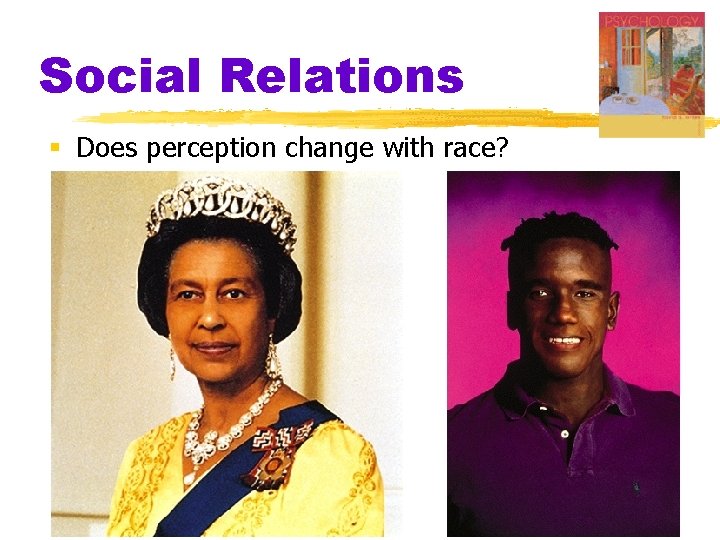
Social Relations § Does perception change with race?
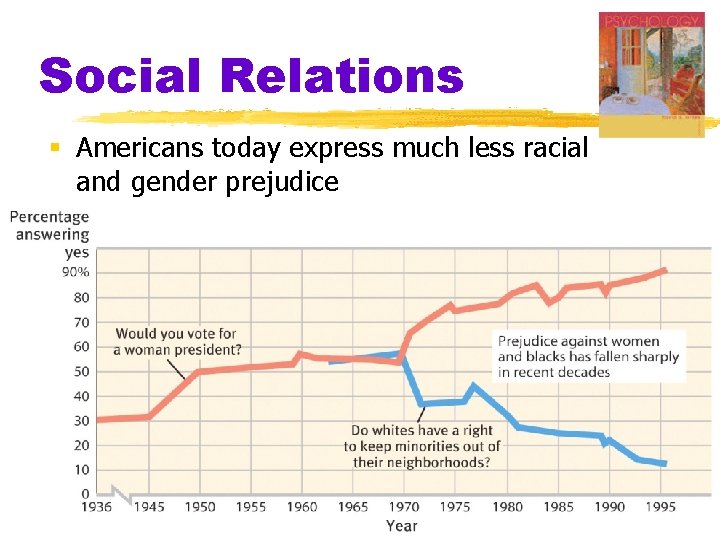
Social Relations § Americans today express much less racial and gender prejudice
Social Relations § Ingroup § “Us”- people with whom one shares a common identity § Outgroup § “Them”- those perceived as different or apart from one’s ingroup
Social Relations § Ingroup Bias § tendency to favor one’s own group § Scapegoat Theory § theory that prejudice provides an outlet for anger by providing someone to blame § Just-World Phenomenon § tendency of people to believe the world is just § people get what they deserve and deserve what they get
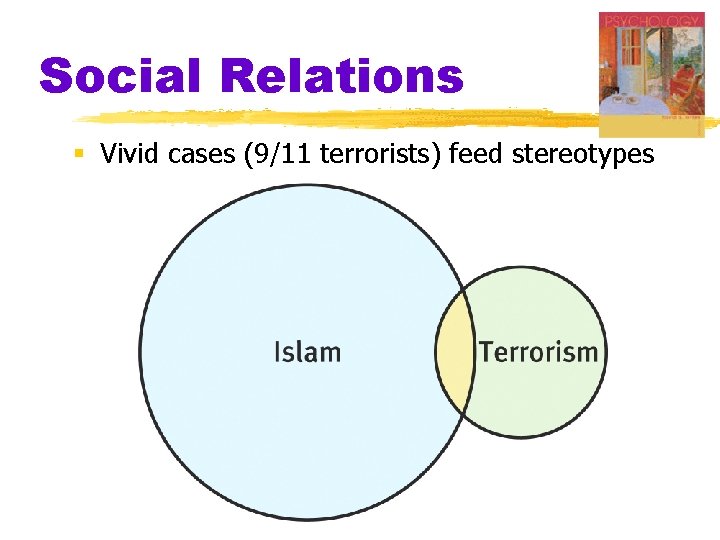
Social Relations § Vivid cases (9/11 terrorists) feed stereotypes
Social Relations § Aggression § any physical or verbal behavior intended to hurt or destroy § Frustration-Aggression Principle § principle that frustration – the blocking of an attempt to achieve some goal – creates anger, which can generate aggression
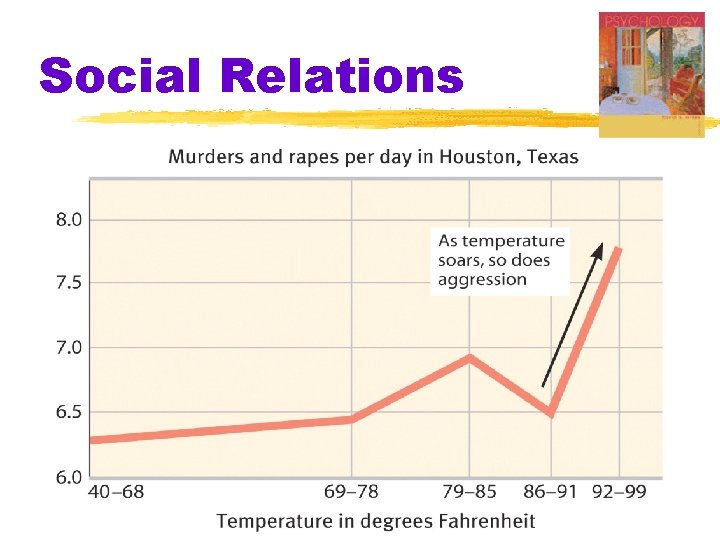
Social Relations
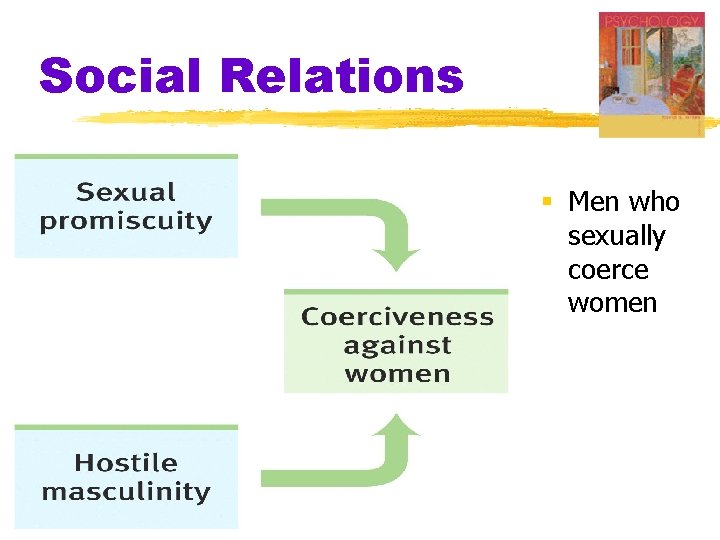
Social Relations § Men who sexually coerce women
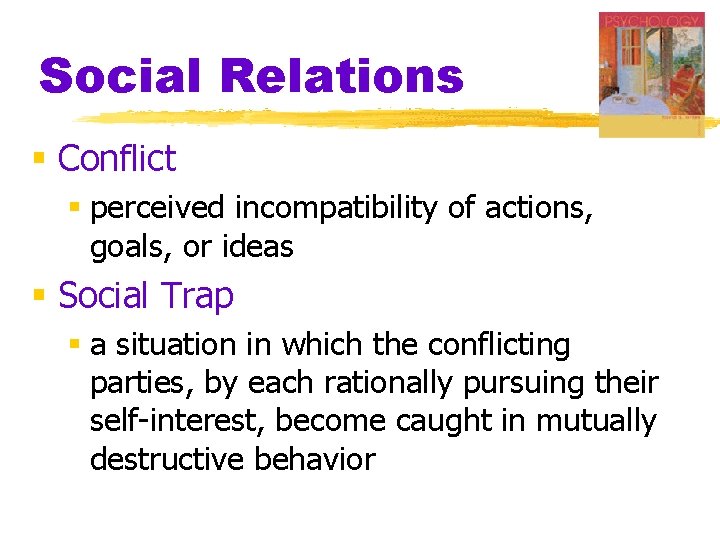
Social Relations § Conflict § perceived incompatibility of actions, goals, or ideas § Social Trap § a situation in which the conflicting parties, by each rationally pursuing their self-interest, become caught in mutually destructive behavior
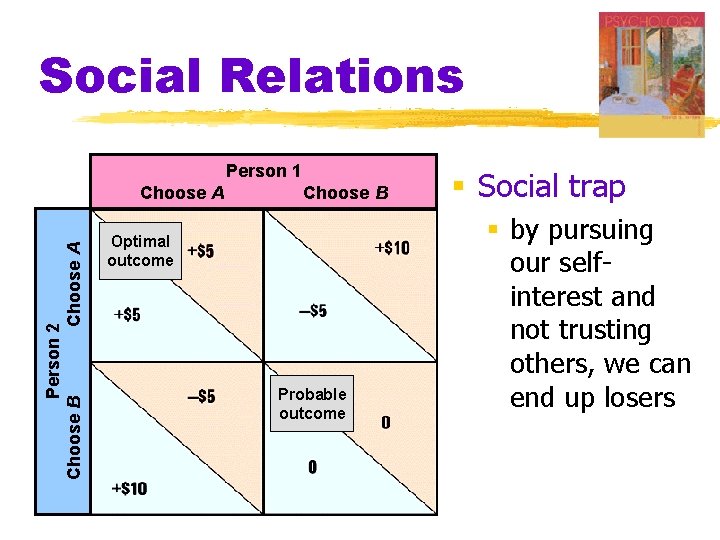
Social Relations Person 1 Person 2 Choose B Choose A Choose B Optimal outcome Probable outcome § Social trap § by pursuing our selfinterest and not trusting others, we can end up losers
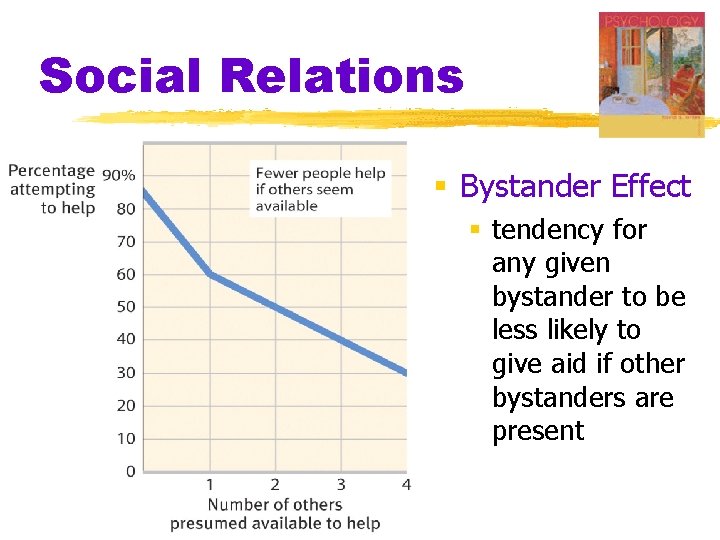
Social Relations § Bystander Effect § tendency for any given bystander to be less likely to give aid if other bystanders are present
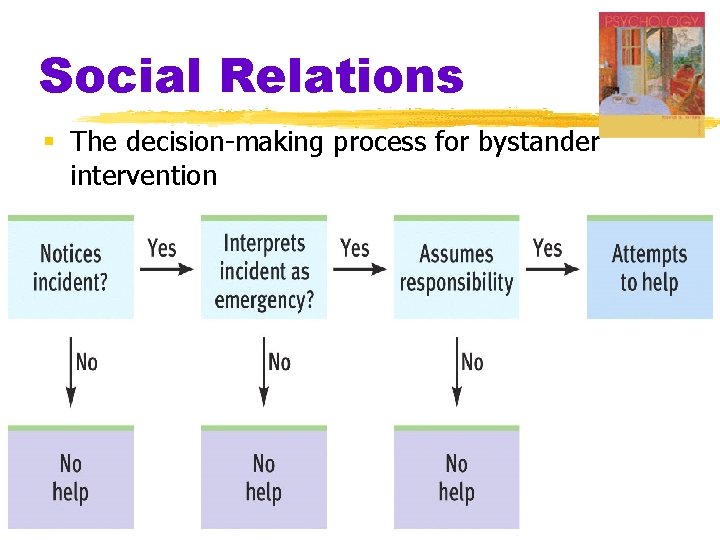
Social Relations § The decision-making process for bystander intervention
Social Relations § Social Exchange Theory § theory that our social behavior is an exchange process, the aim of which is to maximize benefits and minimize costs § Equity § a condition in which people receive from a relationship in proportion to what they give to it § Self-Disclosure § revealing intimate aspects of oneself to others
Chapter 18 Test Review The belief that our achievements are mostly due to luck reflects an _______ locus of control: a. b. c. d. external independent Internal
Chapter 18 Test Review The belief that our achievements are mostly due to luck reflects an _______ locus of control: external
Chapter 18 Test Review Which of the following proverbs is most clearly supported by research on social attraction? a. b. c. d. Absence makes the heart grow fonder Birds of a feather flock together Familiarity breeds contempt The beautiful are the lonely
Chapter 18 Test Review Which of the following proverbs is most clearly supported by research on social attraction? Birds of a feather flock together
Chapter 18 Test Review Teachers who anticipate better math performance from boys than from girls often give boys the kind of preferential treatment that leads them to outperform their female classmates. This best illustrates the dynamics of: a. b. c. d. Foot-in-the door phenomenon Self-fulfilling prophecies Social facilitation The fundamental attribution error
Chapter 18 Test Review Teachers who anticipate better math performance from boys than from girls often give boys the kind of preferential treatment that leads them to outperform their female classmates. This best illustrates the dynamics of: Self-fulfilling prophecies
Chapter 18 Test Review Passionate love refers to: a. b. c. d. A condition in which people receive from a relationship in proportion to what they give to it An aroused state of intense absorption in another person Deep affectionate attachment we feel for another person over a long period of time Revealing intimate aspects of ourselves to another person
Chapter 18 Test Review Passionate love refers to: An aroused state of intense absorption in another person
Chapter 18 Test Review Most children believe their school is better than other schools in their town. This best illustrates: a. b. c. d. Ingroup bias Scapegoating Outgroup bias The just-world phenomenon
Chapter 18 Test Review Most children believe their school is better than other schools in their town. This best illustrates: Ingroup bias
Chapter 18 Test Review Researchers find that which of the following factors is the best predictor of whether two people in a dating situation will say the like each other: a. b. c. d. Attractiveness humor kindness Personality
Chapter 18 Test Review Researchers find that which of the following factors is the best predictor of whether two people in a dating situation will say the like each other: Attractiveness
Chapter 18 Test Review Three key ingredients to attraction identified in the text are: a. b. c. d. Body shape, health, and reproductive capability Interest, wealth, and social status Novelty, uniqueness, and personality Proximity, physical attractiveness, and similarity
Chapter 18 Test Review Three key ingredients to attraction identified in the text are: Proximity, physical attractiveness, and similarity
Chapter 18 Test Review Sara, a 20 year-old-college sophomore, is very beautiful. Research suggests that she is likely to _____than less attractive college women. a. b. c. d. Be perceived as less intelligent Be perceived as more socially skilled Date less frequently have a much higher level of self-esteem
Chapter 18 Test Review Sara, a 20 year-old-college sophomore, is very beautiful. Research suggests that she is likely to _____than less attractive college women. Be perceived as more socially skilled
Chapter 18 Test Review Repeated exposure to novel/unique stimuli increases our liking of the stimuli according to the: a. b. c. d. Mere-exposure effect Altruism theory Ingroup bias Just-world phenomenon
Chapter 18 Test Review Repeated exposure to novel/unique stimuli increases our liking of the stimuli according to the: Mere-exposure effect
Chapter 18 Test Review Most researchers who have examined the effects of viewing televised aggression conclude that: a. b. c. d. There is no correlation between viewing aggression and behaving aggressive Viewing violence leads to aggressive behavior in boys but not girls Viewing violence may lead children and teenagers to behave aggressively Viewing violence takes people’s minds off their own problems and thus reduces their aggressive urges
Chapter 18 Test Review Most researchers who have examined the effects of viewing televised aggression conclude that: Viewing violence may lead children and teenagers to behave aggressively
Chapter 18 Test Review Adjusting our behavior to match a unanimous group standard is called: a. conformity b. groupthink c. obedience d. Social facilitation
Chapter 18 Test Review Adjusting our behavior to match a unanimous group standard is called: conformity
Chapter 18 Test Review Which of the following three factors determine whether our attitudes will affect our actions? a. b. c. d. Genetics, environment, brain anatomy Outside influences, awareness of attitude, relevance of attitude Situational factors, cognitive dissonance, deindividuation Social factors, cultural factors, personal factors
Chapter 18 Test Review Which of the following three factors determine whether our attitudes will affect our actions? Outside influences, awareness of attitude, relevance of attitude
Chapter 18 Test Review In Milgram’s obedience study, what was the approximate percentage of participants who followed the orders to deliver the maximum level of shock? a. b. c. d. 5% 30% 60% 90%
Chapter 18 Test Review In Milgram’s obedience study, what was the approximate percentage of participants who followed the orders to deliver the maximum level of shock? 60%
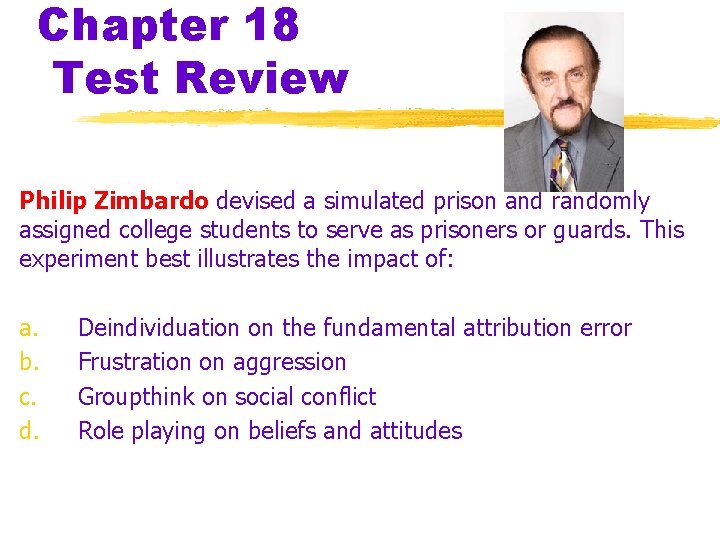
Chapter 18 Test Review Philip Zimbardo devised a simulated prison and randomly assigned college students to serve as prisoners or guards. This experiment best illustrates the impact of: a. b. c. d. Deindividuation on the fundamental attribution error Frustration on aggression Groupthink on social conflict Role playing on beliefs and attitudes
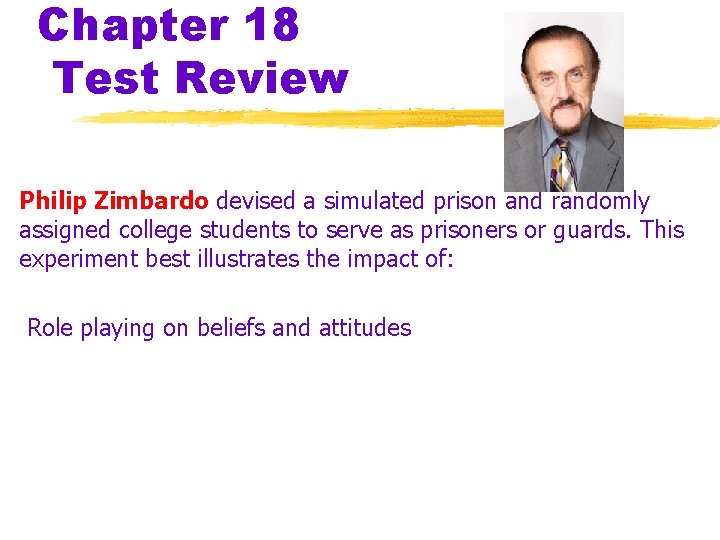
Chapter 18 Test Review Philip Zimbardo devised a simulated prison and randomly assigned college students to serve as prisoners or guards. This experiment best illustrates the impact of: Role playing on beliefs and attitudes
Chapter 18 Test Review Individuals who believe that the death penalty should be abolished meet to discuss the issue. Research on group polarization suggests that after the discussion the individuals will be: a. Convinced that the death penalty should be retained b. Even more convinced that the death penalty should be abolished c. In favor of a more moderate position on the issue d. Sharply divided over whether the death penalty should be abolished
Chapter 18 Test Review Individuals who believe that the death penalty should be abolished meet to discuss the issue. Research on group polarization suggests that after the discussion the individuals will be: Even more convinced that the death penalty should be abolished
Chapter 18 Test Review Individualistic cultures tend to have _____ achievement motivation. a. Formal operational b. High c. low d. Medium levels of
Chapter 18 Test Review Individualistic cultures tend to have _____ achievement motivation. High
Chapter 18 Test Review The tendency to view the world based on your own “cultural filters” is called: a. b. c. d. Culture bound Culture specific ethnocentrism Locus of control
Chapter 18 Test Review The tendency to view the world based on your own “cultural filters” is called: ethnocentrism
Chapter 18 Test Review The participants in Lawrence Kohlberg’s research on moral development were mostly: a. b. c. d. From collectivist cultures In the formal operational stage Urban schoolchildren White males
Chapter 18 Test Review The participants in Lawrence Kohlberg’s research on moral development were mostly: White males
Chapter 18 Test Review The cultural style that places group goals ahead of personal goals is called: a. b. c. d. Collectivism Ethnicity Individualism Locus of control
Chapter 18 Test Review The cultural style that places group goals ahead of personal goals is called: Collectivism
Chapter 18 Test Review One of the main goals of cross-cultural research is to discover whether certain behaviors are _____ or ______. a. b. c. d. Achievement motivated; internally motivated Cultural; racial Racist; ethnocentric Universal; culture-bound
Chapter 18 Test Review One of the main goals of cross-cultural research is to discover whether certain behaviors are _____ or ______. Universal; culture-bound
Chapter 18 Test Review After an exciting football game in which the home team loses by one point, a crowd of fans throws bottles and begins to tear up the field. This behavior is best understood in terms of: a. b. c. d. Deindividuation Group polarization Groupthink Social facilitation
Chapter 18 Test Review After an exciting football game in which the home team loses by one point, a crowd of fans throws bottles and begins to tear up the field. This behavior is best understood in terms of: Deindividuation
Chapter 18 Test Review The two-fingered “peace” sign is an example of a _____ human behavior. a. b. c. d. Culture-bound External Internal Universal
Chapter 18 Test Review The two-fingered “peace” sign is an example of a _____ human behavior. Culture-bound
Chapter 18 Test Review The Milgram obedience experiments were controversial because the: a. b. c. d. “learners” received painful electric shocks even if they had heart problems “teachers” actually seemed to enjoy shocking the “learners” “teachers” were deceived and frequently subjected to severe stress Experiments were performed despite mass student protests against the research
Chapter 18 Test Review The Milgram obedience experiments were controversial because the: “teachers” were deceived and frequently subjected to severe stress
Chapter 18 Test Review Fernando’s favorable attitude toward capital punishment began to change when he was asked to offer arguments opposing it in a college debate class. His attitude change is best explained by: a. b. c. d. Cognitive dissonance Deindividuation Social facilitation The bystander effect
Chapter 18 Test Review Fernando’s favorable attitude toward capital punishment began to change when he was asked to offer arguments opposing it in a college debate class. His attitude change is best explained by: Cognitive dissonance
- Slides: 113