ATTENTIONDEFICIT HYPERACTIVITY DISORDER ADHD Hyperacivity for children in


- Slides: 25
ATTENTION-DEFICIT / HYPERACTIVITY DISORDER (ADHD) Hyperacivity for children in school
0 INTRODUCTION: -Short Video - What is ADHD -Prevalence of ADHD 0 BODY: - Signs and symptoms of ADHD - Causes of ADHD -How is ADHD Diagnosed -School Nurse Role -CONCLUSION - Summary - Article OU TLI NE
OBJECTIVES OF THE SEMINAR The student will be able to: v Define ADHD v Identify signs and symptoms of ADHD v Recognize causes of ADHD v Identify Diagnosis v Identify School Nurse Role
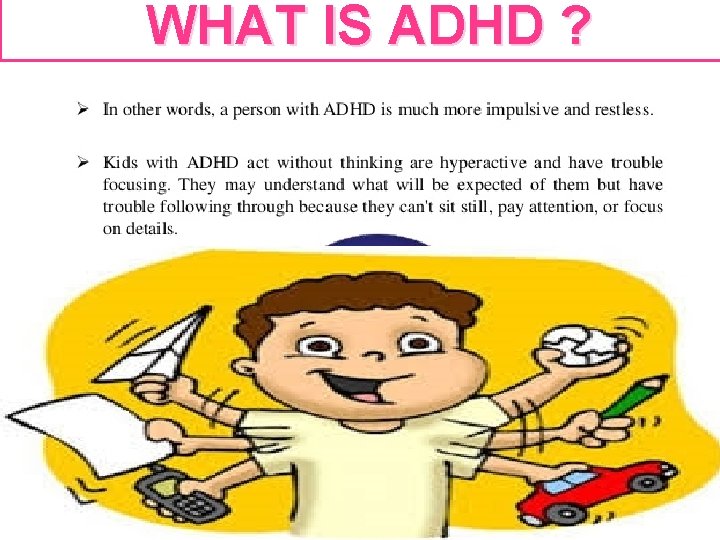
WHAT IS ADHD ? OBJECTIVES OF THE SEMINAR The student will be able to: v Define ADHD v Identify signs and symptoms of ADHD v Mention 2 of ADHD types v Recognize causes of ADHD v Identify Inattention v Identify School Nurse Role
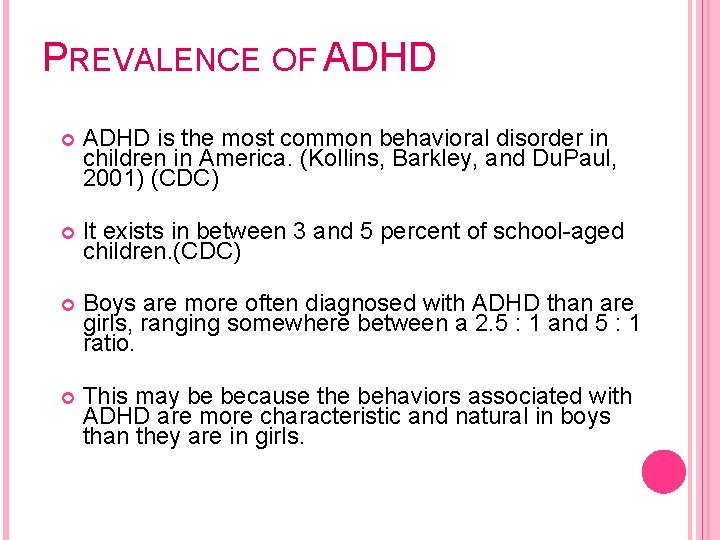
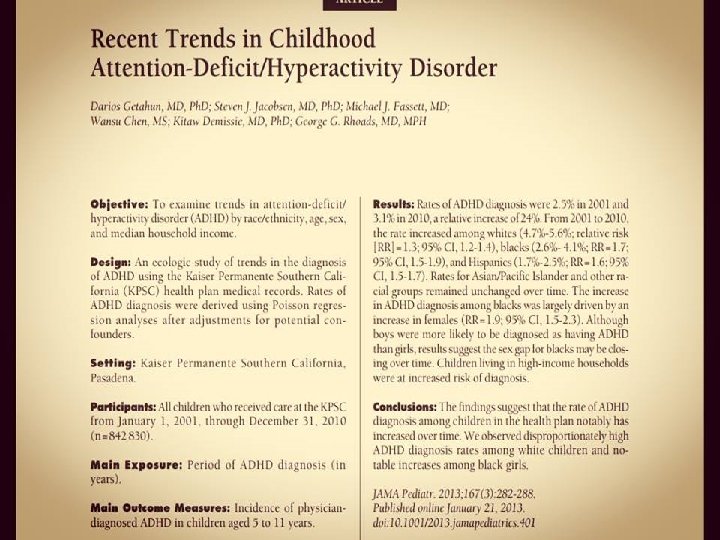
PREVALENCE OF ADHD is the most common behavioral disorder in children in America. (Kollins, Barkley, and Du. Paul, 2001) (CDC) It exists in between 3 and 5 percent of school-aged children. (CDC) Boys are more often diagnosed with ADHD than are girls, ranging somewhere between a 2. 5 : 1 and 5 : 1 ratio. This may be because the behaviors associated with ADHD are more characteristic and natural in boys than they are in girls.
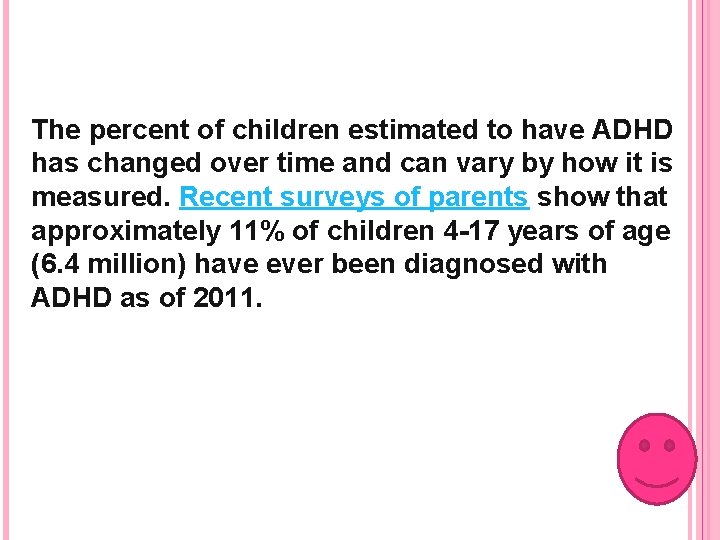
The percent of children estimated to have ADHD has changed over time and can vary by how it is measured. Recent surveys of parents show that approximately 11% of children 4 -17 years of age (6. 4 million) have ever been diagnosed with ADHD as of 2011.
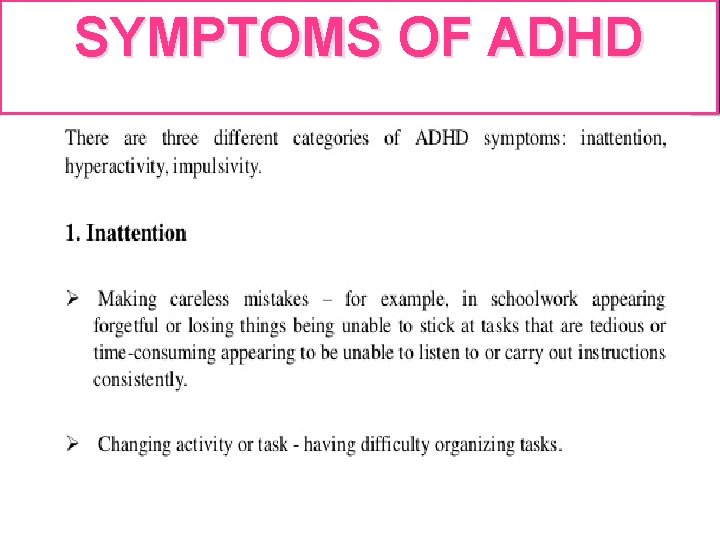
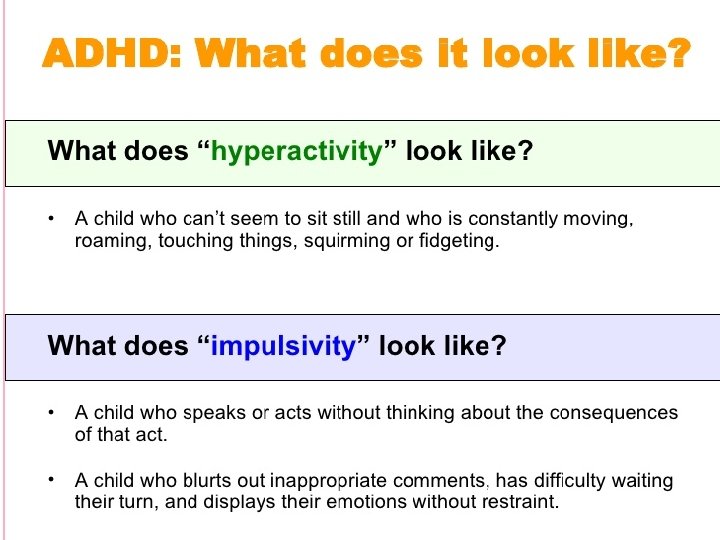
SYMPTOMS OF ADHD E 4
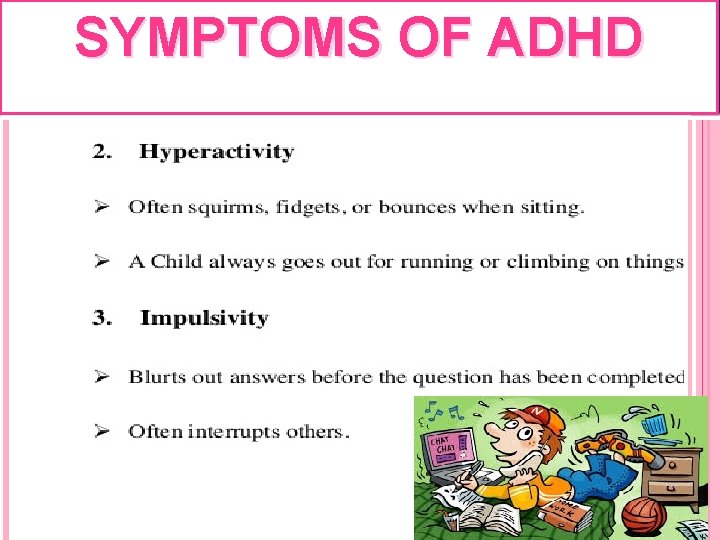
SYMPTOMS OF ADHD
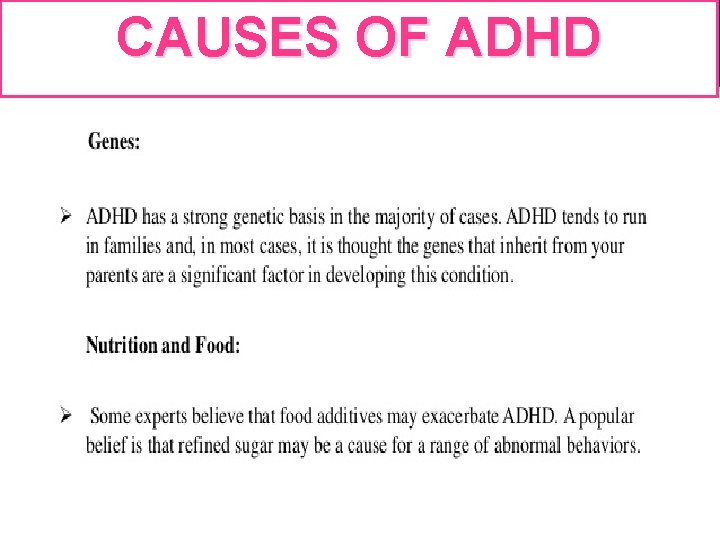
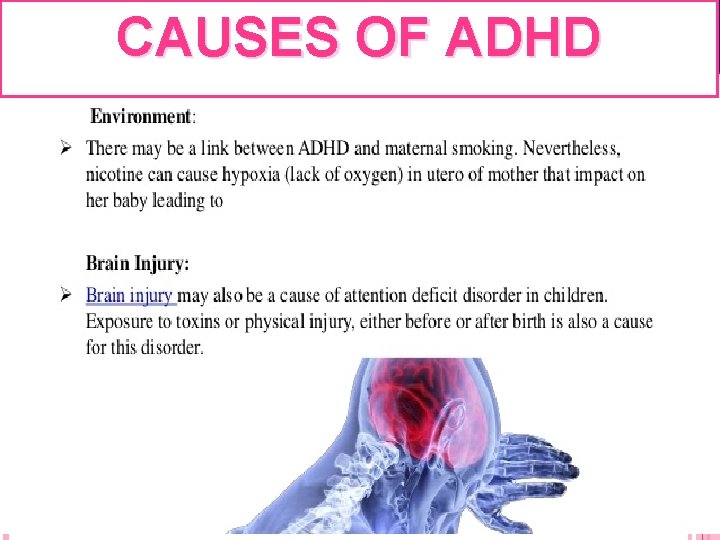
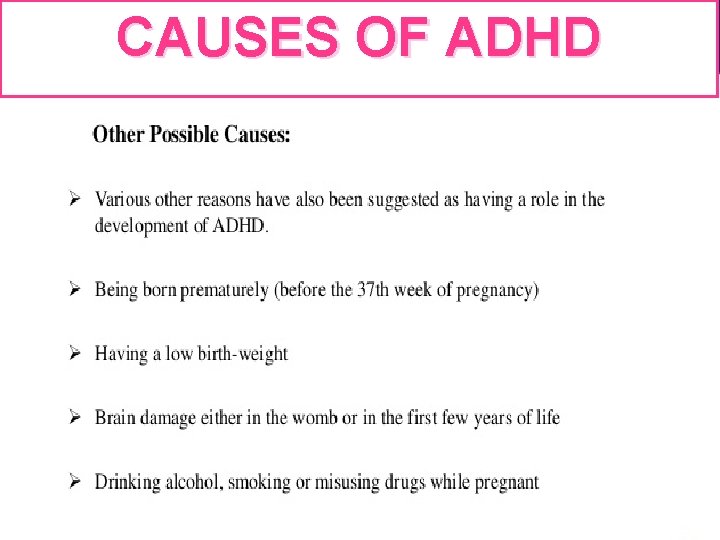
CAUSES OF ADHD
CAUSES OF ADHD
CAUSES OF ADHD
HOW IS ADHD DIAGNOSED
School Nurse Role
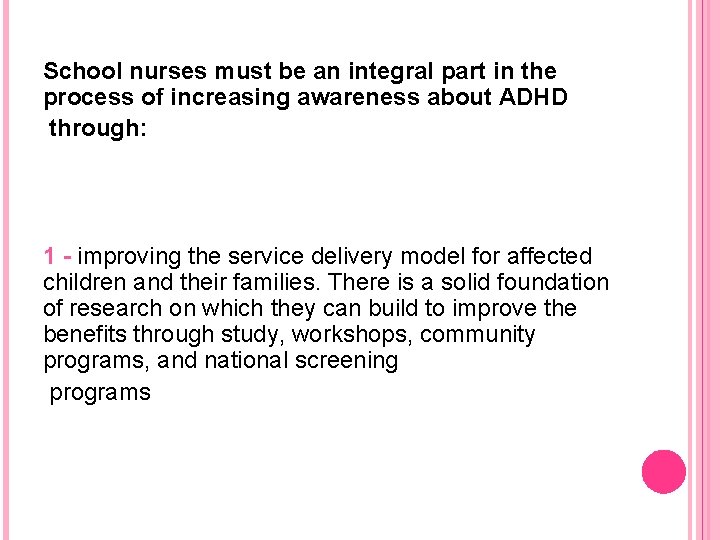
School nurses must be an integral part in the process of increasing awareness about ADHD through: 1 - improving the service delivery model for affected children and their families. There is a solid foundation of research on which they can build to improve the benefits through study, workshops, community programs, and national screening programs
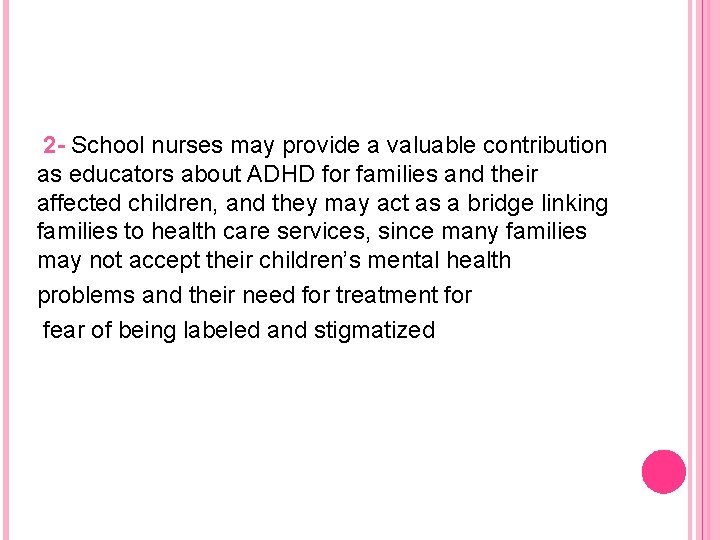
2 - School nurses may provide a valuable contribution as educators about ADHD for families and their affected children, and they may act as a bridge linking families to health care services, since many families may not accept their children’s mental health problems and their need for treatment for fear of being labeled and stigmatized
*It is important for these nurses to establish programs and workshops to fight this stigma and increase awareness about child behavioral problems, in particular ADHD.
FOR EXAMPLE in collaboration with other health care providers, school nurses can initiate national screening programs for children’s behavioral problems in general, and specifically for ADHD in school-age and younger children. Those children who screen positive are then individually and clinically evaluated by qualified, highly trained professionals in this field. In addition, workshops can be held for further evaluation, and these workshops can also be used to educate people about such conditions: how, when, and where to seek professional help, and the benefits of early diagnosis in preventing the complications.
Finally: school nurses can help in initiating parent support groups for those who are affected and not affected, aiming to empower parents and enable them to help themselves and their children
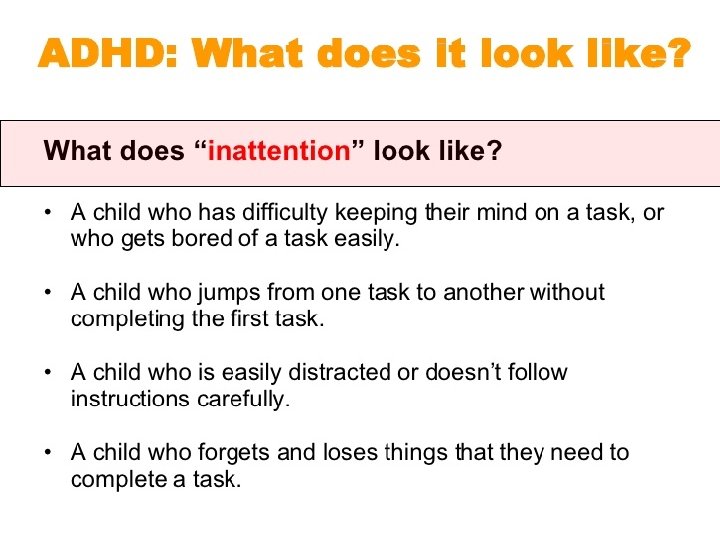
SUMMARY § § § ADHD is one of the most common neurodevelopment disorders of childhood. It is usually first diagnosed in childhood and often lasts into adulthood. Inattention: Six or more symptoms of inattention for children up to age 16, or five or more for adolescents 17 and older and adults; symptoms of inattention have been present for at least 6 months.
CONCLUSION v In early childhood, it may be difficult to distinguish symptoms of ADHD from age-appropriate behaviors in active children (e. g. , running around or being noisy ). v Inattention in the classroom may also occur when children with high intelligence are placed in academically understimulating environments.
References https: //kidshealth. org/en/parents/adhd. html http: //www. cdc. gov/ncbddd/adhd/index. html ADAM Medical Encyclopedia (March 2012). Attention Deficit Hyperactive Disorder (ADHD). Retrieved last August 22, 2012 from http: //www. ncbi. nlm. nih. gov/pubmedhealth/PMH 0002518/ American Psychiatric Association: Diagnostic and Statistical Manual of Mental Disorders, Fourth Edition, Text Revision. (2000). Washington, DC, American Psychiatric Association. Retrieved last August 23, 2012 from http: //www. cdc. gov/ncbddd/adhd/diagnosis. html Huelskoetter & Murray. (1991). Psychiatric Mental Health Nursing: Giving emotional care. C & E Publishing Co. National Institute on Mental Health. (January 2012). What is attention deficit hyperactive disorder? Retrieved last August 23, 2012 from http: //www. nimh. nih. gov/health/publications/attention-deficit-hyperactivitydisorder/complete-index. shtml Smith & Segal (May 2012). ADD/ADHD Parenting Tips. Retrieved last August 22, 2012 from http: //www. helpguide. org/mental/adhd_add_parenting_strategies. htm Shives, L. R. (2008). Basic Concepts of Psychiatric- Mental Health Nursing 7 th Edition. Lippincott Williams & Wilkins.