
Section H OTHER DISORDERS Chapter H 4 Borderline
Section H: OTHER DISORDERS Chapter H. 4 Borderline Personality Disorder Lionel Cailhol, Ludovic Gicquel & Jean-Philippe Raynaud DEPRESSION IN CHILDREN AND ADOLESCENTS Companion Power. Point Presentation Adapted by Julie Chilton
The “IACAPAP Textbook of Child and Adolescent Mental Health” is available at the IACAPAP website http: //iacapap. org/iacapap-textbook-of-child-and-adolescentmental-health Please note that this book and its companion powerpoint are: · Free and no registration is required to read or download it · This is an open-access publication under the Creative Commons Attribution Noncommercial License. According to this, use, distribution and reproduction in any medium are allowed without prior permission provided the original work is properly cited and the use is non-commercial.

Borderline Personality Disorder Learning Objectives: • Definition • Epidemiology • Age of Onset and Course • Causes and Risk Factors • Diagnosis • Treatment • Further Resources Janis Joplin
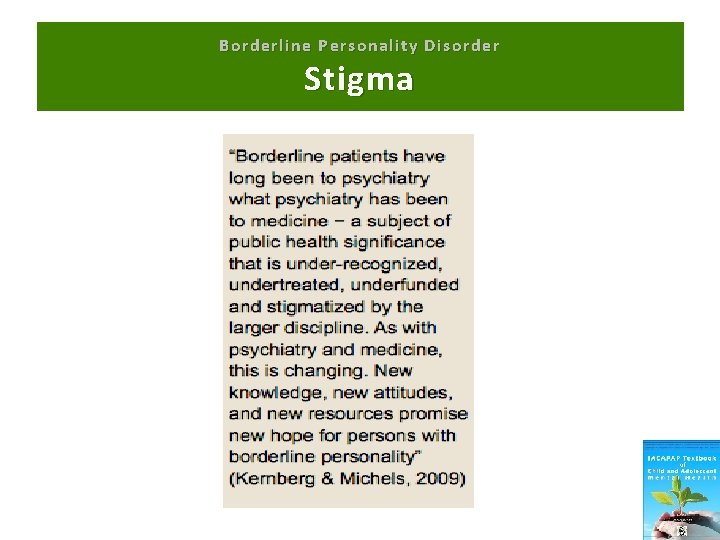
Borderline Personality Disorder Stigma

Borderline Personality Disorder DSM-5 Definition

Borderline Personality Disorder ICD-10 Definition
Borderline Personality Disorder Epidemiology: Prevalence Uncertain prevalence • Adults – Estimated to be between 1% and 6% according to study – US data: 6. 4% in general medical population and 20% in psychiatric inpatients • Adolescents: – French study: 10% boys, 18% girls – Chinese study: 2%
Borderline Personality Disorder Epidemiology: Gender • Similar prevalence between genders in general population • Females > males in clinical populations
Borderline Personality Disorder Epidemiology: Culture • Borderline concept began in Western cultures • Differing views on borderline traits – Emotional lability in Latin and Nordic Countries – Dissociative symptoms
Borderline Personality Disorder Epidemiology: Burden of Illness • • 17, 000 euro/year per patient in Netherlands Stress of risk-taking behavior on families Communication problems with parents Physical consequences of risk-taking – Accidents – Substance misuse – Sexually transmitted diseases
Borderline Personality Disorder Epidemiology: Burden of Illness Observational studies of mothers with BPD: • Less availability • Poorer organisation of behaviours and mood • Lower expectation of positive interactions • More often overprotective/intrusive • Less demonstrative/sensitive
Borderline Personality Disorder Epidemiology: Burden of Illness Studies of children of mothers with BPD: • Higher rates of parental separation and loss of employment • Tend to withdraw from surroundings • Less attentive, interested or eager to interact with their mothers • More disorganized attachment • High rates of suicidal thoughts • Increased rate of depression
Borderline Personality Disorder Age of Onset and Course • Technically, diagnosis only after 18 • Practically, earlier when symptoms clear and persistent • Peak frequency of symptoms at 14 years of age • 80% teens with BPD have a PD in adulthood, but only 16% have BPD
Borderline Personality Disorder Age of Onset and Course • Follow up studies: – – • 74% remit after 6 years 88% remit after 10 years 2 clusters of symptoms: – – Anger and abandonment stable and persistent Self harm and suicidality less persistent • Risk of suicide 4 -10%; especially at 30 -37 years of age; rare during treatment • Impaired functioning – Worse than other personality disorders and depression – Frequent job losses, unstable relationships, history of rape
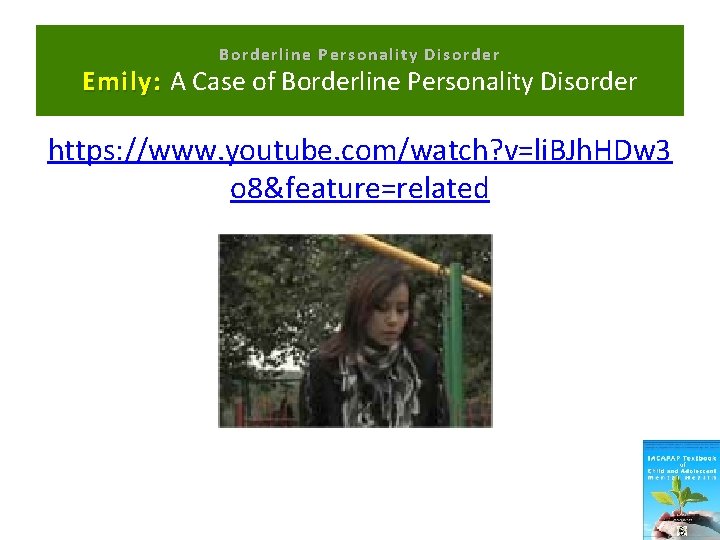
Borderline Personality Disorder Emily: A Case of Borderline Personality Disorder https: //www. youtube. com/watch? v=li. BJh. HDw 3 o 8&feature=related
Borderline Personality Disorder Causes Several hypotheses*: • Object Relations Theory – Otto Kernberg • Attachment Theory – John Bowlby • Emotional Dysregulation Theory – Marsha Linehan • Cognitive Theories • Chronic Childhood Trauma Theory *All stress individual’s poor emotional development, scarred by trauma and emotional deficits, with failure to adapt environment to child’s needs
Borderline Personality Disorder Risk Factors • • • Childhood trauma Sexual abuse Early maternal separation Neglect Genetics—heritability~47%
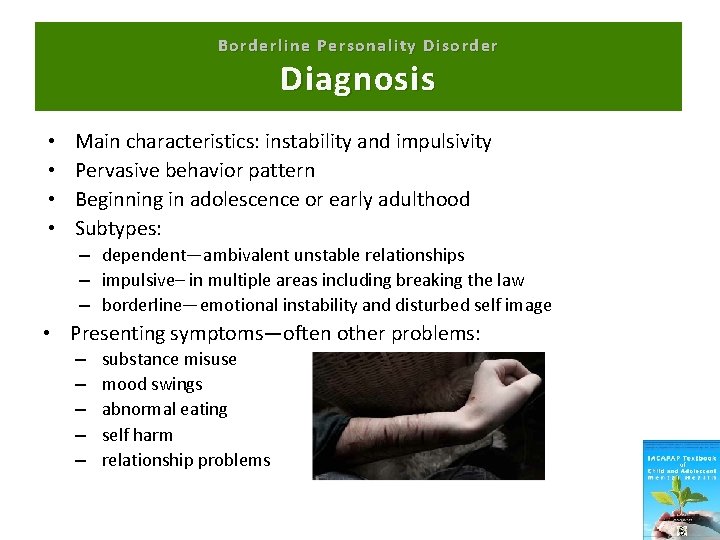
Borderline Personality Disorder Diagnosis • • Main characteristics: instability and impulsivity Pervasive behavior pattern Beginning in adolescence or early adulthood Subtypes: – dependent—ambivalent unstable relationships – impulsive– in multiple areas including breaking the law – borderline—emotional instability and disturbed self image • Presenting symptoms—often other problems: – – – substance misuse mood swings abnormal eating self harm relationship problems
Borderline Personality Disorder Comorbidity • • • Depression 71% Anorexia 40% Bulimia 33% Alcohol abuse 24% Substance abuse 8% ADHD • Antisocial PD 22% • Avoidant PD 21%
Borderline Personality Disorder Psychometric Evaluation • SIDP-IV (Structured Interview for the Diagnosis of DSM-IV Personality Disorders) • SCID-II (Structured Clinical Interview for DSM-IV) • IPDE (International Personality Disorders Examination) • DIB-R (Diagnostic Interview for Borderline-Revised) • CAPA (Child and Adolescent Psychiatric Assessment) • MSI-BPD (Mc. Lean Screening Instrument for BPD) • PDQ-4+ (Personality Diagnostic Questionnaire)
Borderline Personality Disorder Treatment Guidelines http: //www. nice. org. Uk/guidance/CG 78 http: //psychiatryonline. org/pb/ass ets/raw/sitewide/practice_guideli nes/guidelines/bpd. pdf
Borderline Personality Disorder Determinants of Care Framework • • Risk evaluation Mental state Level of psychosocial functioning Aims and motivation of patient Social environment Comorbidity Predominant symptoms
Borderline Personality Disorder Treatment Setting • Inpatient: – severe comorbidity – failure of crisis management – no effectiveness data – risk of regression • Outpatient: – – individual clinician partnership day hospital school support *Treatment of adolescents with BPD should usually be delivered as outpatient
Borderline Personality Disorder Treatment Set treatment plan and treatment goals Monitor patient’s progress Work from a crisis management approach Progress toward long-term work on personality aspects • Involve adult caregivers in harm prevention • •
Borderline Personality Disorder Biological Treatments • No medication has been shown to be effective for BPD yet • Medication is for comorbid disorders NOT for BPD symptoms • Sedatives should not be used for more than a week • Antipsychotics can have short-term benefits – Cognitive-perceptual symptoms – Anger – Mood lability
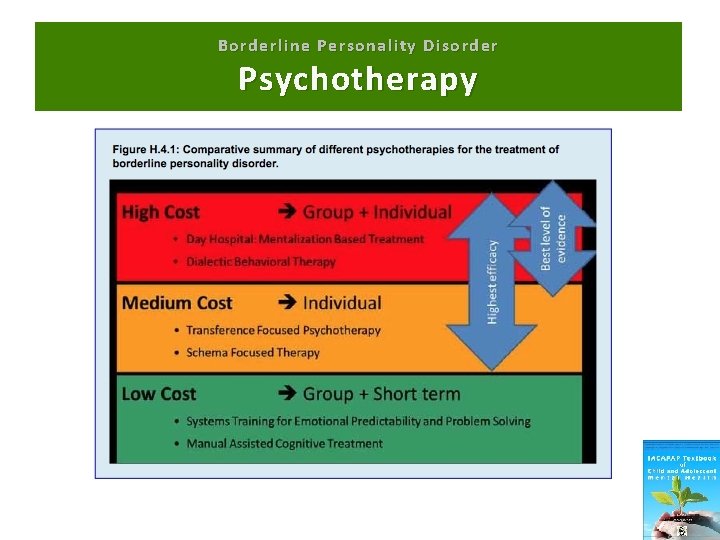
Borderline Personality Disorder Psychotherapy

Borderline Personality Disorder Psychotherapy: Dialectical Behavior Therapy http: //www. nytimes. com/2011/06/23/health/23 lives. html? pagewanted=all&_r=0
Borderline Personality Disorder Psychotherapy: Mentalization Based Treatment Psychodynamic • Developed by Bateman and Fonagy • Focuses on the ability to differentiate and separate out one’s own thoughts and feelings from those of others • Less directive than CBT-based treatments
Borderline Personality Disorder Psychotherapy: Transference Focused Psychotherapy Psychodynamic • Assumes psychological structure underlies symptoms of BPD • Dichotomy of good/bad, black/white, all/nothing • Splitting emphasized • Sessions twice a week • Focus on transference
Borderline Personality Disorder Further Information http: //www. tara 4 bpd. org/dyn/index. php http: //personnalitelimite. net
Medication: Thank You! ADHD Borderline Personality Disorder
- Slides: 31