Assist Prof Merve Topcu PSY 335 Department of
- Slides: 45
Assist. Prof. Merve Topcu PSY 335 Department of Psychology, Çankaya University 2016 -2017, Fall
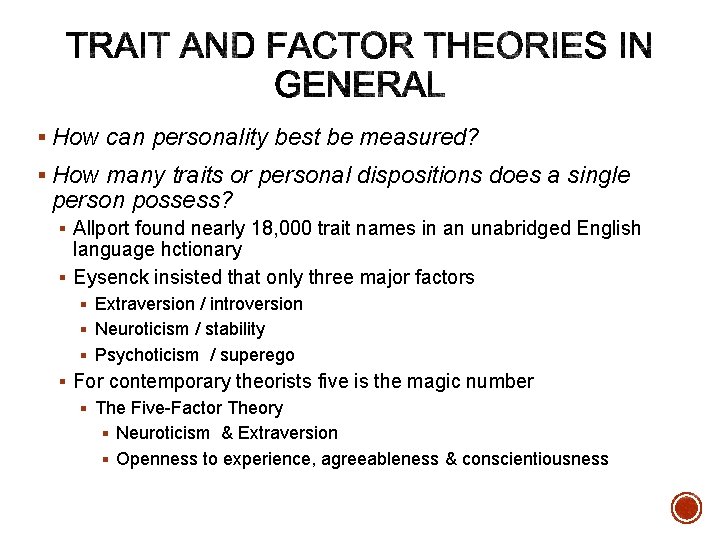
§ How can personality best be measured? § How many traits or personal dispositions does a single person possess? § Allport found nearly 18, 000 trait names in an unabridged English language hctionary § Eysenck insisted that only three major factors § Extraversion / introversion § Neuroticism / stability § Psychoticism / superego § For contemporary theorists five is the magic number § The Five-Factor Theory § Neuroticism & Extraversion § Openness to experience, agreeableness & conscientiousness
§ Cattell's trait theory enhances the understanding of Eysenck's three-factor theory § Different each other in terms of § Reasoning § Theory § Methodology § Assessment § Classification of traits
§ Correlation coefficient § A mathematical procedure for expressing the degree of correspondence between two sets of scores § Factor analysis can account for a large number of variables with a smaller number of “more basic dimensions = traits” § Factors represent a cluster of closely related variables § Factor loadings § the extent to which each individual score contributes to the various factors § Traits generated through factor analysis § Unipolar traits are scaled from zero to some large amount. § Height, weight, and intellectual ability § Bipolar traits extend from one pole to an opposite pole, with zero representing a midpoint § Introversion versus extraversion
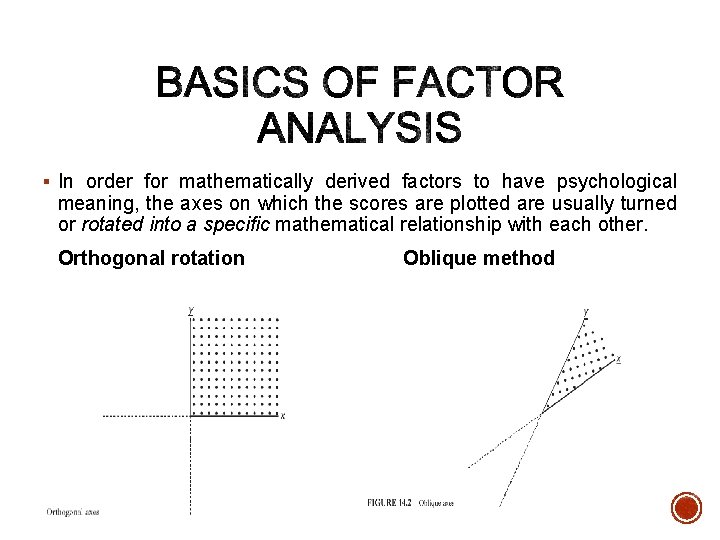
§ In order for mathematically derived factors to have psychological meaning, the axes on which the scores are plotted are usually turned or rotated into a specific mathematical relationship with each other. Orthogonal rotation Oblique method
§ Has strong psychometric and biological components § Psychometric findings are meaningless unless they have been shown to possess a biological existence 1. Psychometric evidence for the factor's existence must be established § Other investigators from separate laboratories, must also be able to find the factor 2. The factor must also possess heritability and must fit an established genetic model § eliminates learned characteristics, such as the ability to mimic the voices of well-known people or a religious or political belief 3. The factor must make sense from a theoretical view. § Eysenck employed the deductive method of investigation, beginning with a theory and then gathering data that are logically consistent with that theory. 4. A factor must possess social relevance § have a r/ship with such socially relevant variables as drug addiction, proneness to unintentional injuries, outstanding performance in sports, etc.
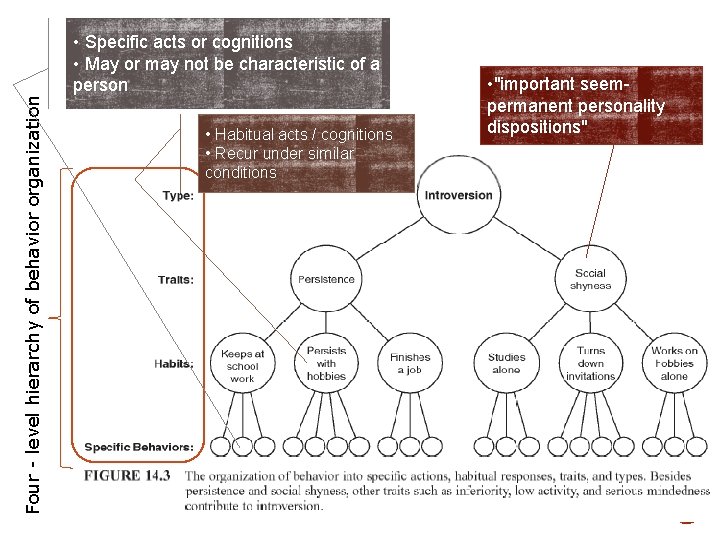
Four - level hierarchy of behavior organization • Specific acts or cognitions • May or may not be characteristic of a person • Habitual acts / cognitions • Recur under similar conditions • "important seempermanent personality dispositions"
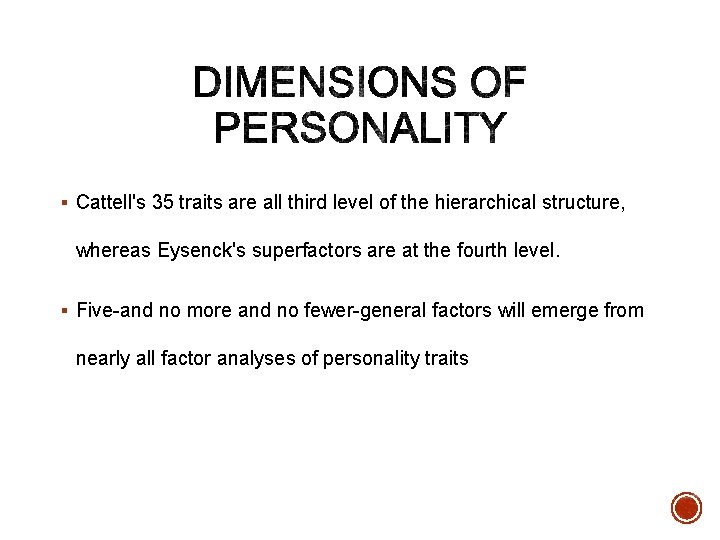
§ Cattell's 35 traits are all third level of the hierarchical structure, whereas Eysenck's superfactors are at the fourth level. § Five-and no more and no fewer-general factors will emerge from nearly all factor analyses of personality traits
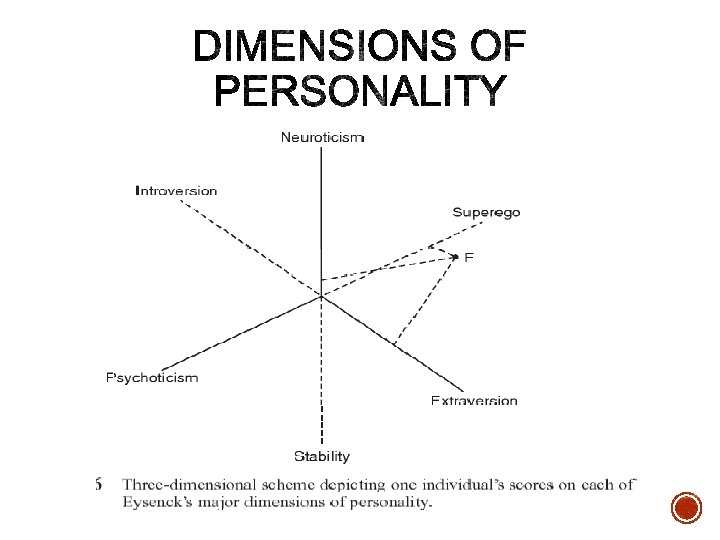
§ Eysenck regarded all three factors as part of normal personality structure. § All three are bipolar § Introversion vs. extraversion § Neuroticism vs. stability § Psychoticism vs. Superego § A strong biological base exists for each of his three superfactors § Agreeableness & conscientiousness do not have an underlying biological foundation § 3 factors relate to such social issues as drug use, sexual behaviors, criminality, preventing cancer & heart disease, & creativity.
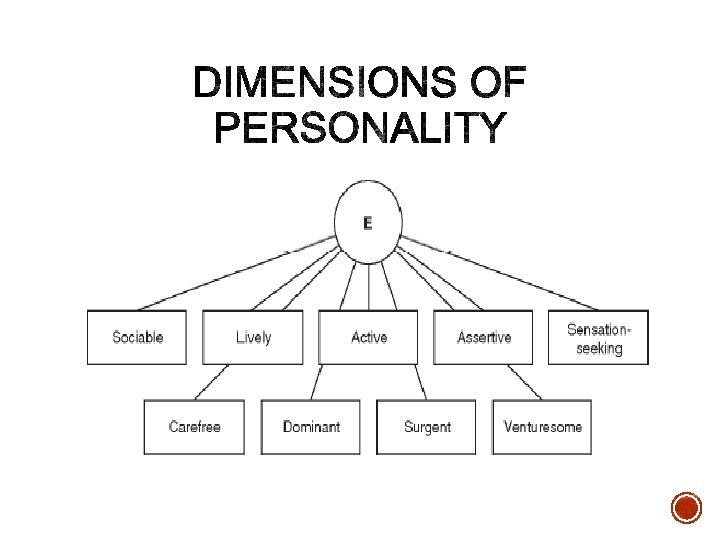
§ Extraversion § characterized primarily by sociability and impulsiveness § jocularity, liveliness, quick-wittedness, optimism § rewarded for their association with others § Introversion § quiet, passive, unsociable, careful, reserved, thoughtful, pessimistic, peaceful, sober, and controlled § the primary cause of differences between extraverts and introverts is one of cortical arousal level § Extraverts have a lower level of cortical arousal than do introverts § have higher sensory thresholds and thus lesser reactions to sensory stimulation § To maintain an optimal level of stimulation, introverts, with their congenitally low sensory threshold, avoid situations that will cause too much excitement.
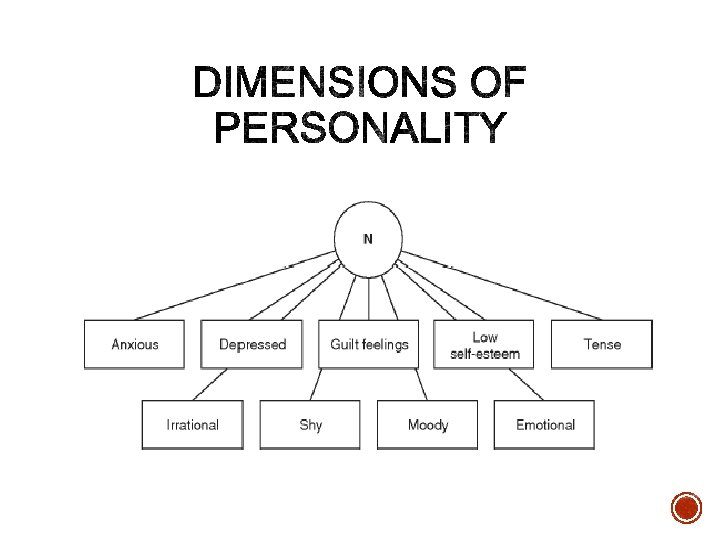
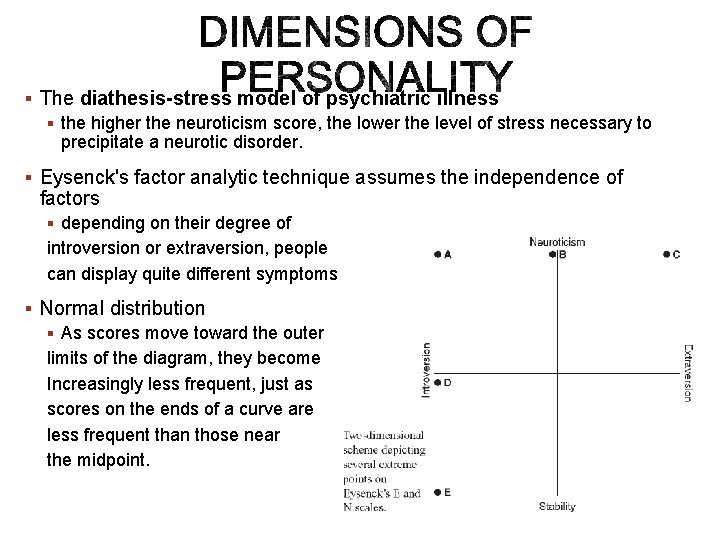
§ Neuroticism / Stability § a tendency to overreact emotionally and to have difficulty returning to a normal state after emotional arousal § frequently complain of physical symptoms § People can score high on neuroticism and be free of any debilitating psychological symptoms. § a genetic basis for such neurotic traits as anxiety, hysteria, and obsessive- compulsive disorders. § Related to antisocial and asocial behaviors such as adult crime, childhood behavior disorders, homosexuality, and alcoholism
§ The diathesis-stress model of psychiatric illness § the higher the neuroticism score, the lower the level of stress necessary to precipitate a neurotic disorder. § Eysenck's factor analytic technique assumes the independence of factors § depending on their degree of introversion or extraversion, people can display quite different symptoms § Normal distribution § As scores move toward the outer limits of the diagram, they become Increasingly less frequent, just as scores on the ends of a curve are less frequent than those near the midpoint.
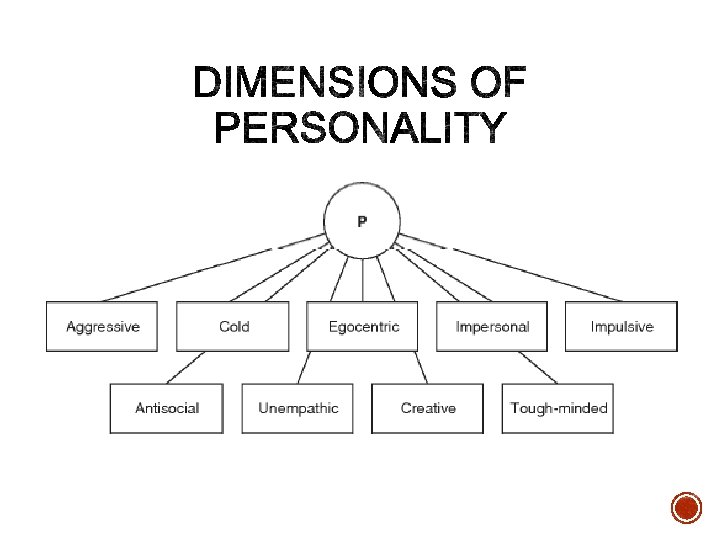
§ Psychoticism / Superego § often egocentric, cold, nonconforming, impulsive, hostile, aggressive, suspicious, psychopathic, and antisocial § low on psychoticism (in the direction of superego function) tend to be altruistic, highly socialized, empathic, caring, cooperative, conforming, and conventional § People who score high on psychoticism and who are also experiencing levels of stress have an increased chance of developing a psychotic disorder. § High P scorers are genetically more vulnerable to stress than are low P scorers.
§ Negative Valence / Olumsuz Değerlik (Gençöz & Öncül, 2012) § Specific to Turkish culture § Negative self-attributions
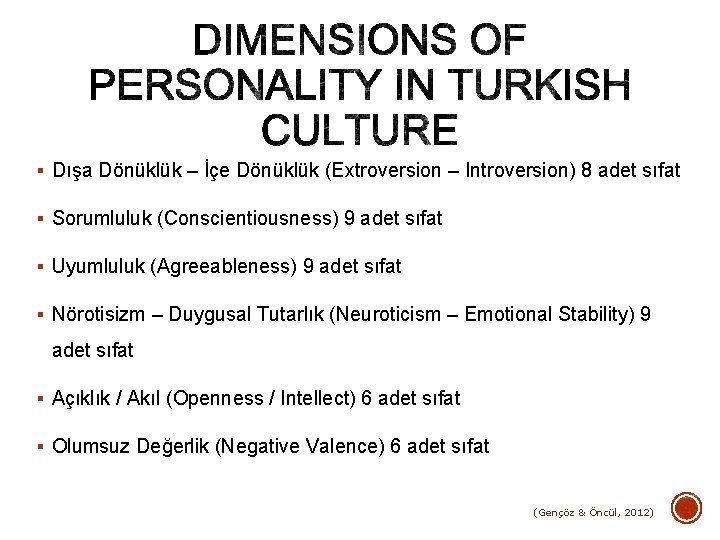
§ Dışa Dönüklük – İçe Dönüklük (Extroversion – Introversion) 8 adet sıfat § Sorumluluk (Conscientiousness) 9 adet sıfat § Uyumluluk (Agreeableness) 9 adet sıfat § Nörotisizm – Duygusal Tutarlık (Neuroticism – Emotional Stability) 9 adet sıfat § Açıklık / Akıl (Openness / Intellect) 6 adet sıfat § Olumsuz Değerlik (Negative Valence) 6 adet sıfat (Gençöz & Öncül, 2012)
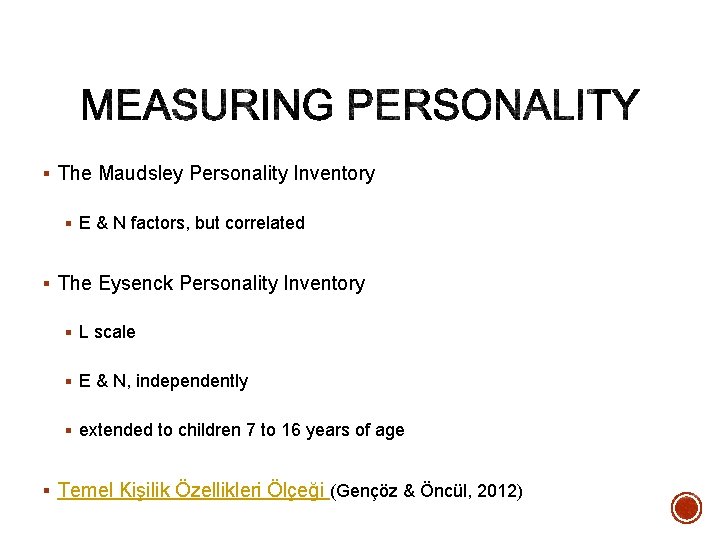
§ The Maudsley Personality Inventory § E & N factors, but correlated § The Eysenck Personality Inventory § L scale § E & N, independently § extended to children 7 to 16 years of age § Temel Kişilik Özellikleri Ölçeği (Gençöz & Öncül, 2012)
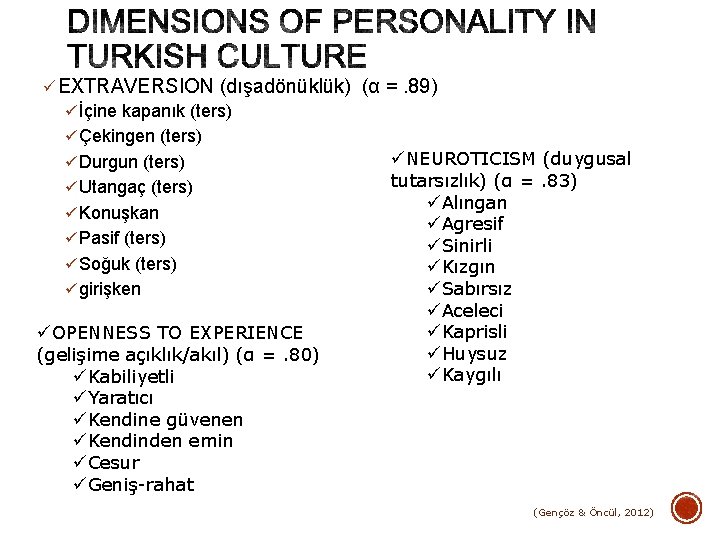
ü EXTRAVERSION (dışadönüklük) (α =. 89) ü İçine kapanık (ters) ü Çekingen (ters) üNEUROTICISM (duygusal ü Durgun (ters) tutarsızlık) (α =. 83) ü Utangaç (ters) üAlıngan ü Konuşkan üAgresif ü Pasif (ters) üSinirli ü Soğuk (ters) üKızgın ü girişken üSabırsız üAceleci üKaprisli üOPENNESS TO EXPERIENCE üHuysuz (gelişime açıklık/akıl) (α =. 80) üKaygılı üKabiliyetli üYaratıcı üKendine güvenen üKendinden emin üCesur üGeniş-rahat (Gençöz & Öncül, 2012)
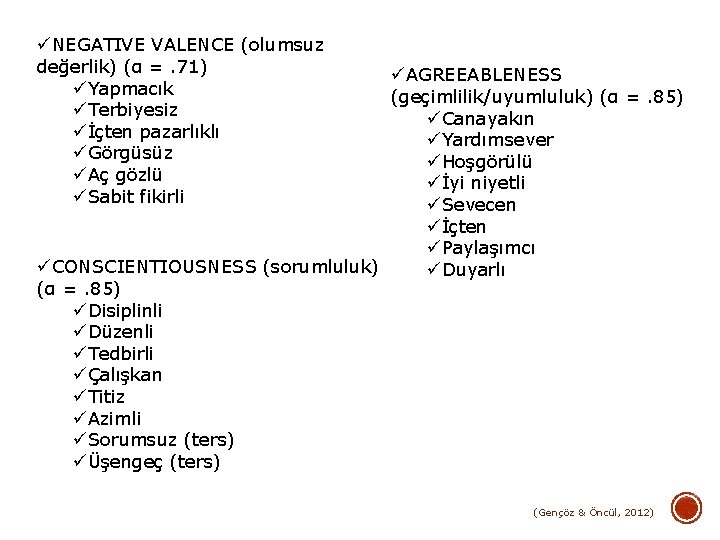
üNEGATIVE VALENCE (olumsuz değerlik) (α =. 71) üYapmacık üTerbiyesiz üİçten pazarlıklı üGörgüsüz üAç gözlü üSabit fikirli üAGREEABLENESS (geçimlilik/uyumluluk) (α =. 85) üCanayakın üYardımsever üHoşgörülü üİyi niyetli üSevecen üİçten üPaylaşımcı üCONSCIENTIOUSNESS (sorumluluk) üDuyarlı (α =. 85) üDisiplinli üDüzenli üTedbirli üÇalışkan üTitiz üAzimli üSorumsuz (ters) üÜşengeç (ters) (Gençöz & Öncül, 2012)
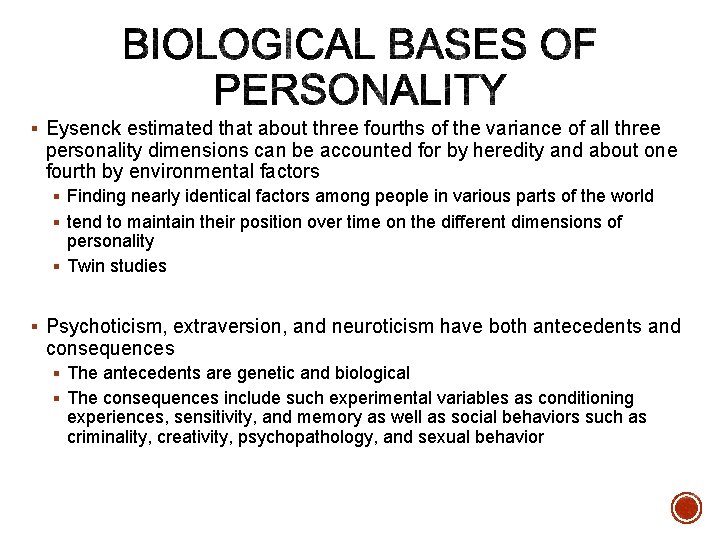
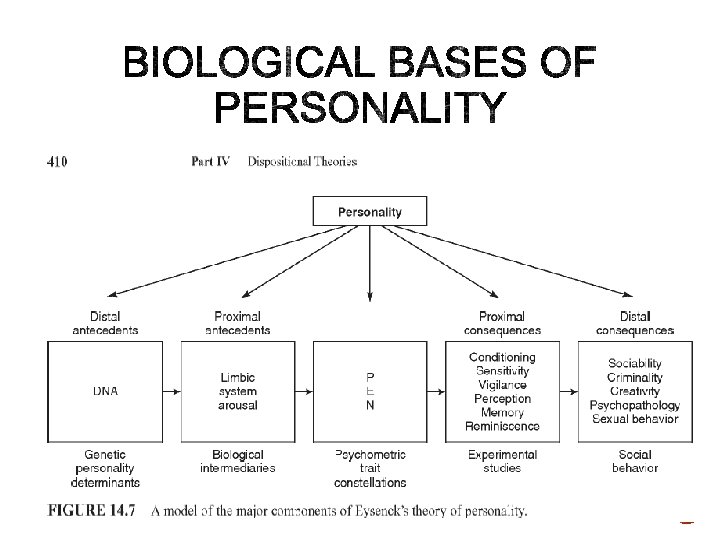
§ Eysenck estimated that about three fourths of the variance of all three personality dimensions can be accounted for by heredity and about one fourth by environmental factors § Finding nearly identical factors among people in various parts of the world § tend to maintain their position over time on the different dimensions of personality § Twin studies § Psychoticism, extraversion, and neuroticism have both antecedents and consequences § The antecedents are genetic and biological § The consequences include such experimental variables as conditioning experiences, sensitivity, and memory as well as social behaviors such as criminality, creativity, psychopathology, and sexual behavior
The psychometric traits of P, E, and N can combine with one another and with genetic determinants, biological intermediates, and experimental studies to predict a variety of social behaviors, including those that contribute to disease.
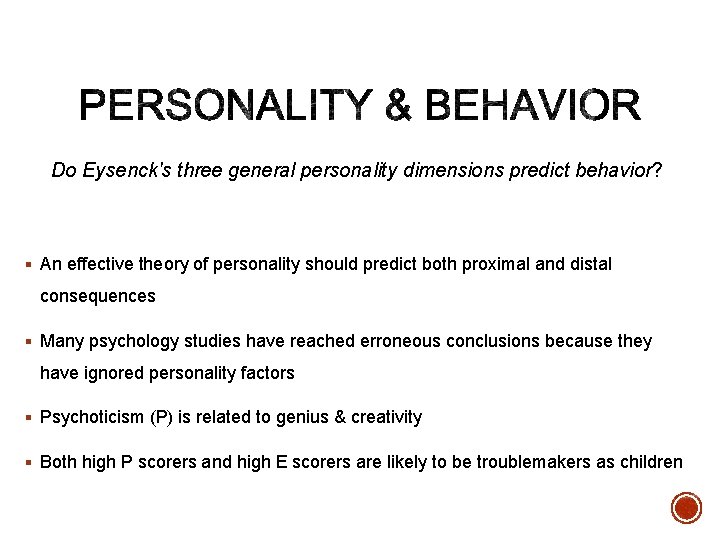
Do Eysenck's three general personality dimensions predict behavior? § An effective theory of personality should predict both proximal and distal consequences § Many psychology studies have reached erroneous conclusions because they have ignored personality factors § Psychoticism (P) is related to genius & creativity § Both high P scorers and high E scorers are likely to be troublemakers as children
Can personality factors predict mortality? § People who scored low on neuroticism (N) on the Maudsley Personality Inventory tended to suppress their emotion and were much more likely than high N scorers to receive a later diagnosis of lung cancer. § Diseases are caused by an interaction of many factors. § factors include family history, age, gender, ethnic background, hypertension, unfavorable ratio of total cholesterol to high density lipoprotein (HDL), smoking, diet, inactive lifestyle, and several personality factors. § when it is combined with stress and personality factors, it helps contribute to death
§ Taxonomy as a classification of things according to their natural relationships. § essential starting point for the advance of science, but that they are not theories § Whereas theories generate research, taxonomies merely supply a classification system. § Eysenck's three-factor approach is a good example of how a scientific theory can use a taxonomy to generate hundreds of hypotheses. § Mc. Crae and Costa's Five-Factor Model (FFM) § Identify basic personality traits as revealed by factor analysis § Evolved into a taxonomy & the five-factor model § Model became a theory, one that can both predict and explain behavior.
§ Costa & Mc. Crae § Using factor analytic techniques to examine the stability and structure of personality. § Focused initially on the two main dimensions of newoticism and extraversion. § Also, found openness to experience § Although Lewis Goldberg had first used the term "Big Five" in 1981 to describe the consistent findings of factor analyses of personality traits, Costa and Mc. Crae continued their work on the three factors. § With the dozens of different personality inventories and hundreds of different scales, how was a common language to emerge? § the five factors show some permanence with age
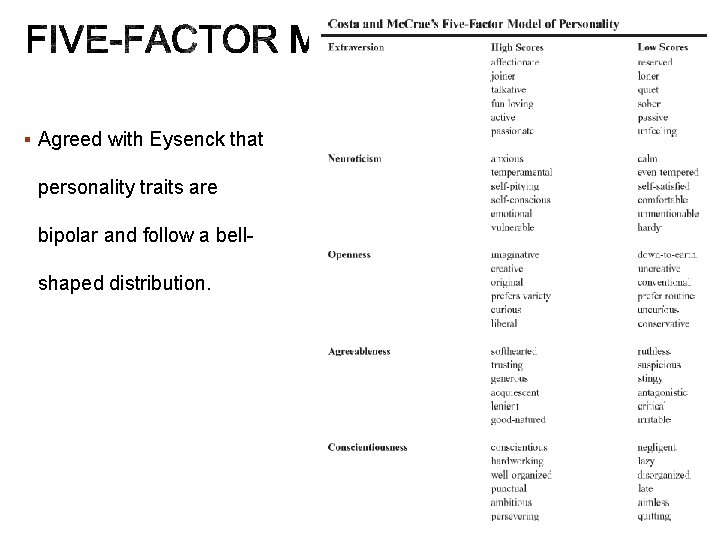
§ Agreed with Eysenck that personality traits are bipolar and follow a bellshaped distribution.
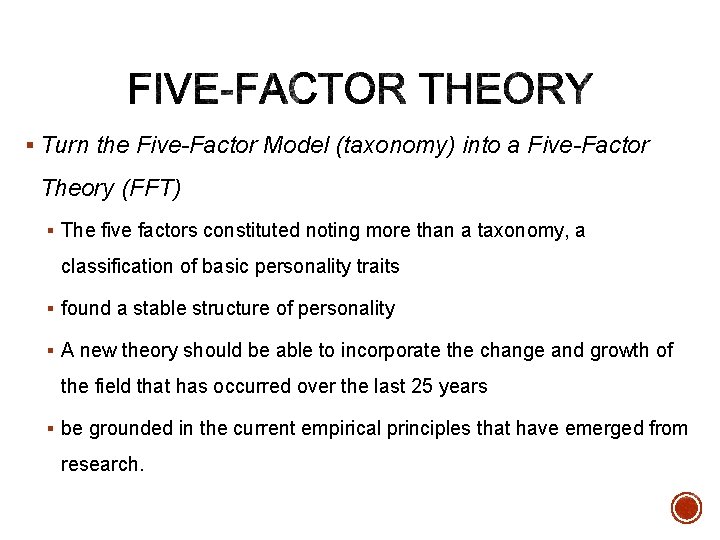
§ Turn the Five-Factor Model (taxonomy) into a Five-Factor Theory (FFT) § The five factors constituted noting more than a taxonomy, a classification of basic personality traits § found a stable structure of personality § A new theory should be able to incorporate the change and growth of the field that has occurred over the last 25 years § be grounded in the current empirical principles that have emerged from research.
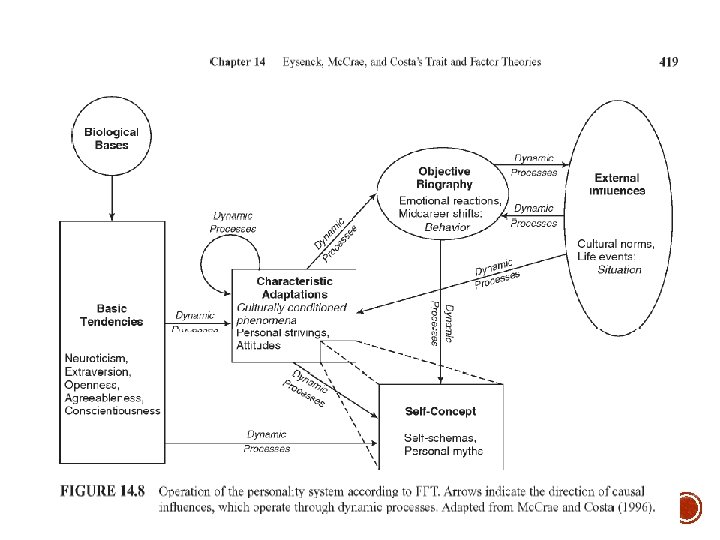
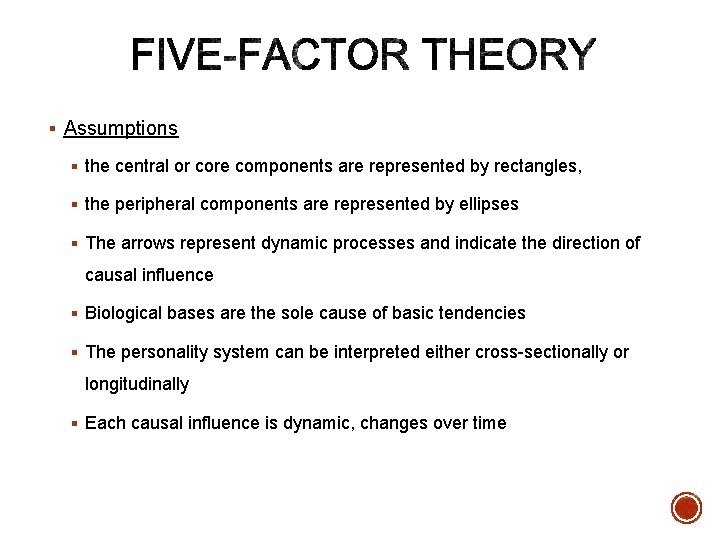
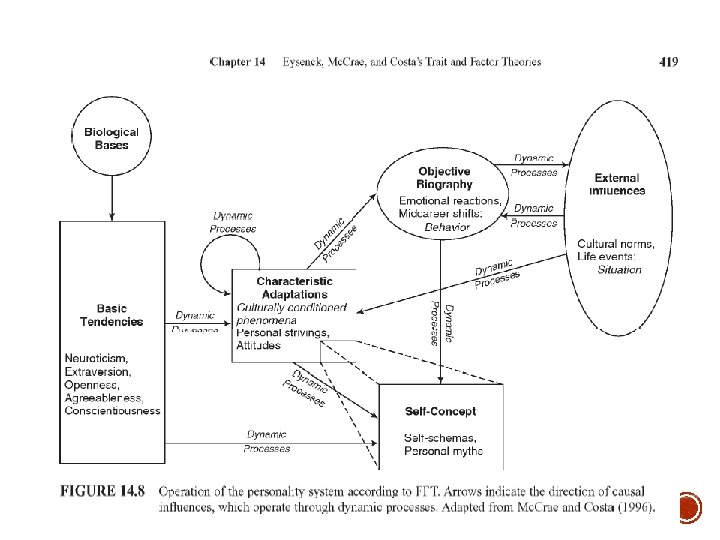
§ Assumptions § the central or core components are represented by rectangles, § the peripheral components are represented by ellipses § The arrows represent dynamic processes and indicate the direction of causal influence § Biological bases are the sole cause of basic tendencies § The personality system can be interpreted either cross-sectionally or longitudinally § Each causal influence is dynamic, changes over time
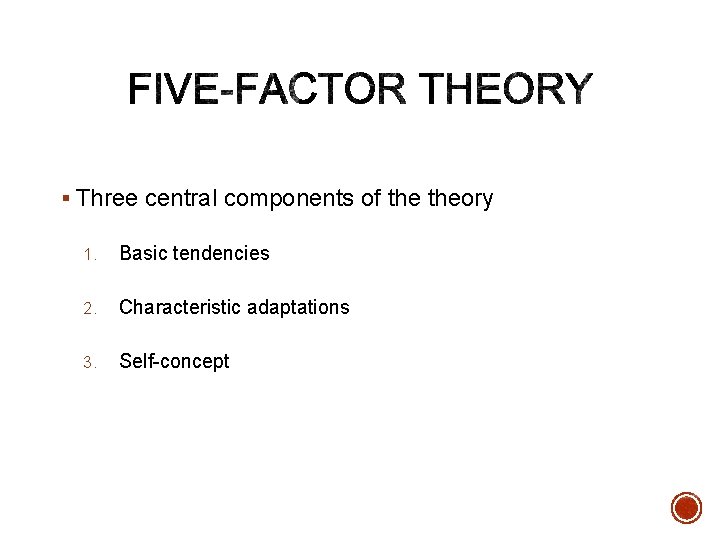
§ Three central components of theory 1. Basic tendencies 2. Characteristic adaptations 3. Self-concept
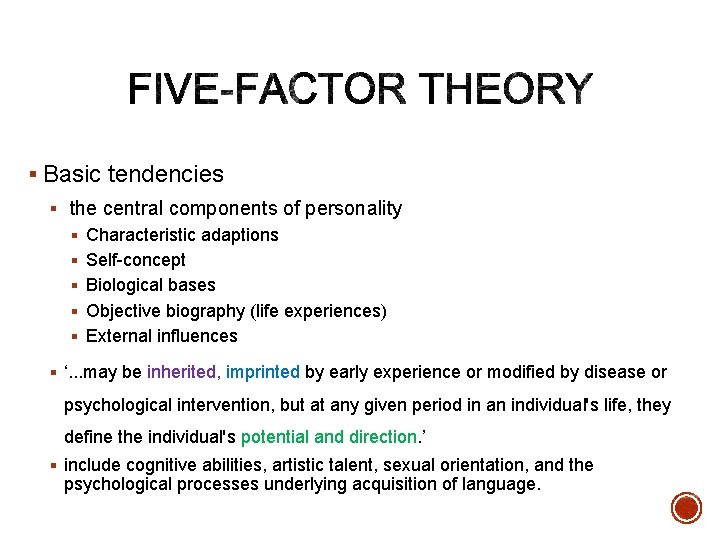
§ Basic tendencies § the central components of personality § Characteristic adaptions § Self-concept § Biological bases § Objective biography (life experiences) § External influences § ‘. . . may be inherited, imprinted by early experience or modified by disease or psychological intervention, but at any given period in an individual's life, they define the individual's potential and direction. ’ § include cognitive abilities, artistic talent, sexual orientation, and the psychological processes underlying acquisition of language.
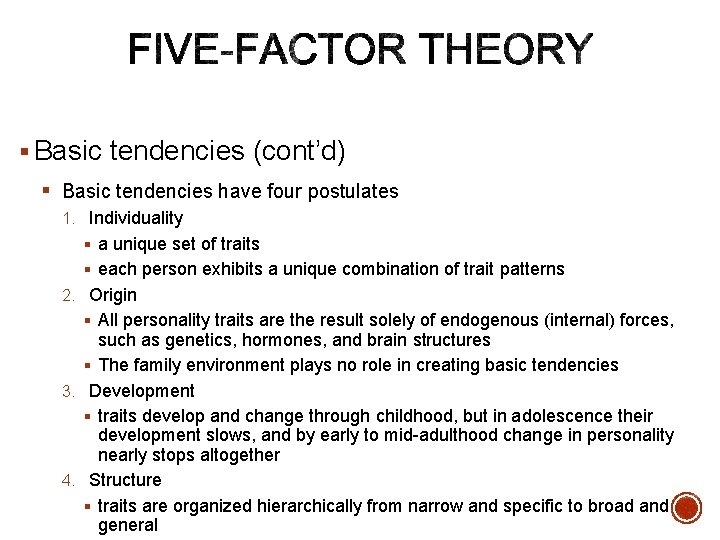
§ Basic tendencies (cont’d) § Basic tendencies have four postulates 1. Individuality § a unique set of traits § each person exhibits a unique combination of trait patterns 2. Origin § All personality traits are the result solely of endogenous (internal) forces, such as genetics, hormones, and brain structures § The family environment plays no role in creating basic tendencies 3. Development § traits develop and change through childhood, but in adolescence their development slows, and by early to mid-adulthood change in personality nearly stops altogether 4. Structure § traits are organized hierarchically from narrow and specific to broad and general
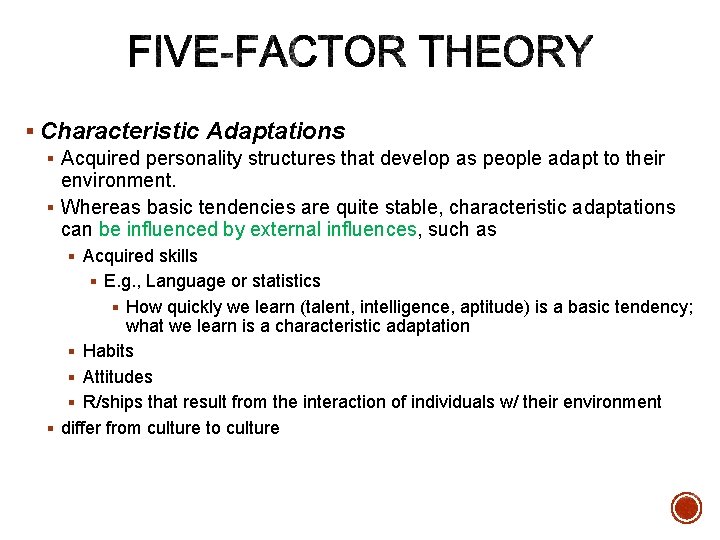
§ Characteristic Adaptations § Acquired personality structures that develop as people adapt to their environment. § Whereas basic tendencies are quite stable, characteristic adaptations can be influenced by external influences, such as § Acquired skills § E. g. , Language or statistics § How quickly we learn (talent, intelligence, aptitude) is a basic tendency; what we learn is a characteristic adaptation § Habits § Attitudes § R/ships that result from the interaction of individuals w/ their environment § differ from culture to culture
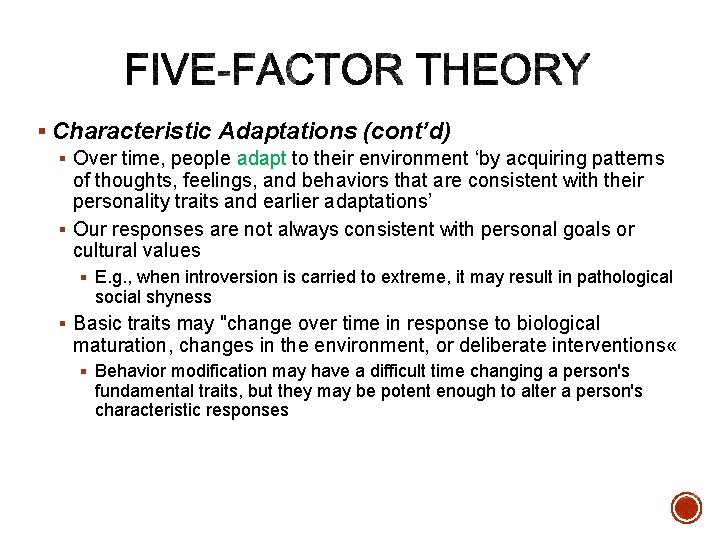
§ Characteristic Adaptations (cont’d) § Over time, people adapt to their environment ‘by acquiring patterns of thoughts, feelings, and behaviors that are consistent with their personality traits and earlier adaptations’ § Our responses are not always consistent with personal goals or cultural values § E. g. , when introversion is carried to extreme, it may result in pathological social shyness § Basic traits may "change over time in response to biological maturation, changes in the environment, or deliberate interventions « § Behavior modification may have a difficult time changing a person's fundamental traits, but they may be potent enough to alter a person's characteristic responses
§ Self-concept is actually a characteristic adaptation, but it gets its own box because it is such an important adaptation. § ‘consists of knowledge, views, and evaluations of the self. . . ’ § The beliefs, attitudes, and feelings one has toward oneself § Personal myths
§ Peripheral Components § 3 peripheral components § Biological bases § Objective biography § External influences
§ Biological bases § The Five-Factor Theory rests on a single causal influence on personality traits, namely biology § Environment has no direct influence on basic tendencies
§ Objective Biography § ‘Everything the person does, thinks, or feels across the whole lifespan’ § What has happened in people's lives (events & experiences) (objective) rather than their view or perceptions of their experiences (subjective)
§ External Influences § How we respond to the opportunities and demands of physical or social situations § These responses are a function of two things: 1. Characteristic adaptations 2. Their interaction w/ external influences
§ Course book § Gençöz, T. , & Öncül, Ö. (2012). Examination of Personality Characteristics in a Turkish Sample: Development of Basic Personality Traits Inventory. The Journal of general psychology, 139(3), 194 -216.