
MAKING FORMAL METHODS WORK IN INDUSTRIAL P RACTICE

- Slides: 60
MAKING FORMAL METHODS WORK IN INDUSTRIAL P RACTICE Jyotirmoy V. Deshmukh Joint work with: Xiaoqing Jin Jim Kapinski Hisahiro Ito Ken Butts Sriram S. Aditya Zutshi Alexandre Donzé Sanjit A. Seshia Nikos Arechiga Paulo Tabuada Ayca Balkan
You might ask… What’s the problem? Do you have any solutions? Why don’t formal methods “just work? ” What is it mathematically and scientifically hard? How do you manage to get paid? Cool, what’s in it for me? I have a hammer, do you have nails? 2/60
Verification & Validation for Automotive Control Systems THE PROBLEM
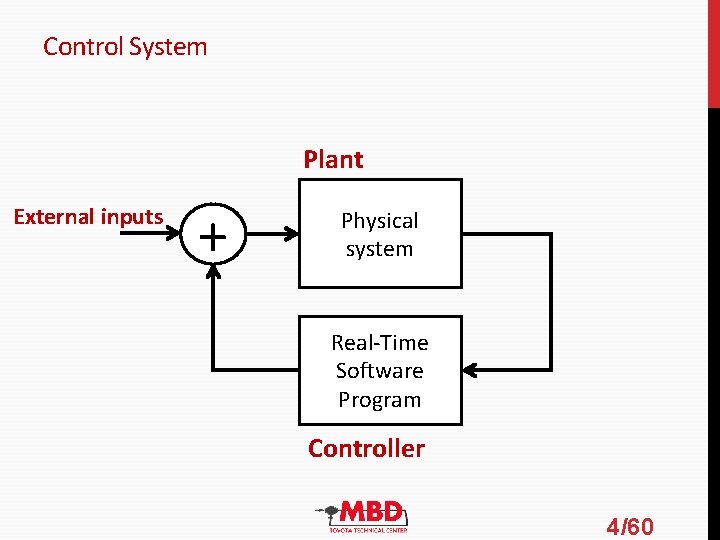
Control System Plant External inputs + Physical system Real-Time Software Program Controller 4/60
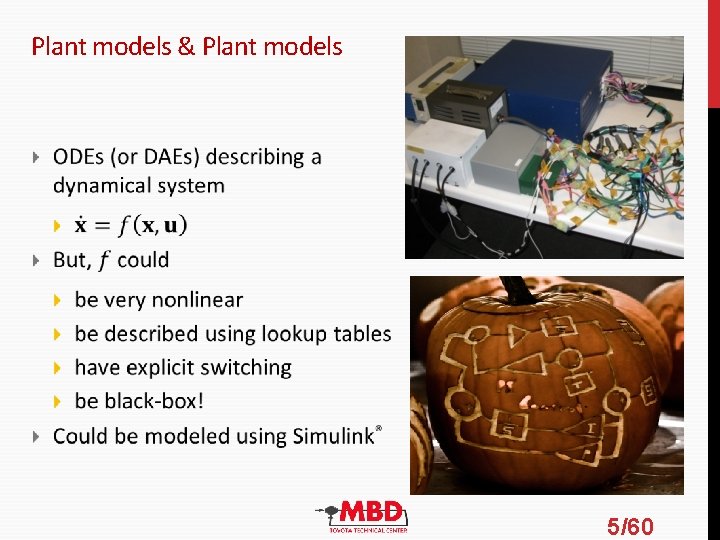
Plant models & Plant models 5/60
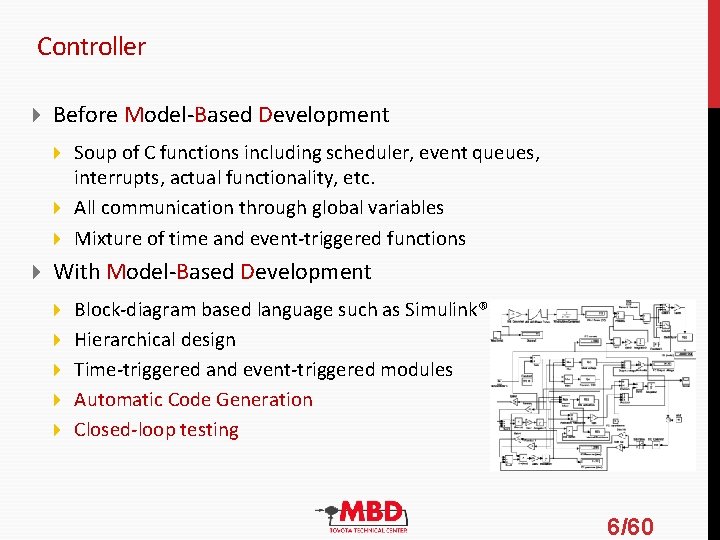
Controller Before Model-Based Development Soup of C functions including scheduler, event queues, interrupts, actual functionality, etc. All communication through global variables Mixture of time and event-triggered functions With Model-Based Development Block-diagram based language such as Simulink® Hierarchical design Time-triggered and event-triggered modules Automatic Code Generation Closed-loop testing 6/60
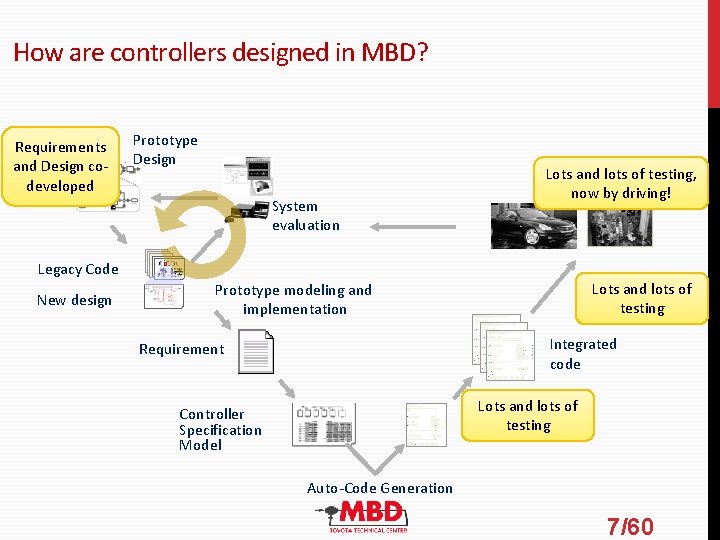
How are controllers designed in MBD? Requirements and Design codeveloped Prototype Design System evaluation Lots and lots of testing, now by driving! Legacy Code New design Lots and lots of testing Prototype modeling and implementation Integrated code Requirement Lots and lots of testing Controller Specification Model Auto-Code Generation 7/60
V&V Problem Spectrum: 1 8/60
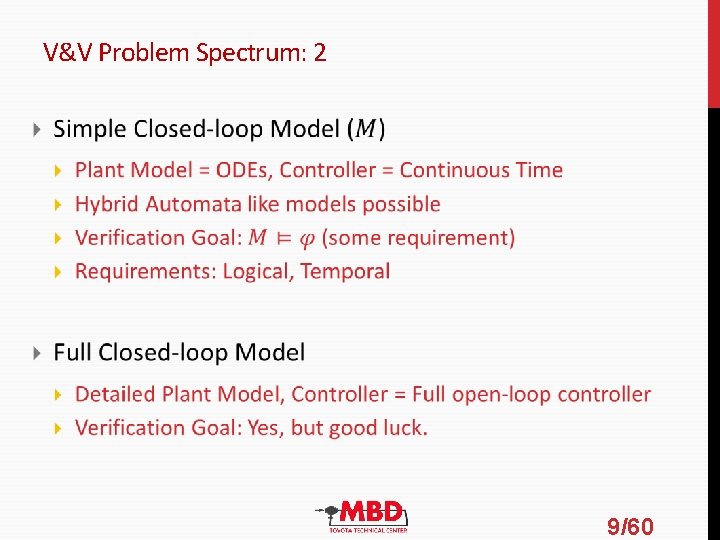
V&V Problem Spectrum: 2 9/60
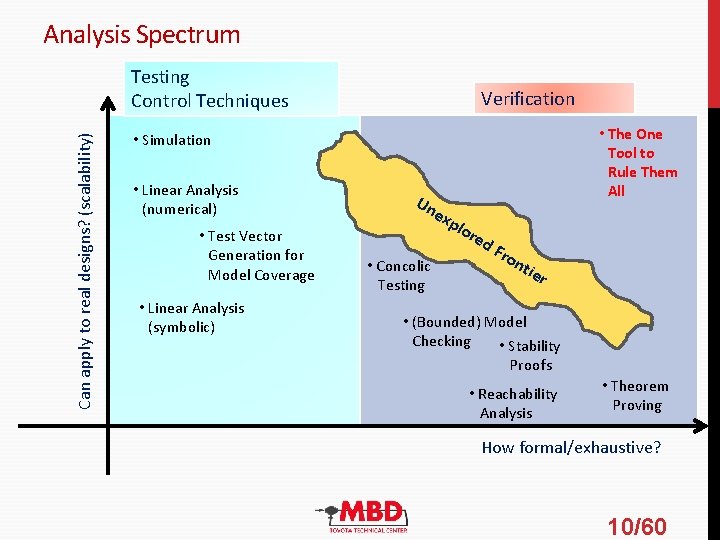
Analysis Spectrum Can apply to real designs? (scalability) Testing Control Techniques Verification • The One Tool to Rule Them All • Simulation • Linear Analysis (numerical) • Test Vector Generation for Model Coverage • Linear Analysis (symbolic) Un ex • Concolic Testing plo red Fr on tie r • (Bounded) Model Checking • Stability Proofs • Reachability Analysis • Theorem Proving How formal/exhaustive? 10/60
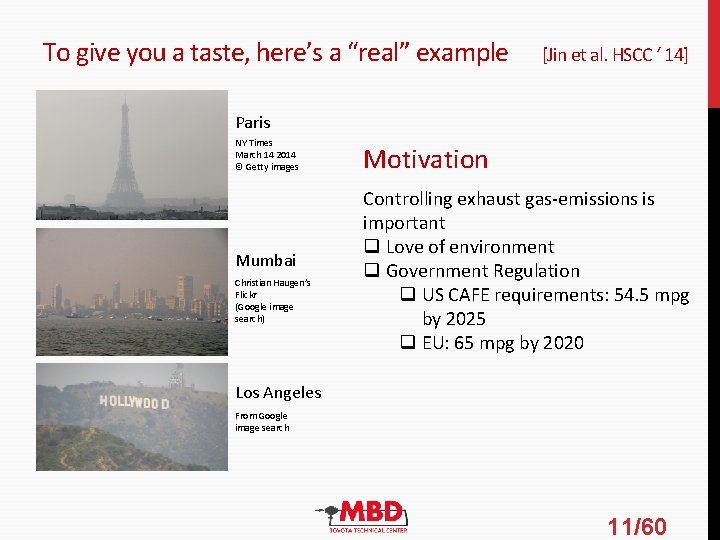
To give you a taste, here’s a “real” example [Jin et al. HSCC ‘ 14] Paris NY Times March 14 2014 © Getty images Mumbai Christian Haugen’s Flickr (Google image search) Motivation Controlling exhaust gas-emissions is important q Love of environment q Government Regulation q US CAFE requirements: 54. 5 mpg by 2025 q EU: 65 mpg by 2020 Los Angeles From Google image search 11/60
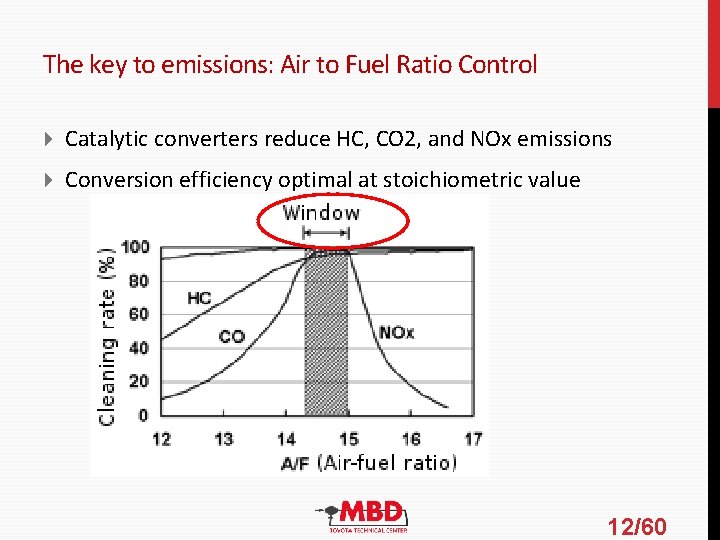
The key to emissions: Air to Fuel Ratio Control Catalytic converters reduce HC, CO 2, and NOx emissions Conversion efficiency optimal at stoichiometric value 12/60
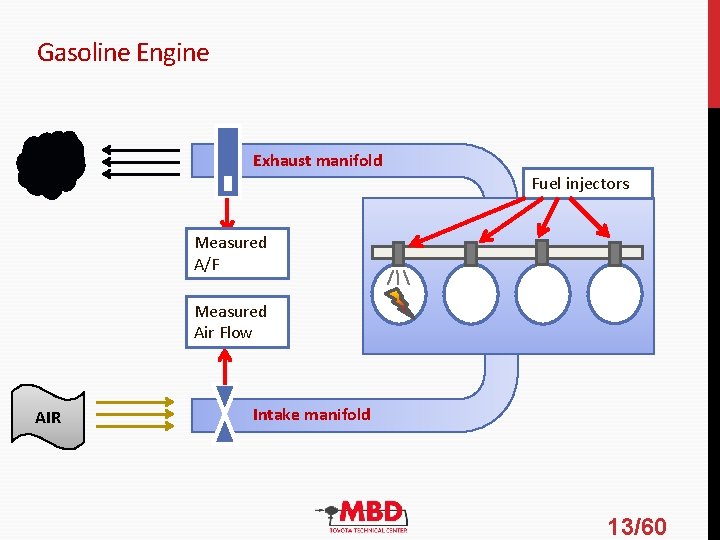
Gasoline Engine Exhaust manifold Fuel injectors Measured A/F Measured Air Flow AIR Intake manifold 13/60
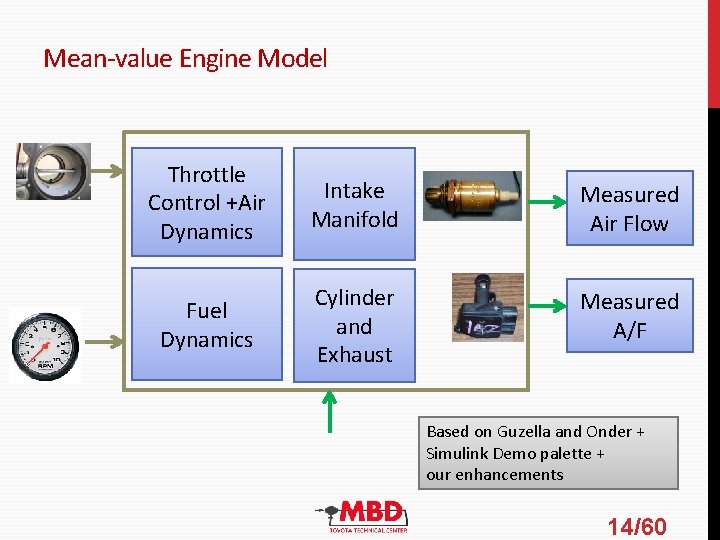
Mean-value Engine Model Throttle Control +Air Dynamics Intake Manifold Measured Air Flow Fuel Dynamics Cylinder and Exhaust Measured A/F Based on Guzella and Onder + Simulink Demo palette + our enhancements 14/60
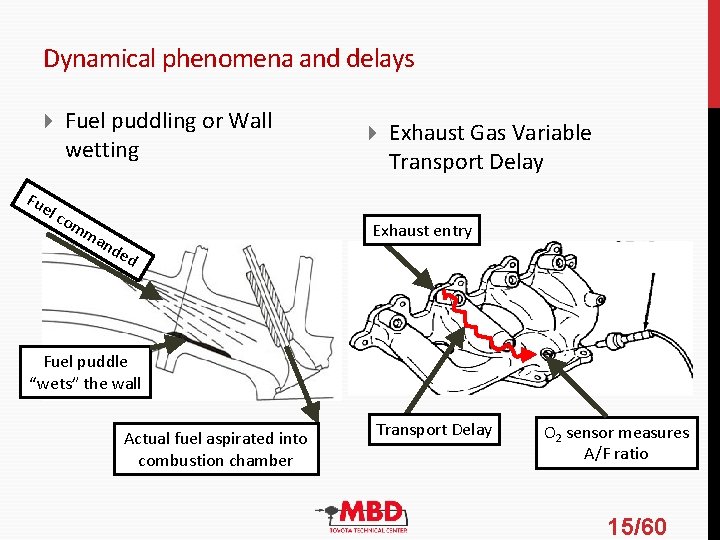
Dynamical phenomena and delays Fuel puddling or Wall wetting Exhaust Gas Variable Transport Delay Fu el c o mm an de d Exhaust entry Fuel puddle “wets” the wall Actual fuel aspirated into combustion chamber Transport Delay O 2 sensor measures A/F ratio 15/60
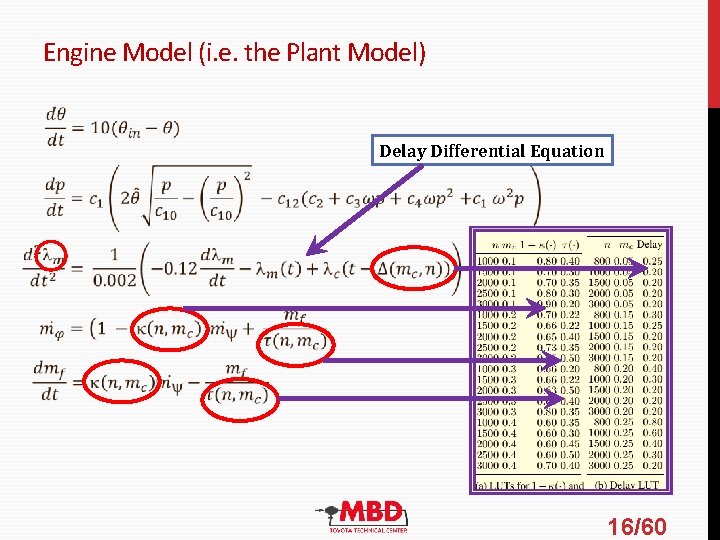
Engine Model (i. e. the Plant Model) Delay Differential Equation 16/60
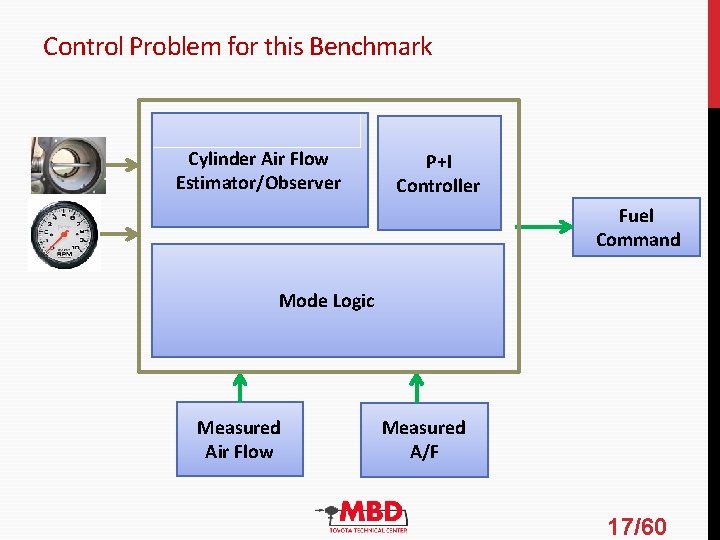
Control Problem for this Benchmark Cylinder Air Flow Estimator/Observer P+I Controller Fuel Command Mode Logic Measured Air Flow Measured A/F 17/60
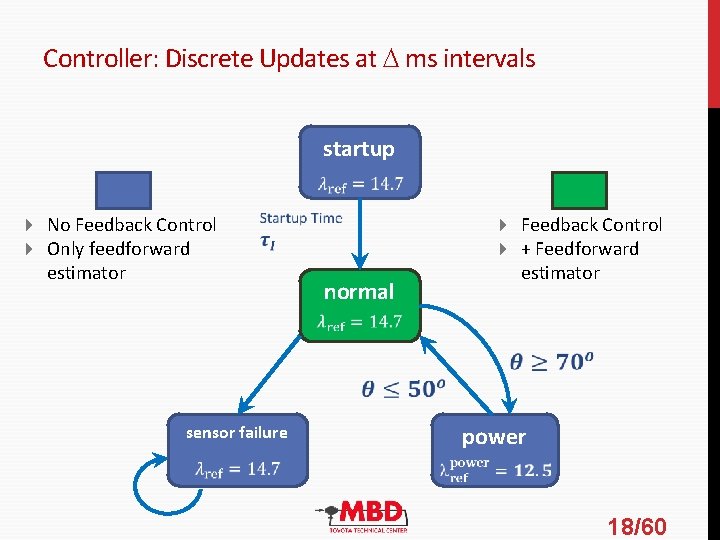
Controller: Discrete Updates at ms intervals startup No Feedback Control Only feedforward estimator normal Feedback Control + Feedforward estimator power sensor failure 18/60
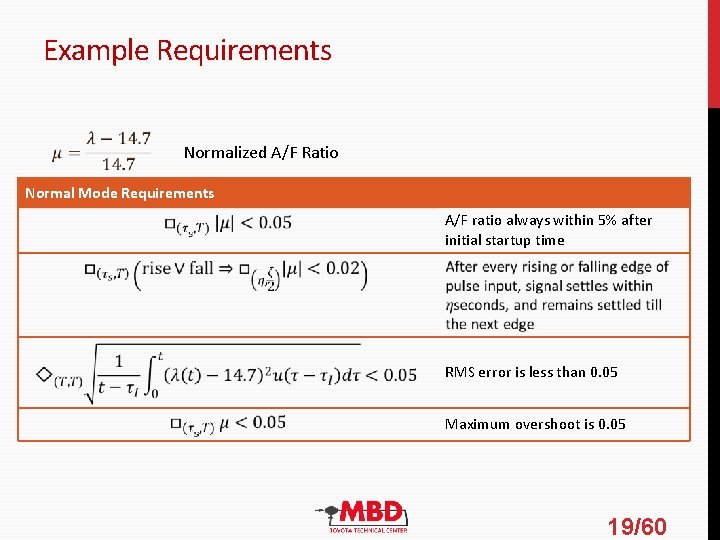
Example Requirements Normalized A/F Ratio Normal Mode Requirements A/F ratio always within 5% after initial startup time RMS error is less than 0. 05 Maximum overshoot is 0. 05 19/60
The Challenge Existing techniques cannot handle this “real” example We have a simplified version to make it amenable to formal methods But existing techniques may still struggle with the simplified version But this example is much simpler than a really real example! How can we verify or analyze such a model? What hope do we have? 20/60
Simulation-Guided Formal Analysis THE SOLUTION (tentative)
Help design validation Provide visual feedback Can uncover bugs Do not require knowledge of: Temporal Logic, SAT modulo theories, Bounded Model Checking; not even Hoare logic, Turing machines or Lambda-calculus! Simulations are cheap and usually fast Test-suites can be shared and built up across models 22/60
Simulation-Guided Formal Analysis: What it’s not Is not a new algorithm that magically solves all problems Is not a silver bullet for undecidable problems May not guarantee Soundness Completeness Termination Optimality a new label for “simulate till you find a bug and declare success, otherwise keep trying. ” 23/60
Simulation-Guided Formal Analysis: What it is A strategy A data-driven approach Makes some assumptions : Traces easy to obtain and plentiful (almost always true) Traces can be used to learn higher-level concepts Can do guided search for simulations that refute learnt concepts 24/60
Some approaches we have tried Mining temporal requirements for closed-loop models Learning Lyapunov functions of nonlinear & hybrid systems Learning contraction metrics for nonlinear systems 25/60
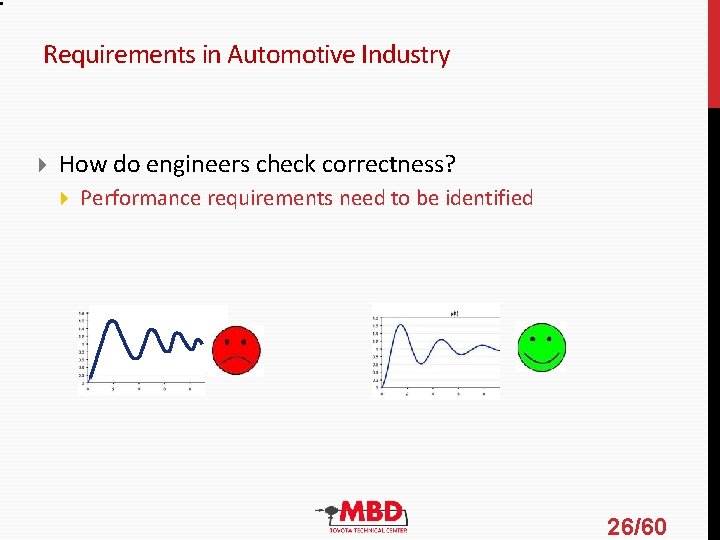
Requirements in Automotive Industry How do engineers check correctness? Performance requirements need to be identified 26/60
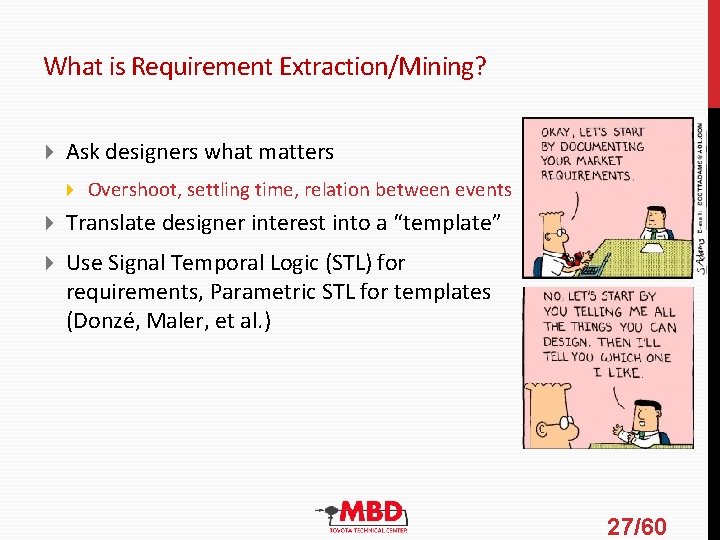
What is Requirement Extraction/Mining? Ask designers what matters Overshoot, settling time, relation between events Translate designer interest into a “template” Use Signal Temporal Logic (STL) for requirements, Parametric STL for templates (Donzé, Maler, et al. ) 27/60
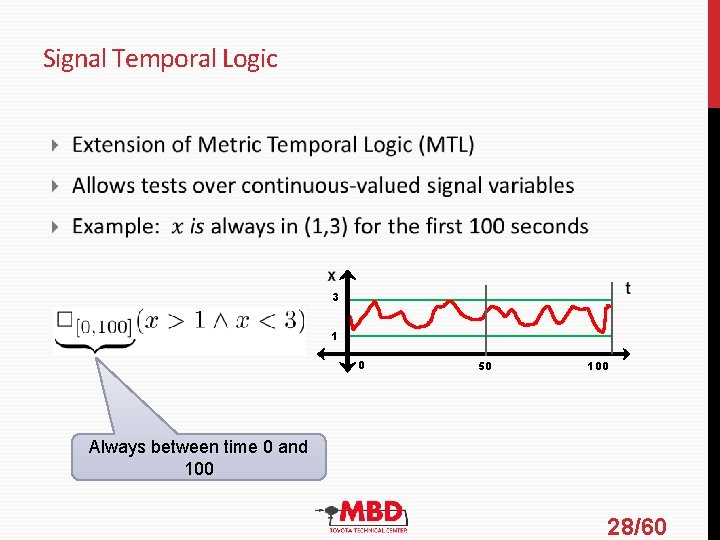
Signal Temporal Logic 3 1 0 50 100 Always between time 0 and 100 28/60
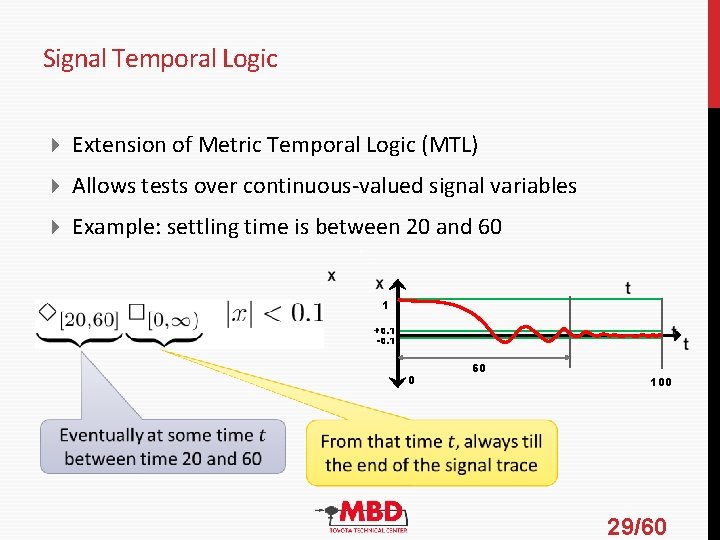
Signal Temporal Logic Extension of Metric Temporal Logic (MTL) Allows tests over continuous-valued signal variables Example: settling time is between 20 and 60 1 +0. 1 -0. 1 0 60 100 29/60
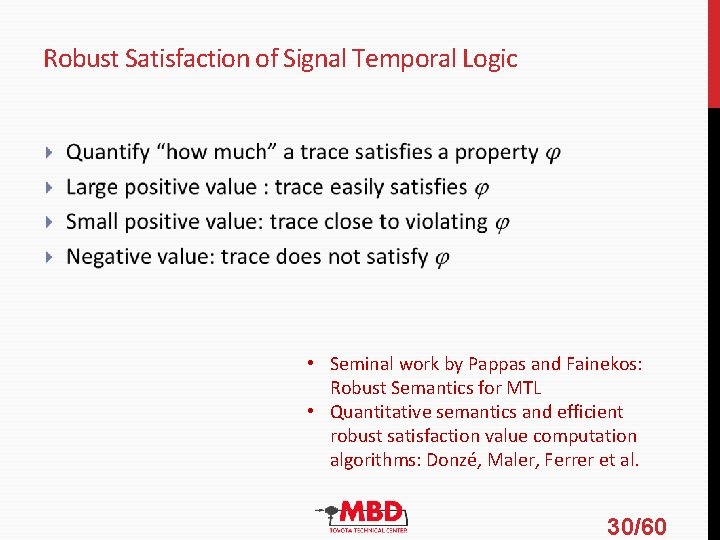
Robust Satisfaction of Signal Temporal Logic • Seminal work by Pappas and Fainekos: Robust Semantics for MTL • Quantitative semantics and efficient robust satisfaction value computation algorithms: Donzé, Maler, Ferrer et al. 30/60
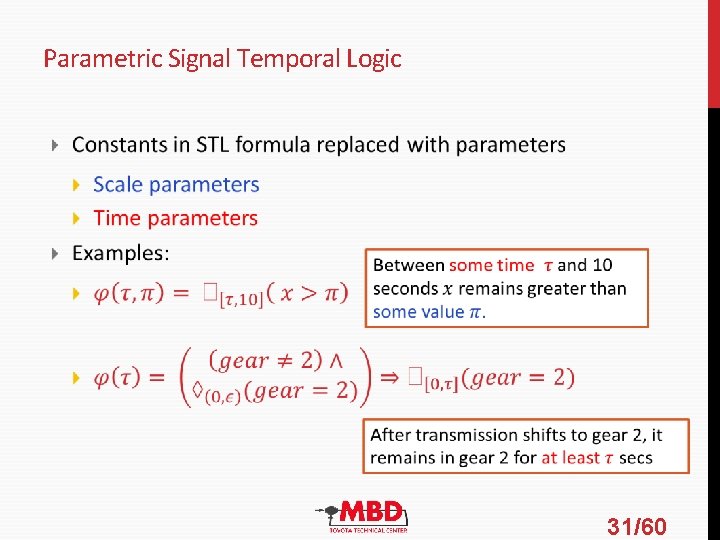
Parametric Signal Temporal Logic 31/60
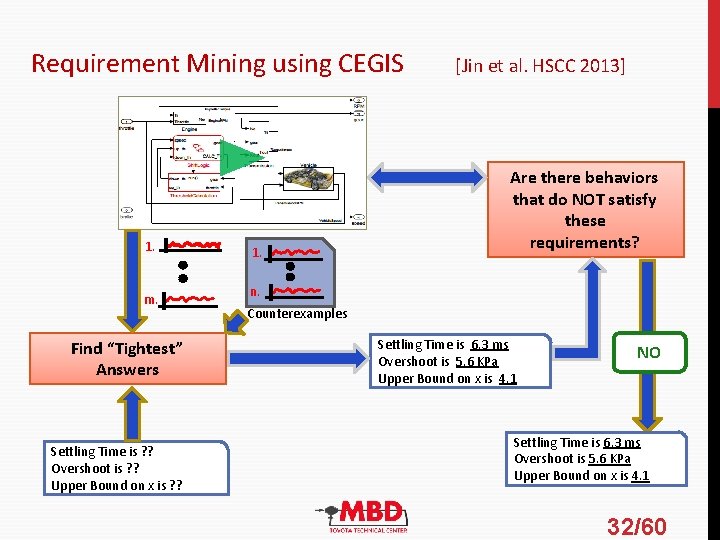
Requirement Mining using CEGIS [Jin et al. HSCC 2013] 1. m. Find “Tightest” Answers Settling Time is ? ? Overshoot is ? ? Upper Bound on x is ? ? 1. Are there behaviors that do NOT satisfy these requirements? n. Counterexamples Settling Time is 6. 3 ms Overshoot is 5. 6 KPa Upper Bound on x is 4. 1 NO Settling Time is 6. 3 ms Overshoot is 5. 6 KPa Upper Bound on x is 4. 1 32/60
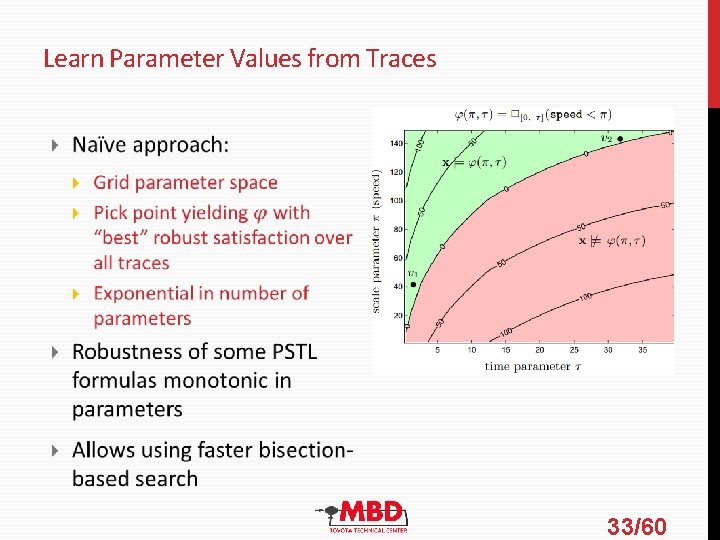
Learn Parameter Values from Traces 33/60
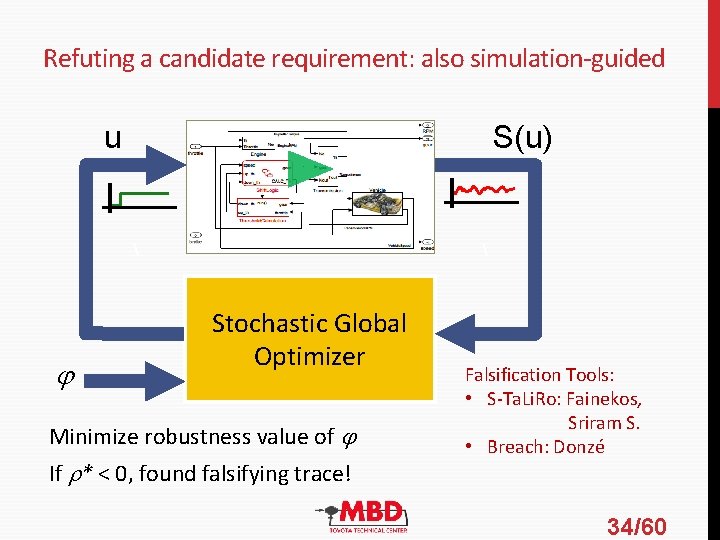
Refuting a candidate requirement: also simulation-guided u S(u) Stochastic Global Optimizer Minimize robustness value of If * < 0, found falsifying trace! Falsification Tools: • S-Ta. Li. Ro: Fainekos, Sriram S. • Breach: Donzé 34/60
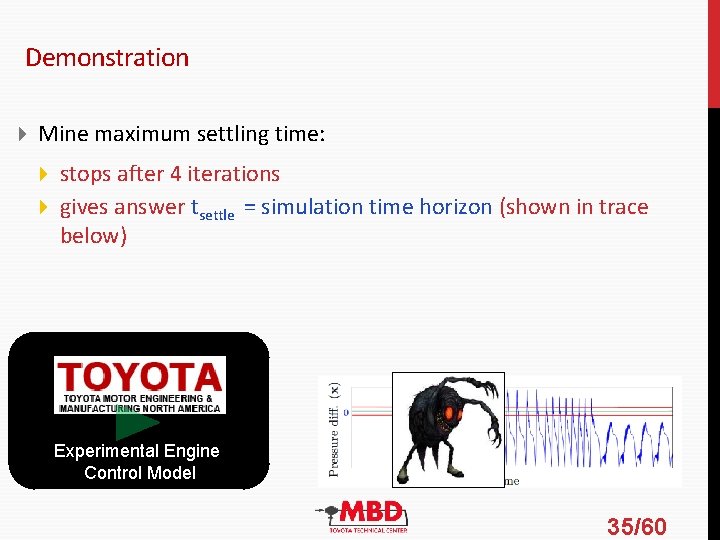
Demonstration Mine maximum settling time: stops after 4 iterations gives answer tsettle = simulation time horizon (shown in trace below) Experimental Engine Control Model 35/60
Finding Lyapunov Functions With my direct method you can: 1. Prove stability 2. Prove setinvariance 3. Prove safety 36/60
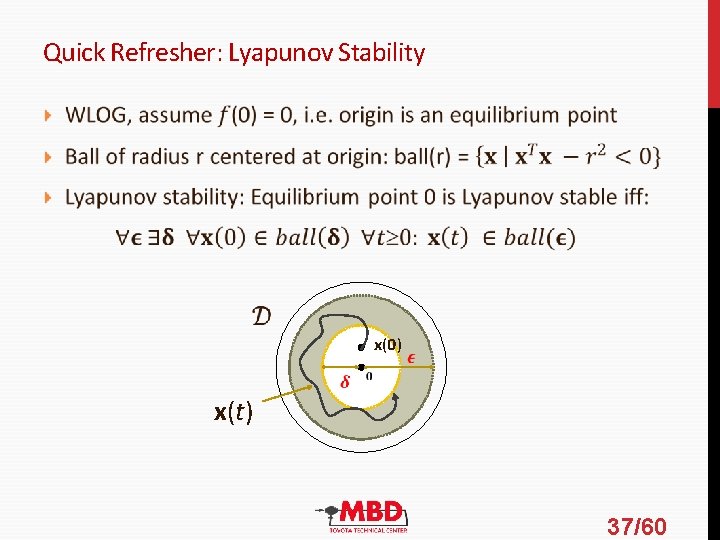
Quick Refresher: Lyapunov Stability x(0) x(t) 37/60
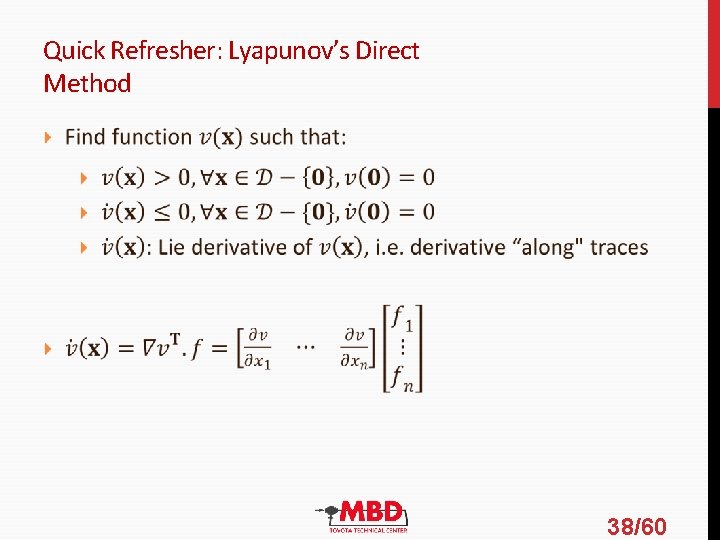
Quick Refresher: Lyapunov’s Direct Method 38/60
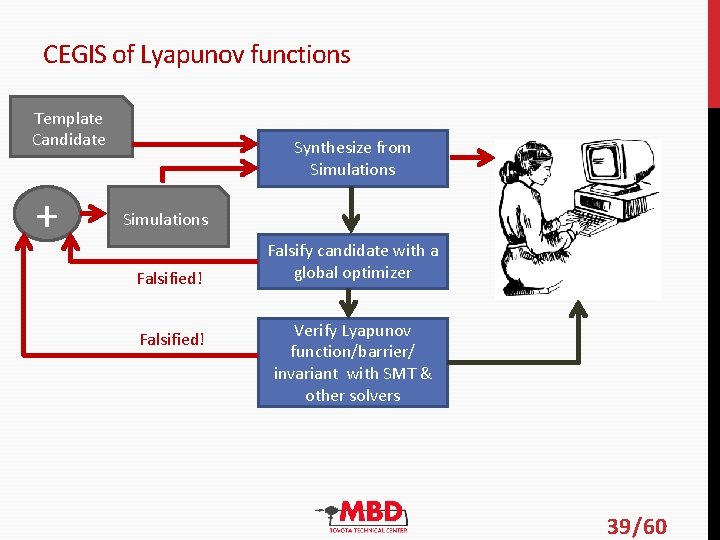
CEGIS of Lyapunov functions Template Candidate + Synthesize from Simulations Falsified! Falsify candidate with a global optimizer Verify Lyapunov function/barrier/ invariant with SMT & other solvers 39/60
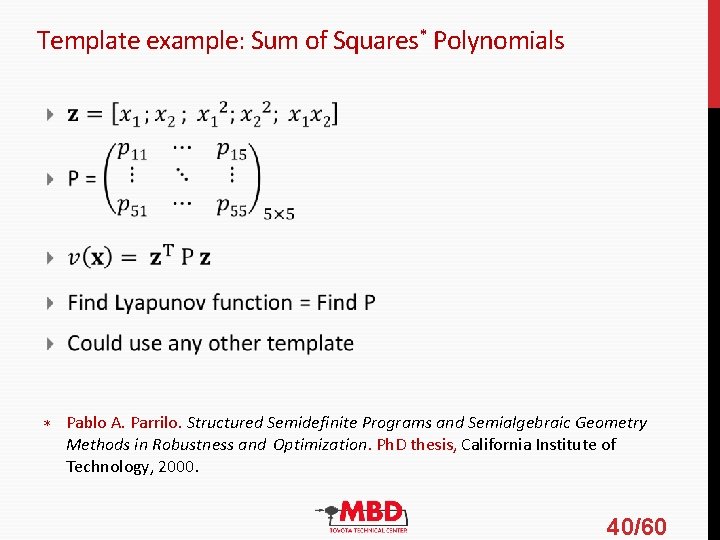
Template example: Sum of Squares* Polynomials ∗ Pablo A. Parrilo. Structured Semidefinite Programs and Semialgebraic Geometry Methods in Robustness and Optimization. Ph. D thesis, California Institute of Technology, 2000. 40/60
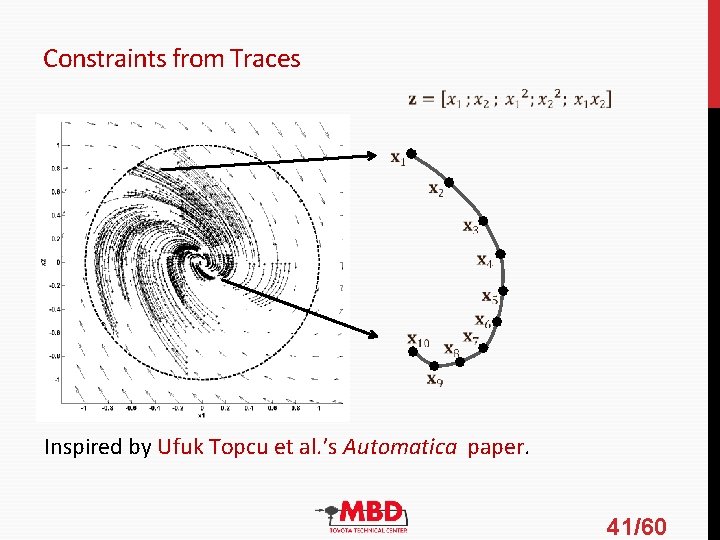
Constraints from Traces Inspired by Ufuk Topcu et al. ’s Automatica paper. 41/60
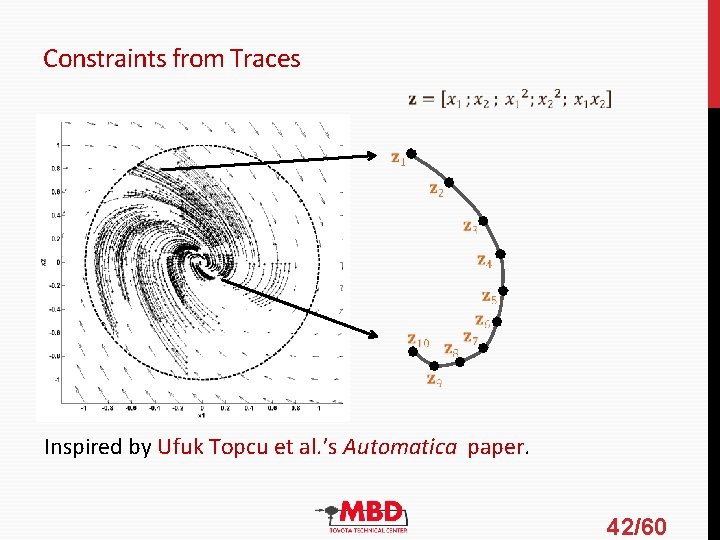
Constraints from Traces Inspired by Ufuk Topcu et al. ’s Automatica paper. 42/60
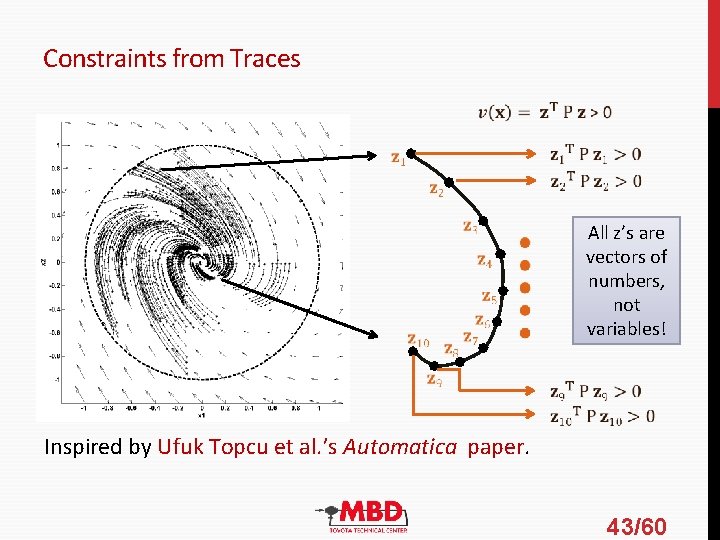
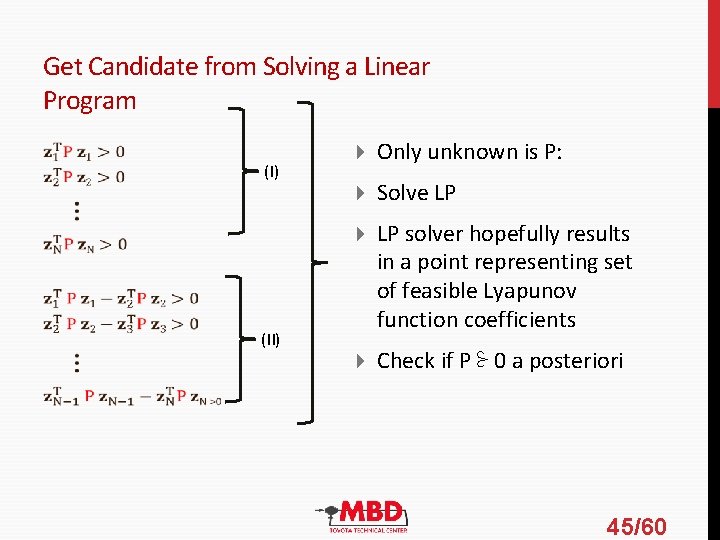
Constraints from Traces All z’s are vectors of numbers, not variables! Inspired by Ufuk Topcu et al. ’s Automatica paper. 43/60
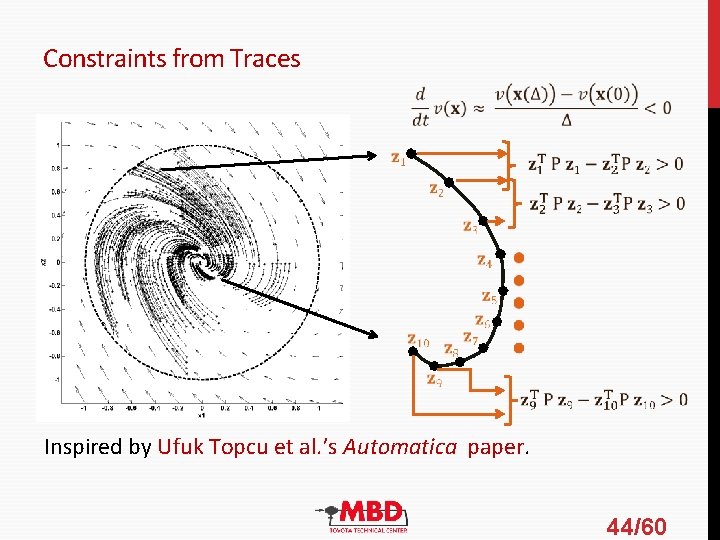
Constraints from Traces Inspired by Ufuk Topcu et al. ’s Automatica paper. 44/60
Get Candidate from Solving a Linear Program (I) Only unknown is P: Solve LP LP solver hopefully results in a point representing set of feasible Lyapunov function coefficients Check if P ⊱ 0 a posteriori (II) 45/60
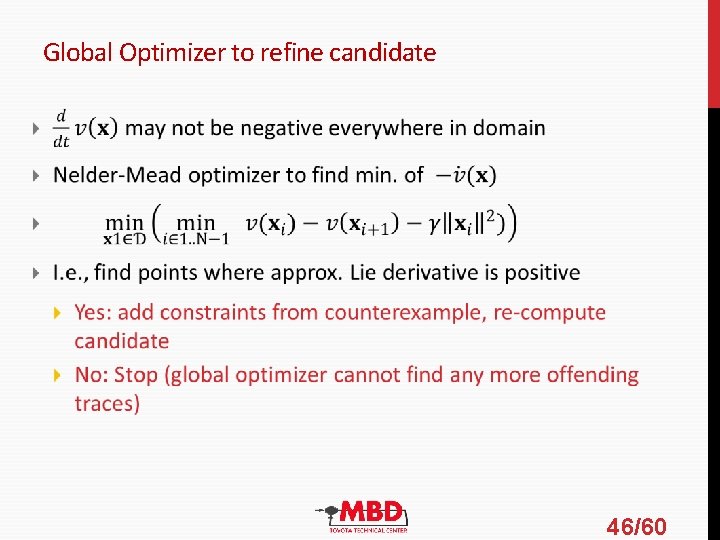
Global Optimizer to refine candidate 46/60
Are we done? No! Global optimizer is not exhaustive Know dynamics? Yes, then use: Nonlinear SMT solvers Algebraic solvers d. Real, i. SAT z 3 Mathematica QEPCAD Meti. Tarski Don’t know dynamics? Can still use sample and test under some conditions 47/60
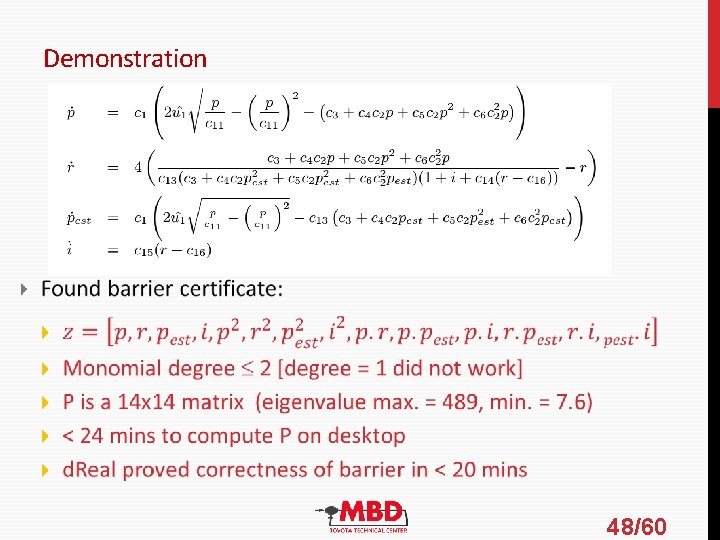
Demonstration 48/60
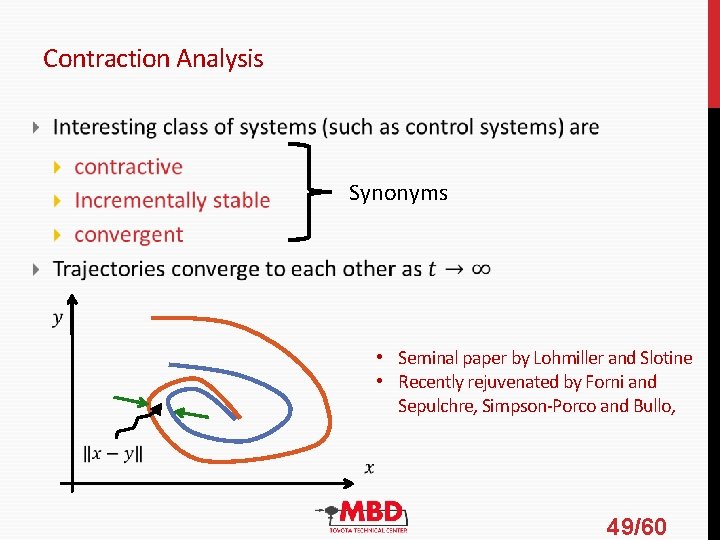
Contraction Analysis Synonyms • Seminal paper by Lohmiller and Slotine • Recently rejuvenated by Forni and Sepulchre, Simpson-Porco and Bullo, 49/60
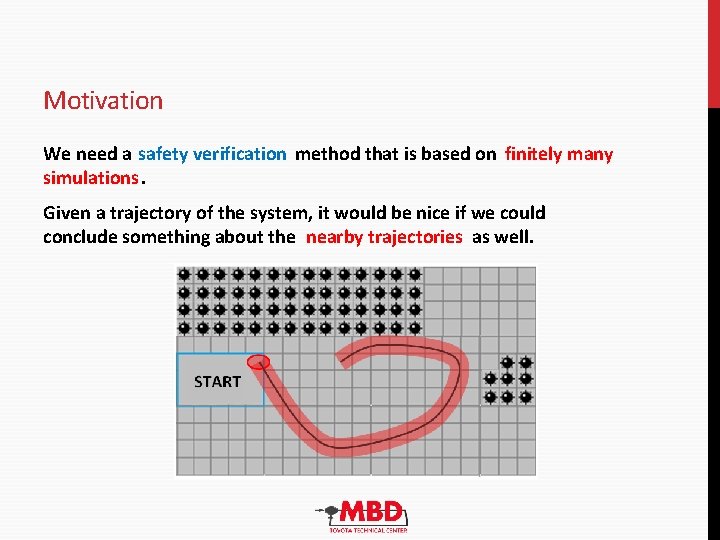
Motivation We need a safety verification method that is based on finitely many simulations. Given a trajectory of the system, it would be nice if we could conclude something about the nearby trajectories as well.
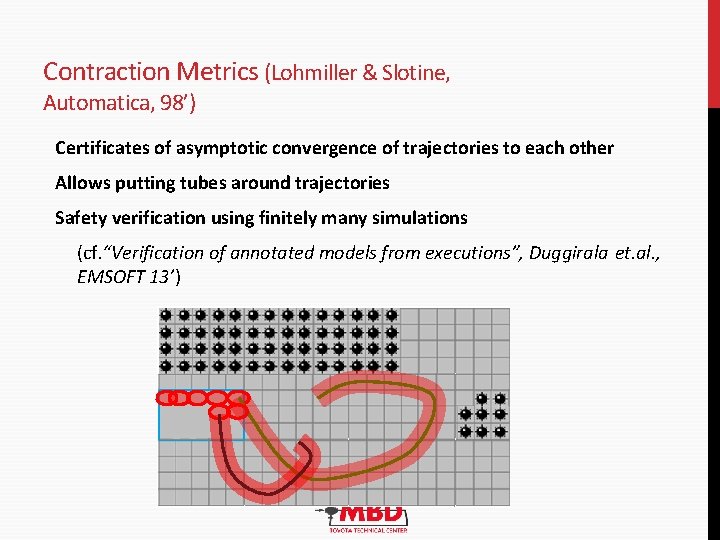
Contraction Metrics (Lohmiller & Slotine, Automatica, 98’) Certificates of asymptotic convergence of trajectories to each other Allows putting tubes around trajectories Safety verification using finitely many simulations (cf. “Verification of annotated models from executions”, Duggirala et. al. , EMSOFT 13’)
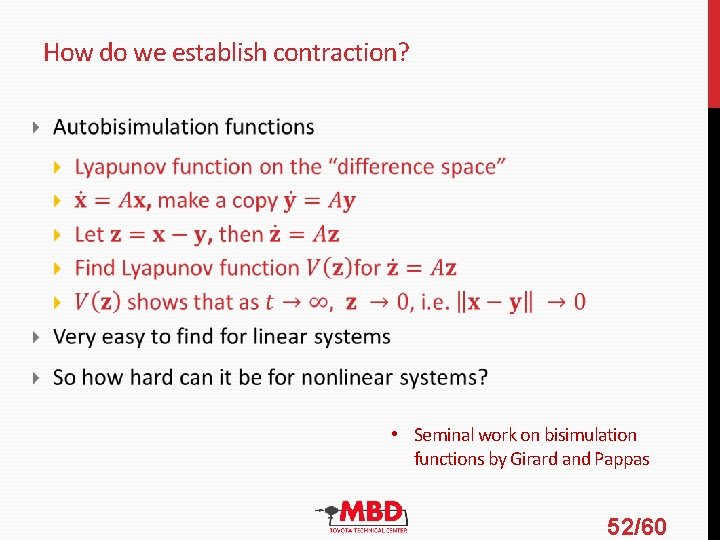
How do we establish contraction? • Seminal work on bisimulation functions by Girard and Pappas 52/60
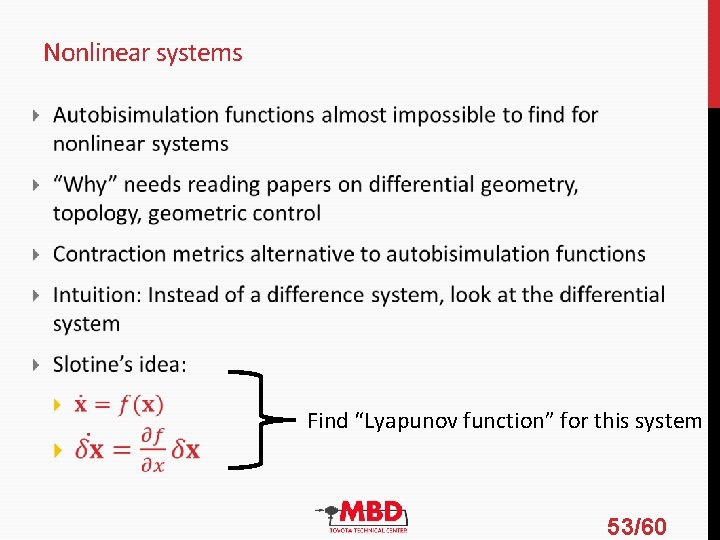
Nonlinear systems Find “Lyapunov function” for this system 53/60
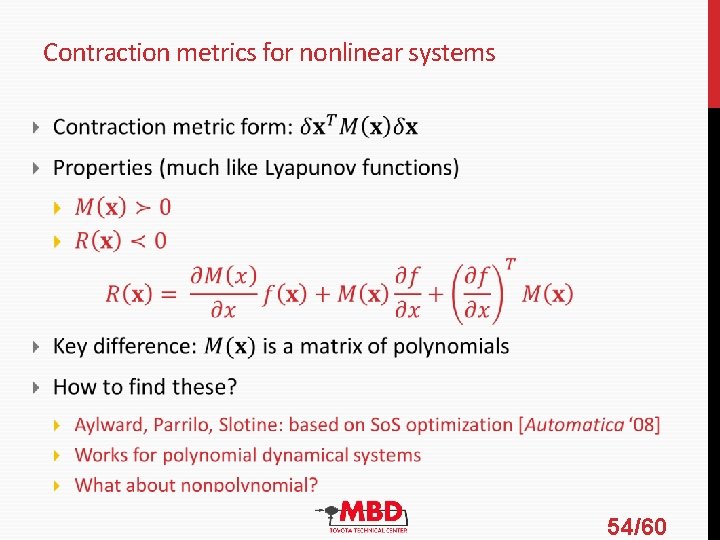
Contraction metrics for nonlinear systems 54/60
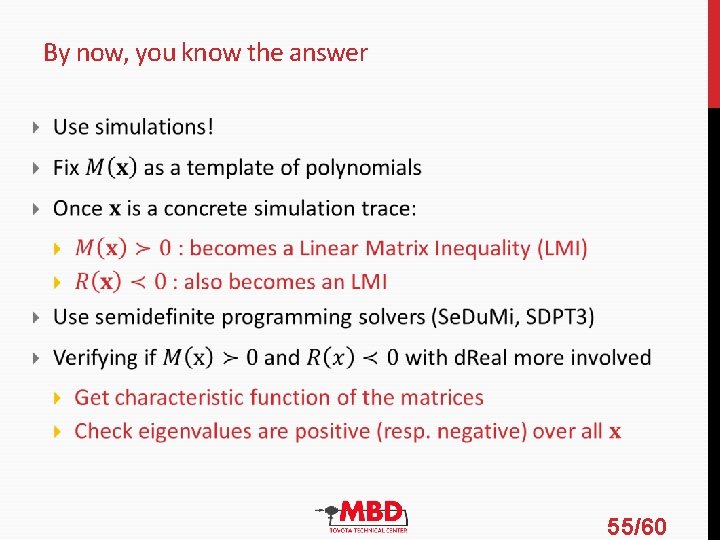
By now, you know the answer 55/60
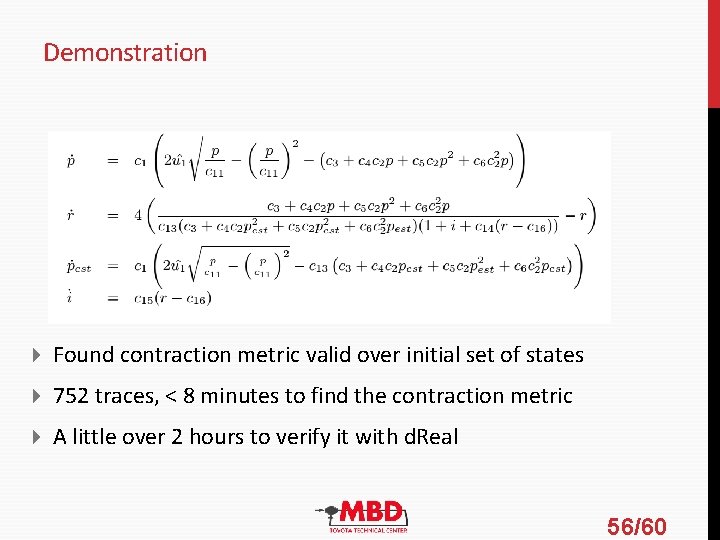
Demonstration Found contraction metric valid over initial set of states 752 traces, < 8 minutes to find the contraction metric A little over 2 hours to verify it with d. Real 56/60
What’s in it for you THE FUTURE
Explore more simulation-guided techniques Simulation-guided Formal Analysis shows a lot of promise Several future directions we are looking at: Compositional approaches for barrier certificates (collaboration with Salar Moarref, Ufuk Topcu, and Rajeev Alur) Using simulation-guided forward invariants to guide proofs of hybrid systems (collaboration with Nikos Arechiga, Bruce Krogh, Andre Platzer at CMU) Learning temporal classifiers from traces Simulation-guided conformance/equivalence checking (collaboration with Rupak Majumdar, Georgios Fainekos) Can you use Si. GFA for your work? 58/60
Beyond Si. GFA: Challenge problems Abstractions with formal guarantees Abstract system: satisfies same temporal requirements has similar transient behavior converges to original system asymptotically is stability-preserving is an over-approximation Reachable set estimation Polynomial & Nonpolynomial dynamics Delay Differential Equations Lookup Tables 59/60
Thank you! Questions? 60/60