AS OF 4 172018 Criminal Law Overview Prof
- Slides: 118
AS OF 4/ 17/2018 Criminal Law Overview: Prof. Hoffmeister 1
MALUM IN SE AND MALUM PROHIBITUM Malum in se (wrong in itself) Inherently evil Malum Prohibitum Only wrong because it is prohibited by legislation 2
PRINCIPLES OF PUNISHMENT General purposes of punishment of crime Restraint Rehabilitation Deterrence Education Retribution 3
RETRIBUTIVE AND UTILITARIAN Theories for punishment Retributive Punishment is justified because people deserve it. Tends to be backward looking. Seeks to justify punishment on the basis of the offender’s past behavior. Utilitarian Believes that justification lies in the useful purposes that punishment seeks. Tend to be forward looking. Seek to justify punishment on the basis of the good consequence it is expected to produce in the future. 4
CONSTITUTIONAL PRINCIPLES Burden of Proof Void for Vagueness Status Crimes Ex Post Facto Bills of Attainder 5
BURDEN OF PROOF Burden of Proof Government must prove each and every element of the crime (In re Winship) with proof beyond a reasonable doubt Defendant may have to prove all affirmative defenses Standard lower than proof beyond a reasonable doubt (clear and convincing or preponderance of the evidence) 6
VOID FOR VAGUENESS A Criminal statute can run afoul of the Due Process Clause of the 5 th and 14 th Amendments and be deemed unconstitutional if it Lacks Fair Warning to the D A statute must give a person of ordinary intelligence fair notice that his conduct is forbidden (U. S. v. Drew) Allows for Arbitrary and Discriminatory Enforcement (In re D. B. ) 7
STATUS CRIMES Robinson v. California FACTS: CA statute 11721 says you can’t “be addicted to the use of narcotics. ” Police found physical signs of drug use on D’s arm and he admitted to using drugs. The judge told the jury that the D could be convicted if he used drugs in LA County or was addicted to drugs while in the city of LA. HOLDING: Statute is unconstitutional. Can’t punish for an illness or for just being addicted to drugs while in the state. D’s conviction violates the 8 th Amendment. 8
STATUS CRIMES Powell v. Texas FACTS: D, a chronic alcoholic, was convicted of TX statute 477 which prohibits being intoxicated in a public place. A psychiatrist testified that a “chronic alcoholic” is an “involuntary drinker. ” PROCEDURE: Law is constitutional. The D is not punished for alcoholism. He is punished for “being in public while drunk on a particular occasion. ” The D is also punished for offending moral and esthetic sensibilities and creating a health and safety hazard. 9
EX POST FACTO AND BILL OF ATTAINDER An Ex Post Facto law is one that Makes an act criminal that when first completed was not criminal Changes the rules of evidence Alters the law of criminal procedure A Bill of Attainder is a Statute that inflicts punishment or denies a privilege to a group or a person without a judicial trial. 10
4 REQUIREMENTS FOR A CRIME Actus Reus Proscribed Act (Guilty Act) Mens Rea Mental State (Guilty Mind) Concurrence: Actus Reus and Mens Rea exist at the same time Causation Link between the act and the harmful result (1) direct cause and (2) proximate cause 11
ACTUS REUS Actus Reus (Proscribed Act) Voluntary Reflex or convulsion does not give rise to criminal liability (Seizure example) Unconsciousness or sleep does not count No criminal liability for an omission unless you have a duty Statute Contract Special dependency or relationship Make the situation worse Cause the initial problem 12
ORC 2921. 22 FAILURE TO REPORT A CRIME (1) Except as provided in division (A)(2) of this section, no person, knowing that a felony has been or is being committed, shall knowingly fail to report such information to law enforcement authorities. (2) No person, knowing that a violation of division (B) of section 2913. 04 of the Revised Code has been, or is being committed or that the person has received information derived from such a violation, shall knowingly fail to report the violation to law enforcement authorities. 13
VICARIOUS LIABILITY Unresponsible Agent Accomplice Conduct Reasonably foreseeable acts of an accomplice Co-Conspirator Conduct Acts of a co-conspirator done in furtherance of the conspiracy Employer-Employee 14
CORPORATE LIABILITY Corporations can be criminally liable for the actions of their employees. This was not true at CL but is true today. Agent acting within the scope of his office or employment Or A corporate agent high enough in the corporate structure that his acts reflects corporate policy 15
MENS REA Mental States Specific Intent and General Intent Malice (Murder and Arson) Strict Liability MPC 16
SPECIFIC INTENT A crime that requires a mental state above and beyond what is necessary to commit the actus reus (achieve some additional consequence) “a special mental element” 17
SPECIFIC INTENT Specific Intent to engage in certain activity beyond the initial actus reus e. g. , burglary and intent to commit a felony therein Conduct will have some future impact e. g. , hindering prosecution The defendant must be aware of a statutory attendant circumstance e. g. , receiving stolen property 18
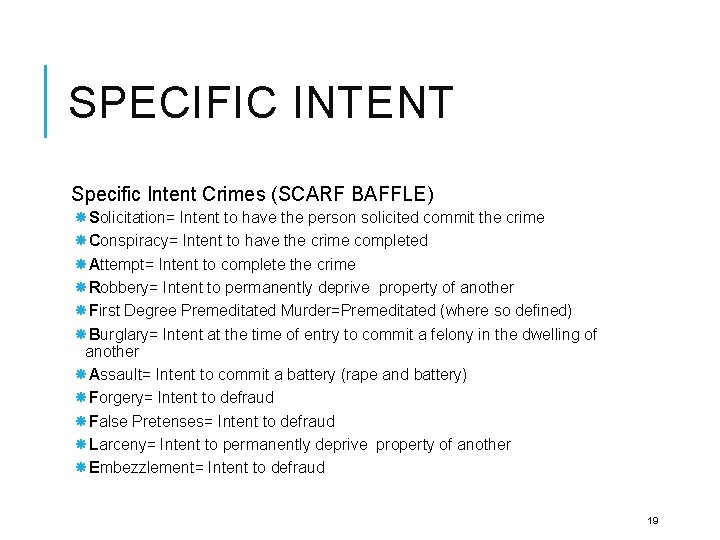
SPECIFIC INTENT Specific Intent Crimes (SCARF BAFFLE) Solicitation= Intent to have the person solicited commit the crime Conspiracy= Intent to have the crime completed Attempt= Intent to complete the crime Robbery= Intent to permanently deprive property of another First Degree Premeditated Murder=Premeditated (where so defined) Burglary= Intent at the time of entry to commit a felony in the dwelling of another Assault= Intent to commit a battery (rape and battery) Forgery= Intent to defraud False Pretenses= Intent to defraud Larceny= Intent to permanently deprive property of another Embezzlement= Intent to defraud 19
GENERAL INTENT General Intent D is aware of all factors constituting a crime or the D has a morally culpable state of mind Battery Rape Kidnapping False Imprisonment 20
ATTENDANT CIRCUMSTANCES Attendant Circumstances: Condition that must be present in conjunction with the prohibited conduct or result. Burglary= “at night” 21
MALICE Malice mens rea only applies to murder (CL) and arson Created to prevent Ds from using Specific Intent defenses D recklessly disregarded an obvious or high risk that the particular harmful result would occur 22
STRICT LIABILITY Strict Liability No mens rea required Statutory Rape Bigamy Consumer Protection or regulatory type of offenses No basis for acquittal on the ground of mistake of law May not have strict liability for every element Generally low-level health and welfare crimes 23
STRICT LIABILITY Criticism of Strict Liability Does not deter Unjust to condemn someone who is not morally culpable Can go after similar harms through civil regulations Dilutes moral force of the law Some strict liability laws arise from careless drafting 24
ORC 2901. 21 (C) (1) When language defining an element of an offense that is related to knowledge or intent or to which mens rea could fairly be applied neither specifies culpability nor plainly indicates a purpose to impose strict liability, the element of the offense is established only if a person acts recklessly. 25
PURPOSELY AND KNOWINGLY Mens Rea (Mental State) (MPC) Purposely 2. 02(a) Conscious object to engage in certain conduct or cause a certain result Knowingly 2. 02(b) Knows result is likely to occur even if he does not consciously seek to cause the result 26
RECKLESSNESS Recklessness 2. 02(c) Consciously disregards a substantial or unjustifiable risk that circumstances exist or that a prohibited result will follow, and this disregard constitutes a gross deviation from the standard of care that a reasonable person would exercise in the situation. 27
NEGLIGENCE Negligence 2. 02 (d) Because of a substantial lapse from due care, the D fails to perceive or avoid a risk Involves no state of awareness unlike the other mental states 28
ORC Mens Rea (Ohio follows the MPC) Purposely Knowingly Recklessly Negligently 29
TRANSFERRED INTENT Transferred Intent D intends to hit A but hits B instead. D may be charged for his act against B and attempt on A. Think 2 crimes when you see a transferred intent fact pattern The actual crime on B and the attempt on A 30
CAUSATION Causation Actual Cause or Cause in Fact= D’s conduct is the cause in fact of the result if the result would not have occurred “but for” the D’s conduct or the D’s act was a substantial factor of the result. 31
CAUSATION Proximate or Legal Cause= D’s conduct is the proximate cause of the result is a natural and probable consequence of the conduct, even if the D did not anticipate the precise manner in which the result occurred. Superseding factors break the chain of proximate causation. 32
CAUSATION An intervening act may prevent holding the D from liability if the act is a coincidence or outside the foreseeable risk created by the D. Intervening Acts God 3 rd Party Act or omission by the V 33
ASSAULT AND BATTERY AT CL Battery is an unlawful touching Assault is an attempt to commit a battery (unlawful touching) Today, many jurisdictions combine assault and battery into one statute. Also, some jurisdictions expand the definition of assault to include intentionally causing apprehension. 34
ORC ASSAULT In Ohio assault covers battery crimes Assault occurs when the D recklessly causes a serious physical injury to another or knowingly causes or attempts to cause physical harm to another Felonious Assault (ORC 2923. 11) occurs when the D knowingly causes serious harm to another or causes or attempts to cause physical harm to another by means of a deadly weapon 35
ORC ASSAULT Aggravated Assault (ORC 2903. 12) is punished less severely than felonious assault and occurs when the D is under the influence of sudden passion or rage brought on by serious provocation. 36
SEXUAL ASSAULT At CL rape was the unlawful carnal knowledge of a woman by a man, not her husband, forcibly and without her consent. Rape was a general intent crime that could only be committed against a woman by a man who was not her husband. Consent Force Threats Incapable of consent Obtained by fraud Fraud in factum (D likely to be convicted) Fraud in inducement (D unlikely to be convicted) 37
SEXUAL ASSAULT Fraud in factum If the deception causes a misunderstanding as to the sexual act there is no legally recognized consent because what happened is not what that for which consent was given Fraud in inducement V deceived in some manner but still knows that the sexual act is occurring Pretending to be a spouse can be either fraud in inducement or fraud in factum 38
SEXUAL ASSAULT Rape Shield Laws Prevent the defense attorney from harassing and humiliating the V Evidence may have no bearing on whether the V consented Keeps the jury focused on the issue at hand Encourages Vs to testify 39
ORC SEXUAL ASSAULT 3 Exceptions to spousal immunity Living Apart Altering legal relationship or One spouse uses force 40
ORC SEXUAL ASSAULT Statutory Rape -Under the Age of 13 regardless of D’s knowledge of the V’s Age Unlawful sexual conduct with a minor --D is 18 and V is 13, 14, or 15. 41
ROBBERY Elements of Robbery Trespassory Taking Carrying Away Personal Property of Another With the Intent to Steal Person or presence of another Taking must be accomplished by means of force or putting in fear Robbery is Assault + Larceny 42
ORC ROBBERY In Ohio a D is guilty of robbery if, while committing a theft or fleeing after a theft or an attempt the D Possesses or controls a deadly weapon Inflicts, threatens to inflict, or attempts to inflict physical harm on another Uses or threatens to use immediate force against another 43
KIDNAPPING At CL kidnapping consists of: 1. an unlawful restraint of a person’s liberty 2. by force or show of force 3. so as to send the V into another country 44
ORC 2905. 01 KIDNAPPING (A) No person, by force, threat, or deception, or, in the case of a victim under the age of thirteen or mentally incompetent, by any means, shall remove another from the place where the other person is found or restrain the liberty of the other person, for any of the following purposes: (1) To hold for ransom, or as a shield or hostage; (2) To facilitate the commission of any felony or flight thereafter; (3) To terrorize, or to inflict serious physical harm on the victim or another; (4) To engage in sexual activity, as defined in section 2907. 01 of the Revised Code, with the victim against the victim's will; (5) To hinder, impede, or obstruct a function of government, or to force any action or concession on the part of governmental authority; (6) To hold in a condition of involuntary servitude. 45
KIDNAPPING ORC 2905. 01 (B) No person, by force, threat, or deception, or, in the case of a victim under the age of thirteen or mentally incompetent, by any means, shall knowingly do any of the following, under circumstances that create a substantial risk of serious physical harm to the victim or, in the case of a minor victim, under circumstances that either create a substantial risk of serious physical harm to the victim or cause physical harm to the victim: (1) Remove another from the place where the other person is found; (2) Restrain another of the other person's liberty. 46
ORC 2905. 01 KIDNAPPING Consists of moving or restraining a person by Force Threat Deception or Any means, where the person being moved or restrained is Under 13 or Mentally incompetent Requires that the restraint or movement must be to Hold the V for ransom Facilitate the commission of a felony or flight from a felony Engage in sexual activity Hinder, impede or obstruct a governmental function 47
2905. 02 ABDUCTION (A) No person, without privilege to do so, shall knowingly do any of the following: (1) By force or threat, remove another from the place where the other person is found; (2) By force or threat, restrain the liberty of another person under circumstances that create a risk of physical harm to the victim or place the other person in fear; (3) Hold another in a condition of involuntary servitude. (B) No person, with a sexual motivation, shall violate division (A) of this section. 48
UNLAWFUL RESTRAINT 2905. 03 Unlawful restraint or False Imprisonment (A) No person, without privilege to do so, shall knowingly restrain another of the other person's liberty. (B) No person, without privilege to do so and with a sexual motivation, shall knowingly restrain another of the other person's liberty. (C) Whoever violates this section is guilty of unlawful restraint, a misdemeanor of the third degree. (D) As used in this section, "sexual motivation" has the same meaning as in section 2971. 01 of the Revised Code. 49
MURDER Murder= unlawful killing of another human being with malice aforethought At CL all murders were capital offenses 50
MURDER AT CL Unlawful killing with malice aforethought. 4 ways to prove malice Intent to kill Desire to kill Substantial certainty of death Intent to do serious bodily harm Attack or assault with a deadly weapon More than bodily injury something less than a fatal injury Reckless indifference to the value of human life Depraved Heart Beyond mere gross negligence 51
FELONY MURDER Felony Murder While in the process of committing a felony someone dies Why do we have the Felony-Murder Doctrine? Punish criminals Deter felons from killing negligently Get criminals to conduct crimes more safely? 52
HOMICIDE At early CL no degrees of murder 1 st and 2 nd degree murders are creatures of statute 1 st Degree Felony Murder Premeditated and Deliberate Intent to kill 2 nd Degree All other types of murder Catch all 53
PREMEDITATION AND DELIBERATION Premeditation and Deliberation Planning Motive Method of killing Drugs or alcohol may reduce the specific intent 54
ORC MURDER Aggravated Murder (1 st Degree Murder) Purposely cause the death of another and Prior Calculation and Design (Premeditated) Victim under 13 Offender is incarcerated for a felony or has escaped Victim was law enforcement Murder (2 nd Degree Murder) Purposely cause the death of another 55
ORC FELONY MURDER Aggravated Murder=D purposely causes the death of another while committing, attempting to commit, or fleeing from a BARRK crime. Murder=D “cause[s] the death of another as a proximate result of the D’s committing or attempting to commit an offense of violence that is a felony of the first or 56
MANSLAUGHTER Manslaughter and Murder same Actus Reus different Mens Rea Voluntary Manslaughter=killing that would otherwise be murder but is distinguishable from murder by adequate provocation Heat of Passion Imperfect Self-Defense 57
VOL. MANSLAUGHTER Voluntary Manslaughter (Heat of Passion and Imperfect Self-Defense) Heat of passion (1) Reasonable provocation (words alone insufficient) (objective) E. g. , serious battery or see spouse in bed with another person (2) Actually provoked (subjective) (3) No time to cool off (objective) (4) D in fact not cooled off (subjective) 58
VOL. MANSLAUGHTER Voluntary Manslaughter Imperfect self-defense (D not entitled to self defense because) (only followed in a minority of jurisdictions) (1) D unreasonably mistaken about the existence of danger (2) D unreasonable mistaken about the need of deadly force (3) D was the aggressor 59
INVOLUNTARY MANSLAUGHTER Unintended killings that are the result of unjustified risk Involuntary Manslaughter Criminal gross negligence Unlawful Act (Misdemeanor. Manslaughter and felonies not included in felony murder) 60
OH VOLUNTARY MANSLAUGHTER ORC 2903. 03 No person, while under the influence of sudden passion or a sudden fit of rage, either of which is brought on by serious provocation occasioned by the victim that is reasonably sufficient to incite the person into using deadly force, shall knowingly cause the death of another or the termination of another’s pregnancy. 61
OH INVOLUNTARY MANSLAUGHTER ORC 2903. 04 D commits involuntary manslaughter when (1) he causes the death of another as a proximate result of committing or attempting to commit a felony (2) he causes the death of another as a proximate result of committing or attempt to a misdemeanor of any degree or a regulatory offense. 62
INVOL. MAN VS. DEPRAVED HEART MURDER Distinguish involuntary manslaughter and reckless indifference to the value of human life The D drives down a country road at 90 mph at 3 am in the morning. D hits and kills someone trying to cross the road. The D drives down Main Street at 90 mph at 3 pm. D hits and kills someone trying to cross the street. 63
LARCENY Larceny Trespassory taking and carrying away of the personal property of another with the intent to permanently deprive Trespassory Taking and Carrying away (asportation) Personal Property (no real property) Of another With intent to steal or permanently deprive Obtain possession not title 64
LARCENY Continuing Trespass= If the D wrongfully takes property without the intent to permanently deprive and later decides to keep the property it becomes larceny at CL. Lost or Mislaid Property= D may still be found guilty of larceny if (a) she forms an intent to permanently deprive at the time of finding the property; and (b) there are clues to ownership. 65
LARCENY BY TRICK Taking of possession (not title) Personal property Known to be owned by another Intent to permanently deprive Taking accomplished by means of a representation or promise Past or present fact or a false promise to return Known by D to be false At the time of the taking Owner must rely on the promise 66
FALSE PRETENSES False Pretenses False misrepresentation of a material present or past fact Causes the victim to pass title of personal property which includes $ D knows his misrepresentation is false and intends to defraud the victim Similar to Larceny by Trick but D obtains title 67
EMBEZZLEMENT Embezzlement (Elements) A Fraudulent Conversion of The Property Of Another By one who is already in lawful possession of it Don’t obtain title 68
THEFT ORC 2913. 02 Larceny, Embezzlement, and False Pretenses all fall under one generic theft statute 69
RECEIPT OF STOLEN PROPERTY Receiving possession and control Of “stolen” personal property Known to have been obtained in a manner constituting a criminal offense By another person With the intent to permanently deprive the owner Property loses “stolen status” when recovered by police 70
BURGLARY Breaking Entering Dwelling of Another Nighttime Intent to Commit a Felony therein 71
ORC AGGRAVATED BURGLARY Aggravated Burglary 2911. 11 occurs when the D by force, stealth, or deception, trespasses in an occupied structure, when someone other than his accomplice is present, with the intent to commit any criminal offense in the structure and one of the following occurs (1) inflicts, threatens or attempts to physically harm another (2) possesses a deadly weapon 72
ORC 2911. 12 BURGLARY A) No person, by force, stealth, or deception, shall do any of the following: (1) Trespass in an occupied structure or in a separately secured or separately occupied portion of an occupied structure, when another person other than an accomplice of the offender is present, with purpose to commit in the structure or in the separately secured or separately occupied portion of the structure any criminal offense; (2) Trespass in an occupied structure or in a separately secured or separately occupied portion of an occupied structure that is a permanent or temporary habitation of any person when any person other than an accomplice of the offender is present or likely to be present, with purpose to commit in the habitation any criminal offense; (3) Trespass in an occupied structure or in a separately secured or separately occupied portion of an occupied structure, with purpose to commit in the structure or separately secured or separately occupied portion of the structure any criminal offense. (B) No person, by force, stealth, or deception, shall trespass in a permanent or temporary habitation of any person when any person other than an accomplice of the offender is present or likely to be present. 73
ORC BREAKING AND ENTERING 2911. 13 Occurs when the D trespasses in an unoccupied structure with the intent to commit a theft offense therein. If the intent is to commit a felony, the trespass must be by force, stealth, or deception. 74
TRESPASS ORC 2911. 21 Trespass occurs when the D without permission to do so Knowingly enters or remains on the land of another Knowingly exceeds any lawful restriction on the use of the land Recklessly enters or remains on the land of another when notice against unauthorized access has been given or Negligently fails or refuses to leave when asked to 75
TRESPASS 2911. 211 Aggravated Trespass occurs when the D remains on the land of another with the purpose to commit a misdemeanor which involves causing physical harm to another or causing another to believe that he will cause harm. 76
ARSON The malicious D acted with the intent or knowledge that the structure would burn, or with reckless disregard of an obvious risk that the structure would burn Burning Scorching insufficient Charring sufficient (need some damage) Dwelling House of Another Ownership immaterial 77
ORC ARSON Aggravated Arson 2909. 02 occurs when the D by fire or explosion creates a substantial risk of harm to another or occupied structure. Arson 2909. 03 occurs when the D by fire or explosion knowingly causes or creates a substantial risk of harm to property 78
INCHOATE CRIMES (ANTICIPATORY CRIMES) Attempt Solicitation Conspiracy 79
ATTEMPT Specific Intent to commit the underlying crime Must go beyond mere preparation Overt act in furtherance Substantial Step Can’t be convicted of both attempt and the underlying offense 80
ATTEMPT Tests for determining if D has gone beyond mere preparation Dangerous Proximity Probability Desistance Unequivocality Indispensable Element Abnormal Substantial Step 81
ATTEMPT Defenses Abandonment CL no MPC and OH yes Impossibility 82
ORC 2923. 02(D) DEFENSES TO ATTEMPT Ohio follows the MPC for Legal Impossibility and attempt Voluntary abandonment is a defense to attempt and conspiracy Prior to the commission of the underlying offense advise conspirators of the abandonment or alert law enforcement Withdrawal is a defense to conspiracy thwarting the success of the conspiracy 83
SOLICITATION Inciting, counseling, advising, inducing, urging or commanding another to commit a felony D must specifically intend the result. Thus, the D cannot be convicted of soliciting a crime based on negligence or recklessness. Crime is complete as soon as the solicitor makes her request. The solicited party need not agree. If the other person agrees both are guilty of conspiracy. Solicitation merges with the underlying crime. 84
SOLICITATION Defenses Factual impossibility not available Can’t be convicted of both solicitation and the underlying offense Withdrawal or renunciation no defense at CL This defense is recognized by 85
CONSPIRACY An agreement between two or more persons to accomplish some criminal or unlawful purpose Agreement between 2 or more persons Specific intent to enter the agreement Specific intent to achieve the objective of the agreement 86
CONSPIRACY MPC requires an overt act It doesn’t take much to have an overt act Less than a substantial step It can be a legal or illegal act CL does not require an overt act CL requires 2 guilty minds MPC does not require to 2 guilty minds (unilateral) 87
CONSPIRACY Renunciation of conspiracy No defense at CL Is a defense for the MPC D must thwart the success of the conspiracy 88
CONSPIRACY Withdrawal from Conspiracy Is a defense to subsequent crimes at CL Give notice to all participants Is a defense to subsequent crimes in the MPC Advise co-conspirators that D is no longer involved or Inform law enforcement 89
CONSPIRACY Wharton’s Rule Need more parties to participate in the agreement than necessary to commit the crime if you want to charge the conspiracy and the underlying crime. E. g. , need at least three folks when charging, bigamy, dueling or adultery 90
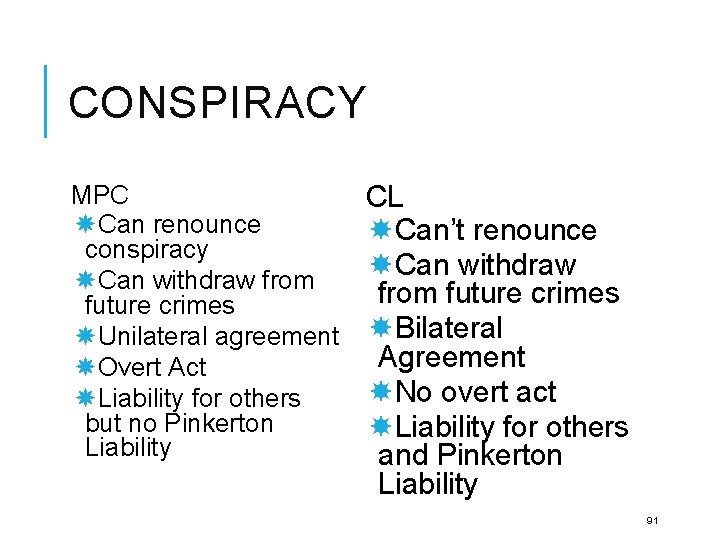
CONSPIRACY MPC CL Can renounce Can’t renounce conspiracy Can withdraw from future crimes Unilateral agreement Bilateral Agreement Overt Act No overt act Liability for others but no Pinkerton Liability for others Liability and Pinkerton Liability 91
CONSPIRACY ORC 2923. 01 Overt act required No bilateral agreement required Conspiracy merges with the underlying crime or an attempt to commit the underlying crime Ohio statute applies to specific crimes e. g. , robbery, murder, drug trafficking Elements With the purpose of committing or facilitating the commission of a specified offense Plans or aids in planning the offense with another Or Agrees with another that one of them will engage in conduct that facilitates a specified offense 92
ACCOMPLICE One who, with the intent that the crime be committed, aids, counsels, or encourages the principal before or during the commission of the crime. Mere presence at the crime scene is generally not enough Accomplice is liable for the crimes he did or counseled and for any other crimes committed in the course of committing the crime contemplated, as long as the other crimes were probable and foreseeable. 93
ACCOMPLICE D can voluntarily withdraw from complicity before a crime is committed by the principal if Repudiates the encouragement and/or Neutralizes his assistance 94
ACCOMPLICE Principal in the First Degree=actually commits the act Principal in the Second Degree=persons who aid, command, or encourage the principal and are present at the crime Accessories before the Fact= persons who aid, abet, or encourage the principal but are not present at the crime Accessories after the Fact= persons who assist the principal after the crime Principals and Accessories before the Fact can be found guilty of the underlying offense Accessories after the Fact are guilty of obstruction of justice 95
COMPLICITY ORC 2923. 03 Accomplice (accessory before the fact) commits the crime of complicity Mere presence at the scene is not enough to convict Obstruction of Justice occurs when the D attempts to prevent the discovery, apprehension, or punishment of another for a crime. 96
ACCOMPLICE VS. CONSPIRACY Not an inchoate crime. The underlying offense needs to be committed Inchoate crime. No need for underlying offense to actually be committed Prosecution must first Greater liability for coprove the commission of conspirators the underlying offense Prosecution must then prove that the D aided and abetted in the offense Different types of accomplices 97
DEFENSES Mistake of Fact Mistake of Law Legal/Factual Impossibility Intoxication Infancy Insanity Competency vs. Insanity Self-Defense 98
MISTAKE OF FACT Mistake of Fact must be reasonable for General Intent crimes (one narrow exception for morally culpable acts) Mistake of Fact can be reasonable or unreasonable for Specific Intent crimes 99
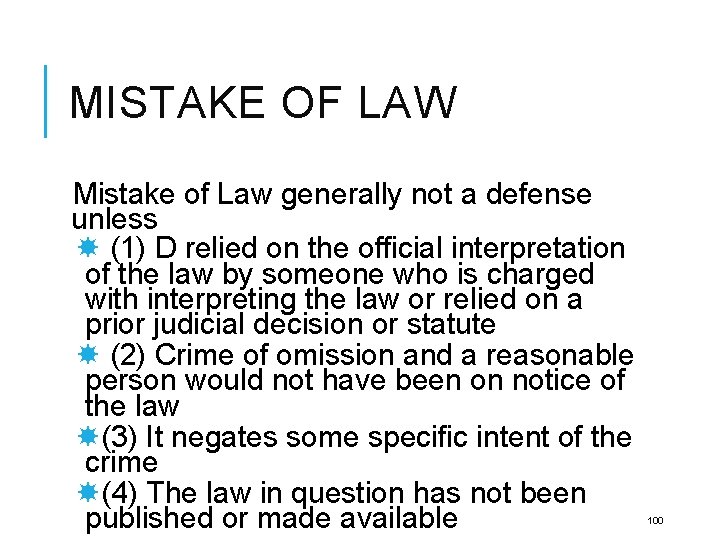
MISTAKE OF LAW Mistake of Law generally not a defense unless (1) D relied on the official interpretation of the law by someone who is charged with interpreting the law or relied on a prior judicial decision or statute (2) Crime of omission and a reasonable person would not have been on notice of the law (3) It negates some specific intent of the crime (4) The law in question has not been published or made available 100
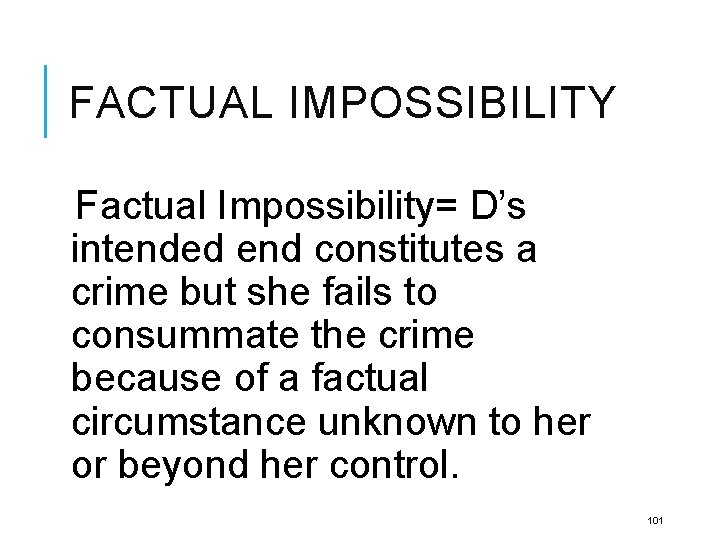
FACTUAL IMPOSSIBILITY Factual Impossibility= D’s intended end constitutes a crime but she fails to consummate the crime because of a factual circumstance unknown to her or beyond her control. 101
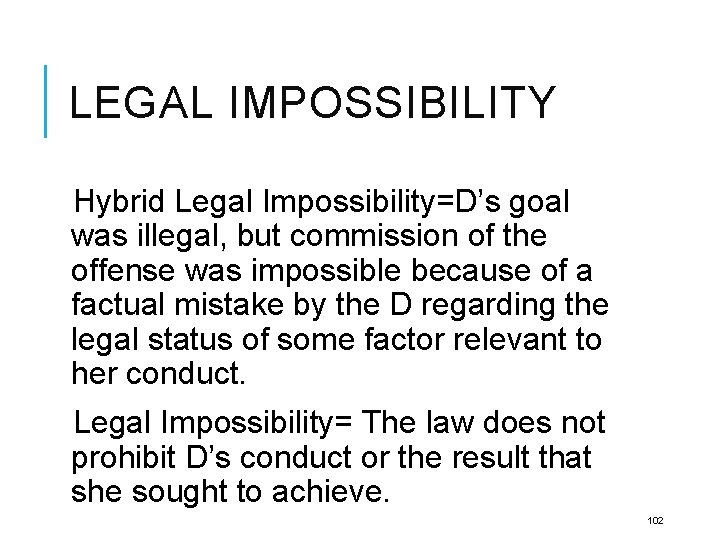
LEGAL IMPOSSIBILITY Hybrid Legal Impossibility=D’s goal was illegal, but commission of the offense was impossible because of a factual mistake by the D regarding the legal status of some factor relevant to her conduct. Legal Impossibility= The law does not prohibit D’s conduct or the result that she sought to achieve. 102
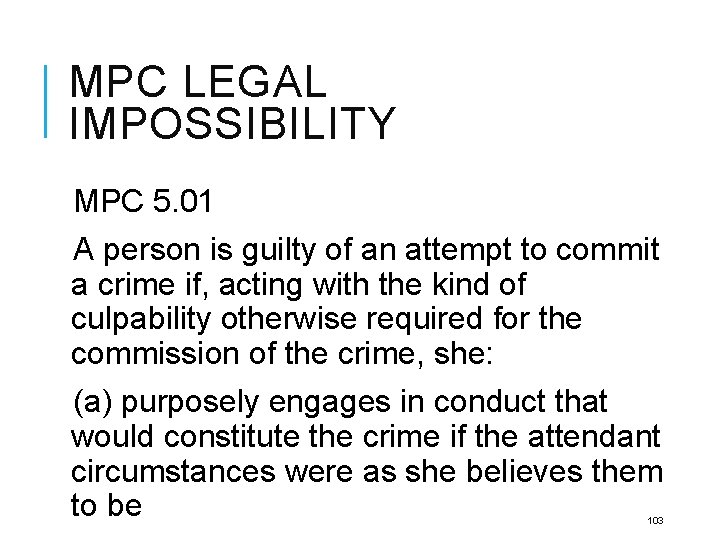
MPC LEGAL IMPOSSIBILITY MPC 5. 01 A person is guilty of an attempt to commit a crime if, acting with the kind of culpability otherwise required for the commission of the crime, she: (a) purposely engages in conduct that would constitute the crime if the attendant circumstances were as she believes them to be 103
ORC 2923. 02 (B) LEGAL IMPOSSIBILITY (B) It is no defense to a charge under this section that, in retrospect, commission of the offense that was the object of the attempt was either factually or legally impossible under the attendant circumstances, if that offense could have been committed had the attendant circumstances been as the actor believed them to be. 104
INTOXICATION Voluntary Intoxication is a defense to degrees of murder and Specific Intent crimes Voluntary Intoxication is not a defense to murder at CL Involuntary Intoxication is treated like insanity in some jurisdictions other jurisdictions like Ohio only allow it to go to 105
INTOXICATION ORC 2901. 21(E) Intoxication Voluntary intoxication is unavailable to show that the D did not act with the relevant mental state. A D may use voluntary intoxication to prove that he was not physically capable of committing the crime. 106
INSANITY M’Naughten (1) Disease Prong; and (2) Act Prong (a) D does not understand the nature and quality of his act (cognitive); or (b) D cannot distinguish between right and wrong at the time he acted (moral incapacity) 107
MPC INSANITY MPC Insanity Result of Mental Disease D lacks substantial capacity to Appreciate criminality (wrongfulness) of his conduct Conform conduct to the requirements of law 108
INSANITY ORC Insanity in Ohio At the time of the commission of the offense, the D did not know the wrongfulness of her conduct because of a severe mental disease or defect. 109
DIMINISHED CAPACITY Standard varies by jurisdiction “expert testimony as to a defendant’s abnormal mental condition may be received and considered, as tending to show, in a responsible way, that defendant did not have the specific mental state required for a particular crime or degree of crime —even though he was aware that his act was wrongful and was able to control it, and hence was not entitled to complete exoneration. ” OH does not recognize the partial defense of diminished capacity 110
COMPETENCY HEARING VS. INSANITY DEFENSE Insanity=mind state when the act occurred Competency=mind state at the time of trial D must be able to (1) understand the proceedings; and (2) be able to assist her attorney 111
INFANCY Under 7—No Criminal Liability Under 14—Rebuttable Presumption of No Criminal Liability 112
SELF-DEFENSE Self Defense unlike Insanity is a justification defense Non aggressor may use a reasonable amount of force against another when reasonably believes that he is in immediate danger. If the individual faces serious physical harm, he may use lethal force. 113
FEAR OF SERIOUS HARM CL says the D must honestly and reasonably believe that lethal force is necessary to protect from imminent death or serious physical harm MPC says the D must honestly believe but this belief can be reasonable or unreasonable OH 114
SELF-DEFENSE Non-deadly Force (1) Reasonably believes that another is going to inflict imminent unlawful bodily harm (2) Force reasonably necessary for protection (3) No duty to retreat (4) Without fault (5) Non-aggressor (D may not always stay the aggressor) 115
DEADLY FORCE Duty to Retreat (Majority and Minority Rules) No duty to retreat for non-deadly force Majority says you don’t have to retreat before using deadly force Minority says you do have to retreat before using deadly force Home (OH includes car) Can’t safely retreat Victim of robbery or kidnapping Law enforcement 116
OH DEFENSE OF OTHERS You can use reasonable force in the defense of another No prior relationship is required If the individual is mistaken about the need force, she will not be liable so long as her mistake was reasonable A minority of jurisdictions, to include Ohio, follow the alter-ego rule. Under this rule, the rescuer can only use the amount of force available to the victim. 117
ORC UNLAWFUL ARREST D cannot resist an illegal arrest by law enforcement if D knows he is being arrested by law enforcement (minority jurisdiction) D cannot be charged with resisting arrest for an unlawful arrest 118