An Introduction to Farm to School Maggie Gosselin
- Slides: 56
An Introduction to Farm to School Maggie Gosselin, M. S. Orientation March 13, 2013 United States Department of Agriculture Food and Nutrition Service
» What is farm to school and what are its benefits? » Federal, state, and nonprofit support » Sourcing locally, and correctly! » Incorporating local foods into school meals: an example » Resources » Questions Overview
What is farm to school and what are its benefits?
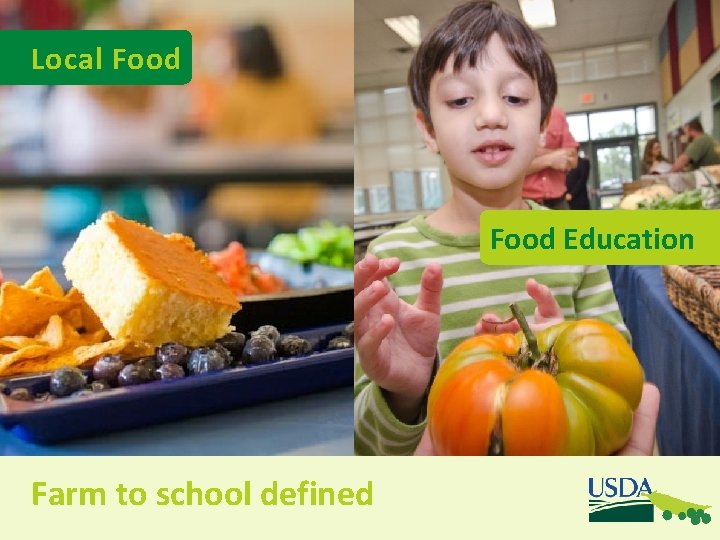
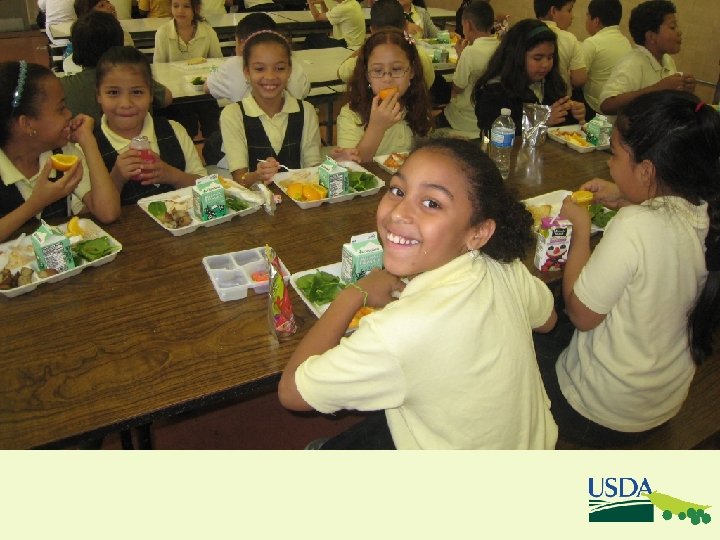
Local Food Education Farm to school defined
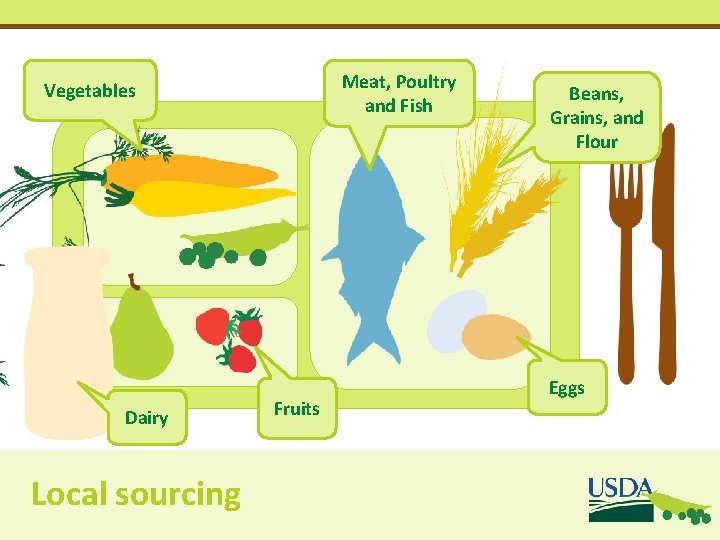
Meat, Poultry and Fish Vegetables Dairy Local sourcing Fruits Beans, Grains, and Flour Eggs
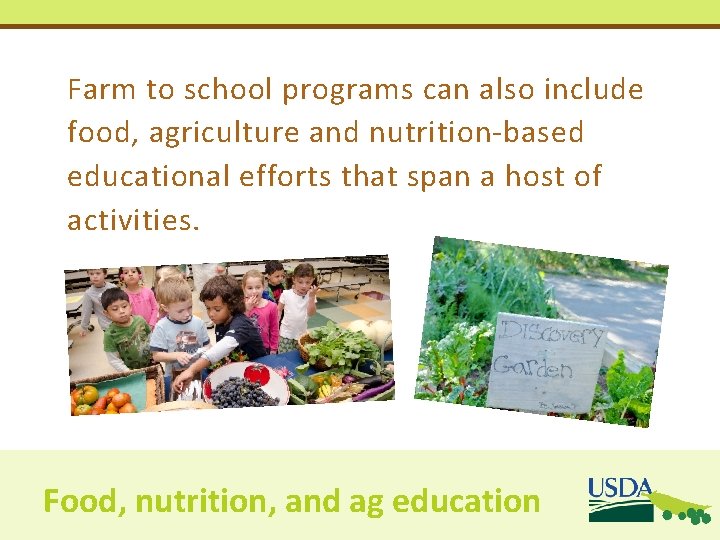
Farm to school programs can also include food, agriculture and nutrition-based educational efforts that span a host of activities. Food, nutrition, and ag education
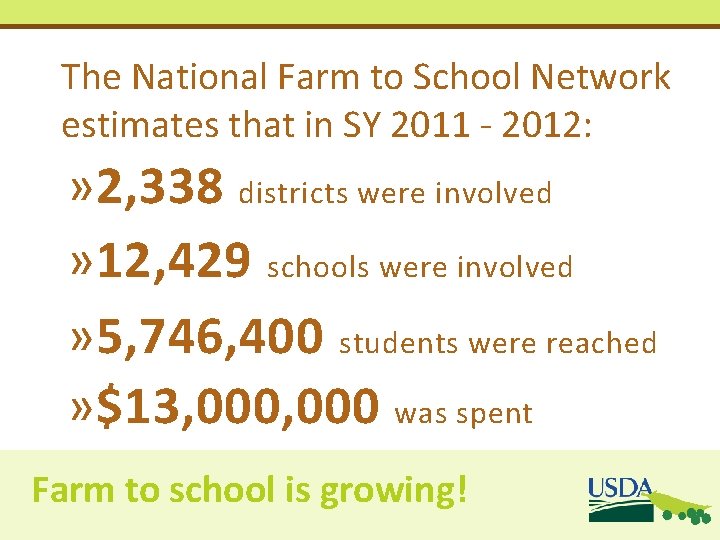
The National Farm to School Network estimates that in SY 2011 - 2012: » 2, 338 districts were involved » 12, 429 schools were involved » 5, 746, 400 students were reached » $13, 000 was spent Farm to school is growing!
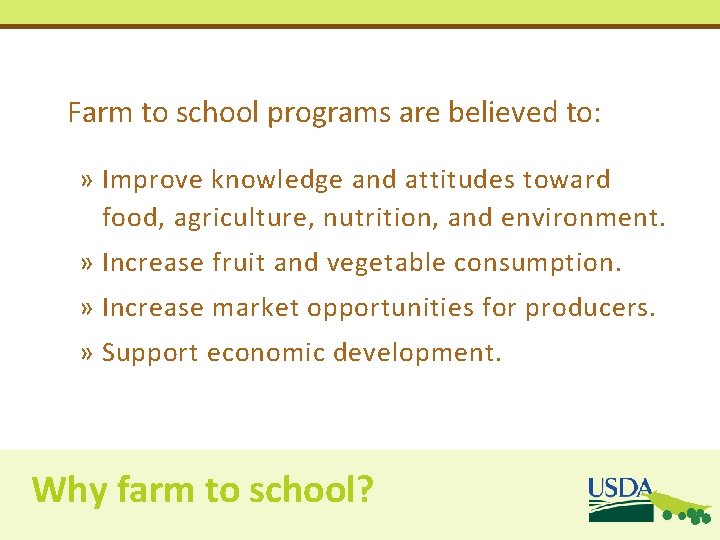
Farm to school programs are believed to: » Improve knowledge and attitudes toward food, agriculture, nutrition, and environment. » Increase fruit and vegetable consumption. » Increase market opportunities for producers. » Support economic development. Why farm to school?
State, federal, and nonprofit support
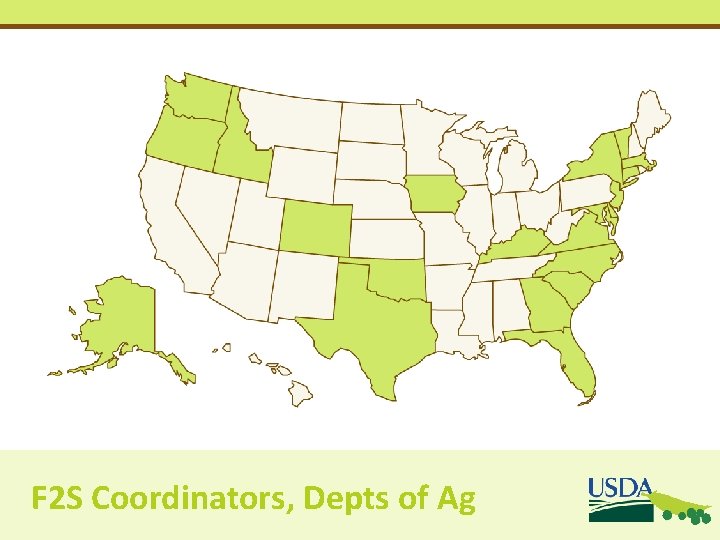
F 2 S Coordinators, Depts of Ag
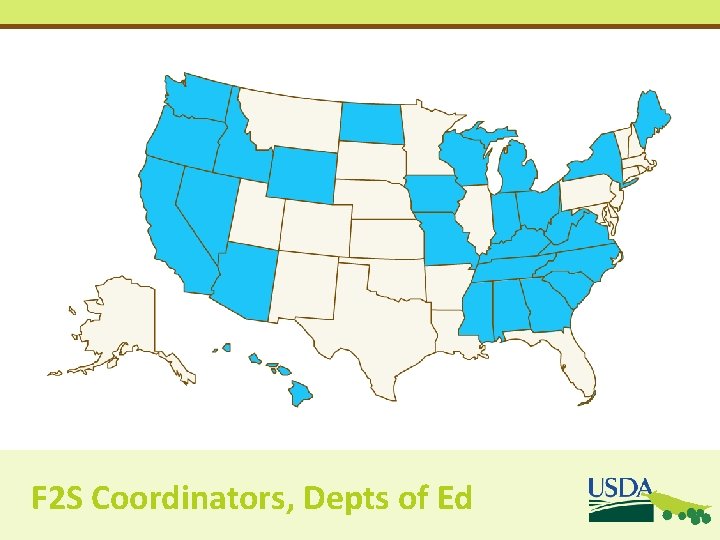
F 2 S Coordinators, Depts of Ed
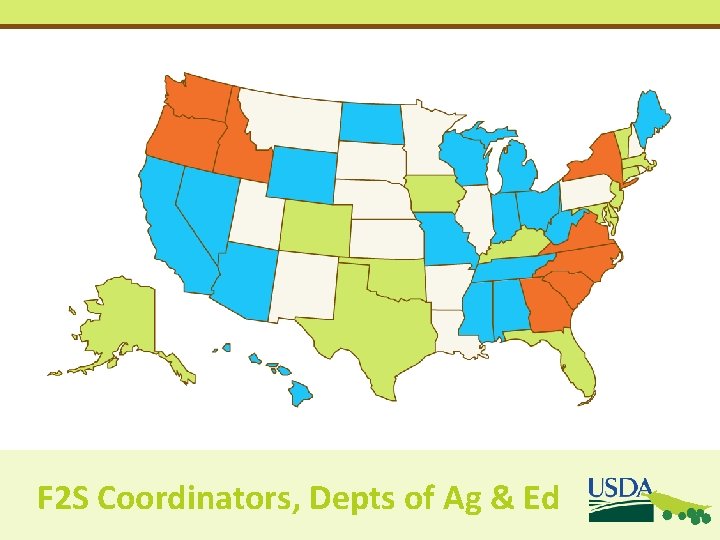
F 2 S Coordinators, Depts of Ag & Ed
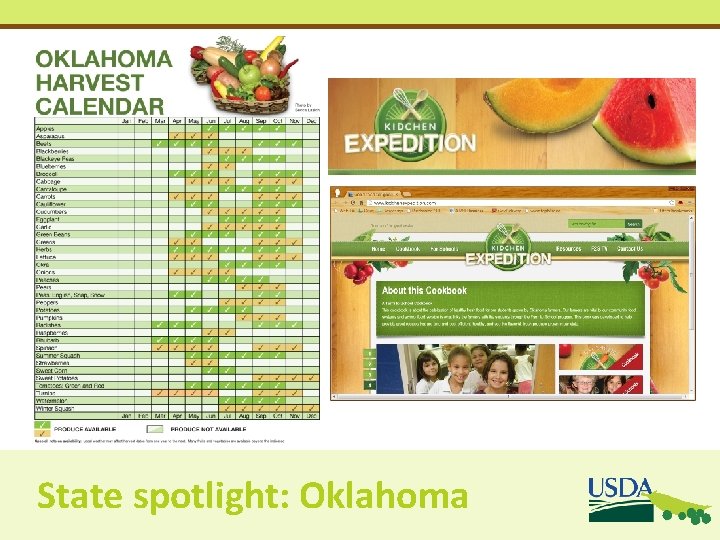
State spotlight: Oklahoma
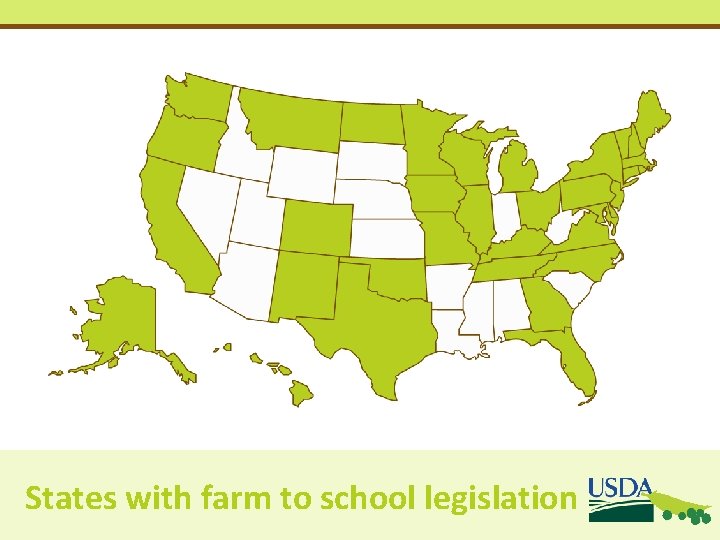
States with farm to school legislation
Nonprofit organizations
The Food and Nutrition Service (FNS) works with State, territorial, and Indian tribal governments to implement child nutrition programs including: » » » The National School Lunch Program The School Breakfast Program The Summer Food Service Program The Fresh Fruit and Vegetable Program The Afterschool Snack Program How is USDA involved?
Section 243 of the Healthy Hunger. Free Kids Act of 2010 directed the Secretary of Agriculture to “improve access to local foods in (eligible) schools” by providing farm to school grants, training, and technical assistance. USDA’s legislative mandate
» Planning grants are schools just beginning farm to school activities. » Implementation grants are for schools to further develop existing farm to school initiatives. » Support Service grants are intended for entities working with schools to further develop and provide broad reaching support services to farm to school initiatives. Grants and technical assistance
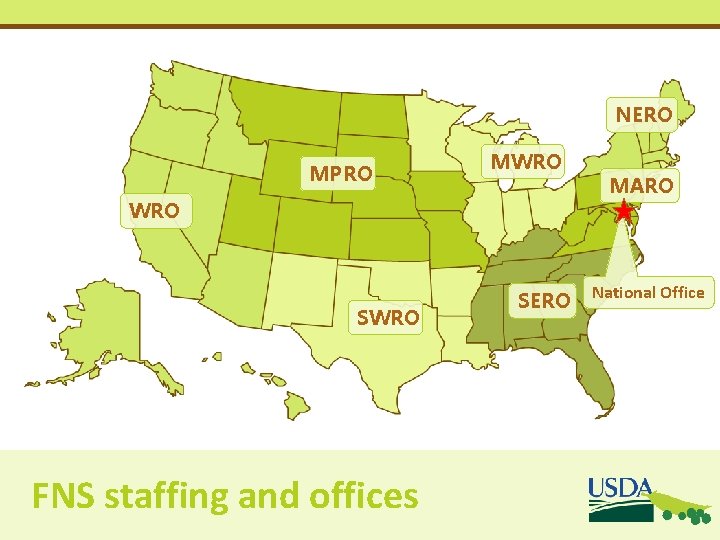
NERO MPRO MWRO SWRO FNS staffing and offices SERO MARO National Office
Group discussion: What’s your experience with local food?
Sourcing locally, and correctly!
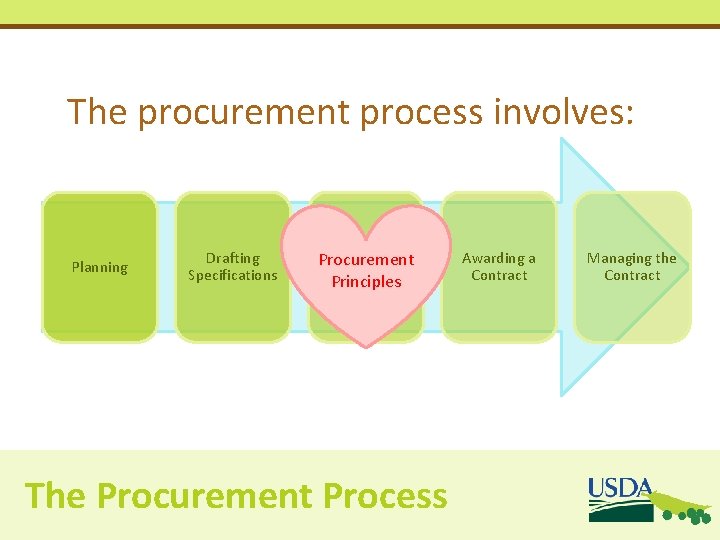
The procurement process involves: Planning Drafting Specifications Advertising Procurement the Principles Procurement The Procurement Process Awarding a Contract Managing the Contract
» The most important principle of a sound procurement is that it is competitive. » Open and free competition means that all suppliers are on a level playing field and have the same opportunity to compete. » Competition is essential to ensure low cost and good quality of goods and services. Federal procurement principles
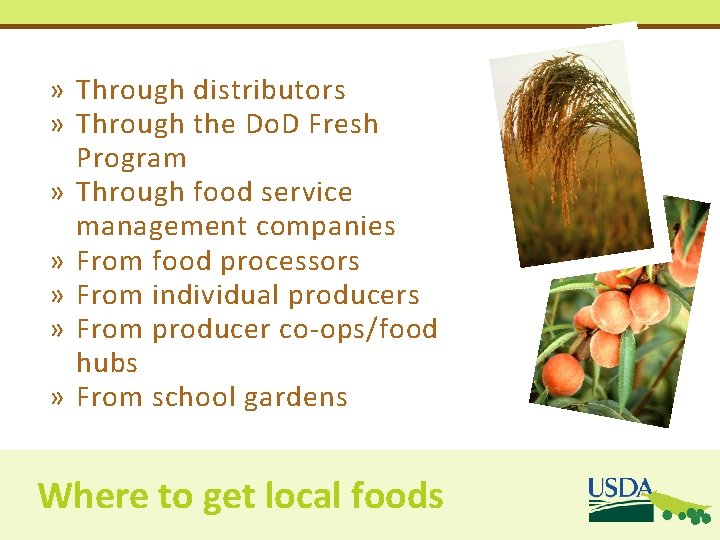
» Through distributors » Through the Do. D Fresh Program » Through food service management companies » From food processors » From individual producers » From producer co-ops/food hubs » From school gardens Where to get local foods
What are the ways that an SFA can source local foods and be in full compliance with federal procurement regulations? » By applying a geographic preference. » Unintentionally. (Because local products happen to be cheaper. ) » By including related characteristics in specifications. » By approaching only local sources under an informal procurement. » By specifying your desire for local foods in contracts with food service management companies, distributors, or Do. D Fresh Methods for Local Sourcing
» Some local products, because of their nature, are likely to be cheaper than nonlocal competitors. » SFAs in some areas are more likely than SFA in other areas to end up “accidentally” procuring local foods. » Ask your providers where your food is coming from—you might be surprised! Procuring local foods without even trying
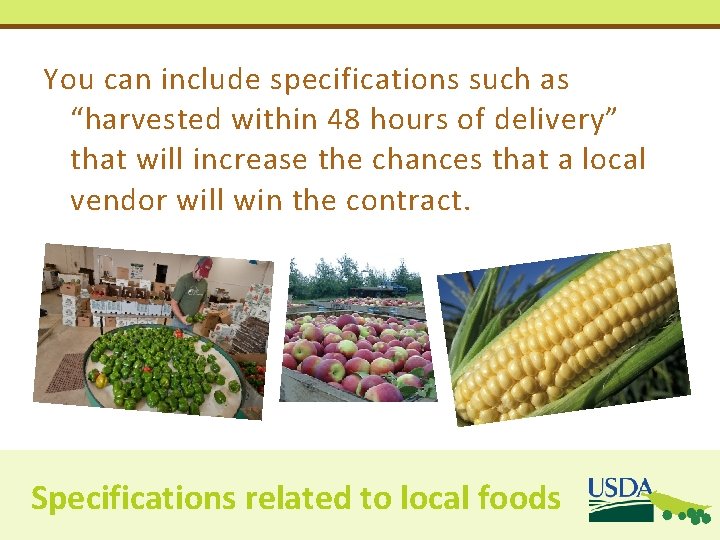
You can include specifications such as “harvested within 48 hours of delivery” that will increase the chances that a local vendor will win the contract. Specifications related to local foods
» If you’re making a purchase that falls under your small purchase threshold, you can get quotes from 3 (or more) local farms or vendors. » But remember, you can’t arbitrarily split up a procurement to come in under the small purchase threshold, and you have to put your specifications in writing. Approaching only local vendors
» To purchase local foods through a distributor or food service management company, you must specify your desire for local products, including as much detail as possible. » Food service management companies must follow Federal procurement regulations, too; therefore, they can source local foods using the same methods you can. Including your desire for local in solicitations
» Do. D Fresh offers an opportunity to use USDA Foods entitlement dollars on fresh produce » Do. D contracts with produce vendors across the country » Many of these vendors purchase regionally grown produce » Contact your produce vendor for more information on local products and work to connect the vendor with other producers in your area Working with Do. D Fresh
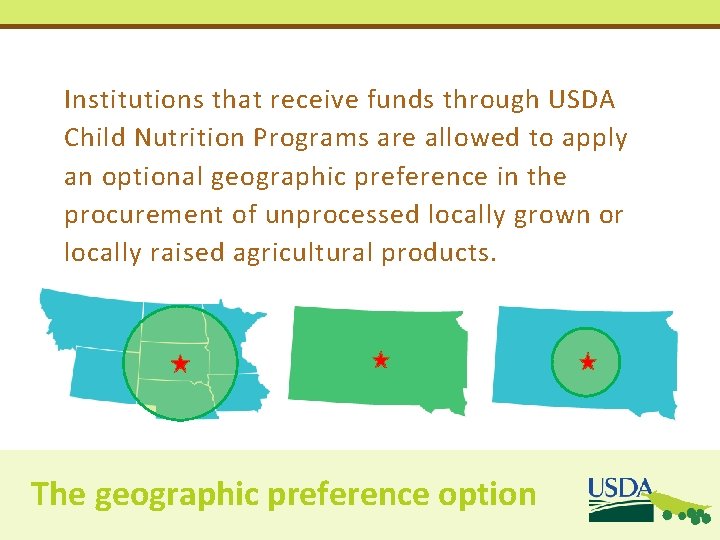
Institutions that receive funds through USDA Child Nutrition Programs are allowed to apply an optional geographic preference in the procurement of unprocessed locally grown or locally raised agricultural products. The geographic preference option
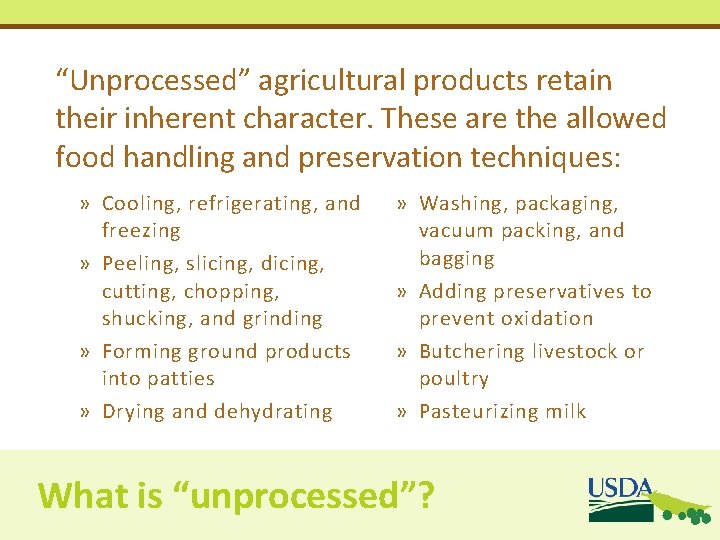
“Unprocessed” agricultural products retain their inherent character. These are the allowed food handling and preservation techniques: » Cooling, refrigerating, and freezing » Peeling, slicing, dicing, cutting, chopping, shucking, and grinding » Forming ground products into patties » Drying and dehydrating » Washing, packaging, vacuum packing, and bagging » Adding preservatives to prevent oxidation » Butchering livestock or poultry » Pasteurizing milk What is “unprocessed”?
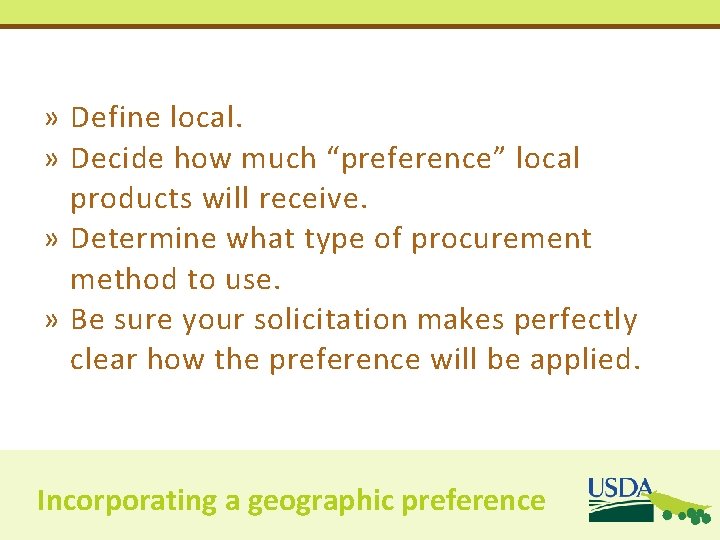
» Define local. » Decide how much “preference” local products will receive. » Determine what type of procurement method to use. » Be sure your solicitation makes perfectly clear how the preference will be applied. Incorporating a geographic preference
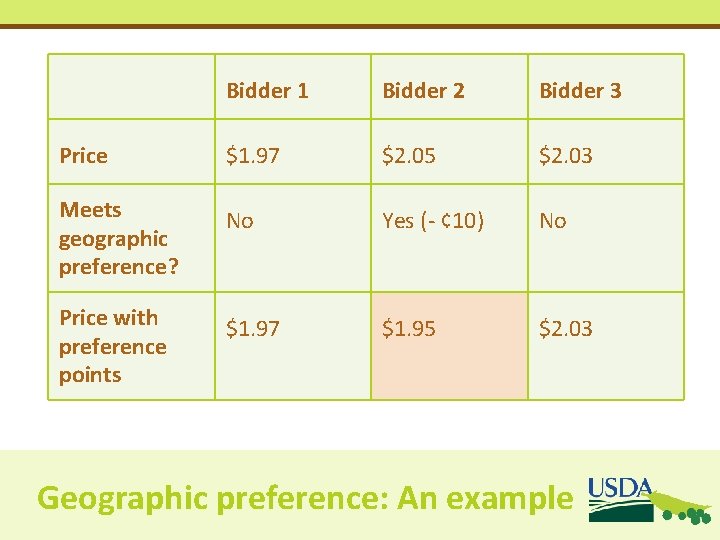
Bidder 1 Bidder 2 Bidder 3 Price $1. 97 $2. 05 $2. 03 Meets geographic preference? No Yes (- ¢ 10) No Price with preference points $1. 97 $1. 95 $2. 03 Geographic preference: An example
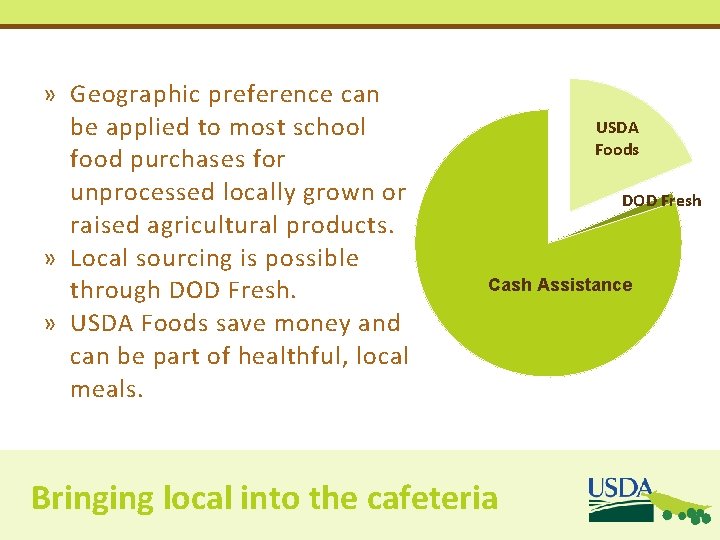
» Geographic preference can be applied to most school food purchases for unprocessed locally grown or raised agricultural products. » Local sourcing is possible through DOD Fresh. » USDA Foods save money and can be part of healthful, local meals. USDA Foods DOD Fresh Cash Assistance Bringing local into the cafeteria
» When purchasing local foods, consider including specifications related to: » Degree of ripeness or maturity » Freshness (age) » Condition upon receipt of product » Temperature » Size uniformity » Other quality standards (such as “organic, ” “no-till, ” “no-spray, ” etc. ) Quality standards
Farm to school operators must ensure the safety of all foods served to kids. Consider developing food safety protocol for: » The school garden » The school kitchen » The production and transport of foods Farm to school and food safety
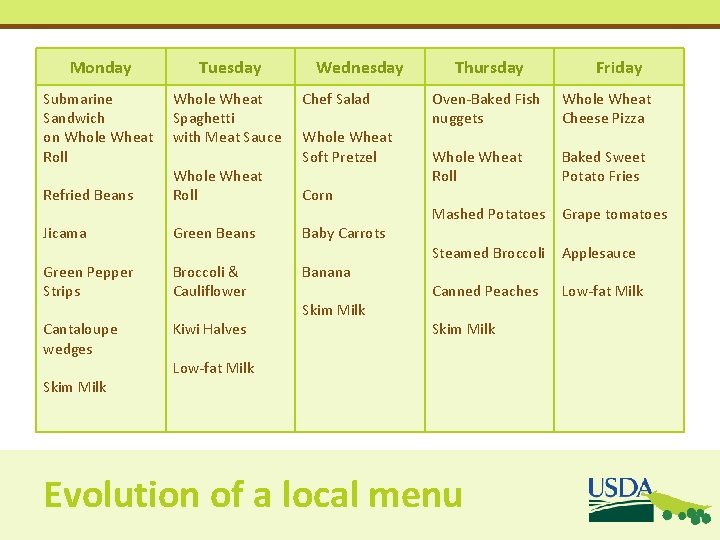
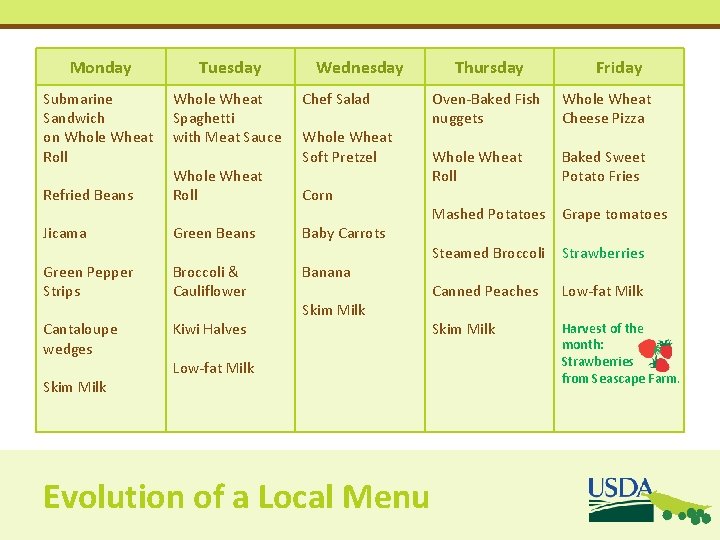
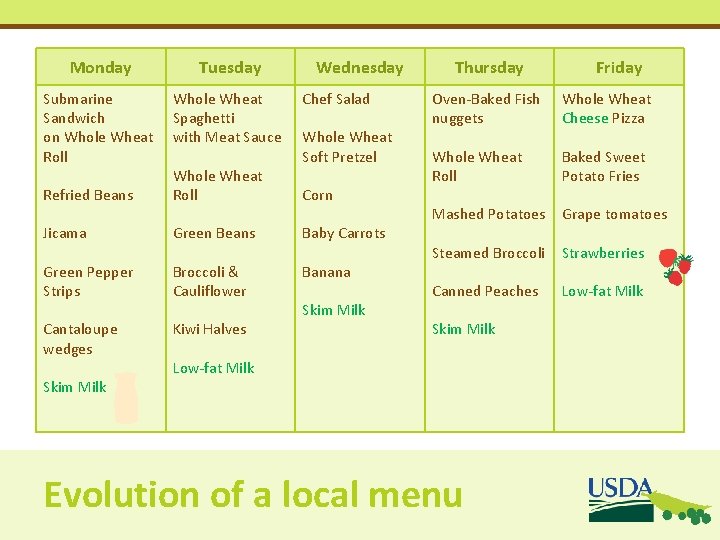
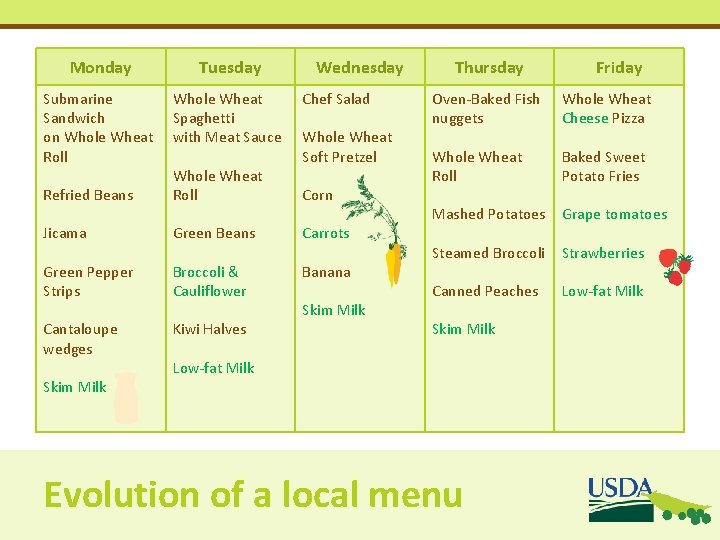
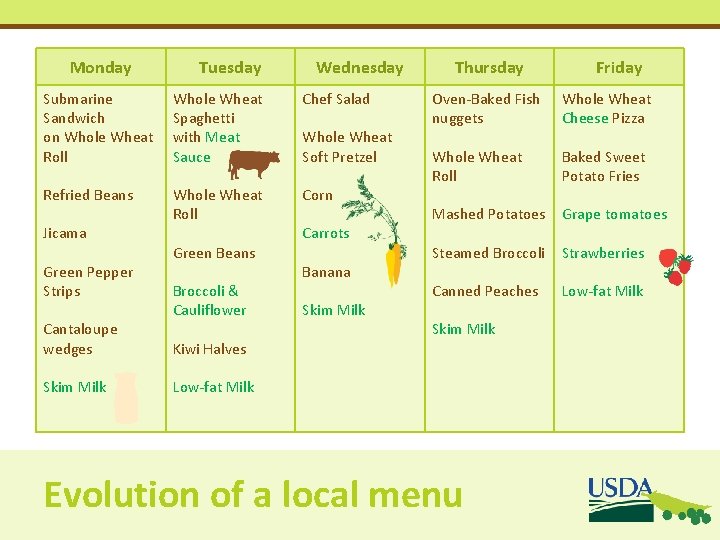
Incorporating local foods into school meals: an example
Monday Tuesday Submarine Sandwich on Whole Wheat Roll Whole Wheat Spaghetti with Meat Sauce Wednesday Chef Salad Whole Wheat Soft Pretzel Refried Beans Whole Wheat Roll Jicama Green Beans Baby Carrots Green Pepper Strips Broccoli & Cauliflower Banana Cantaloupe wedges Kiwi Halves Skim Milk Corn Skim Milk Thursday Friday Oven-Baked Fish nuggets Whole Wheat Cheese Pizza Whole Wheat Roll Baked Sweet Potato Fries Mashed Potatoes Grape tomatoes Steamed Broccoli Applesauce Canned Peaches Low-fat Milk Skim Milk Low-fat Milk Evolution of a local menu
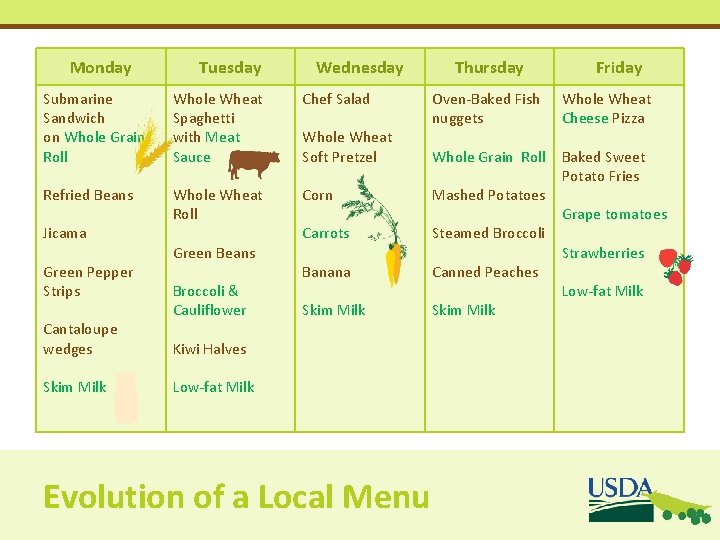
Monday Tuesday Submarine Sandwich on Whole Wheat Roll Whole Wheat Spaghetti with Meat Sauce Wednesday Chef Salad Whole Wheat Soft Pretzel Refried Beans Whole Wheat Roll Jicama Green Beans Baby Carrots Green Pepper Strips Broccoli & Cauliflower Banana Cantaloupe wedges Kiwi Halves Skim Milk Corn Skim Milk Low-fat Milk Evolution of a Local Menu Thursday Friday Oven-Baked Fish nuggets Whole Wheat Cheese Pizza Whole Wheat Roll Baked Sweet Potato Fries Mashed Potatoes Grape tomatoes Steamed Broccoli Strawberries Canned Peaches Low-fat Milk Skim Milk Harvest of the month: Strawberries from Seascape Farm.
Monday Tuesday Submarine Sandwich on Whole Wheat Roll Whole Wheat Spaghetti with Meat Sauce Wednesday Chef Salad Whole Wheat Soft Pretzel Refried Beans Whole Wheat Roll Jicama Green Beans Baby Carrots Green Pepper Strips Broccoli & Cauliflower Banana Cantaloupe wedges Kiwi Halves Skim Milk Corn Skim Milk Thursday Friday Oven-Baked Fish nuggets Whole Wheat Cheese Pizza Whole Wheat Roll Baked Sweet Potato Fries Mashed Potatoes Grape tomatoes Steamed Broccoli Strawberries Canned Peaches Low-fat Milk Skim Milk Low-fat Milk Evolution of a local menu
Monday Tuesday Submarine Sandwich on Whole Wheat Roll Whole Wheat Spaghetti with Meat Sauce Wednesday Chef Salad Whole Wheat Soft Pretzel Refried Beans Whole Wheat Roll Jicama Green Beans Carrots Green Pepper Strips Broccoli & Cauliflower Banana Cantaloupe wedges Kiwi Halves Skim Milk Corn Skim Milk Thursday Friday Oven-Baked Fish nuggets Whole Wheat Cheese Pizza Whole Wheat Roll Baked Sweet Potato Fries Mashed Potatoes Grape tomatoes Steamed Broccoli Strawberries Canned Peaches Low-fat Milk Skim Milk Low-fat Milk Evolution of a local menu
Monday Tuesday Wednesday Submarine Sandwich on Whole Wheat Roll Whole Wheat Spaghetti with Meat Sauce Chef Salad Refried Beans Whole Wheat Roll Corn Jicama Green Pepper Strips Cantaloupe wedges Skim Milk Green Beans Broccoli & Cauliflower Kiwi Halves Whole Wheat Soft Pretzel Carrots Banana Skim Milk Thursday Friday Oven-Baked Fish nuggets Whole Wheat Cheese Pizza Whole Wheat Roll Baked Sweet Potato Fries Mashed Potatoes Grape tomatoes Steamed Broccoli Strawberries Canned Peaches Low-fat Milk Skim Milk Low-fat Milk Evolution of a local menu
Monday Tuesday Wednesday Thursday Submarine Sandwich on Whole Grain Roll Whole Wheat Spaghetti with Meat Sauce Chef Salad Refried Beans Whole Wheat Roll Corn Mashed Potatoes Carrots Steamed Broccoli Banana Canned Peaches Skim Milk Jicama Green Pepper Strips Cantaloupe wedges Skim Milk Green Beans Broccoli & Cauliflower Whole Wheat Soft Pretzel Kiwi Halves Low-fat Milk Evolution of a Local Menu Friday Oven-Baked Fish nuggets Whole Wheat Cheese Pizza Whole Grain Roll Baked Sweet Potato Fries Grape tomatoes Strawberries Low-fat Milk
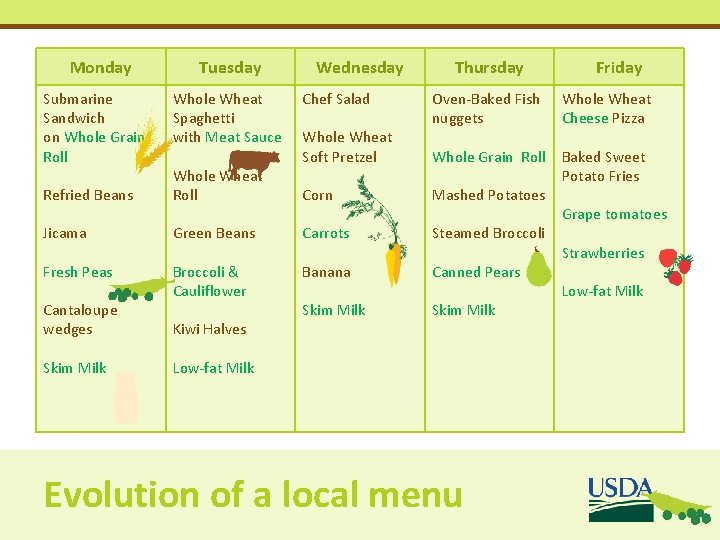
Monday Submarine Sandwich on Whole Grain Roll Tuesday Whole Wheat Spaghetti with Meat Sauce Refried Beans Whole Wheat Roll Jicama Fresh Peas Cantaloupe wedges Skim Milk Wednesday Chef Salad Whole Wheat Soft Pretzel Thursday Oven-Baked Fish nuggets Whole Wheat Cheese Pizza Whole Grain Roll Baked Sweet Potato Fries Corn Mashed Potatoes Green Beans Carrots Steamed Broccoli & Cauliflower Banana Canned Pears Skim Milk Kiwi Halves Friday Low-fat Milk Evolution of a local menu Grape tomatoes Strawberries Low-fat Milk
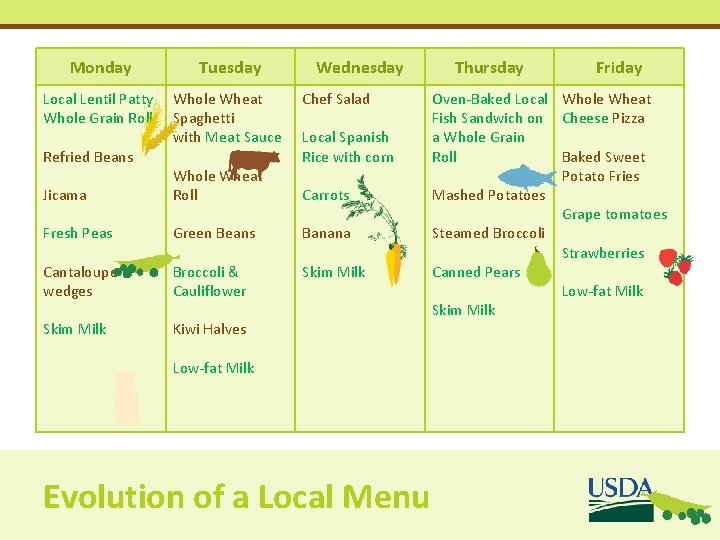
Monday Tuesday Local Lentil Patty Whole Grain Roll Whole Wheat Spaghetti with Meat Sauce Refried Beans Wednesday Chef Salad Local Spanish Rice with corn Jicama Whole Wheat Roll Fresh Peas Green Beans Banana Cantaloupe wedges Broccoli & Cauliflower Skim Milk Kiwi Halves Carrots Low-fat Milk Evolution of a Local Menu Thursday Friday Oven-Baked Local Whole Wheat Fish Sandwich on Cheese Pizza a Whole Grain Roll Baked Sweet Potato Fries Mashed Potatoes Grape tomatoes Steamed Broccoli Strawberries Canned Pears Low-fat Milk Skim Milk
Farm to school resources
Potential audiences: » Students » Teachers and administrators » Parents and community members » Farmers » The media Marketing and promotions
At www. fns. usda. gov/cnd/f 2 s: » Sign up for the USDA Farm to School E-letter » Learn more about USDA Farm to School Grants » Find arm to school related policies and policy guidance » Find contact information state farm to school coordinator and USDA staff » www. farmtoschool. org » www. schoolfoodfocus. org » www. ecoliteracy. org Resources
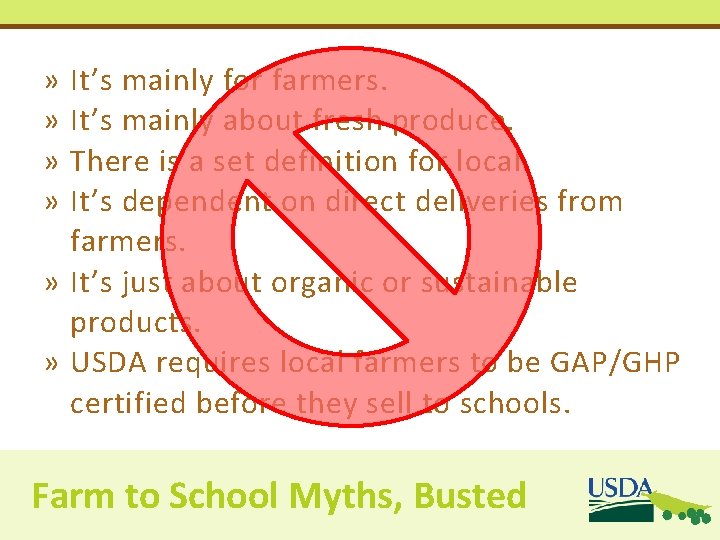
» » It’s mainly for farmers. It’s mainly about fresh produce. There is a set definition for local. It’s dependent on direct deliveries from farmers. » It’s just about organic or sustainable products. » USDA requires local farmers to be GAP/GHP certified before they sell to schools. Farm to School Myths, Busted
Thank you! Questions?