Jeep and its Commercialization A History of an
- Slides: 1
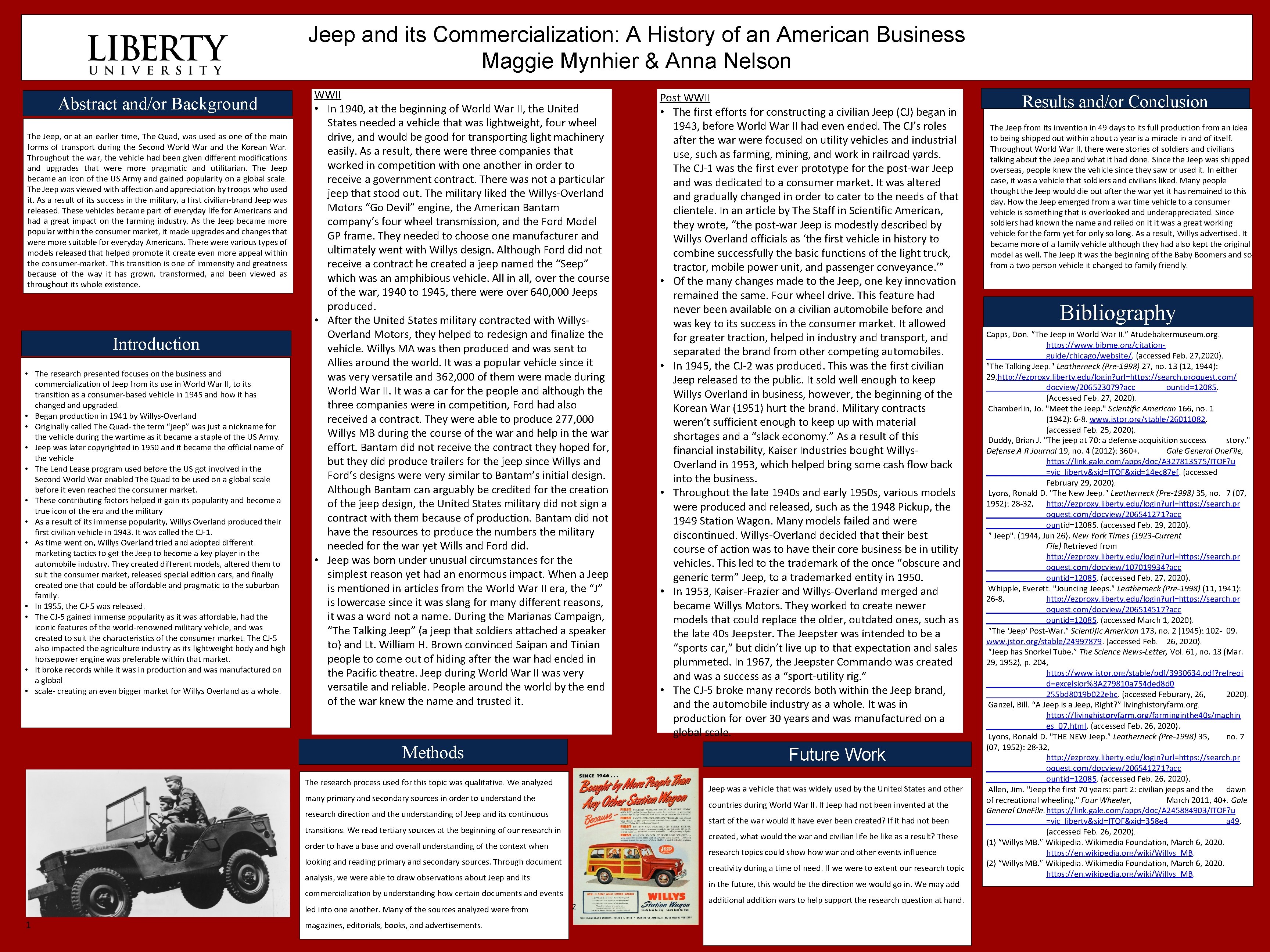
Jeep and its Commercialization: A History of an American Business Maggie Mynhier & Anna Nelson Abstract and/or Background The Jeep, or at an earlier time, The Quad, was used as one of the main forms of transport during the Second World War and the Korean War. Throughout the war, the vehicle had been given different modifications and upgrades that were more pragmatic and utilitarian. The Jeep became an icon of the US Army and gained popularity on a global scale. The Jeep was viewed with affection and appreciation by troops who used it. As a result of its success in the military, a first civilian-brand Jeep was released. These vehicles became part of everyday life for Americans and had a great impact on the farming industry. As the Jeep became more popular within the consumer market, it made upgrades and changes that were more suitable for everyday Americans. There were various types of models released that helped promote it create even more appeal within the consumer-market. This transition is one of immensity and greatness because of the way it has grown, transformed, and been viewed as throughout its whole existence. Introduction • The research presented focuses on the business and commercialization of Jeep from its use in World War II, to its transition as a consumer-based vehicle in 1945 and how it has changed and upgraded. • Began production in 1941 by Willys-Overland • Originally called The Quad- the term “jeep” was just a nickname for the vehicle during the wartime as it became a staple of the US Army. • Jeep was later copyrighted in 1950 and it became the official name of the vehicle • The Lend Lease program used before the US got involved in the Second World War enabled The Quad to be used on a global scale before it even reached the consumer market. • These contributing factors helped it gain its popularity and become a true icon of the era and the military • As a result of its immense popularity, Willys Overland produced their first civilian vehicle in 1943. It was called the CJ-1. • As time went on, Willys Overland tried and adopted different marketing tactics to get the Jeep to become a key player in the automobile industry. They created different models, altered them to suit the consumer market, released special edition cars, and finally created one that could be affordable and pragmatic to the suburban family. • In 1955, the CJ-5 was released. • The CJ-5 gained immense popularity as it was affordable, had the iconic features of the world-renowned military vehicle, and was created to suit the characteristics of the consumer market. The CJ-5 also impacted the agriculture industry as its lightweight body and high horsepower engine was preferable within that market. • It broke records while it was in production and was manufactured on a global • scale- creating an even bigger market for Willys Overland as a whole. WWII • In 1940, at the beginning of World War II, the United States needed a vehicle that was lightweight, four wheel drive, and would be good for transporting light machinery easily. As a result, there were three companies that worked in competition with one another in order to receive a government contract. There was not a particular jeep that stood out. The military liked the Willys-Overland Motors “Go Devil” engine, the American Bantam company’s four wheel transmission, and the Ford Model GP frame. They needed to choose one manufacturer and ultimately went with Willys design. Although Ford did not receive a contract he created a jeep named the “Seep” which was an amphibious vehicle. All in all, over the course of the war, 1940 to 1945, there were over 640, 000 Jeeps produced. • After the United States military contracted with Willys- Overland Motors, they helped to redesign and finalize the vehicle. Willys MA was then produced and was sent to Allies around the world. It was a popular vehicle since it was very versatile and 362, 000 of them were made during World War II. It was a car for the people and although the three companies were in competition, Ford had also received a contract. They were able to produce 277, 000 Willys MB during the course of the war and help in the war effort. Bantam did not receive the contract they hoped for, but they did produce trailers for the jeep since Willys and Ford’s designs were very similar to Bantam’s initial design. Although Bantam can arguably be credited for the creation of the jeep design, the United States military did not sign a contract with them because of production. Bantam did not have the resources to produce the numbers the military needed for the war yet Wills and Ford did. • Jeep was born under unusual circumstances for the simplest reason yet had an enormous impact. When a Jeep is mentioned in articles from the World War II era, the “J” is lowercase since it was slang for many different reasons, it was a word not a name. During the Marianas Campaign, “The Talking Jeep” (a jeep that soldiers attached a speaker to) and Lt. William H. Brown convinced Saipan and Tinian people to come out of hiding after the war had ended in the Pacific theatre. Jeep during World War II was very versatile and reliable. People around the world by the end of the war knew the name and trusted it. Methods Jeep was a vehicle that was widely used by the United States and other many primary and secondary sources in order to understand the countries during World War II. If Jeep had not been invented at the research direction and the understanding of Jeep and its continuous start of the war would it have ever been created? If it had not been transitions. We read tertiary sources at the beginning of our research in created, what would the war and civilian life be like as a result? These order to have a base and overall understanding of the context when research topics could show war and other events influence looking and reading primary and secondary sources. Through document creativity during a time of need. If we were to extent our research topic analysis, we were able to draw observations about Jeep and its in the future, this would be the direction we would go in. We may add commercialization by understanding how certain documents and events 1 magazines, editorials, books, and advertisements. Future Work The research process used for this topic was qualitative. We analyzed led into one another. Many of the sources analyzed were from Post WWII • The first efforts for constructing a civilian Jeep (CJ) began in 1943, before World War II had even ended. The CJ’s roles after the war were focused on utility vehicles and industrial use, such as farming, mining, and work in railroad yards. The CJ-1 was the first ever prototype for the post-war Jeep and was dedicated to a consumer market. It was altered and gradually changed in order to cater to the needs of that clientele. In an article by The Staff in Scientific American, they wrote, “the post-war Jeep is modestly described by Willys Overland officials as ‘the first vehicle in history to combine successfully the basic functions of the light truck, tractor, mobile power unit, and passenger conveyance. ’” • Of the many changes made to the Jeep, one key innovation remained the same. Four wheel drive. This feature had never been available on a civilian automobile before and was key to its success in the consumer market. It allowed for greater traction, helped in industry and transport, and separated the brand from other competing automobiles. • In 1945, the CJ-2 was produced. This was the first civilian Jeep released to the public. It sold well enough to keep Willys Overland in business, however, the beginning of the Korean War (1951) hurt the brand. Military contracts weren’t sufficient enough to keep up with material shortages and a “slack economy. ” As a result of this financial instability, Kaiser Industries bought Willys. Overland in 1953, which helped bring some cash flow back into the business. • Throughout the late 1940 s and early 1950 s, various models were produced and released, such as the 1948 Pickup, the 1949 Station Wagon. Many models failed and were discontinued. Willys-Overland decided that their best course of action was to have their core business be in utility vehicles. This led to the trademark of the once “obscure and generic term” Jeep, to a trademarked entity in 1950. • In 1953, Kaiser-Frazier and Willys-Overland merged and became Willys Motors. They worked to create newer models that could replace the older, outdated ones, such as the late 40 s Jeepster. The Jeepster was intended to be a “sports car, ” but didn’t live up to that expectation and sales plummeted. In 1967, the Jeepster Commando was created and was a success as a “sport-utility rig. ” • The CJ-5 broke many records both within the Jeep brand, and the automobile industry as a whole. It was in production for over 30 years and was manufactured on a global scale. 2 additional addition wars to help support the research question at hand. Results and/or Conclusion Results The Jeep from its invention in 49 days to its full production from an idea to being shipped out within about a year is a miracle in and of itself. Throughout World War II, there were stories of soldiers and civilians talking about the Jeep and what it had done. Since the Jeep was shipped overseas, people knew the vehicle since they saw or used it. In either case, it was a vehicle that soldiers and civilians liked. Many people thought the Jeep would die out after the war yet it has remained to this day. How the Jeep emerged from a war time vehicle to a consumer vehicle is something that is overlooked and underappreciated. Since soldiers had known the name and relied on it it was a great working vehicle for the farm yet for only so long. As a result, Willys advertised. It became more of a family vehicle although they had also kept the original model as well. The Jeep It was the beginning of the Baby Boomers and so from a two person vehicle it changed to family friendly. Bibliography Capps, Don. “The Jeep in World War II. ” Atudebakermuseum. org. https: //www. bibme. org/citationguide/chicago/website/. (accessed Feb. 27, 2020). "The Talking Jeep. " Leatherneck (Pre-1998) 27, no. 13 (12, 1944): 29, http: //ezproxy. liberty. edu/login? url=https: //search. proquest. com/ docview/206523079? acc ountid=12085. (Accessed Feb. 27, 2020). Chamberlin, Jo. "Meet the Jeep. " Scientific American 166, no. 1 (1942): 6 -8. www. jstor. org/stable/26011082. (accessed Feb. 25, 2020). Duddy, Brian J. "The jeep at 70: a defense acquisition success story. " Defense A R Journal 19, no. 4 (2012): 360+. Gale General One. File, https: //link. gale. com/apps/doc/A 327813575/ITOF? u =vic_liberty&sid=ITOF&xid=14 ec 87 ef. (accessed February 29, 2020). Lyons, Ronald D. "The New Jeep. " Leatherneck (Pre-1998) 35, no. 7 (07, 1952): 28 -32, http: //ezproxy. liberty. edu/login? url=https: //search. pr oquest. com/docview/206541271? acc ountid=12085. (accessed Feb. 29, 2020). " Jeep". (1944, Jun 26). New York Times (1923 -Current File) Retrieved from http: //ezproxy. liberty. edu/login? url=https: //search. pr oquest. com/docview/107019934? acc ountid=12085. (accessed Feb. 27, 2020). Whipple, Everett. "Jouncing Jeeps. " Leatherneck (Pre-1998) (11, 1941): 26 -8, http: //ezproxy. liberty. edu/login? url=https: //search. pr oquest. com/docview/206514517? acc ountid=12085. (accessed March 1, 2020). "The ‘Jeep’ Post-War. " Scientific American 173, no. 2 (1945): 102 - 09. www. jstor. org/stable/24997879. (accessed Feb. 26, 2020). “Jeep has Snorkel Tube. ” The Science News-Letter, Vol. 61, no. 13 (Mar. 29, 1952), p. 204, https: //www. jstor. org/stable/pdf/3930634. pdf? refreqi d=excelsior%3 A 279810 a 754 ded 8 d 0 255 bd 8019 b 022 ebc. (accessed Feburary, 26, 2020). Ganzel, Bill. “A Jeep is a Jeep, Right? ” livinghistoryfarm. org. https: //livinghistoryfarm. org/farminginthe 40 s/machin es_07. html. (accessed Feb. 26, 2020). Lyons, Ronald D. "THE NEW Jeep. " Leatherneck (Pre-1998) 35, no. 7 (07, 1952): 28 -32, http: //ezproxy. liberty. edu/login? url=https: //search. pr oquest. com/docview/206541271? acc ountid=12085. (accessed Feb. 26, 2020). Allen, Jim. "Jeep the first 70 years: part 2: civilian jeeps and the dawn of recreational wheeling. " Four Wheeler, March 2011, 40+. Gale General One. File. https: //link. gale. com/apps/doc/A 245884903/ITOF? u =vic_liberty&sid=ITOF&xid=358 e 4 a 49. (accessed Feb. 26, 2020). (1) “Willys MB. ” Wikipedia. Wikimedia Foundation, March 6, 2020. https: //en. wikipedia. org/wiki/Willys_MB. (2) “Willys MB. ” Wikipedia. Wikimedia Foundation, March 6, 2020. https: //en. wikipedia. org/wiki/Willys_MB.