
Exploring the Fourth Dimension Maggie Bernard May 8
Exploring the Fourth Dimension Maggie Bernard May 8, 2012
History • Georg Friedrich Bernhard Riemann – introduction of the fourth dimension in geometry • Möbius - turn a three-dimensional object into its mirror image by an appropriate rotation through four -dimensional space • W. I Stringham – six regular polytopes • Hermann Minkowski – space/time continuum
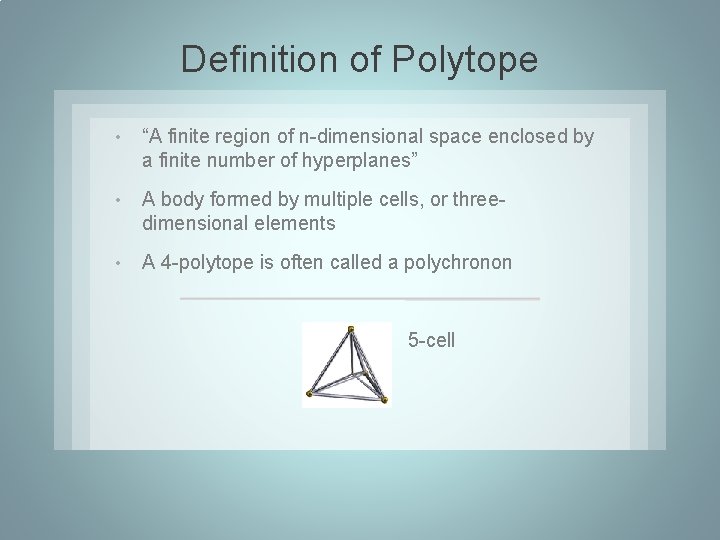
Definition of Polytope • “A finite region of n-dimensional space enclosed by a finite number of hyperplanes” • A body formed by multiple cells, or threedimensional elements • A 4 -polytope is often called a polychronon 5 -cell
Hypersphere • Sphere lying in R 4 • The set of points (x 1, x 2, x 3, x 4) such that x 12 + x 22 + x 32 + x 42 = R 2, where R is the radius of the hypersphere • Cross sections are spheres • • Dimensional analysis: circle, sphere, hypersphere Gluing together 3 -balls • Glue together along boundary, which is a 2 -sphere. We are not gluing together the interior.

Hypersphere: Stereographic Projection • Hypersphere maps to R 3 • Send the South Pole to the origin of R 3 • Points send us further and further from origin • The North Pole is sent to infinity

Visualization 1. Vectors: • The four standard basic vectors that can be used to reach any point in R 4 are as follows: 1 0 0 0 0 1
Visualization 2. Adding time three-dimensional universe • Example 1: Building a sphere using 2 -D circles and time • Example 2: Building a hypersphere using 3 -D spheres and time
Dimensional Analysis 1. Shadows: A four dimensional body casts a three dimensional shadow 2. Bounding curves: A four dimensional body is body by three dimensional surfaces
Euler Characteristic • Can also use dimensional analysis to determine the Euler characteristic equation for four dimensional bodies: • A two dimensional object has a Euler characteristic of V-E=0 • A three dimensional surface has a X=V-E+F=2 • A four dimensional body has a X=V-E+F-C=0, where c = number of cells
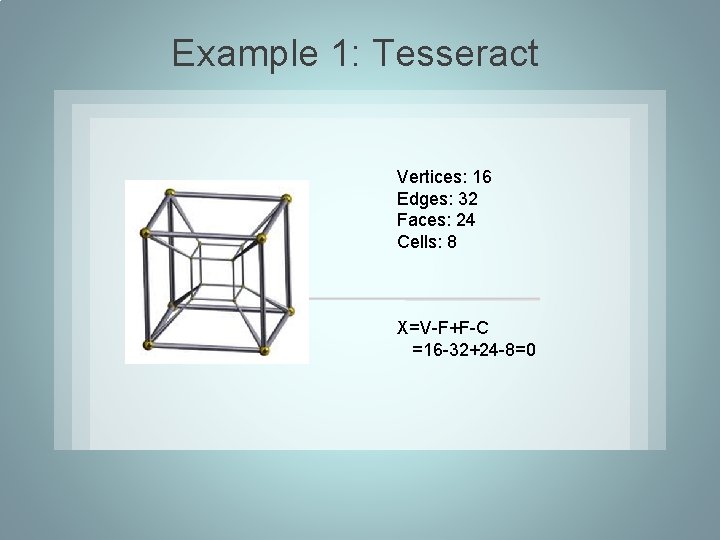
Example 1: Tesseract Vertices: 16 Edges: 32 Faces: 24 Cells: 8 X=V-F+F-C =16 -32+24 -8=0
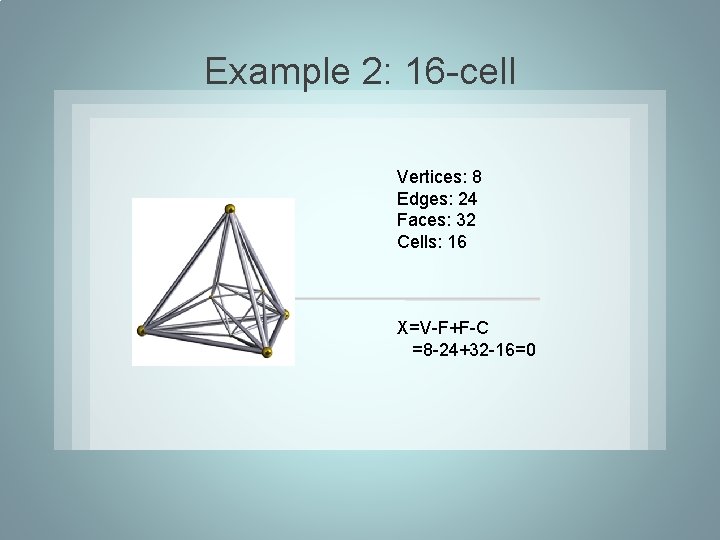
Example 2: 16 -cell Vertices: 8 Edges: 24 Faces: 32 Cells: 16 X=V-F+F-C =8 -24+32 -16=0
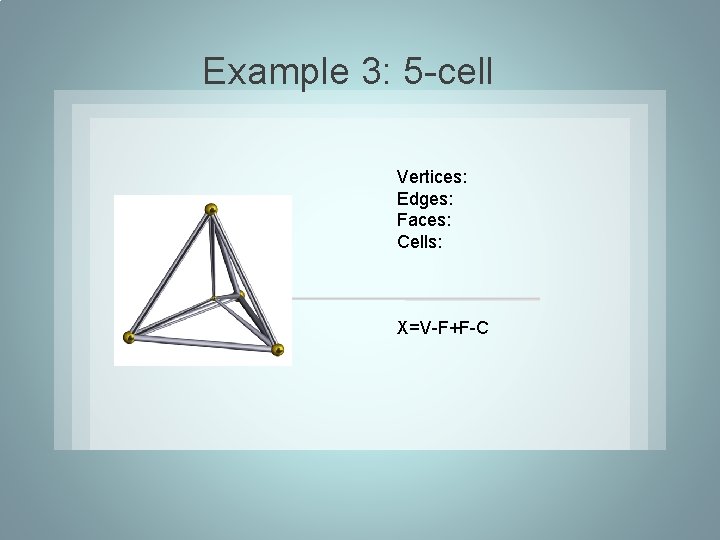
Example 3: 5 -cell Vertices: Edges: Faces: Cells: X=V-F+F-C
- Slides: 12