
Cancer Care Workforce Challenges Can System Changes Enhance

- Slides: 34
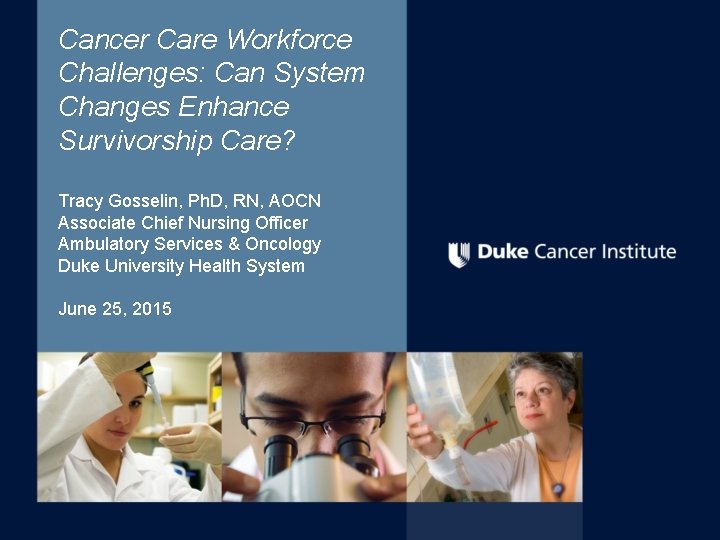
Cancer Care Workforce Challenges: Can System Changes Enhance Survivorship Care? Tracy Gosselin, Ph. D, RN, AOCN Associate Chief Nursing Officer Ambulatory Services & Oncology Duke University Health System June 25, 2015
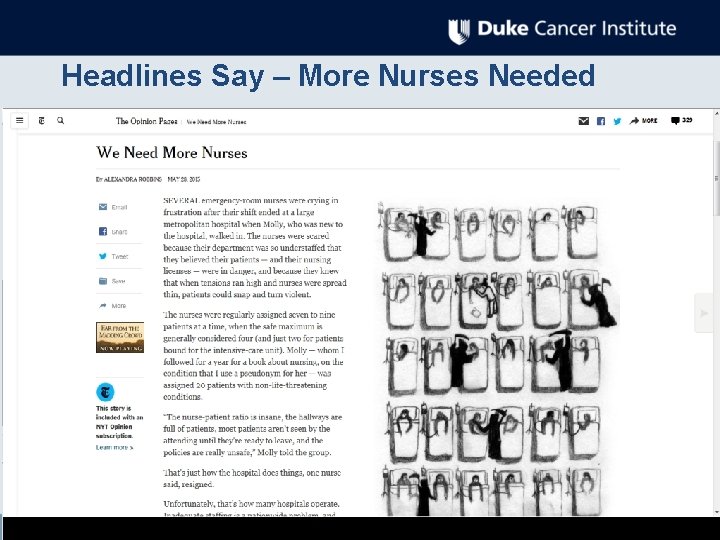
Headlines Say – More Nurses Needed 2 All Rights Reserved, Duke Medicine 2011
DRIVERS OF CHANGE 3 All Rights Reserved, Duke Medicine 2011
IOM – Crossing the Quality Chasms • Better care for individuals: – Safety – Effectiveness – Patient-centeredness – Timeliness – Efficiency – Equity IOM. (2001). Crossing the Quality Chasm. All Rights Reserved, Duke Medicine 2011
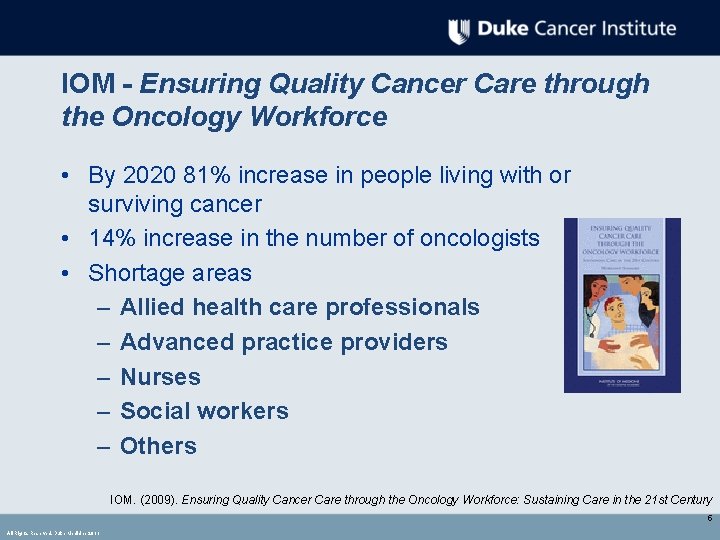
IOM - Ensuring Quality Cancer Care through the Oncology Workforce • By 2020 81% increase in people living with or surviving cancer • 14% increase in the number of oncologists • Shortage areas – Allied health care professionals – Advanced practice providers – Nurses – Social workers – Others IOM. (2009). Ensuring Quality Cancer Care through the Oncology Workforce: Sustaining Care in the 21 st Century 5 All Rights Reserved, Duke Medicine 2011
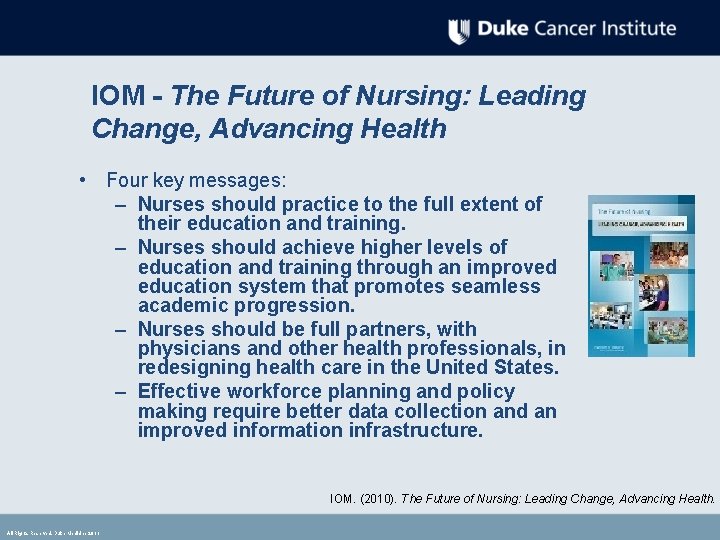
IOM - The Future of Nursing: Leading Change, Advancing Health • Four key messages: – Nurses should practice to the full extent of their education and training. – Nurses should achieve higher levels of education and training through an improved education system that promotes seamless academic progression. – Nurses should be full partners, with physicians and other health professionals, in redesigning health care in the United States. – Effective workforce planning and policy making require better data collection and an improved information infrastructure. IOM. (2010). The Future of Nursing: Leading Change, Advancing Health. All Rights Reserved, Duke Medicine 2011
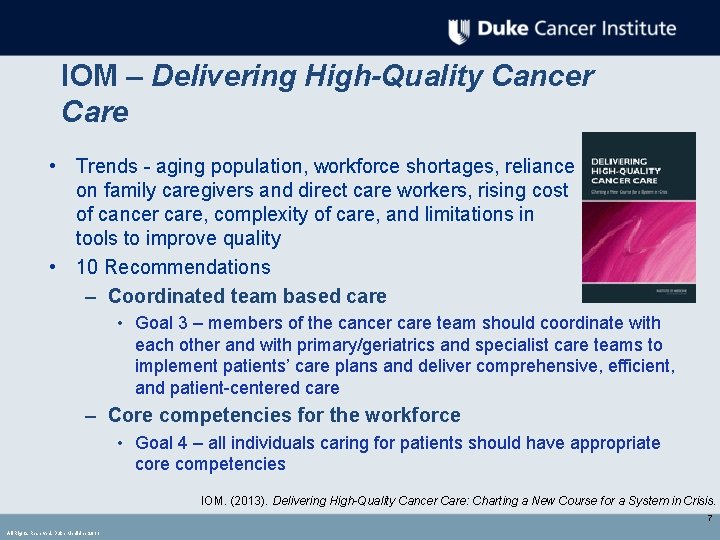
IOM – Delivering High-Quality Cancer Care • Trends - aging population, workforce shortages, reliance on family caregivers and direct care workers, rising cost of cancer care, complexity of care, and limitations in tools to improve quality • 10 Recommendations – Coordinated team based care • Goal 3 – members of the cancer care team should coordinate with each other and with primary/geriatrics and specialist care teams to implement patients’ care plans and deliver comprehensive, efficient, and patient-centered care – Core competencies for the workforce • Goal 4 – all individuals caring for patients should have appropriate core competencies IOM. (2013). Delivering High-Quality Cancer Care: Charting a New Course for a System in Crisis. 7 All Rights Reserved, Duke Medicine 2011
IOM – Delivering High-Quality Cancer Care – Recommendation 3 • Federal and state legislative and regulatory bodies should eliminate reimbursement and scope-ofpractice barriers to team-based care • Academic institutions and professional societies should develop interprofessional education programs to train the workforce in team-based cancer care and promote coordination with primary/geriatrics and specialist care teams • Congress should fund the National Workforce Commission IOM. (2013). Delivering High-Quality Cancer Care: Charting a New Course for a System in Crisis. 8 All Rights Reserved, Duke Medicine 2011
IOM – Delivering High-Quality Cancer Care – Recommendation 4 • Professional organizations that represent clinicians who care for patients with cancer should define cancer core competencies for their membership • Cancer care delivery organizations should require that the members of the cancer care team have the necessary competencies to deliver high-quality cancer care, as demonstrated through training, certification, or credentials • Organizations responsible for accreditation, certification, and training of non-oncology clinicians should promote the development of relevant core competencies across the cancer care continuum • The US Dept. of HHS and other funders should finance demonstration projects to train family caregivers and direct-care workers in relevant core competencies related to caring for cancer patients IOM. (2013). Delivering High-Quality Cancer Care: Charting a New Course for a System in Crisis. 9 All Rights Reserved, Duke Medicine 2011
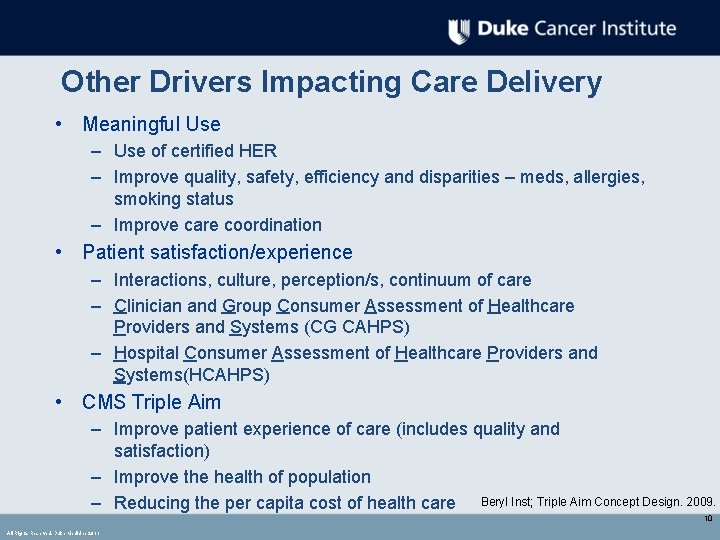
Other Drivers Impacting Care Delivery • Meaningful Use – Use of certified HER – Improve quality, safety, efficiency and disparities – meds, allergies, smoking status – Improve care coordination • Patient satisfaction/experience – Interactions, culture, perception/s, continuum of care – Clinician and Group Consumer Assessment of Healthcare Providers and Systems (CG CAHPS) – Hospital Consumer Assessment of Healthcare Providers and Systems(HCAHPS) • CMS Triple Aim – Improve patient experience of care (includes quality and satisfaction) – Improve the health of population – Reducing the per capita cost of health care Beryl Inst; Triple Aim Concept Design. 2009. 10 All Rights Reserved, Duke Medicine 2011
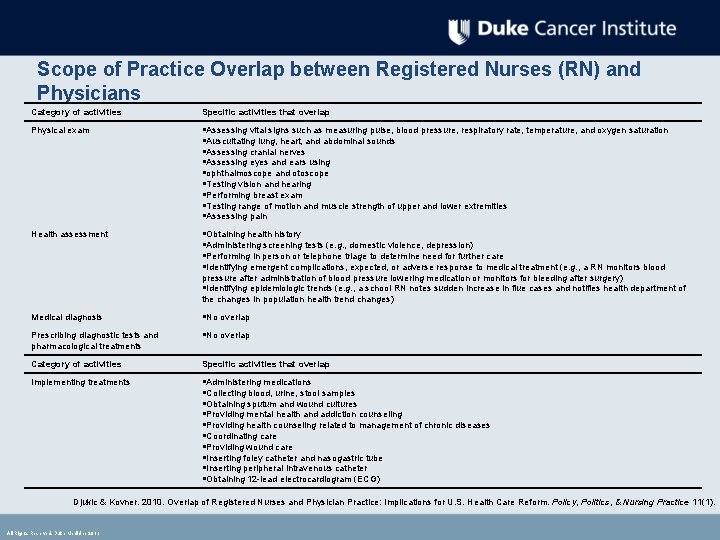
Scope of Practice Overlap between Registered Nurses (RN) and Physicians Category of activities Specific activities that overlap Physical exam Assessing vital signs such as measuring pulse, blood pressure, respiratory rate, temperature, and oxygen saturation Auscultating lung, heart, and abdominal sounds Assessing cranial nerves Assessing eyes and ears using ophthalmoscope and otoscope Testing vision and hearing Performing breast exam Testing range of motion and muscle strength of upper and lower extremities Assessing pain Health assessment Obtaining health history Administering screening tests (e. g. , domestic violence, depression) Performing in person or telephone triage to determine need for further care Identifying emergent complications, expected, or adverse response to medical treatment (e. g. , a RN monitors blood pressure after administration of blood pressure lowering medication or monitors for bleeding after surgery) Identifying epidemiologic trends (e. g. , a school RN notes sudden increase in flue cases and notifies health department of the changes in population health trend changes) Medical diagnosis No overlap Prescribing diagnostic tests and pharmacological treatments No overlap Category of activities Specific activities that overlap Implementing treatments Administering medications Collecting blood, urine, stool samples Obtaining sputum and wound cultures Providing mental health and addiction counseling Providing health counseling related to management of chronic diseases Coordinating care Providing wound care Inserting foley catheter and nasogastric tube Inserting peripheral intravenous catheter Obtaining 12 -lead electrocardiogram (ECG) Djukic & Kovner. 2010. Overlap of Registered Nurses and Physician Practice: Implications for U. S. Health Care Reform. Policy, Politics, & Nursing Practice 11(1). All Rights Reserved, Duke Medicine 2011
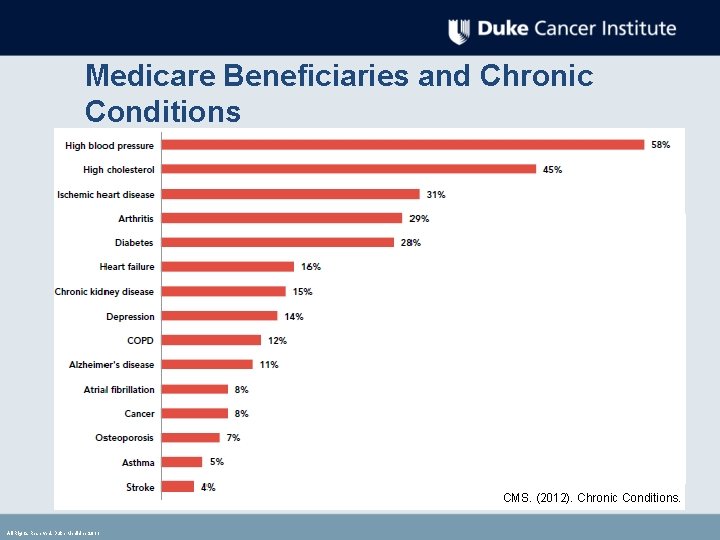
Medicare Beneficiaries and Chronic Conditions D A A Aa A CMS. (2012). Chronic Conditions. All Rights Reserved, Duke Medicine 2011
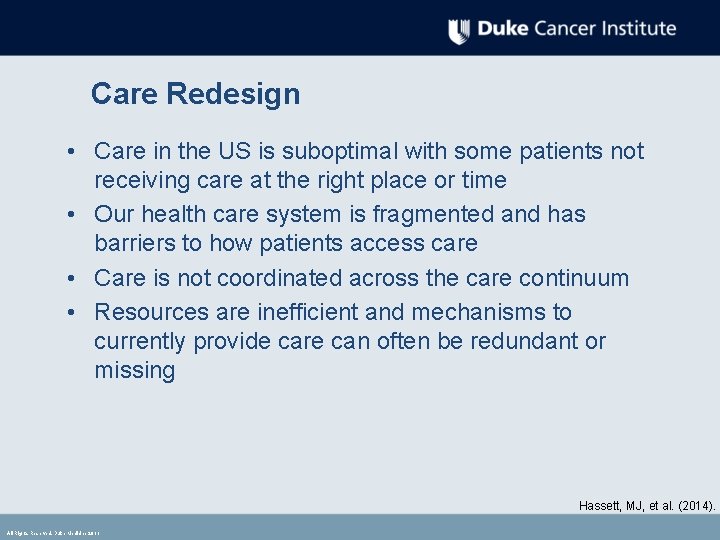
Care Redesign • Care in the US is suboptimal with some patients not receiving care at the right place or time • Our health care system is fragmented and has barriers to how patients access care • Care is not coordinated across the care continuum • Resources are inefficient and mechanisms to currently provide care can often be redundant or missing Hassett, MJ, et al. (2014). All Rights Reserved, Duke Medicine 2011
WORKFORCE TRENDS All Rights Reserved, Duke Medicine 2011
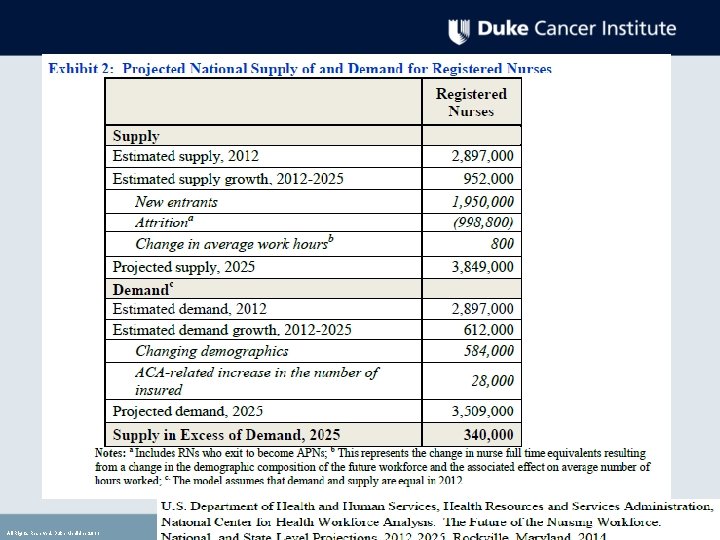
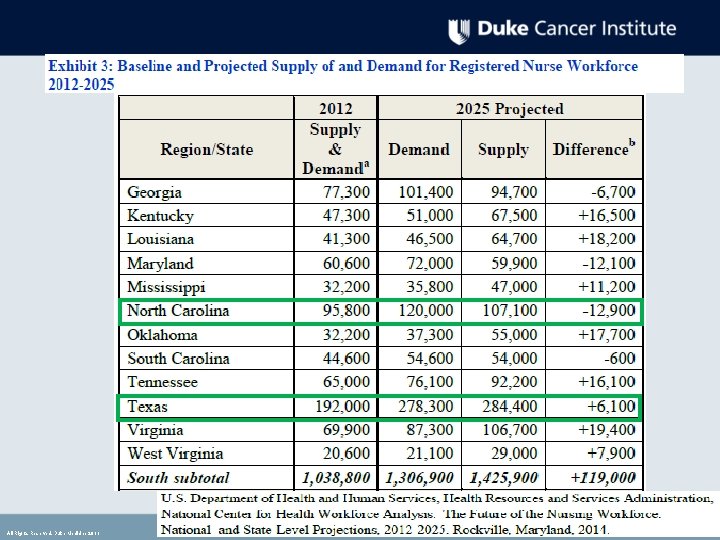
Future of the Nursing Workforce • Nationally, the change in RN supply between 2012 and 2025 is projected to outpace demand. • Approximately 2. 9 million RNs were active in the workforce in 2012. Consistent with standard workforce research methodology, the Health Workforce Simulation Model assumes that the RN demand in 2012 equals the RN supply. • Assuming RNs continue to train at the current levels and accounting for new entrants and attrition, the RN supply is expected to grow by 952, 000 full-time equivalents (FTEs) – from 2, 897, 000 FTEs in 2012 to 3, 849, 000 FTEs in 2025 – a 33 percent increase nationally. http: //bhpr. hrsa. gov/healthworkforce/supplydemand/nursing/workforceprojections/nursingprojections. pdf 15 All Rights Reserved, Duke Medicine 2011
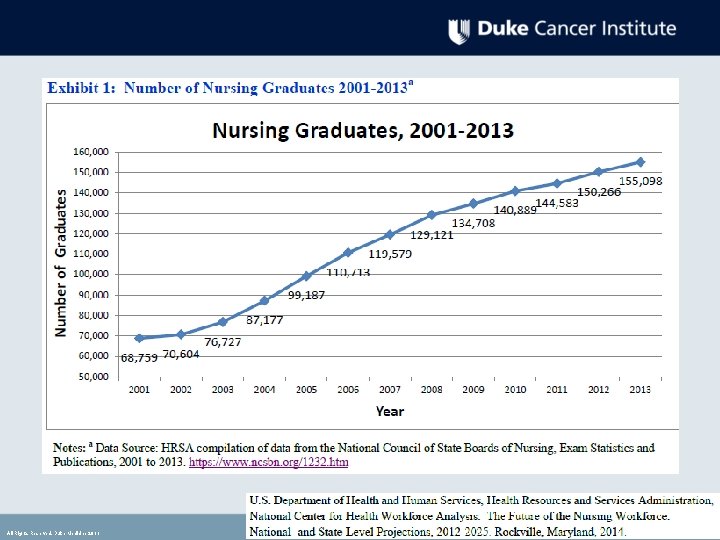
Future of the Nursing Workforce • The nationwide demand for RNs, however, is projected to grow by only 612, 000 FTEs – from 2, 897, 000 FTEs in 2012 to 3, 509, 000 FTEs in 2025 – a 21 percent increase. • The number of new graduates that entered the workforce has substantially increased from approximately 68, 000 individuals in 2001 to more than 150, 000 in 2012 and in 2013. • While not considered in this study, emerging care delivery models, with a focus on managing health status and preventing acute health issues, will likely contribute to new growth in demand for nurses, e. g. , nurses taking on new and/or expanded roles in preventive care and care coordination. http: //bhpr. hrsa. gov/healthworkforce/supplydemand/nursing/workforceprojections/nursingprojections. pdf 16 All Rights Reserved, Duke Medicine 2011
All Rights Reserved, Duke Medicine 2011
All Rights Reserved, Duke Medicine 2011
All Rights Reserved, Duke Medicine 2011
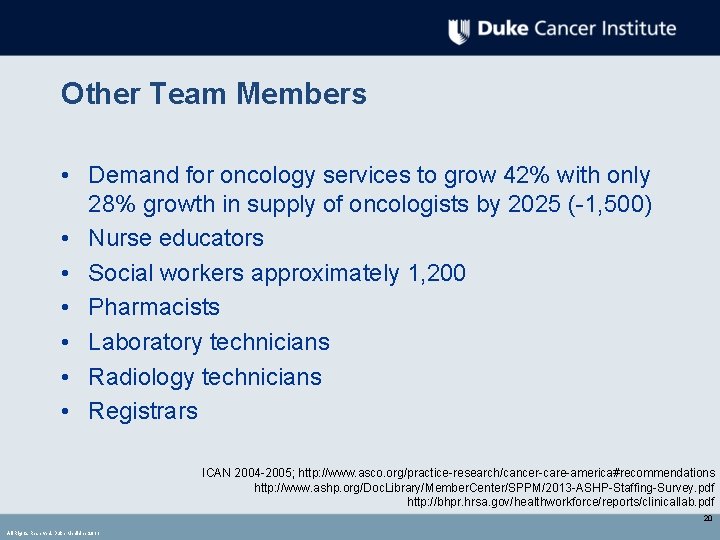
Other Team Members • Demand for oncology services to grow 42% with only 28% growth in supply of oncologists by 2025 (-1, 500) • Nurse educators • Social workers approximately 1, 200 • Pharmacists • Laboratory technicians • Radiology technicians • Registrars ICAN 2004 -2005; http: //www. asco. org/practice-research/cancer-care-america#recommendations http: //www. ashp. org/Doc. Library/Member. Center/SPPM/2013 -ASHP-Staffing-Survey. pdf http: //bhpr. hrsa. gov/healthworkforce/reports/clinicallab. pdf 20 All Rights Reserved, Duke Medicine 2011
STRATEGIES 21 All Rights Reserved, Duke Medicine 2011
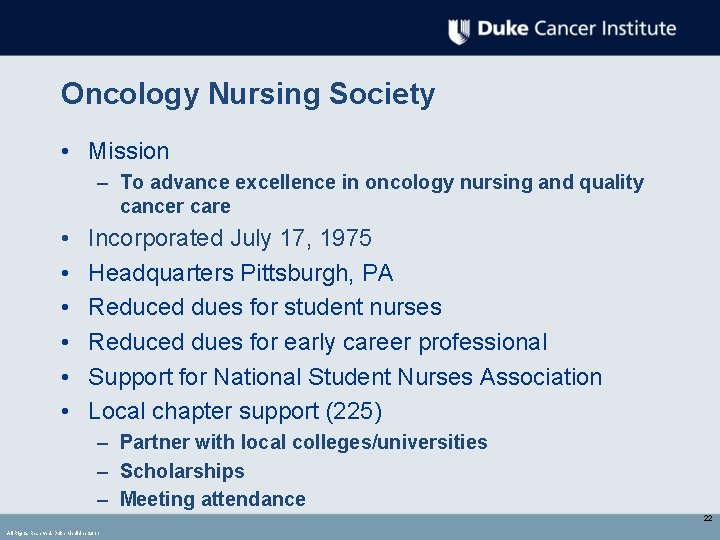
Oncology Nursing Society • Mission – To advance excellence in oncology nursing and quality cancer care • • • Incorporated July 17, 1975 Headquarters Pittsburgh, PA Reduced dues for student nurses Reduced dues for early career professional Support for National Student Nurses Association Local chapter support (225) – Partner with local colleges/universities – Scholarships – Meeting attendance 22 All Rights Reserved, Duke Medicine 2011
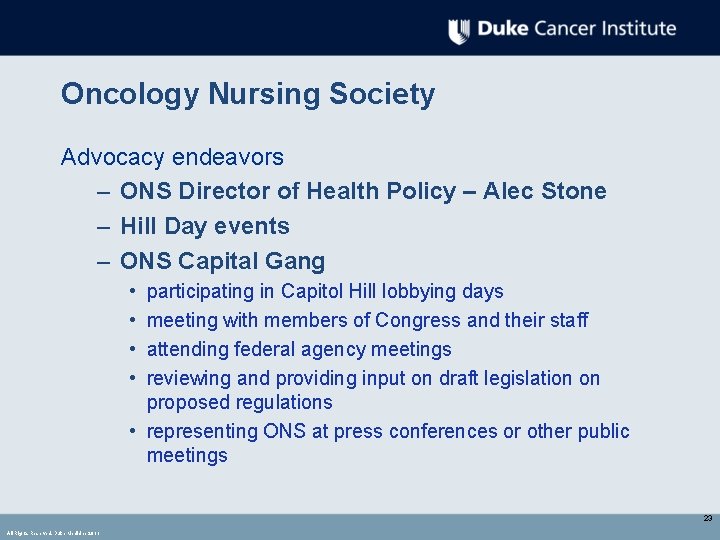
Oncology Nursing Society Advocacy endeavors – ONS Director of Health Policy – Alec Stone – Hill Day events – ONS Capital Gang • • participating in Capitol Hill lobbying days meeting with members of Congress and their staff attending federal agency meetings reviewing and providing input on draft legislation on proposed regulations • representing ONS at press conferences or other public meetings 23 All Rights Reserved, Duke Medicine 2011
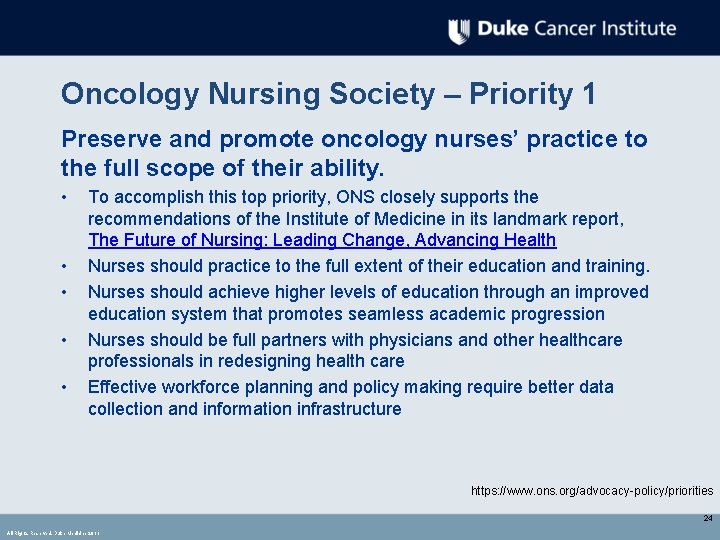
Oncology Nursing Society – Priority 1 Preserve and promote oncology nurses’ practice to the full scope of their ability. • • • To accomplish this top priority, ONS closely supports the recommendations of the Institute of Medicine in its landmark report, The Future of Nursing: Leading Change, Advancing Health Nurses should practice to the full extent of their education and training. Nurses should achieve higher levels of education through an improved education system that promotes seamless academic progression Nurses should be full partners with physicians and other healthcare professionals in redesigning health care Effective workforce planning and policy making require better data collection and information infrastructure https: //www. ons. org/advocacy-policy/priorities 24 All Rights Reserved, Duke Medicine 2011
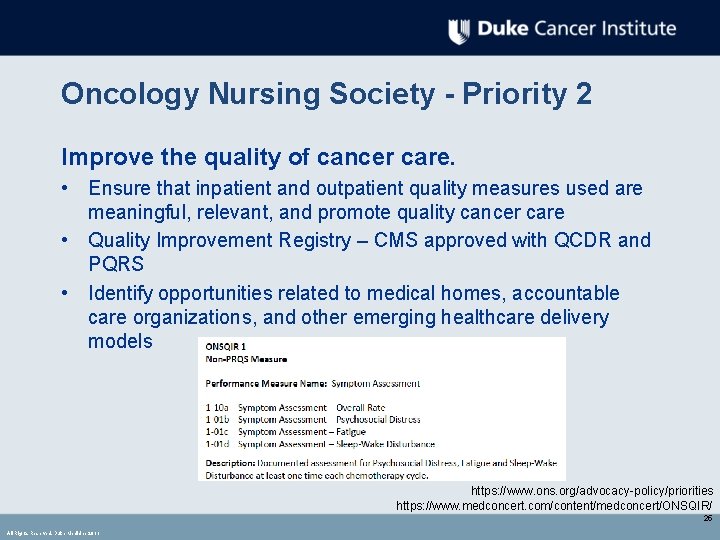
Oncology Nursing Society - Priority 2 Improve the quality of cancer care. • Ensure that inpatient and outpatient quality measures used are meaningful, relevant, and promote quality cancer care • Quality Improvement Registry – CMS approved with QCDR and PQRS • Identify opportunities related to medical homes, accountable care organizations, and other emerging healthcare delivery models https: //www. ons. org/advocacy-policy/priorities https: //www. medconcert. com/content/medconcert/ONSQIR/ 25 All Rights Reserved, Duke Medicine 2011
Oncology Nursing Society – Priority 3 Advocate for payment models that incorporate the work of oncology nurses and positively impact oncology practice. • Ensure adequate reimbursement of nursing care in CMS processes to develop chronic care management codes and payment schedules • Impact decision making and rules for the Centers for Medicare and Medicaid Services (CMS) value-based purchasing initiatives https: //www. ons. org/advocacy-policy/priorities 26 All Rights Reserved, Duke Medicine 2011
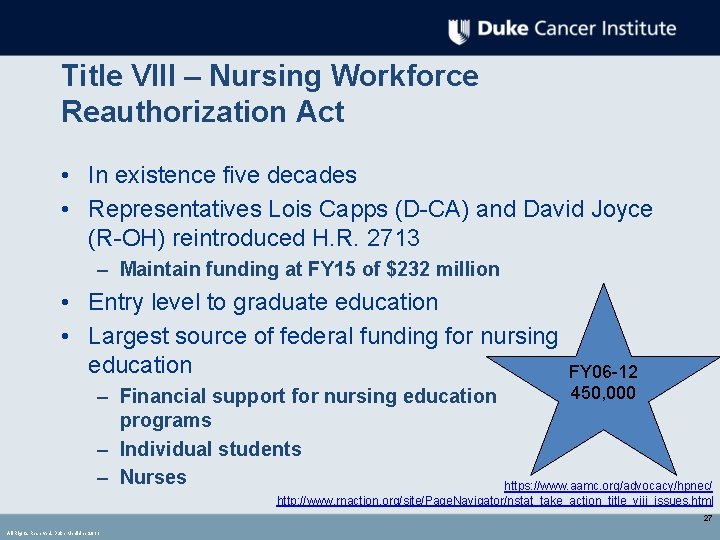
Title VIII – Nursing Workforce Reauthorization Act • In existence five decades • Representatives Lois Capps (D-CA) and David Joyce (R-OH) reintroduced H. R. 2713 – Maintain funding at FY 15 of $232 million • Entry level to graduate education • Largest source of federal funding for nursing education FY 06 -12 450, 000 – Financial support for nursing education programs – Individual students – Nurses https: //www. aamc. org/advocacy/hpnec/ http: //www. rnaction. org/site/Page. Navigator/nstat_take_action_title_viii_issues. html 27 All Rights Reserved, Duke Medicine 2011
CMS Graduate Nurse Demonstration Project • Mandated by section 5509 of the Affordable Care Act • 2012 call for application – More community based training sites – More nurse practitioners • Five sites awarded – – – Duke University Hospital in Durham, N. C. Hospital of the University of Pennsylvania in Philadelphia, Penn. Memorial Hermann-Texas Medical Center Hospital in Houston, Texas Rush University Medical Center in Chicago, Ill. Honor Health (formerly Scottsdale Healthcare Medical Center) in Scottsdale, Ariz. • Four year initiative, wrap up 2017 • Evaluation by American Institute Research • Presentation to Congress http: //innovation. cms. gov/initiatives/gne/ 28 All Rights Reserved, Duke Medicine 2011
CMS Graduate Nurse Demonstration Project • Focuses on – Primary care – Preventative care – Transitional care – Chronic care management – Other services appropriate to Medicare beneficiaries • Post graduation – Non hospital based setting – Rural communities http: //innovation. cms. gov/initiatives/gne/ 29 All Rights Reserved, Duke Medicine 2011
2015 Nursing Workforce Study • National Council of State Boards of Nursing & National Forum of State Nursing Workforce Centers • Focus on supply of nurses • Sample – RNs & LPNs – 260, 000 of 4. 5 million licensed (5. 8%) • Paper or web based survey – June to September 30 All Rights Reserved, Duke Medicine 2011
Advanced Practice Registered Nurse (APRN) • Full practice authority – Limited by state regulations – not uniform – Limited by provider • 21 states plus DC permit nurse practitioners (NP) to diagnose, treat and prescribe without physician oversight • 7 states require physician oversight of NP prescribing • 22 states require oversight of diagnosis, treatment, and prescribing • Payer policies • Consensus Model for APRN Regulation: Licensure, Accreditation, Certification and Education - Endorsed by ONS and ONCC • North Carolina – Modernizing Nursing Practice Act (SB 695/HB 807) – Regulatory, supervisory & oversight requirements https: //www. ncsbn. org/Consensus_Model_for_APRN_Regulation_July_2008. pdf http: //www. ncnurses. org/practice/docs/Optimizing. Nurse. Rolespaper 2015 -06. pdf http: //www. nihcr. org/PCP-Workforce-NPs 31 All Rights Reserved, Duke Medicine 2011
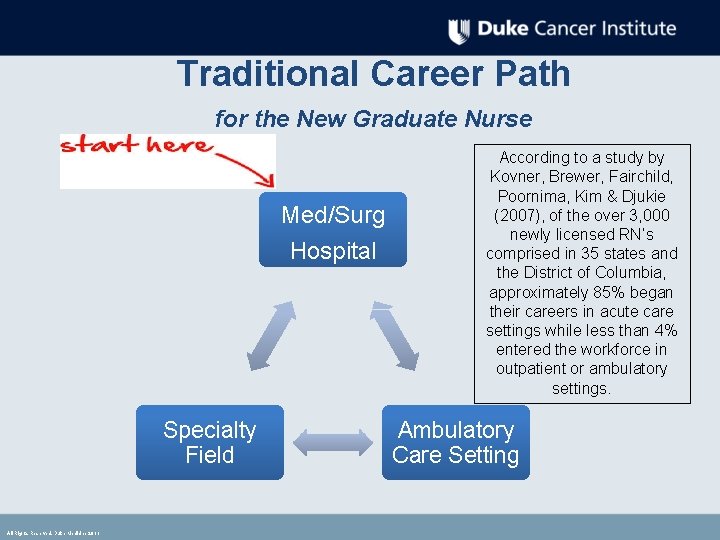
Traditional Career Path for the New Graduate Nurse Med/Surg Hospital Specialty Field All Rights Reserved, Duke Medicine 2011 According to a study by Kovner, Brewer, Fairchild, Poornima, Kim & Djukie (2007), of the over 3, 000 newly licensed RN’s comprised in 35 states and the District of Columbia, approximately 85% began their careers in acute care settings while less than 4% entered the workforce in outpatient or ambulatory settings. Ambulatory Care Setting
Workforce Development & Support to Improve Survivorship Care • • Prelicensure ambulatory rotations Professional Nursing Student Internship Curriculum Ambulatory oncology nursing residency programs Scope of Practice Post graduate fellowship program for nurse practitioners Leveraging technology Collaboration & Partnerships – Primary Care – Business development – Colleges/schools • Burnout/compassion fatigue 33 All Rights Reserved, Duke Medicine 2011
Conclusion • Collaboration across stakeholder groups • Modernization of Nurse Practice Acts • Funding for entry and advanced practice education • Discovery and funding for innovative models of care All Rights Reserved, Duke Medicine 2011