An Efficient SMT Solver Leonardo de Moura and







- Slides: 70
An Efficient SMT Solver Leonardo de Moura and Nikolaj Bjørner Microsoft Research FSE &
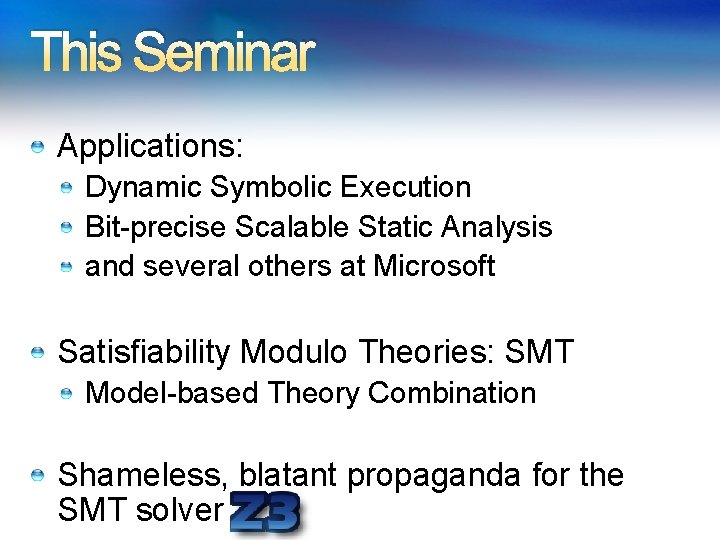
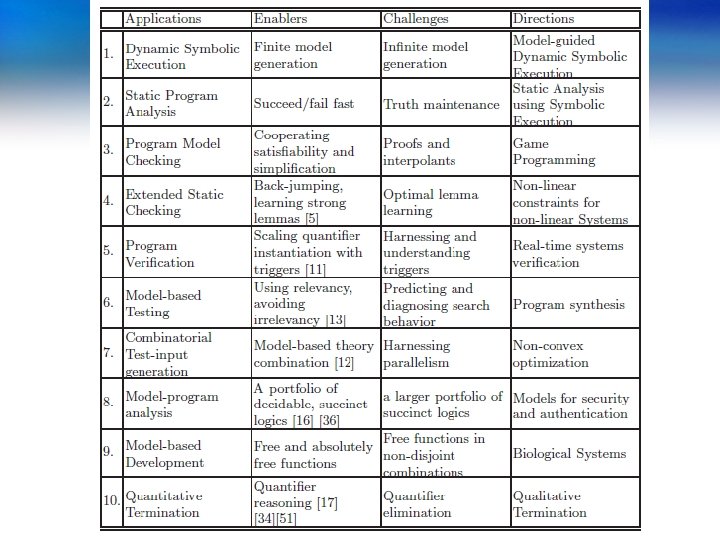
This Seminar Applications: Dynamic Symbolic Execution Bit-precise Scalable Static Analysis and several others at Microsoft Satisfiability Modulo Theories: SMT Model-based Theory Combination Shameless, blatant propaganda for the SMT solver Z 3
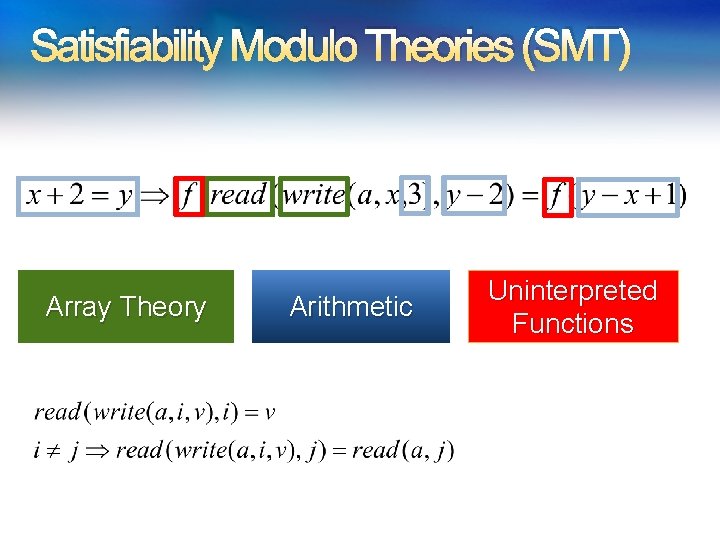
Satisfiability Modulo Theories (SMT) Is formula satisfiable modulo theory T ? SMT solvers have specialized algorithms for T
The Calculus of Computation Also the title of Bradley & Manna’s book Why Theorem Proving? At the core of every software analysis engine is invariably a component using logical formulas for describing states and transformations between system states.
The Calculus of Computation Some Microsoft engines: - SDV: The Static Driver Verifier PREfix: The Static Analysis Engine for C/C++. Pex: Program EXploration for. NET. SAGE: Scalable Automated Guided Execution Spec#: C# + contracts VCC: Verifying C Compiler for the Viridian Hyper-Visor HAVOC: Heap-Aware Verification of C-code. Spec. Explorer: Model-based testing of protocol specs. Hyper-Vexecution + abstraction. Yogi: Dynamic symbolic FORMULA: Model-based Design F 7: Refinement types for security protocols M 3: Model Program Modeling VS 3: Abstract interpretation and Synthesis They all use the SMT solver Z 3.
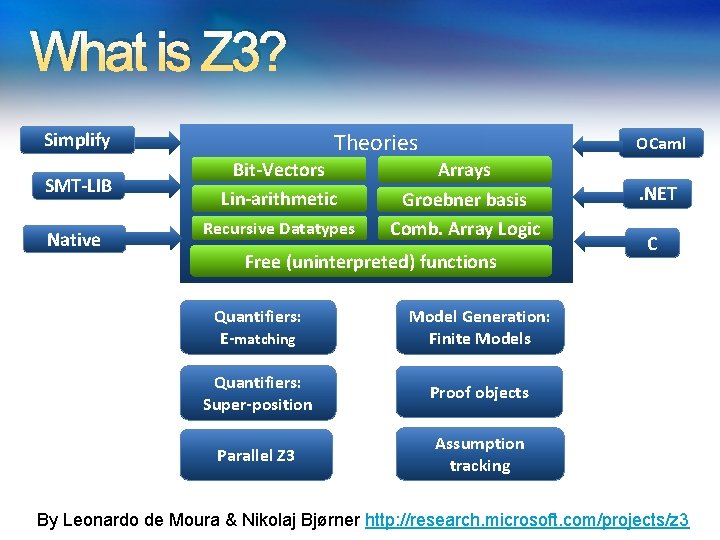
What is Z 3? Theories Simplify SMT-LIB Native Bit-Vectors Lin-arithmetic Recursive Datatypes OCaml Arrays Groebner basis Comb. Array Logic Free (uninterpreted) functions Quantifiers: E-matching Model Generation: Finite Models Quantifiers: Super-position Proof objects Parallel Z 3 Assumption tracking . NET C By Leonardo de Moura & Nikolaj Bjørner http: //research. microsoft. com/projects/z 3
What is Z 3? Leonardo de Moura & Nikolaj Bjørner Microsoft Research Redmond
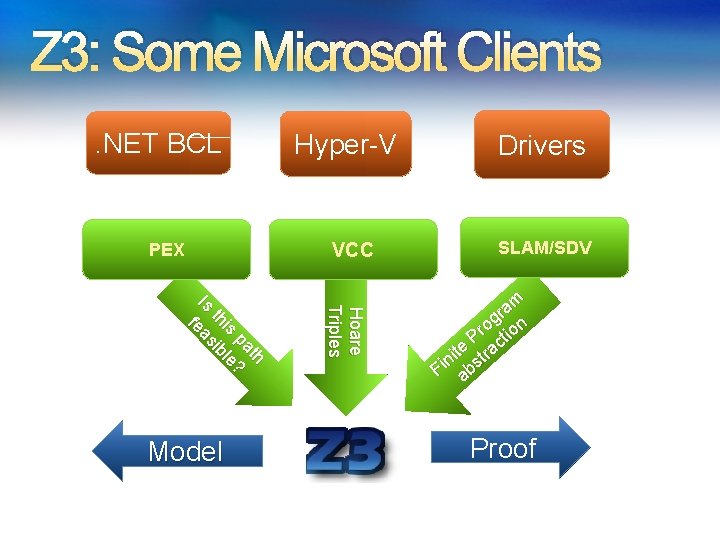
Z 3: Some Microsoft Clients. NET BCL PEX VCC Hoare Triples th pa ? is le th ib Is eas f Model Hyper-V Drivers SLAM/SDV am r og ion r P ct e a t ni str i F ab Proof
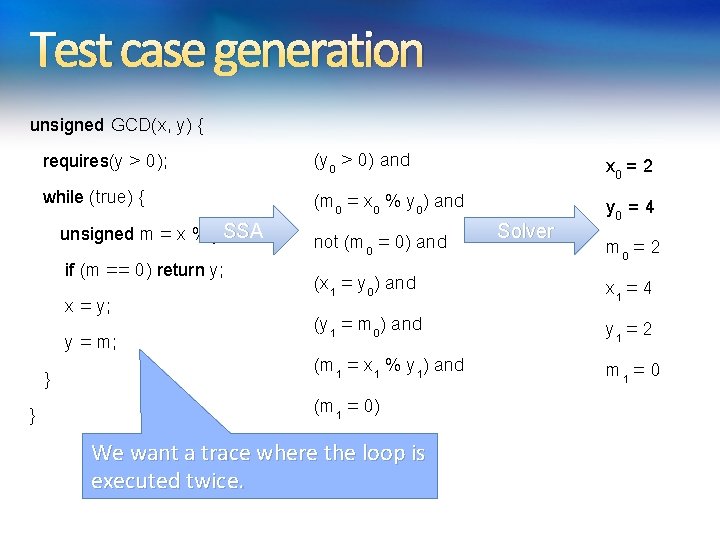
Test case generation unsigned GCD(x, y) { requires(y > 0); while (true) { unsigned m = x % y; SSA if (m == 0) return y; x = y; y = m; } } (y 0 > 0) and (m 0 = x 0 % y 0) and not (m 0 = 0) and (x 1 = y 0) and (y 1 = m 0) and (m 1 = x 1 % y 1) and (m 1 = 0) We want a trace where the loop is executed twice. Solver x 0 = 2 y 0 = 4 m 0 = 2 x 1 = 4 y 1 = 2 m 1 = 0
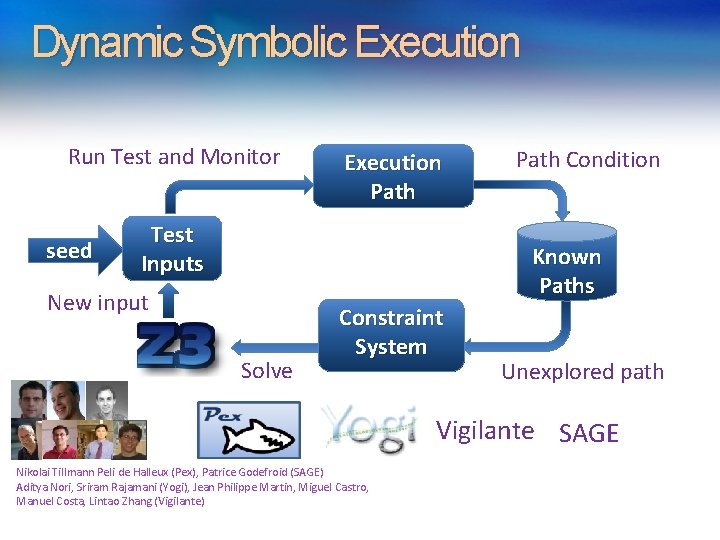
Dynamic Symbolic Execution Run Test and Monitor seed Execution Path Test Inputs Path Condition Known Paths New input Solve Constraint System Unexplored path Vigilante SAGE Nikolai Tillmann Peli de Halleux (Pex), Patrice Godefroid (SAGE) Aditya Nori, Sriram Rajamani (Yogi), Jean Philippe Martin, Miguel Castro, Manuel Costa, Lintao Zhang (Vigilante)
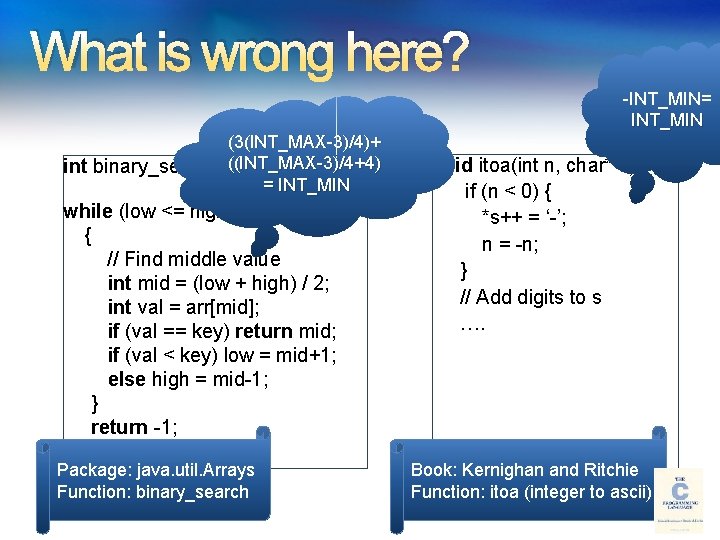
What is wrong here? -INT_MIN= INT_MIN (3(INT_MAX-3)/4)+ ((INT_MAX-3)/4+4) int binary_search(int[] arr, int low, = INT_MIN int high, int key) while (low <= high) { // Find middle value int mid = (low + high) / 2; int val = arr[mid]; if (val == key) return mid; if (val < key) low = mid+1; else high = mid-1; } return -1; } Package: java. util. Arrays Function: binary_search void itoa(int n, char* s) { if (n < 0) { *s++ = ‘-’; n = -n; } // Add digits to s …. Book: Kernighan and Ritchie Function: itoa (integer to ascii)
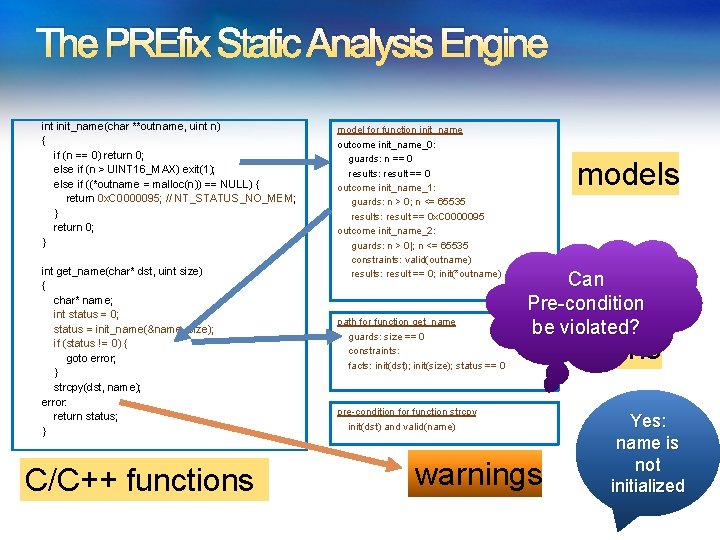
The PREfix Static Analysis Engine int init_name(char **outname, uint n) { if (n == 0) return 0; else if (n > UINT 16_MAX) exit(1); else if ((*outname = malloc(n)) == NULL) { return 0 x. C 0000095; // NT_STATUS_NO_MEM; } return 0; } int get_name(char* dst, uint size) { char* name; int status = 0; status = init_name(&name, size); if (status != 0) { goto error; } strcpy(dst, name); error: return status; } C/C++ functions 6/26/2009 model for function init_name outcome init_name_0: guards: n == 0 results: result == 0 outcome init_name_1: guards: n > 0; n <= 65535 results: result == 0 x. C 0000095 outcome init_name_2: guards: n > 0|; n <= 65535 constraints: valid(outname) results: result == 0; init(*outname) path for function get_name guards: size == 0 constraints: facts: init(dst); init(size); status == 0 models Can Pre-condition be violated? pre-condition for function strcpy init(dst) and valid(name) warnings paths Yes: name is not initialized
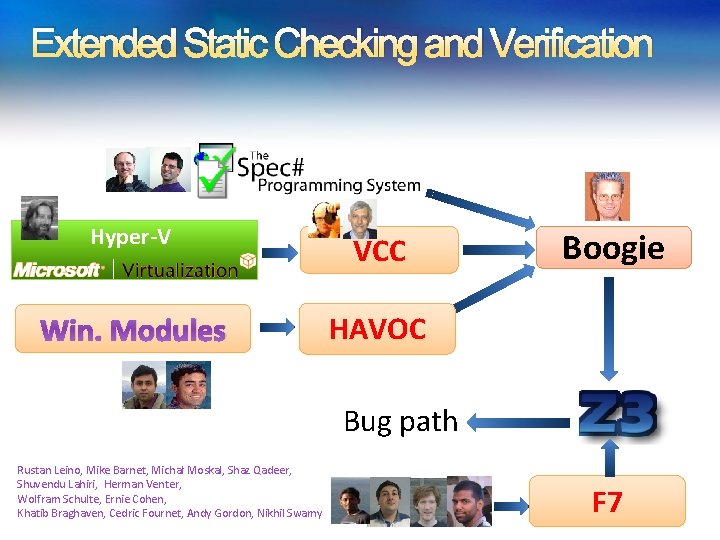
Extended Static Checking and Verification Hyper-V VCC Win. Modules HAVOC Boogie Verification condition Bug path Rustan Leino, Mike Barnet, Michał Moskal, Shaz Qadeer, Shuvendu Lahiri, Herman Venter, Wolfram Schulte, Ernie Cohen, Khatib Braghaven, Cedric Fournet, Andy Gordon, Nikhil Swamy F 7
What is SMT?
Satisfiability Modulo Theories (SMT) Array Theory Z 3: An Efficient SMT Arithmetic Uninterpreted Functions
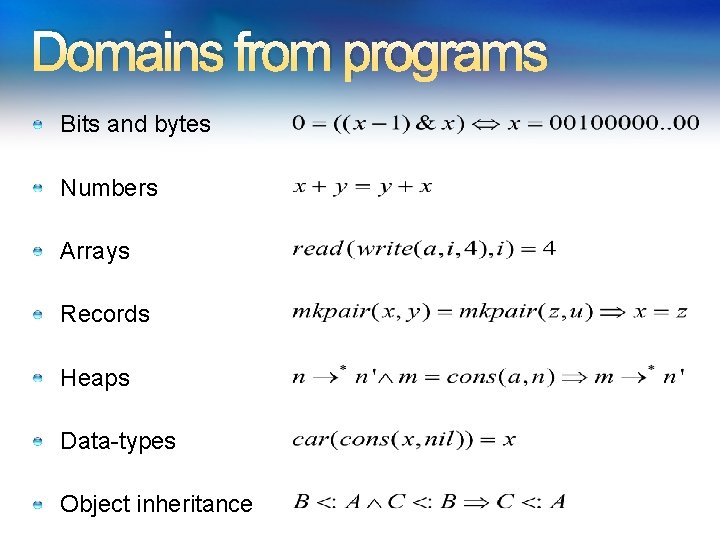
Domains from programs Bits and bytes Numbers Arrays Records Heaps Data-types Object inheritance
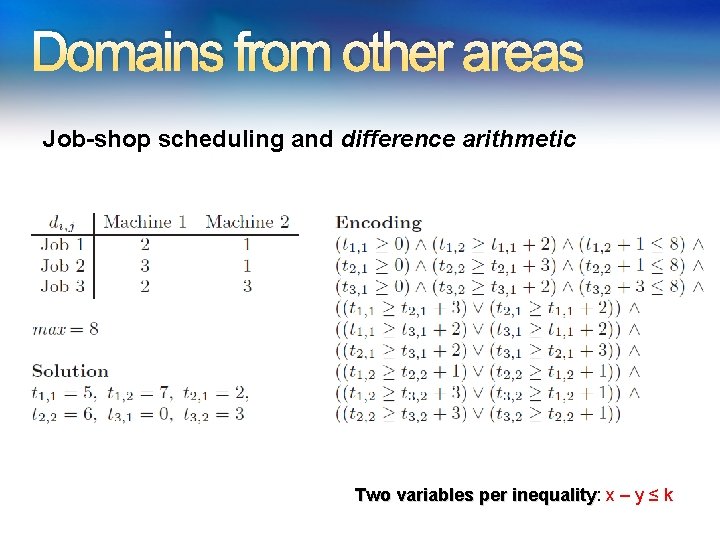
Domains from other areas Job-shop scheduling and difference arithmetic Two variables per inequality: inequality x – y ≤ k
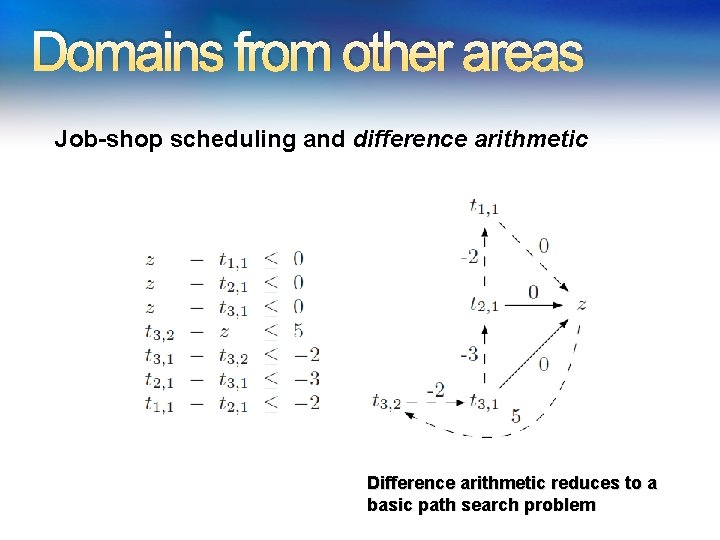
Domains from other areas Job-shop scheduling and difference arithmetic Difference arithmetic reduces to a basic path search problem
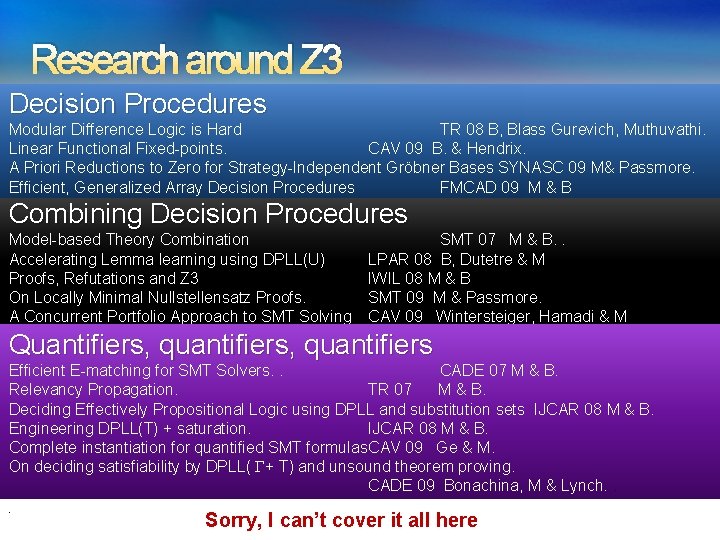
Research around Z 3 Decision Procedures Modular Difference Logic is Hard TR 08 B, Blass Gurevich, Muthuvathi. Linear Functional Fixed-points. CAV 09 B. & Hendrix. A Priori Reductions to Zero for Strategy-Independent Gröbner Bases SYNASC 09 M& Passmore. Efficient, Generalized Array Decision Procedures FMCAD 09 M & B Combining Decision Procedures Model-based Theory Combination Accelerating Lemma learning using DPLL(U) Proofs, Refutations and Z 3 On Locally Minimal Nullstellensatz Proofs. A Concurrent Portfolio Approach to SMT Solving SMT 07 M & B. . LPAR 08 B, Dutetre & M IWIL 08 M & B SMT 09 M & Passmore. CAV 09 Wintersteiger, Hamadi & M Quantifiers, quantifiers Efficient E-matching for SMT Solvers. . CADE 07 M & B. Relevancy Propagation. TR 07 M & B. Deciding Effectively Propositional Logic using DPLL and substitution sets IJCAR 08 M & B. Engineering DPLL(T) + saturation. IJCAR 08 M & B. . Complete instantiation for quantified SMT formulas. CAV 09 Ge & M. . On deciding satisfiability by DPLL( + T) and unsound theorem proving. CADE 09 Bonachina, M & Lynch. . . Sorry, I can’t cover it all here
Theory Combinations
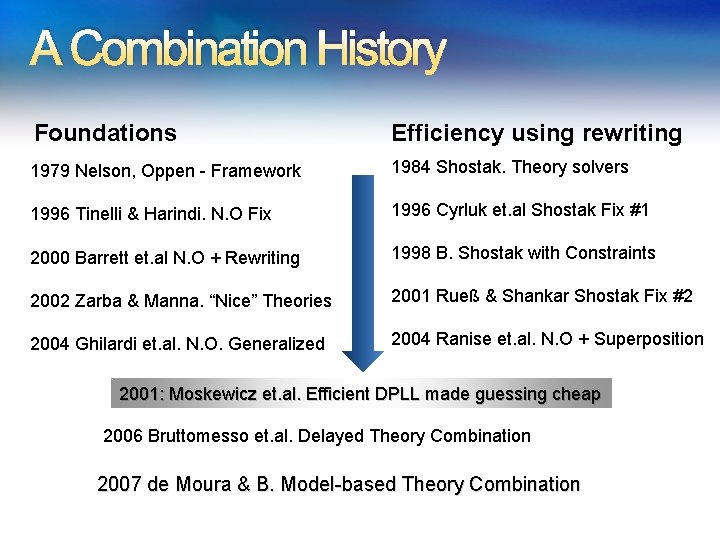
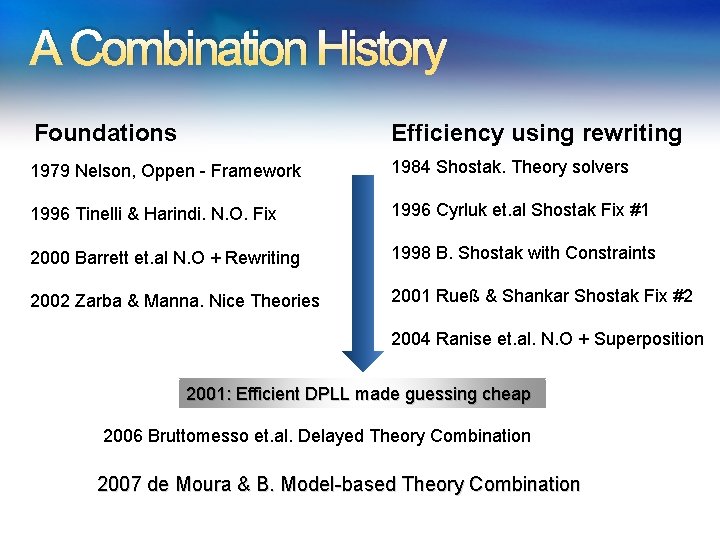
A Combination History Foundations Efficiency using rewriting 1979 Nelson, Oppen - Framework 1984 Shostak. Theory solvers 1996 Tinelli & Harindi. N. O Fix 1996 Cyrluk et. al Shostak Fix #1 2000 Barrett et. al N. O + Rewriting 1998 B. Shostak with Constraints 2002 Zarba & Manna. “Nice” Theories 2001 Rueß & Shankar Shostak Fix #2 2004 Ghilardi et. al. N. O. Generalized 2004 Ranise et. al. N. O + Superposition 2001: Moskewicz et. al. Efficient DPLL made guessing cheap 2006 Bruttomesso et. al. Delayed Theory Combination 2007 de Moura & B. Model-based Theory Combination
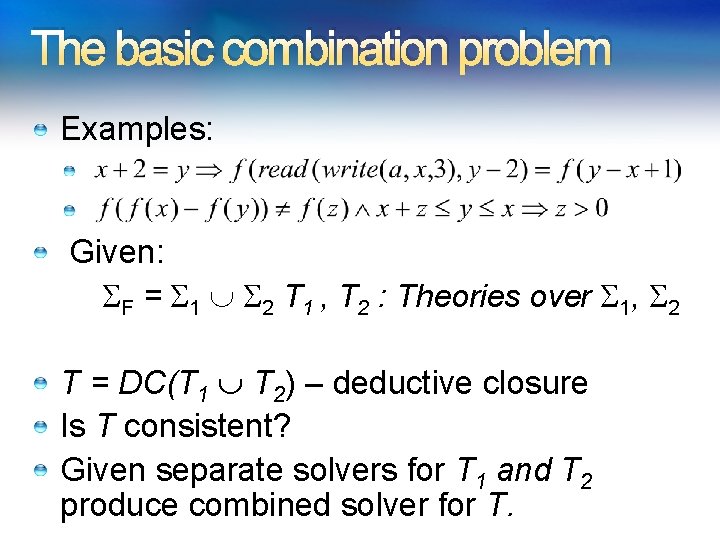
The basic combination problem Examples: Given: F = 1 2 T 1 , T 2 : Theories over 1, 2 T = DC(T 1 T 2) – deductive closure Is T consistent? Given separate solvers for T 1 and T 2 produce combined solver for T.
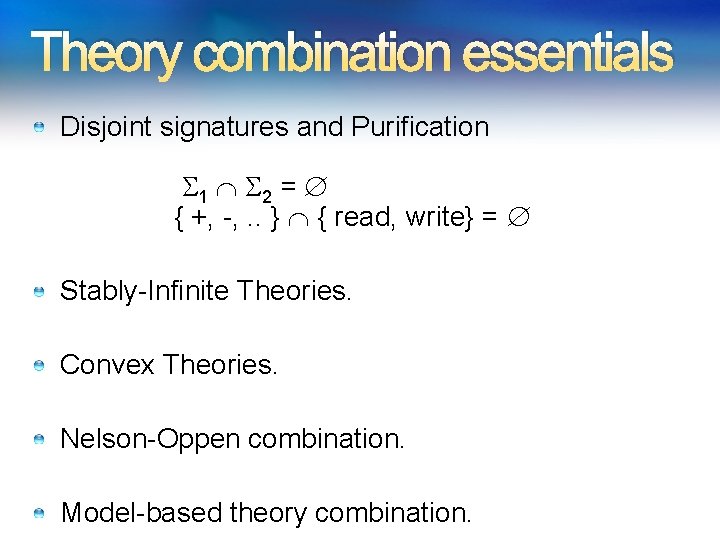
Theory combination essentials Disjoint signatures and Purification 1 2 = { +, -, . . } { read, write} = Stably-Infinite Theories. Convex Theories. Nelson-Oppen combination. Model-based theory combination.
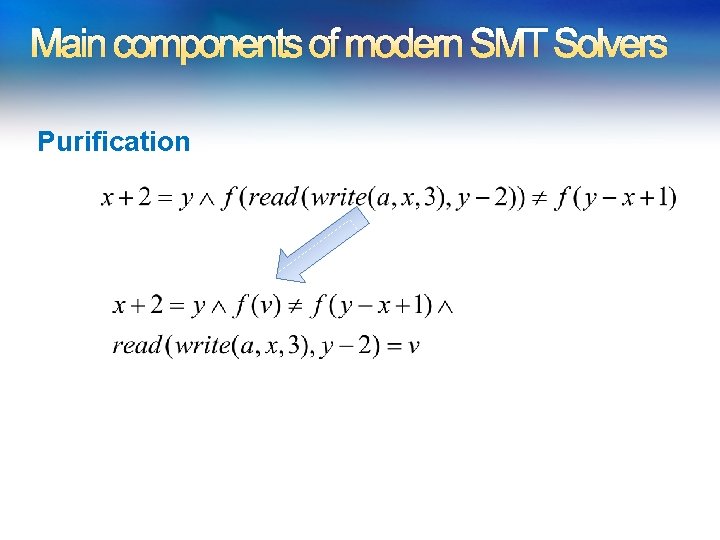
Main components of modern SMT Solvers Purification
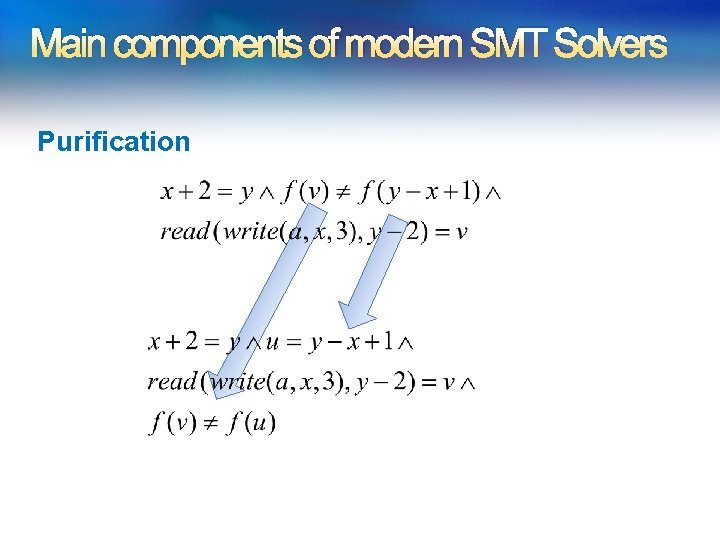
Main components of modern SMT Solvers Purification
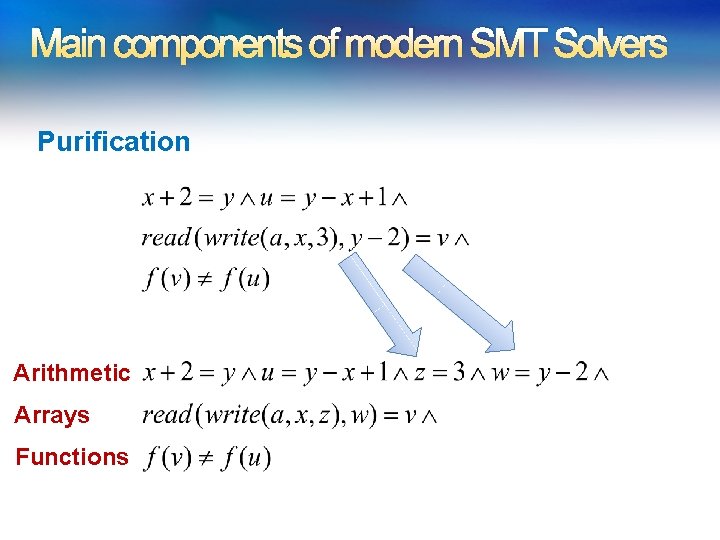
Main components of modern SMT Solvers Purification Arithmetic Arrays Functions
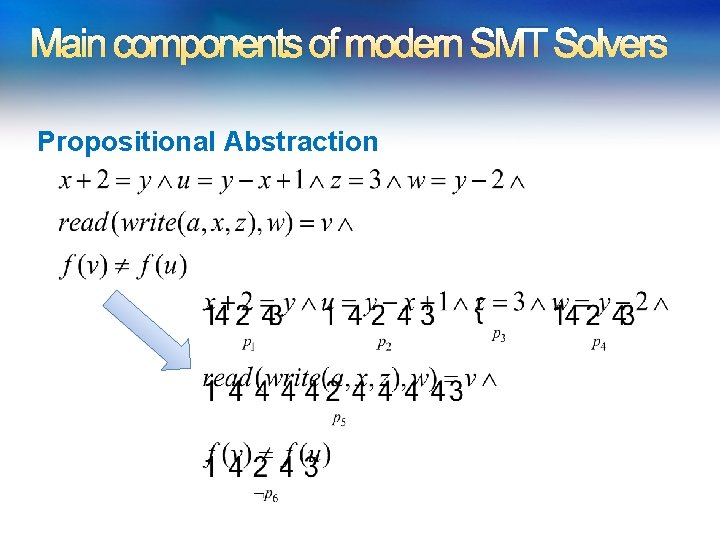
Main components of modern SMT Solvers Propositional Abstraction
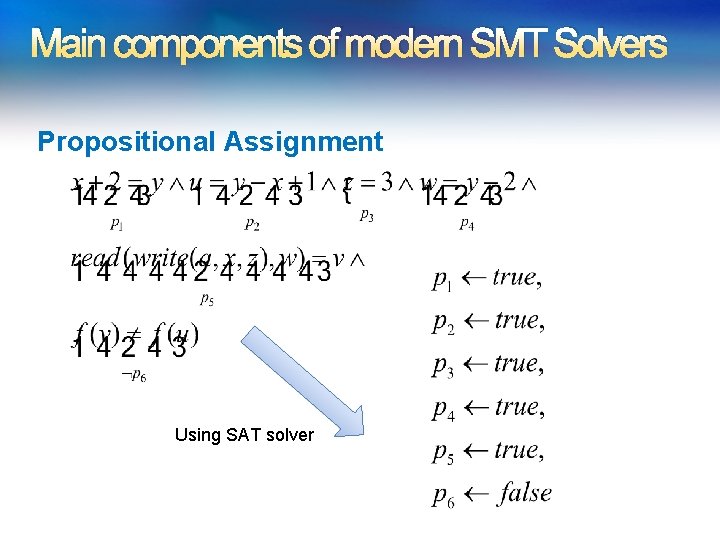
Main components of modern SMT Solvers Propositional Assignment Using SAT solver
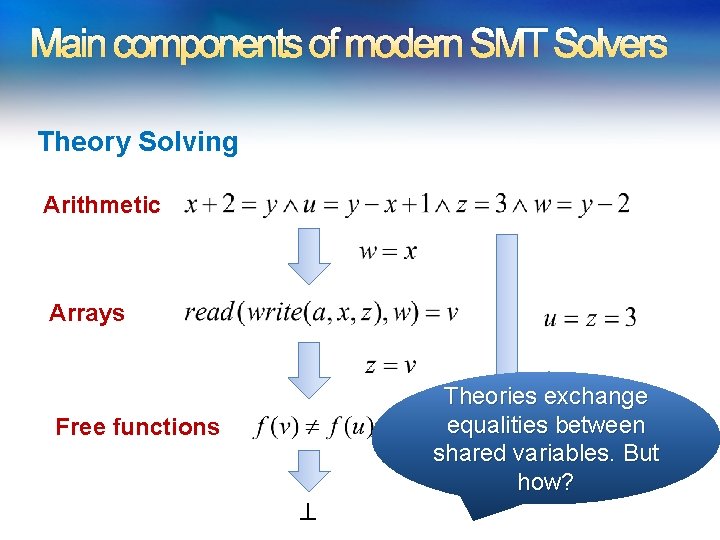
Main components of modern SMT Solvers Theory Solving Arithmetic Arrays Free functions Theories exchange equalities between shared variables. But how?
Patience… Now to Stably Infiniteness
Stably-Infinite Theories Theorem: The union of two consistent, disjoint, stablyinfinite theories is consistent.
Stably-Infinite Theories A theory is stably-infinite if every satisfiable QFF is satisfiable in an infinite model. We can glue together models M 1 and M 2 from stably infinite theories: we can extend the size of models M 1 and M 2 to each have |M 1 | + |M 2 | elements.
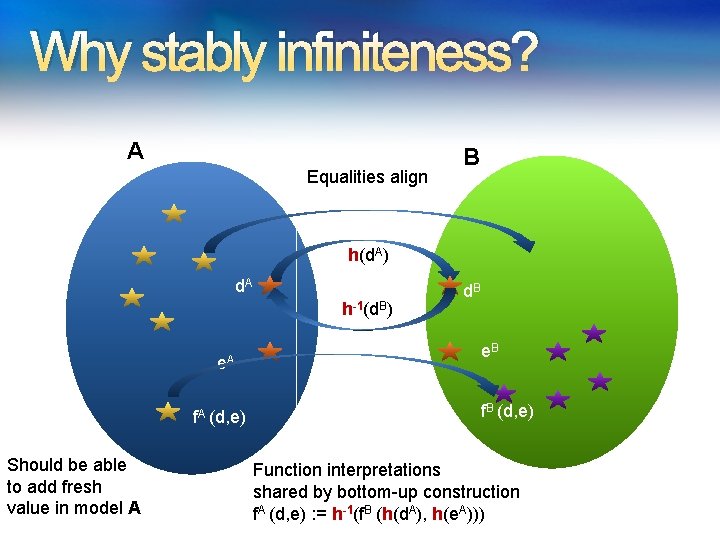
Why stably infiniteness? A Equalities align B h(d. A) d. A h-1(d. B) e. A f. A (d, e) Should be able to add fresh value in model A d. B e. B f. B (d, e) Function interpretations shared by bottom-up construction f. A (d, e) : = h-1(f. B (h(d. A), h(e. A)))
Convexity
Convex Theories Theorem: The union of two convex theories can be solved in time O(n 4 x T 1(n) x T 2(n)). The combination of a non-convex theory with another can incur exponential cost.
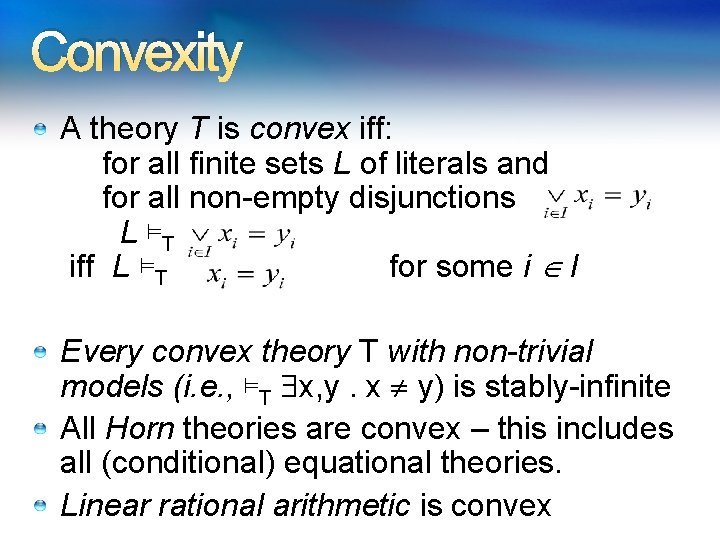
Convexity A theory T is convex iff: for all finite sets L of literals and for all non-empty disjunctions L ⊨T iff L ⊨T for some i I Every convex theory T with non-trivial models (i. e. , ⊨T x, y. x y) is stably-infinite All Horn theories are convex – this includes all (conditional) equational theories. Linear rational arithmetic is convex
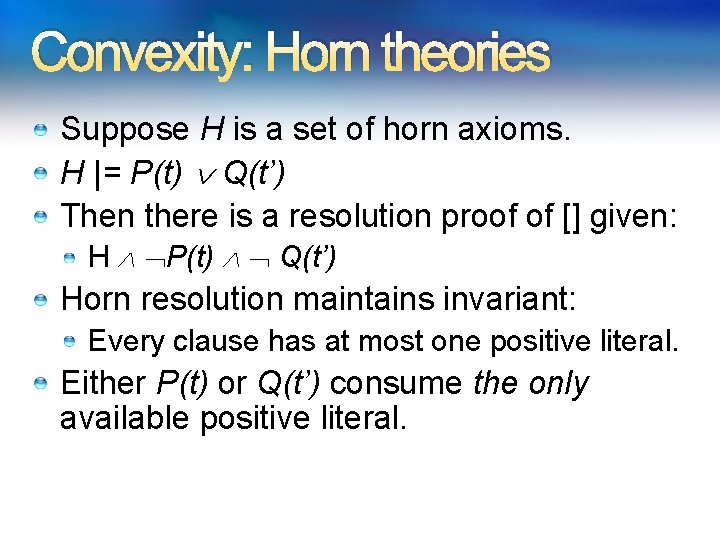
Convexity: Horn theories Suppose H is a set of horn axioms. H |= P(t) Q(t’) Then there is a resolution proof of [] given: H P(t) Q(t’) Horn resolution maintains invariant: Every clause has at most one positive literal. Either P(t) or Q(t’) consume the only available positive literal.
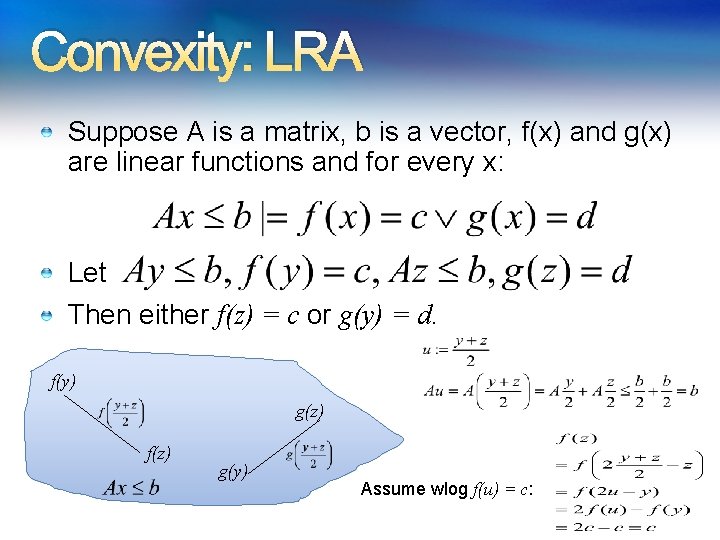
Convexity: LRA Suppose A is a matrix, b is a vector, f(x) and g(x) are linear functions and for every x: Let Then either f(z) = c or g(y) = d. f(y) g(z) f(z) g(y) Assume wlog f(u) = c:
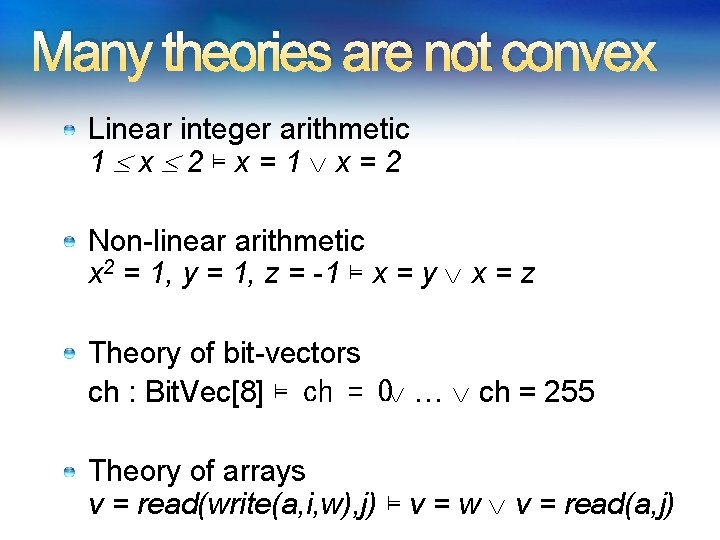
Many theories are not convex Linear integer arithmetic 1 x 2⊨x=1 x=2 Non-linear arithmetic x 2 = 1, y = 1, z = -1 ⊨ x = y x = z Theory of bit-vectors ch : Bit. Vec[8] ⊨ ch = 0 … ch = 255 Theory of arrays v = read(write(a, i, w), j) ⊨ v = w v = read(a, j)
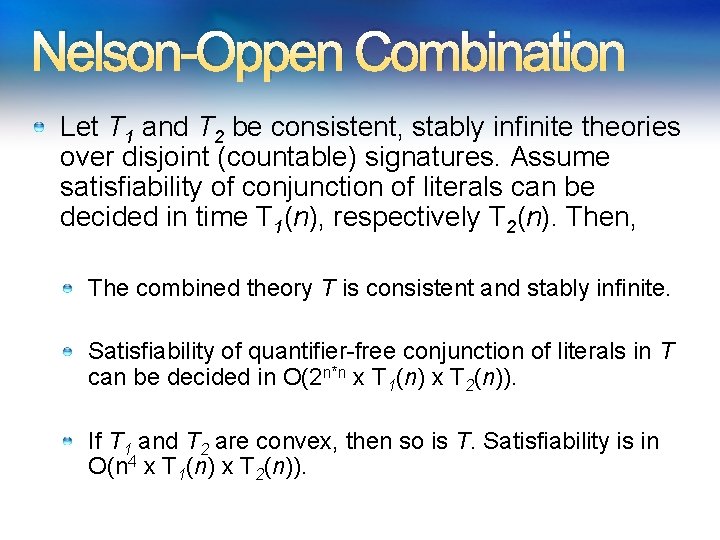
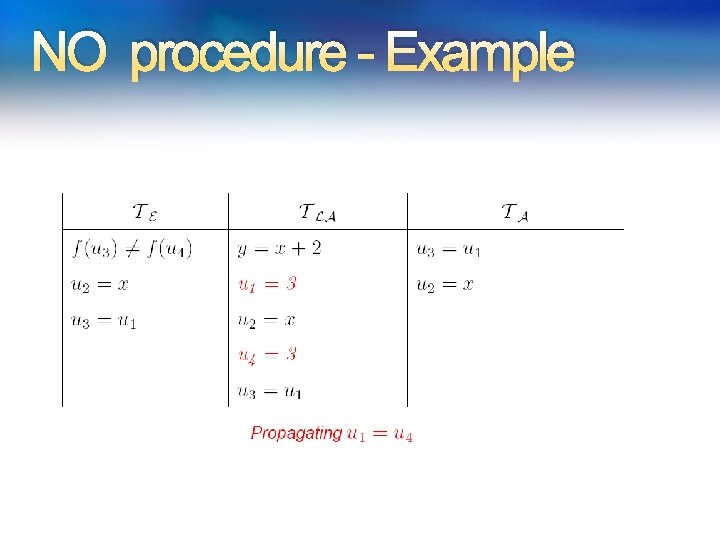
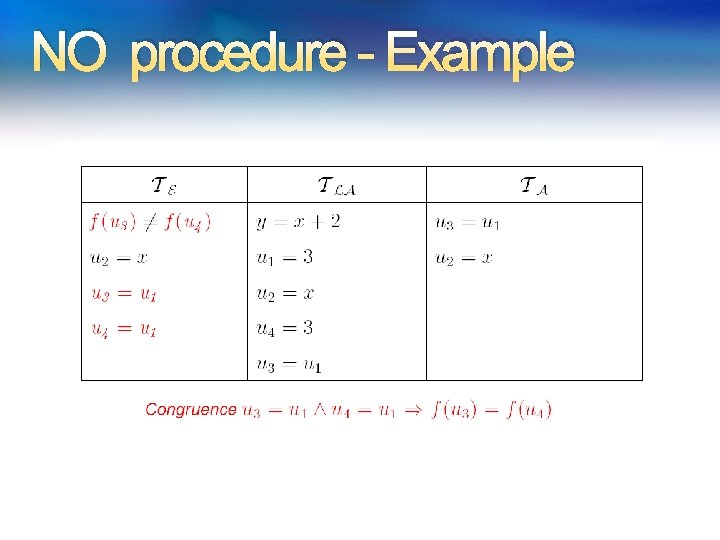
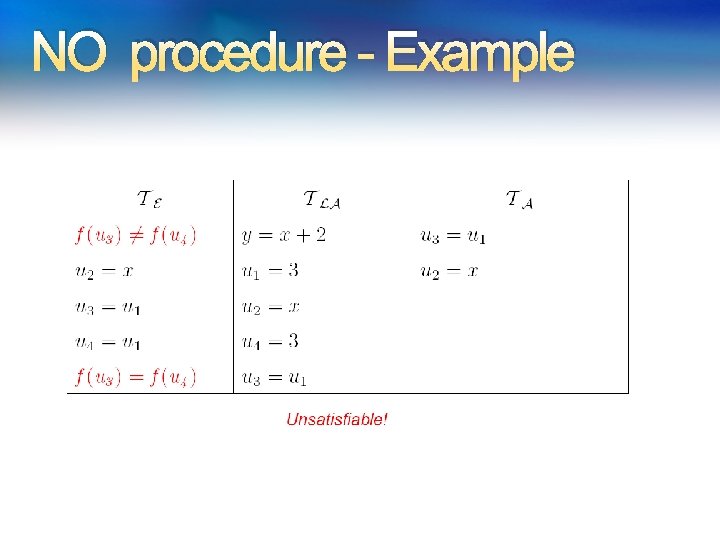
Nelson-Oppen Combination Let T 1 and T 2 be consistent, stably infinite theories over disjoint (countable) signatures. Assume satisfiability of conjunction of literals can be decided in time T 1(n), respectively T 2(n). Then, The combined theory T is consistent and stably infinite. Satisfiability of quantifier-free conjunction of literals in T can be decided in O(2 n*n x T 1(n) x T 2(n)). If T 1 and T 2 are convex, then so is T. Satisfiability is in O(n 4 x T 1(n) x T 2(n)).
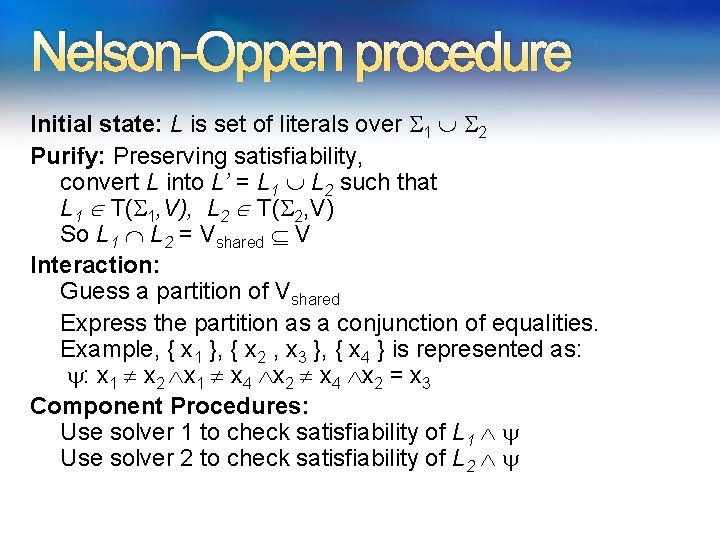
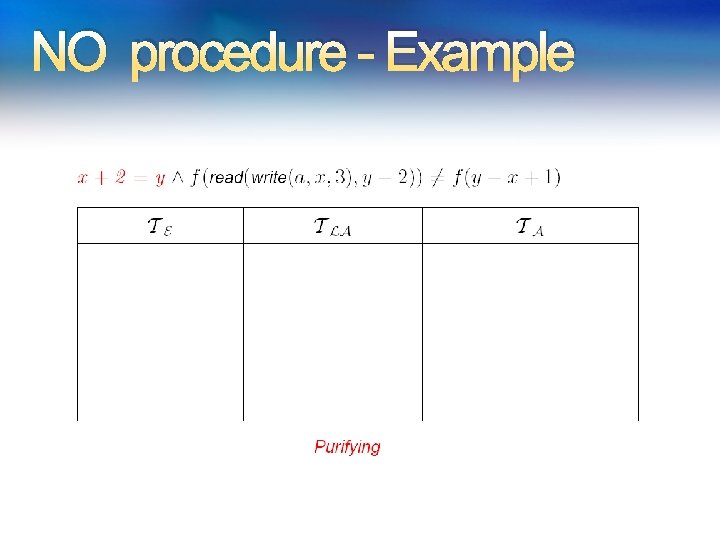
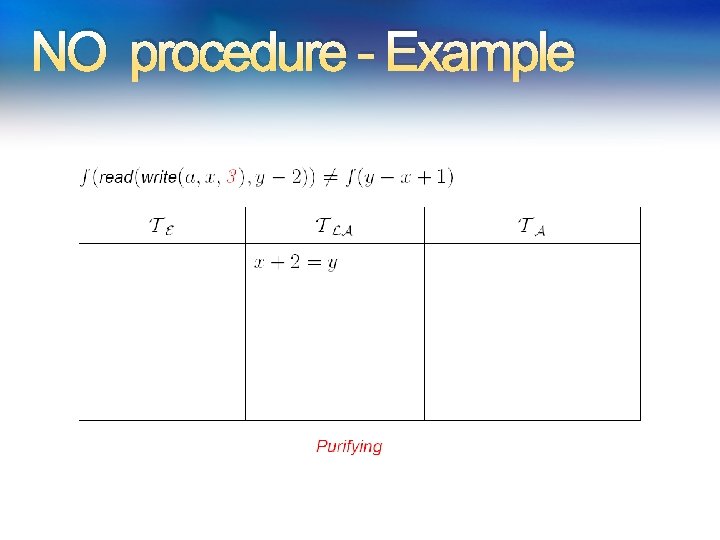
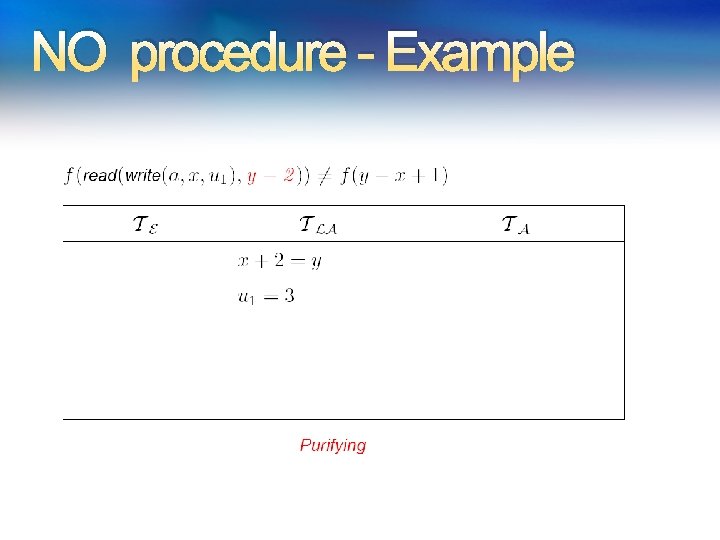
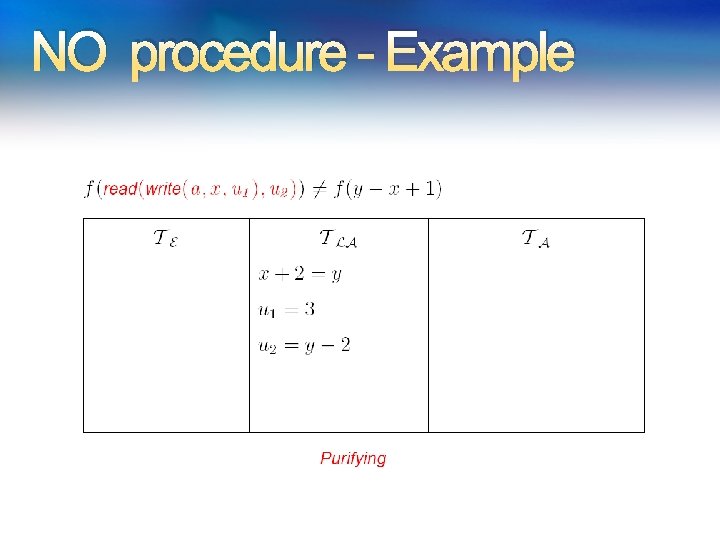
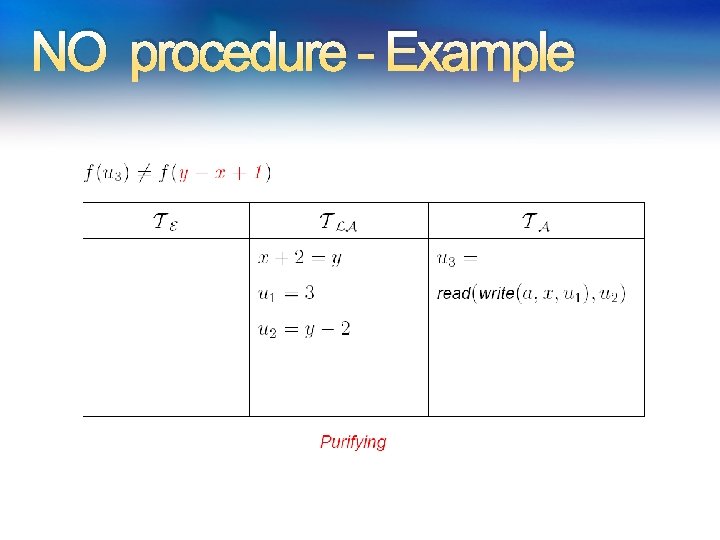
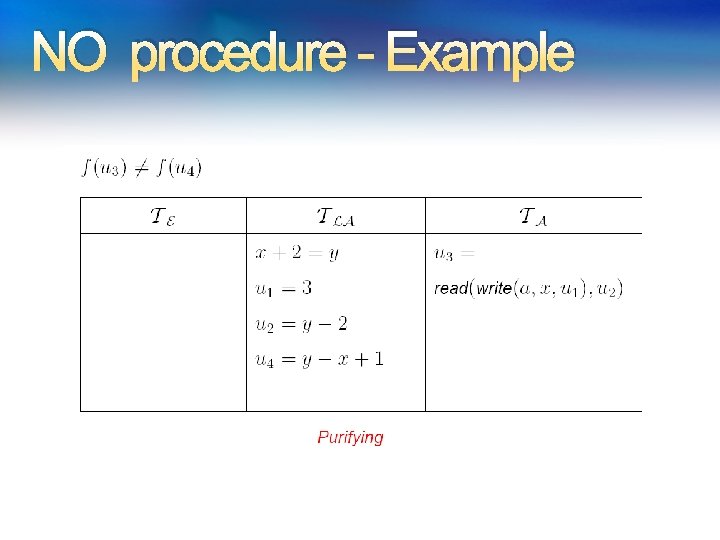
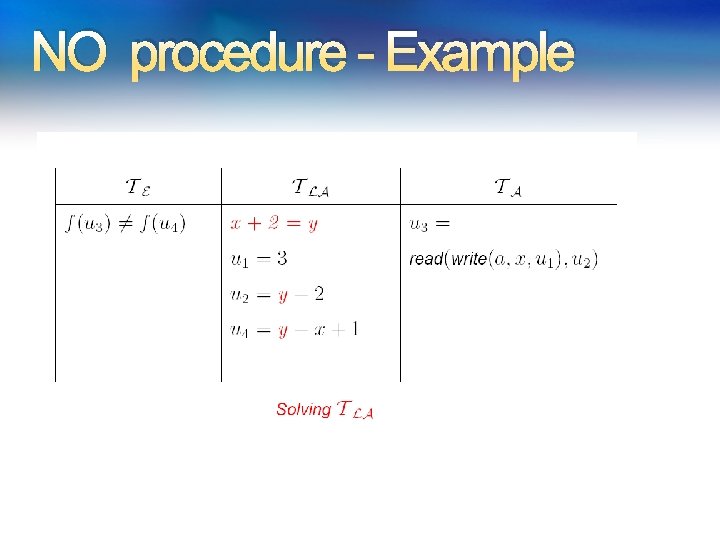
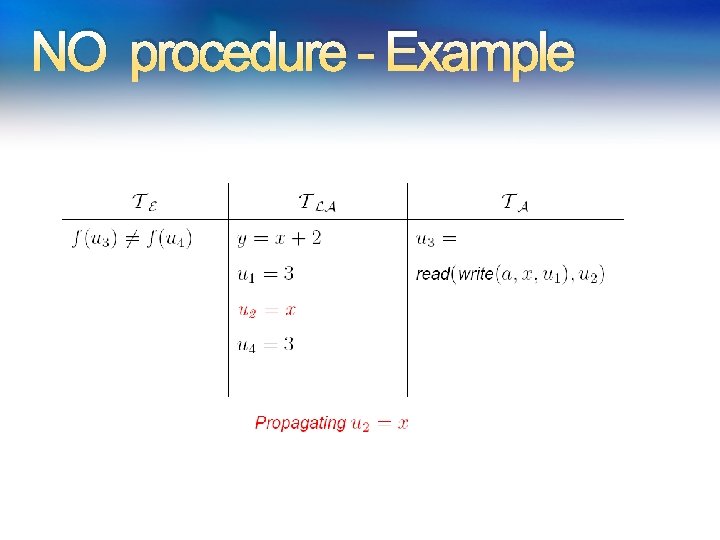
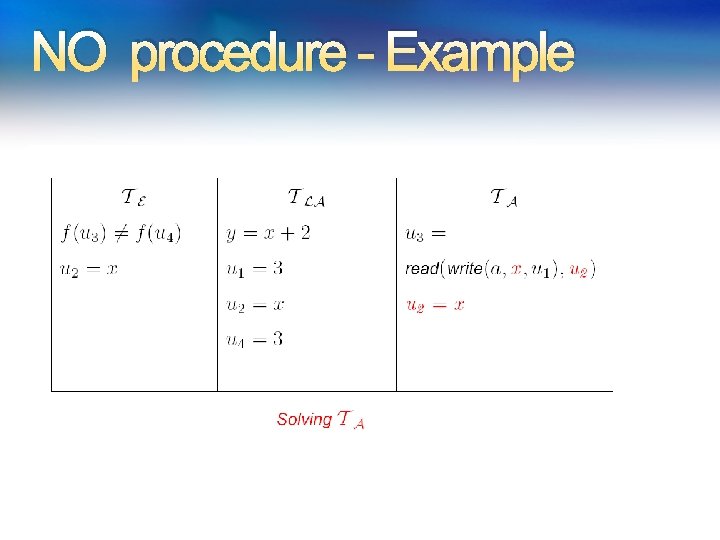
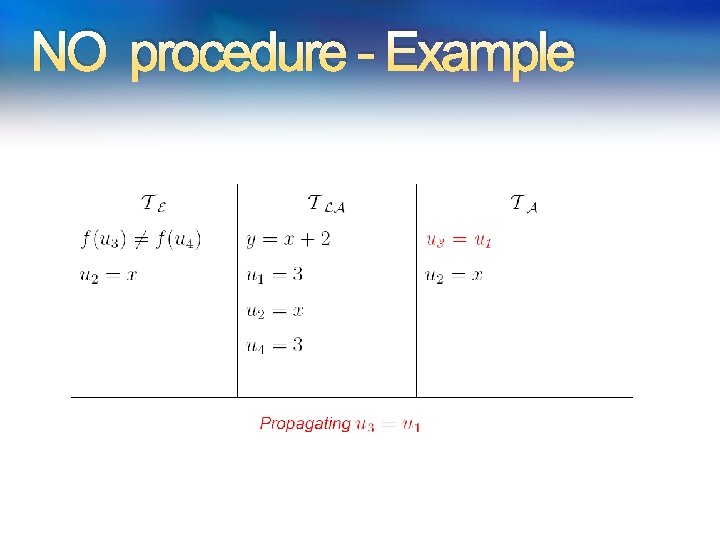
Nelson-Oppen procedure Initial state: L is set of literals over 1 2 Purify: Preserving satisfiability, convert L into L’ = L 1 L 2 such that L 1 T( 1, V), L 2 T( 2, V) So L 1 L 2 = Vshared V Interaction: Guess a partition of Vshared Express the partition as a conjunction of equalities. Example, { x 1 }, { x 2 , x 3 }, { x 4 } is represented as: : x 1 x 2 x 1 x 4 x 2 = x 3 Component Procedures: Use solver 1 to check satisfiability of L 1 Use solver 2 to check satisfiability of L 2
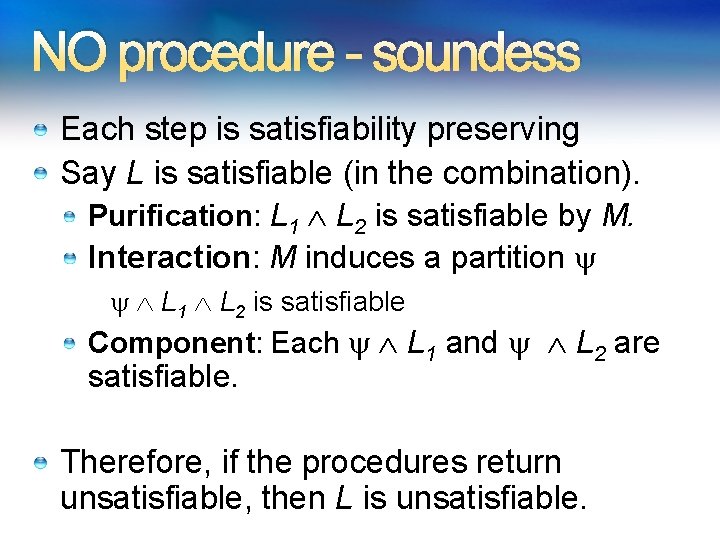
NO procedure - soundess Each step is satisfiability preserving Say L is satisfiable (in the combination). Purification: L 1 L 2 is satisfiable by M. Interaction: M induces a partition L 1 L 2 is satisfiable Component: Each L 1 and L 2 are satisfiable. Therefore, if the procedures return unsatisfiable, then L is unsatisfiable.
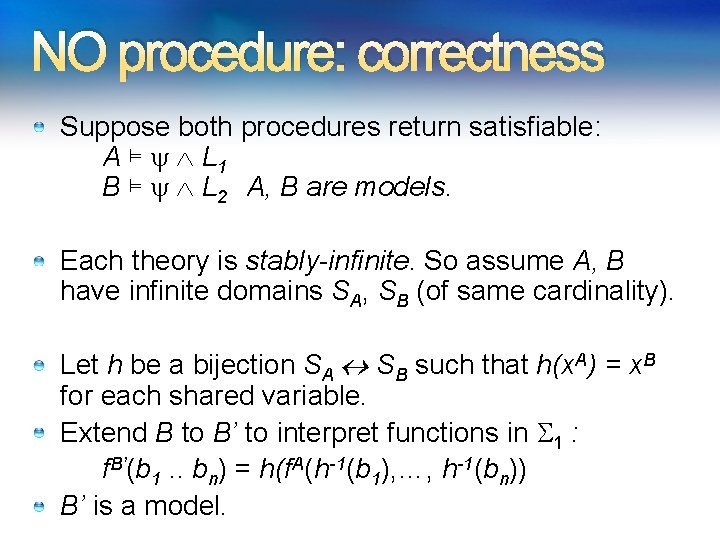
NO procedure: correctness Suppose both procedures return satisfiable: A ⊨ L 1 B ⊨ L 2 A, B are models. Each theory is stably-infinite. So assume A, B have infinite domains SA, SB (of same cardinality). Let h be a bijection SA SB such that h(x. A) = x. B for each shared variable. Extend B to B’ to interpret functions in 1 : f. B’(b 1. . bn) = h(f. A(h-1(b 1), …, h-1(bn)) B’ is a model.
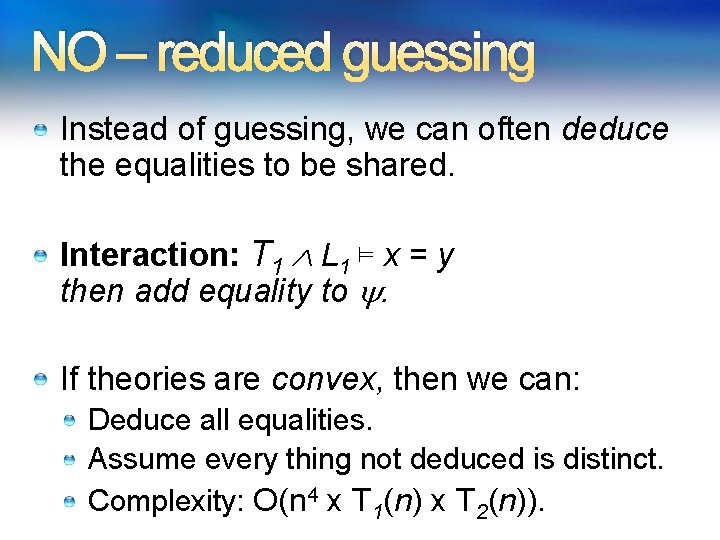
NO – reduced guessing Instead of guessing, we can often deduce the equalities to be shared. Interaction: T 1 L 1 ⊨ x = y then add equality to . If theories are convex, then we can: Deduce all equalities. Assume every thing not deduced is distinct. Complexity: O(n 4 x T 1(n) x T 2(n)).
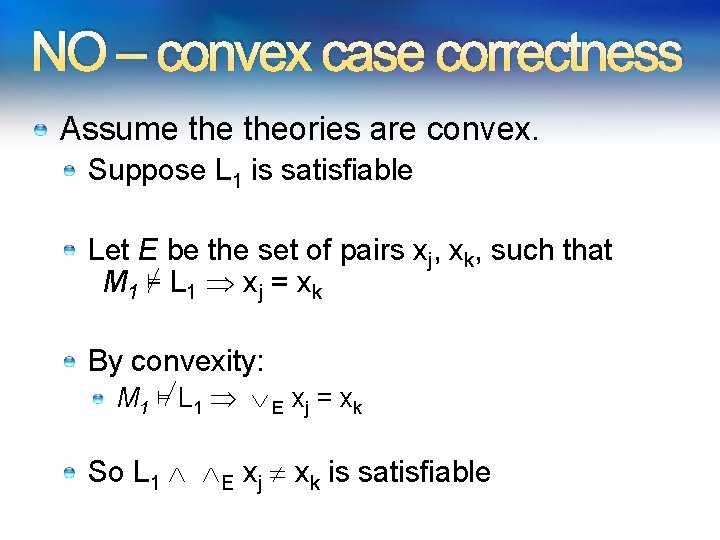
NO – convex case correctness Assume theories are convex. Suppose L 1 is satisfiable Let E be the set of pairs xj, xk, such that M 1 ⊨ L 1 x j = x k By convexity: M 1 ⊨ L 1 E xj = xk So L 1 E xj xk is satisfiable
NO procedure - Example
NO procedure - Example
NO procedure - Example
NO procedure - Example
NO procedure - Example
NO procedure - Example
NO procedure - Example
NO procedure - Example
NO procedure - Example
NO procedure - Example
NO procedure - Example
NO procedure - Example
NO procedure - Example
A Combination History Foundations Efficiency using rewriting 1979 Nelson, Oppen - Framework 1984 Shostak. Theory solvers 1996 Tinelli & Harindi. N. O. Fix 1996 Cyrluk et. al Shostak Fix #1 2000 Barrett et. al N. O + Rewriting 1998 B. Shostak with Constraints 2002 Zarba & Manna. Nice Theories 2001 Rueß & Shankar Shostak Fix #2 2004 Ranise et. al. N. O + Superposition 2001: Efficient DPLL made guessing cheap 2006 Bruttomesso et. al. Delayed Theory Combination 2007 de Moura & B. Model-based Theory Combination
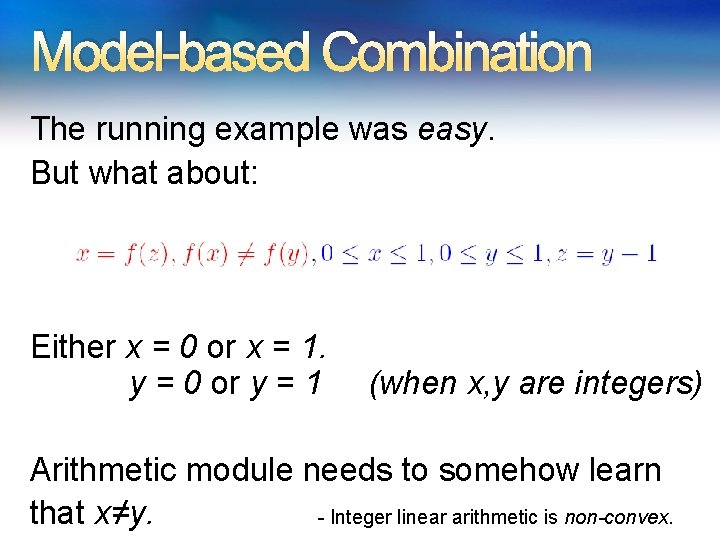
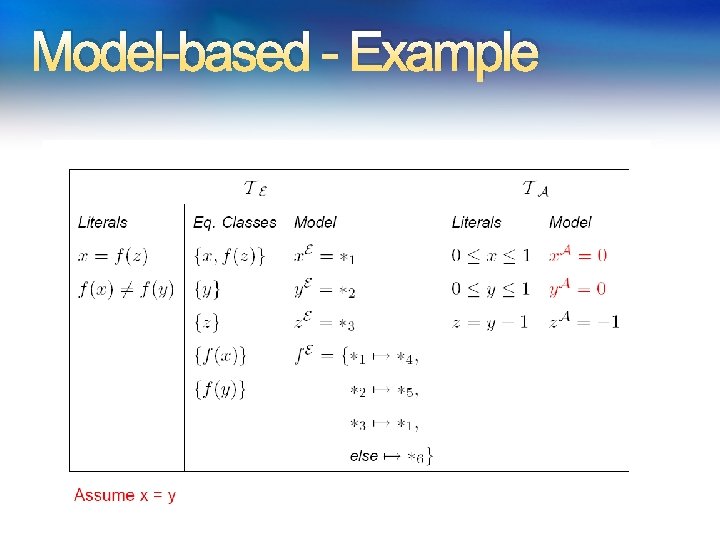
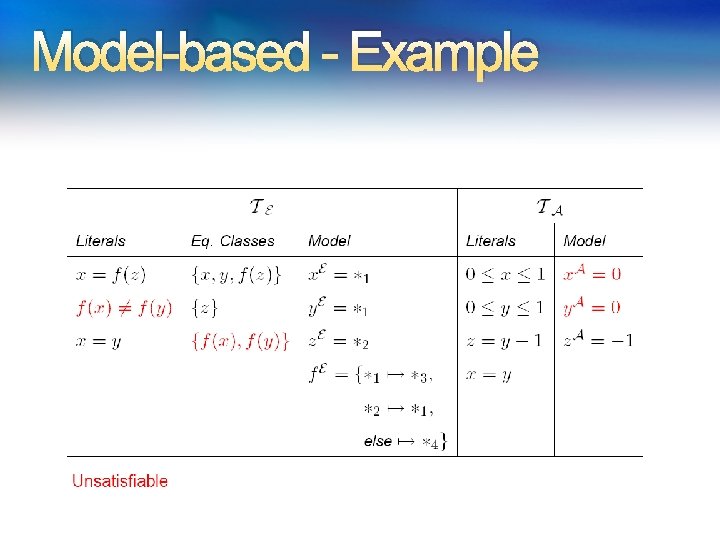
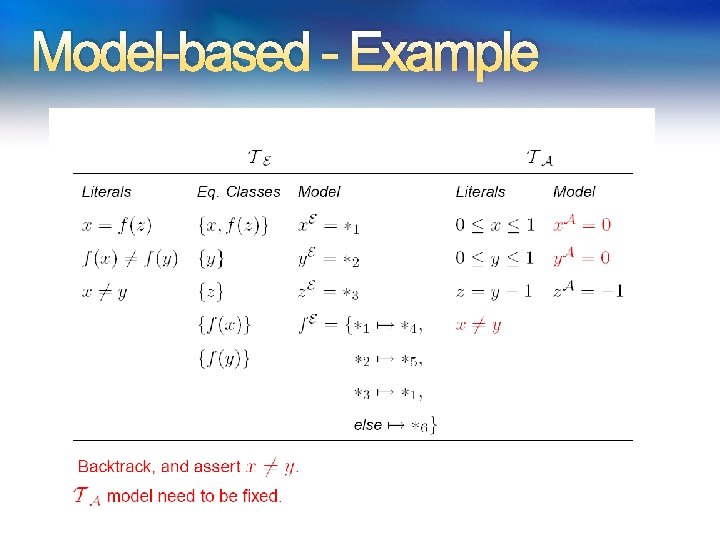
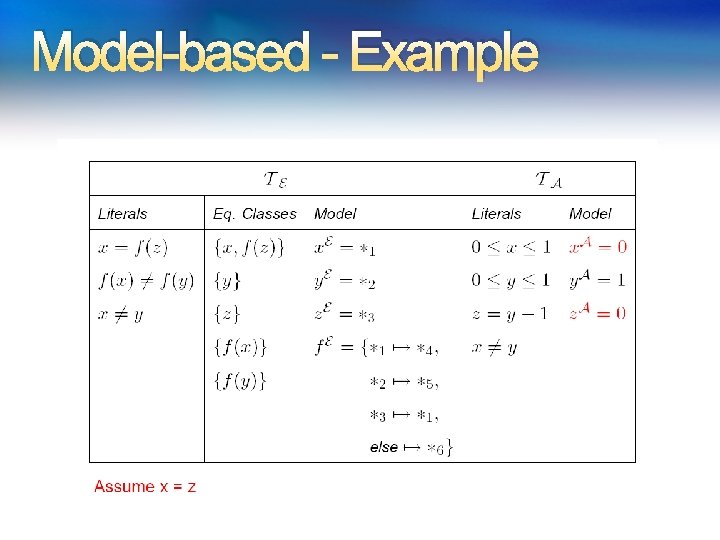
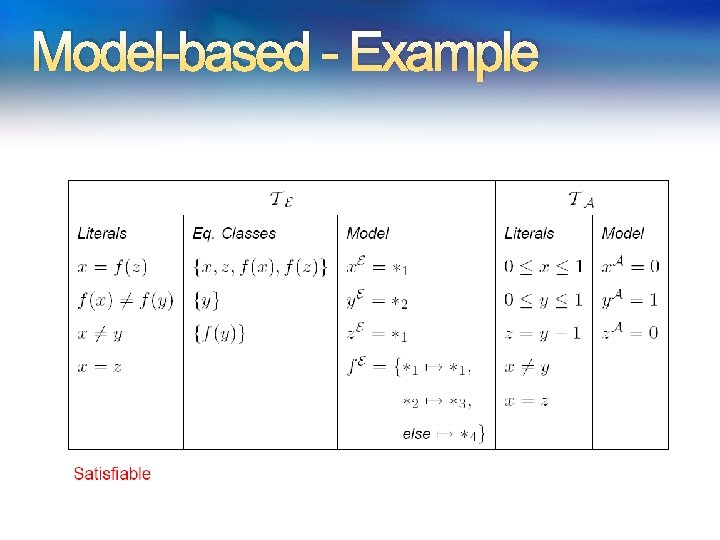
Model-based Combination The running example was easy. But what about: Either x = 0 or x = 1. y = 0 or y = 1 (when x, y are integers) Arithmetic module needs to somehow learn that x≠y. - Integer linear arithmetic is non-convex.
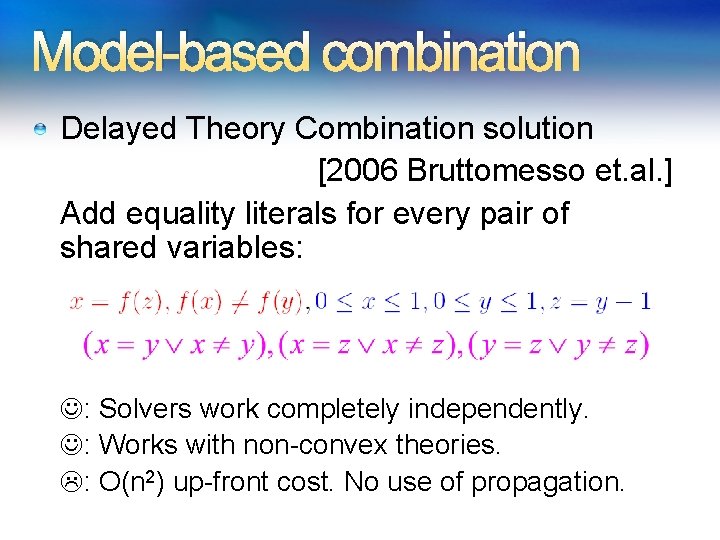
Model-based combination Delayed Theory Combination solution [2006 Bruttomesso et. al. ] Add equality literals for every pair of shared variables: : Solvers work completely independently. : Works with non-convex theories. : O(n 2) up-front cost. No use of propagation.
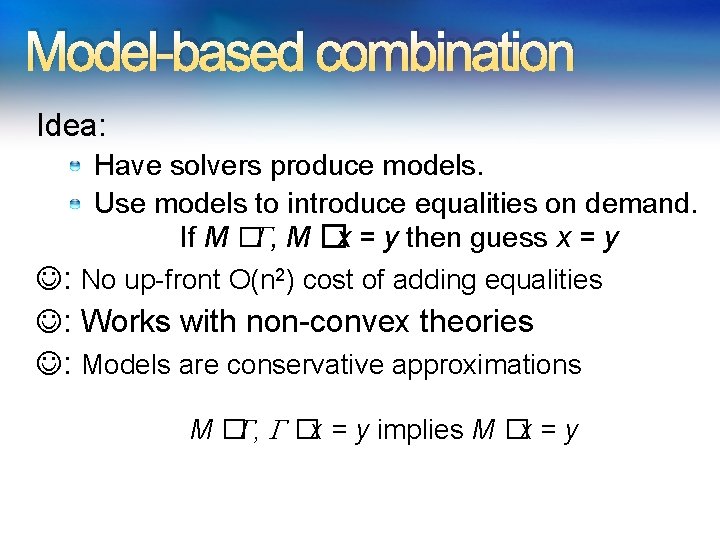
Model-based combination Idea: Have solvers produce models. Use models to introduce equalities on demand. If M � , M � x = y then guess x = y : No up-front O(n 2) cost of adding equalities : Works with non-convex theories : Models are conservative approximations M � , �x = y implies M �x = y
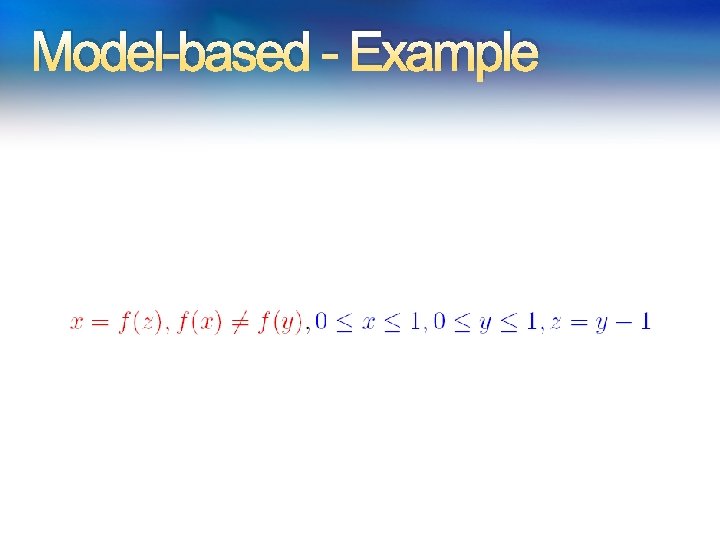
Model-based - Example
Model-based - Example
Model-based - Example
Model-based - Example
Model-based - Example
Model-based - Example
Conclusions SMT solvers are a great fit for software tools Current main applications: Test-case generation. Verifying compilers. Model Checking & Predicate Abstraction. Model-based testing and development Future opportunities in SMT research and applications abound