
Minesweeper Solver Marina Maznikova Artificial Intelligence II Fall
- Slides: 23
Minesweeper Solver Marina Maznikova Artificial Intelligence II Fall 2011
Agenda 1. 2. 3. 4. 5. 6. The Minesweeper Game Theoretical Background Solving Agents Evaluation Extension Summary 2
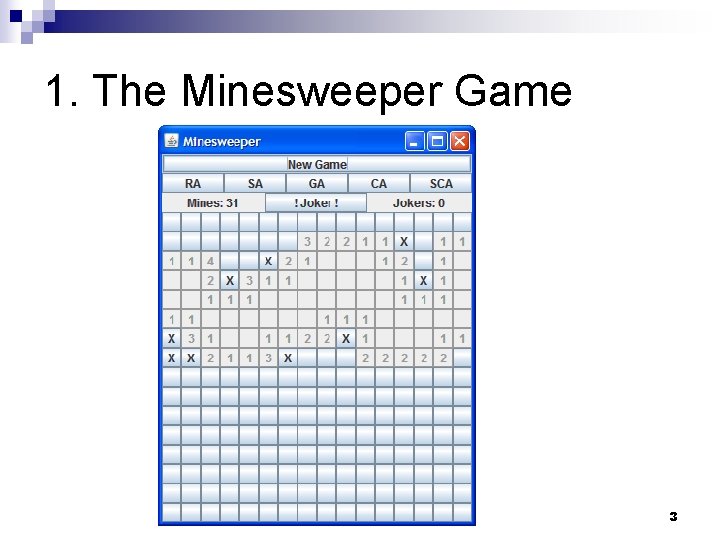
1. The Minesweeper Game 3
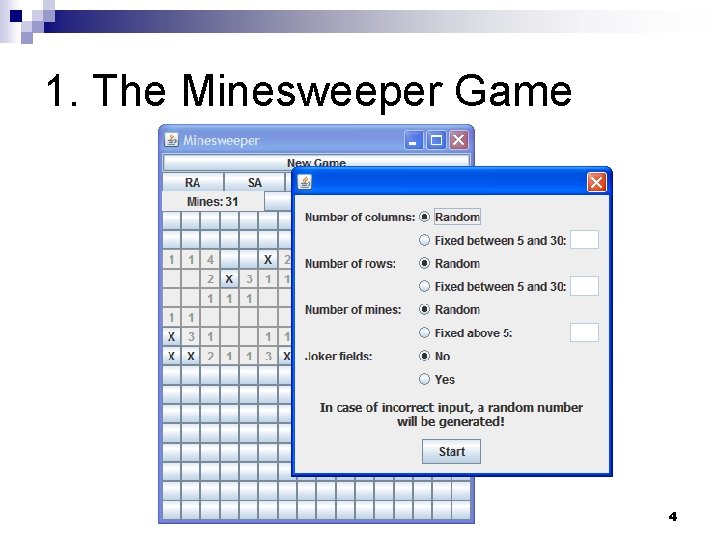
1. The Minesweeper Game 4
2. Theoretical Background n NP-completeness (8 -SAT) n Solving approaches: ¨ Constraints ¨ Reinforcement learning 5
3. Solving Agents n Random agent (RA) 6
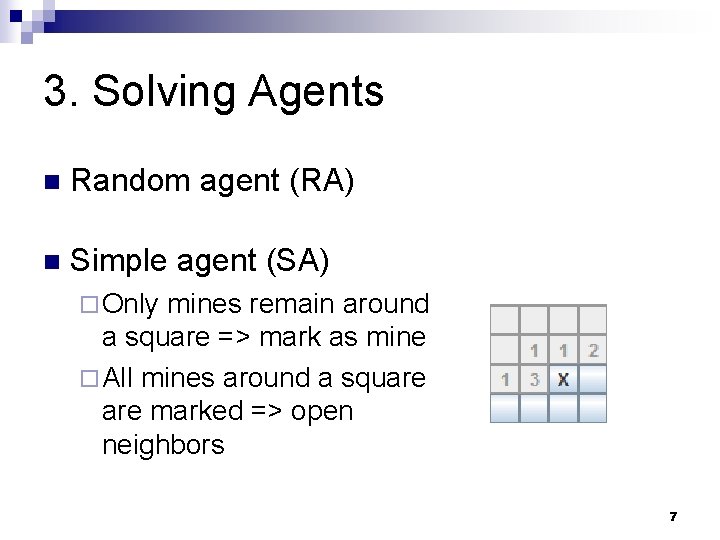
3. Solving Agents n Random agent (RA) n Simple agent (SA) ¨ Only mines remain around a square => mark as mine ¨ All mines around a square marked => open neighbors 7
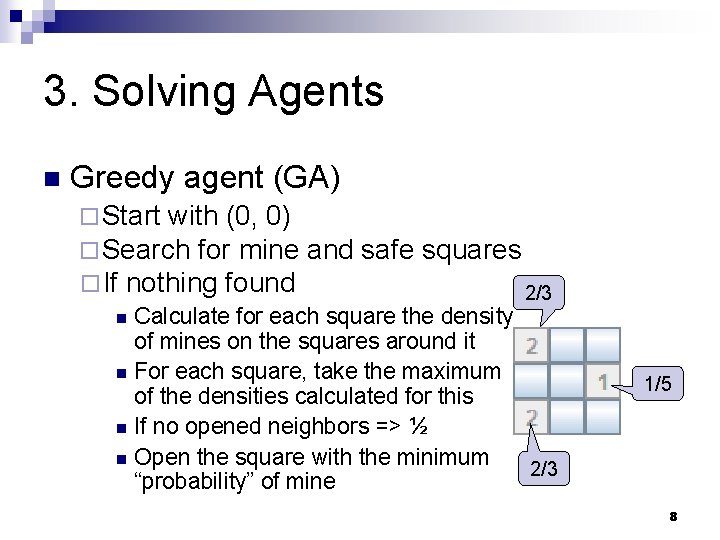
3. Solving Agents n Greedy agent (GA) ¨ Start with (0, 0) ¨ Search for mine and safe squares ¨ If nothing found 2/3 n Calculate for each square the density of mines on the squares around it n For each square, take the maximum of the densities calculated for this n If no opened neighbors => ½ n Open the square with the minimum 2/3 “probability” of mine 1/5 8
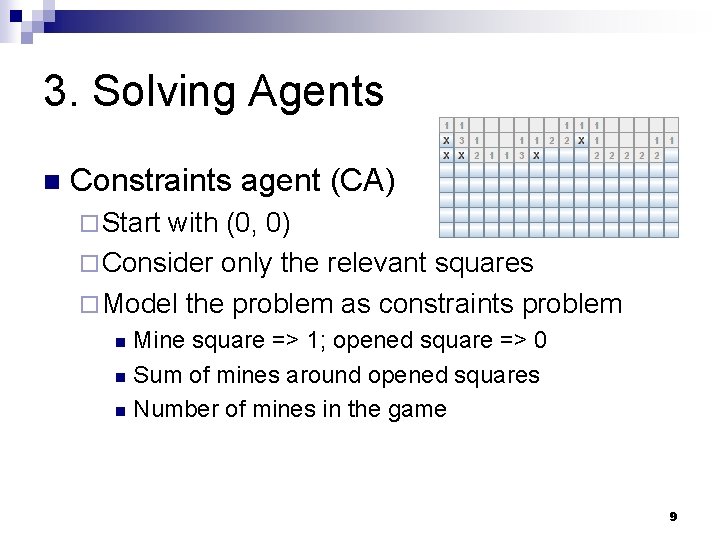
3. Solving Agents n Constraints agent (CA) ¨ Start with (0, 0) ¨ Consider only the relevant squares ¨ Model the problem as constraints problem Mine square => 1; opened square => 0 n Sum of mines around opened squares n Number of mines in the game n 9
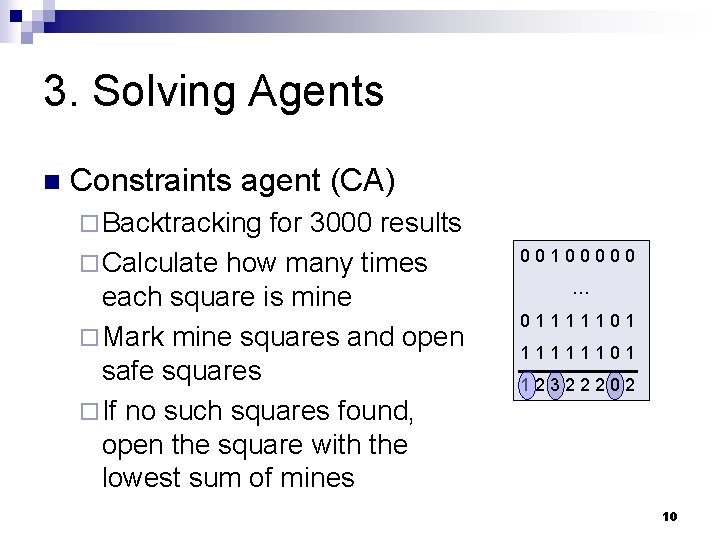
3. Solving Agents n Constraints agent (CA) ¨ Backtracking for 3000 results ¨ Calculate how many times each square is mine ¨ Mark mine squares and open safe squares ¨ If no such squares found, open the square with the lowest sum of mines 00100000 … 01111101 12322202 10
3. Solving Agents n Constraints agent (CA) ¨ Problem: Exponential algorithm Impossible to generate always all the solutions n Time n 11
3. Solving Agents n Constraints agent (CA) ¨ Problem: Exponential algorithm n Impossible to generate always all the solutions n Time n “Simple” constraints agent (SCA) ¨ Start with (0, 0) ¨ Search for mine and safe squares ¨ If nothing found, use constraints 12
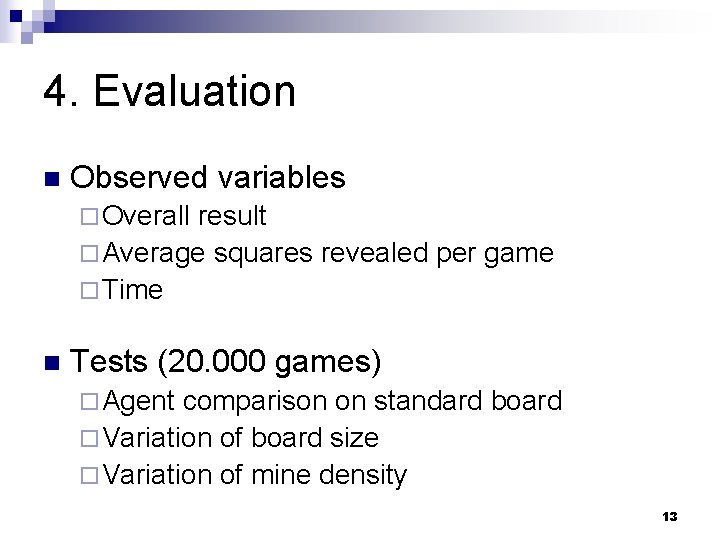
4. Evaluation n Observed variables ¨ Overall result ¨ Average squares revealed per game ¨ Time n Tests (20. 000 games) ¨ Agent comparison on standard board ¨ Variation of board size ¨ Variation of mine density 13
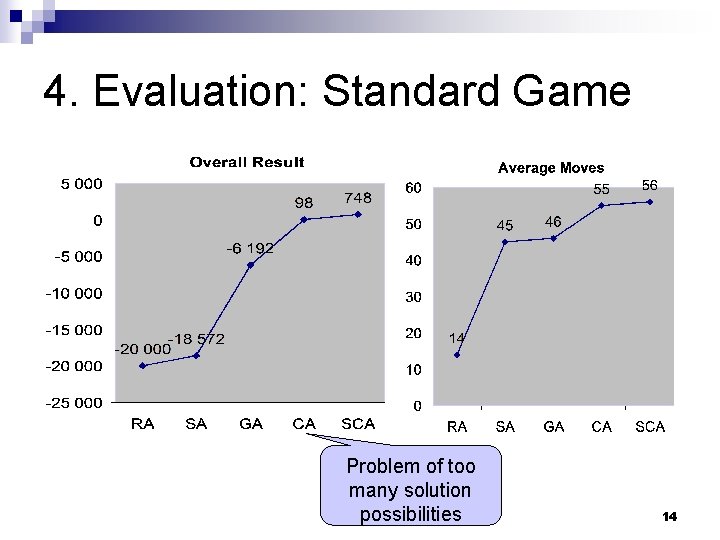
4. Evaluation: Standard Game Problem of too many solution possibilities 14
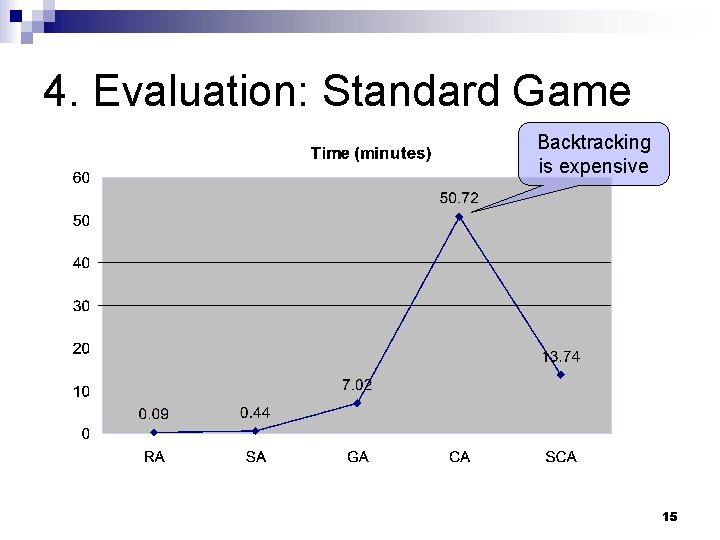
4. Evaluation: Standard Game Backtracking is expensive 15
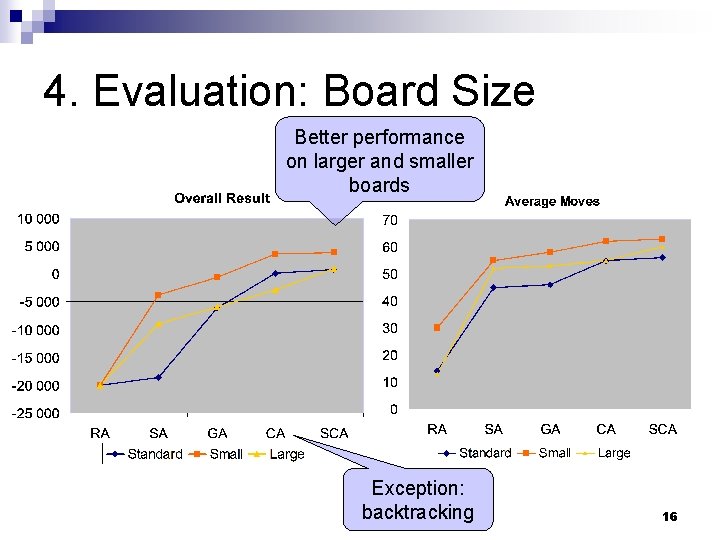
4. Evaluation: Board Size Better performance on larger and smaller boards Exception: backtracking 16
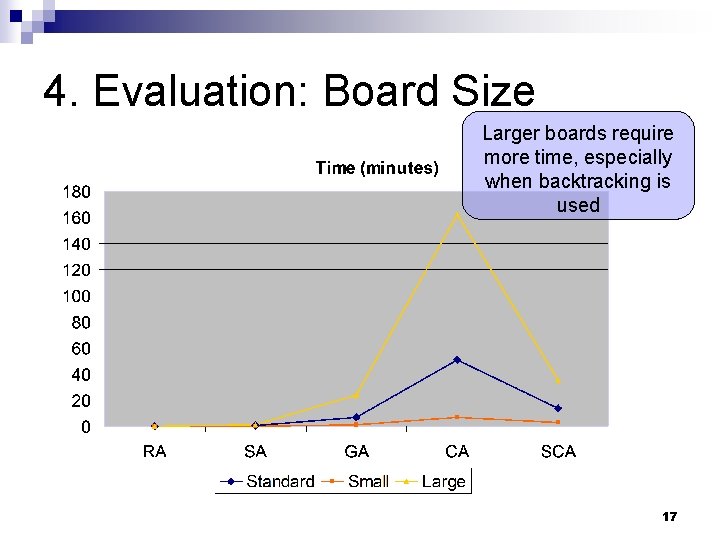
4. Evaluation: Board Size Larger boards require more time, especially when backtracking is used 17
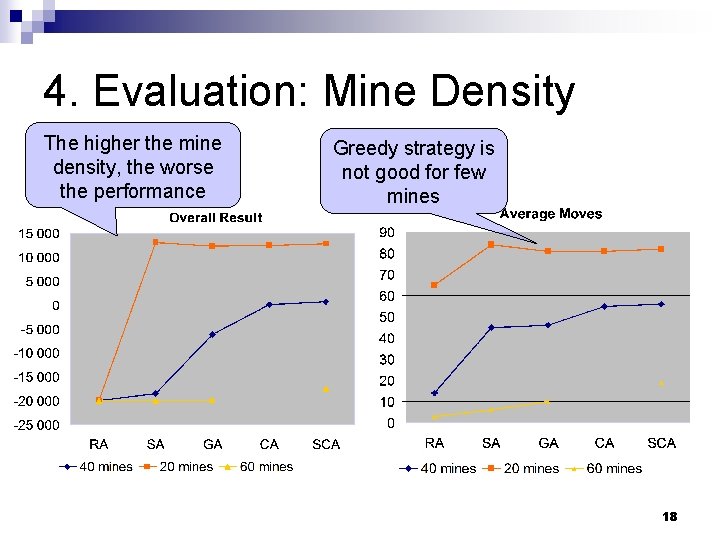
4. Evaluation: Mine Density The higher the mine density, the worse the performance Greedy strategy is not good for few mines 18
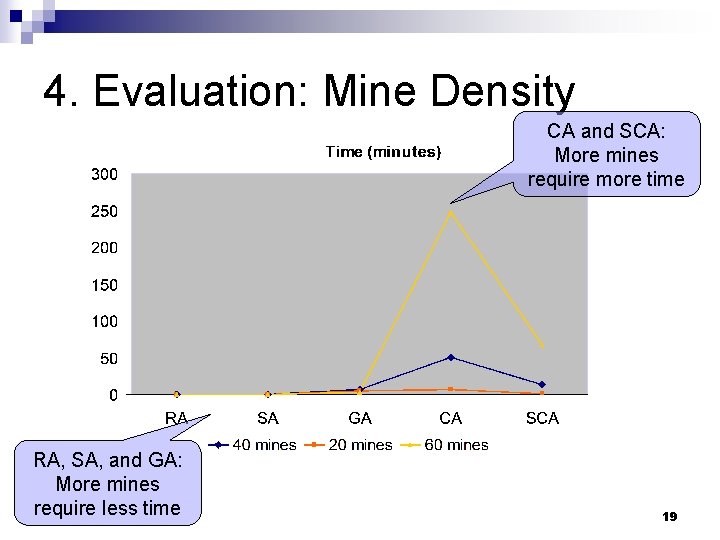
4. Evaluation: Mine Density CA and SCA: More mines require more time RA, SA, and GA: More mines require less time 19
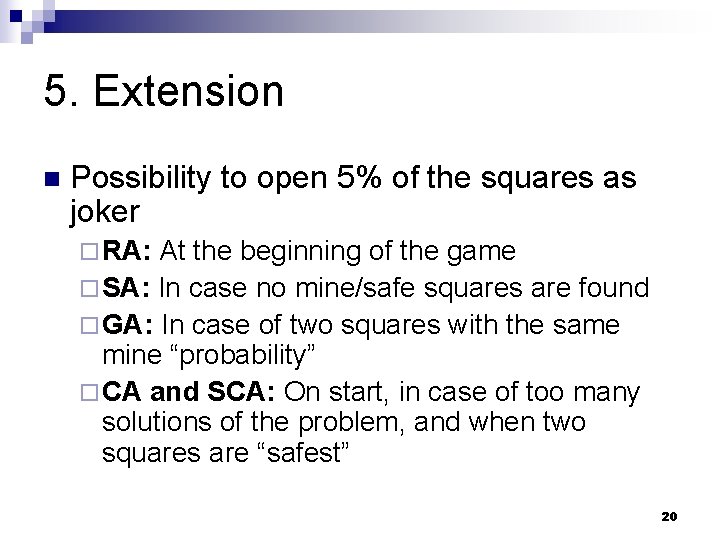
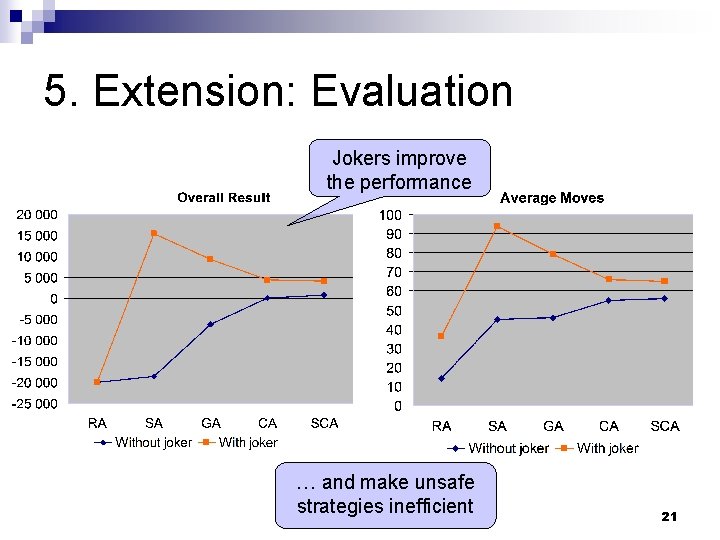
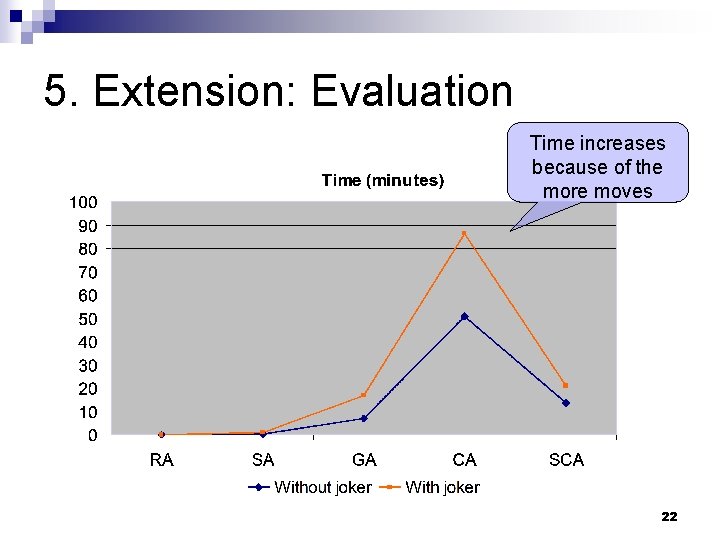
5. Extension n Possibility to open 5% of the squares as joker ¨ RA: At the beginning of the game ¨ SA: In case no mine/safe squares are found ¨ GA: In case of two squares with the same mine “probability” ¨ CA and SCA: On start, in case of too many solutions of the problem, and when two squares are “safest” 20
5. Extension: Evaluation Jokers improve the performance … and make unsafe strategies inefficient 21
5. Extension: Evaluation Time increases because of the more moves 22
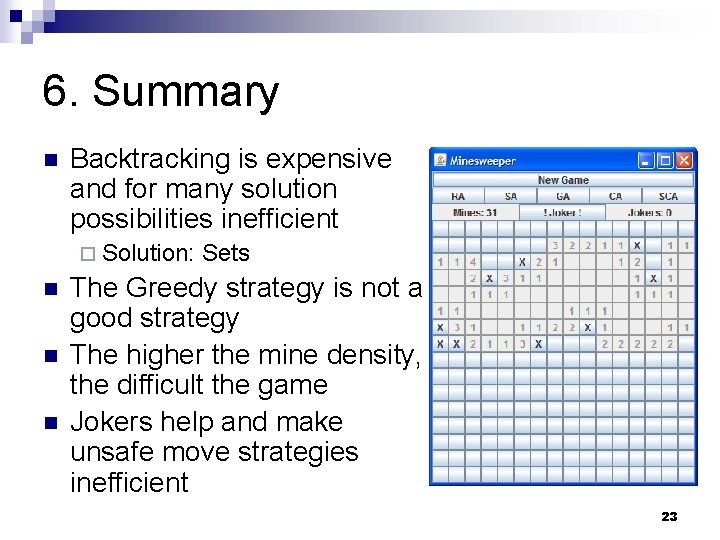
6. Summary n Backtracking is expensive and for many solution possibilities inefficient ¨ Solution: n n n Sets The Greedy strategy is not a good strategy The higher the mine density, the difficult the game Jokers help and make unsafe move strategies inefficient 23