AIM DETERMINING IONIZATION ENERGY AND ELECTRONEGATIVITY OF ELEMENTS



- Slides: 23
AIM: DETERMINING IONIZATION ENERGY AND ELECTRONEGATIVITY OF ELEMENTS DO NOW: 1. LIST IN ORDER OF INCREASING ATOMIC RADII: MAGNESIUM, SILICON, BARIUM, BROMINE 2. COMPARE THE IONIC RADIUS OF METALS TO THEIR ATOMIC RADIUS, AND THE IONIC RADIUS OF NONMETALS TO THEIR ATOMIC RADIUS
IONS • Positive and negative ions form when electrons are transferred between atoms. • Metals tend to lose electrons; nonmetals tend to gain those electrons
ANION • An ion with a negative charge • (N-3, O-2, Cl-1)
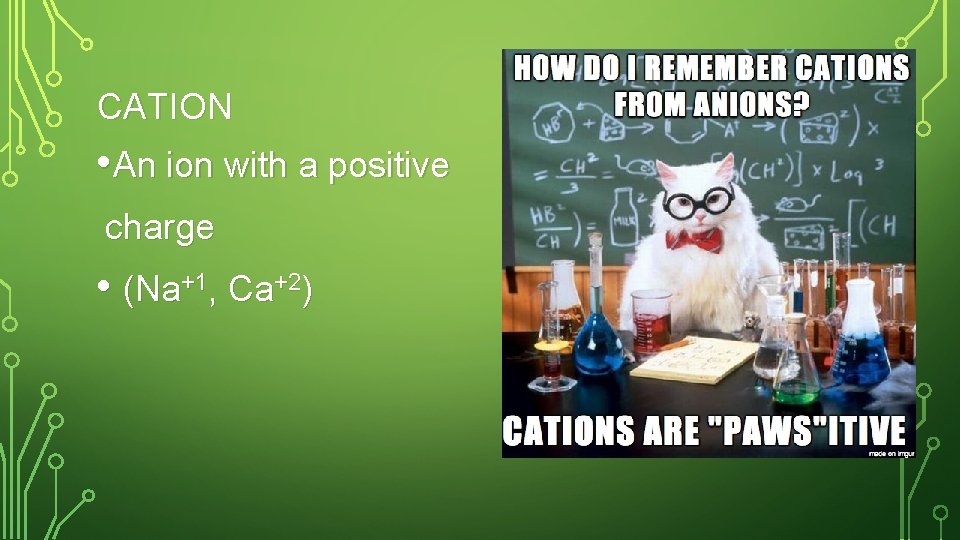
CATION • An ion with a positive charge • (Na+1, Ca+2)
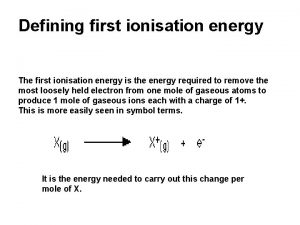
IONIZATION ENERGY • The energy required to remove an electron from an atom. • The larger the ionization energy value the harder to lose an electron (the stronger the atom is holding on to its electron)!
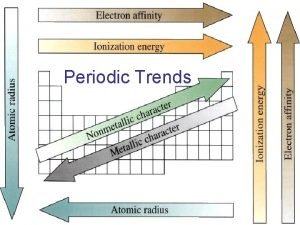
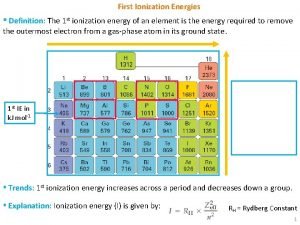
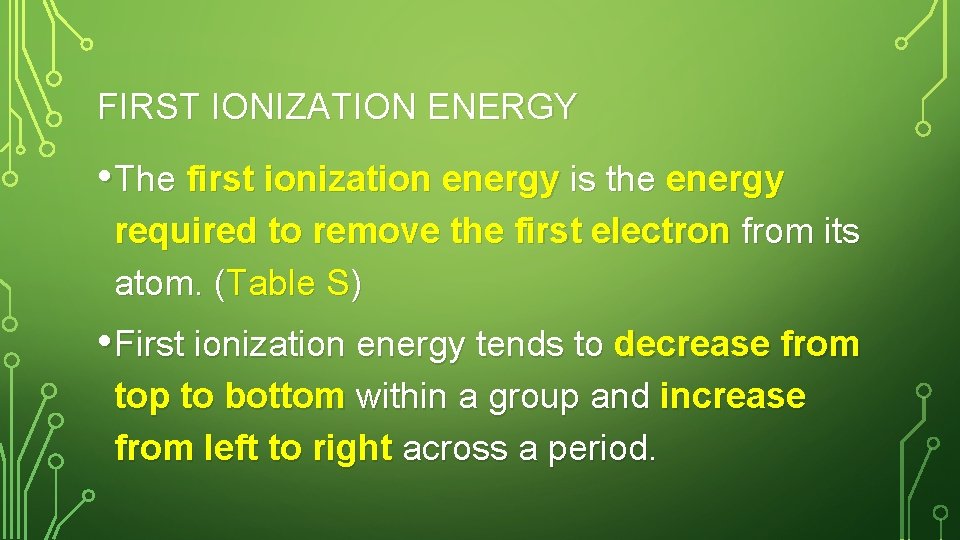
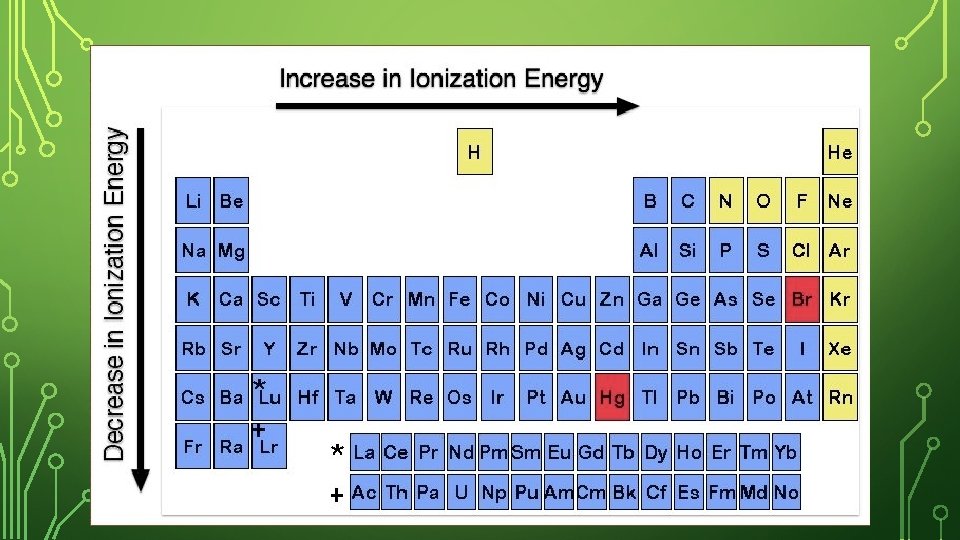
FIRST IONIZATION ENERGY • The first ionization energy is the energy required to remove the first electron from its atom. (Table S) • First ionization energy tends to decrease from top to bottom within a group and increase from left to right across a period.
SECOND AND THIRD IONIZATION ENERGY • The second ionization energy is the energy required to remove an electron from an ion with a 1+ charge. • The third ionization energy is the energy required to remove an electron from an ion with a 2+ charge.
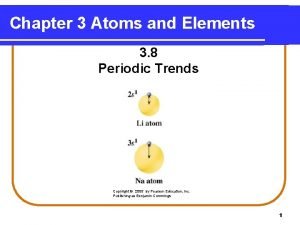
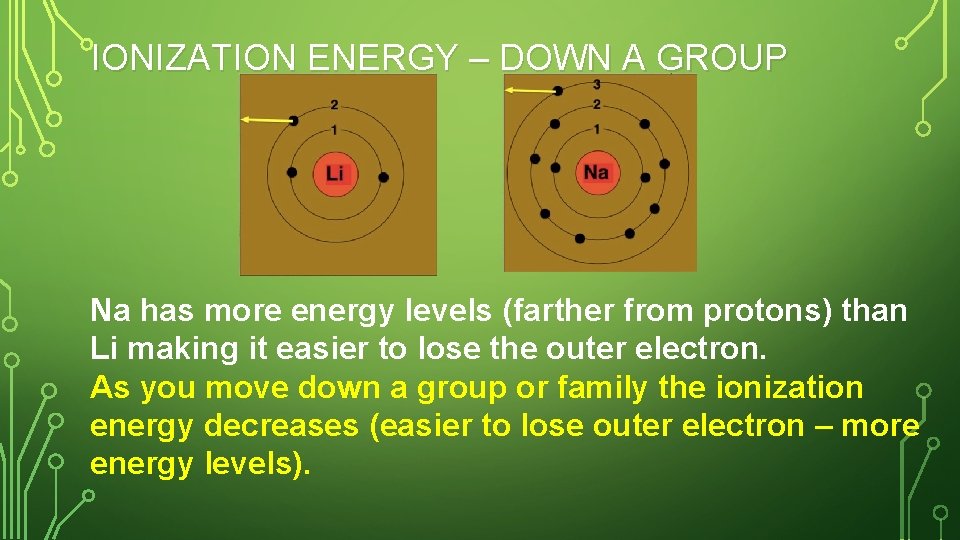
IONIZATION ENERGY – DOWN A GROUP Na has more energy levels (farther from protons) than Li making it easier to lose the outer electron. As you move down a group or family the ionization energy decreases (easier to lose outer electron – more energy levels).
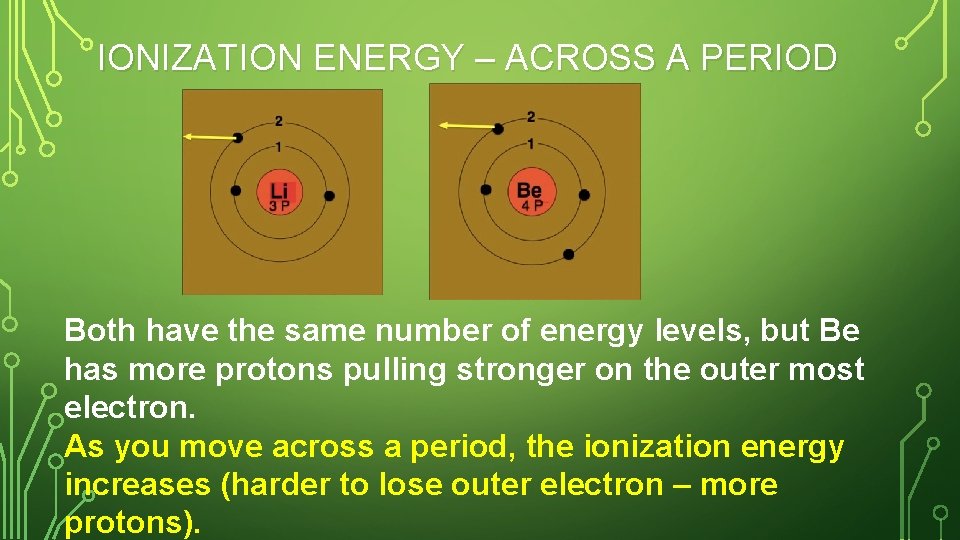
IONIZATION ENERGY – ACROSS A PERIOD Both have the same number of energy levels, but Be has more protons pulling stronger on the outer most electron. As you move across a period, the ionization energy increases (harder to lose outer electron – more protons).
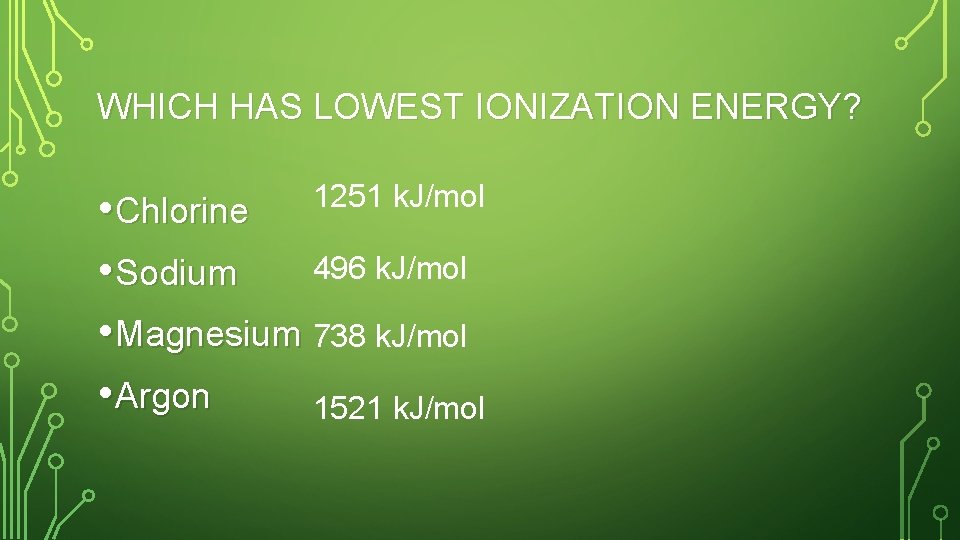
WHICH HAS LOWEST IONIZATION ENERGY? 1251 k. J/mol • Chlorine 496 k. J/mol • Sodium • Magnesium 738 k. J/mol • Argon 1521 k. J/mol
ELECTRONEGATIVITY • The ability of an atom to attract electrons when the atom is in a compound. (Table S) • The ability of an atom to steal an electron from another atom (electron thieves).
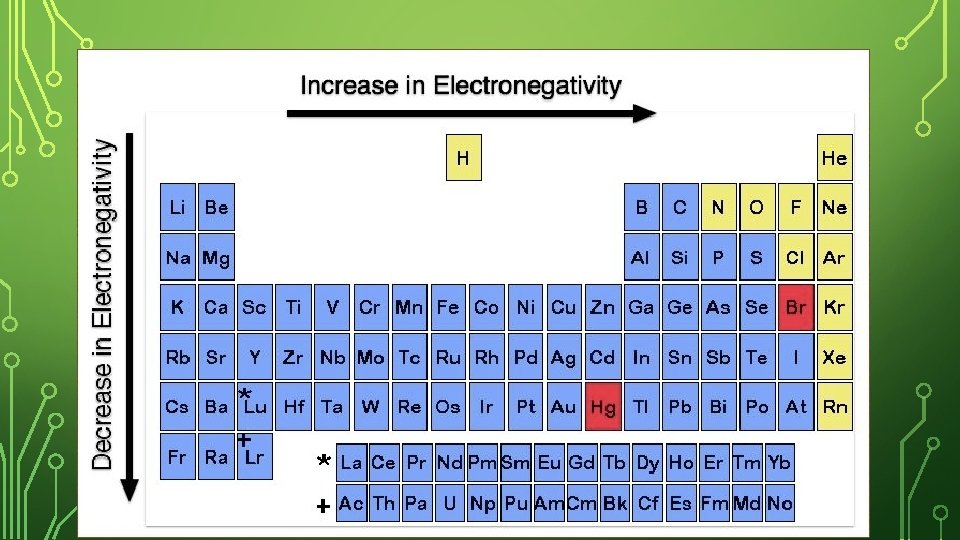
ELECTRONEGATIVITY • In general, electronegativity values decrease from top to bottom within a group, and increase from left to right across a period.
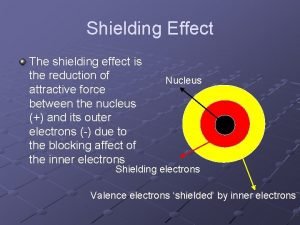
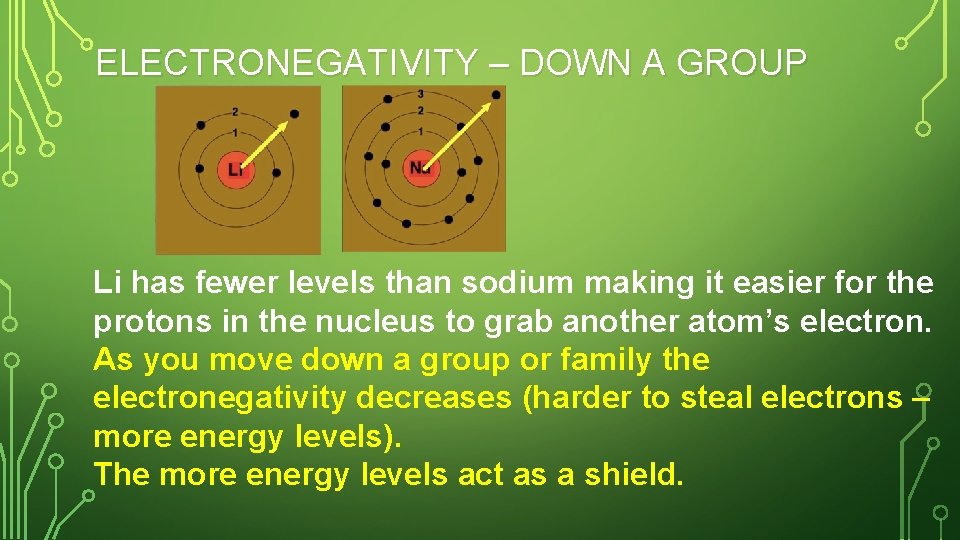
ELECTRONEGATIVITY – DOWN A GROUP Li has fewer levels than sodium making it easier for the protons in the nucleus to grab another atom’s electron. As you move down a group or family the electronegativity decreases (harder to steal electrons – more energy levels). The more energy levels act as a shield.
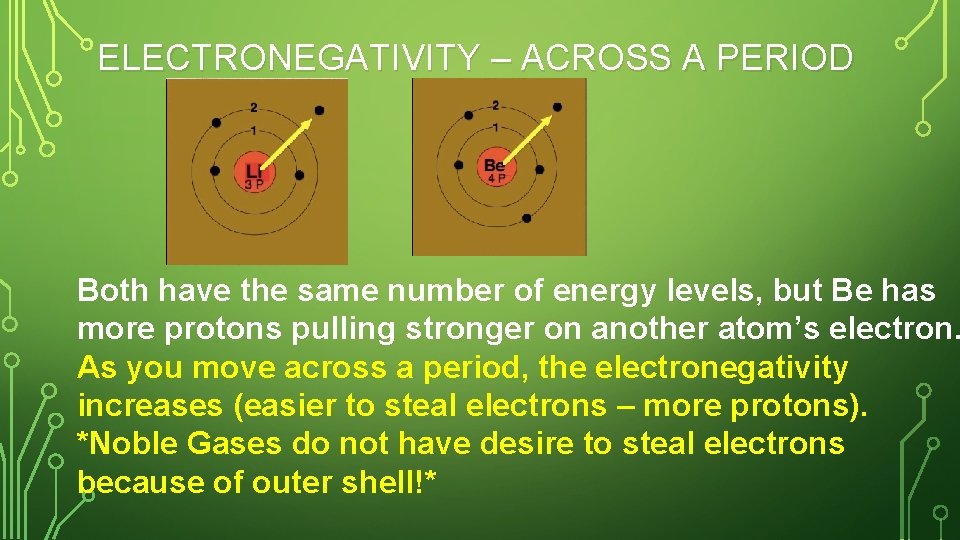
ELECTRONEGATIVITY – ACROSS A PERIOD Both have the same number of energy levels, but Be has more protons pulling stronger on another atom’s electron. As you move across a period, the electronegativity increases (easier to steal electrons – more protons). *Noble Gases do not have desire to steal electrons because of outer shell!*
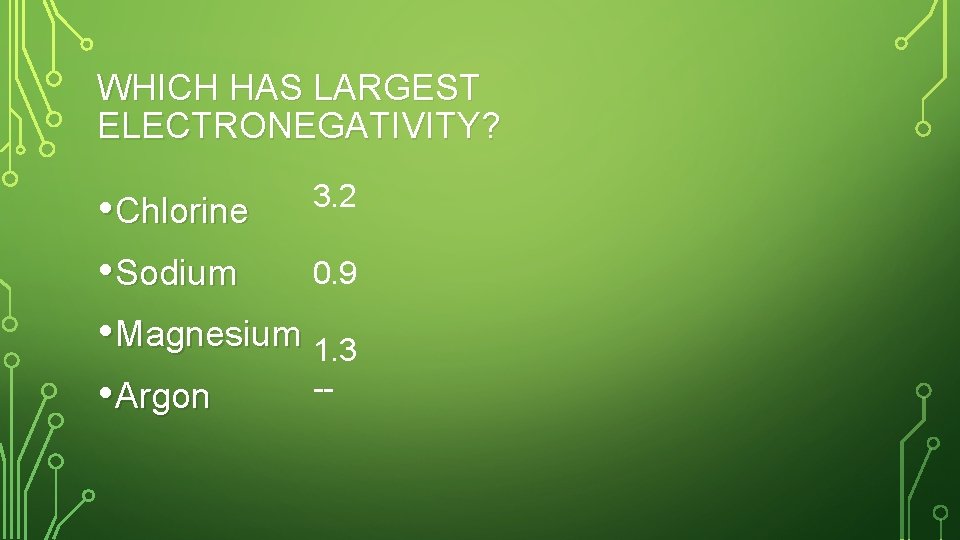
WHICH HAS LARGEST ELECTRONEGATIVITY? 3. 2 • Chlorine 0. 9 • Sodium • Magnesium 1. 3 - • Argon
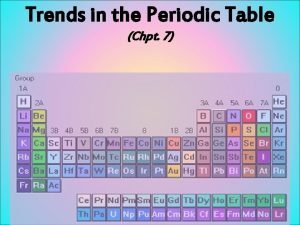
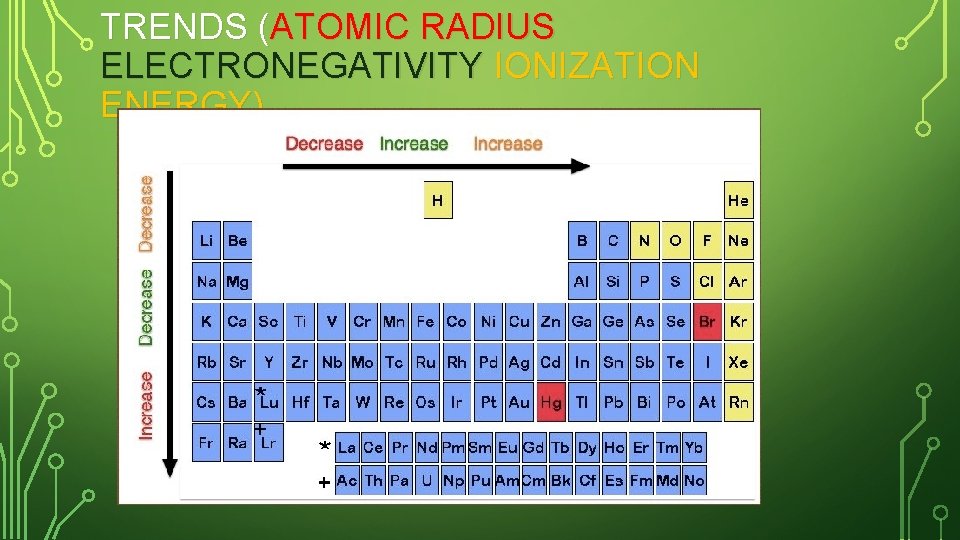
TRENDS (ATOMIC RADIUS ELECTRONEGATIVITY IONIZATION ENERGY)
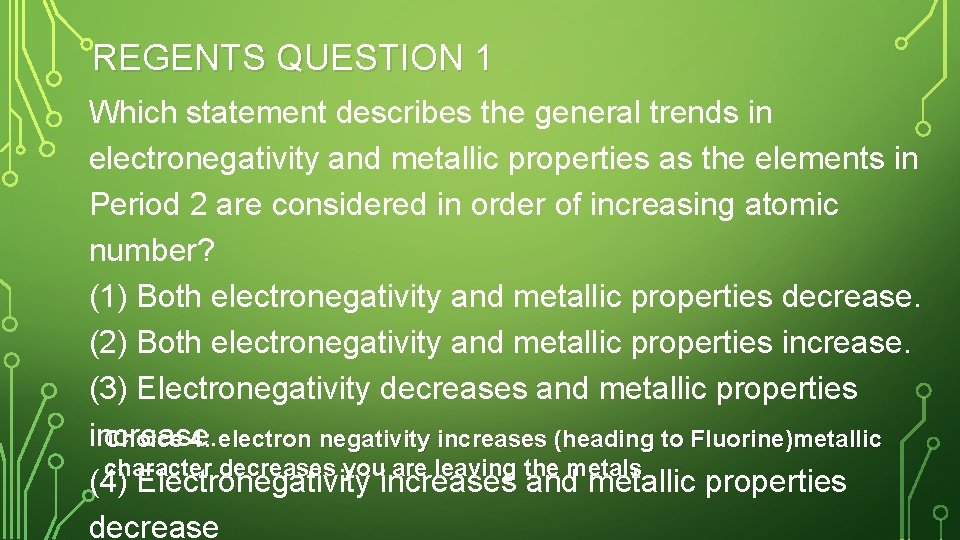
REGENTS QUESTION 1 Which statement describes the general trends in electronegativity and metallic properties as the elements in Period 2 are considered in order of increasing atomic number? (1) Both electronegativity and metallic properties decrease. (2) Both electronegativity and metallic properties increase. (3) Electronegativity decreases and metallic properties increase. Choice 4: electron negativity increases (heading to Fluorine)metallic character decreases you are leaving the metals (4) Electronegativity increases and metallic properties decrease
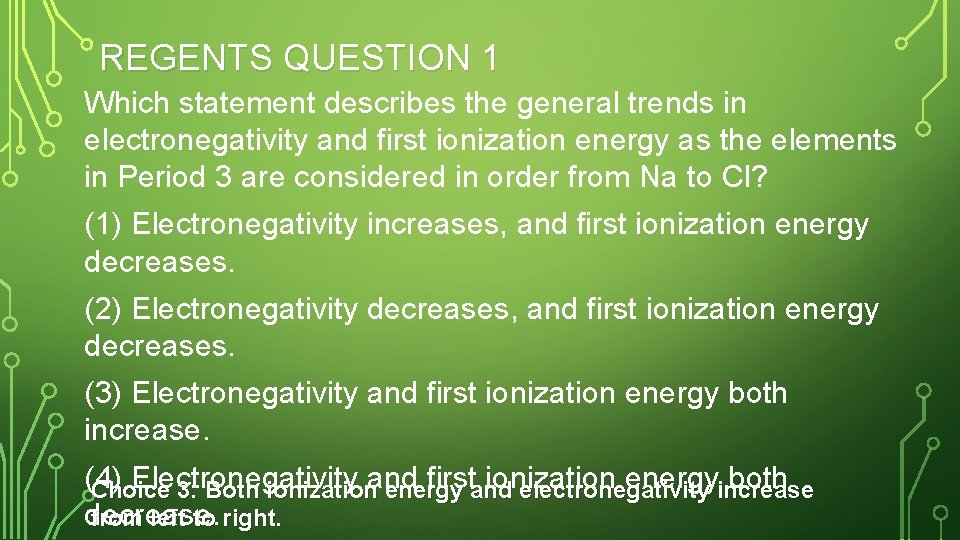
REGENTS QUESTION 1 Which statement describes the general trends in electronegativity and first ionization energy as the elements in Period 3 are considered in order from Na to Cl? (1) Electronegativity increases, and first ionization energy decreases. (2) Electronegativity decreases, and first ionization energy decreases. (3) Electronegativity and first ionization energy both increase. (4) Electronegativity and first ionization energy both Choice 3: Both ionization energy and electronegativity increase decrease. from left to right.
REGENTS QUESTION 3 The amount of energy required to remove the outermost electron from a gaseous atom in the ground state is known as (1) first ionization energy (2) activation energy (3) conductivity (4) electronegativity Choice 1: definition of ionization energy
REGENTS QUESTION 4 Which term represents the attraction one atom has for the electrons in a bond from another atom? (1) electronegativity (2) electrical conductivity (3) first ionization energy (4) mechanical energy Choice 1: Definition of electronegativity is the ability to attract an electron from another atom
SUMMARY • Define: • Atomic Radius • Ionization Energy • Electronegativity-