
Chapter 3 Atoms and Elements 3 8 Periodic
- Slides: 25
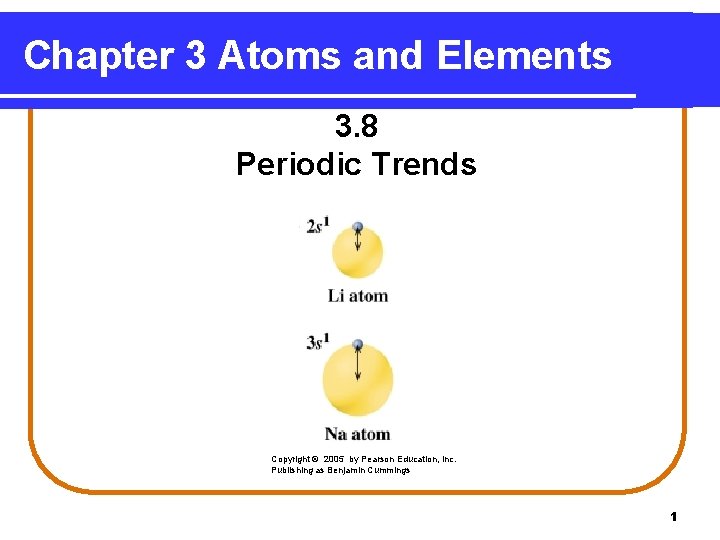
Chapter 3 Atoms and Elements 3. 8 Periodic Trends Copyright © 2005 by Pearson Education, Inc. Publishing as Benjamin Cummings 1
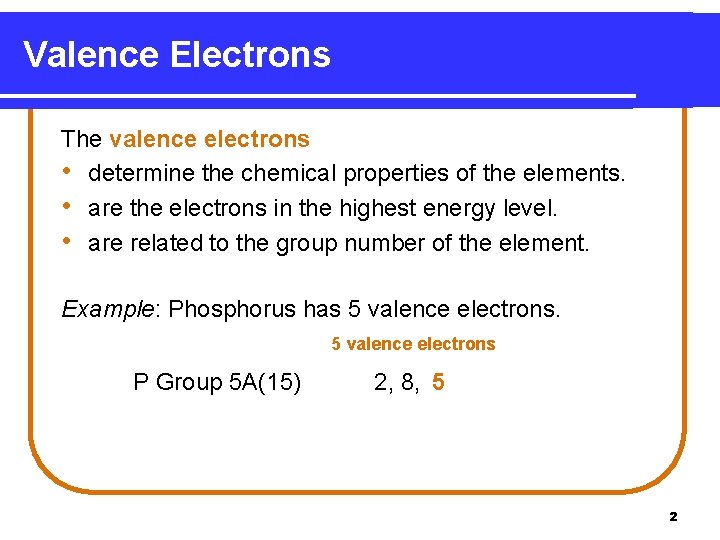
Valence Electrons The valence electrons • determine the chemical properties of the elements. • are the electrons in the highest energy level. • are related to the group number of the element. Example: Phosphorus has 5 valence electrons P Group 5 A(15) 2, 8, 5 2
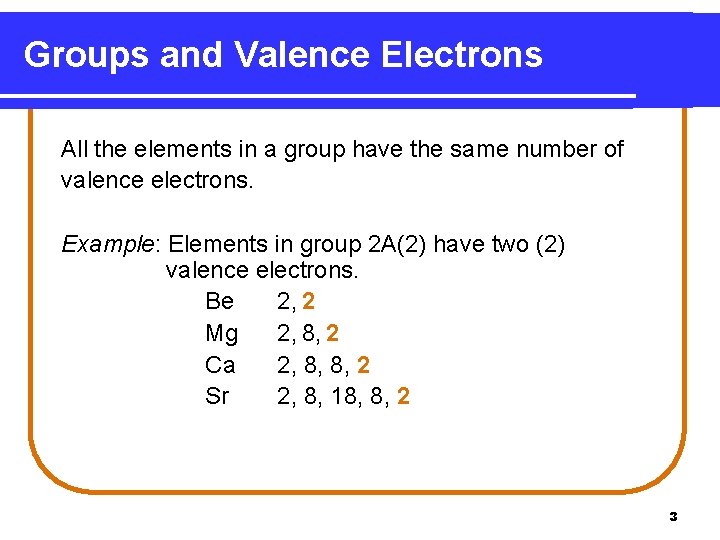
Groups and Valence Electrons All the elements in a group have the same number of valence electrons. Example: Elements in group 2 A(2) have two (2) valence electrons. Be 2, 2 Mg 2, 8, 2 Ca 2, 8, 8, 2 Sr 2, 8, 18, 8, 2 3
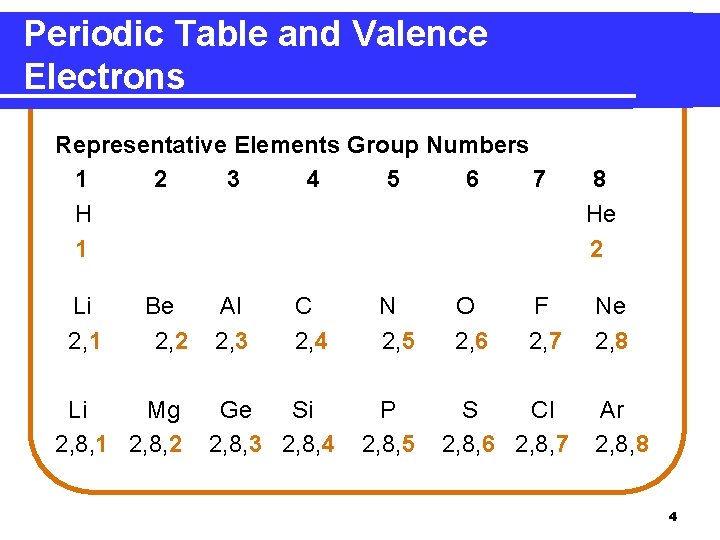
Periodic Table and Valence Electrons Representative Elements Group Numbers 1 2 3 4 5 6 7 H 1 Li 2, 1 Be 2, 2 Li Mg 2, 8, 1 2, 8, 2 Al 2, 3 C 2, 4 N 2, 5 Ge Si 2, 8, 3 2, 8, 4 P 2, 8, 5 O 2, 6 F 2, 7 S Cl 2, 8, 6 2, 8, 7 8 He 2 Ne 2, 8 Ar 2, 8, 8 4
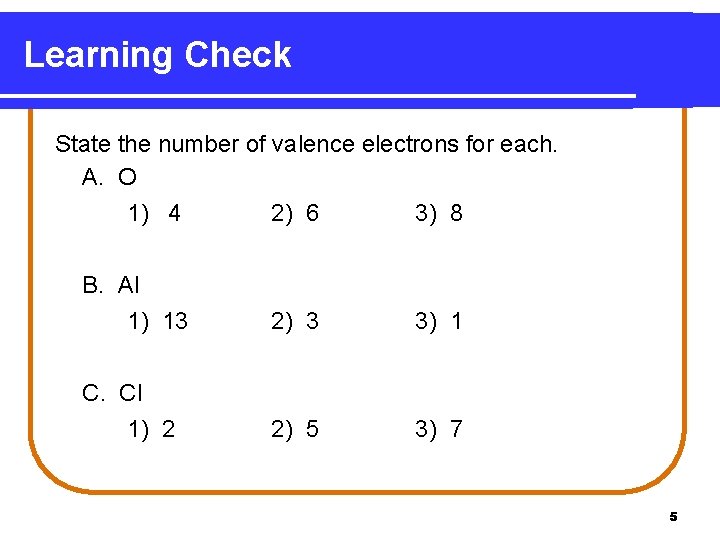
Learning Check State the number of valence electrons for each. A. O 1) 4 2) 6 3) 8 B. Al 1) 13 2) 3 3) 1 C. Cl 1) 2 2) 5 3) 7 5
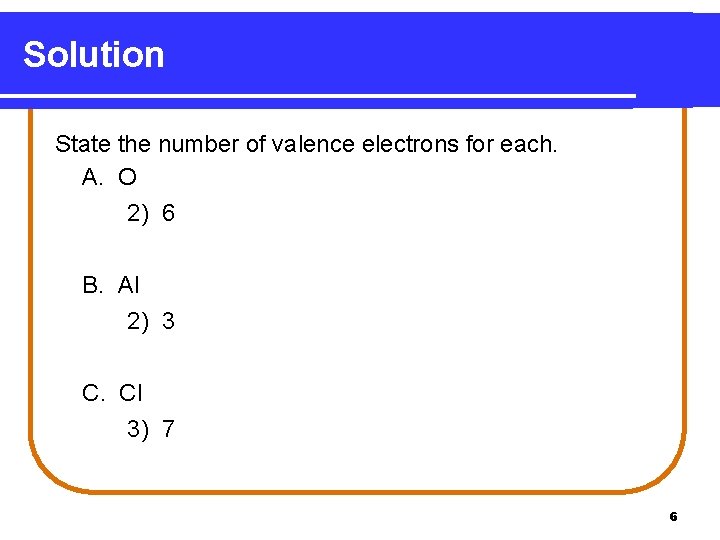
Solution State the number of valence electrons for each. A. O 2) 6 B. Al 2) 3 C. Cl 3) 7 6
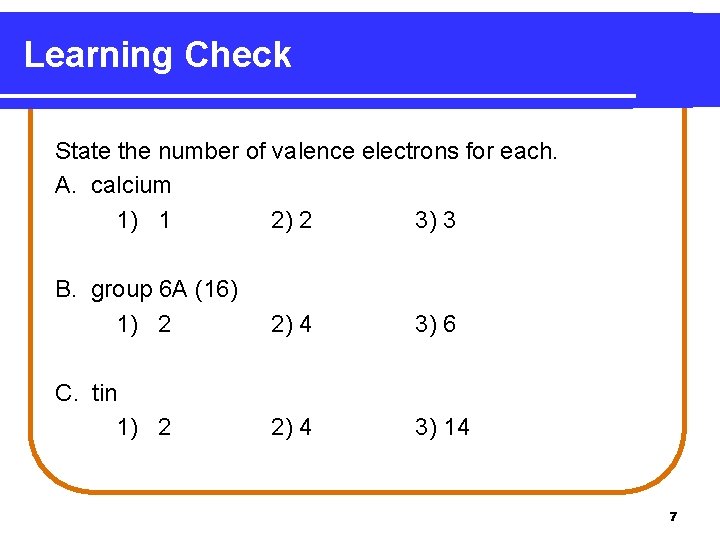
Learning Check State the number of valence electrons for each. A. calcium 1) 1 2) 2 3) 3 B. group 6 A (16) 1) 2 2) 4 3) 6 C. tin 1) 2 2) 4 3) 14 7
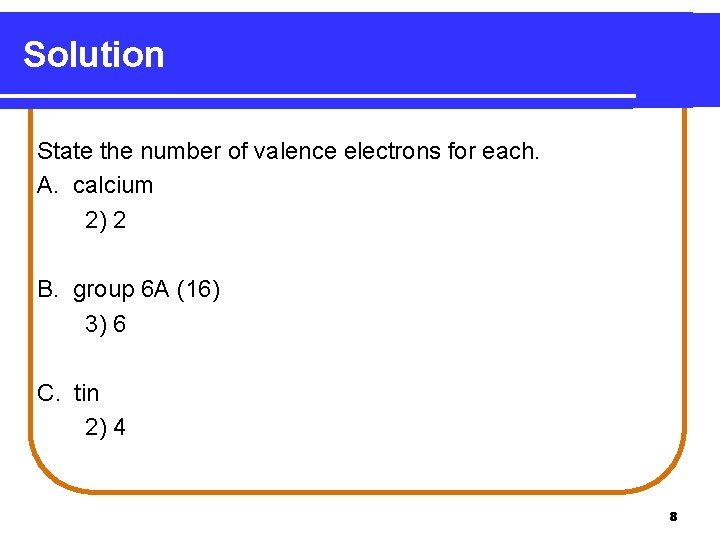
Solution State the number of valence electrons for each. A. calcium 2) 2 B. group 6 A (16) 3) 6 C. tin 2) 4 8
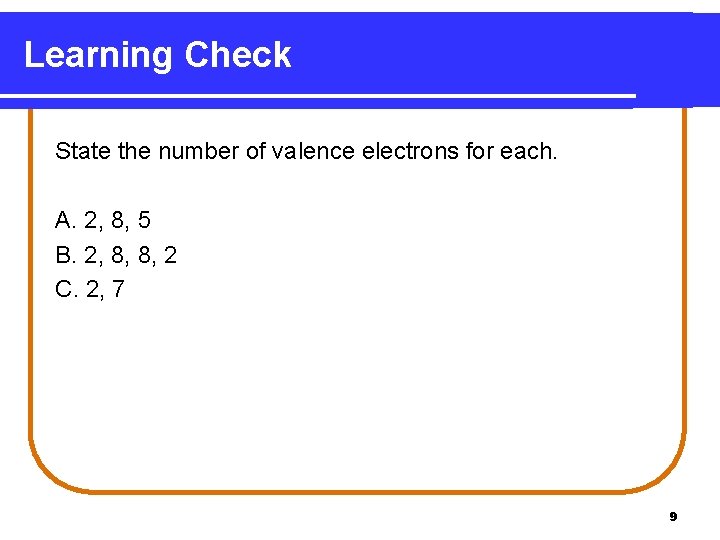
Learning Check State the number of valence electrons for each. A. 2, 8, 5 B. 2, 8, 8, 2 C. 2, 7 9
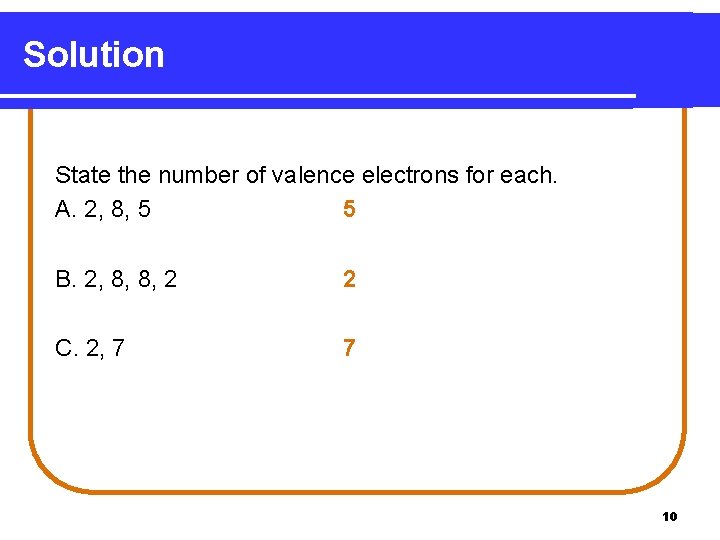
Solution State the number of valence electrons for each. A. 2, 8, 5 5 B. 2, 8, 8, 2 2 C. 2, 7 7 10
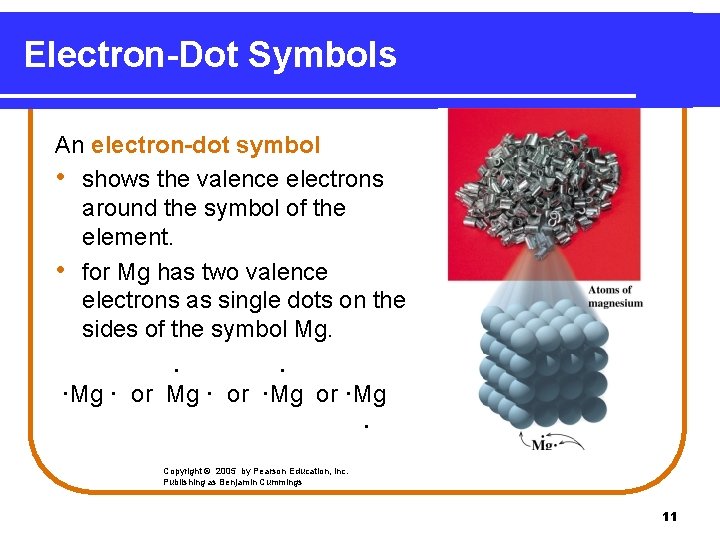
Electron-Dot Symbols An electron-dot symbol • shows the valence electrons around the symbol of the element. • for Mg has two valence electrons as single dots on the sides of the symbol Mg. . . ·Mg · or ·Mg · Copyright © 2005 by Pearson Education, Inc. Publishing as Benjamin Cummings 11
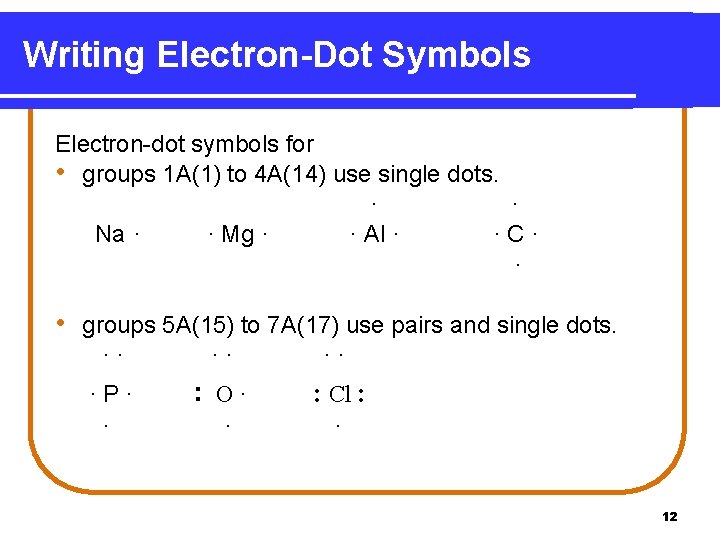
Writing Electron-Dot Symbols Electron-dot symbols for • groups 1 A(1) to 4 A(14) use single dots. · · Na · · Mg · · Al · ·C· · • groups 5 A(15) to 7 A(17) use pairs and single dots. ·· ·· ·· ·P· · : : O · : Cl : · · 12
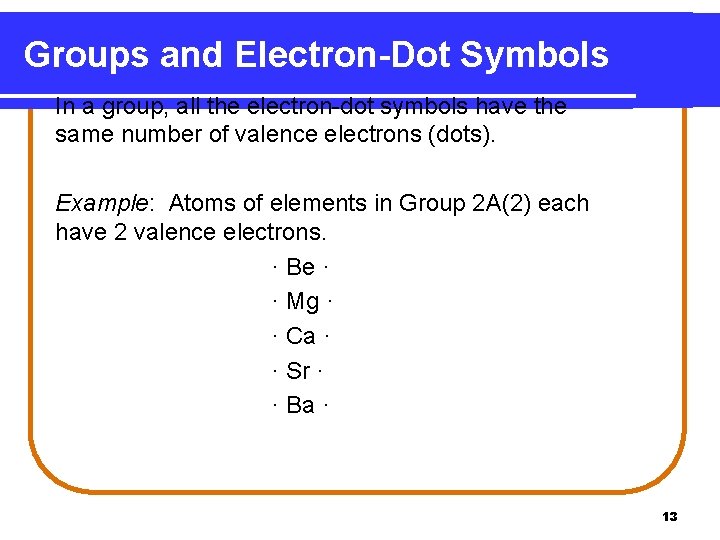
Groups and Electron-Dot Symbols In a group, all the electron-dot symbols have the same number of valence electrons (dots). Example: Atoms of elements in Group 2 A(2) each have 2 valence electrons. · Be · · Mg · · Ca · · Sr · · Ba · 13
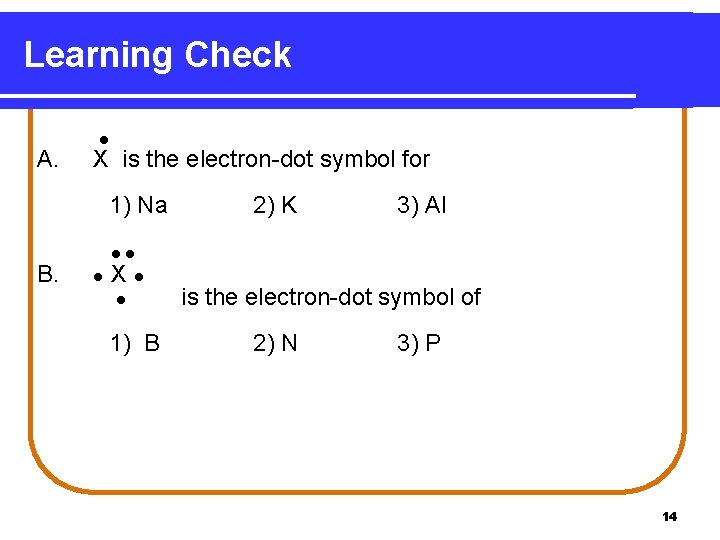
Learning Check A. X is the electron-dot symbol for 1) Na B. 2) K 3) Al X 1) B is the electron-dot symbol of 2) N 3) P 14
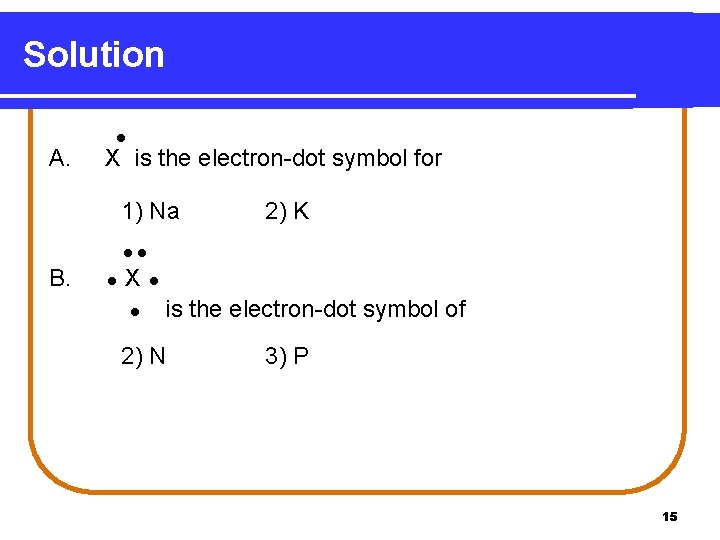
Solution A. X is the electron-dot symbol for 1) Na 2) K B. X is the electron-dot symbol of 2) N 3) P 15
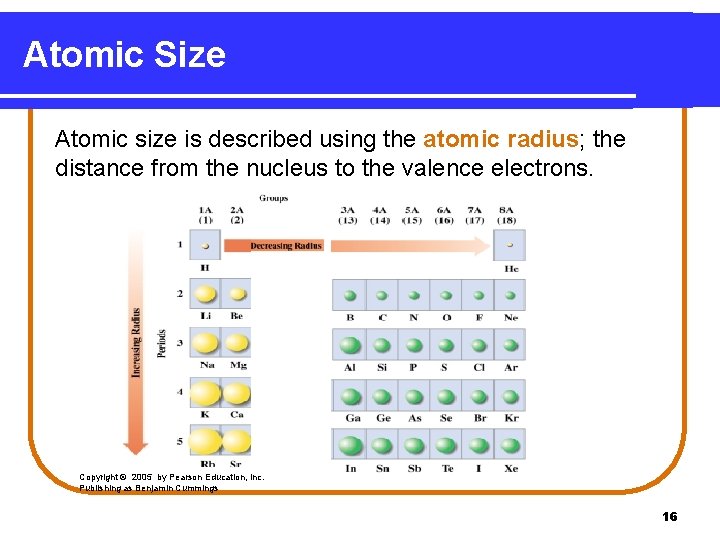
Atomic Size Atomic size is described using the atomic radius; the distance from the nucleus to the valence electrons. Copyright © 2005 by Pearson Education, Inc. Publishing as Benjamin Cummings 16
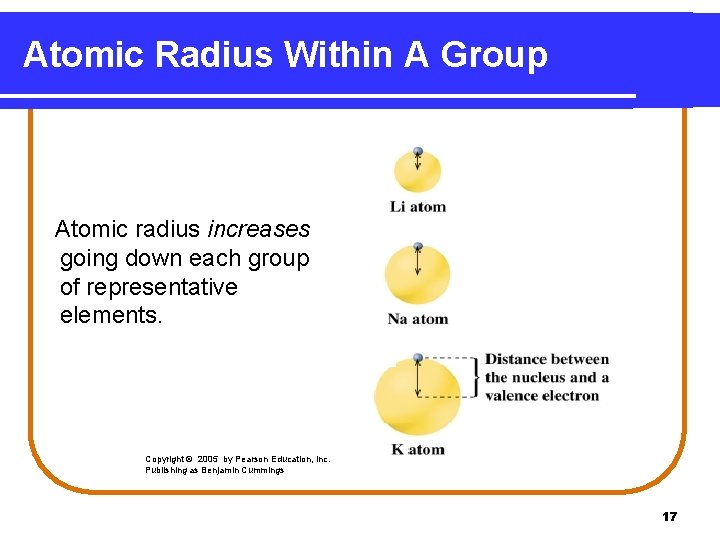
Atomic Radius Within A Group Atomic radius increases going down each group of representative elements. Copyright © 2005 by Pearson Education, Inc. Publishing as Benjamin Cummings 17
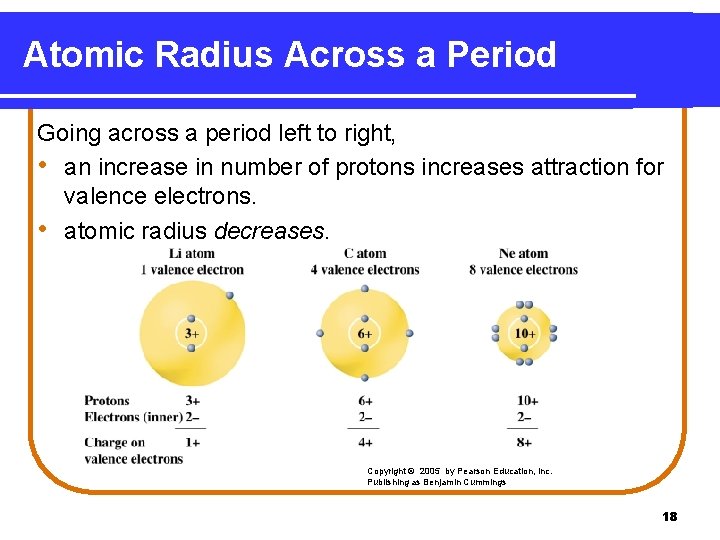
Atomic Radius Across a Period Going across a period left to right, • an increase in number of protons increases attraction for valence electrons. • atomic radius decreases. Copyright © 2005 by Pearson Education, Inc. Publishing as Benjamin Cummings 18
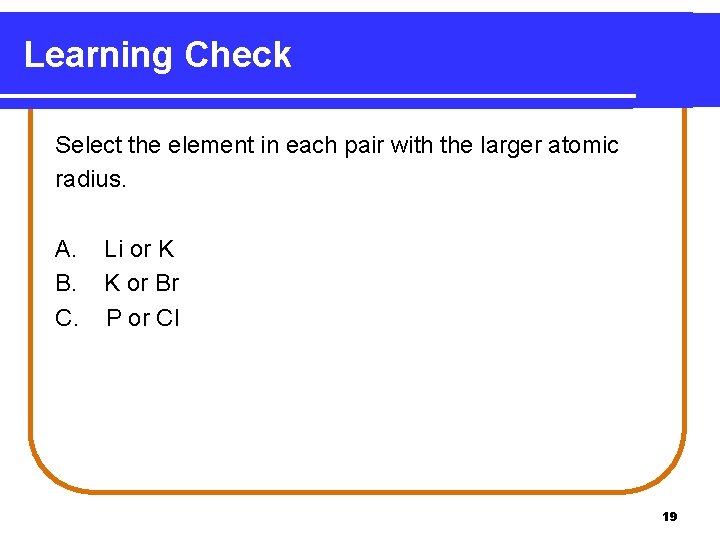
Learning Check Select the element in each pair with the larger atomic radius. A. B. C. Li or K K or Br P or Cl 19
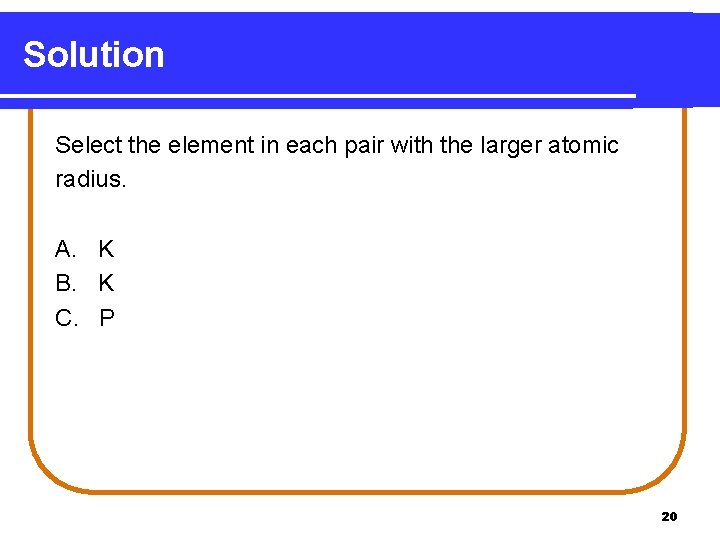
Solution Select the element in each pair with the larger atomic radius. A. K B. K C. P 20
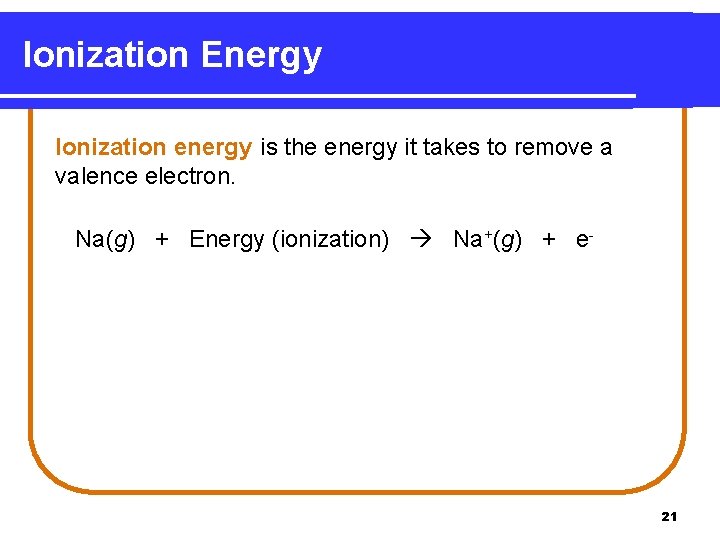
Ionization Energy Ionization energy is the energy it takes to remove a valence electron. Na(g) + Energy (ionization) Na+(g) + e- 21
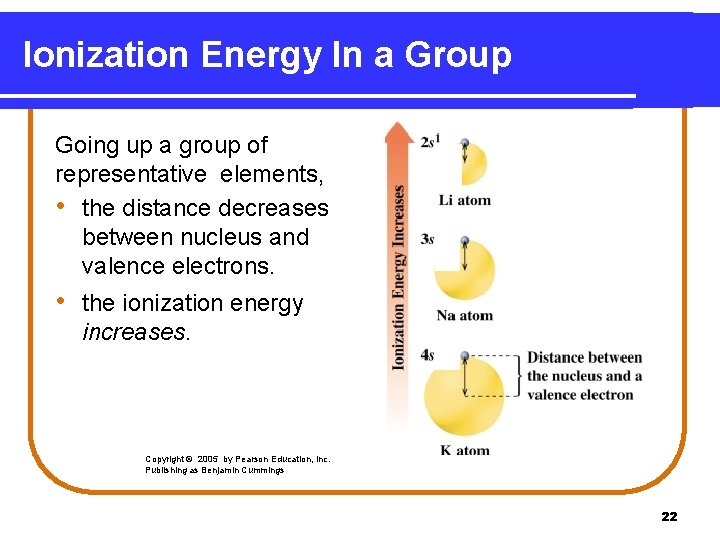
Ionization Energy In a Group Going up a group of representative elements, • the distance decreases between nucleus and valence electrons. • the ionization energy increases. Copyright © 2005 by Pearson Education, Inc. Publishing as Benjamin Cummings 22
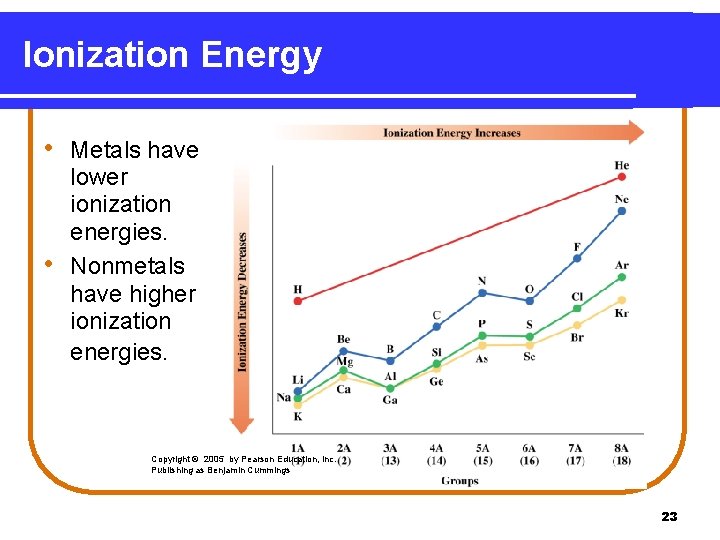
Ionization Energy • Metals have • lower ionization energies. Nonmetals have higher ionization energies. Copyright © 2005 by Pearson Education, Inc. Publishing as Benjamin Cummings 23
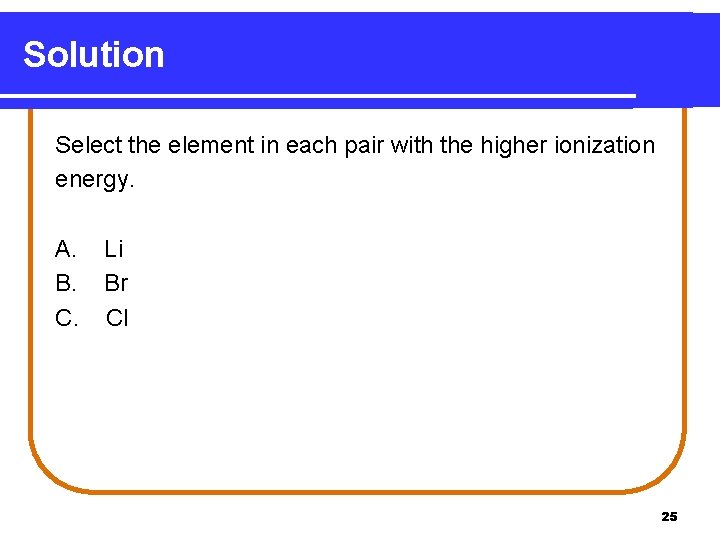
Learning Check Select the element in each pair with the higher ionization energy. A. B. C. Li or K K or Br P or Cl 24
Solution Select the element in each pair with the higher ionization energy. A. B. C. Li Br Cl 25