Accelerating Read Mapping with Fast HASH Hongyi Xin
- Slides: 34
Accelerating Read Mapping with Fast. HASH Hongyi Xin† Donghyuk Lee† Farhad Hormozdiari ‡ Samihan Yedkar† Can Alkan § Onur Mutlu† † Carnegie Mellon University § University of Washington ‡ University of California Los Angeles
Outline n Read Mapping and its Challenges n Hash Table-Based Mappers n Problem and Goal n Key Observations n Mechanisms n Results n Conclusion 2
Outline n Read Mapping and its Challenges n Hash Table-Based Mappers n Problem and Goal n Key Observations n Mechanisms n Results n Conclusion 3
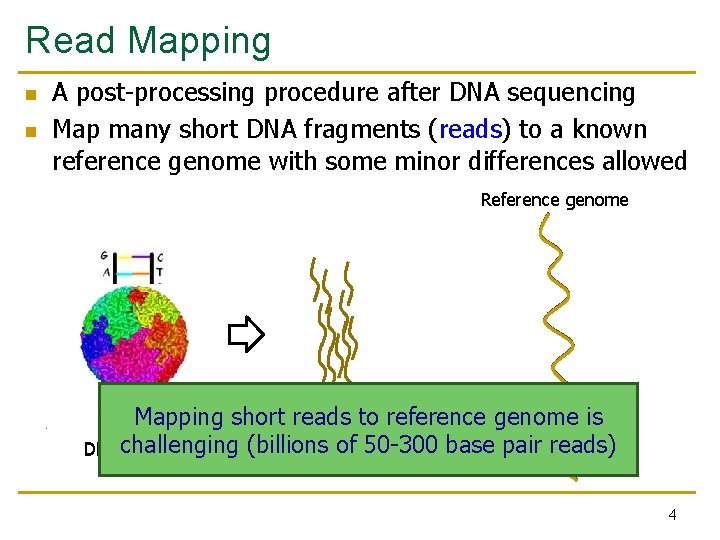
Read Mapping n n A post-processing procedure after DNA sequencing Map many short DNA fragments (reads) to a known reference genome with some minor differences allowed Reference genome Mapping short reads to reference genome is Reads (billions of 50 -300 base pair reads) DNA, challenging physically logically 4
Challenges n n n Need to find many mappings of each read q A short read may map to many locations, especially with Next Generation DNA Sequencing q How can we find all mappings efficiently? Need to tolerate small variances/errors in each read q Each individual is different: Subject’s DNA may slightly differ from the reference (Mismatches, insertions, deletions) q How can we efficiently map each read with up to e errors present? Need to map each read very fast (i. e. , performance is important) q Human DNA is 3. 2 billion base pairs long Millions to billions of reads (State-of-the-art mappers take weeks to map a human’s DNA) q How can we design a much higher performance read mapper? 5
Outline n Read Mapping and its Challenges n Hash Table-Based Mappers q Preprocess the reference into a Hash Table q Use Hash Table to map reads n Problem and Goal n Key Observations n Mechanisms n Results 6
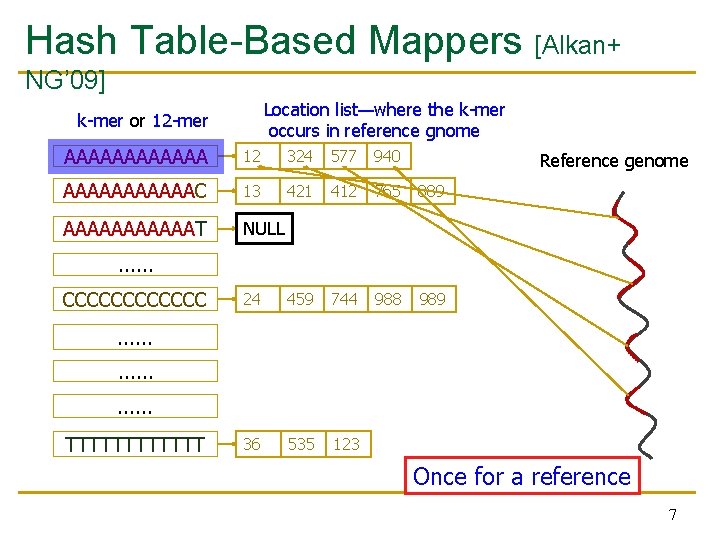
Hash Table-Based Mappers [Alkan+ NG’ 09] Location list—where the k-mer occurs in reference gnome k-mer or 12 -mer AAAAAA 12 324 577 940 AAAAAAC 13 421 412 765 889 AAAAAAT NULL 24 459 744 988 989 36 535 123 Reference genome . . . CCCCCC. . . . TTTTTT Once for a reference 7
Outline n Read Mapping and its Challenges n Hash Table-Based Mappers q Preprocess the reference into a Hash Table q Use Hash Table to map reads n Problem and Goal n Key Observations n Mechanisms n Results 8
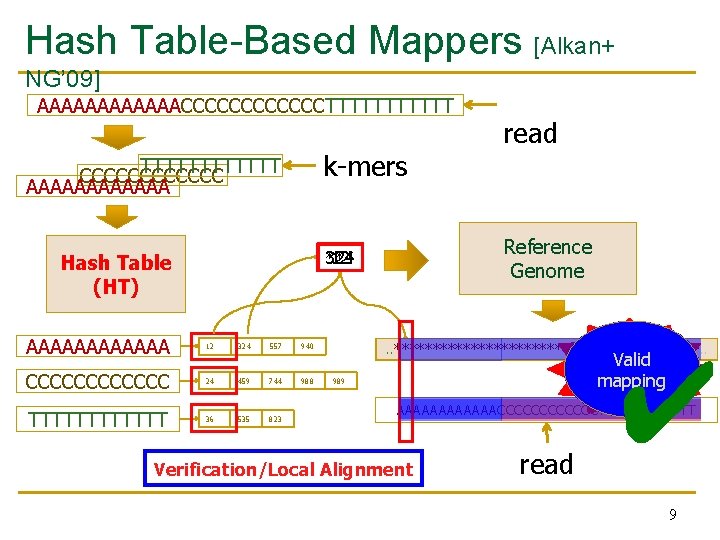
Hash Table-Based Mappers [Alkan+ NG’ 09] AAAAAACCCCCCTTTTTT k-mers TTTTTT CCCCCC AAAAAA Reference Genome 12 324 *** Hash Table (HT) AAAAAA 12 324 557 940 CCCCCC 24 459 744 988 TTTTTT 36 535 823 read . . ********************. . …AAAAAACCCCCCTTTTTT… AAAAAAACGCTTCCACCTTAATCTGGTTG. . ✔ Valid Invalid mapping 989 AAAAAACCCCCCTTTTTT Verification/Local Alignment read 9
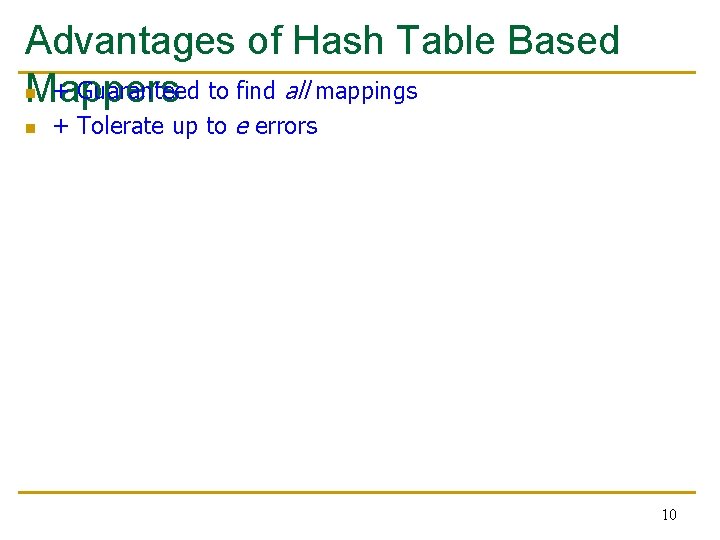
Advantages of Hash Table Based n + Guaranteed to find all mappings Mappers n + Tolerate up to e errors 10
Outline n Read Mapping and its Challenges n Hash Table-Based Mappers n Problem and Goal n Key Observations n Mechanisms n Results n Conclusion 11
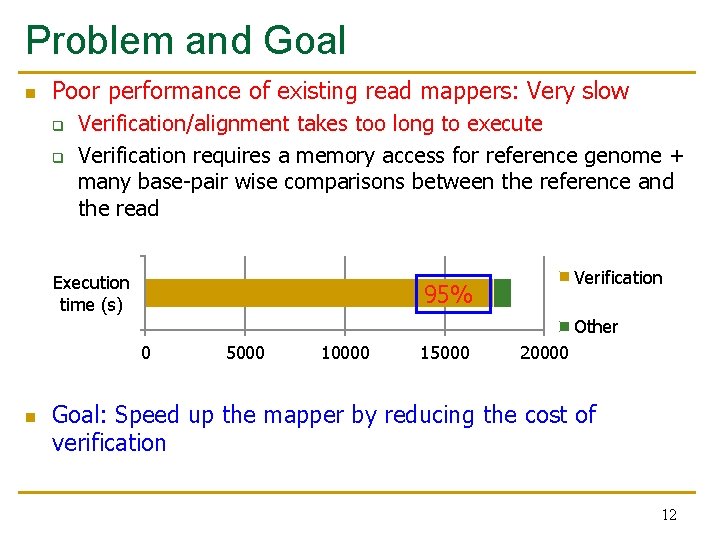
Problem and Goal n Poor performance of existing read mappers: Very slow q q Verification/alignment takes too long to execute Verification requires a memory access for reference genome + many base-pair wise comparisons between the reference and the read Execution time (s) Verification 95% Other 0 n 5000 10000 15000 20000 Goal: Speed up the mapper by reducing the cost of verification 12
Reducing the Cost of Verification n We observe that most verification calculations are unnecessary q n 1 out of 1000 potential locations passes the verification process We also observe that we can get rid of unnecessary verification calculations by q Detecting and rejecting early invalid mappings q Reducing the number of potential mappings 13
Outline n Read Mapping and its Challenges n Hash Table-Based Mappers n Problem and Goal n Key Observations n Mechanisms n Results n Conclusion 14
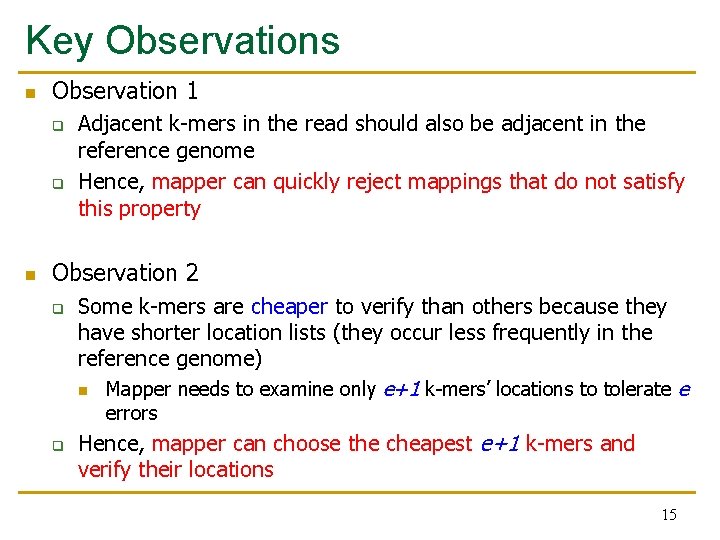
Key Observations n Observation 1 q q n Adjacent k-mers in the read should also be adjacent in the reference genome Hence, mapper can quickly reject mappings that do not satisfy this property Observation 2 q Some k-mers are cheaper to verify than others because they have shorter location lists (they occur less frequently in the reference genome) n Mapper needs to examine only e+1 k-mers’ locations to tolerate e errors q Hence, mapper can choose the cheapest e+1 k-mers and verify their locations 15
Outline n Read Mapping and its Challenges n Hash Table-Based Mappers n Problem and Goal n Key Observations n Mechanisms n Results n Conclusion 16
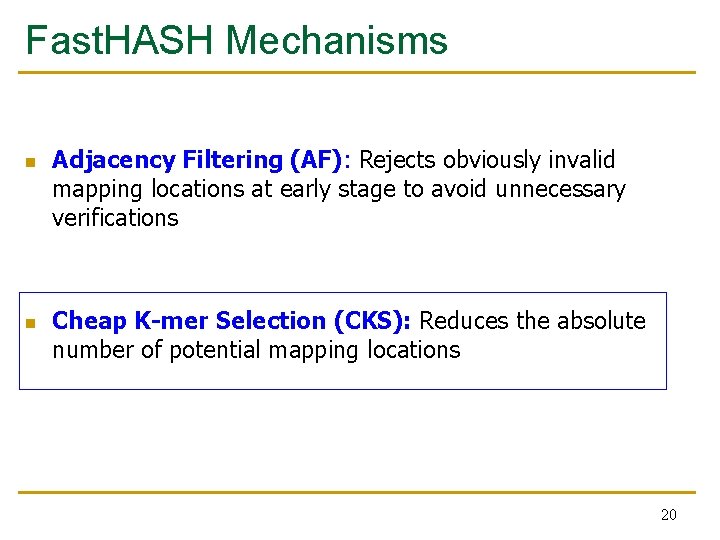
Fast. HASH Mechanisms n n Adjacency Filtering (AF): Rejects obviously invalid mapping locations at early stage to avoid unnecessary verifications Cheap K-mer Selection (CKS): Reduces the absolute number of potential mapping locations 17
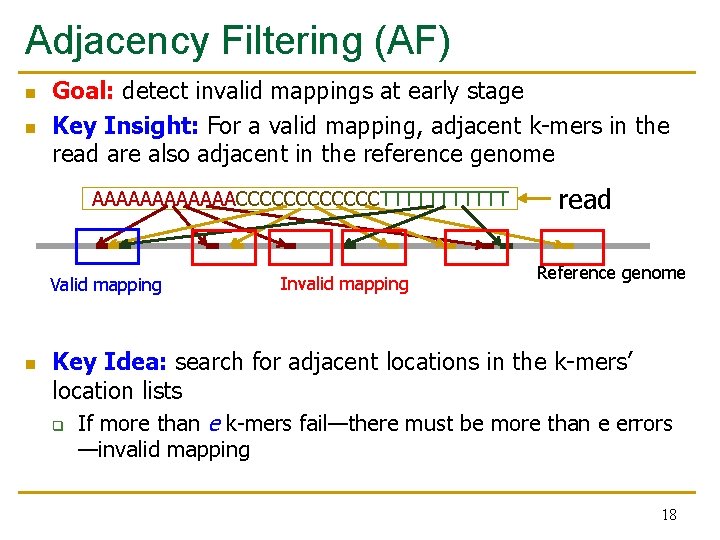
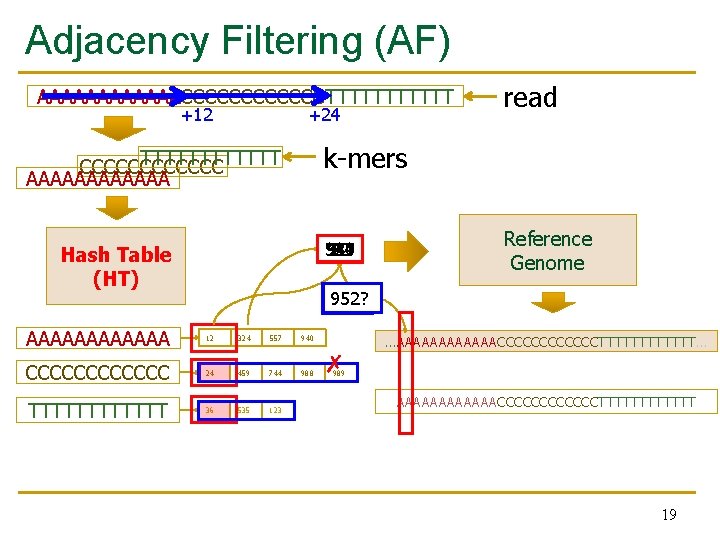
Adjacency Filtering (AF) n n Goal: detect invalid mappings at early stage Key Insight: For a valid mapping, adjacent k-mers in the read are also adjacent in the reference genome AAAAAACCCCCCTTTTTT Valid mapping n Invalid mapping read Reference genome Key Idea: search for adjacent locations in the k-mers’ location lists q If more than e k-mers fail—there must be more than e errors —invalid mapping 18
Adjacency Filtering (AF) AAAAAACCCCCCTTTTTT +12 +24 read k-mers TTTTTT CCCCCC AAAAAA 12 940 *** 557 324 Hash Table (HT) Reference Genome 569? 952? 336? 24? AAAAAA 12 324 557 940 CCCCCC 24 459 744 988 TTTTTT 36 535 123 …AAAAAACCCCCCTTTTTT… ✗ 989 AAAAAACCCCCCTTTTTT 19
Fast. HASH Mechanisms n n Adjacency Filtering (AF): Rejects obviously invalid mapping locations at early stage to avoid unnecessary verifications Cheap K-mer Selection (CKS): Reduces the absolute number of potential mapping locations 20
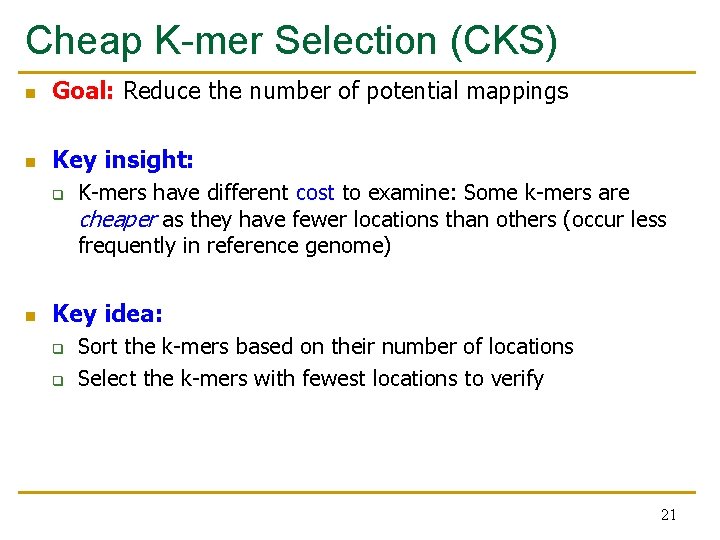
Cheap K-mer Selection (CKS) n Goal: Reduce the number of potential mappings n Key insight: q n K-mers have different cost to examine: Some k-mers are cheaper as they have fewer locations than others (occur less frequently in reference genome) Key idea: q q Sort the k-mers based on their number of locations Select the k-mers with fewest locations to verify 21
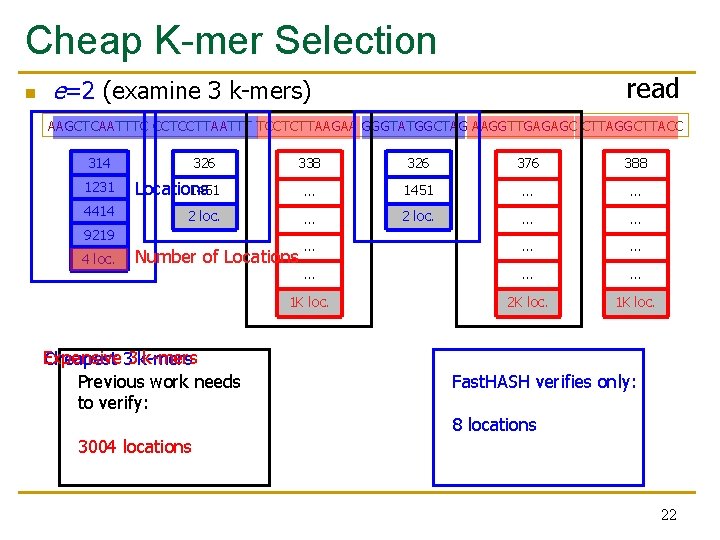
Cheap K-mer Selection n read e=2 (examine 3 k-mers) AAGCTCAATTTC CCTCCTTAATTT TCCTCTTAAGAA GGGTATGGCTAG AAGGTTGAGAGC CTTAGGCTTACC 314 326 1231 4414 338 326 376 388 1451 Locations … 1451 … … 2 loc. … … … … 1 K loc. 2 K loc. 1 K loc. 9219 4 loc. Number of Locations Expensive k-mers Cheapest 33 k-mers Previous work needs to verify: 3004 locations Fast. HASH verifies only: 8 locations 22
Outline n Read Mapping and its Challenges n Hash Table-Based Mappers n Problem and Goal n Key Observations n Mechanisms n Results n Conclusion 23
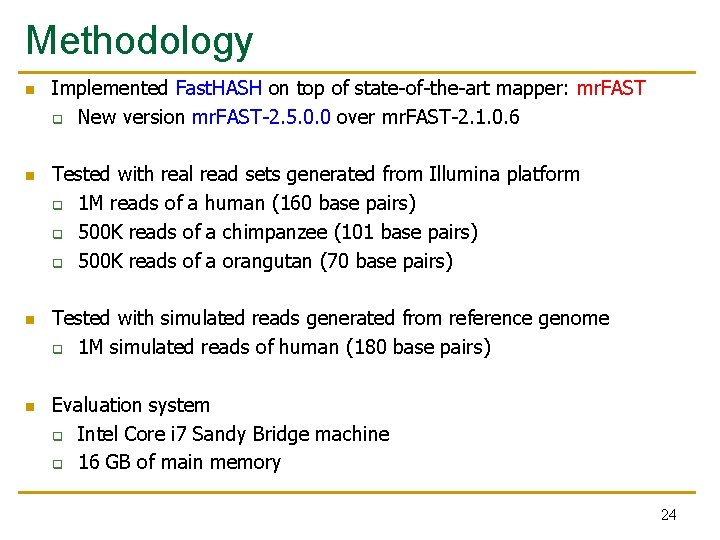
Methodology n n Implemented Fast. HASH on top of state-of-the-art mapper: mr. FAST q New version mr. FAST-2. 5. 0. 0 over mr. FAST-2. 1. 0. 6 Tested with real read sets generated from Illumina platform q 1 M reads of a human (160 base pairs) q 500 K reads of a chimpanzee (101 base pairs) q 500 K reads of a orangutan (70 base pairs) Tested with simulated reads generated from reference genome q 1 M simulated reads of human (180 base pairs) Evaluation system q Intel Core i 7 Sandy Bridge machine q 16 GB of main memory 24
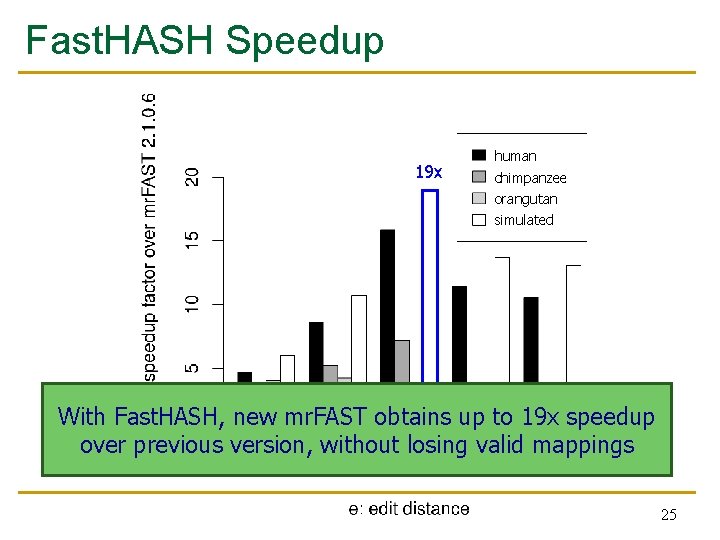
Fast. HASH Speedup 19 x human chimpanzee orangutan simulated With Fast. HASH, new mr. FAST obtains up to 19 x speedup over previous version, without losing valid mappings 25
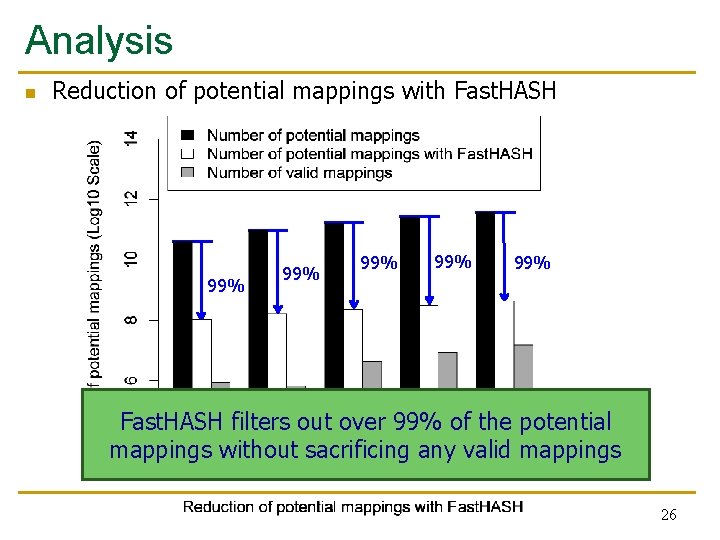
Analysis n Reduction of potential mappings with Fast. HASH 99% 99% 99% Fast. HASH filters out over 99% of the potential mappings without sacrificing any valid mappings 26
Other Key Results (In the paper) n n Fast. HASH finds all possible valid mappings Correctly mapped all simulated reads (with fewer than e artificially added errors) 27
Outline n Read Mapping and its Challenges n Hash Table-Based Mappers n Problem and Goal n Key Observations n Mechanisms n Results n Conclusion 28
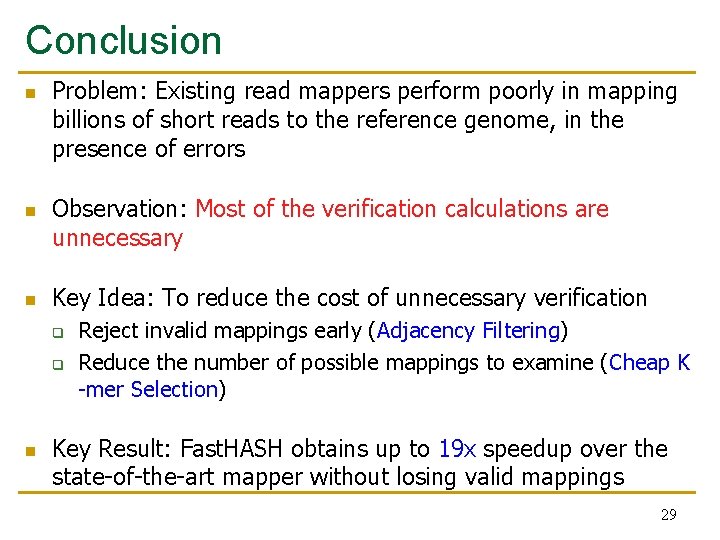
Conclusion n Problem: Existing read mappers perform poorly in mapping billions of short reads to the reference genome, in the presence of errors Observation: Most of the verification calculations are unnecessary Key Idea: To reduce the cost of unnecessary verification q q n Reject invalid mappings early (Adjacency Filtering) Reduce the number of possible mappings to examine (Cheap K -mer Selection) Key Result: Fast. HASH obtains up to 19 x speedup over the state-of-the-art mapper without losing valid mappings 29
Acknowledgements n n n Carnegie Mellon University (Hongyi Xin, Donghyuk Lee, Samihan Yedkar and Onur Mutlu, co-authors) Bilkent University (Can Alkan, co-author) University of Washington (Evan Eichler and Can Alkan) UCLA (Farhad Hormozdiari, co-author) NIH (National Institutes of Health) for financial support 30
Thank you! n n n Questions? Download link to Fast. HASH You can find the slides on SAFARI group website: q http: //www. ece. cmu. edu/~safari 31
Accelerating Read Mapping with Fast. HASH Hongyi Xin† Donghyuk Lee† Farhad Hormozdiari ‡ Samihan Yedkar† Can Alkan § Onur Mutlu† † Carnegie Mellon University § University of Washington ‡ University of California Los Angeles
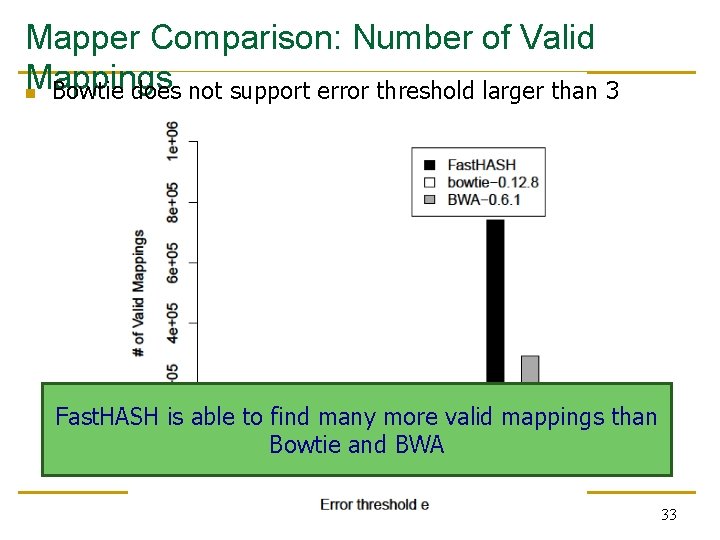
Mapper Comparison: Number of Valid Mappings n Bowtie does not support error threshold larger than 3 Fast. HASH is able to find many more valid mappings than Bowtie and BWA 33
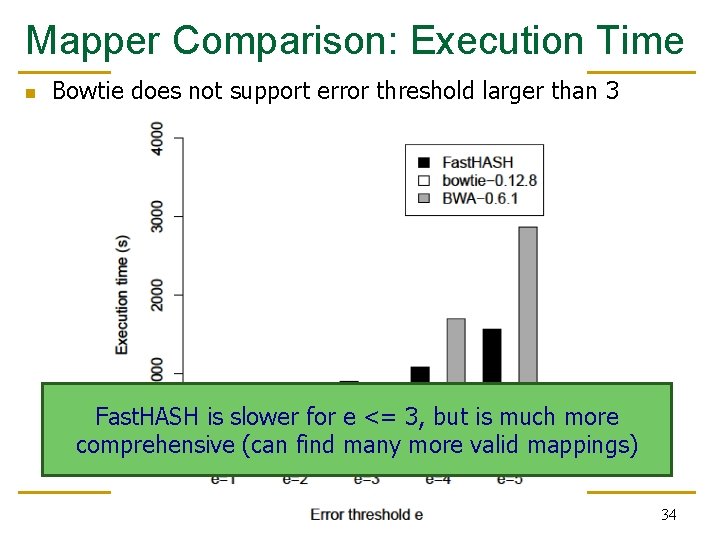
Mapper Comparison: Execution Time n Bowtie does not support error threshold larger than 3 Fast. HASH is slower for e <= 3, but is much more comprehensive (can find many more valid mappings) 34