RealTime Dynamics of Language Acquisition in TwoYearOld Children

- Slides: 27
Real-Time Dynamics of Language Acquisition in Two-Year-Old Children and Connectionist Models Jessica S. Horst (jessica-horst@uiowa. edu) Larissa K. Samuelson (larissa-samuelson@uiowa. edu) Bob Mc. Murray (bob-mcmurray@uiowa. edu) Dept. of Psychology University of Iowa
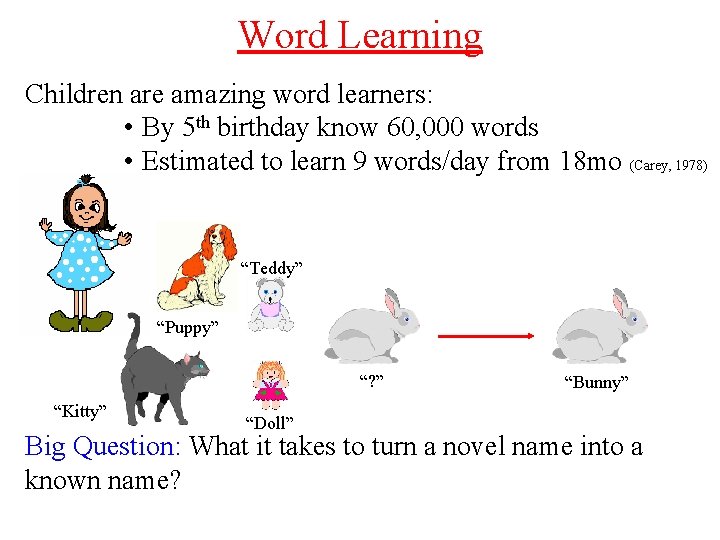
Word Learning Children are amazing word learners: • By 5 th birthday know 60, 000 words • Estimated to learn 9 words/day from 18 mo (Carey, 1978) “Teddy” “Puppy” “? ” “Kitty” “Doll” “Bunny” Big Question: What it takes to turn a novel name into a known name?
Fast Mapping Linking a novel name to a novel referent with minimal exposure (Carey & Bartlett, 1978) Literature associates amazing word learning with fast mapping: • Children can fast map several names in a single session (Golinkoff et al. , 1992) • Children can determine the referent of a novel name in less than 3 seconds (Halberda, submitted) Big Picture: Understanding the processes of word learning, by determining exactly what children are learning about name-object mappings taught with minimal exposure
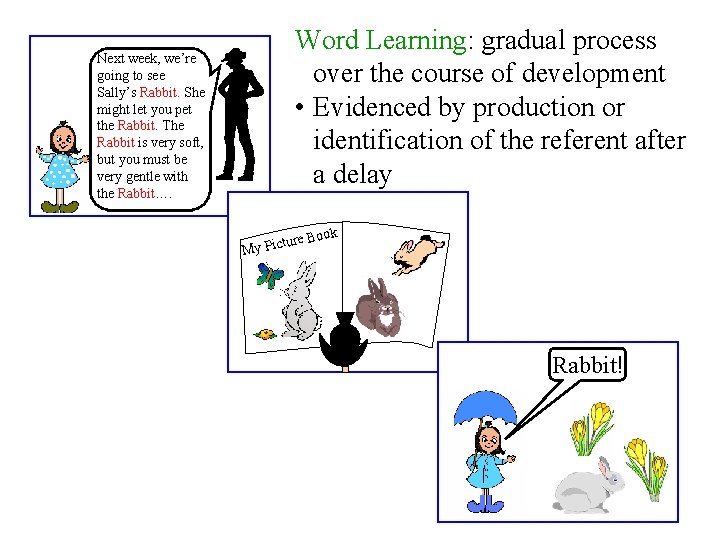
Two Times Scales in Language Acquisition Fast Mapping and Word Learning represent two time scales of learning: Rabbit Fast Mapping: quick process emerging in the moment • Based on the Principle of Lexical Contrast (Clark, 1987) “Puppy” ≠ “Rabbit” “Kitty” ≠ “Rabbit”? This must be “Rabbit”
Next week, we’re going to see Sally’s Rabbit. She might let you pet the Rabbit. The Rabbit is very soft, but you must be very gentle with the Rabbit…. Word Learning: gradual process over the course of development • Evidenced by production or identification of the referent after a delay ture Bo My Pic ok Rabbit!
Question: Is Lexical Contrast enough to truly learn a word, i. e. , to show evidence of learning after a delay?
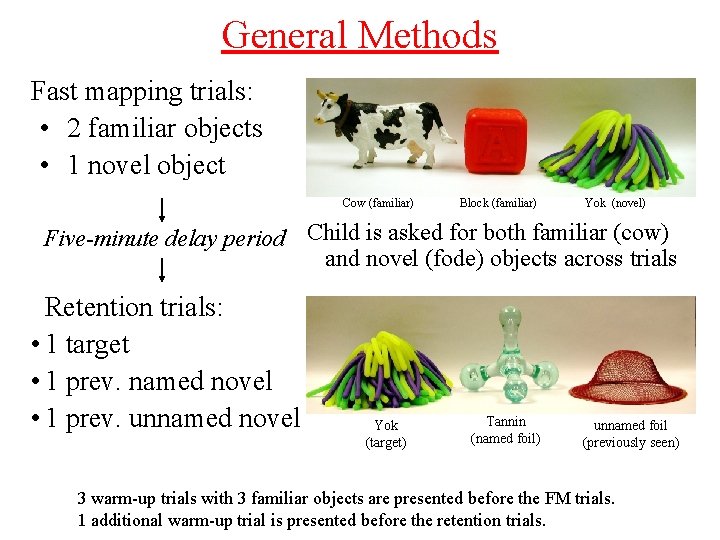
General Methods Fast mapping trials: • 2 familiar objects • 1 novel object Cow (familiar) Block (familiar) Yok (novel) Five-minute delay period Child is asked for both familiar (cow) and novel (fode) objects across trials Retention trials: • 1 target • 1 prev. named novel • 1 prev. unnamed novel Yok (target) Tannin (named foil) unnamed foil (previously seen) 3 warm-up trials with 3 familiar objects are presented before the FM trials. 1 additional warm-up trial is presented before the retention trials.
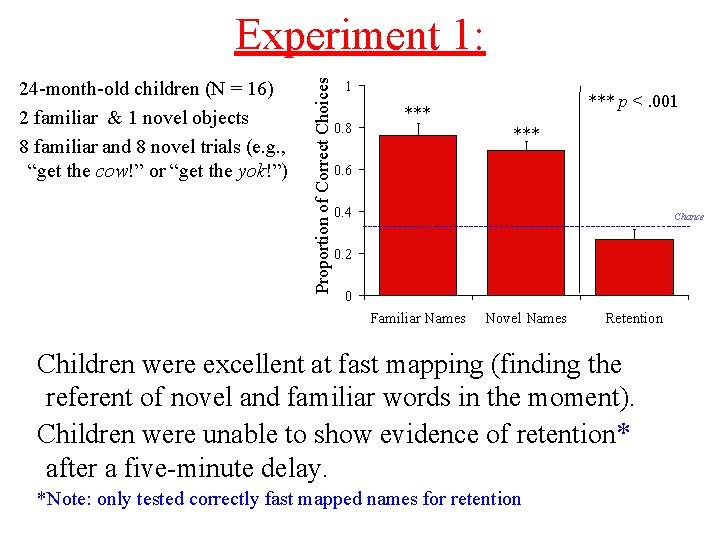
24 -month-old children (N = 16) 2 familiar & 1 novel objects 8 familiar and 8 novel trials (e. g. , “get the cow!” or “get the yok!”) Proportion of Correct Choices Experiment 1: 1 0. 8 *** p <. 001 *** 0. 6 0. 4 Chance 0. 2 0 Familiar Names Novel Names Retention Children were excellent at fast mapping (finding the referent of novel and familiar words in the moment). Children were unable to show evidence of retention* after a five-minute delay. *Note: only tested correctly fast mapped names for retention
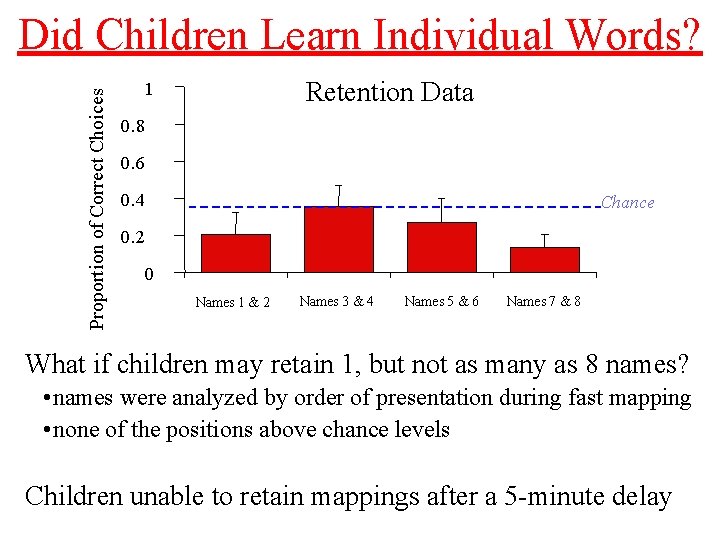
Proportion of Correct Choices Did Children Learn Individual Words? Retention Data 1 0. 8 0. 6 0. 4 Chance 0. 2 0 Names 1 & 2 Names 3 & 4 Names 5 & 6 Names 7 & 8 What if children may retain 1, but not as many as 8 names? • names were analyzed by order of presentation during fast mapping • none of the positions above chance levels Children unable to retain mappings after a 5 -minute delay
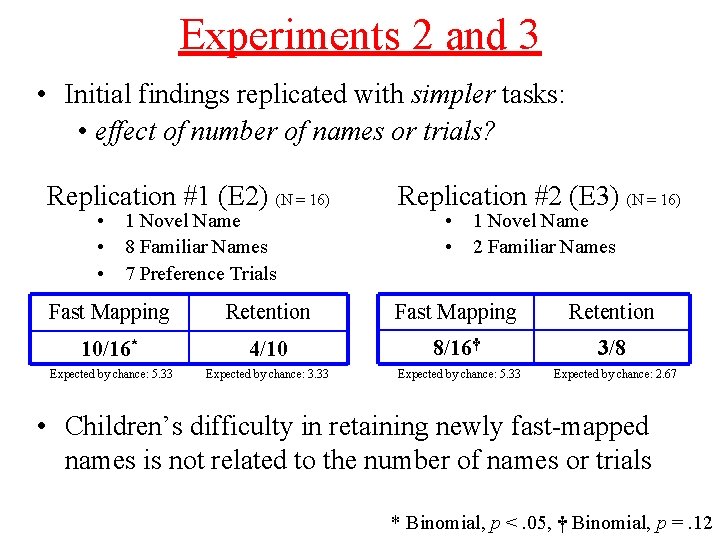
Experiments 2 and 3 • Initial findings replicated with simpler tasks: • effect of number of names or trials? Replication #1 (E 2) (N = 16) Replication #2 (E 3) (N = 16) Fast Mapping Retention 10/16* 4/10 8/16† 3/8 Expected by chance: 5. 33 Expected by chance: 3. 33 • 1 Novel Name • 8 Familiar Names • 7 Preference Trials • 1 Novel Name • 2 Familiar Names Expected by chance: 5. 33 Expected by chance: 2. 67 • Children’s difficulty in retaining newly fast-mapped names is not related to the number of names or trials * Binomial, p <. 05, † Binomial, p =. 12
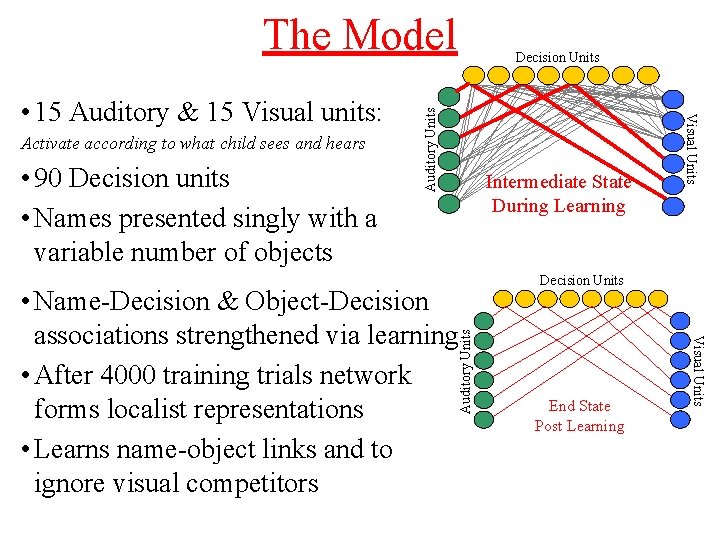
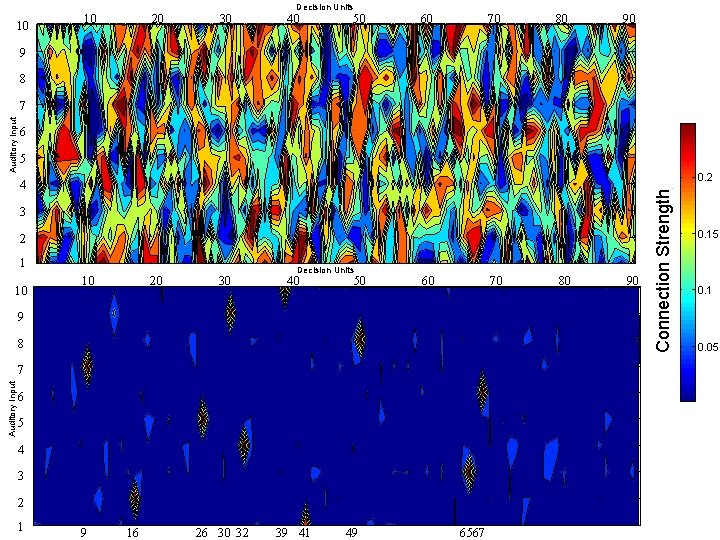
The Model • 90 Decision units • Names presented singly with a variable number of objects Auditory Units Activate according to what child sees and hears Intermediate State During Learning Auditory Units Decision Units End State Post Learning Visual Units • Name-Decision & Object-Decision associations strengthened via learning • After 4000 training trials network forms localist representations • Learns name-object links and to ignore visual competitors Visual Units • 15 Auditory & 15 Visual units: Decision Units
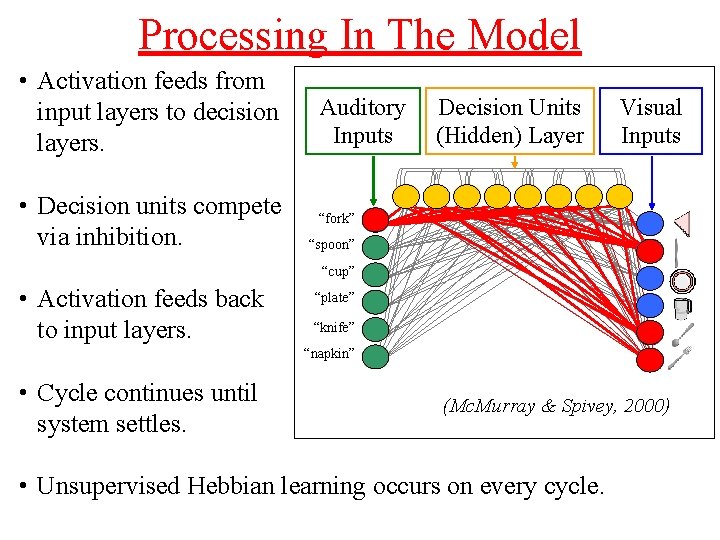
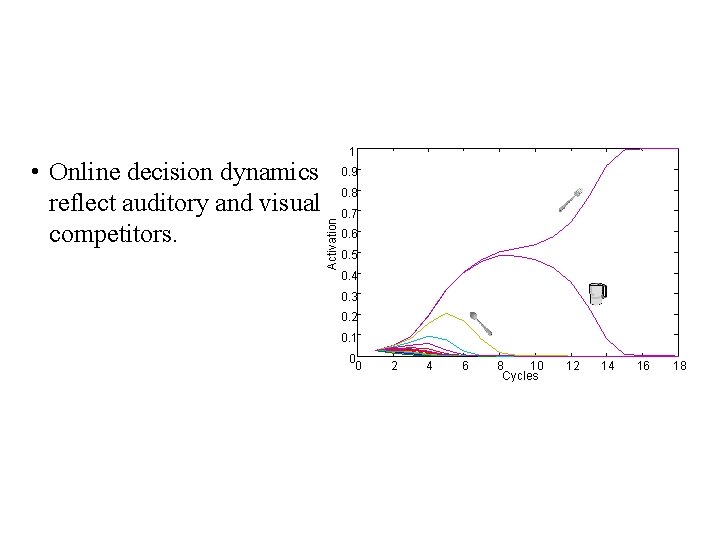
Processing In The Model • Activation feeds from input layers to decision layers. • Decision units compete via inhibition. Auditory Inputs Decision Units (Hidden) Layer Visual Inputs “fork” “spoon” “cup” • Activation feeds back to input layers. “plate” “knife” “napkin” • Cycle continues until system settles. (Mc. Murray & Spivey, 2000) • Unsupervised Hebbian learning occurs on every cycle.
0. 9 0. 8 Activation • Online decision dynamics reflect auditory and visual competitors. 1 0. 7 0. 6 0. 5 0. 4 0. 3 0. 2 0. 1 0 0 2 4 6 8 10 Cycles 12 14 16 18
10 10 20 30 Decision Units 40 50 60 70 80 90 9 8 6 5 0. 2 4 3 2 1 10 10 20 30 Decision Units 40 50 60 70 9 8 Auditory Input 7 6 5 4 3 2 1 9 16 26 30 32 39 41 49 6567 80 90 Connection Strength Auditory Input 7 0. 15 0. 1 0. 05
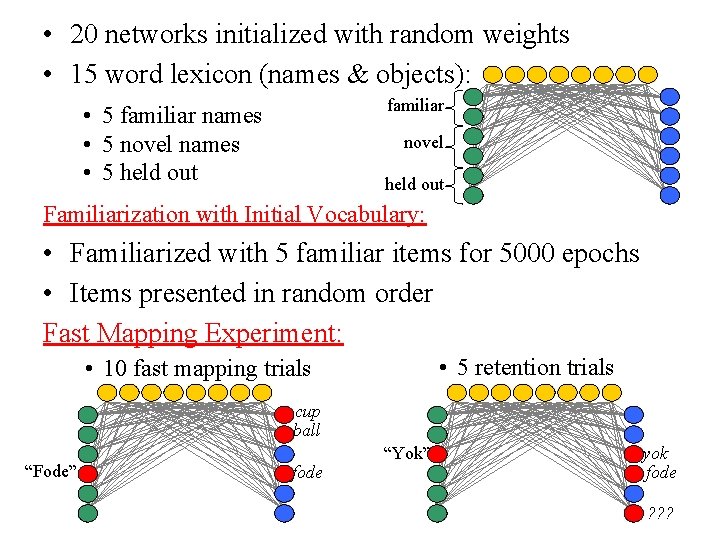
• 20 networks initialized with random weights • 15 word lexicon (names & objects): familiar • 5 familiar names • 5 novel names • 5 held out novel held out Familiarization with Initial Vocabulary: • Familiarized with 5 familiar items for 5000 epochs • Items presented in random order Fast Mapping Experiment: • 5 retention trials • 10 fast mapping trials cup ball “Fode” fode “Yok” yok fode ? ? ?
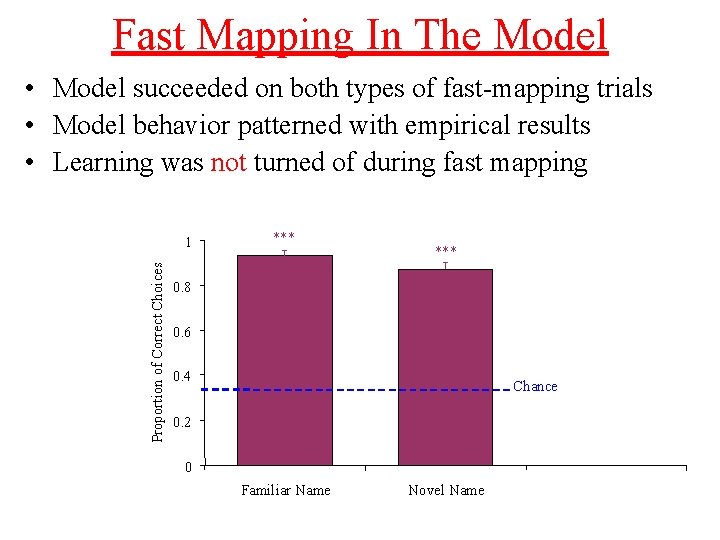
Fast Mapping In The Model • Model succeeded on both types of fast-mapping trials • Model behavior patterned with empirical results • Learning was not turned of during fast mapping Proportion of Correct Choices 1 *** 0. 8 0. 6 0. 4 Chance 0. 2 0 Familiar Name Novel Name
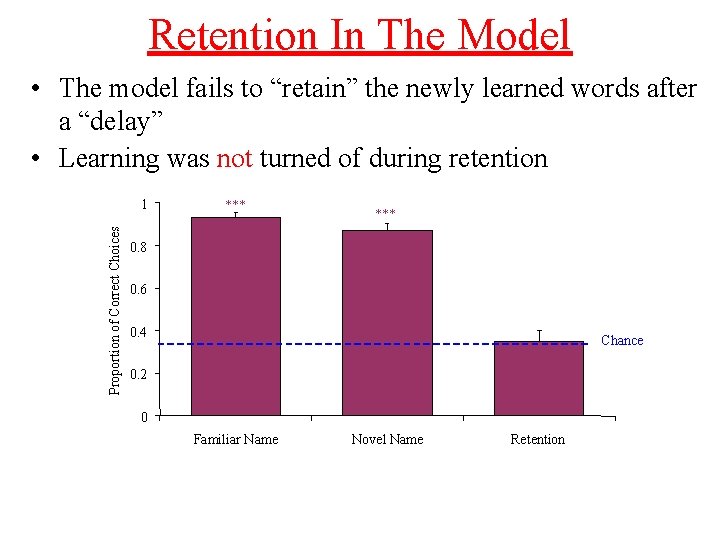
Retention In The Model • The model fails to “retain” the newly learned words after a “delay” • Learning was not turned of during retention Proportion of Correct Choices 1 *** 0. 8 0. 6 0. 4 Chance 0. 2 0 Familiar Name Novel Name Retention
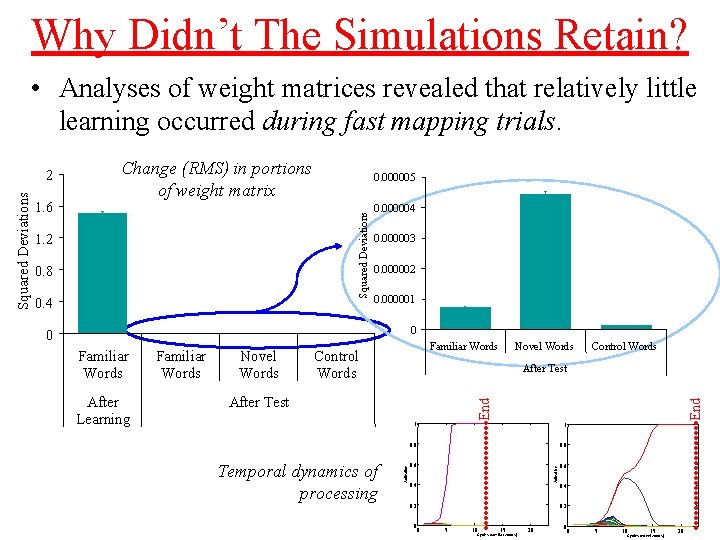
Why Didn’t The Simulations Retain? • Analyses of weight matrices revealed that relatively little learning occurred during fast mapping trials. 0. 000005 1. 2 0. 8 0. 4 0. 000003 0. 000002 0. 000001 0 0 Familiar Words Control Words After Test Temporal dynamics of processing Novel Words End After Learning Familiar Words Activation Familiar Words 1 1 0. 8 0. 6 Activation 1. 6 Change (RMS) in portions of weight matrix Squared Deviations 2 0. 4 0. 2 0 0 0. 4 0. 2 5 10 15 Cycles (familiar words) 20 0 0 5 10 15 Cycles (novel words) 20
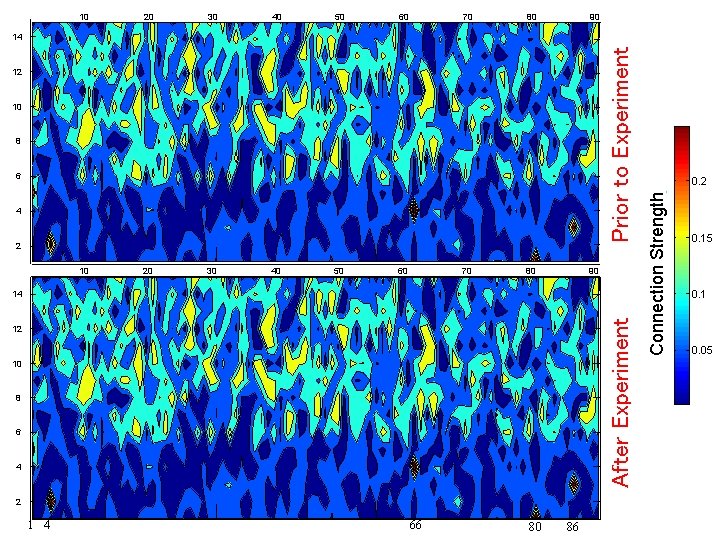
10 20 30 40 50 60 70 80 90 12 10 8 6 4 2 10 20 30 40 50 60 70 80 90 After Experiment 14 12 10 8 6 4 2 1 4 66 80 86 0. 2 Connection Strength Prior to Experiment 14 0. 15 0. 1 0. 05
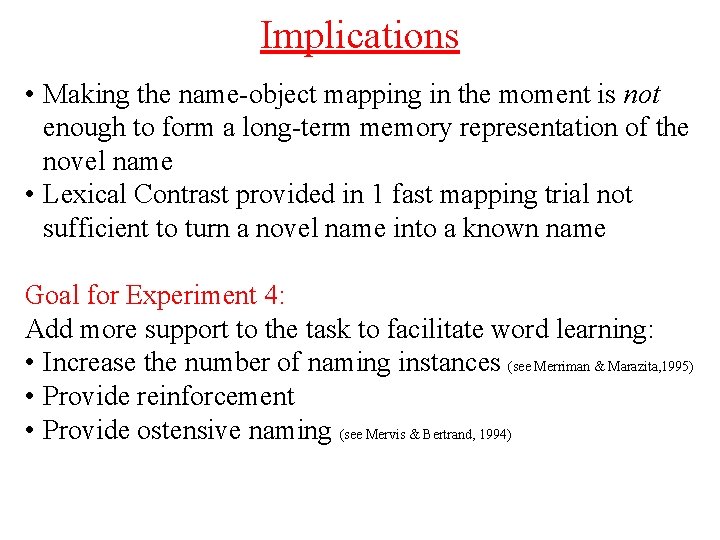
Implications • Making the name-object mapping in the moment is not enough to form a long-term memory representation of the novel name • Lexical Contrast provided in 1 fast mapping trial not sufficient to turn a novel name into a known name Goal for Experiment 4: Add more support to the task to facilitate word learning: • Increase the number of naming instances (see Merriman & Marazita, 1995) • Provide reinforcement • Provide ostensive naming (see Mervis & Bertrand, 1994)
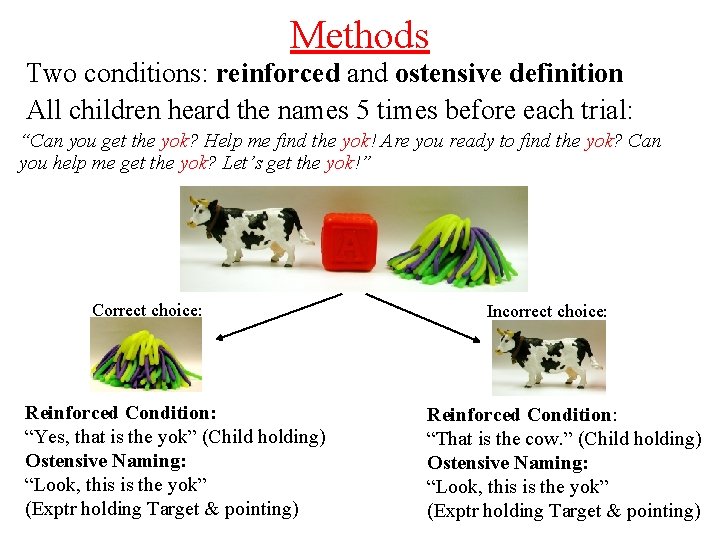
Methods Two conditions: reinforced and ostensive definition All children heard the names 5 times before each trial: “Can you get the yok? Help me find the yok! Are you ready to find the yok? Can you help me get the yok? Let’s get the yok!” Correct choice: Reinforced Condition: “Yes, that is the yok” (Child holding) Ostensive Naming: “Look, this is the yok” (Exptr holding Target & pointing) Incorrect choice: Reinforced Condition: “That is the cow. ” (Child holding) Ostensive Naming: “Look, this is the yok” (Exptr holding Target & pointing)
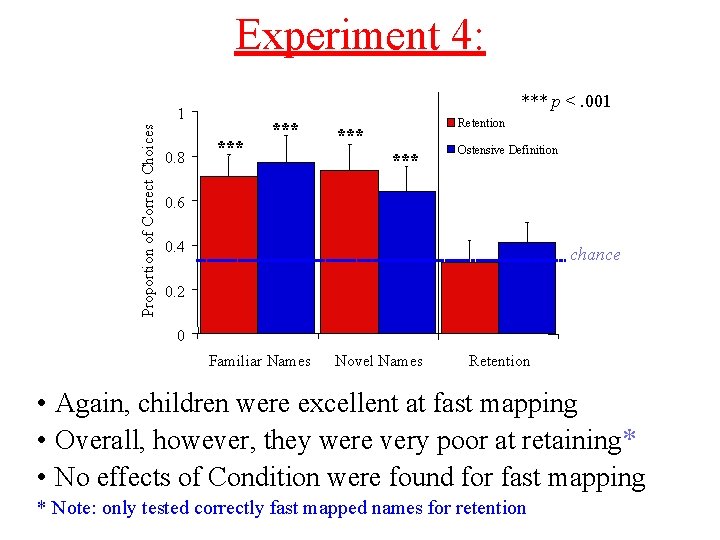
Experiment 4: *** p <. 001 Proportion of Correct Choices 1 0. 8 *** Retention *** Ostensive Definition 0. 6 0. 4 chance 0. 2 0 Familiar Names Novel Names Retention • Again, children were excellent at fast mapping • Overall, however, they were very poor at retaining* • No effects of Condition were found for fast mapping * Note: only tested correctly fast mapped names for retention
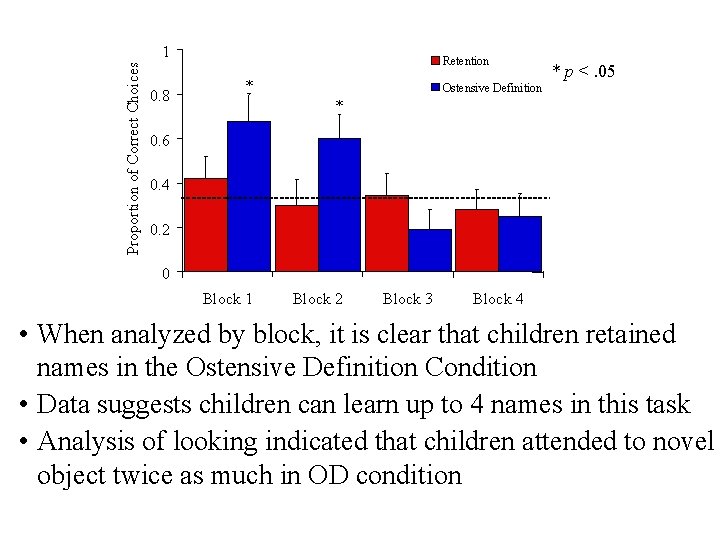
Proportion of Correct Choices 1 0. 8 Retention * * p <. 05 Ostensive Definition * 0. 6 0. 4 0. 2 0 Block 1 Block 2 Block 3 Block 4 • When analyzed by block, it is clear that children retained names in the Ostensive Definition Condition • Data suggests children can learn up to 4 names in this task • Analysis of looking indicated that children attended to novel object twice as much in OD condition
Conclusions • Overall, children were excellent at finding the referent in the moment, but unable to retain the names over a fiveminute delay (E 1) • Follow-up experiments indicate poor retention not due to • The number of names introduced (E 2) or • The number of trials in the session (E 3) • The Connectionist Network captured the data and • Showed the same pattern of results: excellent Fast Mapping, poor Retention • Learning was occurring during fast mapping, but not enough learning to support later evidence of retention
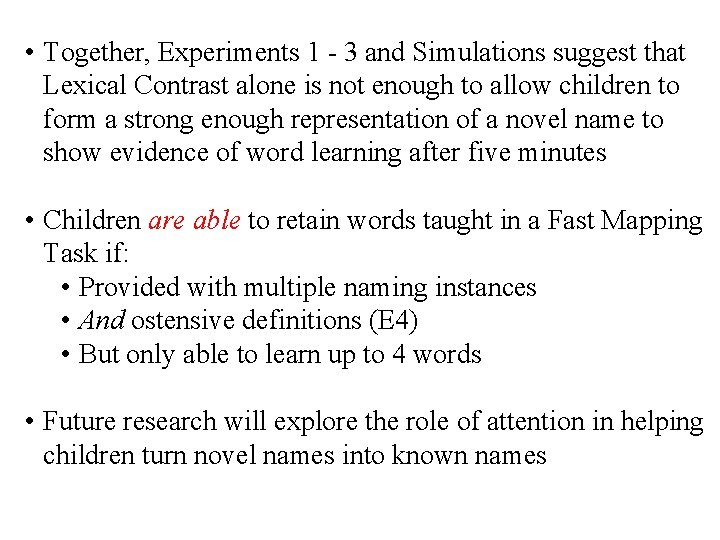
• Together, Experiments 1 - 3 and Simulations suggest that Lexical Contrast alone is not enough to allow children to form a strong enough representation of a novel name to show evidence of word learning after five minutes • Children are able to retain words taught in a Fast Mapping Task if: • Provided with multiple naming instances • And ostensive definitions (E 4) • But only able to learn up to 4 words • Future research will explore the role of attention in helping children turn novel names into known names
Take Home Message: Fast Mapping is a quick, online mechanism that can produce smart online behavior but not actual word learning.
References Carey, S. (1978). The child as word learner. In M. Halle, J. Bresnan & A. Miller (Eds. ), Linguistic Theory and Psychological Reality (pp. 264 -293). Cambridge, MA: MIT Press. Carey, S. , & Bartlett, E. (1978). Acquiring a single new word. Proceedings of the Stanford Child Language Conference, 15(17 -29). Clark, E. (1987). The Principle of Contrast: A Constraint on Language Acquisition. In B. Mc. Whinney (Ed. ), Mechanisms of Language Acquisition (pp. 1 -33). Hillsdale, NJ: Lawrence Erlbaum Associates Inc. Golinkoff, R. M. , Hirshpasek, K. , Bailey, L. M. , & Wenger, N. R. (1992). Young-Children and Adults Use Lexical Principles to Learn New Nouns. Developmental Psychology, 28(1), 99 -108. Halberda, J. & Goldman, J. (submitted). One Trial Learning in 2 -Year-Olds: Children Learn New Nouns in 3 Seconds Flat. Mervis, C. B. , & Bertrand, J. (1994). Acquisition of the Novel Nameless Category (N 3 c) Principle. Child Development, 65(6), 1646 -1662 Merriman, W. E. & Marazita, J. M. (1995). The Effect of Hearing Similar Sounding Words on Young 2 Year-Olds’ Disambiguation of Novel Reference. Developmental Psychology, 31(6), 973 -984. Mc. Murray, B. , & Spivey, M. (2000). The Categorical Perception of Consonants: The Interaction of Learning and Processing, The Proceedings of the Chicago Linguistics Society, 34(2), 205 -220. Acknowledgements The authors would like to thank Joseph Toscano for programming assistance and support. This work was supported by NICHD Grant R 01 -HD 045713 to LKS.