
Electrochemicalcalorimetric studies on lithium ion pouch cells E


- Slides: 17
Electrochemical-calorimetric studies on lithium ion pouch cells E. Schuster, C. Ziebert, H. J. Seifert Karlsruhe Institute of Technology (KIT) Dipl. phys. Elke Schuster Institute for Applied Materials – Applied Materials Physics (IAM-AWP) KIT – University of the State of Baden-Wuerttemberg and National Research Center of the Helmholtz Association www. kit. edu
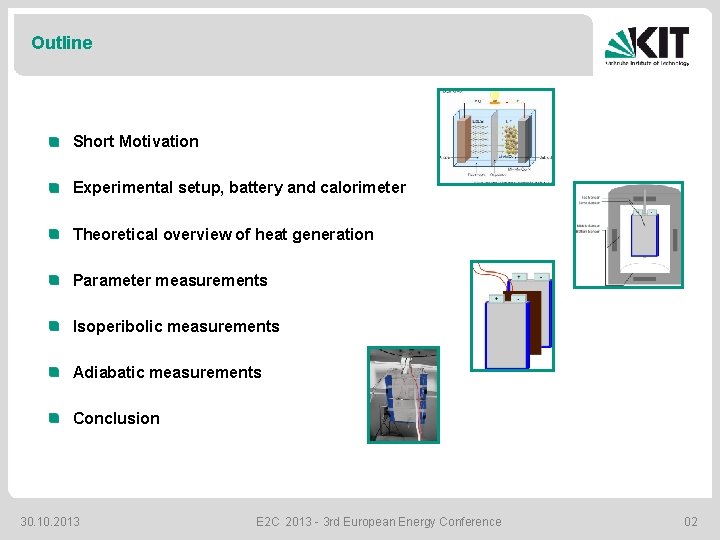
Outline Short Motivation Experimental setup, battery and calorimeter Theoretical overview of heat generation Parameter measurements Isoperibolic measurements Adiabatic measurements Conclusion 30. 10. 2013 E 2 C 2013 - 3 rd European Energy Conference 02
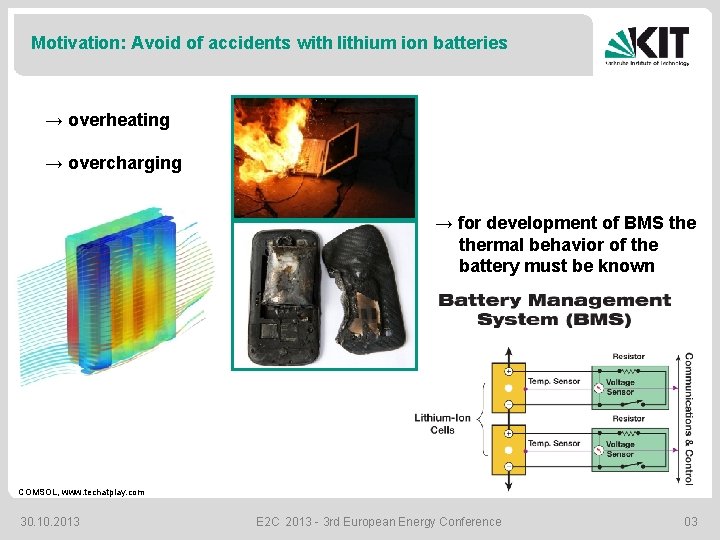
Motivation: Avoid of accidents with lithium ion batteries → overheating → overcharging → for development of BMS thermal behavior of the battery must be known COMSOL, www. techatplay. com 30. 10. 2013 E 2 C 2013 - 3 rd European Energy Conference 03
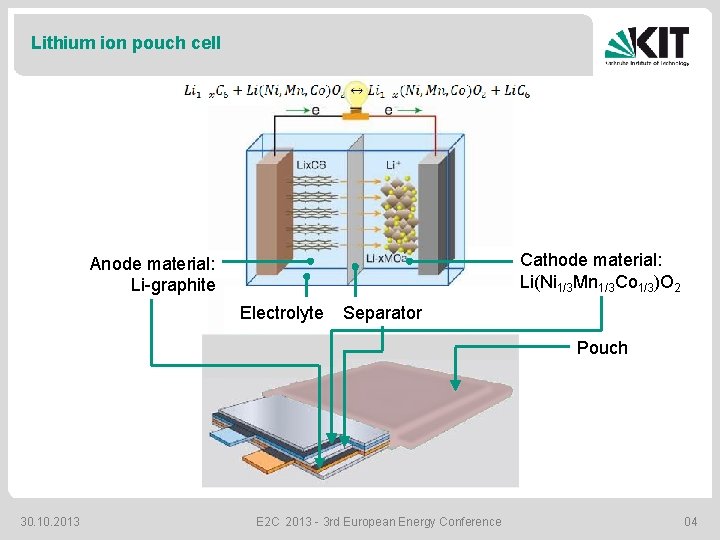
Lithium ion pouch cell Cathode material: Li(Ni 1/3 Mn 1/3 Co 1/3)O 2 Anode material: Li-graphite Electrolyte Separator Pouch 30. 10. 2013 E 2 C 2013 - 3 rd European Energy Conference 04
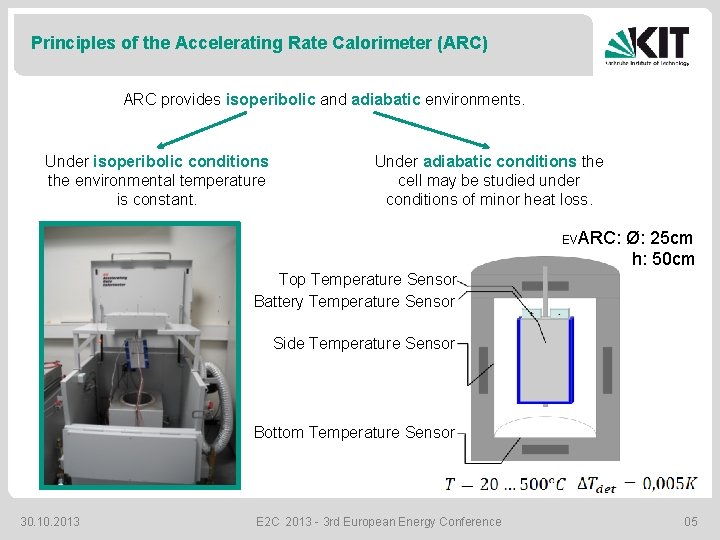
Principles of the Accelerating Rate Calorimeter (ARC) ARC provides isoperibolic and adiabatic environments. Under isoperibolic conditions the environmental temperature is constant. Under adiabatic conditions the cell may be studied under conditions of minor heat loss. EVARC: Ø: 25 cm h: 50 cm Top Temperature Sensor Battery Temperature Sensor Side Temperature Sensor Bottom Temperature Sensor 30. 10. 2013 E 2 C 2013 - 3 rd European Energy Conference 05
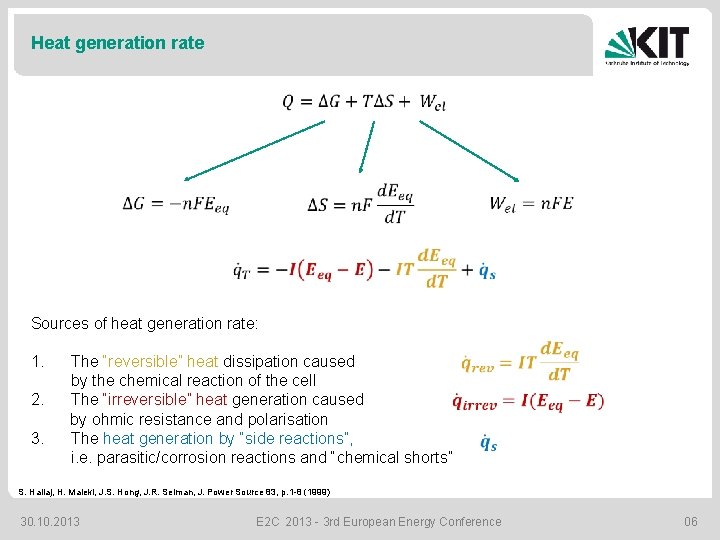
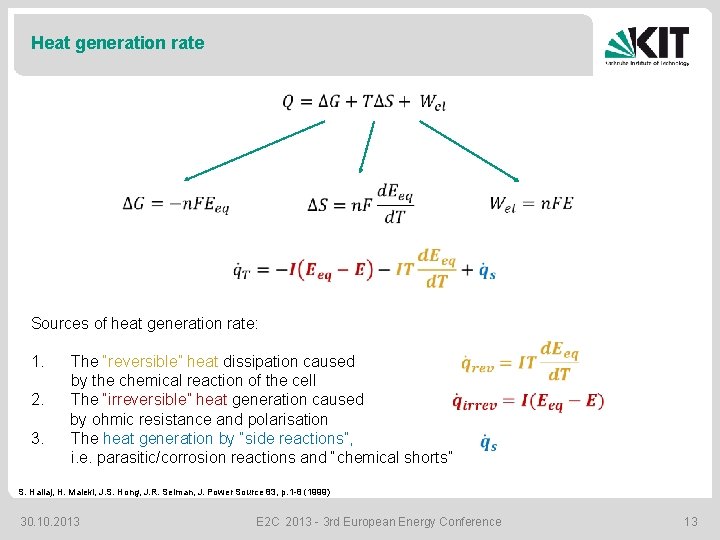
Heat generation rate Sources of heat generation rate: 1. The “reversible” heat dissipation caused by the chemical reaction of the cell 2. The “irreversible” heat generation caused by ohmic resistance and polarisation 3. The heat generation by “side reactions”, i. e. parasitic/corrosion reactions and “chemical shorts” S. Hallaj, H. Maleki, J. S. Hong, J. R. Selman, J. Power Source 83, p. 1 -8 (1999) 30. 10. 2013 E 2 C 2013 - 3 rd European Energy Conference 06
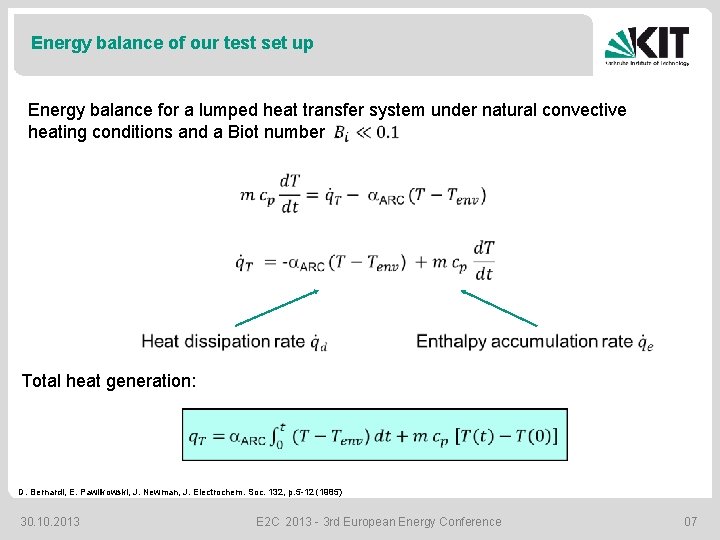
Energy balance of our test set up Energy balance for a lumped heat transfer system under natural convective heating conditions and a Biot number : Total heat generation: D. Bernardi, E. Pawlikowski, J. Newman, J. Electrochem. Soc. 132, p. 5 -12 (1985) 30. 10. 2013 E 2 C 2013 - 3 rd European Energy Conference 07
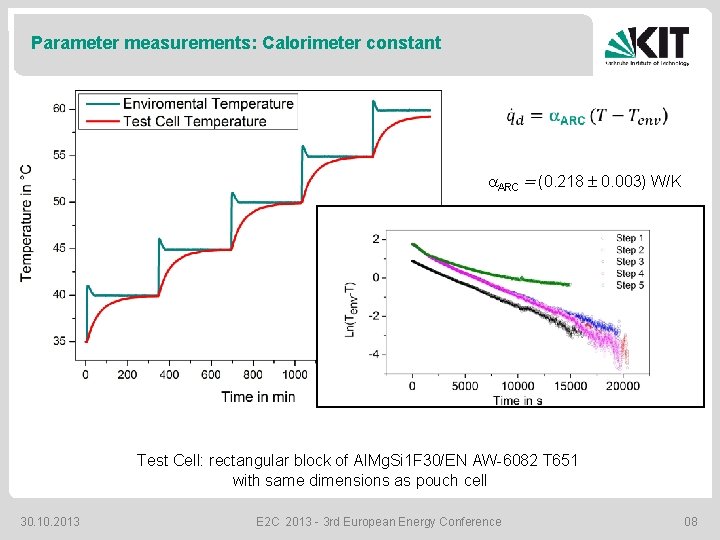
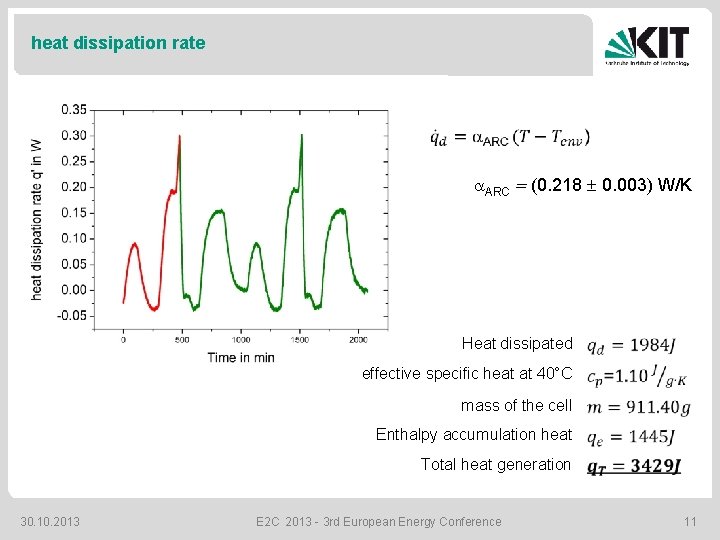
Parameter measurements: Calorimeter constant a. ARC = (0. 218 0. 003) W/K Test Cell: rectangular block of Al. Mg. Si 1 F 30/EN AW-6082 T 651 with same dimensions as pouch cell 30. 10. 2013 E 2 C 2013 - 3 rd European Energy Conference 08
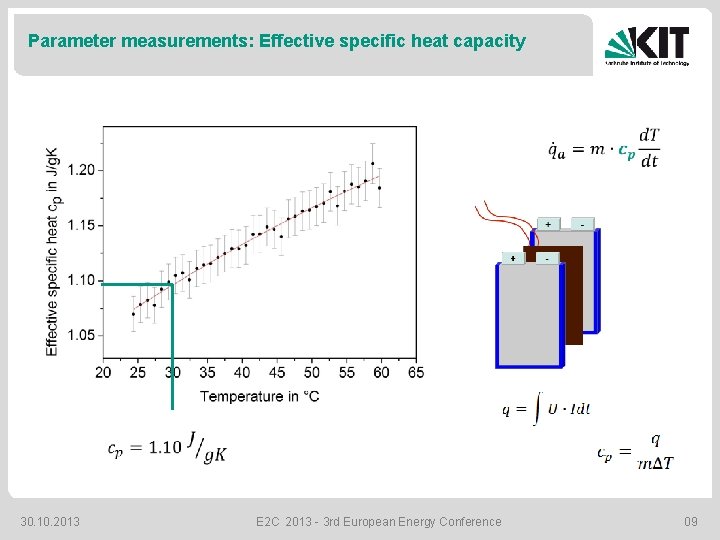
Parameter measurements: Effective specific heat capacity 30. 10. 2013 E 2 C 2013 - 3 rd European Energy Conference 09
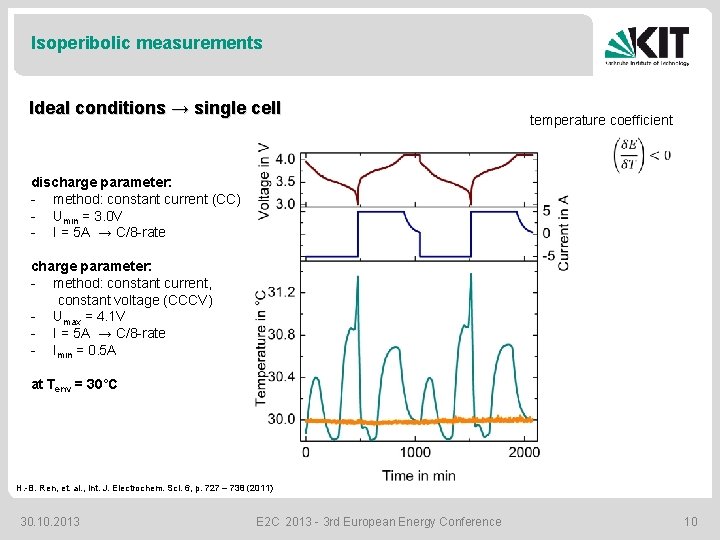
Isoperibolic measurements Ideal conditions → single cell temperature coefficient discharge parameter: - method: constant current (CC) - Umin = 3. 0 V - I = 5 A → C/8 -rate charge parameter: - method: constant current, constant voltage (CCCV) - Umax = 4. 1 V - I = 5 A → C/8 -rate - Imin = 0. 5 A at Tenv = 30°C H. -B. Ren, et. al. , Int. J. Electrochem. Sci. 6, p. 727 – 738 (2011) 30. 10. 2013 E 2 C 2013 - 3 rd European Energy Conference 10
heat dissipation rate a. ARC = (0. 218 0. 003) W/K Heat dissipated effective specific heat at 40°C mass of the cell Enthalpy accumulation heat Total heat generation 30. 10. 2013 E 2 C 2013 - 3 rd European Energy Conference 11
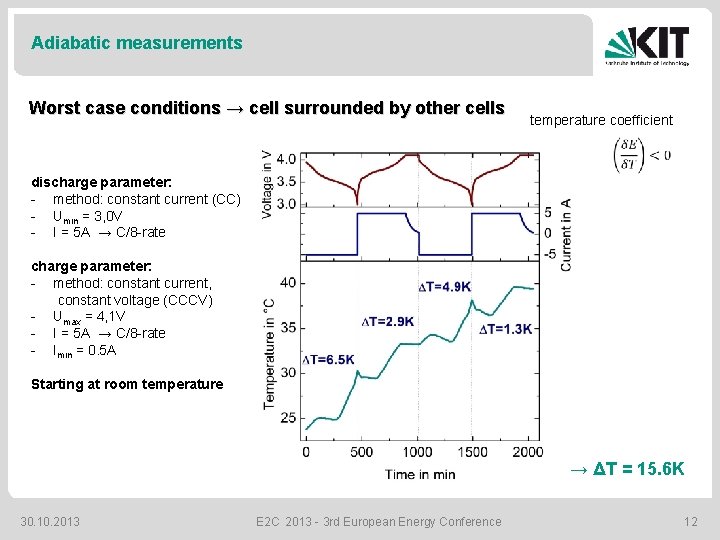
Adiabatic measurements Worst case conditions → cell surrounded by other cells temperature coefficient discharge parameter: - method: constant current (CC) - Umin = 3, 0 V - I = 5 A → C/8 -rate charge parameter: - method: constant current, constant voltage (CCCV) - Umax = 4, 1 V - I = 5 A → C/8 -rate - Imin = 0. 5 A Starting at room temperature → ΔT = 15. 6 K 30. 10. 2013 E 2 C 2013 - 3 rd European Energy Conference 12
Heat generation rate Sources of heat generation rate: 1. The “reversible” heat dissipation caused by the chemical reaction of the cell 2. The “irreversible” heat generation caused by ohmic resistance and polarisation 3. The heat generation by “side reactions”, i. e. parasitic/corrosion reactions and “chemical shorts” S. Hallaj, H. Maleki, J. S. Hong, J. R. Selman, J. Power Source 83, p. 1 -8 (1999) 30. 10. 2013 E 2 C 2013 - 3 rd European Energy Conference 13
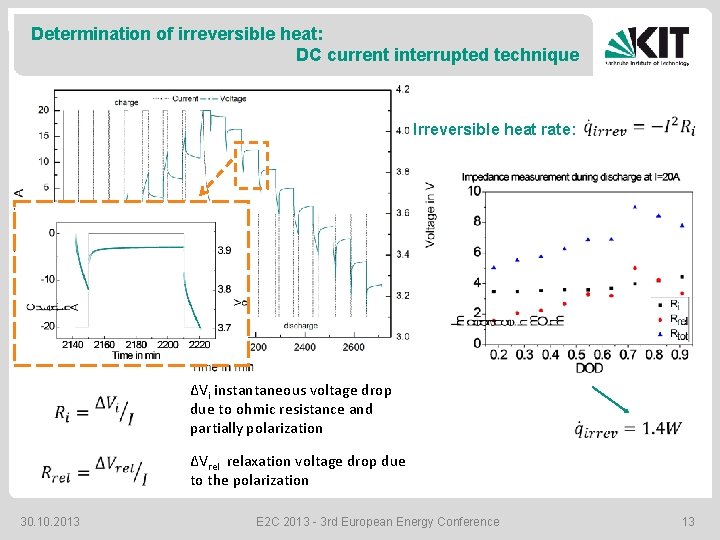
Determination of irreversible heat: DC current interrupted technique Irreversible heat rate: ΔVi instantaneous voltage drop due to ohmic resistance and partially polarization ΔVrel relaxation voltage drop due to the polarization 30. 10. 2013 E 2 C 2013 - 3 rd European Energy Conference 13
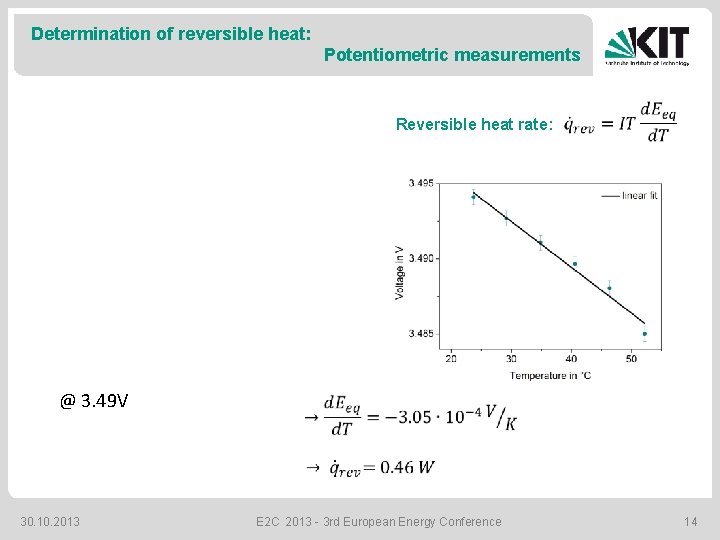
Determination of reversible heat: Potentiometric measurements Reversible heat rate: @ 3. 49 V 30. 10. 2013 E 2 C 2013 - 3 rd European Energy Conference 14
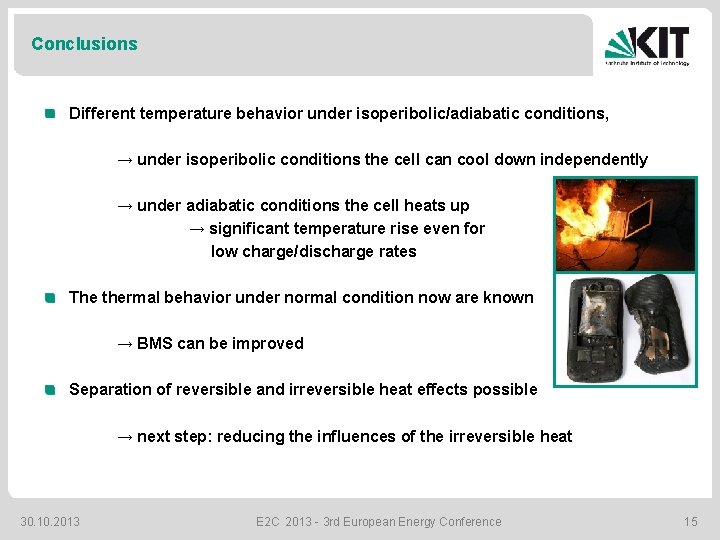
Conclusions Different temperature behavior under isoperibolic/adiabatic conditions, → under isoperibolic conditions the cell can cool down independently → under adiabatic conditions the cell heats up → significant temperature rise even for low charge/discharge rates The thermal behavior under normal condition now are known → BMS can be improved Separation of reversible and irreversible heat effects possible → next step: reducing the influences of the irreversible heat 30. 10. 2013 E 2 C 2013 - 3 rd European Energy Conference 15
Thank you for your attention! We gratefully acknowledge the funding by the German Research Foundation priority programme SPP 1473 We. NDe. LIB 30. 10. 2013 E 2 C 2013 - 3 rd European Energy Conference 16