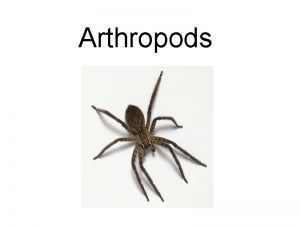
28 1 Introduction to the Arthropods Slide 1



- Slides: 46
28 -1 Introduction to the Arthropods Slide 1 of 42 End Show
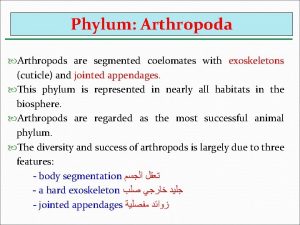
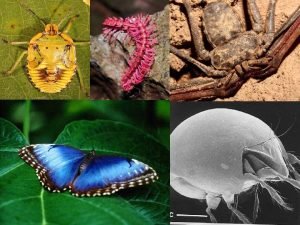
What Is an Arthropod? Arthropods have a segmented body, a tough exoskeleton, and jointed appendages. Arthropods include insects, crabs, centipedes, and spiders. Slide 2 of 42 End Show
What Is an Arthropod? Arthropods are surrounded by a tough external covering, or exoskeleton. The exoskeleton is made from protein and chitin. Chitin is a carbohydrate. Slide 3 of 42 End Show
What Is an Arthropod? All arthropods have jointed appendages. Appendages are structures that extend from the body wall. Legs and antennae are appendages. Slide 4 of 42 End Show
Form and Function in Arthropods • Arthropods use complex organ systems to carry out different essential functions. • Organ systems are interrelated; the functioning of one system depends on that of other systems. Slide 5 of 42 End Show
Form and Function in Arthropods Feeding • Arthropods include herbivores, carnivores, and omnivores. There are filter feeders, detritivores, and parasites. • The mouthparts of arthropods are adapted to the type of food the arthropod eats. Slide 6 of 42 End Show
Form and Function in Arthropods Most aquatic arthropods, such as lobsters and crabs, respire through featherlike gills. Horseshoe crabs respire through book gills. Slide 7 of 42 End Show
Form and Function in Arthropods Circulation • Arthropods have an open circulatory system. • The heart pumps blood through arteries that branch and enter the tissues. Heart Slide 8 of 42 End Show
28– 2 Groups of Arthropods Form and Function in Arthropods Excretion In aquatic arthropods, diffusion moves wastes from the body into the surrounding water. Slide 9 of 42 End Show
28– 2 Groups of Arthropods Form and Function in Arthropods Response • Most arthropods have a well-developed nervous system. • All arthropods have a brain. • Two nerves connect the brain to a ventral nerve cord. Along this nerve cord are several groups of nerve cells called ganglia. These ganglia coordinate the movements of individual legs. Slide 10 of 42 End Show
28– 2 Groups of Arthropods Form and Function in Arthropods Most arthropods have sophisticated sense organs such as compound eyes. Compound eyes may have more than 2000 separate lenses and can detect color and motion very well. Slide 11 of 42 End Show
28– 2 Groups of Arthropods Form and Function in Arthropods Movement • Arthropods move using well-developed groups of muscles that are coordinated and controlled by the nervous system. • Muscles generate force by contracting and then pulling on the exoskeleton. Slide 12 of 42 End Show
28– 2 Groups of Arthropods Form and Function in Arthropods Reproduction • In some species, males deposit sperm inside females. • In other species, the males deposit a sperm packet that is picked up by the females. • Aquatic arthropods may have internal or external fertilization. Slide 13 of 42 End Show
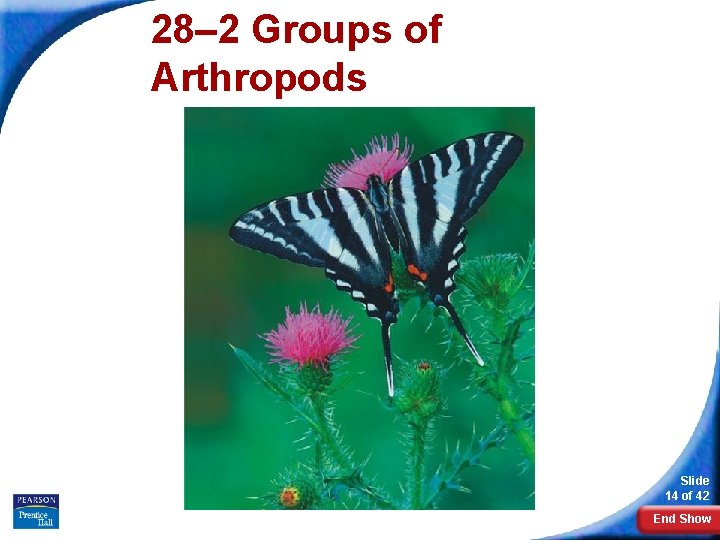
28– 2 Groups of Arthropods Slide 14 of 42 End Show
28– 2 Groups of Arthropods are classified based on the number and structure of their body segments and appendages—particularly their mouthparts. The three major groups of arthropods are: • crustaceans • spiders and their relatives • insects and their relatives Slide 15 of 42 End Show
28– 2 Groups of Arthropods Crustaceans What are the distinguishing features of the crustaceans? Slide 16 of 42 End Show
28– 2 Groups of Arthropods Crustaceans are primarily aquatic. This subphylum includes crabs, shrimps, lobsters, crayfishes, and barnacles. Slide 17 of 42 End Show
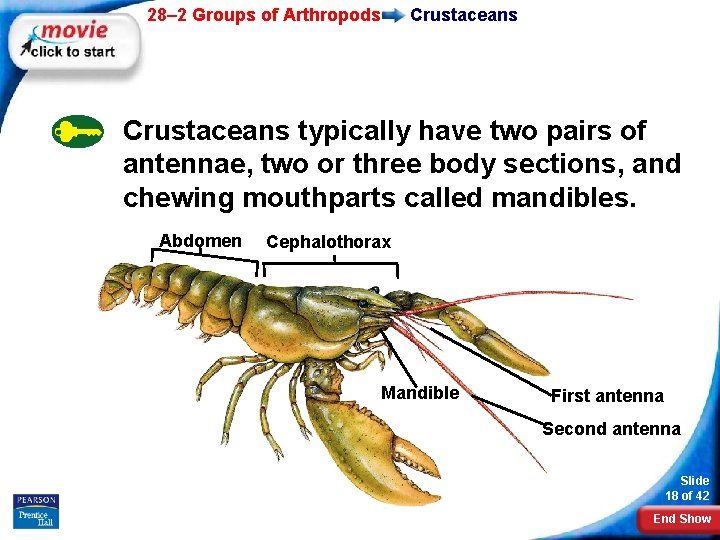
28– 2 Groups of Arthropods Crustaceans typically have two pairs of antennae, two or three body sections, and chewing mouthparts called mandibles. Abdomen Cephalothorax Mandible First antenna Second antenna Slide 18 of 42 End Show
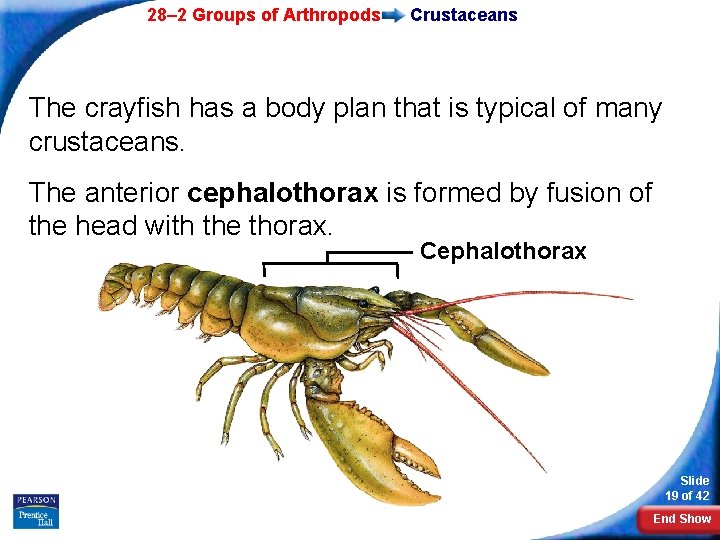
28– 2 Groups of Arthropods Crustaceans The crayfish has a body plan that is typical of many crustaceans. The anterior cephalothorax is formed by fusion of the head with the thorax. Cephalothorax Slide 19 of 42 End Show
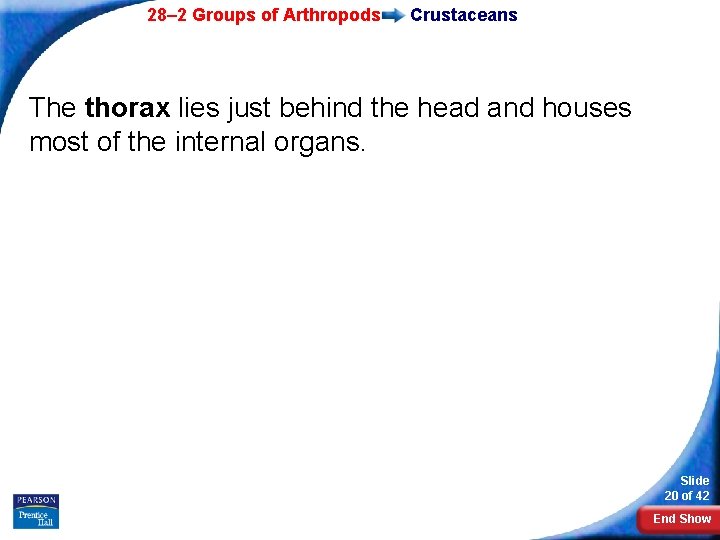
28– 2 Groups of Arthropods Crustaceans The thorax lies just behind the head and houses most of the internal organs. Slide 20 of 42 End Show
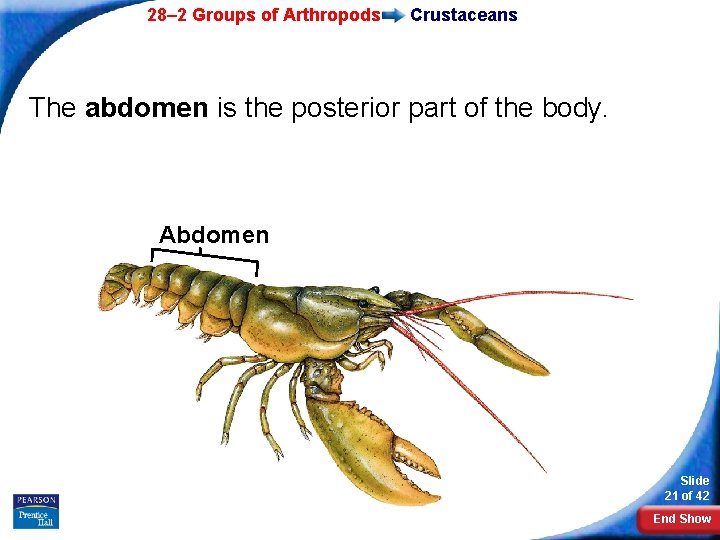
28– 2 Groups of Arthropods Crustaceans The abdomen is the posterior part of the body. Abdomen Slide 21 of 42 End Show
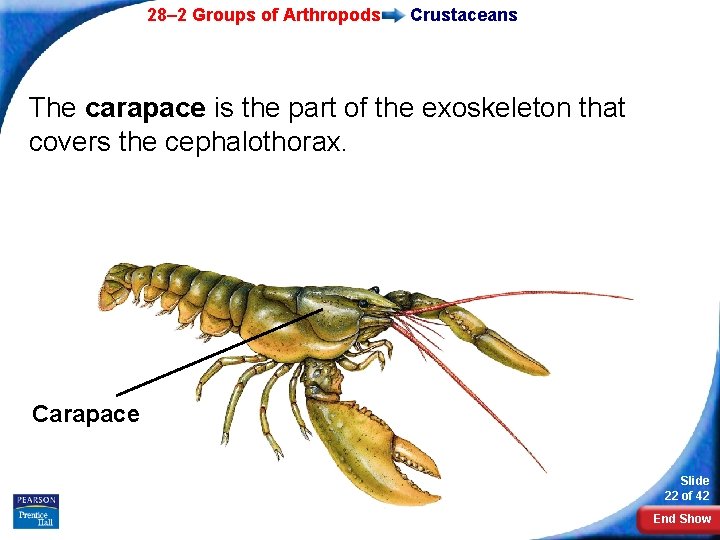
28– 2 Groups of Arthropods Crustaceans The carapace is the part of the exoskeleton that covers the cephalothorax. Carapace Slide 22 of 42 End Show
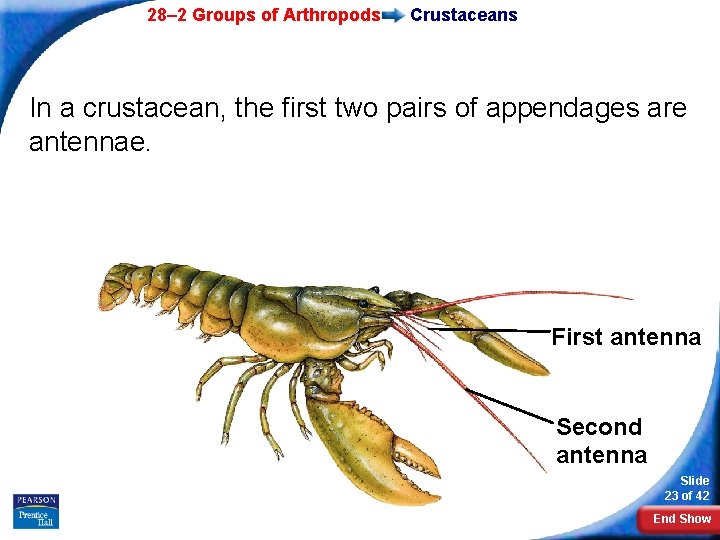
28– 2 Groups of Arthropods Crustaceans In a crustacean, the first two pairs of appendages are antennae. First antenna Second antenna Slide 23 of 42 End Show
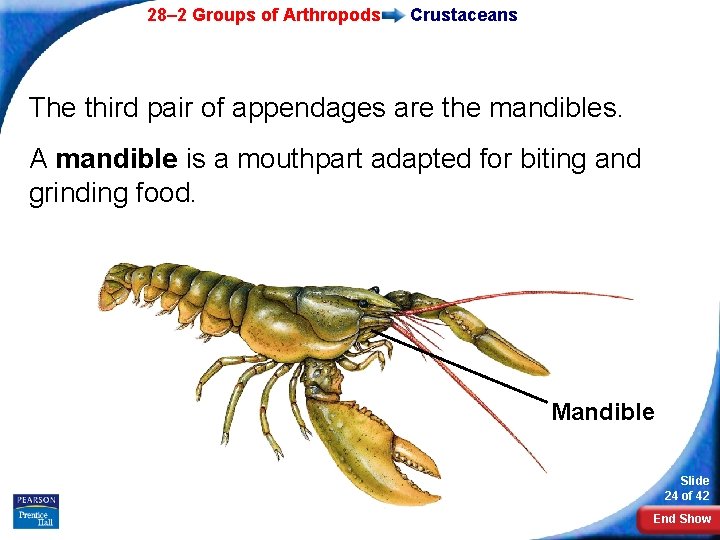
28– 2 Groups of Arthropods Crustaceans The third pair of appendages are the mandibles. A mandible is a mouthpart adapted for biting and grinding food. Mandible Slide 24 of 42 End Show
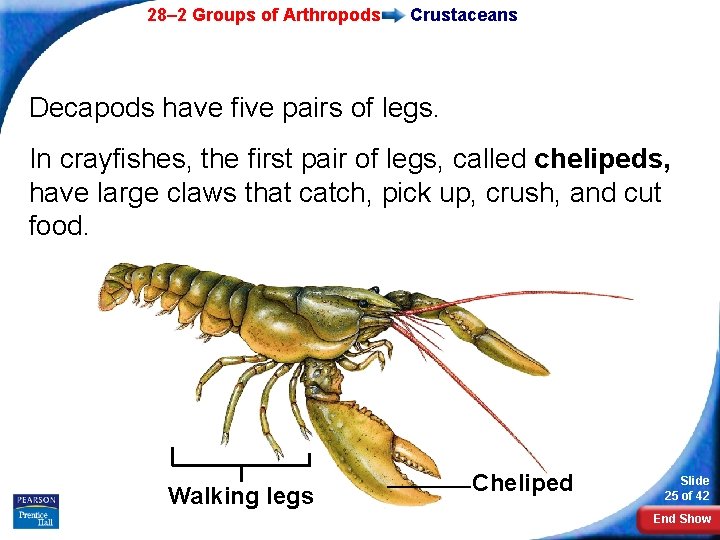
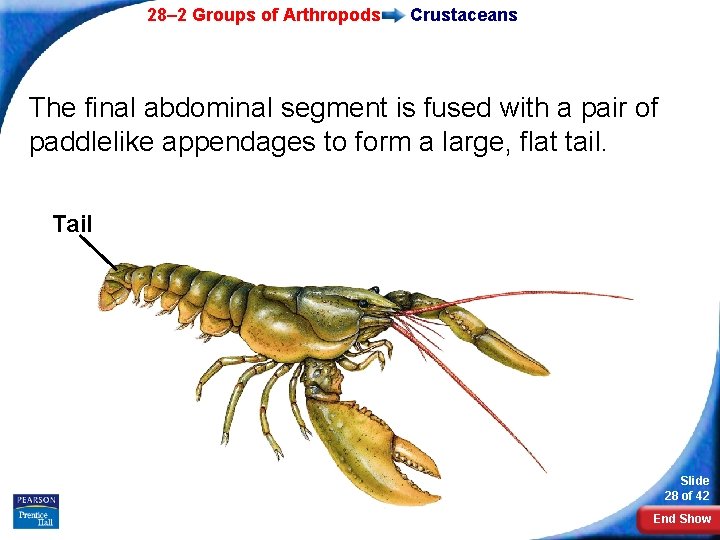
28– 2 Groups of Arthropods Crustaceans Decapods have five pairs of legs. In crayfishes, the first pair of legs, called chelipeds, have large claws that catch, pick up, crush, and cut food. Walking legs Cheliped Slide 25 of 42 End Show
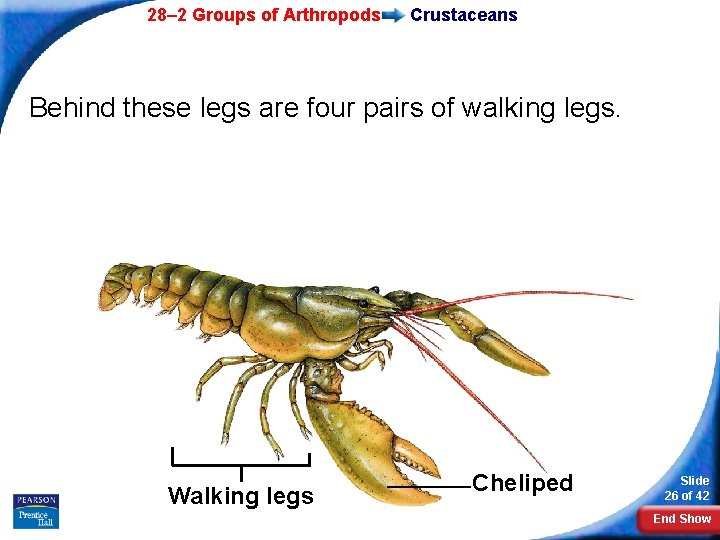
28– 2 Groups of Arthropods Crustaceans Behind these legs are four pairs of walking legs. Walking legs Cheliped Slide 26 of 42 End Show
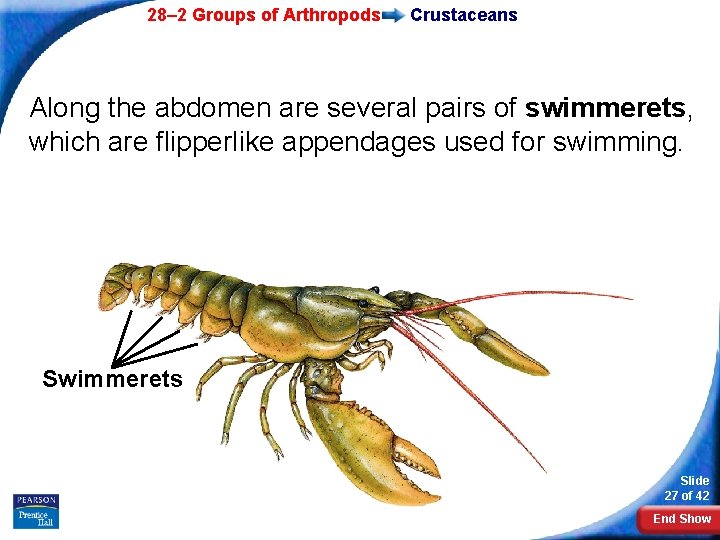
28– 2 Groups of Arthropods Crustaceans Along the abdomen are several pairs of swimmerets, which are flipperlike appendages used for swimming. Swimmerets Slide 27 of 42 End Show
28– 2 Groups of Arthropods Crustaceans The final abdominal segment is fused with a pair of paddlelike appendages to form a large, flat tail. Tail Slide 28 of 42 End Show
28– 2 Groups of Arthropods Spiders and Their Relatives What are the distinguishing features of spiders and their relatives? Slide 29 of 42 End Show
28– 2 Groups of Arthropods Spiders and Their Relatives Horseshoe crabs, spiders, ticks, and scorpions are chelicerates. Chelicerates lack antennae. Slide 30 of 42 End Show
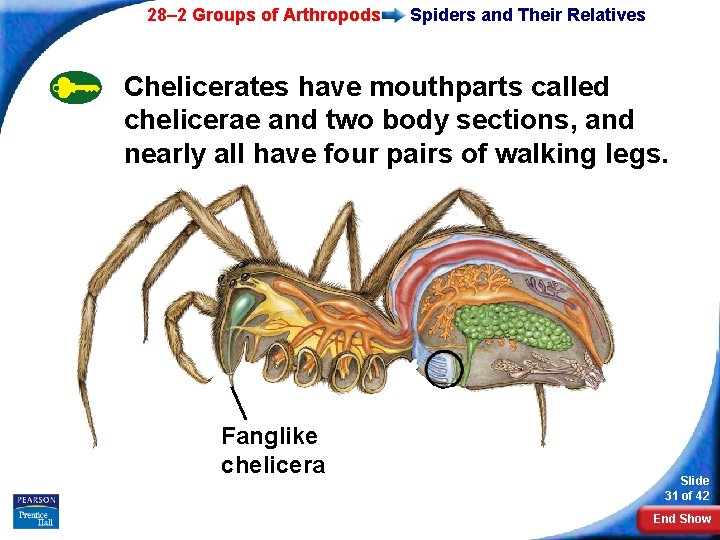
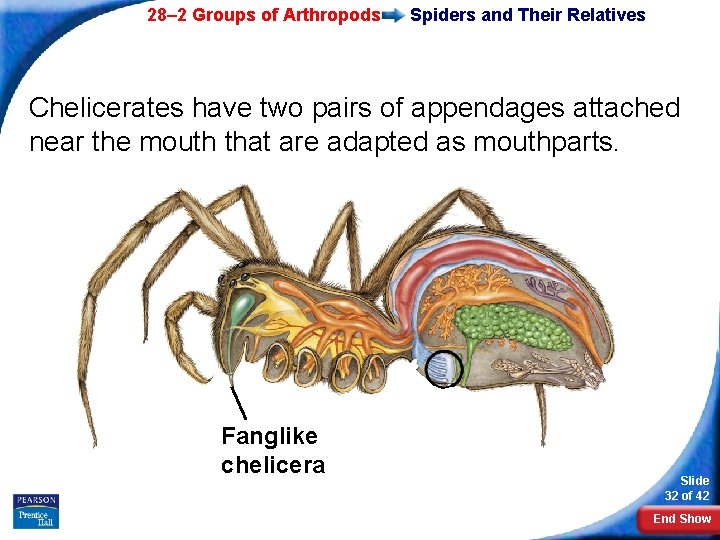
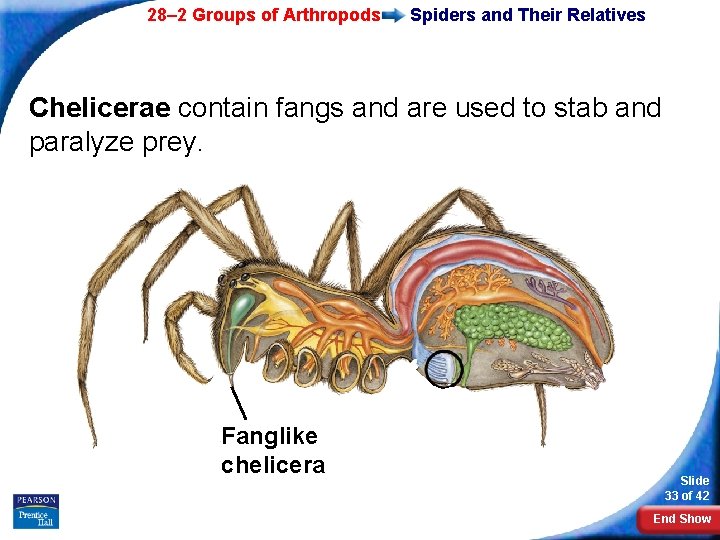
28– 2 Groups of Arthropods Spiders and Their Relatives Chelicerates have mouthparts called chelicerae and two body sections, and nearly all have four pairs of walking legs. Fanglike chelicera Slide 31 of 42 End Show
28– 2 Groups of Arthropods Spiders and Their Relatives Chelicerates have two pairs of appendages attached near the mouth that are adapted as mouthparts. Fanglike chelicera Slide 32 of 42 End Show
28– 2 Groups of Arthropods Spiders and Their Relatives Chelicerae contain fangs and are used to stab and paralyze prey. Fanglike chelicera Slide 33 of 42 End Show
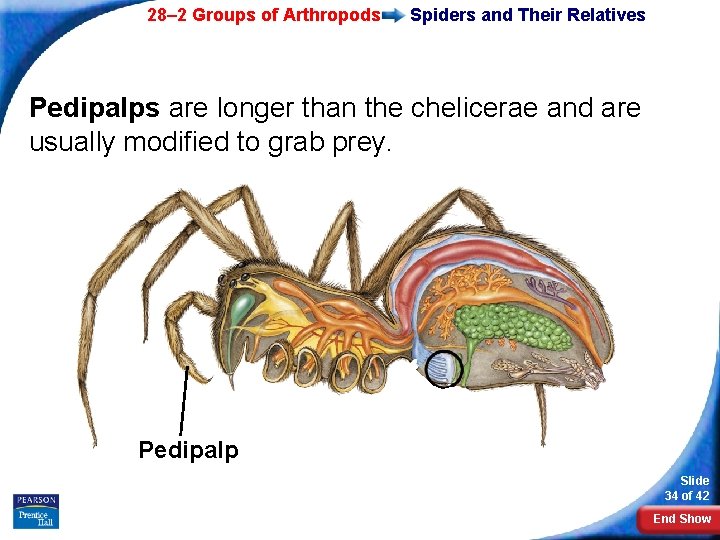
28– 2 Groups of Arthropods Spiders and Their Relatives Pedipalps are longer than the chelicerae and are usually modified to grab prey. Pedipalp Slide 34 of 42 End Show
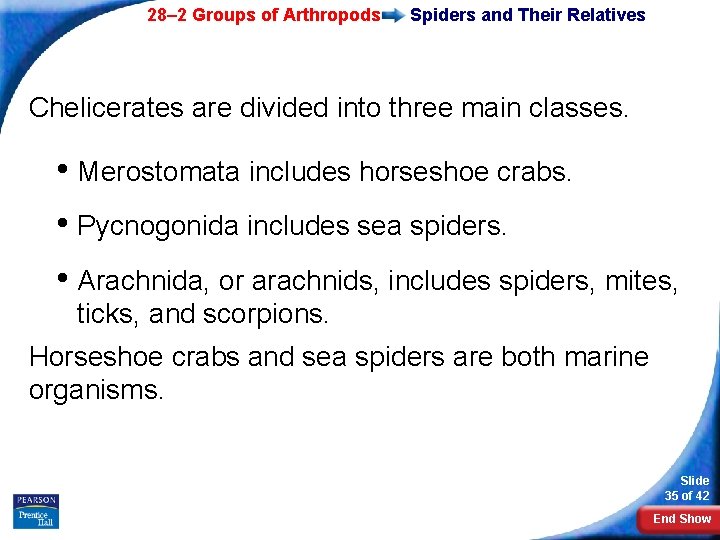
28– 2 Groups of Arthropods Spiders and Their Relatives Chelicerates are divided into three main classes. • Merostomata includes horseshoe crabs. • Pycnogonida includes sea spiders. • Arachnida, or arachnids, includes spiders, mites, ticks, and scorpions. Horseshoe crabs and sea spiders are both marine organisms. Slide 35 of 42 End Show
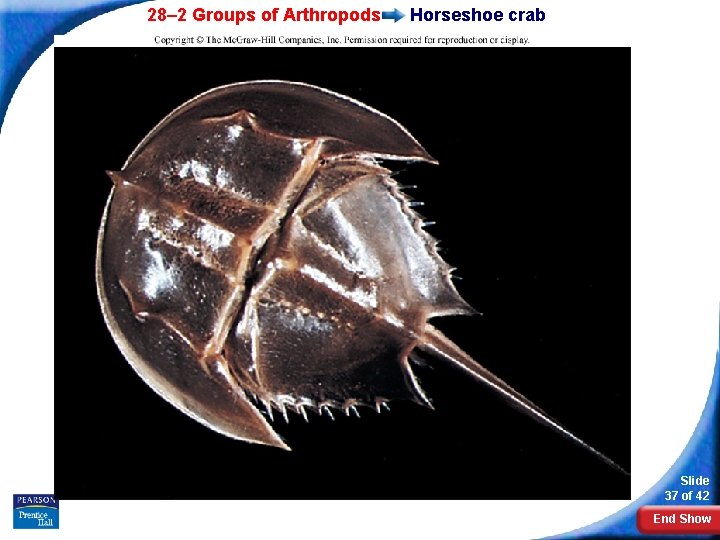
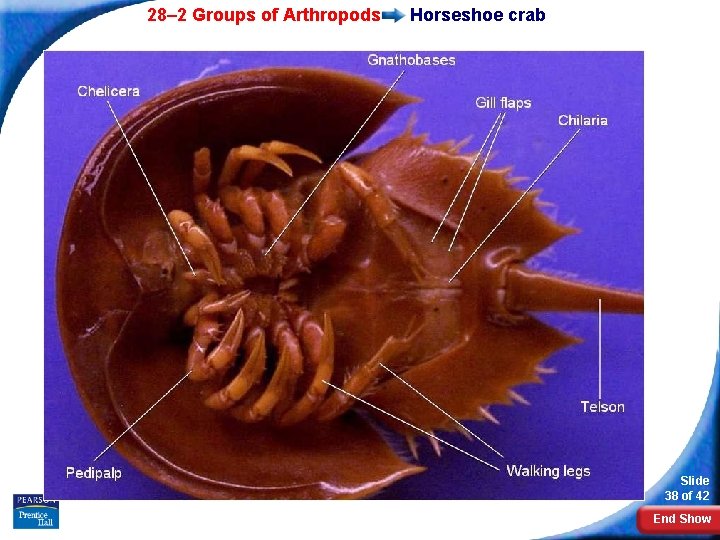
28– 2 Groups of Arthropods Spiders and Their Relatives Horseshoe Crabs Horseshoe crabs are found in shallow water on soft sandy or muddy bottoms. There has been a decline in number of individuals, as a consequence of coastal habitat destruction and pollution. They have chelicerae, five pairs of walking legs, and a long spikelike tail that is used for movement. While they can swim upside down, they usually are found on the ocean floor searching for worms and molluscs, which are their main food. They may also feed on crustaceans and even small fish. Slide 36 of 42 End Show
28– 2 Groups of Arthropods Horseshoe crab Slide 37 of 42 End Show
28– 2 Groups of Arthropods Horseshoe crab Slide 38 of 42 End Show
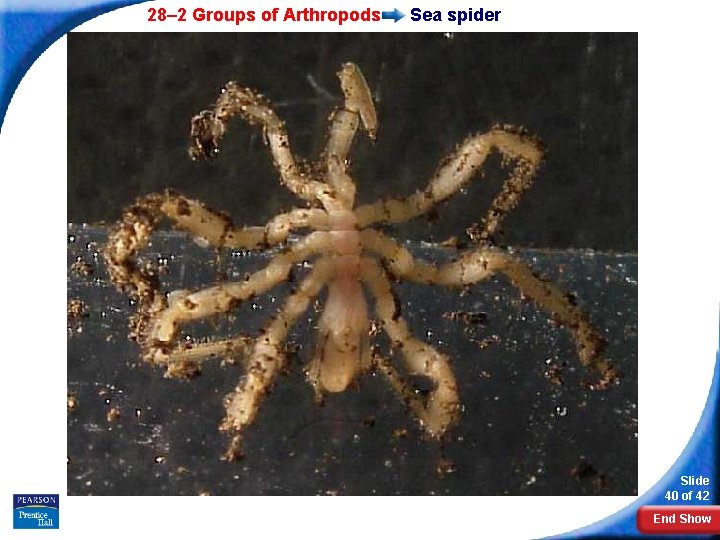
28– 2 Groups of Arthropods Spiders and Their Relatives Sea Spiders Sea spiders have long legs in contrast to a small body size. The number of walking legs is usually eight (four pairs), but species with five and six pairs exist. Because of their small size and slender body and legs, no respiratory system is necessary, with gases moving by diffusion. A proboscis allows them to suck nutrients from softbodied invertebrates, and their digestive tract has diverticula extending into the legs. Slide 39 of 42 End Show
28– 2 Groups of Arthropods Sea spider Slide 40 of 42 End Show
28– 2 The two main groups of chelicerates are a. spiders and scorpions. b. horseshoe crabs and spiders. c. horseshoe crabs and arachnids. d. arachnids and insects. Slide 41 of 42 End Show
28– 2 Insects are part of the group a. crustaceans. b. uniramians. c. chelicerates. d. diplopods. Slide 42 of 42 End Show
28– 2 Most mites and ticks are a. parasites. b. predators. c. herbivores. d. detritovores. Slide 43 of 42 End Show
28– 2 Which of the following is NOT a typical crustacean characteristic? a. either two or three body segments b. chewing mouthparts called mandibles c. chelicerae that paralyze prey d. two pairs of antennae Slide 44 of 42 End Show
28– 2 Spiders differ from the other arachnids because they have a. two major body segments and six legs. b. three major body segments and eight legs. c. two major body segments and eight legs. d. three major body segments and six legs. Slide 45 of 42 End Show
END OF SECTION