15 P Vector Analysis Copyright Cengage Learning All
- Slides: 37
15 P Vector Analysis Copyright © Cengage Learning. All rights reserved.
15. 2 Line Integrals Copyright © Cengage Learning. All rights reserved.
Objectives n Understand use the concept of a piecewise smooth curve. n Write and evaluate a line integral of a vector field. n Write and evaluate a line integral in differential form. 3
Piecewise Smooth Curves 4
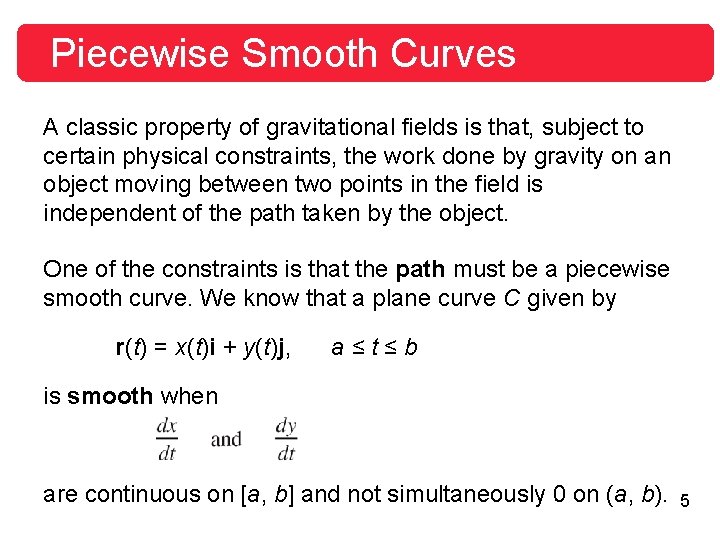
Piecewise Smooth Curves A classic property of gravitational fields is that, subject to certain physical constraints, the work done by gravity on an object moving between two points in the field is independent of the path taken by the object. One of the constraints is that the path must be a piecewise smooth curve. We know that a plane curve C given by r(t) = x(t)i + y(t)j, a≤t≤b is smooth when are continuous on [a, b] and not simultaneously 0 on (a, b). 5
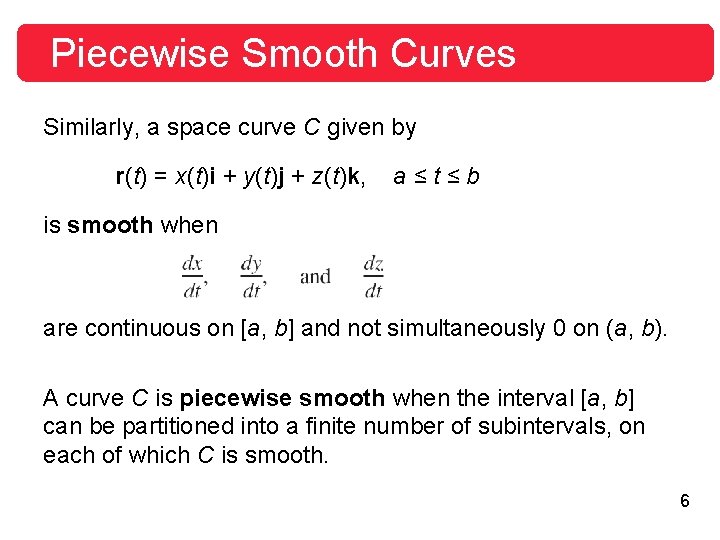
Piecewise Smooth Curves Similarly, a space curve C given by r(t) = x(t)i + y(t)j + z(t)k, a≤t≤b is smooth when are continuous on [a, b] and not simultaneously 0 on (a, b). A curve C is piecewise smooth when the interval [a, b] can be partitioned into a finite number of subintervals, on each of which C is smooth. 6
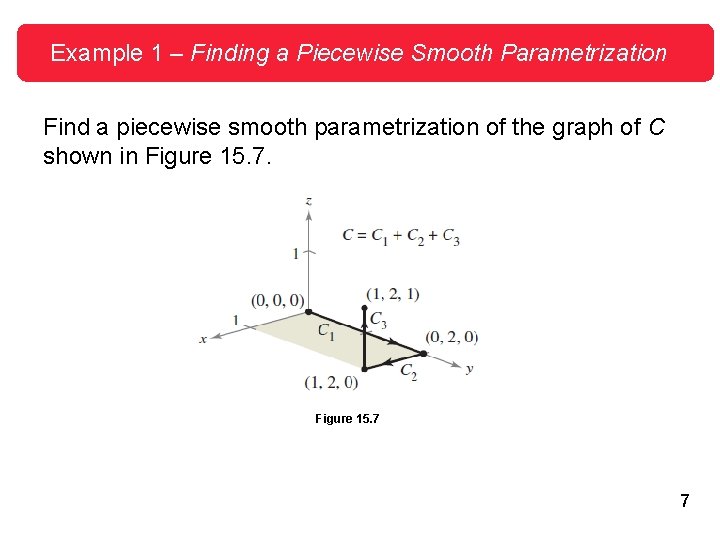
Example 1 – Finding a Piecewise Smooth Parametrization Find a piecewise smooth parametrization of the graph of C shown in Figure 15. 7 7
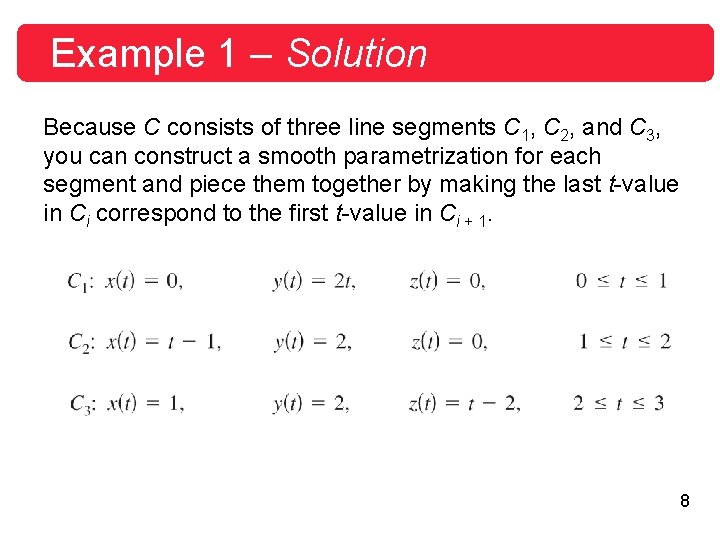
Example 1 – Solution Because C consists of three line segments C 1, C 2, and C 3, you can construct a smooth parametrization for each segment and piece them together by making the last t-value in Ci correspond to the first t-value in Ci + 1. 8
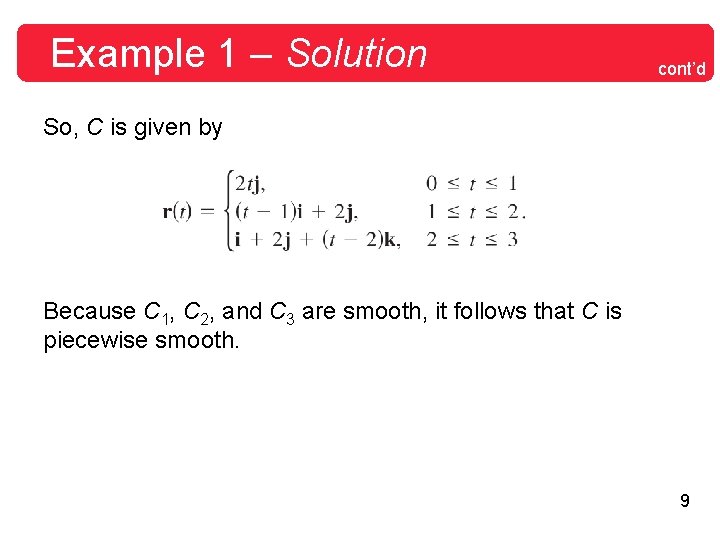
Example 1 – Solution cont’d So, C is given by Because C 1, C 2, and C 3 are smooth, it follows that C is piecewise smooth. 9
Piecewise Smooth Curves Parametrization of a curve induces an orientation to the curve. For instance, in Example 1, the curve is oriented such that the positive direction is from (0, 0, 0), following the curve to (1, 2, 1). 10
Line Integrals 11
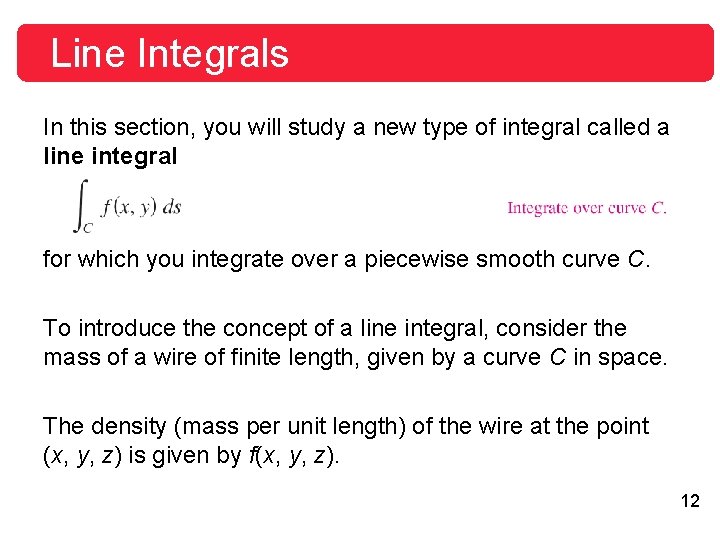
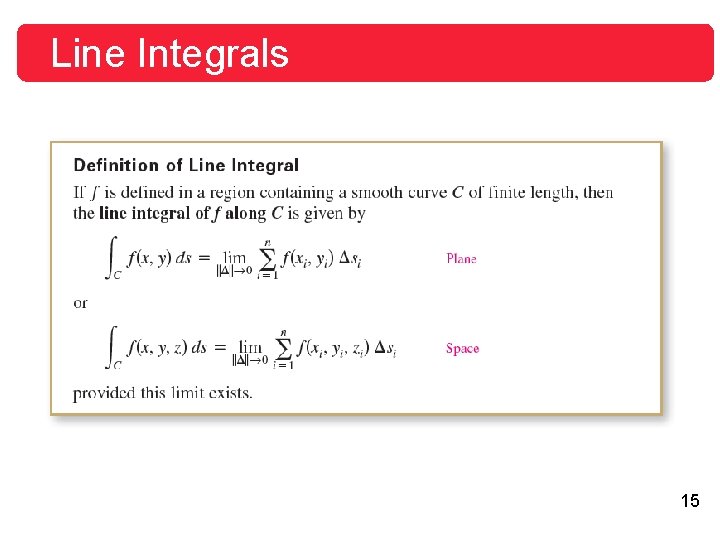
Line Integrals In this section, you will study a new type of integral called a line integral for which you integrate over a piecewise smooth curve C. To introduce the concept of a line integral, consider the mass of a wire of finite length, given by a curve C in space. The density (mass per unit length) of the wire at the point (x, y, z) is given by f(x, y, z). 12
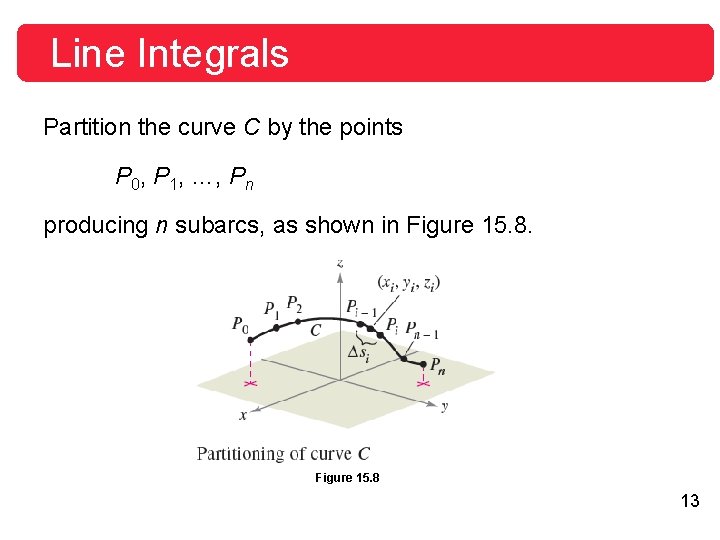
Line Integrals Partition the curve C by the points P 0, P 1, …, Pn producing n subarcs, as shown in Figure 15. 8 13
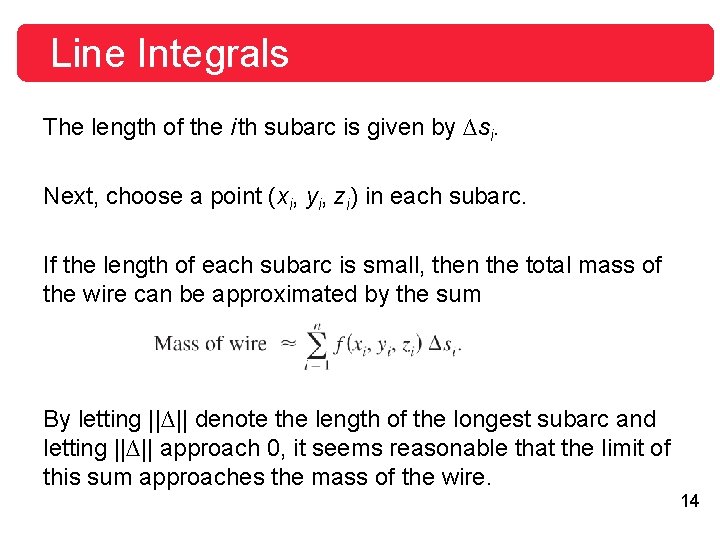
Line Integrals The length of the i th subarc is given by ∆si. Next, choose a point (xi, yi, zi) in each subarc. If the length of each subarc is small, then the total mass of the wire can be approximated by the sum By letting ||∆|| denote the length of the longest subarc and letting ||∆|| approach 0, it seems reasonable that the limit of this sum approaches the mass of the wire. 14
Line Integrals 15
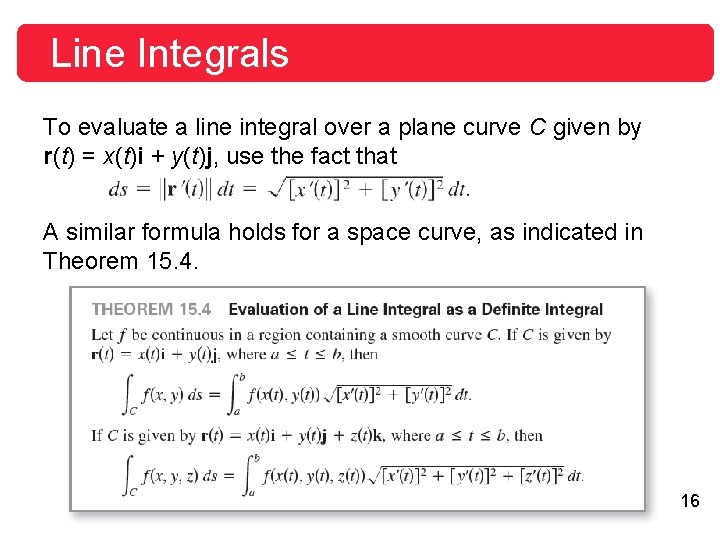
Line Integrals To evaluate a line integral over a plane curve C given by r(t) = x(t)i + y(t)j, use the fact that A similar formula holds for a space curve, as indicated in Theorem 15. 4. 16
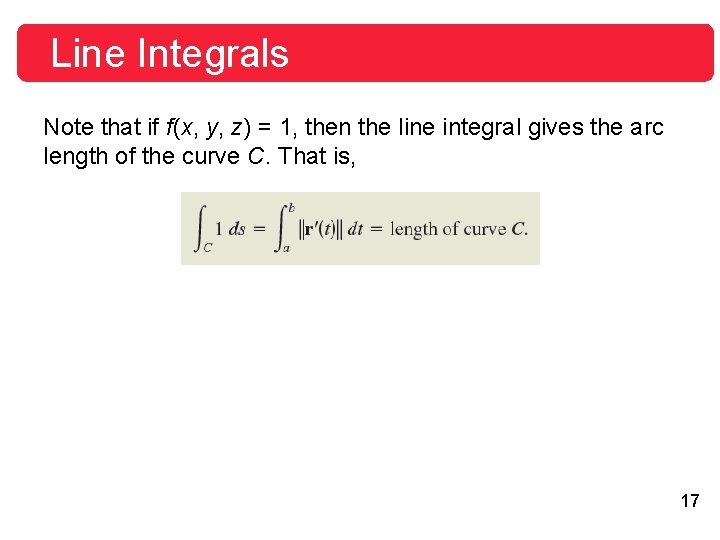
Line Integrals Note that if f(x, y, z) = 1, then the line integral gives the arc length of the curve C. That is, 17
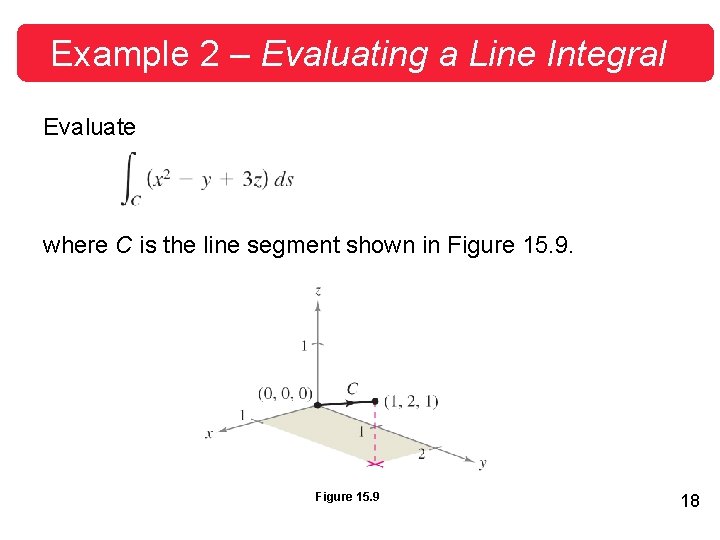
Example 2 – Evaluating a Line Integral Evaluate where C is the line segment shown in Figure 15. 9 18
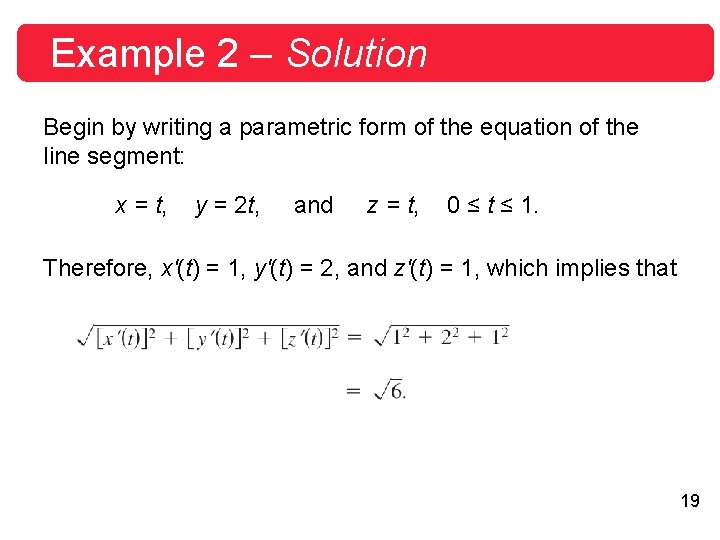
Example 2 – Solution Begin by writing a parametric form of the equation of the line segment: x = t, y = 2 t, and z = t, 0 ≤ t ≤ 1. Therefore, x'(t) = 1, y'(t) = 2, and z'(t) = 1, which implies that 19
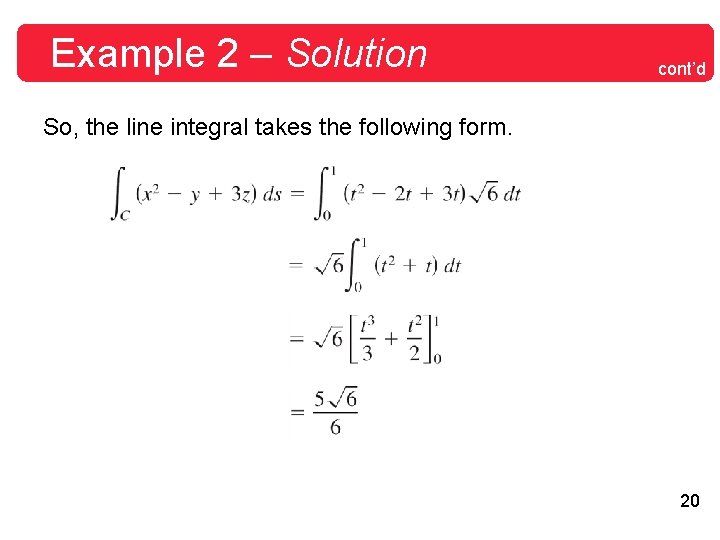
Example 2 – Solution cont’d So, the line integral takes the following form. 20
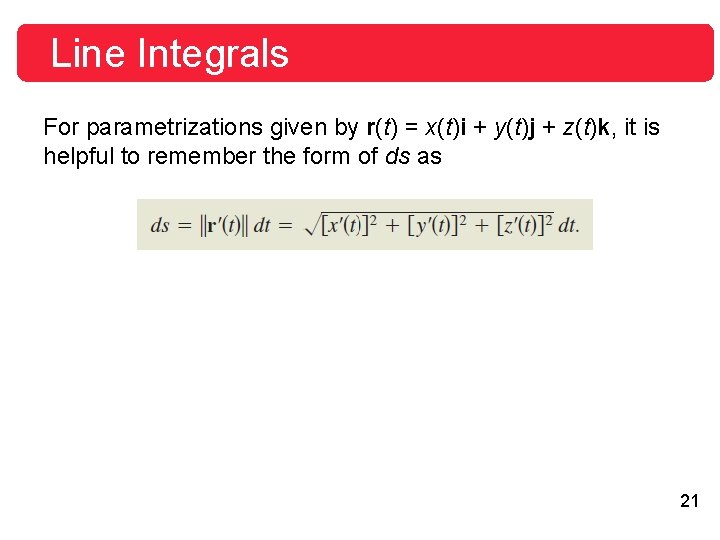
Line Integrals For parametrizations given by r(t) = x(t)i + y(t)j + z(t)k, it is helpful to remember the form of ds as 21
Line Integrals of Vector Fields 22
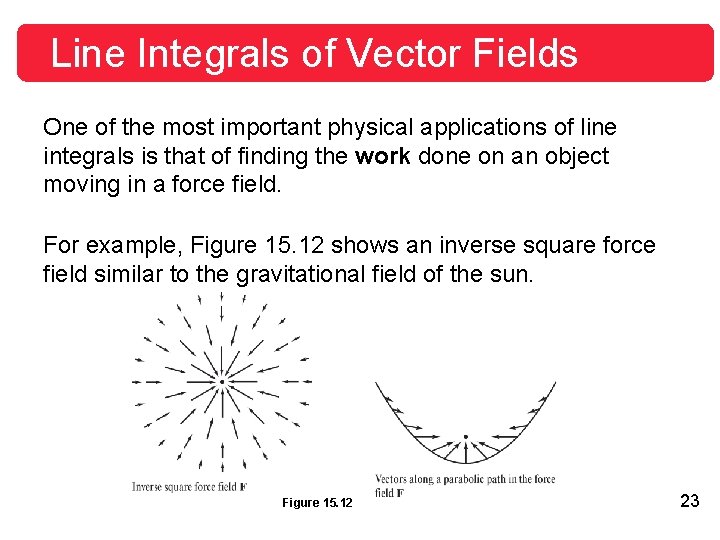
Line Integrals of Vector Fields One of the most important physical applications of line integrals is that of finding the work done on an object moving in a force field. For example, Figure 15. 12 shows an inverse square force field similar to the gravitational field of the sun. Figure 15. 12 23
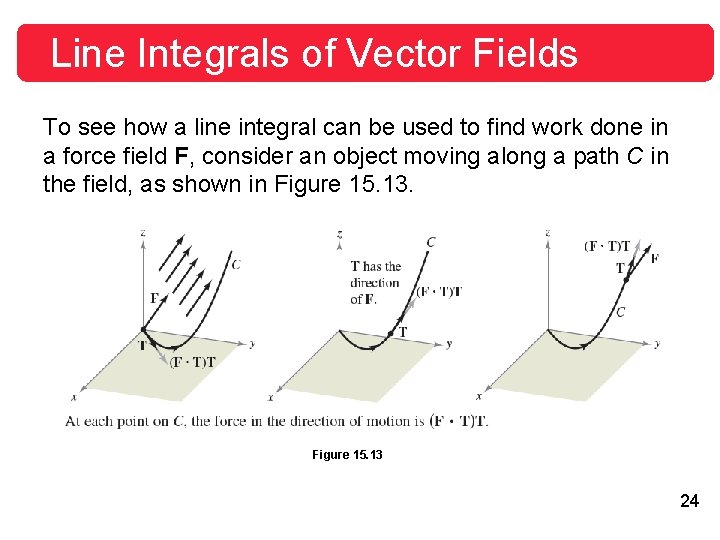
Line Integrals of Vector Fields To see how a line integral can be used to find work done in a force field F, consider an object moving along a path C in the field, as shown in Figure 15. 13 24
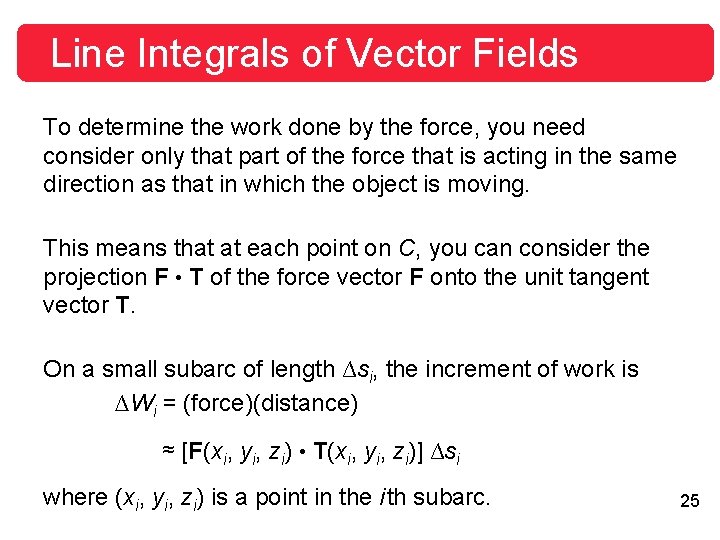
Line Integrals of Vector Fields To determine the work done by the force, you need consider only that part of the force that is acting in the same direction as that in which the object is moving. This means that at each point on C, you can consider the projection F • T of the force vector F onto the unit tangent vector T. On a small subarc of length ∆si, the increment of work is ∆Wi = (force)(distance) ≈ [F(xi, yi, zi) • T(xi, yi, zi)] ∆si where (xi, yi, zi) is a point in the i th subarc. 25
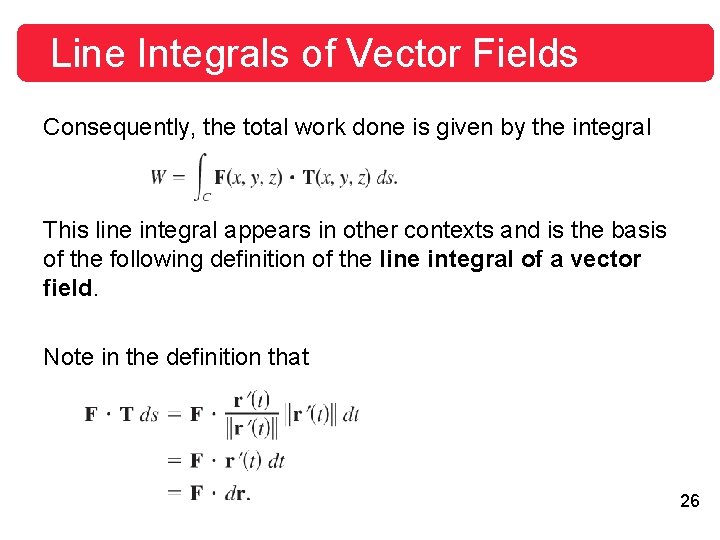
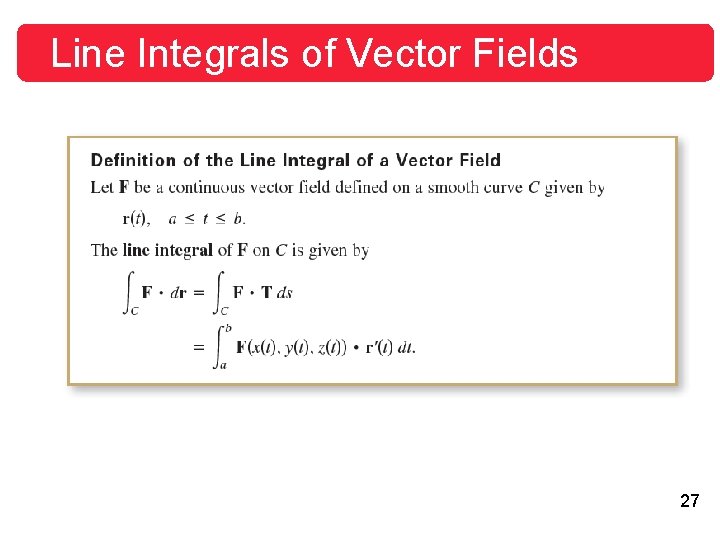
Line Integrals of Vector Fields Consequently, the total work done is given by the integral This line integral appears in other contexts and is the basis of the following definition of the line integral of a vector field. Note in the definition that 26
Line Integrals of Vector Fields 27
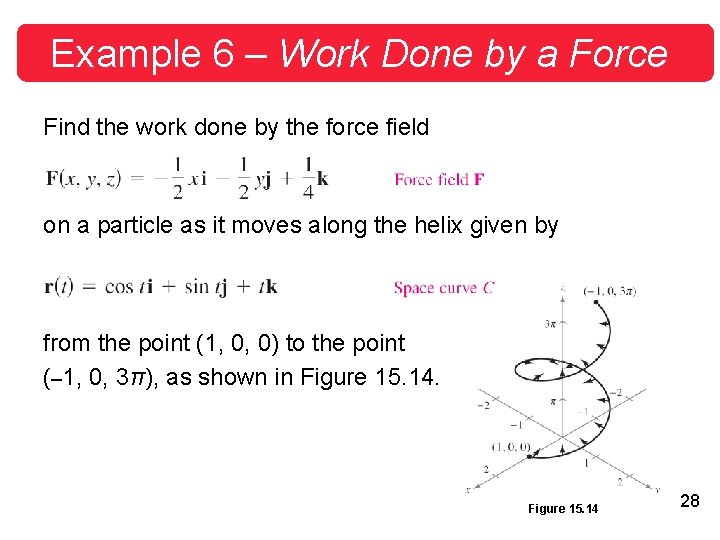
Example 6 – Work Done by a Force Find the work done by the force field on a particle as it moves along the helix given by from the point (1, 0, 0) to the point (– 1, 0, 3π), as shown in Figure 15. 14 28
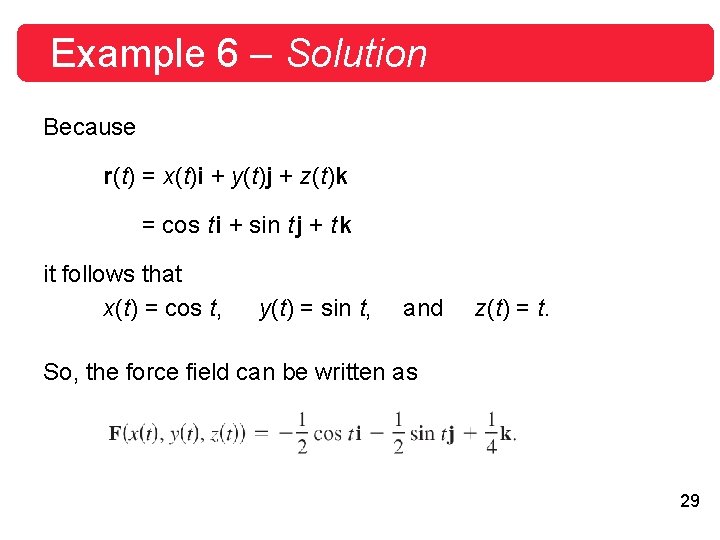
Example 6 – Solution Because r(t) = x(t)i + y(t)j + z(t)k = cos t i + sin t j + t k it follows that x(t) = cos t, y(t) = sin t, and z(t) = t. So, the force field can be written as 29
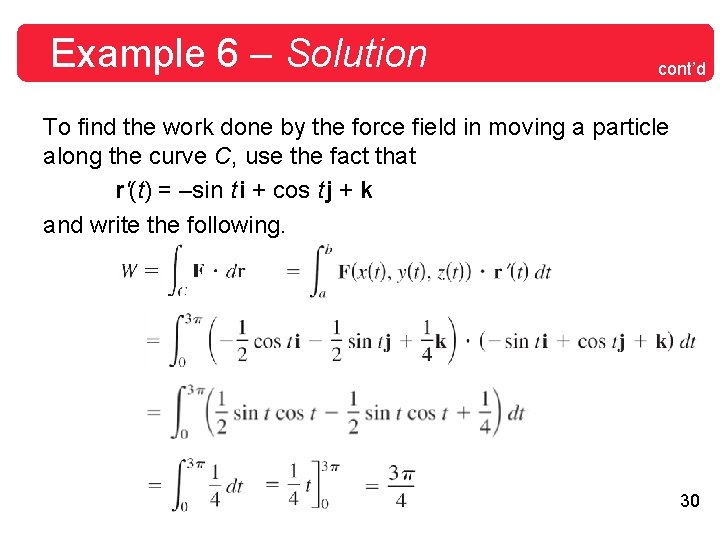
Example 6 – Solution cont’d To find the work done by the force field in moving a particle along the curve C, use the fact that r'(t) = –sin t i + cos t j + k and write the following. 30
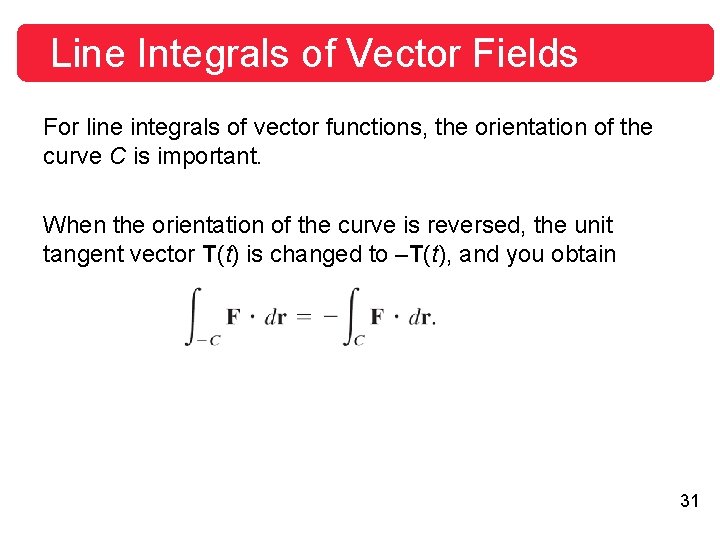
Line Integrals of Vector Fields For line integrals of vector functions, the orientation of the curve C is important. When the orientation of the curve is reversed, the unit tangent vector T(t) is changed to –T(t), and you obtain 31
Line Integrals in Differential Form 32
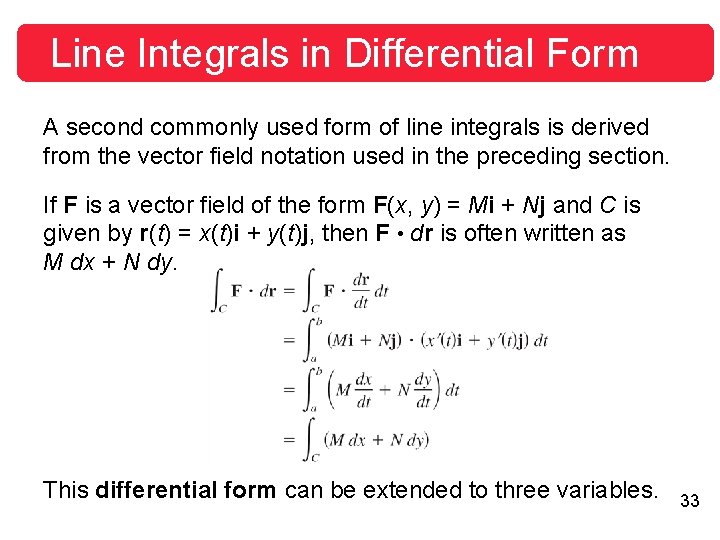
Line Integrals in Differential Form A second commonly used form of line integrals is derived from the vector field notation used in the preceding section. If F is a vector field of the form F(x, y) = Mi + Nj and C is given by r(t) = x(t)i + y(t)j, then F • dr is often written as M dx + N dy. This differential form can be extended to three variables. 33
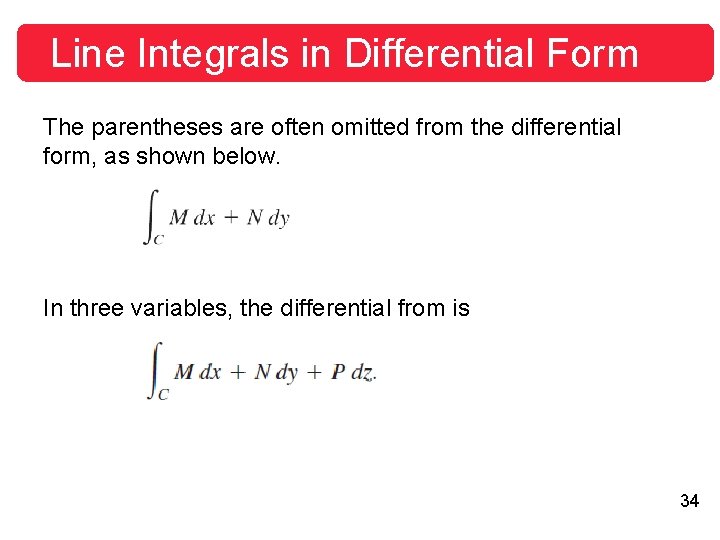
Line Integrals in Differential Form The parentheses are often omitted from the differential form, as shown below. In three variables, the differential from is 34
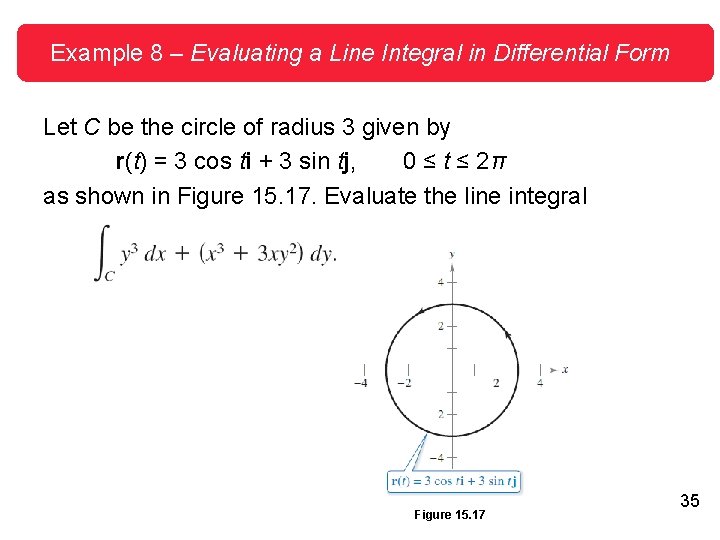
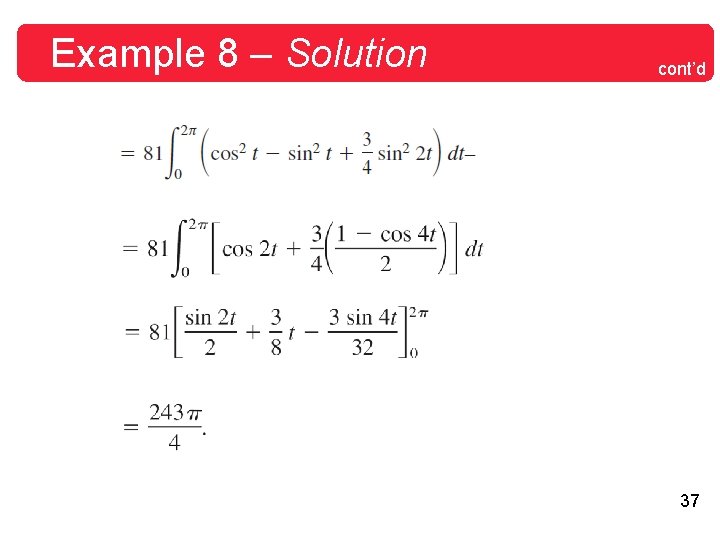
Example 8 – Evaluating a Line Integral in Differential Form Let C be the circle of radius 3 given by r(t) = 3 cos ti + 3 sin tj, 0 ≤ t ≤ 2π as shown in Figure 15. 17. Evaluate the line integral Figure 15. 17 35
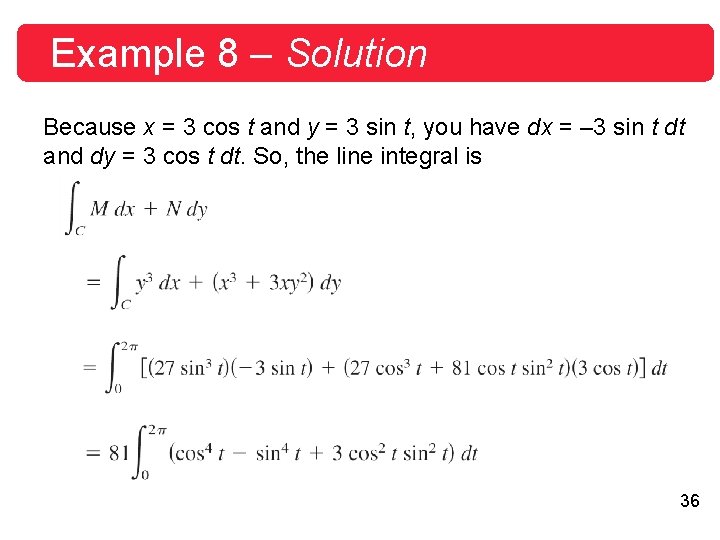
Example 8 – Solution Because x = 3 cos t and y = 3 sin t, you have dx = – 3 sin t dt and dy = 3 cos t dt. So, the line integral is 36
Example 8 – Solution cont’d 37