Wisconsin APRN Coalition SUPPORT ENGAGE ALIGN I think
- Slides: 32
Wisconsin APRN Coalition SUPPORT | ENGAGE | ALIGN
“I think one’s feelings waste themselves in words; they ought all to be distilled into actions which bring results. ” Florence Nightingale SUPPORT | ENGAGE | ALIGN 2
Overview of this presentation This presentation provides an overview of the following: ▪ What is Grassroots Advocacy/Lobbying ▪ Ways to communicate ▪ Important steps in the lobbying process where your voice is needed ▪ How to prepare and give testimony at legislative committee hearings ▪ Other resources SUPPORT | ENGAGE | ALIGN 3
What is Grassroots Lobbying? Your Legislators ▪ It is about building relationships and responding to Calls to Action! ▪ Increase legislator awareness of the APRN Modernization Act through… ▪ Meetings at home or state office ▪ Providing scripted messaging materials/talking points ▪ Scheduling legislative events such group receptions/breakfasts, coffees and/or fundraisers ▪ Inviting to job shadow to learn about your role ▪ Telling your story ▪ Attending APRN Lobby Day ▪ Following legislator on Twitter and Facebook SUPPORT | ENGAGE | ALIGN July 2017 4
What is Grassroots Lobbying? Your APRN Colleagues ▪ It is about building relationships and responding to Calls to Action! ▪ Increase APRN awareness of the APRN Modernization Act through… ▪ One-on-one discussion regarding the intent of the legislation ▪ Assisting with scheduling informational meetings with other APRNs ▪ Providing standardized informational materials ▪ Encouraging colleagues to join the WI APRN Coalition so they remain engaged, aware and ready to act when requested ▪ Inviting to coffees, breakfasts/receptions and fundraisers SUPPORT | ENGAGE | ALIGN July 2017 5
What is Grassroots Lobbying? Your Employer ▪ It is about building relationships and responding to Calls to Action! ▪ Increase employer awareness of the APRN Modernization Act through… ▪ Requesting a meeting with the leadership of your organization to describe the purpose and intent of the APRN Modernization Act ▪ Bringing a few co-workers to meeting to show unity but not too many that will overwhelm ▪ Utilizing scripted messaging tools for employers ▪ Asking for support and advocacy SUPPORT | ENGAGE | ALIGN July 2017 6
What is Grassroots Lobbying? Your Patients and Families ▪ It is about building relationships and responding to Calls to Action! ▪ Increase consumer awareness of the APRN Modernization Act through… ▪ One-on-one discussion with your patients ▪ Presenting to consumer groups ▪ Submitting letters to the Editor or Op-ed using standardized talking points SUPPORT | ENGAGE | ALIGN July 2017 7
Toolkit for influencing the passage of the APRN Modernization Act ▪ This toolkit includes the following tips related to: ▪ Messaging and communicating ▪ When your voice is needed during the legislative process ▪ Preparing and delivering testimony to legislative committee SUPPORT | ENGAGE | ALIGN July 2017 8
Messaging and Communicating SUPPORT | ENGAGE | ALIGN 9
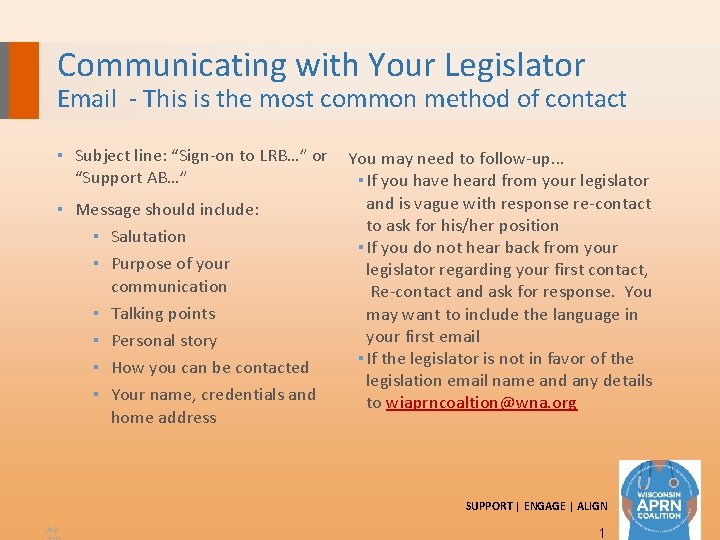
Communicating with Your Legislator Email - This is the most common method of contact ▪ Subject line: “Sign-on to LRB…” or “Support AB…” ▪ Message should include: ▪ Salutation ▪ Purpose of your communication ▪ Talking points ▪ Personal story ▪ How you can be contacted ▪ Your name, credentials and home address You may need to follow-up. . . ▪If you have heard from your legislator and is vague with response re-contact to ask for his/her position ▪If you do not hear back from your legislator regarding your first contact, Re-contact and ask for response. You may want to include the language in your first email ▪If the legislator is not in favor of the legislation email name and any details to wiaprncoaltion@wna. org SUPPORT | ENGAGE | ALIGN July 1
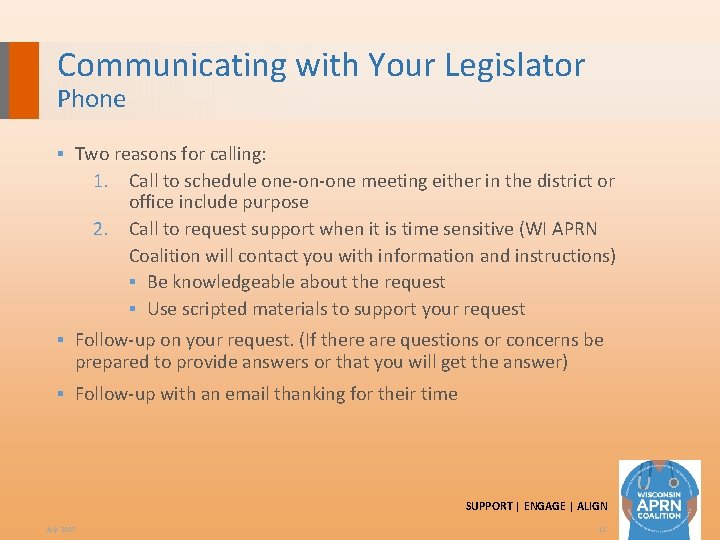
Communicating with Your Legislator Phone ▪ Two reasons for calling: 1. Call to schedule one-on-one meeting either in the district or office include purpose 2. Call to request support when it is time sensitive (WI APRN Coalition will contact you with information and instructions) ▪ Be knowledgeable about the request ▪ Use scripted materials to support your request ▪ Follow-up on your request. (If there are questions or concerns be prepared to provide answers or that you will get the answer) ▪ Follow-up with an email thanking for their time SUPPORT | ENGAGE | ALIGN July 2017 11
Communicating with Your Legislator Face-to-Face ▪ Meet either in the district or office at the state capitol ▪ Prepare! ▪ Schedule an appointment and include purpose. ▪ Conduct some research your legislator i. e. city, education, career, member of which legislative committees by going to WI Legislature website. http: //legis. wisconsin. gov/ ▪ Become familiar with the messaging that you are going to provide ▪ Use WI APRN Coalition standardized materials ▪ Have a personal story that you would like to tell that explains your role and scope of practice. ▪ Know where you are going (offices at the state capitol can be hard to find) and arrive early. There is an information desk located in the center of the building. ▪ Dress code for capitol meetings is business attire SUPPORT | ENGAGE | ALIGN July 2017 12
Communicating With Your Legislator Face-to-Face ▪ Face-to-face meeting either in the district or office at the state capitol ▪ Dress and be professional, friendly and courteous ▪ Present your purpose of the meeting – “I want to discuss some proposed legislation that we are supporting that is good for patients. It is the APRN Modernization Act” ▪ Provide information - Avoid use of nursing jargon – talk to your legislator as if you were teaching your patient ▪ Review who APRNs are ▪ Provide standardized talking points SUPPORT | ENGAGE | ALIGN July 2017 13
Communicating With Your Legislator Face-to-Face ▪ You may meet with the legislators staff person. Do not be disappointed as staff can be more informed on the bill than the legislator. ▪ Be concise, meeting duration may be only 15 minutes ▪ Answer questions ▪ Ask about their level of support ▪ Provide the “Leave Behind” materials or folder provided by WI APRN Coalition staff ▪ Thank him/her SUPPORT | ENGAGE | ALIGN July 2017 14
Communicating With Your Legislator ▪ Post face-to-face meeting ▪ Send a thank you that includes ▪ Summary of meeting topic ▪ Ask that he/she support the legislation ▪ Follow-up on how he/she will vote ▪ Monitor progress SUPPORT | ENGAGE | ALIGN July 2017 15
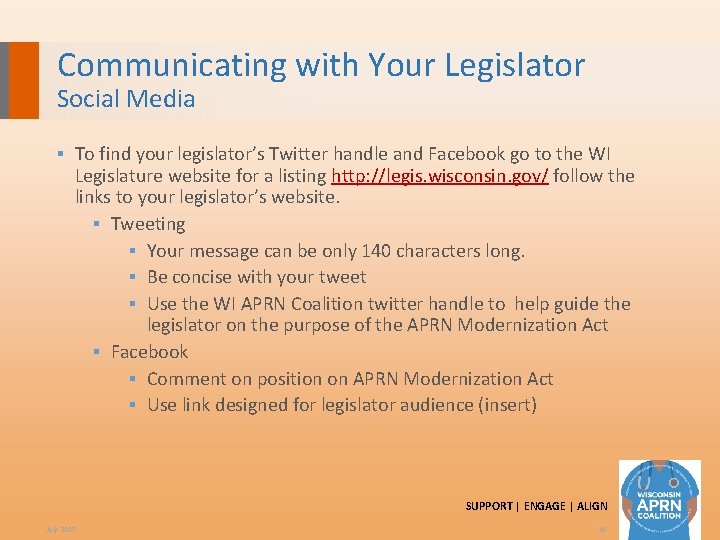
Communicating with Your Legislator Social Media ▪ To find your legislator’s Twitter handle and Facebook go to the WI Legislature website for a listing http: //legis. wisconsin. gov/ follow the links to your legislator’s website. ▪ Tweeting ▪ Your message can be only 140 characters long. ▪ Be concise with your tweet ▪ Use the WI APRN Coalition twitter handle to help guide the legislator on the purpose of the APRN Modernization Act ▪ Facebook ▪ Comment on position on APRN Modernization Act ▪ Use link designed for legislator audience (insert) SUPPORT | ENGAGE | ALIGN July 2017 16
Important timeframes when you need to contact your legislator SUPPORT | ENGAGE | ALIGN 17
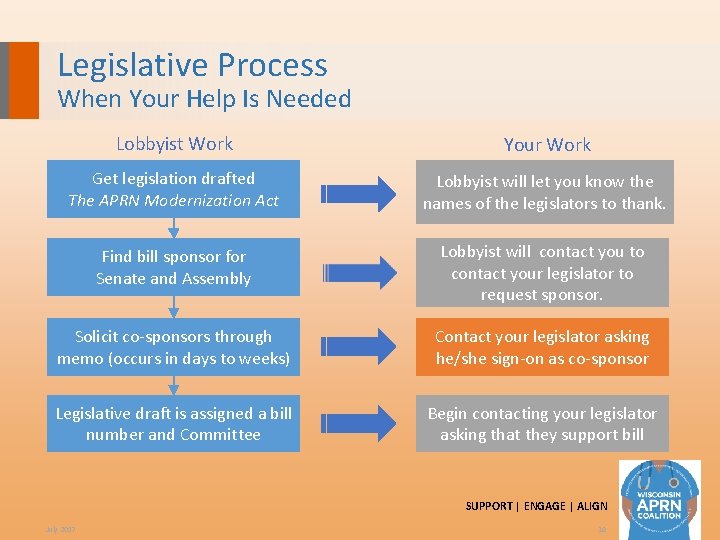
Legislative Process When Your Help Is Needed Lobbyist Work Your Work Get legislation drafted The APRN Modernization Act Lobbyist will let you know the names of the legislators to thank. Find bill sponsor for Senate and Assembly Lobbyist will contact you to contact your legislator to request sponsor. Solicit co-sponsors through memo (occurs in days to weeks) Contact your legislator asking he/she sign-on as co-sponsor Legislative draft is assigned a bill number and Committee Begin contacting your legislator asking that they support bill SUPPORT | ENGAGE | ALIGN July 2017 18
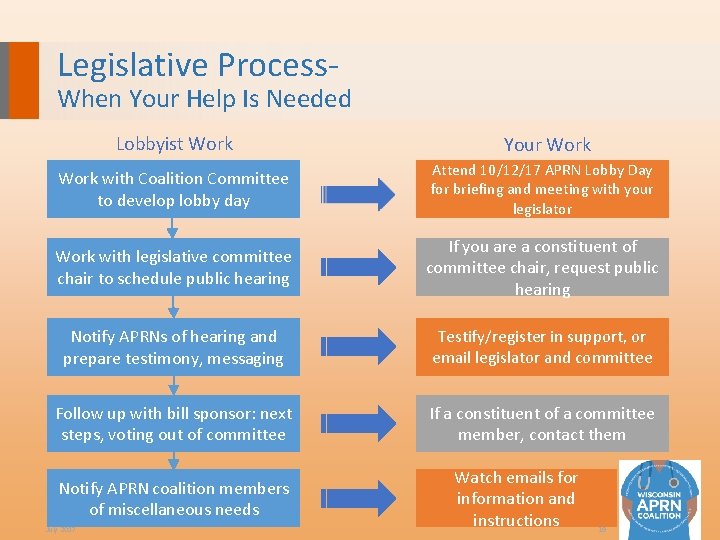
Legislative Process- When Your Help Is Needed Lobbyist Work Your Work with Coalition Committee to develop lobby day Attend 10/12/17 APRN Lobby Day for briefing and meeting with your legislator Work with legislative committee chair to schedule public hearing If you are a constituent of committee chair, request public hearing Notify APRNs of hearing and prepare testimony, messaging Testify/register in support, or email legislator and committee Follow up with bill sponsor: next steps, voting out of committee If a constituent of a committee member, contact them Notify APRN coalition members of miscellaneous needs July 2017 Watch emails for information and| ALIGN SUPPORT | ENGAGE instructions 19
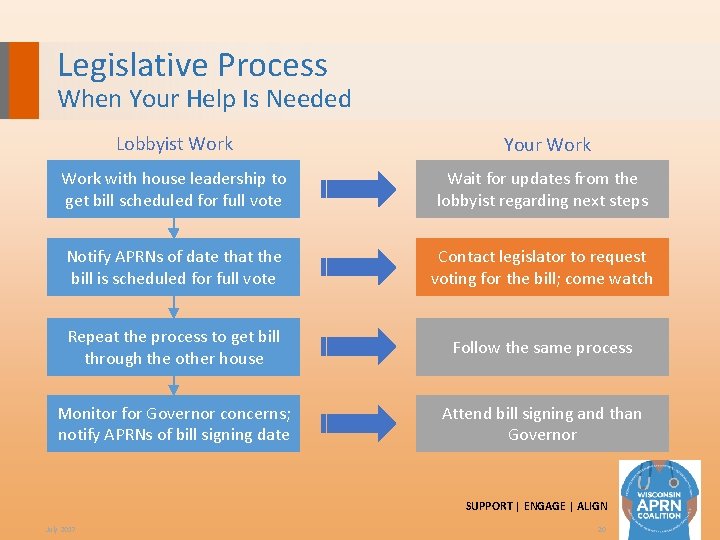
Legislative Process When Your Help Is Needed Lobbyist Work Your Work with house leadership to get bill scheduled for full vote Wait for updates from the lobbyist regarding next steps Notify APRNs of date that the bill is scheduled for full vote Contact legislator to request voting for the bill; come watch Repeat the process to get bill through the other house Follow the same process Monitor for Governor concerns; notify APRNs of bill signing date Attend bill signing and than Governor SUPPORT | ENGAGE | ALIGN July 2017 20
Testimony: prepare, deliver & follow-up SUPPORT | ENGAGE | ALIGN 21
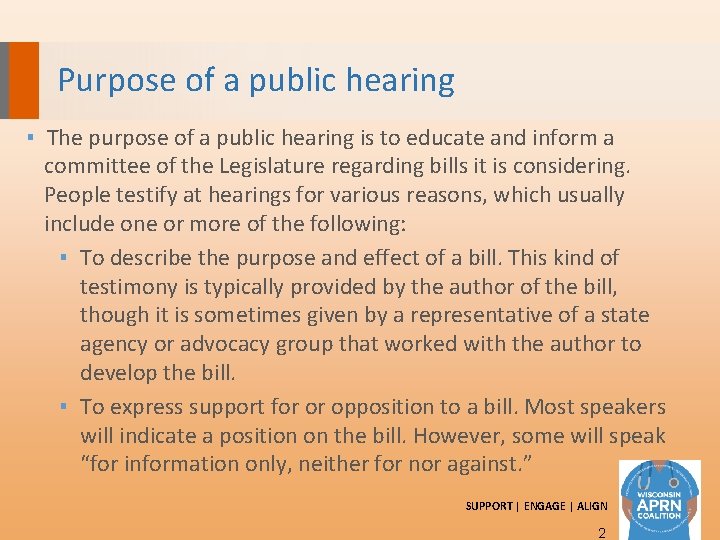
Purpose of a public hearing ▪ The purpose of a public hearing is to educate and inform a committee of the Legislature regarding bills it is considering. People testify at hearings for various reasons, which usually include one or more of the following: ▪ To describe the purpose and effect of a bill. This kind of testimony is typically provided by the author of the bill, though it is sometimes given by a representative of a state agency or advocacy group that worked with the author to develop the bill. ▪ To express support for or opposition to a bill. Most speakers will indicate a position on the bill. However, some will speak “for information only, neither for nor against. ” SUPPORT | ENGAGE | ALIGN 2
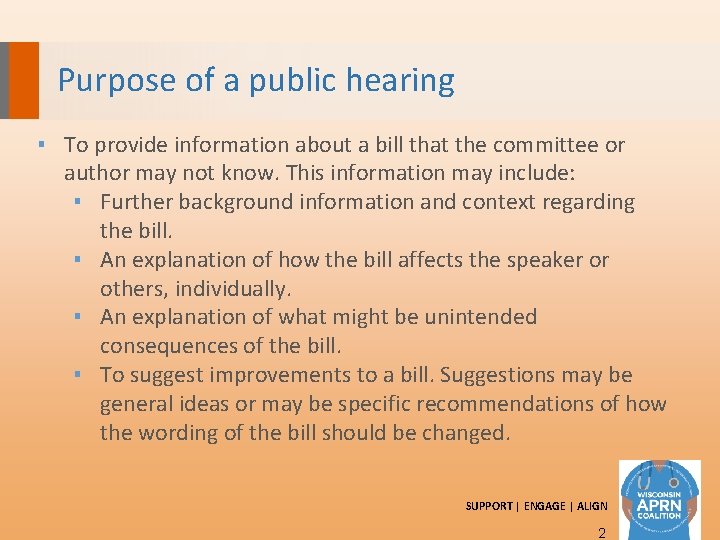
Purpose of a public hearing ▪ To provide information about a bill that the committee or author may not know. This information may include: ▪ Further background information and context regarding the bill. ▪ An explanation of how the bill affects the speaker or others, individually. ▪ An explanation of what might be unintended consequences of the bill. ▪ To suggest improvements to a bill. Suggestions may be general ideas or may be specific recommendations of how the wording of the bill should be changed. SUPPORT | ENGAGE | ALIGN 2
Providing Testimony At Committee Hearing Preparation ▪ Prepare – You can request assistance in preparing your testimony by contacting the WI APRN Coalition Lobbyist wiaprncoaltion@wna. org ▪ Know the legislative bill “APRN Modernization Act” ▪ Review and know the important talking points ▪ Prepare written testimony ▪ Make copies for each committee member ▪ If you are one of the committee members constituent contact his/her office letting them know that you will be testifying ▪ Know the location of hearing room ▪ Know time of public hearing ▪ Know if other legislative bills will be on the agenda SUPPORT | ENGAGE | ALIGN July 2017 24
Providing Testimony At Committee Hearing Day ▪ Dress in business attire ▪ Review committee hearing agenda ▪ Fill out public hearing form ▪ Name or number of the legislative bill ▪ Your name and home address ▪ Indicate if you are testifying and “in support” or “in opposition” ▪ Give this to hearing committee staffer/page ▪ When called on to testify, provide copies of your testimony to the staffer/page SUPPORT | ENGAGE | ALIGN July 2017 25
Waiting To Testify ▪ Silence cell phone ▪ Restrain from conversations ▪ When the APRN Modernization Act bill is up for testimony ▪ Listen to what others have to say ▪ Take notes and strategize your counter-points to opposing views ▪ Prior to your being called on, try to confer with lobbyist to determine if you need to refute any of opposing views ▪ When you are called on to testify be ready to avoid repeating what has already been said but be prepared to tell your story to provide illustration to support previous points SUPPORT | ENGAGE | ALIGN July 2017 26
Providing Your Testimony ▪ When you are called on testify ▪ Bring your materials ▪ Sit down and check the microphone to make sure it is on ▪ Greet the committee chair and members ▪ Let them know that you have submitted written testimony ▪ Thank chair for holding a hearing on bill number/The APRN Modernization Act ▪ Acknowledge a committee member if you are his/her constituent ▪ Tell them who you are, what you do and why you are testifying SUPPORT | ENGAGE | ALIGN July 2017 27
Providing Your Testimony ▪ Testifying ▪ Describe the purpose of the bill and what the bill does for patients/consumers ▪ Tell your story ▪ Be Brief (under 5 minutes) and try not to read a statement ▪ Use words such as “I agree with the previous speakers point on…” rather than repeating points ▪ Describe why you disagree with point(s) made by previous speaker ▪ Summarize your remarks at the end ▪ Ask for their support and thank them SUPPORT | ENGAGE | ALIGN 28
Answering Committee Questions Following Testimony ▪ When you are called on testify… ▪ You may be asked questions ▪ Think about your answer ▪ Remain polite – avoid nursing jargon and make this a teachable moment ▪ Refer to your position or personal experience or other related talking points that support your answer to the question SUPPORT | ENGAGE | ALIGN July 2017 29
Post-Testimony ▪ Stay around and listen to the rest of the testimony ▪ If your legislator is on the committee he/she may want to talk to you about the issue. ▪ Be willing to discuss or clarify ▪ You may want to schedule a follow-up meeting ▪ Try to debrief with the lobbyists and colleagues ▪ Give yourself time to reflect on the strengths of your testimony and what you may want to do differently next time. SUPPORT | ENGAGE | ALIGN July 2017 30
Access to resources presented in this toolkit SUPPORT | ENGAGE | ALIGN 31
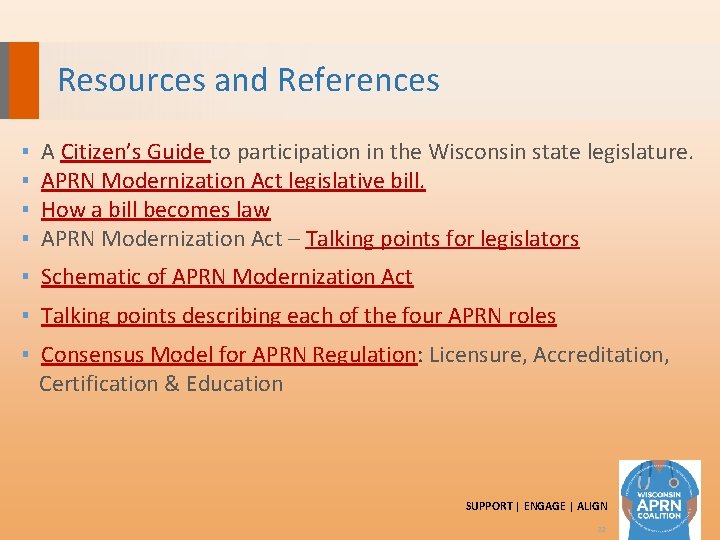
Resources and References ▪ ▪ A Citizen’s Guide to participation in the Wisconsin state legislature. APRN Modernization Act legislative bill. How a bill becomes law APRN Modernization Act – Talking points for legislators ▪ Schematic of APRN Modernization Act ▪ Talking points describing each of the four APRN roles ▪ Consensus Model for APRN Regulation: Licensure, Accreditation, Certification & Education SUPPORT | ENGAGE | ALIGN 32