
REALIGN Dabigatran in Patients With a Mechanical Heart
RE-ALIGN: Dabigatran in Patients With a Mechanical Heart Valve Randomized, phase II study to Evaluate the s. Afety and pharmacokinetics of ora. L dab. IGatran etexilate in patients after heart valve replaceme. Nt Frans Van de Werf, MD, Ph. D
Disclosures Frans Van de Werf, MD, Ph. D Research Grants: Boehringer Ingelheim, Astra. Zeneca, MSD, The Medicines Company, Novartis, Roche, Sanofi-Aventis Consulting Fees: Boehringer Ingelheim, Astra. Zeneca, MSD, The Medicines Company, Roche, Sanofi-Aventis, Eli Lilly Speaker’s Bureau: Boehringer Ingelheim, Astra. Zeneca, MSD, Sanofi-Aventis, Eli Lilly, The Medicines Company 2
Background • Vitamin K antagonists provide effective protection against thrombosis in patients with a mechanical valve but require food, alcohol and drug restrictions and coagulation monitoring • Dabigatran 150 mg bid is superior to warfarin in non-valvular atrial fibrillation • Encouraging preclinical data with dabigatran in porcine mechanical valve models 3
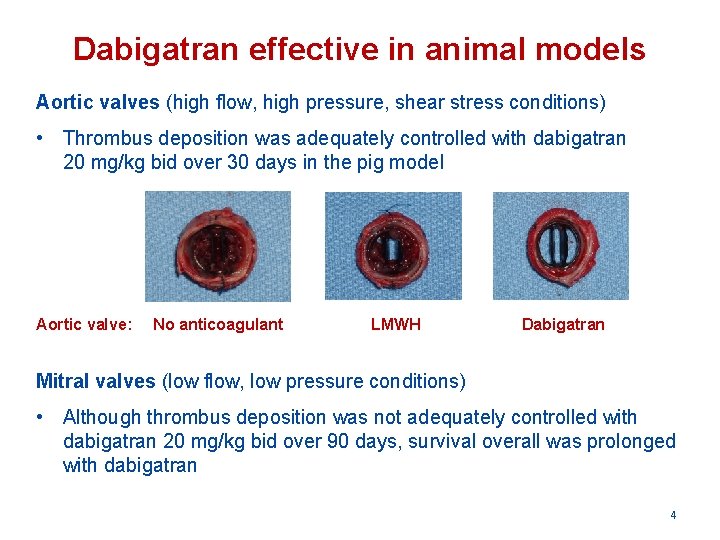
Dabigatran effective in animal models Aortic valves (high flow, high pressure, shear stress conditions) • Thrombus deposition was adequately controlled with dabigatran 20 mg/kg bid over 30 days in the pig model Aortic valve: No anticoagulant LMWH Dabigatran Mitral valves (low flow, low pressure conditions) • Although thrombus deposition was not adequately controlled with dabigatran 20 mg/kg bid over 90 days, survival overall was prolonged with dabigatran 4
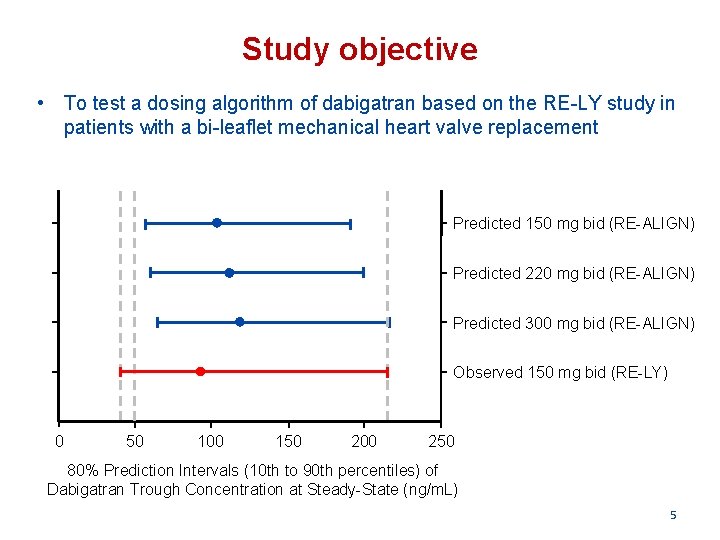
Study objective • To test a dosing algorithm of dabigatran based on the RE-LY study in patients with a bi-leaflet mechanical heart valve replacement Predicted 150 mg bid (RE-ALIGN) Predicted 220 mg bid (RE-ALIGN) Predicted 300 mg bid (RE-ALIGN) Observed 150 mg bid (RE-LY) 0 50 100 150 200 250 80% Prediction Intervals (10 th to 90 th percentiles) of Dabigatran Trough Concentration at Steady-State (ng/m. L) 5
Patients studied • Patients aged 18– 75 years, with or without additional thromboembolic risk factors: – Population A (67%): Aortic and/or mitral valve implantation during current hospital stay – Population B (33%): Mitral valve implantation > 3 months previously 6
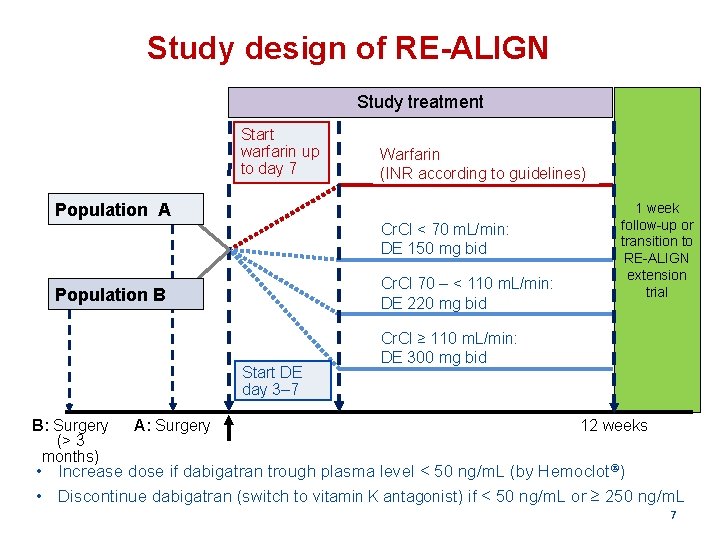
Study design of RE-ALIGN Study treatment Start warfarin up to day 7 Warfarin (INR according to guidelines) Population A Cr. Cl < 70 m. L/min: DE 150 mg bid Cr. Cl 70 – < 110 m. L/min: DE 220 mg bid Population B Start DE day 3– 7 B: Surgery (> 3 months) A: Surgery 1 week follow-up or transition to RE-ALIGN extension trial Cr. Cl ≥ 110 m. L/min: DE 300 mg bid 12 weeks • Increase dose if dabigatran trough plasma level < 50 ng/m. L (by Hemoclot ) • Discontinue dabigatran (switch to vitamin K antagonist) if < 50 ng/m. L or ≥ 250 ng/m. L 7
Analysis and statistical methods • Primary outcome: Trough plasma concentrations of dabigatran – Determined by high-performance liquid chromatography/tandem mass spectrometry (HPLC-MS/MS) • Clinical outcomes: Stroke, systemic embolism, transient ischaemic attack, valve thrombosis, bleeding, venous thromboembolism, myocardial infarction and death – Clinical events were analysed descriptively (study not powered for clinical outcome events) 8
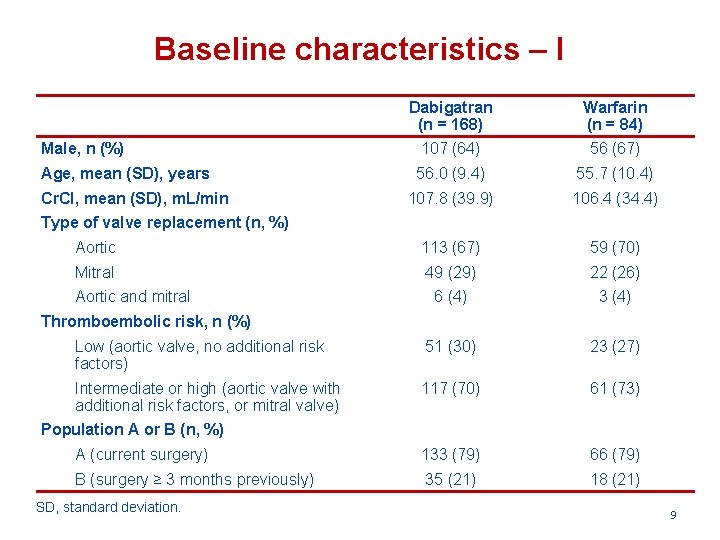
Baseline characteristics – I Dabigatran (n = 168) Warfarin (n = 84) Male, n (%) 107 (64) 56 (67) Age, mean (SD), years 56. 0 (9. 4) 55. 7 (10. 4) 107. 8 (39. 9) 106. 4 (34. 4) Aortic 113 (67) 59 (70) Mitral 49 (29) 22 (26) 6 (4) 3 (4) Low (aortic valve, no additional risk factors) 51 (30) 23 (27) Intermediate or high (aortic valve with additional risk factors, or mitral valve) 117 (70) 61 (73) A (current surgery) 133 (79) 66 (79) B (surgery ≥ 3 months previously) 35 (21) 18 (21) Cr. Cl, mean (SD), m. L/min Type of valve replacement (n, %) Aortic and mitral Thromboembolic risk, n (%) Population A or B (n, %) SD, standard deviation. 9
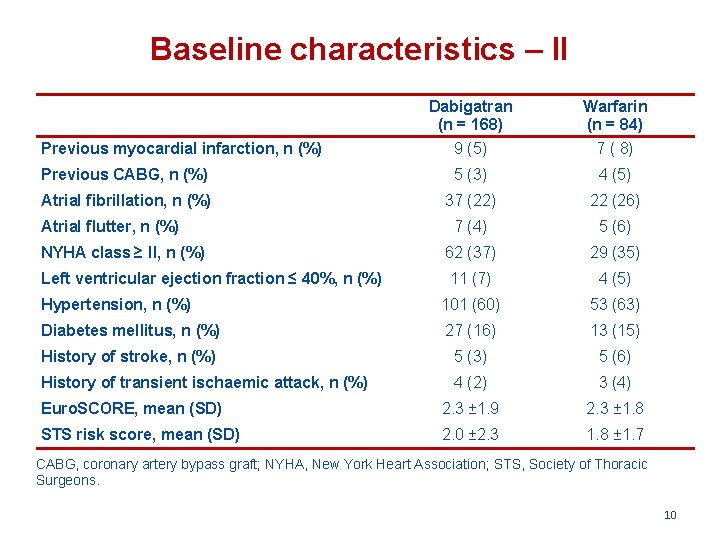
Baseline characteristics – II Dabigatran (n = 168) Warfarin (n = 84) Previous myocardial infarction, n (%) 9 (5) 7 ( 8) Previous CABG, n (%) 5 (3) 4 (5) Atrial fibrillation, n (%) 37 (22) 22 (26) 7 (4) 5 (6) NYHA class ≥ II, n (%) 62 (37) 29 (35) Left ventricular ejection fraction ≤ 40%, n (%) 11 (7) 4 (5) Hypertension, n (%) 101 (60) 53 (63) Diabetes mellitus, n (%) 27 (16) 13 (15) History of stroke, n (%) 5 (3) 5 (6) History of transient ischaemic attack, n (%) 4 (2) 3 (4) Euro. SCORE, mean (SD) 2. 3 ± 1. 9 2. 3 ± 1. 8 STS risk score, mean (SD) 2. 0 ± 2. 3 1. 8 ± 1. 7 Atrial flutter, n (%) CABG, coronary artery bypass graft; NYHA, New York Heart Association; STS, Society of Thoracic Surgeons. 10
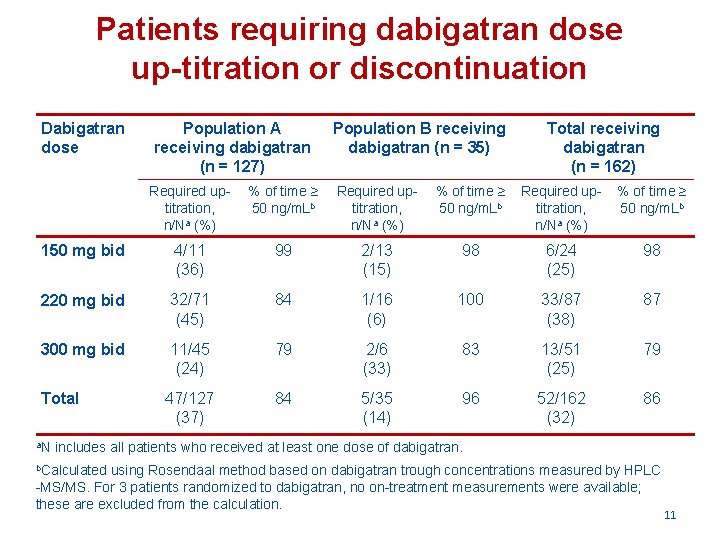
Patients requiring dabigatran dose up-titration or discontinuation Dabigatran dose Population A receiving dabigatran (n = 127) Population B receiving dabigatran (n = 35) Total receiving dabigatran (n = 162) Required uptitration, n/Na (%) % of time ≥ 50 ng/m. Lb 150 mg bid 4/11 (36) 99 2/13 (15) 98 6/24 (25) 98 220 mg bid 32/71 (45) 84 1/16 (6) 100 33/87 (38) 87 300 mg bid 11/45 (24) 79 2/6 (33) 83 13/51 (25) 79 Total 47/127 (37) 84 5/35 (14) 96 52/162 (32) 86 a. N includes all patients who received at least one dose of dabigatran. b. Calculated using Rosendaal method based on dabigatran trough concentrations measured by HPLC -MS/MS. For 3 patients randomized to dabigatran, no on-treatment measurements were available; these are excluded from the calculation. 11
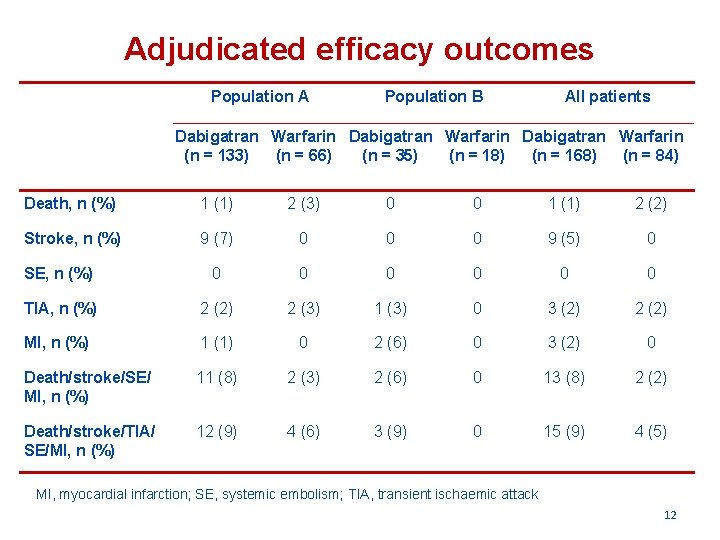
Adjudicated efficacy outcomes Population A Population B All patients Dabigatran Warfarin (n = 133) (n = 66) (n = 35) (n = 18) (n = 168) (n = 84) Death, n (%) 1 (1) 2 (3) 0 0 1 (1) 2 (2) Stroke, n (%) 9 (7) 0 0 0 9 (5) 0 SE, n (%) 0 0 0 TIA, n (%) 2 (2) 2 (3) 1 (3) 0 3 (2) 2 (2) MI, n (%) 1 (1) 0 2 (6) 0 3 (2) 0 Death/stroke/SE/ MI, n (%) 11 (8) 2 (3) 2 (6) 0 13 (8) 2 (2) Death/stroke/TIA/ SE/MI, n (%) 12 (9) 4 (6) 3 (9) 0 15 (9) 4 (5) MI, myocardial infarction; SE, systemic embolism; TIA, transient ischaemic attack 12
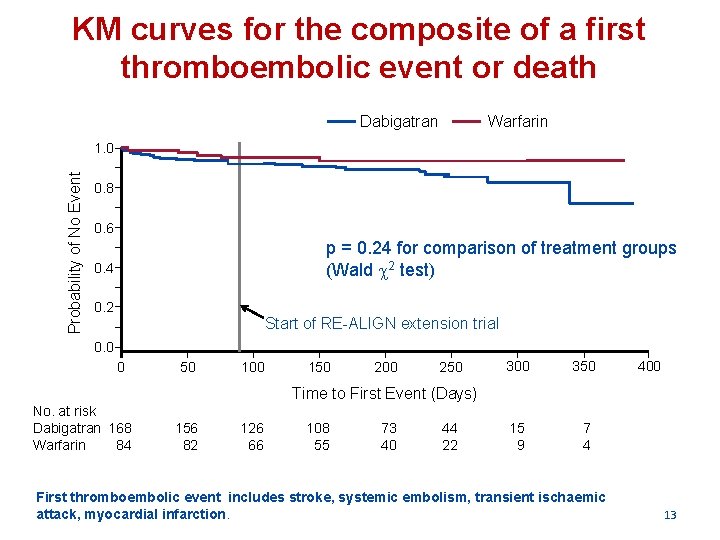
KM curves for the composite of a first thromboembolic event or death Dabigatran Warfarin Probability of No Event 1. 0 0. 8 0. 6 p = 0. 24 for comparison of treatment groups (Wald 2 test) 0. 4 0. 2 Start of RE-ALIGN extension trial 0. 0 0 50 100 150 200 250 300 350 15 9 7 4 400 Time to First Event (Days) No. at risk Dabigatran 168 Warfarin 84 156 82 126 66 108 55 73 40 44 22 First thromboembolic event includes stroke, systemic embolism, transient ischaemic attack, myocardial infarction. 13
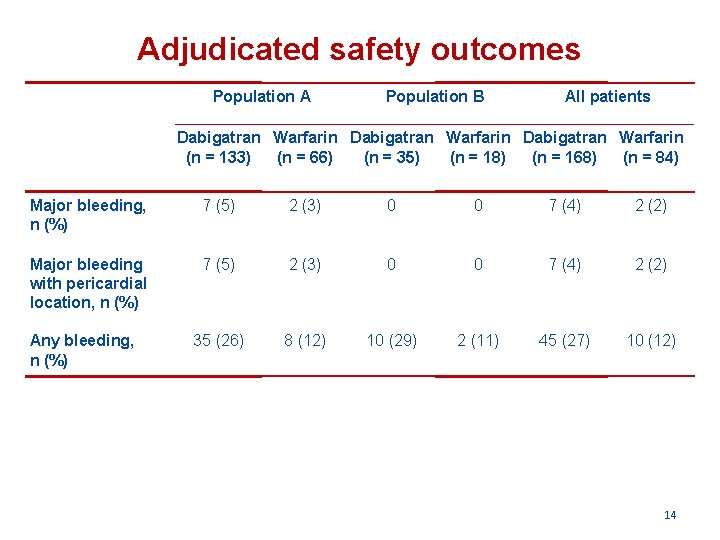
Adjudicated safety outcomes Population A Population B All patients Dabigatran Warfarin (n = 133) (n = 66) (n = 35) (n = 18) (n = 168) (n = 84) Major bleeding, n (%) 7 (5) 2 (3) 0 0 7 (4) 2 (2) Major bleeding with pericardial location, n (%) 7 (5) 2 (3) 0 0 7 (4) 2 (2) 35 (26) 8 (12) 10 (29) 2 (11) 45 (27) 10 (12) Any bleeding, n (%) 14
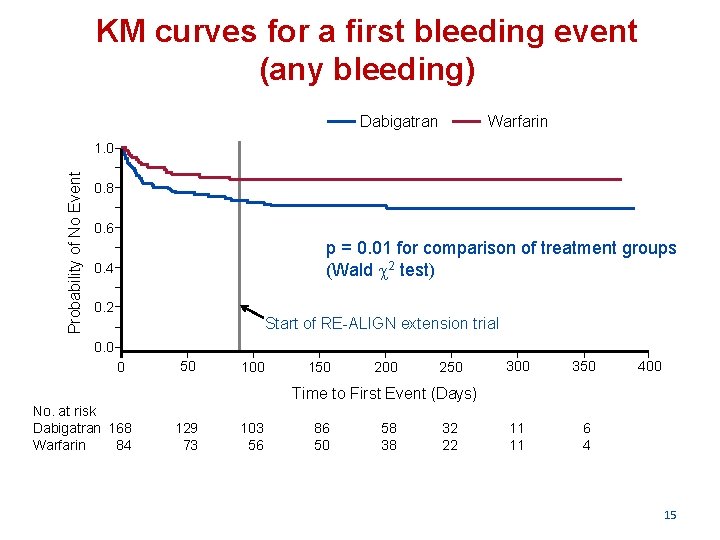
KM curves for a first bleeding event (any bleeding) Dabigatran Warfarin Probability of No Event 1. 0 0. 8 0. 6 p = 0. 01 for comparison of treatment groups (Wald 2 test) 0. 4 0. 2 Start of RE-ALIGN extension trial 0. 0 0 50 100 150 200 250 300 350 11 11 6 4 400 Time to First Event (Days) No. at risk Dabigatran 168 Warfarin 84 129 73 103 56 86 50 58 38 32 22 15
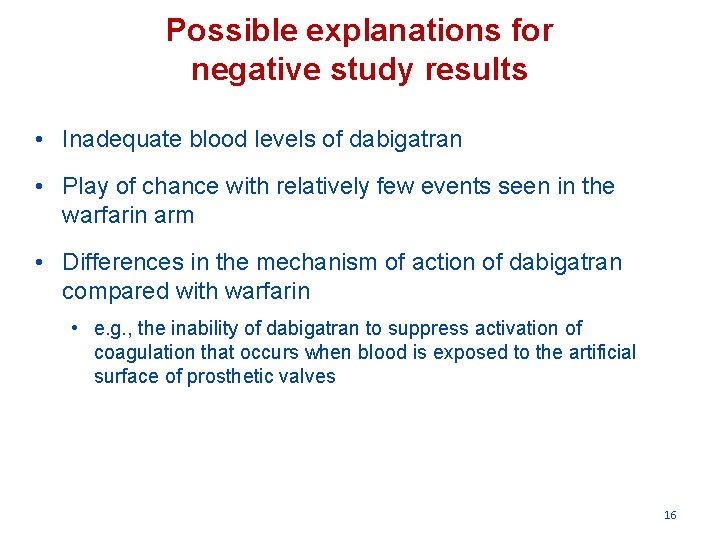
Possible explanations for negative study results • Inadequate blood levels of dabigatran • Play of chance with relatively few events seen in the warfarin arm • Differences in the mechanism of action of dabigatran compared with warfarin • e. g. , the inability of dabigatran to suppress activation of coagulation that occurs when blood is exposed to the artificial surface of prosthetic valves 16
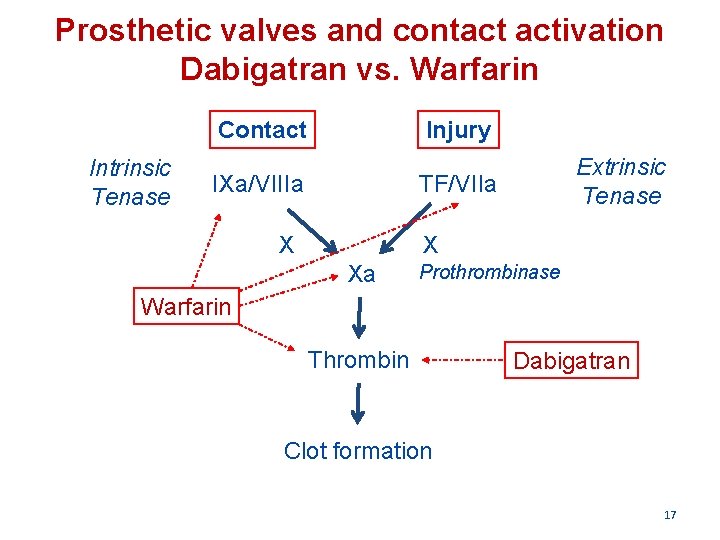
Prosthetic valves and contact activation Dabigatran vs. Warfarin Contact Intrinsic Tenase Injury IXa/VIIIa Extrinsic Tenase TF/VIIa X X Xa Prothrombinase Warfarin Thrombin Dabigatran Clot formation 17
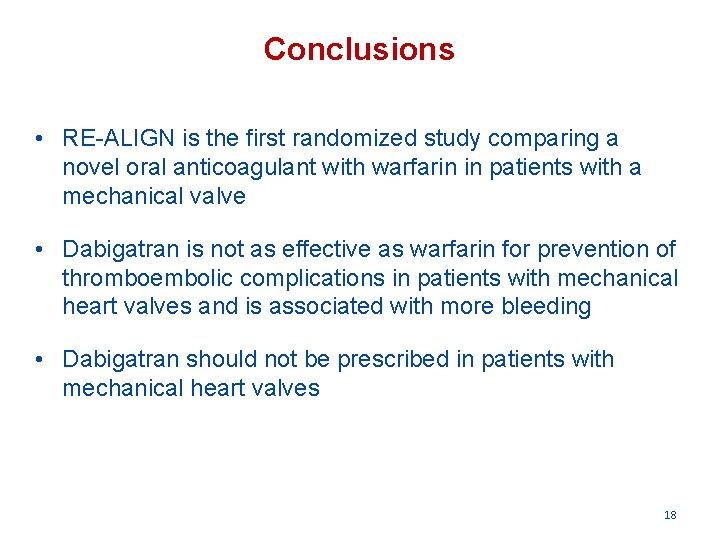
Conclusions • RE-ALIGN is the first randomized study comparing a novel oral anticoagulant with warfarin in patients with a mechanical valve • Dabigatran is not as effective as warfarin for prevention of thromboembolic complications in patients with mechanical heart valves and is associated with more bleeding • Dabigatran should not be prescribed in patients with mechanical heart valves 18
RE-ALIGN INVESTIGATORS • Steering Committee: F. Van de Werf (co-chair), J. Eikelboom (co-chair), S. Connolly, C. Granger, P. Kappetein, M. Brueckmann, M. Mack • Data Safety Monitoring Board: M. L. Simoons , D. Lindblom, M. Prins; J. G. P. Tijssen • Echocardiography Core Lab J-U. Voigt, Dept. of Cardiovasc. Sciences, Leuven, Belgium • Data Management and Statistics: Boehringer Ingelheim, UK • Principal Investigators in the RE-ALIGN trial (at least one patient screened): Belgium: M. De Pauw, M-C. Herregods, D. Schoors, J-L. Vanoverschelde, M. Vrolix; Canada: C. Brown, S. Meyer, M. Quantz, R. Singal, K. H. T. Teoh, S. Verma, R. Whitlock; Czech Republic: H. Bedanova, R. Brat, P. Marcian, M. Setina, J. Vojacek, Denmark: S. U. A. Gill, P. Skov Olsen; France: L. Barandon, B. Iung, A. Leguerrier, J-F. Obadia; Germany: T. Horacek, S. Schellong, M. R. Siepe, G. Szabó, M. Thielmann, Netherlands: A. M. W. Alings, R. Riezebos, R. J. Winter de; Norway: D. Atar, R. Haaverstad, S. Halvorsen; Poland: T. Hryniewiecki, P. Ponikowski, J. Rogowski; Sweden: C. Christersson, A. Jeppsson, J. Sjögren 19
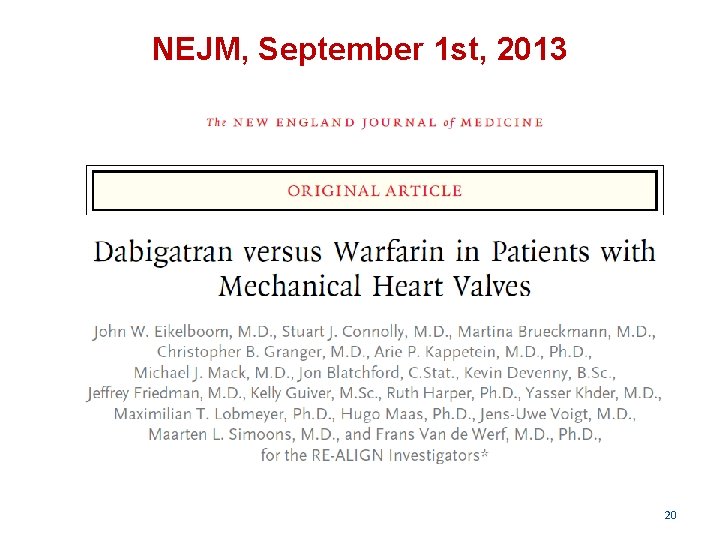
NEJM, September 1 st, 2013 20

21
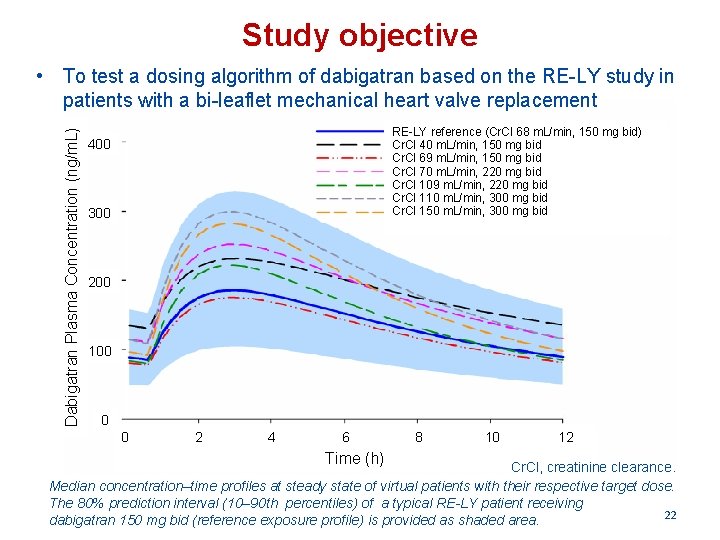
Study objective Dabigatran Plasma Concentration (ng/m. L) • To test a dosing algorithm of dabigatran based on the RE-LY study in patients with a bi-leaflet mechanical heart valve replacement RE-LY reference (Cr. Cl 68 m. L/min, 150 mg bid) Cr. Cl 40 m. L/min, 150 mg bid Cr. Cl 69 m. L/min, 150 mg bid Cr. Cl 70 m. L/min, 220 mg bid Cr. Cl 109 m. L/min, 220 mg bid Cr. Cl 110 m. L/min, 300 mg bid Cr. Cl 150 m. L/min, 300 mg bid 400 300 200 100 0 2 2 4 4 6 6 Time(h) 8 8 10 10 12 12 Cr. Cl, creatinine clearance. Median concentration–time profiles at steady state of virtual patients with their respective target dose. The 80% prediction interval (10– 90 th percentiles) of a typical RE-LY patient receiving 22 dabigatran 150 mg bid (reference exposure profile) is provided as shaded area.
- Slides: 22